RSS
 

Posts Tagged ‘Field’

Change of focus: 755 MP Lytro Cinema camera enables 300 fps light field video

12 Apr

Lytro is bringing its Light Field technology to the world of cinema and visual effects, shortly after its CEO announced in a blog post Lytro’s intention of abandoning the consumer stills camera space. Lytro Cinema turns every frame of live action into a 3D model, capturing intensity, color, and angular information of light rays. Coupling light field with a 755 MP sensor capable of capturing images at 300 fps, Lytro Cinema promises extensive post-production freedom, including adjustment of focus, depth-of-field, shutter speed and frame rate, as well as the elimination of green screens.

Although Lytro experienced some difficulty in adoption of light field technology in stills, the technology had, and continues to have, immense potential for imaging. Saving creative decisions for post-processing allows for more creative freedom, and allows a photographer or DP to focus on other elements during capture. Nowhere will this be more appreciated than in cinema, where the realities of production mean that any technology aimed at saving certain creative decisions, like focus, for post-capture are welcome.

Focus and aperture sliders in post-production. In video. No joke. I wish my Raw converter had this (Lytro’s Raw converter already does). Photo credit: Lytro

And that’s exactly what Lytro Cinema aims to do. By capturing directional information about light rays and essentially sampling multiple perspectives behind the aperture, Lytro Cinema allows for adjustment of focus placement, depth-of-field (via aperture adjustment), perspective, and more in post-processing. And since a depth map is rendered for every frame of video, Lytro claims Cinema will make it easier to combine CGI with live footage, no longer requiring green screens to extract elements or subjects from a scene. You’ll be able to just extract a subject based on its depth, which Lytro shows in a convincing example below:

Since light field cameras effectively sample multiple perspectives from behind the lens, you can even simulate camera movement as if it were moved on-set. The degree of motion is of course limited, but the technique can be very effective, as demonstrated in this haunting music video shot entirely on the stills-focused Lytro Illum. As Lead Engineer for Light Field Video Brendan Bevensee explains: “You have a virtual camera that can be controlled in post-production.” That means there’s also nothing stopping one from simulating short dolly motion or perspective shifts in post, with nothing but a static camera at the time of capture. “You can shift the camera to the left… [or] to the right, as if you had made that exact decision on set. It can even move your camera in and out” says Head of Light Field Video, Jon Karafin.

Imagine small, smooth, meditative camera movements that don’t even require a complicated motion rig to set up.

Furthermore, by precisely recording X, Y, Z, pitch, roll, and yaw, Lytro Cinema even offers automated camera tracking, which makes it easier to composite and mat CGI elements. And just as the Illum paired with Lytro Desktop software allowed one to select various objects and depths to throw them in and out of focus for selective depth-of-field and background blur, one can do the same in video with the Cinema, choosing, for example, to marry live footage from minimum focus to, say, 10m with different footage, or CGI, for everything beyond those distances. In other words, control over not just single planes, but ranges of planes.

Beyond just light field benefits, Lytro is also addressing another common headache: the selection of shutter angle (or shutter speed). Often, this is a decision made at the time of capture, dictating the level of blur or stuttering (a la action scenes in ‘Saving Private Ryan’ or ‘Gladiator’) in your footage. At high frame rates of capture, though, high shutter angles are required, removing some of the flexibility of how much motion blur you can or can’t have (e.g. 300 fps cannot be shot with shutter speeds longer than 1/300s, which inevitably freezes action). By decoupling the shutter angle of capture from the shutter angle required for artistic effect, a DP can creatively use motion blur, or lack thereof, to suit the story. The technology, which undoubtedly uses some form of interpolation and averaging in conjunction with the temporal oversampling, also means that you can extract stills with a desired level of motion blur. 

Lytro claims that by capturing at 300 fps, they can computationally allow for any of a number of shutter angles in post-production, allowing a cinematographer to decouple shutter angle required for capture from that required for artistic intent. Photo credit: Lytro

With every development over at Lytro, we’ve been excited by the implications for both stills and video. The implications for the latter, in particular, have always been compelling. Along with the announcement of the Lytro Immerge 360º virtual reality light field rig, we’re extremely excited to see light field video becoming a reality, and look forward to what creatives can produce with what is poised to be an unimaginably powerful filmmaking platform. Filmmakers can sign up for a demonstration and a personalized production package on Lytro’s site. For now, Lytro Cinema will be available on a subscription basis, understandable given the complexities involved (the immense data capture rates require servers on-set).

Head over to the Lytro Cinema page for more in-depth information. Lytro will be demo-ing “Life”, a short film shot using Lytro Cinema at NAB 2016.

Lytro Brings Revolutionary Light Field Technology to Film and TV Production with Lytro Cinema

  • World’s First Light Field Solution for Cinema Allows Breakthrough Creative Capabilities and Unparalleled Flexibility on Set and in Post-Production
  • First Short Produced with Academy Award Winners Robert Stromberg, DGA and David Stump, ASC in Association with The Virtual Reality Company (VRC) Will Premiere at NAB on April 19

Lytro unlocks a new level of creative freedom and flexibility for filmmakers with the introduction of Lytro Cinema, the world’s first Light Field solution for film and television. The breakthrough capture system enables the complete virtualization of the live action camera — transforming creative camera controls from fixed on set decisions to computational post-production processes — and allows for historically impossible shots.

“We are in the early innings of a generational shift from a legacy 2D video world to a 3D volumetric Light Field world,” said Jason Rosenthal, CEO of Lytro. “Lytro Cinema represents an important step in that evolution. We are excited to help usher in a new era of cinema technology that allows for a broader creative palette than has ever existed before.”

Designed for cutting edge visual effects (VFX), Lytro Cinema represents a complete paradigm shift in the integration of live action footage and computer generated (CG) visual effects. The rich dataset captured by the system produces a Light Field master that can be rendered in any format in post-production and enables a whole range of creative possibilities that have never before existed.

“Lytro Cinema defies traditional physics of on-set capture allowing filmmakers to capture shots that have been impossible up until now,” said Jon Karafin, Head of Light Field Video at Lytro. “Because of the rich data set and depth information, we’re able to virtualize creative camera controls, meaning that decisions that have traditionally been made on set, like focus position and depth of field, can now be made computationally. We’re on the cutting edge of what’s possible in film production.”

With Lytro Cinema, every frame of a live action scene becomes a 3D model: every pixel has color and directional and depth properties bringing the control and creative flexibility of computer generated VFX to real world capture. The system opens up new creative avenues for the integration of live action footage and visual effects with capabilities like Light Field Camera Tracking and Lytro Depth Screen — the ability to accurately key green screens for every object and space in the scene without the need for a green screen.

“Lytro has always been a company thinking about what the future of imaging will be,” said Ted Schilowitz, Futurist at FOX Studios. “There are a lot of companies that have been applying new technologies and finding better ways to create cinematic content, and they are all looking for better ways and better tools to achieve live action highly immersive content. Lytro is focusing on getting a much bigger, better and more sophisticated cinematography-level dataset that can then flow through the VFX pipeline and modernize that world.”

Lytro Cinema represents a step function increase in terms of raw data capture and optical performance:

  • The highest resolution video sensor ever designed, 755 RAW megapixels at up to 300 FPS
  • Up to 16 stops of dynamic range and wide color gamut
  • Integrated high resolution active scanning

By capturing the entire high resolution Light Field, Lytro Cinema is the first system able to produce a Light Field Master. The richest dataset in the history of the medium, the Light Field Master enables creators to render content in multiple formats — including IMAX®, RealD® and traditional cinema and broadcast at variable frame rates and shutter angles.

Lytro Cinema comprises a camera, server array for storage and processing, which can also be done in the cloud, and software to edit Light Field data. The entire system integrates into existing production and post-production workflows, working in tandem with popular industry standard tools. Watch a video about Lytro Cinema at www.lytro.com/cinema#video.

“Life” the first short produced with Lytro Cinema in association with The Virtual Reality Company (VRC) will premiere at the National Association of Broadcasters (NAB) conference on Tuesday, April 19 at 4 p.m. PT at the Las Vegas Convention Center in Room S222. “Life” was directed by Academy Award winner Robert Stromberg, Chief Creative Officer at VRC and shot by David Stump, Chief Imaging Scientist at VRC.

Learn more about Lytro Cinema activities during the 2016 NAB Show and get a behind-the-scenes look on the set of “Life” at www.lytro.com/nab2016.

Lytro Cinema will be available for production in Q3 2016 to exclusive partners on a subscription basis. For more information on Lytro Cinema, visit www.lytro.com/cinema.

Articles: Digital Photography Review (dpreview.com)

 
Comments Off on Change of focus: 755 MP Lytro Cinema camera enables 300 fps light field video

Posted in Uncategorized


Field Test: Claire Bangser and the Olympus PEN-F hit the Mississippi Blues Trail

11 Apr

DPReview’s Wenmei Hill and New Orleans-based photographer Claire Bangser recently hit the road with the Olympus PEN-F, visiting historic spots along the Mississippi Blues Trail. If you love the blues or want to learn more about the folks living in the small towns that dot the route, then you’ll enjoy our latest field test. 


This is sponsored content, created with the support of Olympus. What does this mean?

Articles: Digital Photography Review (dpreview.com)

 
Comments Off on Field Test: Claire Bangser and the Olympus PEN-F hit the Mississippi Blues Trail

Posted in Uncategorized


An Exercise For You to Practice Depth of Field Without Going Outside

01 Apr

lead-photo-Vickie-Lewis-Photography-for-dps

Many photographers, especially when starting out, have a difficult time understanding depth of field. I also hear quite often that photographers are waiting for nice weather to get out and shoot. So, here’s a fun exercise you can do at home, in any weather, that will help you understand the finer aspects of depth of field.

Depth of field is determined by which aperture you choose, what focal length you’re using, and the distance between the camera and the subject. In this example, we’ll explore depth of field using a 100mm lens.

To set up

Find between one and three small objects you can photograph. I found three sports water bottles with balls on the top to shoot. Next, you need some studio space. A patio door or very wide window works well.

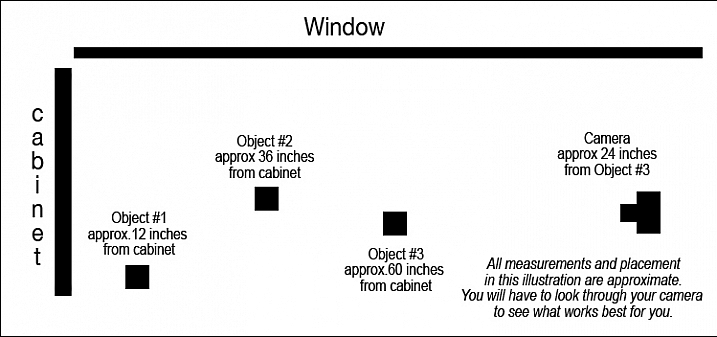
Your next step is to set up your object, or objects, in front of the window and to place your camera in position. The object and camera should be parallel to the window.

depth_of_field_illustration

This is how I set up my camera and objects.

I put the first ball, the soccer ball, about 12 inches in front of the cabinet. Then I put the second ball, the baseball, about 24 inches in front of that. I put the third object, the basketball, 24 inches in front of the next object, and finally I set my camera about two feet in front of the last object.

You’ll need to play a little bit to see what works best for you. It will vary depending on the size of the object you are shooting, and the focal length you are using. You want to be able to focus on all three objects, and take a photo of them without moving your camera, so play for a minute. Focus on the first object and make sure you can see all three objects in the frame. Then focus on the second and make sure you can still see them all. Lastly, do it with the third one, too.

Set your camera on either aperture priority or manual exposure, and use the widest aperture you have. I chose f/2.8. Your lens might not have that aperture available, if so f/4 or f/4.5 will be just fine.

Shoot wide opened focusing on each object in turn

Now, without changing anything but your focus, take a photo of each of the three objects.

200__depth_of_field_f-2.8

This photo was shot at f/2.8 while focused on the object closest to the camera, the basketball. Notice the narrow depth of field, in other words, how blurry the background is.

201__depth_of_field_f-2.8-f-2.8

This was also shot at f/2.8, but this time, I focused on the middle object, the baseball. Notice that it is blurry in front and in back.

202__depth_of_field_f-2.8

This photo was also shot at f/2.8, but I focused on the soccer ball. I did not change camera position nor did I change lenses. Notice the depth of field, but also notice the change in perspective. Can you see that more of the cabinet is in the photograph?

Next shoot with a small aperture

Now, let’s try something a little different. Instead of shooting at your widest f-stop, shoot at your smallest, which means a higher number, like f/32 or f/16.

205__depth_of_field_-f-32

Here is the same situation. The camera hasn’t moved, but the aperture is now at f/32. The focus is on the basketball, but look how much is sharp.

204__depth_of_field_-f-32

Look closely. The aperture is still at f/32, but the focus has changed to the baseball. Notice the basketball is more out of focus, but the soccer ball in the back looks pretty sharp.

203__depth_of_field_-f-32

Above is the third example. The focus is on the soccer ball.

You can practice each of these things with different f/stops to see the difference between f/4, f/8, f/11, f/16 and f/32. Each choice will change the depth of field.

Change the distance to the subject

209__depth_of_field_-f-2.8

In the above photograph, I moved the camera closer to the baseball and shot at f/2.8. Practice isolating the elements and see what happens. Notice how the baseball really stands out, and look at the background. By isolating the baseball with a very narrow depth of field, the background becomes really out of focus. This tool is very helpful to clean up backgrounds.

210__depth_of_field_-f-2.8

Then I changed my focus to the soccer ball. The aperture is still at f/2.8. What do you notice about the background?

213__depth_of_field_-f-32

In the shot above the soccer ball is still in the original position, about a foot away from the cabinet. Notice how sharp the background is – this was shot at f/32.

214__depth_of_field_-f-11

Now, notice how we start to lose detail in the cabinet behind. This image above was shot at f/11.

215__depth_of_field_-f-2.8

Finally, by shooting at f/2.8, and without moving the position of the soccer ball or the background, the background has become more out of focus and less distracting.

Take some times and practice this at home. So what you’ve learned here is a great way to practice depth of field at home–even on a rainy day! So take out your camera, find some small objects to shoot and start practicing.

Please share in the comments below how controlling the depth of field could impact how you shoot. What did you learn by doing this exercise?

googletag.cmd.push(function() {
tablet_slots.push( googletag.defineSlot( “/1005424/_dPSv4_tab-all-article-bottom_(300×250)”, [300, 250], “pb-ad-78623” ).addService( googletag.pubads() ) ); } );

googletag.cmd.push(function() {
mobile_slots.push( googletag.defineSlot( “/1005424/_dPSv4_mob-all-article-bottom_(300×250)”, [300, 250], “pb-ad-78158” ).addService( googletag.pubads() ) ); } );

The post An Exercise For You to Practice Depth of Field Without Going Outside by Vickie Lewis appeared first on Digital Photography School.


Digital Photography School

 
Comments Off on An Exercise For You to Practice Depth of Field Without Going Outside

Posted in Photography


Presidential Graveyard: 43 Colossal Statues Crumble in a Field

26 Mar

[ By Steph in Destinations & Sights & Travel. ]

Drone footage of abandoned president statues

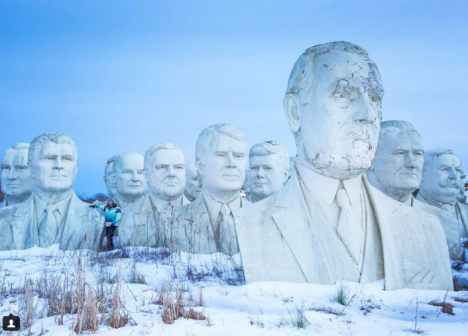
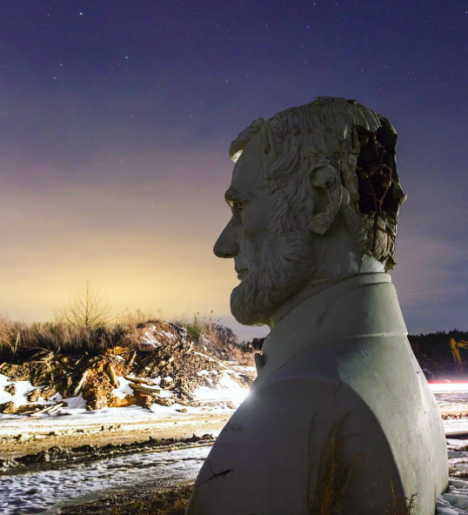
Nearly every single President of the United States, from George Washington through George W. Bush, sits in a dead field in Virginia, some with the tops of their heads blown off or streaks of dirt streaming down their cheeks, looking rather war-torn. Stark white and silent, they wait for what will likely be their ultimate fate: total destruction. The 43 crumbling statues were saved from demolition after the closure of Presidents Park in Williamsburg, Virginia in 2010, and now drone footage has captured them in their current state of purgatory.

Screen Shot 2016-03-25 at 8.28.20 AM

Screen Shot 2016-03-25 at 8.51.30 AM

A man named Howard Hankins was reportedly tasked with destroying the statues when the park shut down after six years in operation, and couldn’t bear to go through with it. He had them moved – at a cost of $ 50,000 – to his farm in the small town of Croaker, about ten miles away. Most of the damage to the twenty-foot-tall statues was sustained during the move. The field is private property and not open to visitors, but Hankins did allow one drone operator access to take this stunning video.

Screen Shot 2016-03-25 at 8.28.27 AM

Weighing up to 20,000 pounds each, the statues were a challenge to relocate. The tops of the their heads had to be cracked so a crane could hook onto the metal frame inside each one to move them, and some sustained neck damage as they were lifted. Once in place, they continued to peel and crack. Ronald Reagan bears the scars of being hit by lightning.

Screen Shot 2016-03-25 at 8.33.38 AM

Their presence in the field is a bit eerie, especially when the landscape is icy, as captured by photographer David Ogden of Abandoned Earth. It’s hard not to see them in a post-apocalyptic light, imagining them crumbling to dust as a symbol of a culture destined to fall – our version of the ruins of Rome. But at this rate, it doesn’t seem like they’ll be around much longer. An attempt to raise funds to preserve them hasn’t mustered any more enthusiasm than the Presidents Park did when it was a tourist attraction tucked behind a motel, too far from Williamsburg’s more popular sights.

Share on Facebook


[ By Steph in Destinations & Sights & Travel. ]

[ WebUrbanist | Archives | Galleries | Privacy | TOS ]


WebUrbanist

 
Comments Off on Presidential Graveyard: 43 Colossal Statues Crumble in a Field

Posted in Creativity


Field Test: Canon PowerShot G5 X on the Olympic Peninsula

16 Mar

The Olympic Peninsula is a year-round destination, as its lakes, rivers and temperate rain forests attract hikers and wildlife enthusiasts even in the winter months. It’s just the kind of place you’d expect to find someone like Kyle Johnson, a freelance photographer and avid fly fisherman. Hoping to give the local Steelhead population a run for its money and to try out the Canon PowerShot G5 X in the wild, DPR staffer Carey Rose joined Kyle at Lake Quinalt for our latest field test. 


This is sponsored content, created with the support of Canon. What does this mean?

Articles: Digital Photography Review (dpreview.com)

 
Comments Off on Field Test: Canon PowerShot G5 X on the Olympic Peninsula

Posted in Uncategorized


Field Test: The Sony Cyber-shot RX100 IV in Mexico

29 Feb

A year of field tests have taken DPR Editor Barney Britton and series director Eric Becker into some challenging shooting environments, so for a change of pace, at the end of last year the pair took the Sony Cyber-shot RX100 IV to the sun-soaked Yucatán peninsula. There they put Sony’s pocket compact through all of the rigor that any traveler might – from shooting in underwater caves to selfies amidst historic Mayan ruins. Watch the video and see Sony’s travel cam in its natural environment.


This is sponsored content, created with the support of Sony. What does this mean?

Articles: Digital Photography Review (dpreview.com)

 
Comments Off on Field Test: The Sony Cyber-shot RX100 IV in Mexico

Posted in Uncategorized


Field Test: Brad Puet and the Fujifilm X-T10

22 Dec

In our most recent Field Test, we took Fujifilm’s X-T10 out onto the streets of Seattle with local photographer Brad Puet. After capturing our street portraits we went about making some prints, first with Fujifilm’s lovely SP-1 Instax printer, and then something a little bigger. See for yourself how the X-T10’s images stand up to exhibition-quality printing.

Articles: Digital Photography Review (dpreview.com)

 
Comments Off on Field Test: Brad Puet and the Fujifilm X-T10

Posted in Uncategorized


Field Test: Kiliii Fish and the Canon EOS Rebel T6i in Alaska

08 Dec

Field Test: Kiliii Fish and the Canon EOS Rebel T6i in Alaska

In this field test we follow photographer Kiliii Fish to the Arctic – specifically, the tiny fishing village of Barrow, Alaska. Using the Canon EOS Rebel T6i – Canon’s 24MP entry-level DSLR – Kiliii has come to Barrow to document how the indigenous population is adapting to the changing environment up here in the far North.

Articles: Digital Photography Review (dpreview.com)

 
Comments Off on Field Test: Kiliii Fish and the Canon EOS Rebel T6i in Alaska

Posted in Uncategorized


Video Field Test: Theron Humphrey and the Sony A7R II

24 Nov

For our latest Field Test video we went not-quite south of the border to Marfa, Texas. There, photographer Theron Humphrey and his internet-famous dog Maddie help us test the Sony Alpha 7R II and a collection of Sony FE lenses. Despite the oppressive heat and rough roads of Big Bend National Park, the impressive sunsets are well worth the trip. Read more

Articles: Digital Photography Review (dpreview.com)

 
Comments Off on Video Field Test: Theron Humphrey and the Sony A7R II

Posted in Uncategorized


Into the woods: Samsung NX500 Field Test

10 Nov

It’s not often we get to eat what we photograph, but that’s what we did in our latest Field Test. We took the Samsung NX500 into the woods with pro photographer and mycology enthusiast Eirik Johnson to forage for some wild mushrooms. While providing a keen eye to make sure we didn’t try to eat anything poisonous, Eirik also helped us try out the NX500’s imaging and 4K video features. Read more

Articles: Digital Photography Review (dpreview.com)

 
Comments Off on Into the woods: Samsung NX500 Field Test

Posted in Uncategorized