RSS
 

Posts Tagged ‘favorite’

My Favorite Features in Adobe Lightroom 6 (CC)

22 Apr

The long awaited next version of Lightroom is out and below is my list of favorite features and improvements:

Note before you upgrade I recommend reviewing  Steps to Save Your Ass With Lightroom Catalog Changes

1. Graduated Filters – Brush function

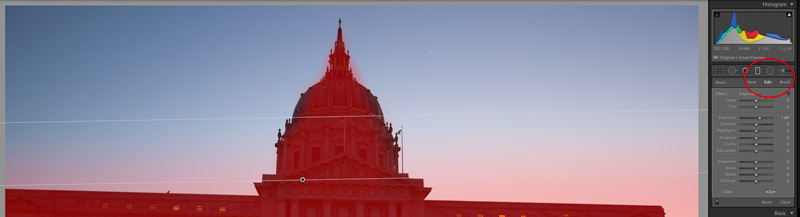
A new Brush function has been added to Graduated Filters so that you can create custom edges versus a linear edge.

Graduated Filter Brush Function

2. Performance: Optimized Multi-Processor and Multi-Core Support + GPU  Utilization

This version of Lightroom has improved export performance that leverages more of your available system resources.  This means that Export is faster, but it also means that you’ll have less resources available during Export for other tasks such as other Lightroom, Photoshop and other application tasks. If you batch export this should be of great benefit for you.

Additionally if you use a 4K or 5K monitor Lightroom CC’s utilization of your computers Graphics Processing Unit (GPU) will result in marked performance improvements.

Requirements to use the GPU in Lightroom CC:

  • 64-­bit only
  • OpenGL 3.3 and up
  • Mac OS 10.9 and higher
  • Windows 7 and higher

Additional system requirements for Lightroom CC / Lightroom 6

3. In Application Panoramic and HDR

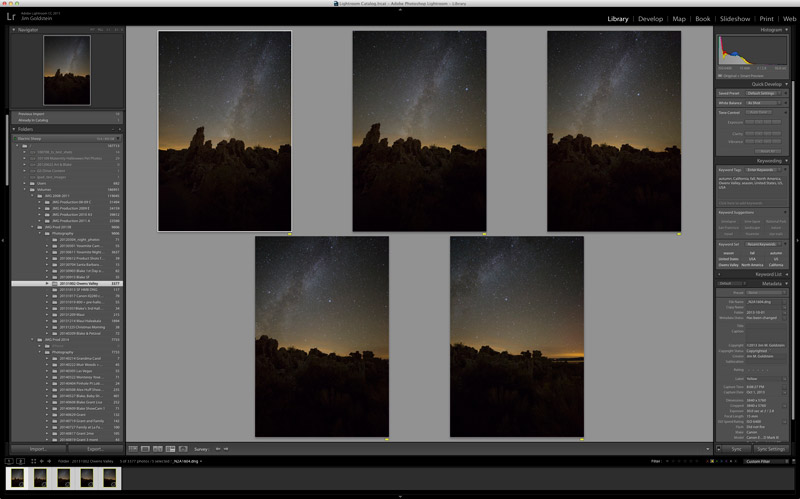
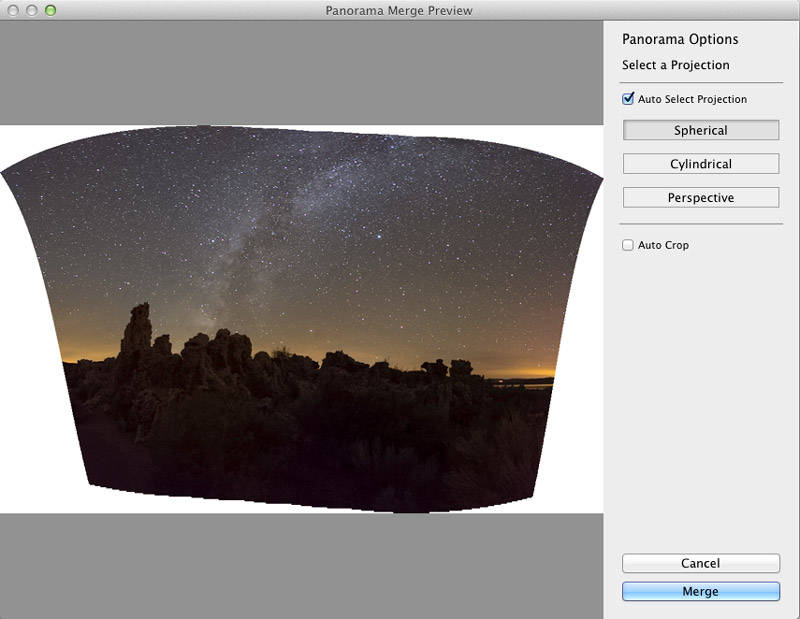
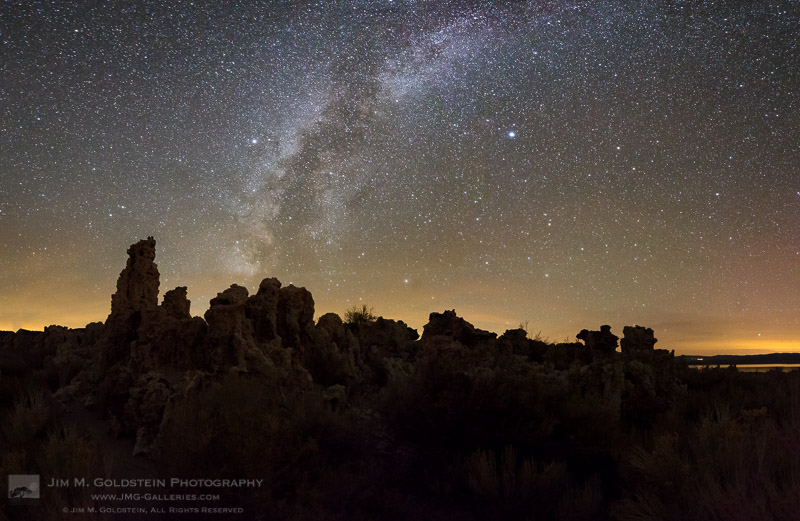
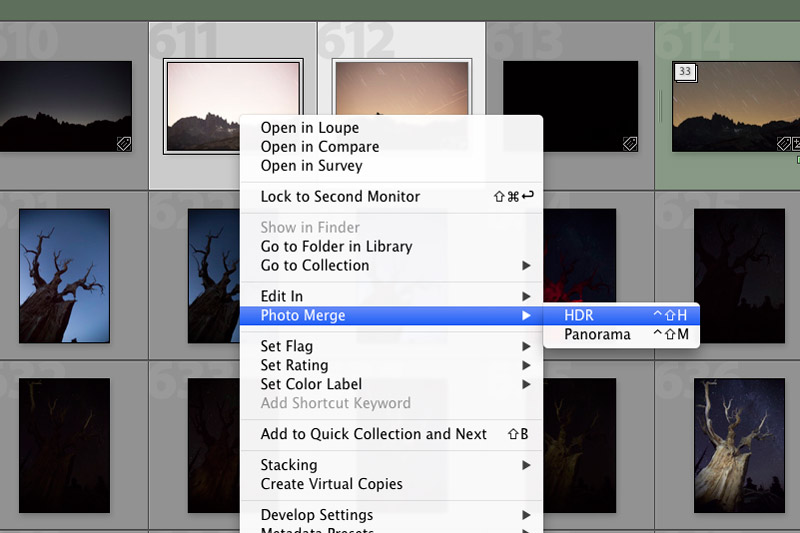
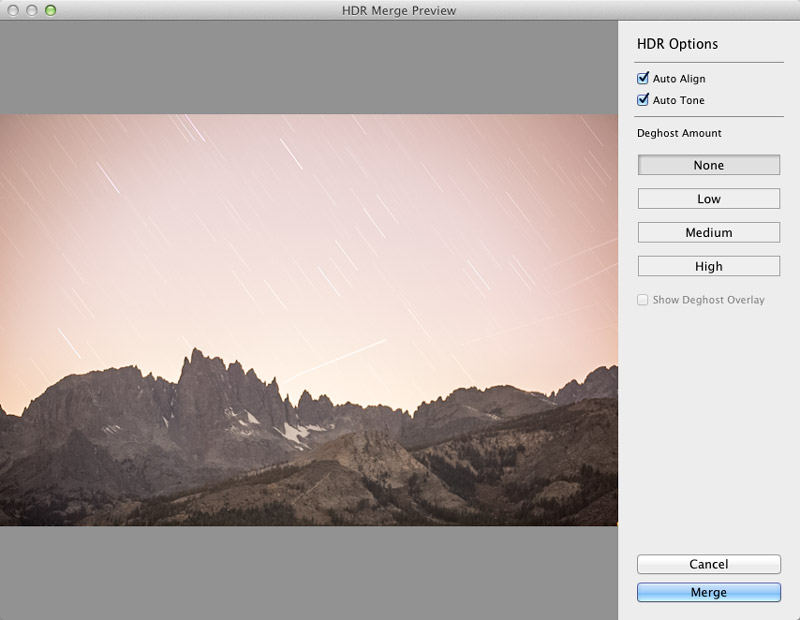
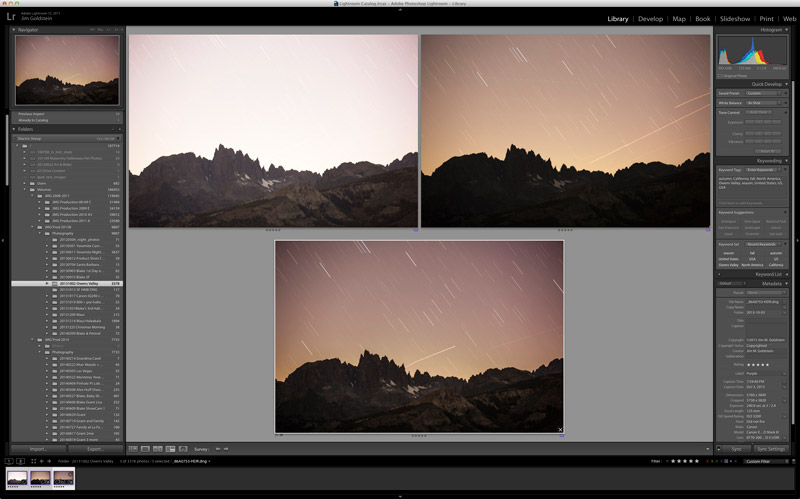
To do Panoramic or HDR merging you no longer need to bounce out of Lightroom to Photoshop. You can now do these functions in Lightroom. As an added bonus there is now a built in preview functionality. In regard to panoramic photos the coolest feature is the “Auto Select Projection” mode that automatically selects the best result between the Spherical, Cylindrical and Perspective modes.  One negative to note you won’t be able to batch process multiple panoramic or HDR photos, but you can repeat this function one after the other with each process running in tandem similar to past multi-exports running in tandem.

Panoramic Selections

Lightroom CC Pano Preview

Mono Lake Milky Way Pano

HDR Lightroom Selection

Lightroom CC HDR Preview

Lightroom CC HDR Image Comparison

4. Facial Recognition

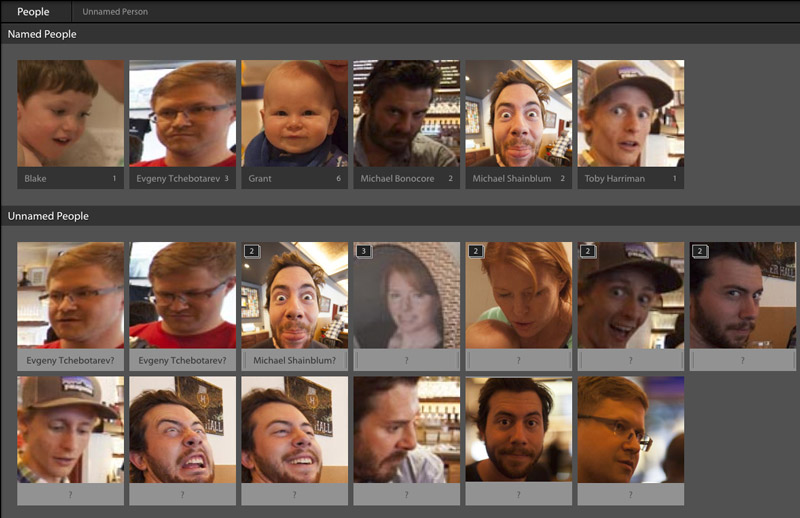
Lightroom now contains facial recognition which is quite nice if you’re photographing events or family. Seeing that I’m known to take tons of photo of my two young boys this will come in handy. By assigning names to each person in your photo you’re essentially applying keywords behind the scenes. With an eye toward privacy names of those in your photos are not exported with keywords unless you adjust your preferences.

Lightroom CC Facial Recognition

Lightroom CC Facial Recognition

Lightroom CC & Photoshop CC Keywords

Lightroom CC & Photoshop CC Keyword Comparison After Lightroom Export

5. Improved Metadata Categorization (Date, Location, etc.)

Now Lightroom does a better job of automatically organizing your photos referencing Dates and Locations. If you utilize GPS in your photos you’ll now be able to make use of the Map module in an easier fashion. Similarly if you search or categorize by dates you’ll find Lightroom CC / 6 a little easier to work with.

6.  Adobe Slate – Publish to the Web

If you’ve yet to hear of Adobe Slate you may want to take note. If you utilize Lightroom CC as part of your Creative Cloud subscription you can publish images and stories to Adobe Slate, a visual blog publishing platform.

Copyright Jim M. Goldstein, All Rights Reserved

My Favorite Features in Adobe Lightroom 6 (CC)

The post My Favorite Features in Adobe Lightroom 6 (CC) appeared first on JMG-Galleries – Landscape, Nature & Travel Photography.


Related Stories

  • My Favorite Features in Adobe Lightroom 6 (CC) – Enclosure
  • 6 Steps to Save Your Ass With Lightroom Catalog Changes
  • 6 Steps to Save Your Ass With Lightroom Catalog Changes – Enclosure
Feed Ads by FeedBlitz
powered by ad choices


JMG-Galleries

 
Comments Off on My Favorite Features in Adobe Lightroom 6 (CC)

Posted in Equipment


Show and Tell:PJers’ Favorite Gear

13 Mar

Ever wonder what products we here at Photojojo can’t live without? All the time, right?

Well you’re in luck!

We’ve rounded up our faves and corralled ‘em right here for your browsing pleasure.

Find Out Who Loves What At Photojojo HQ
(…)
Read the rest of Show and Tell:
PJers’ Favorite Gear (0 words)


© laurel for Photojojo, 2015. |
Permalink |
No comment |
Add to
PJers’ Favorite Gear”>del.icio.us

Post tags:


Photojojo

 
Comments Off on Show and Tell:PJers’ Favorite Gear

Posted in Equipment


Sunshine: My Favorite Light Source

11 Mar

w170

I’m a minimalist gal when it comes to most things, and photography equipment is no exception. I know that some people love equipment and gear; the more the better. But when I think about lugging lights, reflectors, and flashes around, my creativity takes a nosedive. My favorite light source, hands down, is the sun. In the words of John Denver, sunshine on my shoulder makes me happy!

I’d love to share some dos (because who likes to be told what NOT to do?) to help you harness the power of the giant lamp in the sky. Hopefully you’ll gain a new appreciation for this natural light source, whether or not you hate lugging equipment around like I do.

The sun is unique

One thing I love about the sun is that it is never the same. Although having an unpredictable light source can be a big challenge, I love that every day, every shoot, every photo, is unique and special. I couldn’t recreate any given day’s exact lighting even if I wanted to. Some days everything works together like magic, and I call that a gift.

DO pay attention to how the light falls on your subject’s face

w500

I see many amateur photographers take photos like the one above, with harsh light and shadows on the face. Most of the time they are paying more attention to a pretty background than the lighting. If the sunlight is very bright, such as midday, or early afternoon, this can be a big problem.

Sunlight is a beautiful light source, but you have to work with it, and position your subject in the correct place, since try as you might, you’re not going to be able to move the sun (unless you want to wait a couple of hours, and let it move itself).

DO try backlighting

w152

This means that the sun is behind your subject, facing you. This method of using the sun is my absolute favorite, because it makes your subject just glow. There are a few things to keep in mind as you try backlighting:

  • DO use backlighting at any time of day. You get different effects backlighting with the sun in different positions. It’s an effective tool to use even when the light is harsh, since it softens the light on your subject’s face, and helps them not to squint. It’s also an ideal tool to use when the sun is low, golden, and gorgeous.
  • DO move yourself around. Slight differences in angles can make a big difference in the look you get. I like to have the sun behind and slightly to the side of my subject (as you can see in the photo above). If the sun is directly facing your camera, you may get flare in your lens that can totally wipe out your subject. You can get beautiful lens flare effects if you find a spot somewhere in between the two. Experiment to find exactly the look you are going for.

w174

  • DO use poles, trunks, bushes, or whatever is there to manipulate the light to your advantage. If the sun is positioned behind leafy trees, you can create beautiful soft bokeh. The trees filter the light a bit so it isn’t so harsh, and you get beautiful warm, soft, lighting. You can position yourself where the sun is partially behind a trunk or pole off to the side, which will cut some of the harshness and glare in your lens. The trunk doesn’t need to be in your photo, it’s just working as an assistant for you.
  • DO pay attention to the clothes YOU are wearing. Try wearing light/white tops as the photographer, and avoid wearing bright colors. It may seem strange that it matters what the photographer is wearing, but when the sun is reflecting off your chest, it can cast colors onto your subject that you weren’t intending, and put odd colored highlights in their eyes.

w162

  • DO use your subjects and your own body to work with the sun. You can position yourself so the sun is directly behind your subject, so your subject filters the light a bit and cuts the glare in your lens. This can create a beautiful glow, or a starburst effect. Sometimes if there is just a little too much glare on my lens, I hold my hand off to the side of my lens (not in the photo) and achieve just the amount of sun flare that I want, without all the washed out glare.

DO experiment with the sun directly lighting your subject

w198

There are lots of great advantages to this type of lighting, including the beautiful sky captured in the photo. When you backlight, your sky is usually washed out in order to have your subjects properly exposed. You can add a sky in post-processing, but when you shoot with the sun behind you, and toward your subjects, you can expose for both at the same time. A few more tips for front lighting using the sun:

  • DO keep in mind that it is usually hard for people not to squint when they are looking into the sun. If it’s a particularly bright day, you may have to have your subjects looking away from the sun. Some people are extra sensitive to light, and you may not be able to use front lighting unless the sun is really low in the sky, almost ready to set. Squinting eyes aren’t very attractive, neither are watery eyes and scrunched up faces.

w149

  • DO use front lighting when you want a dark background. If you position your subject near the opening of a shed or garage, the background will fall into darkness, since you have your exposure set for the bright subject in the front.
  • DO use front lighting for drama, and for high key photography, but be careful that you don’t lose too much dimension and end up with flat images.

DO use the sun for beautiful portraits

w167

When the light is soft, either when it’s almost down, or with a few clouds over it, you can light your subject from the side to get dimension. You can get dramatic moody portraits, soft flattering portraits, fun happy portraits…the sky is the limit!

DO become a light watcher

I can’t talk to someone without noticing how the light falls on their face. I look at how shadows fall at different times of the day. I study the quality of the light constantly, and take photographs with my mind all day long. The more you know about how the sun works, and how you can work with the sun, the better your photos will get.

Lastly – just one little don’t

DON’T be discouraged if the sun is hiding behind clouds. If you’re lucky, they’re thin clouds, and you can still harness a bit of that magical sunny glow. If it’s overcast, just remember that you’re still using the sun as your light source, and be grateful for the ease of using the whole sky as a giant soft light. Don’t forget; in the words of Annie, the sun will come out tomorrow!

googletag.cmd.push(function() {
tablet_slots.push( googletag.defineSlot( “/1005424/_dPSv4_tab-all-article-bottom_(300×250)”, [300, 250], “pb-ad-78623” ).addService( googletag.pubads() ) ); } );

googletag.cmd.push(function() {
mobile_slots.push( googletag.defineSlot( “/1005424/_dPSv4_mob-all-article-bottom_(300×250)”, [300, 250], “pb-ad-78158” ).addService( googletag.pubads() ) ); } );

The post Sunshine: My Favorite Light Source by Melinda Smith appeared first on Digital Photography School.


Digital Photography School

 
Comments Off on Sunshine: My Favorite Light Source

Posted in Photography


Writer’s Favorite Wildlife Lens – Tamron 150-600mm

24 Feb
Writer with Tamron 150-600 on his Nikon D7100 in Le Claire Iowa. Photo by: J. Todd Polling

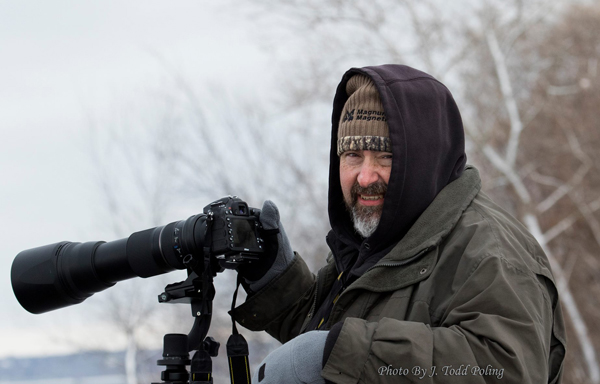
Writer Bruce Wunderlich with Tamron 150-600mm on his Nikon D7100 in Le Claire, Iowa. Photo by: J. Todd Poling

One of my favorite subjects to photograph is wildlife. In the past, great wildlife images were very difficult for me to shoot because my close presence usually meant disturbing the wild creature I had my eye on. I began looking for a longer lens with plenty of reach that wasn’t going to break my piggy bank. So, after much patient and thorough research, I purchased the Tamron 150-600mm SP F/5-6.3 Di VC USD zoom lens for my Nikon D7100.

The reach of this lens gave me some great results right out of the box, but I will have to admit that it takes some practice to photograph moving subjects, such as birds in flight, with this lens. Tamron 150-600mm does have some limitations, but one thing you will find with any telephoto lens is that no matter how much you have, you will always want more.

Technical Specifications:

  • Focal length: 150-600mm (equivalent to 225-900mm on a cropped sensor)
  • Maximum aperture: f/5- f/6.3
  • Available mounts: Nikon, Canon and Sony
  • Minimum focus distance: 8.86′ (2.7 m)
  • Weight: 4.3 lb (1.95 kg)

Compared to Prime lens

Of course, this lens I purchased doesn’t match the quality of a prime lens like the Nikon 6oomm f/4. But besides costing around $ 8000 less then the Nikon lens, it has a few other advantages over its prime equivalent. Besides the heftier price tag, the Nikon prime weighs in at over 11 pounds compared to just over 4 pounds  (1.95 kg) for the Tamron. Unless you are a body builder, hand-holding the prime for an extended period of time is nearly impossible. The Tamron 150-600mm can easily be hand-held, though I recommend using a Gimbal head on your tripod for smoother panning. While the Nikon Prime is a fixed 600mm focal length, the Tamron zooms from 150-600mm, great for those opportunities when you unexpectly get very close to the wildlife, and you can quickly adjust and zoom back.

Be Prepared

The best way to get great wildlife images is to always be prepared. This lens is small enough that I leave it on my camera all the time in my camera bag, so if I happen onto a sudden wildlife encounter I don’t lose time switching out my original lens to the Tamron and miss the opportunity to get the image.

Eagle Shoot in Iowa

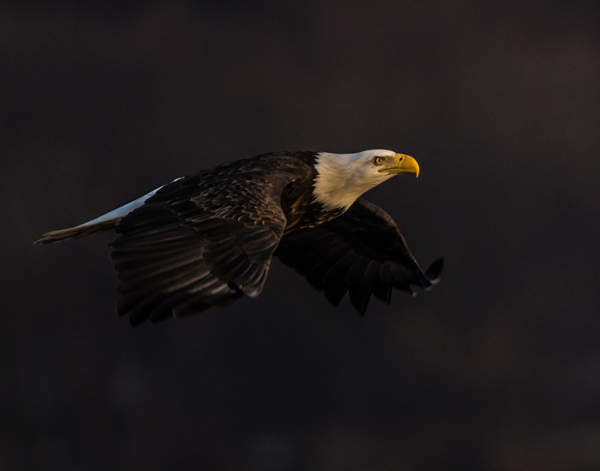
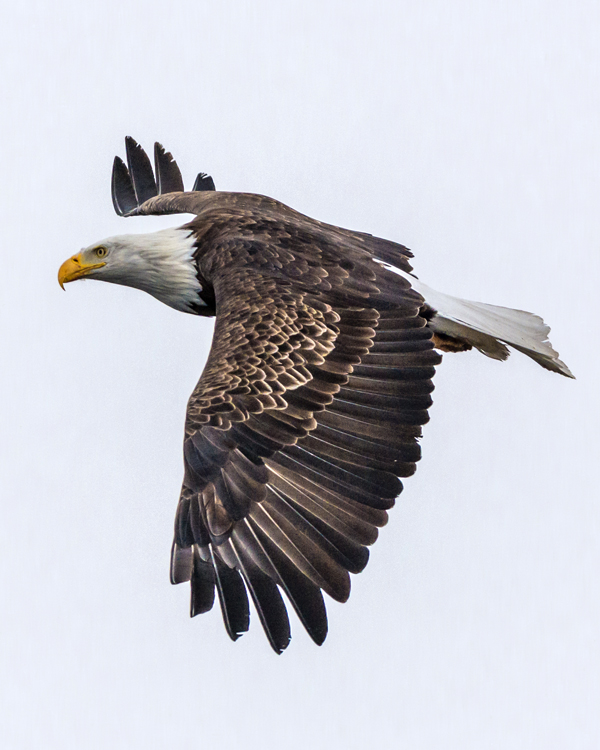
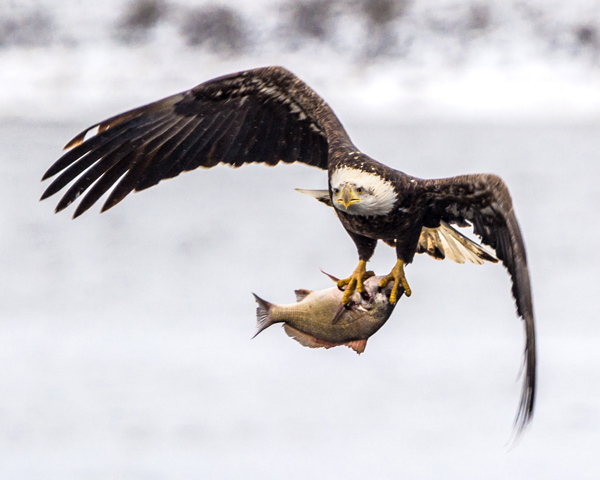
Recently, I had the opportunity to take a road trip with friends to Le Claire, Iowa, to photograph bald eagles on the Mississippi River. This was the perfect chance for me to put my Tamron 150-600mm to good use. Here are a few of my favorite images captured with the Tamron on the trip.

Flying into the Sunset  Focal Length: 600mm 1/1000 of second, f/6.3 with ISO 400

Flying into the Sunset
Focal length: 600mm, 1/1000th of second, f/6.3, ISO 400

Focal Length 360mm 1/2500 of a second, f/6.3, ISO 1000 im Aperture priority mode.

Focal length 360mm, 1/2500th of a second, f/6.3, ISO 1000 in aperture priority mode.

Sweet Spot

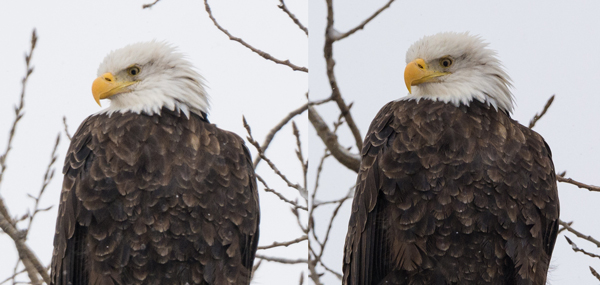
From 150-450 mm, images shot with this lens are really sharp. From 450-600 mm, the results are a little softer, but in most cases it still captures very useable images. In good light the autofocus performs quickly and accurately, while in low light it is some what slower. But for the price, this is a very nice lens.

Image of Eagle on left was captured at 600mm and image on right was captured at 450mm. Image on right has a little more detail in the feathers.

Image of the eagle on left was captured at 600mm and image on right was captured at 450mm. Image on right has a little more detail in the feathers.

Focal Length: 600mm. 1/800th of a second, f/6.3, ISO 320

Focal length: 600mm, 1/800th of a second, f/6.3, ISO 320

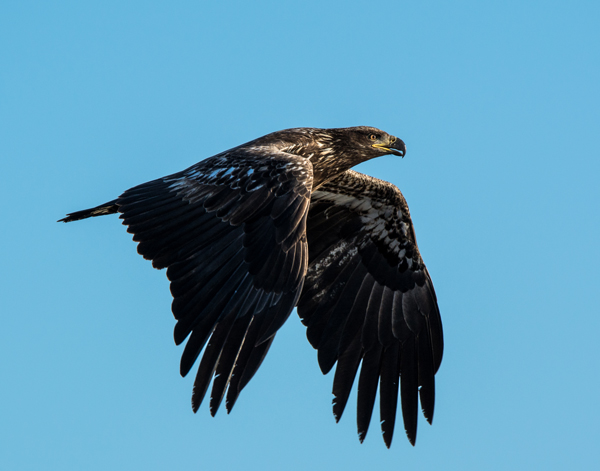
This juvenile Bald Eagle was captured in bright mid day light. Focal Length: 450mm, 1/1000th of a second, f/6.3, ISO 320

This juvenile bald eagle was captured in bright midday light. Focal length: 450mm, 1/1000th of a second, f/6.3, ISO 320

 Conclusion

In my opinion, if you are in the market for a versatile wildlife lens and are on a budget, the Tamron 150-600mm would be a very good choice. I’ve been pleased with the wildlife images I’ve captured with mine, and am looking forward to getting even better ones with practice. That’s why it’s my favorite wildlife lens.

What is your favorite wildlife lens?

googletag.cmd.push(function() {
tablet_slots.push( googletag.defineSlot( “/1005424/_dPSv4_tab-all-article-bottom_(300×250)”, [300, 250], “pb-ad-78623” ).addService( googletag.pubads() ) ); } );

googletag.cmd.push(function() {
mobile_slots.push( googletag.defineSlot( “/1005424/_dPSv4_mob-all-article-bottom_(300×250)”, [300, 250], “pb-ad-78158” ).addService( googletag.pubads() ) ); } );

The post Writer’s Favorite Wildlife Lens – Tamron 150-600mm by Bruce Wunderlich appeared first on Digital Photography School.


Digital Photography School

 
Comments Off on Writer’s Favorite Wildlife Lens – Tamron 150-600mm

Posted in Photography


Wundershine smart frame prints, displays and stores your favorite images

05 Feb

Dutch startup Wundershine has re-imagined the photo frame with Makerframe, a wooden frame that can print and display your images thanks to a built-in inkless thermal printer. Still in the development phase, the system is controlled via Android or iOS app. A simpler model called Reframe that doesn’t include the printer is also in the works. Read more

Articles: Digital Photography Review (dpreview.com)

 
Comments Off on Wundershine smart frame prints, displays and stores your favorite images

Posted in Uncategorized


Writer’s Favorite Lens: 50mm f/1.8

03 Feb

Picking a favorite lens can be tricky, because there are aspects of a variety of lenses that I like. Sometimes I like to use zoom lenses, sometimes prime lenses, and other times specialty lenses like macro or ultra-wide-angle. But despite the variety of options available, at the end of the day I keep coming back to one particular lens as my pick of the litter. The lens that gets the job done no matter what situation I’m in, the one that consistently produces outstanding results more than any other, is my trusty Nikon 50mm f/1.8G. It’s a workhorse that has survived rain, cold, and even being dropped on a concrete garage floor. It’s incredible versatility is why I like to recommend it to photographers – especially those new to the craft who want to expand beyond their kit lens.

yucca

Value and versatility

When I was first exploring digital photography several years ago, I was enticed by the zooming function of a kit lens and could not understand why anyone would want a lens with a fixed focal length. It seemed quite limiting, and since I was just getting my feet wet I did not understand why I would spend over $ 200 on a non-zooming lens when I could spend less than half that on one that covered a greater variety of focal lengths. The price, I thought, made the lens a waste of money. But nevertheless I listened to the advice of my friends Ryan and Kevin and skipped the kit lens entirely, opting instead to shoot only with the Nikon 50mm f/1.8 on my newly-acquired D200. And my, oh my, what a difference that made.

Despite what might seem like a high price tag for new photographers, this lens is quite inexpensive compared to many of its counterparts. Because its focal length is not especially wide, but not all that tight, it can be used in an astonishing variety of situations even on a crop-sensor camera. In fact, the only time I have found myself reaching for a wider lens is when I am shooting multiple people indoors. If I’m using my “Nifty Fifty” during these situations I have to either stand clear across the room or at the other end of the hallway to fit my subjects in the shot.

Other than that it works great for nature, architecture, animal, and especially portrait photography. I have done several portrait sessions with nothing but this 50mm lens, and it produces solid results if you want close-ups with beautiful blurry backgrounds or even whole group shots. While other lenses like the 85mm f/1.8 or 35mm f/1.8 are ideal for tighter or wider shots, this one lens can cover a greater variety of your photographic needs like almost nothing else. The price might seem a bit steep, but it will certainly pay off over time.

portrait

If you’re on a limited budget and want to take nice portraits, look no further than a 50mm lens.

Features

At first glance it might not seem like a non-zooming lens would have much in the way of features, and this particular one doesn’t even have image stabilization that is found on some cheaper kit lenses! But the more I used this lens, the more I realized how many features it did have, and how much they impacted my photography.

For instance, this lens has two focusing modes: Automatic/Manual and Manual. Because I use back-button focusing on my camera, the A/M mode on the 50mm f/1.8 means I don’t have to press any buttons or change any options if I want to quickly shift between Automatic and Manual focusing. On many other lenses I would need to fiddle with a switch on the lens itself in order to change this option. That might not seem like much of a hassle, but I have been in many situations in which I needed to quickly change from Automatic to Manual focusing and back. Not having to flip a switch every time has been an incredible time saver, and resulted in much better photos with much less frustration on my part.

droplet

Being able to switch easily between manual and automatic focus allowed me to get this shot of a precariously-perched water droplet.

Another key feature of this lens is its overall size. While a big zoom lens might seem tempting, and indeed they are certainly useful in a variety of situations, I like the compact size of this lens because it makes it ideal for tossing in a camera bag or carrying around for a day of casual shooting. It only protrudes a few inches from the camera, rendering it quite inconspicuous in a crowd of people. Though it is not ideal for street photography on a crop sensor body, it has allowed me to get plenty of candid shots in a variety of situations because it was simply easy to carry around on my camera.

guitar

While it is a bit on the tight-angle end for casual street photography, the 50mm lens on a crop sensor body can still deliver outstanding results.

Finally, there are a few features of the actual construction of the lens that elevate this lens as my favorite. One of the round glass elements inside the lens is aspherical, which significantly reduces some of the optical oddities caused by a defect called “chromatic aberration” that crops up on photos from time to time. This helps ensure that the photos I take using this lens are tack-sharp and have less of the strange color fringes that can show up on the edges of various elements of a picture.

It helps you learn

tower-flare

Learning to work within the constraints of this lens helped me understand so much more about photography than I would have otherwise.

Noted speaker Martin Villeneuve said that “constraints can actually boost creativity,” and this has certainly been my experience with this non-zooming 50mm lens. Shooting exclusively with it for over a year helped me learn far more about photography than I ever would have otherwise. Its wide aperture unlocked creative photographic opportunities that I would have never experienced with a kit lens Also, the inability to zoom forced me to become more invested in the situations I was photographing, as well as seek out new angles from which to shoot them. This has helped me learn how to use available light much better because I rarely needed to use the on-camera flash or external speedlights, and it helped me understand how the various elements of exposure worked in tandem because there was so much room to experiment with such wide aperture values.

bike

Even in the pouring rain, this lens has never let me down.

To take the idea of working within limits a step further, and help me continually experiment with photography, I started a blog called Weekly Fifty where I post one image each week that was taken with this 50mm lens. After almost two years of doing this I feel like I am just scratching the surface of what it has to offer! Whether you are a new photographer looking for an addition to your gear bag, or a seasoned professional who wants to push new creative boundaries, you can’t go wrong with this simple but powerful piece of glass.

Do you use a 50mm lens? Post your thoughts about it in the comments below, or share any other favorite lenses you might have as well.

googletag.cmd.push(function() {
tablet_slots.push( googletag.defineSlot( “/1005424/_dPSv4_tab-all-article-bottom_(300×250)”, [300, 250], “pb-ad-78623” ).addService( googletag.pubads() ) ); } );

googletag.cmd.push(function() {
mobile_slots.push( googletag.defineSlot( “/1005424/_dPSv4_mob-all-article-bottom_(300×250)”, [300, 250], “pb-ad-78158” ).addService( googletag.pubads() ) ); } );

The post Writer’s Favorite Lens: 50mm f/1.8 by Simon Ringsmuth appeared first on Digital Photography School.


Digital Photography School

 
Comments Off on Writer’s Favorite Lens: 50mm f/1.8

Posted in Photography


My Favorite Year: A Sony shooter’s inspiring 365 day project

28 Dec

With start of a new year, many photographers will take up a ‘365 challenge’, creating and sharing a photo every day of the year. If you’re looking for inspiration to start your own, Toni Ahvenainen’s ‘Year of the Alpha’ project is the perfect place to start. He’s a DPR reader, an enthusiast photographer and, of course, a Sony shooter. In our Q&A he tells us how the project started, how it evolved and what he learned along the way. See gallery

Articles: Digital Photography Review (dpreview.com)

 
Comments Off on My Favorite Year: A Sony shooter’s inspiring 365 day project

Posted in Uncategorized


Writer’s Favorite Lens – The Canon 24-105mm f/4

21 Dec

I like shooting all manner of outdoor scenes. I am a sucker for landscapes and seascapes, which almost always require a wide-angle lens. I really enjoy exploring new cities with my camera, which also requires a wide-angle lens but can also be helped by a little zoom to capture details. And, of course, I like taking pictures of my family while we are out, which requires portrait focal lengths. My favorite lens, the Canon 24-105mm f/4 does all these things, and does them remarkably well.
Bernard

A wide angle allows you to get right behind your subject and also get the background. Shot at 24 mm (1/100, f/8, ISO 200)

So when the dPS writers began writing about their favorite lenses, I did not need to think more than a second to determine which lens was my favorite. I carry other lenses, like an extreme wide angle, and a longer telephoto zoom, but I find I rarely need to break them out. In fact, perusing my Lightroom library shows me that I actually used the 24-105mm to capture over 60% of all the pictures I have ever taken.
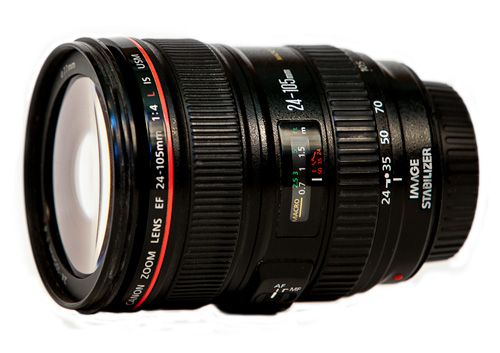
Canon 24-105mm f/4 L IS

Image courtesy of Canon

Here is a quick look at the technical specs for this lens:

  • Local lengths: 24-105 mm (38mm – 168mm on APS-C cameras)
  • Aperture: f/4 (max.) – f/22 (min.)
  • Dimensions: 8.4 cm x 10.7 cm (3.3″ x 4.2″)
  • Weight: 670g (1.47 lb.)
  • Minimum focusing distance: 45 cm

A Great “Walking-Around” Lens

Sure, there is a place for prime lenses. But gone are the days when serious photographers needed to carry around a bunch of prime lenses in order to get high quality. Sometimes you want to just carry your camera and one lens. And sometimes you just don’t want to have to change lenses.

With the 24-105mm, you can carry one lens of high quality and moderate size, and shoot with it all day. It will handle landscapes, urban, street, and people photography really well. As such, it is almost ideal for taking on the family vacation, where you will likely encounter any or all of these scenes. Rather than dig through your bag to find a lens, then change lenses, and then get the shot, you can just walk around with the 24-105mm on your camera and be ready for almost everything.
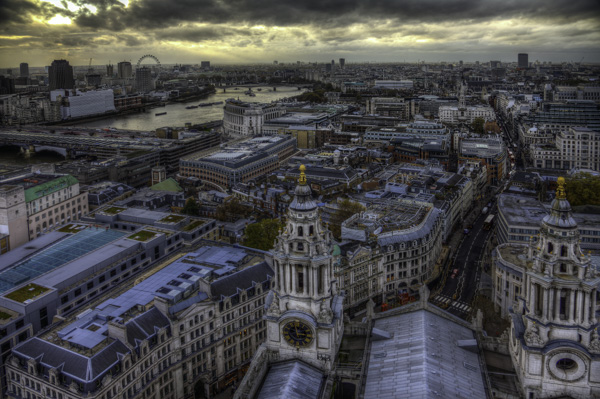
London from top of St. Paul's

The 24-105mm is great for urban shots where you want to zoom out to get the whole scene. It is also nice to walk around with one lens when you have to climb a bunch of stairs, like at St. Paul’s Cathedral in London. Zoomed all the way out at 24mm (1/80 sec., f/5.6, ISO 200).

This is particularly true for full-frame shooters. At full frame, zooming all the way out to 24mm will take a nice wide angle shot, and that is often as wide as you will need to go. Further, at full frame you need to get up to 105mm to cover the portrait focal lengths and get a little bit of telephoto for details. More on that in a second.

High Quality

But am I really just advocating for good walk-around lenses in general? I don’t think so. The focal lengths for these sort of lenses are nice, but they have to be of high quality, and the 24-105mm is remarkable in that regard. It is an L-series lens. It is fully weather sealed. It is sharp and has great image quality. It is known for fast and accurate focusing. My personal experience with it has borne this out. But beyond that, any test I have ever seen of this lens has given it high marks. I have honestly never seen a bad review of this lens (or even a luke-warm one).
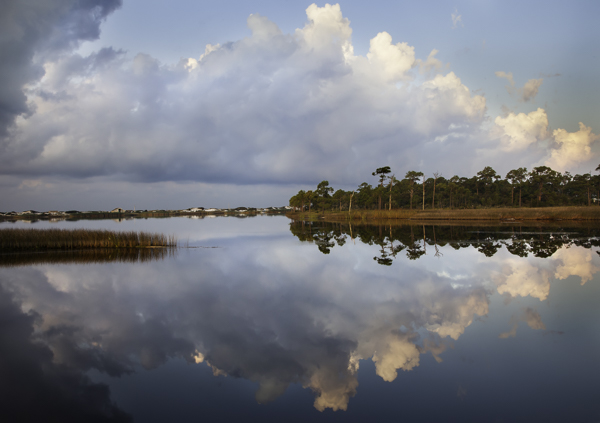
Western Lake

Landscapes and seascapes require a good wide angle. Shot at 28mm (1/30 sec., f/16, ISO 200).

Compared to Other Mid-Range Zooms

But don’t most serious photographers use a 24-70mm for their mid-range zoom lens? Perhaps. I believe they are drawn to the aperture of f/2.8 (versus the f/4 for the 24-105mm). There is no question that the wider aperture of such lenses will get you a greater degree of background blur, and the 24-70 is a really nice lens. But I have a few reasons why the 24-105mm is a better choice for many photographers, particularly those shooting full frame:

1 – Image stabilization

Although the aperture on the 24-70mm opens up one stop more (f/2.8 versus f/4), the 24-105mm has image stabilization, which actually gives you three extra stops in low-light situations.  So unless you need to stop the action in low light, you will actually get better low-light performance out of the 24-105mm.

2 – Better for portraits

If you want to shoot portraits, the 24-70mm is not a good choice despite its wider aperture, at least if you are shooting full frame. The best focal length for portraits is in the range of 80-90mm, which is not included in the range of the 24-70 mm at full frame. It will get there with an APS-C camera since the crop factor will result in an effective focal length of up to 105mm, but not at full frame.

3 – Price/cost

The 24-105mm is a relative bargain at $ 1,150, since you will pay almost twice as much for the 24 -70mm f/2.8.

The price of the 24-105mm becomes even better if you buy it along with a camera, as it is the “kit lens” for some high-end Canon cameras.

The Importance of Lens Diameter

One final note on price, and that is to consider the effect of the purchase of filters. I use a lot of filters, as do many outdoor photographers. I carry three different strength neutral density filters, a polarizer, and a graduated neutral density filter kit. Some photographers might add a UV filter to that list as well. So it is worth mentioning that another good thing about the 24-105mm is that its lens diameter of 77 mm is the same as other common Canon lenses (it is the same for the three lenses I use most often).
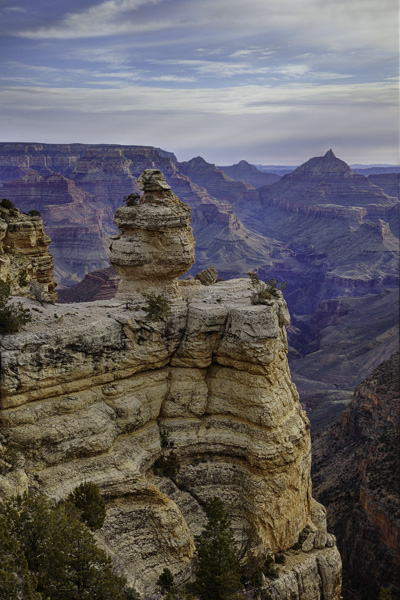
Grand Canyon

When out hiking, you often want to keep your weight down, so a walking around lens like the 24-105 works great. Shot at 58 mm (1/200 sec., f/11, ISO 250).

Why is that important? Because having the same lens diameter on different lenses means that I can use the same set of filters on all of them. If I had to buy new sets of filters for lenses of different diameters, it would get very expensive, very fast. That is especially true if you are using high-quality filters (and you should be, since it directly affects the optics).

Lenses that share the 77 mm diameter with the 24-105mm include the:

  • 100 – 400 mm f/4.5 – 5.6
  • 70 – 200 mm f/2.8
  • 17 – 55 mm f/2.8
  • 17 – 40 mm f/4
  • 16 – 35 mm f/4
  • 10 – 22 mm f/3.5 – 4.5

Not for Everyone

So I think the 24-105mm f/4 is the perfect combination of great focal lengths, high quality, and reasonable price. It will allow you to take landscapes, urban scenes, street photos, and family pictures. You might never take it off your camera.
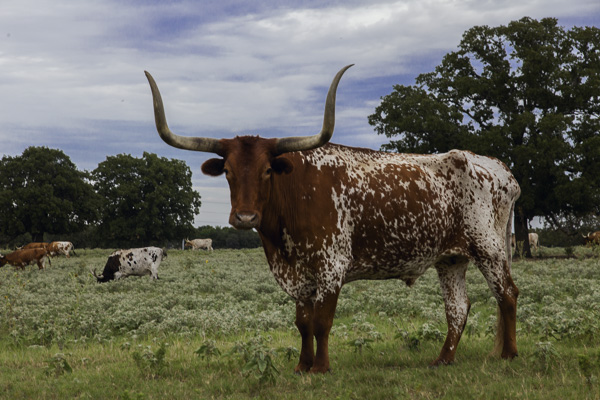
Longhorn

Sometimes you want to zoom in a bit. Shot at 82 mm (1/100 sec., f/8, ISO 400).

But, of course, the 24-105mm is not for everyone. Even among those looking for a good walking-around lens, the $ 1,150 price tag might be too strong. In addition, there are a lot of things this lens won’t do, like macro, for example.  It doesn’t have enough reach for sports or wildlife photography. Although the focal length of the 24-105mm does cover the “portrait lengths,” portrait and wedding photographers will doubtlessly want a faster lens. In fact, anyone shooting inside will likely want a faster lens (larger maximum aperture).
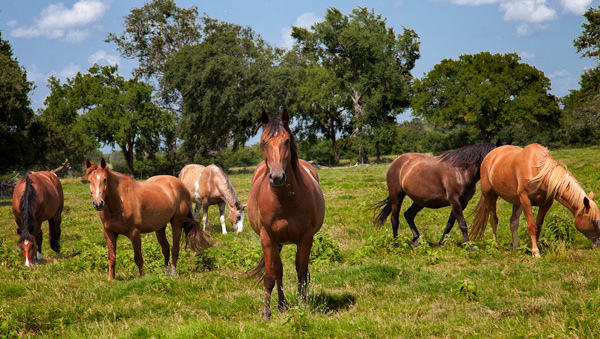
When you are photographing horses, you need to be ready for a variety of focal lengths.  Sometimes they will walk up to you looking for a treat, and sometimes they stay away.  These stayed away, so I needed all 105 mm.  (Shot at 105 mm, 1/160 sec., f/11, ISO 200)

When you are photographing horses, you need to be ready for a variety of focal lengths. Sometimes they will walk up to you looking for a treat, and sometimes they stay away. These stayed away, so I needed all 105 mm. (Shot at 105 mm, 1/160 sec., f/11, ISO 200)

Conclusion

For many, the 24-105mm will be a great choice. Rarely do you see this combination of focal length, quality, and price. I would say that it would make a great addition to your photography bag, except that it is likely that this lens won’t spent much time in your bag (unless your camera is also in your bag). I agree with Bryan Carnahan of The Digital Picture, who writes that “if I had only one lens, this would be the one.”

googletag.cmd.push(function() {
tablet_slots.push( googletag.defineSlot( “/1005424/_dPSv4_tab-all-article-bottom_(300×250)”, [300, 250], “pb-ad-78623” ).addService( googletag.pubads() ) ); } );

googletag.cmd.push(function() {
mobile_slots.push( googletag.defineSlot( “/1005424/_dPSv4_mob-all-article-bottom_(300×250)”, [300, 250], “pb-ad-78158” ).addService( googletag.pubads() ) ); } );

The post Writer’s Favorite Lens – The Canon 24-105mm f/4 by Jim Hamel appeared first on Digital Photography School.


Digital Photography School
 
Comments Off on Writer’s Favorite Lens – The Canon 24-105mm f/4

Posted in Photography


The Canon EF 8-15mm f/4L Fisheye USM, My New Favorite Wide Angle Canon L Series Lens

21 Nov

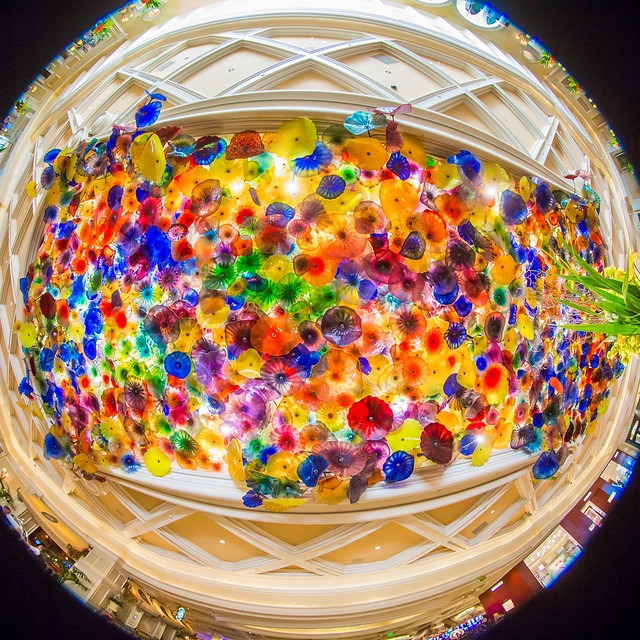
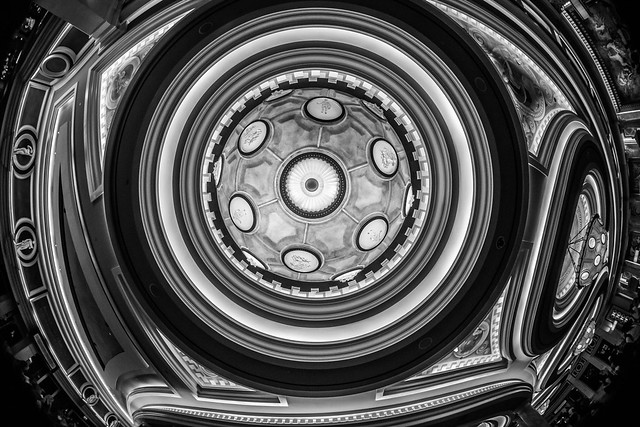
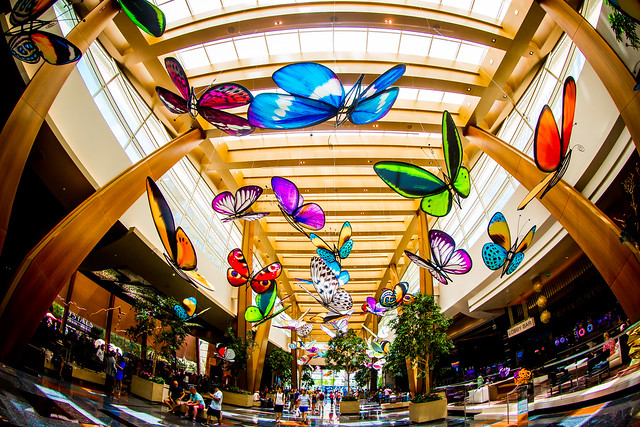
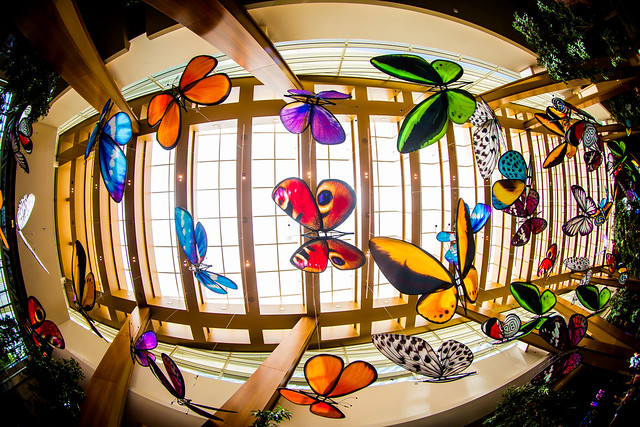
My Friend Chihuly Says Hi

I almost didn’t purchase the Canon EF 8-15mm f/4L Fisheye USM lens. I remember a conversation when I bought it a few years back on Google+ with my good pal Gordon Laing where I was really debating buying it. It was in pre production and I had an order in with B&H but it hadn’t shipped yet. At around $ 1,400 the lens felt expensive for what I worried might be an oddball lens, a lens useful for making a few high impact fisheye shots but not good for much else.

I’m happy to say that I did buy the EF 8-15mm fisheye lens and that I couldn’t be more happy about that decision.

My main dilemma with the EF 8-15mm fisheye was that I already owned the excellent EF 24mm f/1.4 lens and EF 14mm f/2.8 lens, and so I felt like I had the whole wide angle world covered. Now I find that I use this lens at 15mm much more than either my EF 24mm f/1.4 lens and EF 14mm f/2.8 lens and get what feels to me to be a remarkable more normal non fishy looking wide angle shot. Yes, you can tell it came from a fisheye lens at 15mm, but barely and I love the slightest degree of distortion I get there artistically speaking.

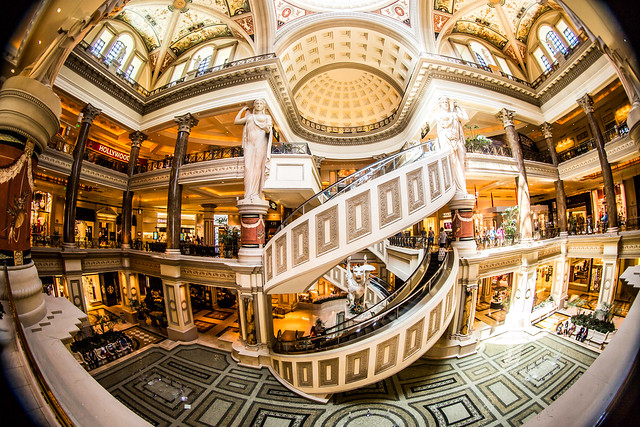
Welcome to Caesars

Of course I have way more fun shooting this lens at 8mm and have found that beyond traditional fisheye subjects, this lens has opened up a whole new world to me when it comes to shooting more abstractly — especially with architecture. I find these days my EF 14mm lens stays in my bag and instead I put on my EF 8-15mm fisheye lens for almost every ceiling photo I take.

I find this lens gets me my highest impact shots. Shots that make you go wow and make people notice.

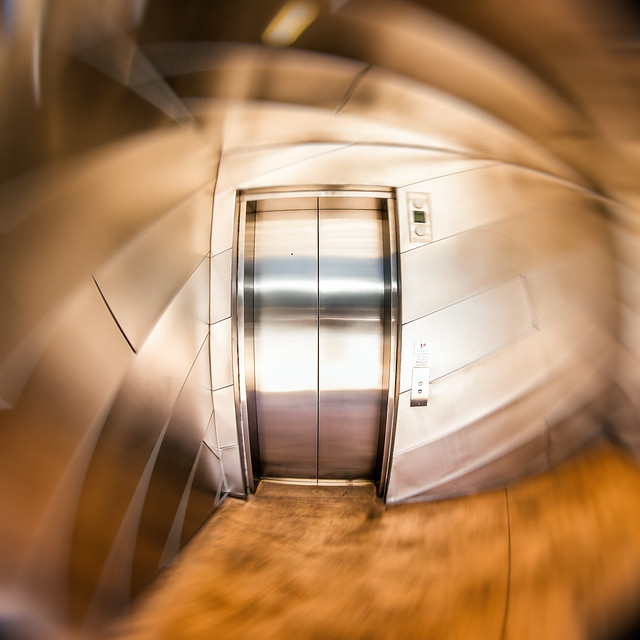
Underground

On a full frame lens this lens gives you a perfect circle at 8mm. I love the square crop format and frequently shoot it at 8mm and then crop square afterwards.

The lens is super sharp and great if you want to get the entire ceiling of Chihuly’s amazing sculpture at the Bellagio like in the photo with this post.

While it’s not the best portrait lens, it can be fun to use as well with photographing people in new and creative ways (like this version of the human eye that I used it on).

As a reminder, my analysis of my Canon gear is being done in partnership with Canon and I am receiving compensation for this work with them.

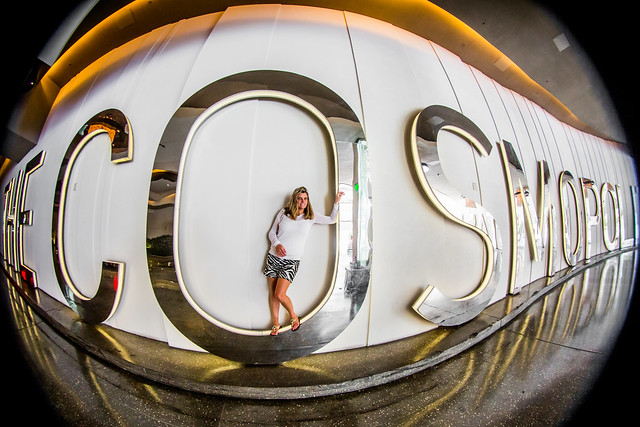
Meet You at the Cosmopolitan

You Give Your Hand to Me

If You Can Find Her

Your Love is My Favorite Color

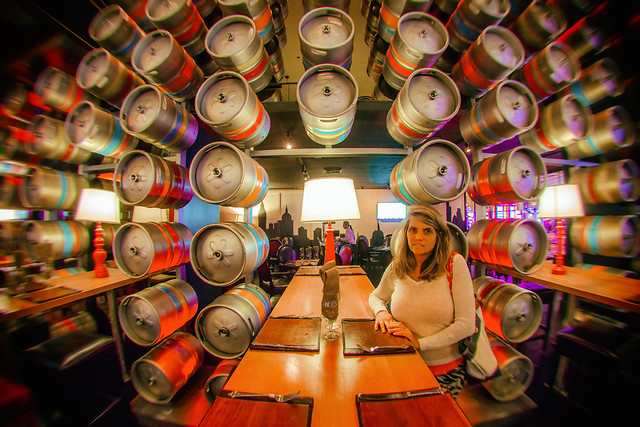
Time for a Beer?

Your Love is My Favorite Color

Penchant


Thomas Hawk Digital Connection

 
Comments Off on The Canon EF 8-15mm f/4L Fisheye USM, My New Favorite Wide Angle Canon L Series Lens

Posted in Photography


Ello, My New Favorite Social Network

21 Nov

ello-40715fdd-0669-4999-bedd-419b07886886

I just spent $ 40 on a t-shirt.

I don’t think I’ve ever spent $ 40 on a t-shirt in my life. The t-shirt is a limited edition threadless Ello t-shirt designed by @nopattern.

I’ve been given t-shirts in the past by many social networks and sites. I have a Google+ t-shirt, I have a Facebook t-shirt, I have a Flickr t-shirt, I have a friendfeed t-shirt from back in the day. Twitter never gave me one, but that’s ok. The Ello one I bought for myself though. I like to think that this is some small way that I can help contribute towards the ad-free social experience that quickly has become my favorite of all the networks.

Over at the Atlantic Alexis Madrigal has an article out today titled “The Fall of Facebook.” In the article he describes a certain “soullessness” of Facebook and writes about the unease that people increasingly have with Facebook’s advertising network.

A few weeks ago, when the San Francisco Giants clinched the World Series, my wife took a photograph of our children and family celebrating the win. Not being particularly privacy conscious when it comes to social media, she added a name for the location, “Hawkville” without realizing that through this process she was creating a new permanent “place” on Facebook that was geotagging our home.

Friends quickly liked both the post and the new “place” and in a matter of hours we were much more public on Facebook than I wanted to be. After realizing that she’d made this mistake, my wife removed the location tag from the photo – but what she couldn’t remove was the new permanent “place” on Facebook, “Hawkville,” which geotagged our home’s exact and precise location against our wishes.

Because I’ve had issues with impersonation on Facebook in the past and I suppose because I have a larger than average social media following, previously I’d been given a link to a special sort of VIP customer service area at Facebook.

Although I was disturbed that there seemed to be no way to remove my geotagged home from Facebook, I figured it would just take reaching out to this VIP customer service group to get the geotag deleted — unfortunately this turned out not to be the case. The Facebook employee who responded to me told me that she was unable to delete the page “Hawkville” or remove the geotag of my personal and private residence.

I next made a post on Facebook about the unfairness of this. Just because my wife made a mistake and geotagged our home, why should that mistake be irreversible? Shouldn’t I have more control over my personal residence on Facebook? Does Facebook believe in doxing? Why were my wife and I locked out of this page, unable to control this personal data? Why had Facebook created a “place” of a personal residence in the first place and why wasn’t my wife warned at the time that by geotagging our home she was permanently and irrevocably adding our location data to Facebook with no way to remove it?

After several posts and further attempts to contact the Facebook VIP customer service department, about a week later I went to a group of Facebook employees who I know personally and I was able to get the geotag removed (although not the place). I really appreciate the personal help that I was given to get this done (I really do), but the fact of the matter is that I shouldn’t have had to go that route to have my personal information removed from Facebook.

I’ve been increasingly disappointed with my experience on Facebook. I find that fewer and fewer of my friends are seeing what I post and engagement is increasingly going down.

I’m seeing more and more “sponsored” posts and advertising crowding out organic content, which probably plays a part in this… or maybe my photography just sucks and is way less interesting to the people who follow me there.

Sponsored posts are the worst as far as I’m concerned. At least with an ad over in the right hand column, I can try to ignore it. A sponsored post shoves itself right into your face though. Time and again I’ve caught myself reading the first few lines of a sponsored post before realizing I’m reading one and then have that terrible feeling I get when I realize I’ve just been suckered for few seconds into an ad.

More than this though, I feel like Facebook doesn’t really care about me. I feel like I’m being targeted and manipulated and probed and studied. I don’t feel like my content there is valued. There *is* a certain soullessness to the place. I’m not sure what can be done about that, it’s just what it feels like to me.

I also feel like photography doesn’t really matter at Facebook. Photos are super small and optimized for mobile, rather than big and glorious and optimized for the web. I get that Facebook has to pay for storage for our photos, but with all of the advertising and personal data they collect to target us, don’t they have even just a few nickels or dimes to make the photos just a tiny bit larger in the feed? Yes, I know that someone can click through and see it larger, but most people don’t and won’t and so your art is presented in an unfavorable small way to the 0.1% of your followers who might actually see it in their feed.

My experience so far at Ello has been the opposite.

At Ello I’ve found an idealistic group of artists, photographers and thinkers who dare to imagine a different, better way. I’ve found some of the freshest, most creative and most interesting art that I’ve seen in years online. There are no ads. Ello is not tracking my information to try and sell it to advertisers.

The founders and operators of Ello come across as creative, innovative, accessible, enthusiastic and engaged. I feel respect for my content on Ello, which is shown large in full high res glory. This is why I put more of myself into my art and photography on Ello than any other site. The respect feels greater.

I’ve met so many new and interesting friends on Ello. I’m settling in there realizing that this will be the place that I will share and communicate online with people going forward more than anywhere else. It feels like I’m hanging out with some really interesting artists in a nice cozy little café in Marfa, Texas with amazing coffee and music — rather than being lost, wandering aimlessly around the world’s largest Walmart, being told not to take photos in the store by some security guard.

Forbes says that the number one social media marketing trend that will dominate 2015 will be the rise of Ello. Rather than rely on crappy paid advertisements on Facebook going forward, Fashionista writes about how brands will actually have to create interesting, creative content to be seen on social networks like Ello in the future.

So is this new network worth $ 40? You’d better believe it is. Plus I get an awesome new t-shirt to go with the Marfa Public Radio one I bought just last week.

Do you like art and photography and architecture and design and creative thinking? Then come hangout on ello. You’ll find me most days online over there at http://ello.co/thomashawk


Thomas Hawk Digital Connection

 
Comments Off on Ello, My New Favorite Social Network

Posted in Photography