RSS
 

Posts Tagged ‘Equipment’

How to Photograph a Wedding – A Guide to Equipment, Shooting, Editing and More

07 Sep
  • Have you ever entertained the thought of being a wedding photographer?
  • Or have you ever been asked by a friend to photograph their wedding?
  • Or have you already taken the leap into wedding photography and it’s not quite going the way you hoped?

If you you answer yes to any of these questions – our brand new Wedding Photography ebook is for you!

Best of all – if you grab it this week it’s 50% off the normal retail price – so it’s your for just $ 9USD!

This beautifully designed eBook was written by Lily Sawyer who many of you will know as a regular writer for dPS.

Lily is also a professional photographer and draws on her experience of photographing more than 500 weddings, events and portrait sessions to share some practical advice for anyone hoping to embark on a similar journey into wedding photography.

7 Chapters of Practical Wedding Photography Advice

Included in this eBook are 7 chapters covering:

  • How to be a good wedding photographer
  • Equipment for wedding photography
  • A step-by-step guide to photographing a wedding day
  • Editing and batch processing
  • Products you can offer your clients
  • Pricing and how to find your happy place
  • Marketing your business

Click through for more details and to preview sample pages and to grab your copy of the eBook.

We think this is one of the best risk-free instantly downloadable resource you can buy to help you on your journey as a wedding photographer – no hype, no over-promising or relentless hustle speak – just realistic advice and practical tips.


Download it Now $ 9USD

P.S. As with all our books and courses, we offer a 60-day money back guarantee, so you can buy it confidently today, risk-free.

The post How to Photograph a Wedding – A Guide to Equipment, Shooting, Editing and More appeared first on Digital Photography School.


Digital Photography School

 
Comments Off on How to Photograph a Wedding – A Guide to Equipment, Shooting, Editing and More

Posted in Photography


Equipment List for Making Better Smartphone Videos

01 Aug

In case you haven’t noticed, smartphone cameras keep getting better and better. Not only do they take better still photos, but they also record high-quality video. Many latest generation smartphones are equipped with image stabilization, focus tracking, and the ability to shoot in 4K.

Smartphone video accessories 03

This is especially notable with the recent release of IGTV and social media platforms encouraging more video creation. With that in mind, it’s worth investigating how to use your smartphone to take better smartphone videos. As usual, it comes down to the tools you use. Here are several accessories worth investing in to take your smartphone videography to the next level.

A Way to Secure Your Phone

Equipment List for Making Better Videos With Your Smartphone - image on a cell phone

Smartphones today are being built tougher, but they still have a sleek body that makes them easy to drop. To keep your phone more secure, consider getting one of these accessories. This will help you take sharper and better videos.

Pop Socket

In case you’re not already hip to the Pop Socket, here’s why they’re so popular.

Image courtesy of Pop Socket.

These little devices look deceptively simple. They’re just a plastic backing that sticks to your phone and pops out to give you a better grip. This helps you hold your phone with one hand while taking selfies or shooting tricky angles. They are especially helpful while shooting video.

But there are some problems with the Pop Socket. For one thing, they’re bulky. Even when retracted, the Pop Socket sticks out just enough to make it a hassle to stick your phone in your pocket or put it into your car’s cell phone holder.

Secondly, Pop Sockets look about as cheap as they cost, at least in my opinion. This can ruin the aesthetic of the pricey phone you’ve invested in. Finally, these suckers are pretty permanent. Once they’re attached to your phone, they’re useless if you remove them. For that reason, I prefer using the next accessory to keep my phone secure.

Black Rapid WandeR Bundle

Image courtesy Black Rapid.

Black Rapid is known for their camera straps, but they also have a cool new product for smartphones. The WandeR Bundle is a nylon tether wrist strap that attaches to your smartphone’s case (above).

You can also use the included TetheR-Clip to secure your phone to a bag or camera strap (see below). It’s a simple concept that is very well executed and will make it hard to drop or lose your phone again.

Image courtesy Black Rapid.

A Smartphone Tripod

Like any other camera, there’s a time and a place to use a tripod with a smartphone, especially when creating videos. The good news is that you don’t need a giant tripod for your smartphone, although you can certainly adapt any basic tripod for use with a cell phone using an adapter (more on that below).

But if you want a more compact setup, consider getting a dedicated smartphone tripod. The Manfrotto PIXI EVO  is a popular option, as is the JOBY GorillaPod Hybrid Mini. Both are small, yet sturdy enough to hold a smartphone or even a small mirrorless camera if needed.

No matter what kind of tripod you end up with, make sure you get a cell phone tripod adapter to properly mount your device.

Equipment List for Making Better Videos With Your Smartphone - Smartphone mounted on a tripod

External microphone

Most smartphones have pretty good built-in audio recording features. But sometimes you need an enhanced audio solution. Note that for both of these microphones, you may need a smartphone audio jack adapter if you have a phone without a traditional audio jack.

One of the best smartphone microphones out there is the Rode VideoMic Me microphone. It’s very compact and comes with a fluffy windscreen (also known as dead cat). To use it, simply plug it into your smartphone’s audio jack. It worked well with my Samsung Galaxy S8 but didn’t work at all with the Google Pixel.

The reason is the location of the audio jack. On the S8, it’s located on the bottom of the phone, on the opposite end of the cameras. The Pixel’s audio jack is located on top, next to the camera. Thus, the microphone was in the shot both with and without the windscreen. So check the audio jack’s proximity to your camera before investing in this mic.

Another type of microphone you may need is a lavalier (or lapel) mic. It is placed in close proximity to the speaker’s mouth to isolate their voice from environmental noise. Lavalier mics are generally wired, meaning they can be difficult to use when plugged directly into your video recording device.

So the most convenient setup is to record your visuals with one camera, and record audio with a lavalier mic plugged into a smartphone. You’ll need an audio recording app to do this. A top of the line lav mic option is the Rode smartLav+, or the more affordable Stony-Edge Simple Lav. Note that sound quality typically corresponds with price, but it truly depends on your budget.

Rode mic on a smartphone - Equipment List for Making Better Videos With Your Smartphone

Smartphone gimbal

Many smartphones come with built-in stabilization that will help minimize or remove shake from your videos. However, you still need an extra tool if you want buttery smooth, cinematic video footage. The simplest video stabilization tool is an electronic handheld gimbal.

There are two main gimbals out there worth considering, and they’re very competitive in terms of features and price. One is the DJI Osmo Mobile 2, and the other is the Zhiyun Smooth Q. I’ve been using the Smooth Q for the past few months and have been blown away by how much my smartphone video quality has improved.

Best of all, a gimbal is easy to use and quite affordable for the features it offers.

girl using a gimbal smartphone stabilizer

Extra Power

While smartphone battery life keeps gradually improving, it’s still a good idea to bring a portable cell phone charger with you.

There are tons of external batteries on the market, but Anker is by far one of the more reputable brands. In particular, the Anker PowerCore 10000 is a compact, efficient, external battery. It can charge either your smartphone or electronic gimbal or both at the same time. Just be sure to charge the battery ahead of time and bring the right cables.

Over to You

In short, you don’t need a lot of tools to start using your smartphone to make better videos. However, if you add these tools to your kit, you’ll be well on your way to producing more professional-looking videos.

Do you have any smartphone video accessories? Let us know your essential tools in the comments below!

The post Equipment List for Making Better Smartphone Videos appeared first on Digital Photography School.


Digital Photography School

 
Comments Off on Equipment List for Making Better Smartphone Videos

Posted in Photography


Discuss: Better Equipment Versus Knowledge – Which Will Help You Improve Your Photography More?

22 Apr

As a photographer, you always have the urge to buy new equipment thinking it will bring you better results. This might be true, but only up to a certain point, because if you don’t have the knowledge you can’t make the most out of your equipment. I started with a Nikon D3200 and I use it to this day because, in my opinion, it’s not the equipment that is going to help me take better photos.

If you’re asking yourself, “What can I do with my entry-level camera?” then this is the article that’s going to prove that you can achieve great things and be a great photographer with your own camera. There are many photographers that took some amazing pictures with film cameras, photographers like; Andreas Feininger, Henri Cartier-Bresson, Eve Arnold, etc.

What keeps you from taking better photos, your EQUIPMENT or your KNOWLEDGE? - portait in a field

We cannot deny that their cameras were the best of their time. But my point is that even today they could compete with any owner of a fancy camera because having the latest camera is not going to guarantee a better vision.

I’m going to give you some tips and tricks on how to take better photos and overcome the obstacle of not having the latest equipment.

1. Read

The most important thing you can do is to read. Many people skip this step and think that only by practicing will they improve. It is true that you have to practice, but unless you study the theory first there is no way of practicing in an efficient way.

For example, if you read an article about shutter speed and aperture it’s easier the understand the mechanism and then apply it, than trying to figure it out all by yourself.

Start here to get to many great dPS articles and find the topics that interest you the most.

girl reading in the grass - What keeps you from taking better photos, your EQUIPMENT or your KNOWLEDGE?

2. Know your equipment

You just bought your first camera and you are stuck with your kit lens. But before buying a new lens you have to learn the basics. You can use your kit lens for numerous types of photos, from landscapes to portrait photography.

I took more than 5,000 images with my kit lens before buying my second one, and I learned a lot of helpful things. If you’re shooting portraits, 35mm focal length can get a nice bokeh having an aperture of f/4.5. This focal length is perfect because it’s not wide so you’re not going to distort the face and you can have more light than shooting the same lens at 55mm, f/5.6.

3. Know what to buy

Buying equipment can be difficult when you can’t afford expensive things and you have to spend your money right. I am speaking from the perspective of a portrait photographer. My first portrait lens was (and still is my main lens) a 35mm f/1.8. If you want nice bokeh for a cheap price this is the right choice. I’m still exploring with this lens and I always find new perspectives.

Knowledge Over Equipment

Next, I’m going to present some arguments on why better equipment doesn’t necessarily make you a better photographer and on why knowledge can help you overcome your equipment struggles.

Buying new equipment is always tempting, but you have to learn how to make the best of what you already have. The best thing you can do as an amateur is buying an entry-level camera and a prime lens. Stick with it and see if you can come up with a new vision every time you go out to take photos.

At first, I didn’t know how to use manual mode. But do you think buying a better camera is going to help with that? No is the answer, you have to read and understand how the relationship between ISO, shutter speed and aperture affect everything in a photo.

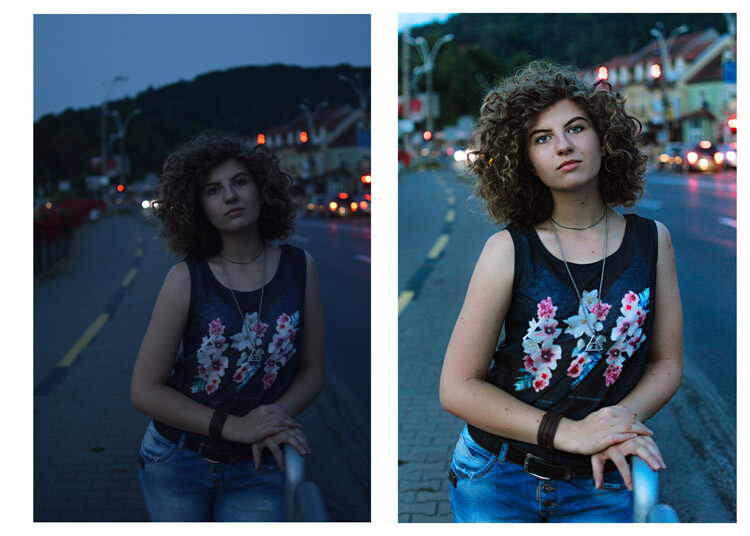
After learning that no picture is the same and the settings are going to change every time, you have to do a lot of trial and error. If you practice enough you can achieve great things. After learning how to use your equipment you have to learn how to process your pictures because it makes a big difference as well.

What keeps you from taking better photos, your EQUIPMENT or your KNOWLEDGE? - before and after processing

What keeps you from taking better photos, your EQUIPMENT or your KNOWLEDGE?

The next thing you have to know is that light makes the difference in every picture, you have to learn how to manipulate and control the light. Once you know how light works you are going to love your equipment.

lady and umbrella snowing - What keeps you from taking better photos, your EQUIPMENT or your KNOWLEDGE?

lady in leaves - What keeps you from taking better photos, your EQUIPMENT or your KNOWLEDGE?

When do you need better gear?

There are a few situations where better equipment can be helpful. I’ll give you a few examples and some tips to overcome the difficulties.

1. Shooting in low light conditions

Having expensive equipment can help you here, you can have a higher ISO without a lot of digital noise. With my entry-level camera, I can raise the ISO to 400 and it already looks really noisy. With a full frame camera or even an expensive DX sensor you can raise the ISO to 1600, or 3200 and your image is still going to look fine.

girl walking in the woods in winter - What keeps you from taking better photos, your EQUIPMENT or your KNOWLEDGE?

2. Sports photography

This is another hard thing to do with an amateur camera, you can still achieve great things. Your autofocus is going to play some tricks on you, so you have to work on your timing. Knowing where and when to press the trigger will help your autofocus a lot. Another thing you can do is to learn the panning technique.

Conclusion

So in summary, equipment is just a tool. It doesn’t help you to shape your vision and buying the latest gear as a beginner is not the best choice you can make. When you find that you have difficulty expressing your vision with your current equipment, then you can start thinking about upgrading.

The post Discuss: Better Equipment Versus Knowledge – Which Will Help You Improve Your Photography More? appeared first on Digital Photography School.


Digital Photography School

 
Comments Off on Discuss: Better Equipment Versus Knowledge – Which Will Help You Improve Your Photography More?

Posted in Photography


Photography Equipment Comparisons – Entry-Level Versus High-End Gear Does it Matter?

16 Feb

Photographers tend to get obsessed with having the latest, greatest toys. But does it matter which camera or bits of equipment you use? If so, how much? Or is it more about how you use it, and the skills you possess?

Let’s take a look at three video comparisons of some of the top level photography equipment available and some entry-level options.

Rich photographer – poor photographer

I like the play on words here, hinting at the concept of the “Rich Dad Poor Dad” series of books by Robert Kiyosaki. In the video, the guys over at f-stoppers do a portrait shoot with two different sets of lighting equipment. One which costs nearly $ 10,000, and the “poor man’s” version which will run you about $ 425.

Can you see a difference in the final portrait results? No, I can’t see much difference either.

$ 1100 versus $ 5499

In this second video, Peter McKinnon looks at the virtues of both the Canon 80D ($ 1099) and the Canon 1Dx Mark II (Note: at the time of writing, this camera is listed at $ 5499). Is the latter worth five times as much? You decide.

If you are a sports shooter, you may need the extra frames per second rate the 1DX offers. But if you’re a wildlife photographer you may prefer the extended reach of the crop sensor in the 80D. Portrait photography can be done with either, but you likely don’t need to spend the extra money on the 1DX if that’s what you shoot.

Note: when the video was made the 1DX was likely priced higher, so please note the difference in prices in the video to current pricing.

Camera shootout – it’s not about the gear

In this last video let’s see what happens if two professional photographers each pick up an entry-level Canon Rebel T3i and hand their Canon 5D Mark IV to an amateur. They do a little shootout with the same model, in the same lighting conditions and studio. Let’s see who comes out on top.

The Canon T3i is discontinued, the price for the current model, the T6 is $ 449 with the 18-55mm lens. The Canon 5D Mark IV  is $ 3299 + $ 1699 for the 35mm f/1.4 lens shown in the video = total $ 4998.

?

Your thoughts?

So what are your thoughts after watching the videos? Have you made the decision to invest in high-end lenses or a full frame camera body? If so, have you found it to fill your needs better – was it worth it? Let’s discuss in the comments below.

The post Photography Equipment Comparisons – Entry-Level Versus High-End Gear Does it Matter? by Darlene Hildebrandt appeared first on Digital Photography School.


Digital Photography School

 
Comments Off on Photography Equipment Comparisons – Entry-Level Versus High-End Gear Does it Matter?

Posted in Photography


How to Know if You Should Upgrade Your Equipment or if You Just Have Gear Lust

29 Jan

Gear lust – it’s out there and is bound to bite you sooner or later. Whether photography is a business or a hobby for you, gear lust is a natural part of the consumer cycle. But there is a sane way to approach your desires and check if they are ruling you or you are ruling them. So here are some tips to help you know if you should upgrade or it’s just gear lust.

How to Know if You Should Upgrade Your Equipment or if You Just Have Gear Lust

New Photo Equipment Flowchart

Follow this flowchart to see where you land. Only if you end up at a green bubble should you consider upgrading or buying more camera gear.

How to Know if You Should Upgrade Your Equipment or if You Just Have Gear Lust - infographic

Click to view the chart in a new tab or print it out.

Do you shoot for profit?

The first question on the chart is the most defining, “Are you going to make money from this lens?” Whether photography is a hobby or profession for you makes a big difference in the purchase decision. I believe both groups should look at the choice through different eyes, so let’s start down the hobby side of things first.

Skip down to below the hobby section to find the questions for profitable shooters.

How to Know if You Should Upgrade Your Equipment or if You Just Have Gear Lust

Hobby: What can’t you currently do with your gear?

If you can’t answer this question truthfully, then you have textbook gear lust. If you answer it and that answer is, “Nothing,” you too have gear lust. That’s not a bad thing! I just want to help you recognize it so you can make your choice with a little more clarity.

But, if there is a technique or style you have tried to replicate over and over again with your current equipment, such as parallel lines in architectural photography or a ten-minute exposure when your camera has no Blub mode, you’re one step closer to justifying an outlay of cash. So let’s take a look at your next question.

Hobby: Should you buy pro equipment?

This question is usually related to lenses but can be adapted to camera bodies, lighting equipment, printers, and more.

If you’re in this photography game for the long haul, it’s in your best interest to purchase higher quality equipment. Lenses specifically will last through a number of camera bodies over the years, while camera bodies tend to make reasonable improvements every 3-5 years.

How to Know if You Should Upgrade Your Equipment or if You Just Have Gear Lust

I usually suggest intermediate or pro-quality equipment to anyone who has been using their gear for a couple of years and continually hits the limit for its abilities. Then we need to ask the next critical question…

Hobby: Can you afford it?

If you can’t afford the higher quality equipment, and you can still justify the need to upgrade, I would suggest looking for used equipment in the style you want or possibly renting it for a short-term project. This is an excellent idea for trips abroad, for instance.

If you have come this far and can afford the purchase without going broke, hungry or breaking up a relationship to do so, I say go for it! It might be wise to do a quick cost/benefit analysis (e.g. I’d rather spend $ 1500 on travel than on a new lens). That might point you to a cheaper option to balance the scales, which tends to be a wise choice for hobbies. Or you might find bliss in your Gear Lust (this time) and will revel in the joy of new shooting opportunities.

Profit: Should you get pro equipment?

How to Know if You Should Upgrade Your Equipment or if You Just Have Gear Lust

If you are making a profit or looking to do so with your equipment, you’re going to want to look at this decision through money-making glasses. That equipment won’t do you any good if it just sits on a shelf. It needs to be making you money!

To answer the pro equipment question for profit-seekers, let’s look at how this lens will be used. Make no mistake; it’s easy for pros to justify business-related purchases right away when they are really just gear lust in disguise.

Real Life Lesson: I bought a drone on the chance that I’d get a gig where I’d use it heavily. The client ended up canceling the project, but I bought the drone before the contract was signed, because of my gear lust. I made up a reason to justify it when I had no concrete payback schedule. Now I use the drone mostly as a hobby and it dented my pocketbook unnecessarily.

Should you get pro equipment? Let’s ask first if the photos are mission critical.

Profit: Are your photos mission critical?

Relating another analogy from my recent past, I bought a nice Sigma 150-600mm Sport Lens because I recently got into birding. I ‘”needed” (heavy emphasis on the quotes) a longer lens to capture those small or far away birds. That’s bad, expensive gear lust and I didn’t ask myself the “Mission Critical” question.

On the other side of the coin, I also shoot weddings and portraits, so buying a new 24-105mm lens would easily be justified, because the lens will pay for itself over time. Those photos are mission critical and pay my bills. Photos of bird, currently, do not. “Maybe I’ll sell some photos in the future,” is not the best business decision to make and the purchase of said item should be put off until it can be afforded as a hobby.

Profit: Will the equipment increase profits?

These new photos you will take with this new equipment, will those photos increase your profits? Really?

How to Know if You Should Upgrade Your Equipment or if You Just Have Gear Lust

Dig deep with this one, because you need to look at this as a business decision. Do you have work lined up that will pay for most, if not all, of the new equipment purchase? If so, skip to the last question. If not, continue.

Profit: Is the new equipment replacing old equipment?

If you’ve answered no this far, this no is your last. It’s gear lust, plain and simple.

How to Know if You Should Upgrade Your Equipment or if You Just Have Gear Lust

If you are replacing old gear, the purchase can likely be justified. Especially if you can offload your old equipment or use it as a much-needed backup. But I have one last question for you before you click the “Buy Now” button.

Profit: Can your old equipment be repaired?

I felt gear lust strong and clear when my 28-300mm L lens started having problems. A new one, not all scratched up, would be so nice. Then I asked Canon about fixing it. They said it would cost me $ 300. Once I compared that to the $ 2700 cost of buying a new lens, my decision was clear.

This choice can be made more difficult if the manufacturer has upgraded your camera or lens to a Mark II or III version. If your old equipment is simply aged beyond your capabilities, or it can’t be repaired, it’s time to buy new gear. But if it can be repaired and you can get a few more years of use out of it, then save your profits for expanding your business rather than giving in to gear lust.

Profit: At what photo business stage are you?

You’ve made your way through the chart and are going to buy that new piece of equipment. Congratulations on being clearheaded!

There is one last thing to consider: What stage are you at in your business development?

Beginner

How to Know if You Should Upgrade Your Equipment or if You Just Have Gear Lust

If you’re just beginning, I would consider some lower cost options for equipment. This might mean getting a mid-level camera body instead of the $ 8000 pro-version that gear lust is drawing you toward. Spending $ 6500 more than you need to on a camera body won’t make you that much more profit. Investing it in advertising has a better chance of bringing in more clients and hence more profits.

If you have a specific project to shoot for a client and you’re not sure if you’ll use that equipment afterward, renting can be a viable option to keep your profits up.

You’re getting some paid gigs

If the money is coming in steady enough, but it’s not your main source of income yet, then it’s likely a good time to upgrade to better gear. Especially if you have made a case for how you can increase profits or ease workflow (e.g. replacing a 6-year old computer will vastly improve your editing speed and leave more time for finding and shooting new gigs).

Be honest with yourself here. If paid work is sporadic and you can do other types of jobs to make cash, hold off on spending profits until the volume is up and more regular.

Also, I highly suggest upgrading your lenses before your bodies, all things being equal. While getting a new body that has GPS or one extra frame per second in high-speed mode might seem tempting, a faster and sharper lens will improve your end product in a more profitable way.

You make regular income with photography

If the dough is rolling in regularly and you can see the next three years being this way, pull the trigger and buy that new gear. You’re in this for the long-haul and can write off the new equipment as a business expense over its useful life.

Hint: If a new purchase would put your balance sheet far into the red for the year, you’re not making enough regular income.

How to Know if You Should Upgrade Your Equipment or if You Just Have Gear Lust

Conclusion

Gear lust happens to us all and it can be a struggle. I’ve suffered from it more than once and made bad choices more than once – thus the reason for this flowchart.

I hope it helps you find your way to photo-taking bliss. Remember, that’s why we own all this stuff: to take amazing photos. Don’t let the gear lust pull you away from that goal.

The post How to Know if You Should Upgrade Your Equipment or if You Just Have Gear Lust by Peter West Carey appeared first on Digital Photography School.


Digital Photography School

 
Comments Off on How to Know if You Should Upgrade Your Equipment or if You Just Have Gear Lust

Posted in Photography


8 Tips for Rocking the Photography Equipment You Currently own Versus Buying New Gear

17 Jan

“I really don’t need any more photography equipment in my gear bag”, said no photographer ever!

We all know that is this far from the truth. Even if you have not voiced this thought out in the open, you have certainly thought it. Especially when you see a photographer that you admire rave about a certain piece of gear that they absolutely cannot live without.

We, photographers, get very upset when strangers compliment our gear over our skill. Yet we seem to fall into that same trap when we don’t quite get the shot we really want.-If only I had that fast lens, if only my camera could handle a low light situation, if only I had image stabilization on my lens, or if only I had a camera that takes more frames per second, etc., etc., etc.

Rocking the Photography Equipment You Currently own Versus Buying New Gear

Before you get ready to give up on the gear you have, I encourage you to look at your pictures with a critical eye and analyze if it is truly a gear limitation versus user error or inexperience. Now, I am not saying that the user is at fault in every situation. I will admit that in some situations gear is very important. For example, photographing a leopard chasing down its next meal or that sports car as it races around the track.

But in most cases, depending on your skill level AND the intended use of your pictures, you can get the shot with the equipment you already own. Here are some tips to help you.

#1 Perfect your composition skills

There are several different composition techniques that you can use to take your photographs from boring to interesting. Often just a small change can create a big impact. Are you finding yourself using the same center focused composition time and again? Try using the rule of thirds instead. Are you always photographing at eye level? Change your perspective and perhaps photograph from top-down or at a 45-degree angle.

Rocking the Photography Equipment You Currently own Versus Buying New Gear

A cloudy gloomy day in Vridhavan, India gave me the perfect opportunity to capture reflections on this relatively still river. I intentionally chose an off-center composition to add additional interest to this image.

#2 Take your camera everywhere

If you are really serious about improving your photography, one of the first things to do is to understand your gear. The best way to do that is to take lots of photos. Take your camera with you everywhere you go.

If you really want to improve your photography, you have to take lots and lots of photos. By taking lots of pictures, you will start to understand how to use your camera in different lighting conditions and what works and what doesn’t. You can only do this if you give yourself many different opportunities to photograph different subjects in different lighting situations.

Take this a step further by actually taking and using the gear you want to perfect. If you own a DSLR but find it too heavy or cumbersome, then perhaps it is time to buy a simple point and shoot or smaller mirrorless camera.

Rocking the Photography Equipment You Currently own Versus Buying New Gear - horse photos

I am always carrying my camera to the barn where my kids learn horse riding. There are so many interesting stories that unfold and the lighting is quite challenging especially during winter so it gives me a chance to practice difficult lighting techniques as well!

#3 Learn to read and analyze light effectively

One of the most important elements of photography is light and yet it is amazing how many photographers don’t understand this important concept. Also, not all light is equal.

Light changes during the day and different types of light can affect images differently. Morning light is different from afternoon light which is different from evening light (a.k.a golden hour) which is yet again different from blue hour. In order to really improve your photography, you must learn to distinguish these different types of lighting situations and how to effectively work in each situation.

Dark and Moody Lifestyle Equestrian Photos - Rocking the Photography Equipment You Currently own Versus Buying New Gear

I saw this image long before I even took the photo. Just something about the light filtering from the right, the catch light and even the color of the horse just made this one of my favorite equestrian photos of all times!

#4 Use a tripod

A tripod is a very useful tool for you as a photographer. It opens up new opportunities for creative photography like low light or night photography. You can experiment with the light at night to capture really beautiful images.

A tripod can let you capture sharp images of non-moving subjects and blur out moving subjects, creating very interesting photographs. You can take this a step further by using a remote trigger that will also enable you to take long exposure shots without fear of camera shake.

#5 Learn to photograph in manual mode

Your camera is a pretty sophisticated piece of machinery with a pre-programmed brain (shooting modes). These modes can be found on the top dial of your camera and are generally labeled as P (Program), M (Manual), Av/A (Aperture Priority), and Tv/S (Shutter priority), plus other automatic modes.

Manual mode (or M on most cameras) is much like using an old film SLR, when they didn’t have buttons that do it all for you. Being the only option, photographers were forced to learn to use their cameras in Manual. In doing so, they fully learned how their cameras worked. Once you know how to properly use your camera, it becomes much easier to spot where you’re going wrong and to fix it.

Semi-automatic modes are good for some situations but, once you know how to properly shoot in Manual, you’ll find there’s no need for them and you’ll get better results on your own. Manual mode also gives you the freedom to make mistakes, freedom to bend the “rules” of photography, and in turn, gives you the freedom to excel in your art.

Car in a foggy day along a ridge road - Rocking the Photography Equipment You Currently own Versus Buying New Gear

Manual mode on your camera gives you so much flexibility in terms of getting creative, photographing in different conditions and also allowing you to experiment with different techniques.

#6 Find great locations to photograph

Don’t just sit at home and expect great pictures to happen. Find local and state parks or perhaps even national parks that might be close to you (by close I mean within an acceptable driving distance) and look for potentially good spots for photography.

When shootig landscapes, you will have to envision your image to see what could look good and what may not. For example, a still lake is a great way to produce a mirrored image where the clouds, trees, and other objects are reflected on the lake. For portrait photography, drive around and see if you can find locations that will look good in the background.

The great thing about portrait photography is that a good background is often easy to find like a white wall, an old building, or an interesting fence. Use your imagination and you will soon be finding great spots all around you.

Custer State Park Outdoor Photos - Rocking the Photography Equipment You Currently own Versus Buying New Gear

#optoutside and I guarantee you will find amazing things to photography. Just being outside in nature changes our perspective and lifts the mood!

#7 Understand basic post-processing

Exposure or brightness, contrast, color balance, and tone/tint are some of the basic things you can fix in an image. There are many free post-processing software out there in the market that you can use to make basic adjustments to your image.

If you want to learn advanced editing techniques there are many options for you like Photoshop, Lightroom, Luminar, etc. Adobe has great creative editing programs that are subscription based (a fee every month). Maybe invest in these programs on a trial basis and see if they will suit your editing needs.

 Custer State Park sunset photo - Rocking the Photography Equipment You Currently own Versus Buying New Gear

I have a certain style of how I like my photos and I always look for elements that will work well with that style. I have a relatively easy hand in terms of editing my photos – minor adjustments in exposure, contrast, tonality and shadows/highlights and I am done. My preference is to keep the natural look and feel of my images intact – just my personal style of photography!

#8 Photograph in RAW

If you are still using JPEG for your pictures, it is about time to move to RAW. Most of the newer cameras today are capable of recording images in RAW format, so give it a try. A RAW image is called “raw” for a reason – it is an unprocessed image with a lot more colors to work with than a JPEG image.

It might not look great at the back of the camera when you take the photo but when you import it into your editing software, you have a lot more options to adjust to give it the look and feel you want. One caveat is that RAW  images do take up more space than JPEG, so you might have to invest in memory cards with more storage and a larger hard drive.

Custer State Park Paddle boarding in Lake Custer - Rocking the Photography Equipment You Currently own Versus Buying New Gear

When we visited this state park, there were a lot of wildfires that were burning in the neighboring areas, so the sky had this general pink glow all throughout! By photographing in raw and editing in post, I was able to retain the look as I remember seeing the park when we visited!

Conclusion

I hope these tips help you understand your existing gear a little bit better. Sure, you may have reached a point in your career where an upgrade is absolutely required and essential.

If not, rather than investing more money in gear that you may not be ready for, try to improve your craft with what you have and a little extra effort.

The post 8 Tips for Rocking the Photography Equipment You Currently own Versus Buying New Gear by Karthika Gupta appeared first on Digital Photography School.


Digital Photography School

 
Comments Off on 8 Tips for Rocking the Photography Equipment You Currently own Versus Buying New Gear

Posted in Photography


4 Great Pieces of Camera Equipment to Help You Get Creative

08 Jan

A great way to broaden your horizons in photography is to try out something new. In some cases, that will be a different technique, and in others, this will be using new gear. In this article, you will see four different kinds of camera equipment to help you get creative.

The obvious new gear for you as a photographer is a new lens. But there are other options though, and these will be explored in this article. Of course, it’s not the best idea to get new equipment until you have thoroughly mastered what you already own. But there comes a time when further growth needs some investment. Luckily there are options for all budgets, and there are so many items to explore.

4 Great Pieces of Camera Equipment to Help You Get Creative

The tripod is my number one pick for camera equipment to get creative.

1 – Is the tripod the best camera equipment to get creative?

What the best purchase you’ll ever make as a photographer? If you were to say a tripod you’d not be far off, as bang for your buck this is the best value piece of equipment you can buy. Once you have learned to properly master the various techniques that a tripod opens up for you, it will be a permanent fixture in your bag.

With such an important item it’s worth spending a little more money to get good quality one, and it’s still great value for the creativity this will then offer. So what kind of photographic opportunities does having a tripod open up?

4 Great Pieces of Camera Equipment to Help You Get Creative

For this photo, I used an ND1000 filter, which allowed long enough exposure to capture motion in the sky.

  • Self-portrait – If you want professional level portraits, ditch the selfie stick and use a tripod. This will allow you to join group photos with your friends. Setting the camera on a tripod, and using the camera’s self-timer will allow you to put yourself in the frame.
  • Bracketing your photos – This means setting your camera up to take three or more photos in rapid fire. These photos will usually be one exposure value apart, so typically -1, 0 and +1 EV. This will allow you to experiment with HDR photography or the more advanced skill of digital blending.
  • Long exposure – Any kind of long exposure needs a good quality tripod. There are so many options available to you once you are exposing for one second or longer. Long exposure is the subject of multiple articles, examples of the types of photographs you can take are; Infrared, Astro-photography, light painting and long exposures of moving water.
  • A light stand – A tripod can double as a light stand when using strobes. Using off-camera flash is great for portrait photography, so this is yet another use for a tripod.

2 – Light up your world

4 Great Pieces of Camera Equipment to Help You Get Creative

A strobe combined with a radio trigger is a great creative tool.

As photography is the art of using light to create images, so the strobe is a very good piece of camera equipment to help you be creative. Take care to make sure the strobe is compatible with your camera, the wrong brand can fry the electronics in your camera.

If you are wishing for the best value you can look at the second-hand market, as getting more than one strobe will give you many more options. The title here is lighting gear, as a strobe on its own won’t give you maximum creativity. The purchase of radio triggers and receivers, for doing off-camera flash is also a great idea.

4 Great Pieces of Camera Equipment to Help You Get Creative

The use of color gels in this photo adds more interest to this portrait.

Tips for using flash

  • Enhance those details – Use a strobe (speedlight) to light a surface such as bank notes, or a brick wall. With the light coming in from the side you will get a lot more texture and detail in your photo.
  • Throw shadows – Use your strobe to throw scary shadows, for the night is dark and full of terrors! Alternatively, you could make a heart shape from a ring, by placing it on a book.
  • See the world in color – The addition of color gels to the front of your flash can make for some nice creative photography. How about experimenting with complementary (opposite) colors? This can work nicely for portrait photos, or you can use the gels to color a background wall.
  • Studio level photos – This is an entire genre and whether you’re interested in portrait photos, or still life photography you could do a lot worse than checking out the strobist.

Do you want something to go with your lighting gear that’s travel size? The Rogue Flashbender is a great off-camera lighting accessory that works both as a soft-box, and as a snoot.

3 – Get that creative filter on

4 Great Pieces of Camera Equipment to Help You Get Creative

There are so many filters to choose from, and they are among the most affordable pieces of camera gear.

Prior to Instagram adding a filter to your photo meant adding something to the front of your lens.  This is really camera gear to get creative with. Let’s take a look at some of the most important lens filters you can use in photography.

  • Circular Polarizing Filter – This is often referred to as a CPL. This has the effect of polarizing the light, so only light from one direction enters the camera. This can be used to either enhance reflections or eliminate them from reflective surfaces such as water. The CPL will also give color images more punch, and on cloudy days you can adjust the filter by rotating it and see the clouds pop out of the frame.
  • Neutral Density Filters – As above, these are commonly referred to in shorthand as ND filters. They have the effect of reducing the amount of light coming into the camera. This is useful when you wish to use a large aperture on a bright sunny day. The filters come in gradients, typically ND2, ND4, and ND8. ND2 is the weakest of these filters. At the more extreme end of the scale are filters like the ND110, or even the ND1000 (10-stops). These more extreme filters are used by landscape photographers for daytime long exposures.
  • Graduated filters – The most common of these are the graduated ND filters, used by landscape photographers to balance the light across the frame. The next most common in this category are sunset filters, that color half the sky in a specific color such as orange or red.
  • The best of the rest – Black and white film photographers will often use red, orange, or yellow filters to enhance the contrast in their scene. Another popular type of filter is the starburst, that makes light sources appear like stars.
4 Great Pieces of Camera Equipment to Help You Get Creative

Infrared photography can be great fun to experiment with.

4 – Specialist camera equipment

In addition to the above, there is some very good niche specific camera equipment to get creative with. These will allow you to take outstanding images, with the effect produced in camera.

  • The Pixelstick – This is a great tool for light painting that will take your photos to a different level. This allows you to fully control the light that’s emitted, and even program in your own patterns. The cheaper variant is to use a glow stick, or fairy lights attached to a stick. The ability to fully program the light source though makes the pixelstick a creative beast.
  • A glass ball – A personal favorite of mine is the glass ball. This can be used for refraction photography and could be referred to as an external lens optic that you carry around with you. If you think of this as a lens, it’s, without a doubt, the cheapest lens you’ll ever buy. Those that want to learn more can read my previous article on this, or perhaps follow the links in my bio below.
  • The dripkit – Have you ever tried your hand and water drop photography? If you haven’t you really should, it’s a ton of fun. The next level up here is the dripkit, which allows you to control every aspect of these types of photo. With the dripkit, you can now create some out of this world splash photography. Truly this is a camera equipment accessory to get creative.
4 Great Pieces of Camera Equipment to Help You Get Creative

This photo of Boston was taken through a glass ball.

Which gear is most interesting to you?

There are so many choices when it comes to camera equipment to help you get creative. The choice of gear you use is down to personal taste.

Here at dPS, we would love to hear your experiences. Have you tried any of the above pieces of equipment? Is there any other gear you’ve used that’s not mentioned here, something that really took your photography in a new direction? Let’s hear from you whether you’ve already tried any of these, or if you are thinking about taking the plunge.

This photo was taken in a single frame. The strobe was used to throw a self-portrait shadow on the wall. The tripod was used as this is a long exposure, also freeing me up to both light paint, and be in the frame. Finally, the light painting was produced using a pixelstick.

The post 4 Great Pieces of Camera Equipment to Help You Get Creative by Simon Bond appeared first on Digital Photography School.


Digital Photography School

 
Comments Off on 4 Great Pieces of Camera Equipment to Help You Get Creative

Posted in Photography


5 Tips for Taking and Caring for Your Camera Equipment in Far Away Places

06 Oct

If the thought of being away from all your camera equipment stresses you out, this article is exactly what you need! I can safely say that being on the road for over two and a half months teaches you a thing or two about need and necessity versus wants.

Road trip

For the longest time, one of my dreams has been to live away from home and travel with my family for an extended period of time. I used to dream about all the places I could travel to, and how much fun I would have living a nomadic life. Of course, then I would wake up and the realities of my responsibilities would take over.

However, earlier this year after suffering a big life setback with the loss of my mom to cancer, I decided that my life was too short to not make my dreams come true. After several months of discussion and planning, my husband and I decided that our little family would spend our summer in India – traveling and visiting family. Somewhere along the way a trip to Ladakh, London, Zurich and Rome got added to my roster and pretty soon I was in charge of planning and packing for a life on the road for two and a half months living out of just four suitcases – one for each one of us. Being a photographer, I knew that somewhere in there I had to pack my camera equipment along with my essentials.

Taking and Caring for Your Camera Equipment in Far Away Places

Sunsets along Lake Zurich were magical – one of my favorite cities that I have ever visited!

Here are a few things that really helped me make the most of my time away from home. It is very likely that I have missed some key photographic opportunities but overall I am very happy with my time away, the opportunities that my family has experienced, and the images that I have created. And as an added bonus, all the camera equipment I did take made it back without any major mishaps along the way.

#1 – Gear Choices

Let’s face the reality of life as a photographer – we all love and want all the gear that we think we need wherever we go. When I was packing I realized that as a photographer I had so many things I wanted to bring, but as a mom, the need for gear was quickly overruled by the need for practical things like clothes, shoes, books, toys, etc. I had to make some very hard choices on the camera equipment that I could take, versus the gear I wanted to take. I narrowed down my list based on where my travels would take me and what gear I could realistically carry and transport safely without any damage.

So, in the end, I settled for this kit:

  • A wide zoom lens – Canon EF 24-70mm f/2.8.
  • A simple point and shoot camera (yes, this was my backup as weight was a concern when flying to and from Asia with layovers on the way there and back).
  • One telephoto lens – Canon 70-200mm f/2.8L.
  • One camera body – Canon 5D MK III.
  • Four camera batteries.
  • One battery charger.
  • A small travel tripod – just a generic brand – mine fits in my carry-on bag.
  • A remote trigger.
  • Five camera CF cards ranging from 8GB to 32GB.
  • Two 2TB External Hard drives ( primary photo storage and a backup photo storage).
  • Two generic lens and camera cleaner kits.

All of these things comfortably fit into my REI brand hiking backpack. I use this bag for everything and store my gear in individual soft-cover bags inside the pack. This is what I have done since day one and something that has worked well for me.

The one thing I wish I had taken with me was a rain cover for my camera. My backpack had its own rain cover which I used numerous times during the trip because we got caught in sudden downpours in the mountains. But without a separate rain over my camera, I was not able to use my gear in the rain.

#2 – Be Prepared and Organized

For me, being prepared and organized included having a rough idea of where I was going and the kind of environment I was going to expose myself and my gear to. Before I left, I jotted down all the serial numbers, make, and brand for my camera equipment and stored them in a document on my cloud-based Dropbox account. All my external hard drives were stored off-site at a friend’s place as well as the remainder of my gear.

Now, obviously, this is a friend I trust. But another option would be to lock it in off-site storage facility. As part of your research, another good thing to keep in your back pocket is the name, address, and contact information of authorized service dealers for your gear in the country you are visiting. Sometimes things just go wrong no matter how prepared you are. Being prepared with this information about services centers and authorized dealers for your gear is a time saver especially when you are traveling in areas where the internet connection is not very reliable.

Taking and Caring for Your Camera Equipment in Far Away Places

An hour’s hike from our campsite in the Himalayas got us to this beautiful alpine lake. But by the time I could get the camera and tripod out, the fog set it…and it was magical!

During my travels, my gear choices on the road would depend on the activities that were planned for the day and the fact that this was a family travel trip, not just a photography expedition. In Rome and Zurich we traveled everywhere either on foot or used public transportation. So I just carried my camera body and the 24-70mm lens among other daily necessities in my backpack. The rest of my camera equipment was either packed away in the hotel room safe or locked away in my suitcase.

When we hiked and camped in the Himalayas, my camera along with both my lenses were always on my person, and the tripod was handed off to the porters that were carrying our camping gear. For my camping trip, I just carried all my CF cards and ditched the charger and external hard drive at the house where we were staying because it was highly unlikely I’d find a charging port on that journey.

All these choices were possible because of the research I had done ahead of time.

Taking and Caring for Your Camera Equipment in Far Away Places

Much of Ladakh is dry and barren and upwards of 10,000 feet above sea level. Altitude sickness is very real and sometimes your gear also acts up. Of course, these dramatic views almost make up for any hardships.

Additionally, a good mindset to have when you travel to far-off exotic locations is one of acceptance of physical and mental limitations – both for yourself and your camera gear. I experienced some altitude sickness in Ladakh as we were traveling on roads at almost 17,000 feet above sea level. I also found my gear did not function as efficiently at that altitude. My batteries did not last as long and the camera also did not shoot as fast. The first few times it happened I freaked out. But then I just accepted it as something beyond my control and gave myself some extra time to be patient in getting the shot that I wanted.

#3 – Know Your Gear

This one is too basic to include here but it is amazing how many of us don’t follow this simple tip. We are so enamored with the latest and greatest gear available, but yet don’t quite know how to use the stuff that we do own.

The best way to get over this is to really limit yourself to a few key pieces of camera equipment for an extended period of time. One of my goals for this trip was to try and capture star trails and The Milky Way when I traveled to Ladakh. After all, I was going to be in a remote part of the country at an altitude of almost 15,000-17,000 feet above sea level. Barring any bad weather, I should be able to get relatively clear shots of The Milky Way and star trails.

Now astrophotography is not my thing. I always limited myself from trying it out because I don’t usually travel with a tripod, nor do I own an intervalometer. So this time I actually downloaded the camera manual on my phone and studied it before I left. With that information, I was able to comfortably and confidently use the B (a.k.a Bulb mode) on my camera to capture star trails in Ladahk. It was quite a thrilling experience for my maiden attempt.

Taking and Caring for Your Camera Equipment in Far Away Places

A 26-minute exposure while sleeping in the car near Jisp along the drive to Leh was one of the highlights of my trip. This is one of my first star trails shot and now I find myself looking out for stars every night! This would have been impossible without a tripod and proper remote trigger.

Another good thing to practice before you head out is gear maintenance. I had to routinely clean my lens and camera throughout this trip. I made the decision to carry two camera cleaning kits just because I knew my gear would get a lot of use. Before every major outing, I spent the time to clean out the dirt and dust from the camera and the lens. The dust pen was kept in my camera bag just in case I needed it while I was out and about photographing.

#4 – Be Local and Think Like a Local

I have to include this one in any travel photography related article because it does relate indirectly to taking care of yourself and your gear. Often times I find photographers I meet along my journeys have a fake sense of entitlement. When you are a guest in someone’s house, are you not on your best behavior? Why is it that when you are a guest in another country, common sense and basic manners seem to fly out the window.

Locals are still people who deserve the same amount of respect and courtesy as anyone. Put yourself in their shoes and try to imagine what they experience when someone shoves a camera in their face without so much as a hello or a smile.

While in Ladhak, we visited a lot of beautiful monasteries. Most of them are still in use and we saw many temples where the monks were in prayer. Even if there is no sign discouraging photography, please use common sense to not invade their private space especially when they are chanting. I cannot tell you how many times I came across tourists that almost jumped over each other or hanging out of moving cars just to take pictures of them chanting and praying. Seeing this rude behavior almost made me embarrassed to take my camera out.

Taking and Caring for Your Camera Equipment in Far Away Places

The infamous cable cars in Lucern, Switzerland…the clouds adds a certain mystery and aura to these engineering marvels!

Additionally flashing your fancy gear around is almost begging for the wrong kind of attention. I remember this one evening in Rome, I was out with my kids taking photos around some of the beautiful horse-drawn carriages. We lost track of time and soon found ourselves in a fairly deserted alley. I quickly put my gear away in my backpack, stuffed it with our jackets, grabbed my kids, and sprinted towards a more crowded piazza.

#5 – Make Friends with Local Photographers

The internet is an amazing tool for almost anything. It is such a great resource to find and connect with other photographers, especially if you are traveling to areas that are new and foreign to you. I was able to connect with some photographers in India as well as in Rome this summer. We chatted on the phone, met for dinner and just became friends.

They even gave me advice on some of the local, non-touristy spots to photograph as well as offered to lend me gear if I needed it. We tried to plan a shoot in India but the timing was not right, I know that the next time around we are going to create some magic, though.

Taking and Caring for Your Camera Equipment in Far Away Places

I met up with another photographer and we attempted to do night photography in Mumbai. But the moisture in the air because of the monsoons was causing some weird light trails against all the lights. So we went for ice cream instead! But it was a cool experience none the less.

Conclusion

I hope these tips are helpful as you plan your next vacation in a far-off destination. If you have other tips and tricks that worked for you, please share them with the community so we may all learn new ways to have an exciting and creatively satisfying vacation.

The post 5 Tips for Taking and Caring for Your Camera Equipment in Far Away Places by Karthika Gupta appeared first on Digital Photography School.


Digital Photography School

 
Comments Off on 5 Tips for Taking and Caring for Your Camera Equipment in Far Away Places

Posted in Photography


My Top Recommended Equipment for Night Photography

24 Sep

Being a Norwegian it’s hard not to be somewhat fascinated with night photography. Our winters are long and dark and when the skies are clear that means great opportunities for night photography. However, it wasn’t until I moved to Spain that I got even more obsessed with photographing the stars and I’ll admit that it’s slightly more comfortable doing so wearing shorts than three layers of clothes.

My Preferred Equipment for Night Photography - milky way shot

A lot can be said about the essential camera equipment for night photography, but in this article, I’d rather look at the equipment that I rely on in order to capture the images that I prefer. Photographers who execute more niche techniques such as star trails and deep space photography would probably add an item or two to this list.

That being said, I strongly recommend using the equipment mentioned in this article. I believe it will be hard for you to capture great images of the night sky without (most) of them.

The Camera…

The camera is your most important tool as a photographer – there’s no way around that. While upgrading your camera is expensive there are certain elements that you should consider if you desire to do better night photography.

Since you’re dealing with low-light at night you depend on using a high ISO in order to capture both the beautiful stars and the details in the landscape/scenery surrounding you. Unfortunately, entry-level cameras have a tendency to not rate well at higher ISO values. Already at a lower value such as ISO 800, they begin introducing a How to Avoid and Reduce Noise in Your Imagessignificant amount of noise. There are a few workarounds for this such as the median technique, but I won’t be getting into that in this article.

Wide Angle Lens

Besides the camera itself, you’ll also need a lens in order to capture an image. There are many different types of lenses available on the market but to get the best possible images during the night, make sure that you choose a lens with a large maximum aperture. This means that you can use an open aperture such as f/2.8 (which lets in more light).

My Preferred Equipment for Night Photography

A subtle display of Northern Lights in Lofoten.

While it might be a personal preference, I find that wide-angle lenses give the best results for night photography. Somewhere between 14-24mm is typically the best.

A Tripod

The last of the three most expensive tools is a tripod. Since you’ll be working with shutter speeds of 15-30 seconds, or even several minutes if you’re making a star trail, you depend on keeping your camera still for that long. This is hard to do without a tripod.

Unless you’re planning on photographing in harsher conditions, you don’t need to buy the most sturdy and solid tripod. However, I still recommend that you choose one that is somewhat solid and will last for a while. Low-end tripods have a tendency to break more easily and in the long run, it will cost you more than one of a higher quality.

Remote Shutter

If you plan to photograph star trails or do exposures longer than 30 seconds (i.e. use Bulb Mode), a remote shutter release is required. You don’t need to spend a lot of money on this and a simple one will do the job. However, I prefer to use one that has a small LCD screen that shows the time of your exposure and allows you to lock up the remote button.

When working with exposures shorter than 30 seconds a remote shutter release isn’t essential. In those cases, you can simply use a 2-second timer or delayed shutter release.

Natural Night Filter

The last of the tools I keep in my bag when doing night photography is a filter that I’ve grown to become a fan of during the last few months – especially when photographing in areas with light pollution.

The Natural Night Filter (I use NiSi’s but other brands such as LEE also have similar products) is made to reduce the amount of light pollution and give you a crisp image. Yes, this is relatively easy to fix in post-production but I find that the more light pollution there is the better the filter works.

Other non-camera related tools

Besides the tools mentioned above, there are a few more items I won’t leave home without when doing night photography. While all of them aren’t used in combination with a camera and don’t have a direct impact on the image itself, they are essential to get the shot:

  1. Extra layers of clothes (at least when photographing in the Arctic!).
  2. Powerful headlamp.
  3. Extra batteries for your camera (if it’s cold keep one on the inner pocket of your jacket).
  4. PhotoPills app – a great tool for planning your night sessions

My Preferred Equipment for Night Photography

What are your preferred tools for night photography? Let me know in a comment!

The post My Top Recommended Equipment for Night Photography by Christian Hoiberg appeared first on Digital Photography School.


Digital Photography School

 
Comments Off on My Top Recommended Equipment for Night Photography

Posted in Photography


Lensrentals is now renting out drones and VR/360 equipment

11 Aug

Popular gear rental (and astute gear commentary) company Lensrentals announced some big news this morning: they’re going to start renting DJI drones and Virtual Reality/360° equipment.

Lots of photographers are considering adding a drone to their kit or dabbling in Virtual Reality and 360° capture, but if you’re not sold on the idea, buying expensive VR or aerial photography gear might seem excessive. Lensrentals expansion into drones and VR offers a try-before-you-buy option that won’t set you back thousands.

Starting today, you can rent the Mavic DJI Pro, DJI Phantom 4 Pro and DJI Inspire 2 drones alongside “a number of supporting equipment items” in the company’s Drones section, as well as the Orah 4i VR camera, Nikon KeyMission 360 action cam and their accompanying accessories under the VR/360 section.

To give you an idea on price, renting a DJI Mavic Pro will run you $ 213 for 7 days, a Nikon KeyMission 360 action cam costs just $ 57 for the same period, and the more powerful Orah 4i VR camera costs $ 270 for that week-long rental. And if you like what you try, you can keep the drone/camera and apply your rental fee towards a purchase through Lensrentals’ Keeper program.

To learn more about the company’s new rental options, or take advantage for yourself, head over to the Lensrentals website.

Press Release

Lensrentals Adds Drone and Virtual Reality / 360 Equipment to Nationwide Rental Program

DJI Mavic Pro, DJI Phantom 4 Pro and DJI Inspire 2 Drones, Orah 4i and Nikon VR Gear Added to Inventory

Memphis, TN – August 10, 2017 – Lensrentals, the largest online provider of photography and video equipment for rental throughout the US, today announced a trial of drone and virtual reality (VR) equipment for rental nationwide. From today the Mavic DJI Pro, DJI Phantom 4 Pro and DJI Inspire 2 drones, and a number of supporting equipment items can be found under the video section of Lensrentals.com. Similarly, Orah 4i and Nikon virtual reality/360 equipment will also be available on Lensrentals.com, with a variety of accessories to enable professional quality image capture.

Following a recent successful trial, Lensrentals will extend the nationwide drone rental program to identify the most robust packaging, efficient maintenance and supplemental equipment options, to ensure the company continues to provide equipment with the lowest failure rate in the industry.

“With any new photo and video rental categories, we need ensure we’re maintaining our high standards for providing ‘like new’ equipment to enable our customers to capture the best quality imagery. ” said Lensrentals, Co-owner, Drew Cicala. “As drone technology has improved, especially stability control reducing the chances of accidental landings, and VR gear quality has increased, we’re more confident that we can maintain an inventory of professional equipment that can be rented repeatedly throughout the U.S.,” Cicala added.

Lensrentals expansion into drones and virtual reality equipment categories create opportunities for individuals seeking to try and buy gear through the Lensrentals Keeper program – that allows customers to rent equipment, keep the equipment and apply rental fees towards the purchase.

To comply with FAA regulations, customers adding a drone to their cart for rental or purchase will be directed to the remote pilot airman certification page at checkout.

In addition to new equipment packages, updated branding, amended layout and a smart shopping cart, customers that visit the Lensrentals website, will notice more streamlined navigation beginning with the type of content they are looking to create. By choosing photo or video customers are able to explore by type of equipment, brand etc., and receive recommendations of packages of equipment compiled by staff members based on the items most frequently rented together.

Articles: Digital Photography Review (dpreview.com)

 
Comments Off on Lensrentals is now renting out drones and VR/360 equipment

Posted in Uncategorized