RSS
 

Posts Tagged ‘Different’

Some Wedding Photography Tips with Two Different Perspectives

16 Nov

Today I wanted to share these two videos with you that offer pretty my completely opposite ways to do wedding photography; candid storytelling and posed shots.

In this first video 19 year wedding veteran  photographer, Joe Buissink, talks about his philosophy on shooting weddings in a storytelling style. He says he started in 1995, I actually have him beat on that one – 1990 for me. Unlike Joe however, I started off doing the more traditional posed style which was popular at the time. Eventually I became a bit bored with it and moved towards using 35mm cameras with high speed b/w film and I got the same reaction Joe talks about in the video. Other photographers would gasp and tell me how wrong that was, that the images would be grainy and it wasn’t quote, “professional”. Like Joe, I did it anyway and my clients loved it because I was able to capture more of the storytelling he talks so passionately about.

While you’re telling their story, your story is also in there (your images) as well. – Joe Buissink

See what else Joe has to say and be inspired by his moving images:

In this second video, Moshe Zusman talks about creating poses rather than capturing moments. This is a different approach to wedding photography. Often many photographers use a mix of both candid storytelling images and posed. See if you can grab some tips from Moshe on posing in this video:

I don’t think either style and philosophy is right or wrong, just different. So which style do you relate to more? If you were getting married which would you want your photographer to shoot?

Want more wedding photography tips? Try these dPS articles:

  • Are you Ready to be a Wedding Photographer?>
  • Wedding Photography – 5 tips for the Speeches
  • How Connecting with Vendors Can Help Skyrocket Your Wedding Photography Business
  • Wedding Photography 101 (Part 1)

The post Some Wedding Photography Tips with Two Different Perspectives by Darlene Hildebrandt appeared first on Digital Photography School.


Digital Photography School

 
Comments Off on Some Wedding Photography Tips with Two Different Perspectives

Posted in Photography


Tips for Photographing in Different Weather Conditions

31 Jul

You’ve figured out that photography is awesome. You have your equipment. You’ve got the basics down. You know all about the “triangle” of ISO, shutter speed, and aperture. Now, you’re ready to put them to use. You’re ready to go outside and experiment. But wait. You haven’t yet considered the weather. This is a little side note to photography that we often forget about. If you’re not shooting in a studio, then the weather will definitely be a factor to consider when going out on a shoot.

MDWeather 01

There are a few basic weather scenarios that you will surely encounter as a photographer: cloudy or overcast, rain, bright sun, high temperatures, and snow to name a few. Each of these conditions has its benefits and limits. I’ll cover a few of those here as well as tips for photographing in different weather conditions.

Cloudy or overcast

These are some of my favorite conditions to shoot in for portraits. An overcast day brings about an amazing amount of diffused light. You can shoot in the middle of the day with little worry about harsh lighting or unwanted shadows. You do want to pay close attention to lighting the face. It’s great to have a reflector to bounce light into the face of your subject(s). Make sure you’re taking a look at the images, as this will help you know if you’re underexposing or overexposing. You’ll also be able to tell if you need to reflect more light on them. See portrait above.

Shooting landscapes in overcast conditions can also be challenging. Overcast skies are gray and don’t usually add a lot of interest to that mountainscape, or field of cows you want to photograph. Look for stormy weather clouds, that add a sense of place and dimension. You can also crop your shot so that you don’t get those unwanted gray skies, but still get great lighting.

Benefit: beautifully diffused lighting
Limit: ugly gray skies

MDWeather 02

Rain

So what happens when your cloudy day turns into a rainy shoot? Well, you make the most of it. A little rain never hurt anybody. One of the best ways to work with rain is to bring an umbrella. Try to keep a nice umbrella in your arsenal of supplies for shoots. Look for one of those clear umbrellas that comes down over your head. It looks amazing in photos. You can also get one that has a nice little pop of color. Try polka dots even. Make the umbrella part of the shoot. You don’t have to use it in every photo but don’t be afraid to incorporate it.

Also look for areas that are shielded from the rain. Overhangs, alleys, even coffee shops can provide you with great areas for your photos. The rain can help you tell a story if you let it. At the end of the shoot, ask your subject if they’re okay getting wet. Work with that and see what you get. Try out different things as you’re learning to work in this condition.

Of course the rain can work against you. You’ll want to make sure your equipment is protected. You don’t have to get fancy coverings if they’re not in the budget. Get a grocery bag and some tape and protect the main body of your camera. If the weather is horribly bad, reschedule your shoot for a less harsh day. Again, safety is key here.

MDWeather 03

Rainy landscapes tell an amazing story. Make sure you’re careful with setting focal points. Your camera will often try to focus on the rain drops and will blur out your landscape. This can be nice if it’s what you intended, if not, you’ll end up with a bunch of blurry photos.

Benefit: added dimension and sense of story and place
Limit: harsh on equipment and uncomfortable for subjects

Bright sun

Many people think that bright sun is the photographer’s worst nightmare for portraits. I beg to differ. Bright sun can create beautiful light and you can play with shadows if you wish. (Read Dispelling the Myth of Good Light and Bad Light for more on this topic.)

When shooting in bright sun, you will find that your camera meter will want to expose for the super bright background or the subject that’s in front of you. This causes your subject to be super dark or your background to be blown out. Try shooting in “open shade”. This means that you’ll place your subject in the shady part close to the light, and bounce light with a reflector back at them. You can also use a flash to make sure your subject is lit without blowing out the background. A flash in the sun? I know it sounds weird but it works. Use your flash to light your subject while exposing for the background. You can also look for natural reflectors around you. Look for a white building or even a white sandy beach. These help reflect light on your subject without blowing out the background too much.

Landscapes in bright sun are absolutely beautiful. Try shooting the beach in the full sun of the day. Practice exposing for the beautiful blue skies as well as the sand.

Benefit: tons of light and the ability to play with shadows
Limit: can create harsh lighting on your subject

MDWeather 04 MDWeather 05

High temperatures

A lot of us shoot in the summer months. This can be beautiful for the late sunsets and beautiful skies, but the temperature can be brutal. It’s great to shed the coats and heavy clothing but the heat isn’t always fun. You want to make sure that you and your subjects will be comfortable and safe. The most important thing is safety. I like to limit my shoots to when the temperature or heat index is below 90f (32c). This may vary depending on where you are shooting. In Puerto Rico, 90 on the beach feels great. In Boston, 90 in the city feels miserable.

Take note of how your subject is feeling on the shoot. If you notice that they’re becoming uncomfortable, ask them and schedule a reshoot if necessary.

Benefit: you and your subjects can come out of limiting coats and clothing
Limit: high temperatures can be draining and uncomfortable

Snow

Shooting in the snow is magical. It’s beautiful and the white stuff reflects light amazingly! Shooting in a blizzard, not so much. Shooting in 10f (-12c) degree weather, even worse. When shooting in the snow, pay special attention to ice and hazards under the fluffy stuff.

MDWeather 06

You can shoot while it’s snowing or once the snow has stopped falling. If you shoot while it’s snowing, treat your camera as if it is raining. The snow melts and water can get into the inner workings of your camera body and lens.

Don’t be afraid to ask your subject to shed that coat. If you’re in an area that gets a lot snow then you know that snow doesn’t necessarily mean unbearable cold. Have your subject shed the coat and shoot for a few frames and then warm up a bit.

Also, play around with capturing the falling snow. When it’s snowing, the sky is generally overcast. The white snow acts as a bit of a reflector so you’ll most likely be able to forgo that. Just go out and practice shooting and see what you’ll need. You probably don’t want to venture into a blizzard though.

If the snow has stopped you’ll need to watch out for ice and hazards under the snow. It doesn’t hurt to protect your camera just in case you take a little tumble. Again, the snow reflects beautifully. Make sure you’re metering for your subject and paying special attention to not blow out the white snow.

Benefit: it’s beautiful and shows a sense of time
Limit: it’s cold and damaging to your equipment

MDWeather 07

Remember, take special care to insure safety at all times. Safety of you, your subjects, and your equipment are all important. Use the weather to your advantage and work with the lighting you have. Don’t be afraid to bring in flash or reflectors. Finally, just have fun with whatever condition you’re shooting in.

The post Tips for Photographing in Different Weather Conditions by Monica Day appeared first on Digital Photography School.


Digital Photography School

 
Comments Off on Tips for Photographing in Different Weather Conditions

Posted in Photography


A Different Kind of Photo Tour to Israel with Vibe Israel

06 Jul

I was recently invited on a photo tour called Vibe Israel by a non-profit organization called Kinetis, I wanted to share my experiences of the trip with you.

Who are Kinetis?

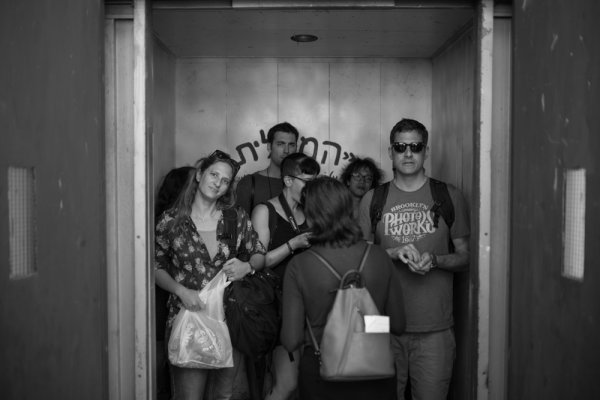
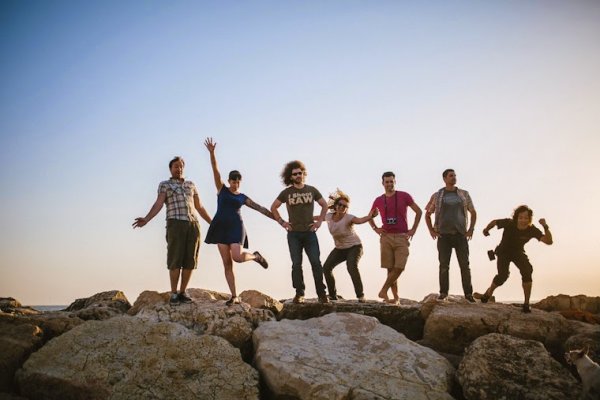
Six of us were on this tour of Israel, a tour to show what Israel has to offer to photographers, to show a different side to Israel compared with the one you might typically see in the news. The different styles and personalities of the six photographers on the tour made for a fantastically fun and inspirational few days.
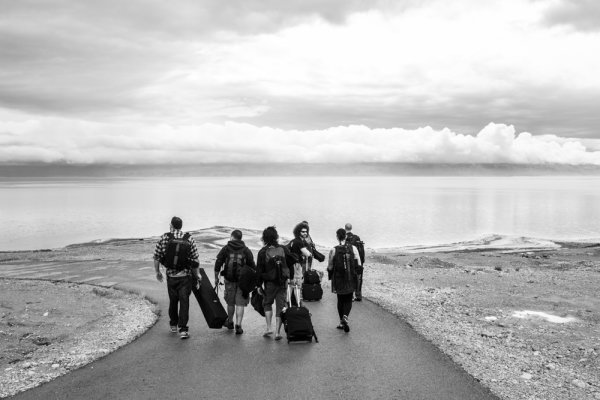
simon-pollock-melbourne-kinetis-tour-israel

Heading down to the Dead Sea with the crew

Travelling with the specific purpose of photography can be a daunting thing, especially with the ever present fear of having your precious camera gear gate checked when you’re about to embark your flight. Is my bag overweight? Will ground crew single me out? Do I look like I’m struggling with this bag? All of these things play through my mind on every flight I’m about to catch, sometimes even when I’m not travelling with a heavy bag! I’ve been very fortunate thus far to have not been stopped for a heavy, or overly large, camera bag at the gate and this trip was no different (although I did have my backpack sent through the Xray machine four times).

I was travelling with a MindShiftGear Panorama camera backpack, the beauty of the Panorama is that you can use both the belt section and the top insert section to put your gear – if you get stopped and asked to gate check your bag, you can pretty much break it down into sections and nine times out of ten you’ll get it through, onboard with your camera gear. The few basic pointers for trying to get you and your camera onboard that I quietly recite to myself every flight are:

  • Smile, but not so much that people think you’re up to something
  • Don’t carry your bag like it’s about to rip your arms off – if it is, you should perhaps rethink anyway
  • Have a plan to take your heaviest camera and heaviest lens out of your bag and hang it around your neck if asked to gate check due to weight – a camera, 99% of the time, will become a personal item and won’t be included in the bag weight
  • Be polite – ground crew have a job to do, so don’t go off at them, it won’t help – I promise you this
  • Insurance really is a good thing! (I’m insured with PPiB if you’re in Australia / were interested)

There’s a lot to be said for only packing what you’re going to need – will I need to take a 100mm macro lens to Israel? Will I use my 5.8mm fisheye? As it happens, I used both of those lenses and I’m glad I packed most of my gear, but I did use a two bag strategy/ Doug Murdoch, president of thinkTankPhoto camera bags writes about it on his blog, a quick interesting read. I had a small laptop bag with my Apple MacBook Air 13″, a WD My Passport Pro 2TB drive for content and all the cables, pens, paper, passports, tickets, etc. Then my camera backpack and my roller bag with my tripod, clothes and another flattened out camera shoulder bag (for short wanders down through markets where I didn’t want to take a backpack) and this combo proved to work really well for me.

So we’re packed, we’re flying, we’re there. I’ve been to Israel once before and was very excited to go back. Arriving into Tel Aviv quite late, then driven to Jerusalem to meet up with the others, we stayed at this great place called Abraham Hostel on the first night (if you’re travelling on a budget, it’s a great place to stay) before travelling across to the hotel we were all meeting at, Dan Boutique Hotel. Thankfully they were totally fine with us setting up Ben’s Broncolor and blasting away on the roof!
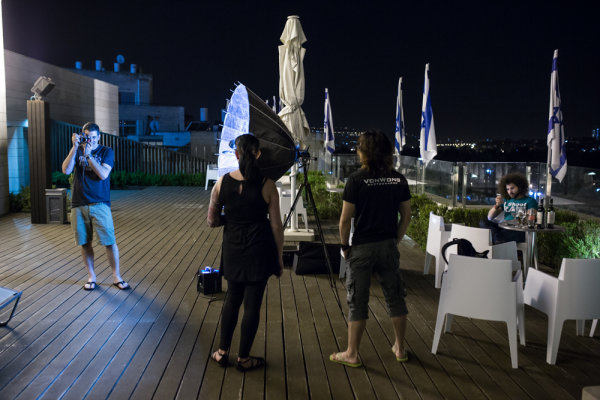
On the roof playing with light...

On the roof playing with light…

A quick introduction to the people on the tour: Adam Lerner, Mike Kelley, Rebecca Litchfield, Benjamin Von Wong, Jared Polin and Simon Pollock (me – Hi!). Mike isn’t in the photo above as he likes to go to bed at 8 p.m. every night hehe. The next day, after a tour of the old markets and surrounding area in the old city of Jerusalem, we headed for the Dead Sea, each of us with different ideas for what we wanted to do when we arrived there – fashion, portraits, landscape, it was set to be an epic adventure.
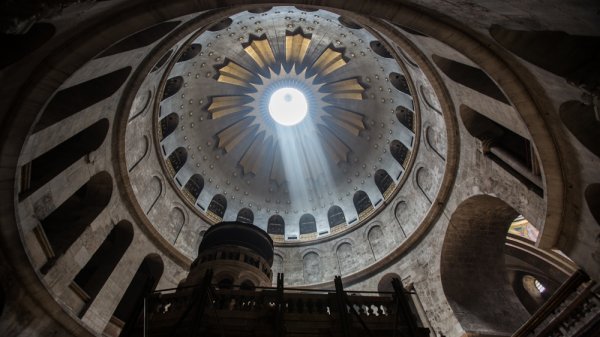
Church of the Holy Sepulchre at 16mm

Church of the Holy Sepulchre at 16mm

Arriving at Ein Gedi, the rain was starting to set in and with a call time of around 4 a.m., it was pretty much a quick dinner and directly to bed – poor Eyal had to put up with my snoring, sorry Eyal! The rain hadn’t stopped the next morning, and we were told that with the Dead Sea clouded in, it was something people rarely get to see. As it turned out, the road was washed away in a couple of places and we had a pretty hard time getting the models, stylists and hair and makeup folks into the area of the Dead Sea that we were using for the shoot – thanks to some handy local wrangling and a police vehicle, we were all set to go once the weather cleared, and clear it did. Here’s a setup shot and a few photographs from the shoot day at Ein Gedi.
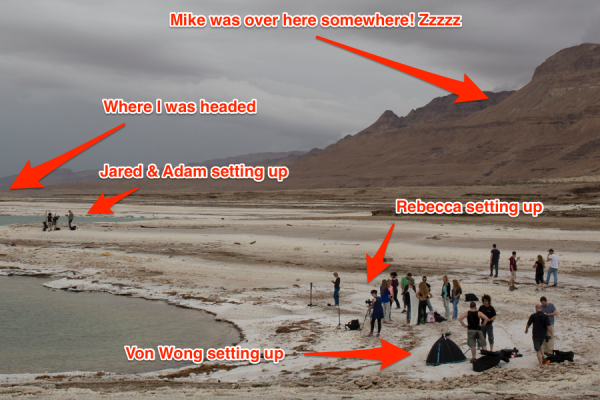
Dead-Sea-Kinetis-Israel-Tour-Simon-Pollock

To give you an idea of where we were…

I was very fortunate to essentially have my own personal guide from epic photo tour company, PhotoTeva which was fantastic as I’m certainly no landscape photographer, but had an amazing time taking in the amazing scenery unfolding before me.
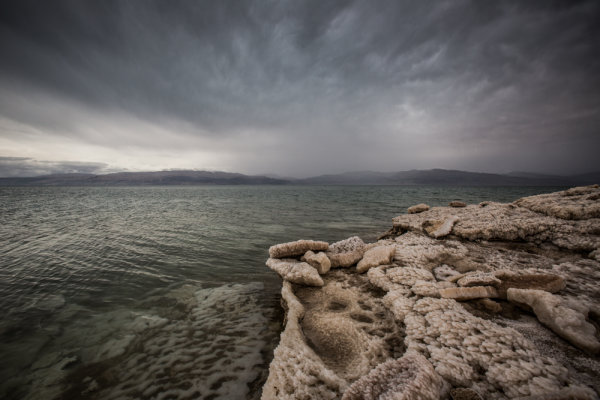
The-Dead-Sea-PhotoTeva-Simon-Pollock-Kinetis

The storm rolled through…

Protecting your gear and keeping it off the deck was pretty important. The water is ultra salty (1/3rd salt, someone was saying) and the ground we were on was all salt – very sharp salt (see, I used the macro lens).

dead-sea-salt-kinetis-simon-pollock-israel

The salty residue was super sharp and happy to cut you up!

dead-sea-salt-kinetis

Anything that didn’t move fast enough was essentially ‘salted’

We only had a day at the Dead Sea and were supposed to head out into the desert to stay together in a big tent. The weather had other ideas and we all piled in the super bus and headed back to Tel Aviv for an impromptu camp out on our new friend, Adi’s floor. A highlight of the trip – impromptu awesome. When you’re travelling on a holiday, and things don’t go to plan, you do your best to make the best of the situation that you’re placed in – this was certainly the case and we had a fantastic evening before checking in to The Diaghilev Live Art Boutique Hotel (which I highly recommend if you’re travelling to Tel Aviv).

The next couple of days were filled with amazing food, adventures and people – rather than bore you with my musings, I’ll tell this part of the adventure in photographs.

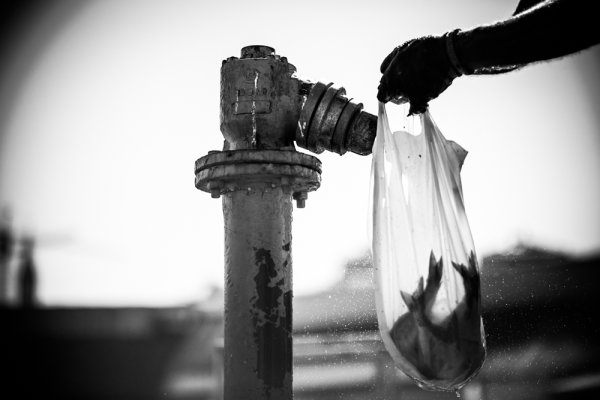
Jared, Adam and I visited a fish market where the fish come off the boats and are snapped up by people waiting on the dock.
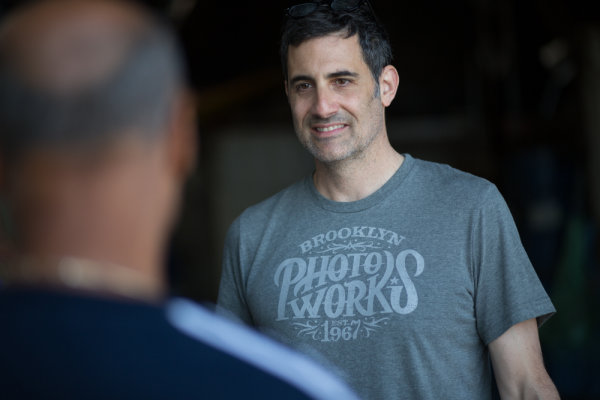
Adam Lerner, a portrait...

Adam Lerner, a portrait…

The fish market...

The fish market…

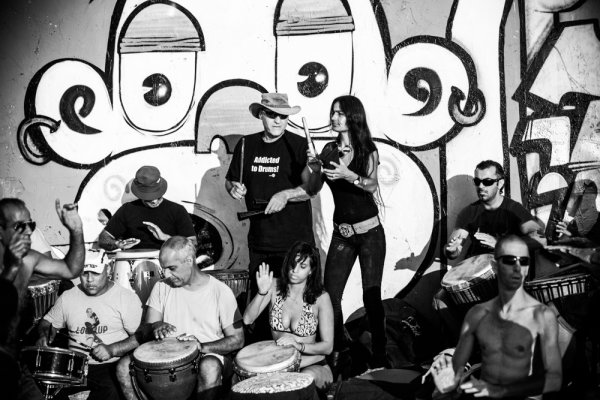
We managed a little beach time and happened across a great drum circle!
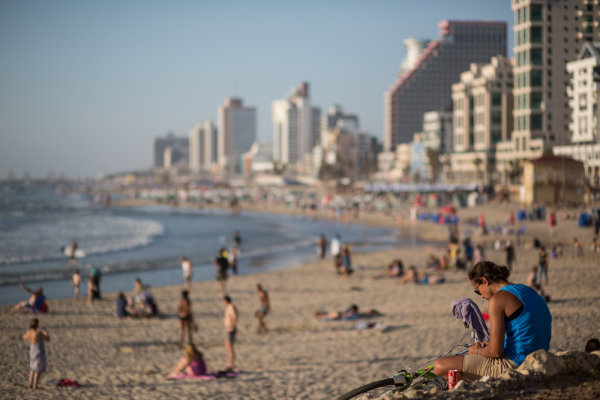
A Tel Aviv beach...

A Tel Aviv beach…

Addicted to drums...

Addicted to drums…

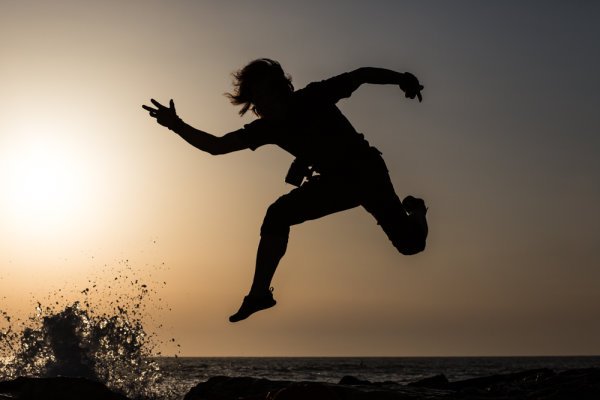
Von Wong takes flight...

Von Wong takes flight…

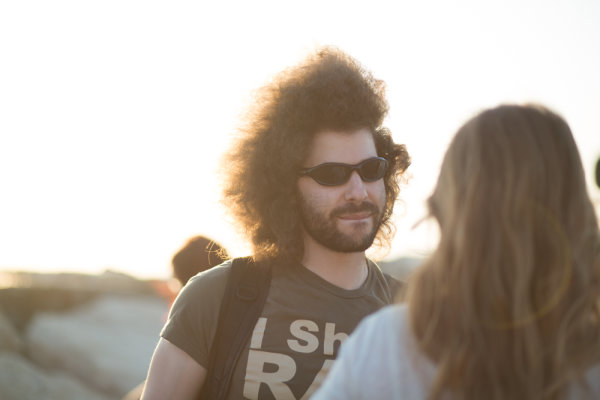
Fro Knows...

Fro Knows…

The fish market...

The fish market…

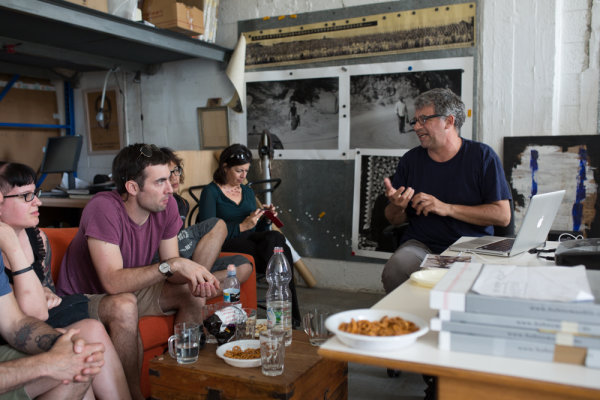
With only a day or two left to run, we had a load more to pack into our schedule, a visit to Israeli photojournalist and Canon Ambassador, Ziv Koren. We spent some time talking to Itzik Canetti, who has developed a nifty laser focus system for photographers, and we were hosted by Wix on our last evening, for drinks on the roof of their building – stunning.
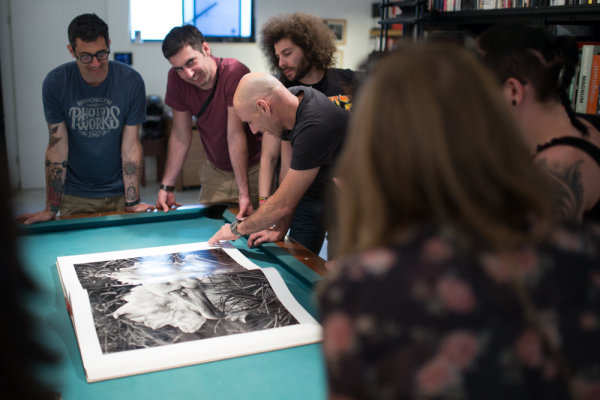
Simon-Pollock-Kinetis-Israel-Ziv-Koren

Simon-Pollock-Kinetis-Israel-Ziv-Koren

Simon-Pollock-Kinetis-Israel-Ziv-Koren

Simon-Pollock-Kinetis-Israel-Ziv-Koren

That was essentially the tour

kinetis-simon-pollock-israel-tour

The point of the photo tour was for us to see a different side of Israel, a creative and vibrant side – and that was exactly what we saw. Lots of tech startup, lots of art and culture, some great coffee and amazing food. If you’re thinking about going somewhere on a photo tour, I’d certainly put Israel on your list! Big thanks to Kinetis and the whole team that made this trip possible. You can learn more about the not for profit work that Kinetis do on their website.

The post A Different Kind of Photo Tour to Israel with Vibe Israel by Sime appeared first on Digital Photography School.


Digital Photography School
 
Comments Off on A Different Kind of Photo Tour to Israel with Vibe Israel

Posted in Photography


A Different Angle: 15 Great Geometric Home Accessories

19 May

[ By Steph in Design & Furniture & Decor. ]

Geometric Home Accessories Main

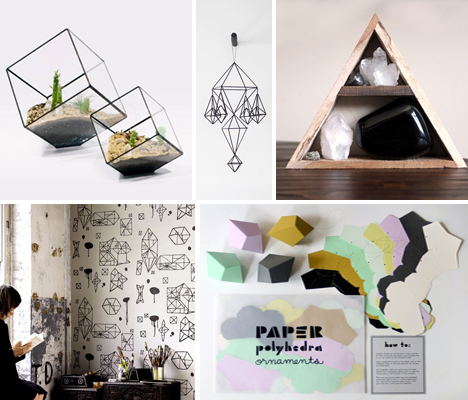
Bring the clean, graphic lines of cubes, pyramids, prisms and other polyhedrons to your home with these (often literally) sharp accessories. Hand-drawn shapes on wallpaper, icosahedron salt and pepper shakers, DIY origami ornaments, modernized Himmeli mobiles and diamond-shaped cookie cutters are among these 15 affordable geometric decorative objects.

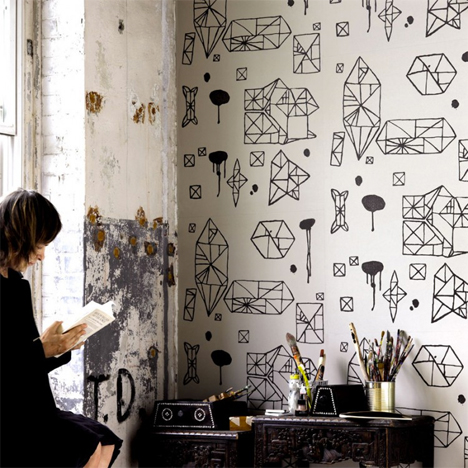
Random Geometry Wallpaper by Nama Rococo

Geometric Home Nama Rococo

The imperfect nature of hand-drawing adds a bit of a quirky feel to the ‘Random Geometry’ wallpaper by Nama Rococo. Plaster an entire room with it, create an accent wall or just frame a single sheet for $ 100.

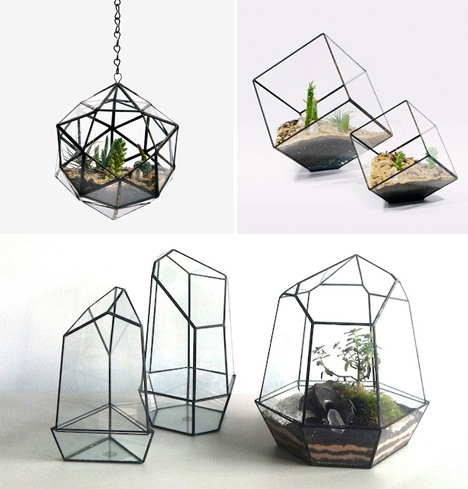
Score + Solder Terrariums & Planters

Geometric Home Score + Solder

Glassworker Matthew Cleland of Score + Solder creates stunning geometric terrariums, planters, lamps and more, handmade to order from his 13-acre farm in British Columbia.

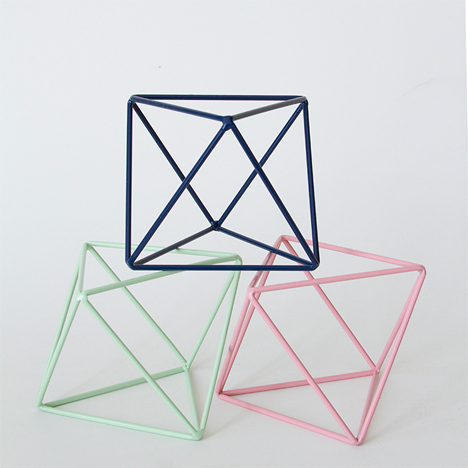
Octahedron Decorative Objects by Eric Trine

Geometric Home Octahedron Decor

Perfect for the mantle or as a conversation piece on the coffee table, this octahedron decorative object by Eric Trine costs just $ 32.

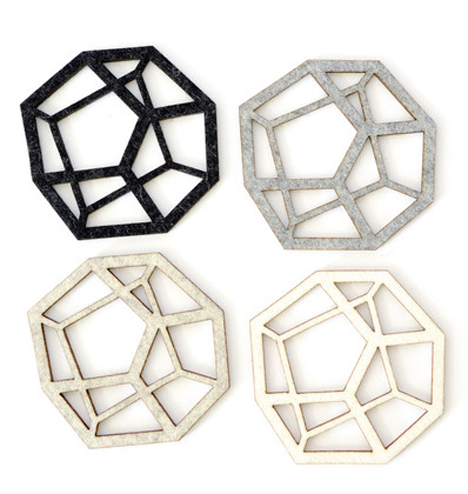
Pentahedron Coasters by Koromiko

Geometric Home Pentahedron Coasters

Protect your table from condensation with this set of four handmade felt pentahedron coasters, handmade in San Francisco by Koromiko, $ 40.

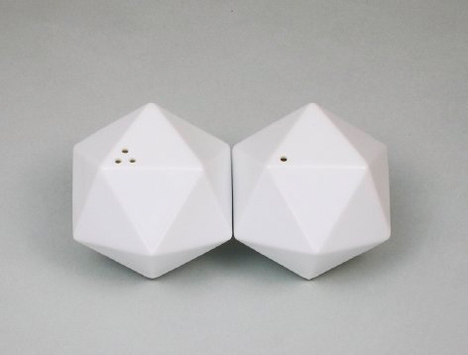
Icosa Salt & Pepper Shakers by Club88inc

Geometric Home Icosa Salt and Pepper

This set of icosahedron-shaped salt and pepper shakers by Club88inc, $ 35, will fit perfectly into the palm of your hand.

Next Page – Click Below to Read More:
A Different Angle 15 Great Geometric Home Accessories

Share on Facebook


[ By Steph in Design & Furniture & Decor. ]

[ WebUrbanist | Archives | Galleries | Privacy | TOS ]


WebUrbanist

 
Comments Off on A Different Angle: 15 Great Geometric Home Accessories

Posted in Creativity


Different Tripods for Different Subjects – Which to Choose?

14 Mar

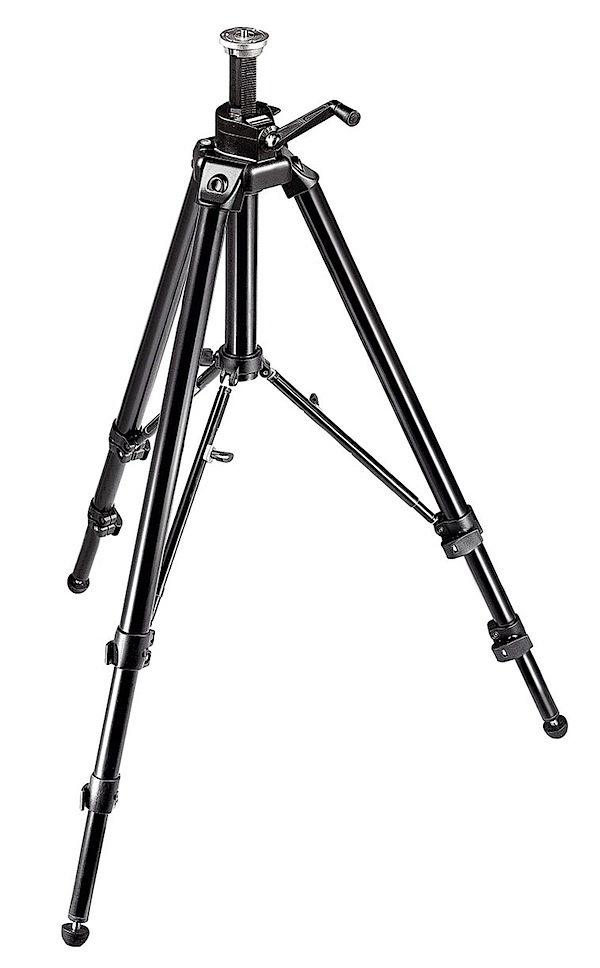
manfrotto-tripod.jpg

Tripods are always a fun topic of conversation but you might not think so because of their simplicity. In more circumstances than others, the tripod that you use really doesn’t make a big difference. The reason is because your tripod is designed to hold your camera and that’s it. But at the same time, different tripods include certain features that are beneficial for special situations.

In this article I will identify six different situations in which different tripod features come in extremely handy and can improve your photographs. These situations will go beyond the basic tripod usage of mounting the camera, adjusting height and angle. Let’s dive in, shall we?

Tripods for long exposure photography

When it comes to photographing long exposures a sturdy tripod is key. However, the most common tripods purchased these days are made of carbon fiber. The reason is due to the strength and light-weight properties of the material. Those two factors make carbon fiber desirable for any type of photography. However, with long exposures you need the tripod to stay still, and having a light tripod is not always the best.
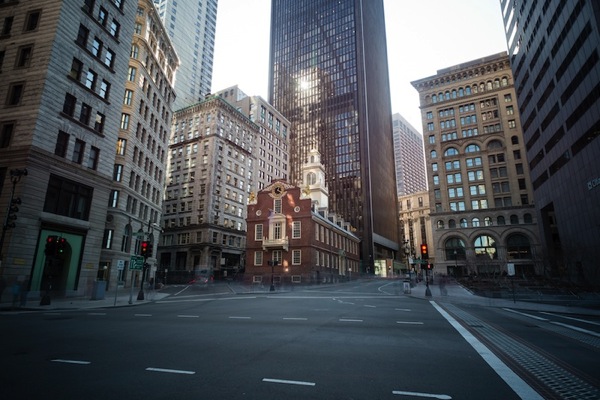
Tripod long exposure photography

Having a tripod that includes a hook under the head or at the bottom of the center column, allows you to hang a weight or bag, helping to steady the tripod even more. Higher quality tripods also include vibration dampening technology which can help reduce shake. Lastly, a tripod that has the ability to attach spikes to the bottom of the feet can be very useful when photographing in dirt, sand or in the ocean.

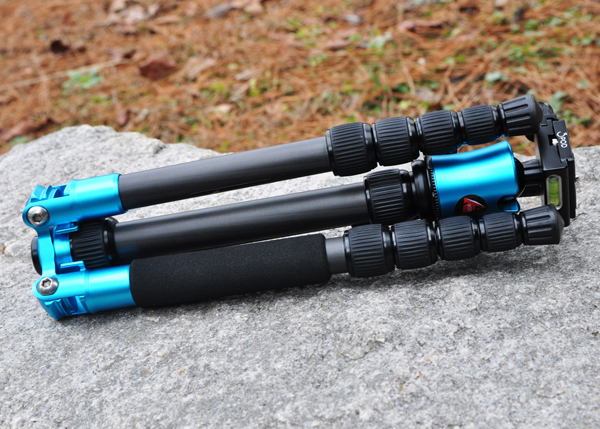
The P5CRH folds up to approximately 12 inches.

The P5CRH – folding tripod

Tripods for panoramic photography

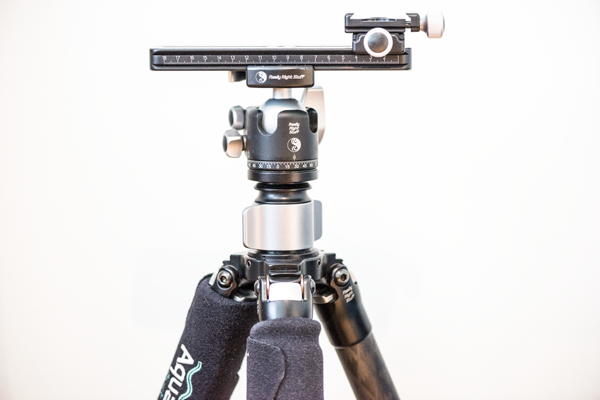
The weight of your tripod does not matter so much with panoramic photography, unless of course you are photographing long exposure panos. There are two tripod components that can really help improve panoramic photographs. The first feature is a leveling plate or base. With it, you can have your tripod in any angle and level the camera separately from the rest of the tripod. That will ensure the smoothest transition between frames. The other feature is a nodal slide, which will help bring the lens closer to the pivoting point of the tripod instead of the camera body. Having the lens nodal point in the correct spot will ensure minimal distortion between frames.

For advanced panoramic photographers, a gimbal head might be the ideal choice for a mounting system.

Tripod panorama

Tripods for headshot photography

Headshot photography is very different than other portrait photography. That might sound strange, but it’s true. With your typical portrait photographs you are likely moving around too much to use a tripod. However, with headshot photography the client is typically standing or sitting in one spot and moving only slightly. You, the photographer, are not moving so much.

At the same time, you are moving enough that you need fluid movements with your tripod, and the ability to let go without the camera changing positions on you. So when it comes to photography headshots be sure to use a ball head on your tripod rather than any other. It will make the process so much better for you. I highly recommend viewing one of Peter Hurley’s headshot videos and how he uses his tripod with a Hasselblad, which is a fairly heavy camera.

Tripods for product photography

Product photography is studio photography where the subject doesn’t move. When you are in the studio photographing product stills your camera is typically in one spot the entire time, with only minor adjustments. Quite often you will be tethered to a laptop, and there are plenty of tripod accessories to attach a camera and laptop at the same time. But oddly enough many product photographers utilize camera stands rather than tripods. They’re the same principal as a tripod except their extremely heavy, and have fine tuning adjustments for height, angle and length of reach. They are also on wheels for portability around the studio. Due to the heavy-duty structure of camera stands, attaching a laptop is very easy and safe.

Tripod product photography

Camera stands are expensive though, typically over $ 1,000, so they are not for everyone. If you’re not willing to dish out that much money in one shot, then my recommendation is a heavier steel tripod. Because you’re not moving them great distances, they are perfect for staying in one place. The weight of these heavy-duty tripods means they can hold heavier cameras, and if you want to attach a laptop mount as well you can feel comfortable it will hold both products safely. Also, for product photography a ball head is not the best choice. Instead, a positioning head like the Induro PHQ-3 would be ideal.

Tripods for wildlife photography

Paul Burwell talked about tripods for wildlife photography previously, so definitely give it a read. Typically a sturdy carbon fiber tripod will do perfectly fine for this type of photography. Gimbal heads can be a wildlife photographer’s best friend in addition to LensCoats (yes, the camo covers). If you cannot afford a Gimbal head, stick with a ball head so you can stay sturdy and adjust your view in smooth motions.

For some wildlife photographers, safari clamps (like the ones from Really Right Stuff) can be extremely useful, especially if you are taking a tour through Africa and have to shoot from a truck.

Tripods for photowalks and travel photography

I combined these two into one, because they’re extremely similar. Even if you are not traveling far for a photowalk, the principal is the same. Basically with any type of travel or photowalk you want to carry a tripod that is light and convenient. I personally have a Really Right Stuff tripod that’s made of carbon fiber. It’s extremely tall, but also light. In fact, it is as light as my compact 3 Legged Thing tripod.

So although the 3LT tripod is perfect for fitting into small places, like a camera bag, the Really Right Stuff doesn’t add weight, is much sturdier and extends much higher.

Tripod street photography

In Conclusion

In this article I shared six reasons why the tripod you use matters, and the differences between them. Although there are specific things to look for in a tripod depending on what you are photographing, it also doesn’t matter.

As long as you know your gear, understand how to use it to the best of its ability and your ability, then you’re fine. Use what you are comfortable with because having a tripod for many situations is better than not having a tripod.

Before wrapping up this article I want to share some other useful articles here on dPS. Be sure to read How to Buy a Tripod, How to use Your Tripod and Steady On.

If you have any additional comments to add please do so on the comments.

The post Different Tripods for Different Subjects – Which to Choose? by Scott Wyden Kivowitz appeared first on Digital Photography School.


Digital Photography School
 
Comments Off on Different Tripods for Different Subjects – Which to Choose?

Posted in Photography


Get Your Creative Juices Flowing with Different Focal Lengths

22 Dec

Get Your Creative Juices Flowing with Different Focal Lengths

Eckert Creative Juices Focal Length 01

14mm lens

I’ve gone through periods of low creativity in my photographic journey. Times when I don’t have compelling ideas or nothing seems new. When the excuses why not to go takes pictures (“It’s too cold, it’s too hot, the light isn’t right, it’s too cloudy, it’s not cloud enough”) manage to outweigh my need to photograph, and I go into an unproductive slump. It can be hard to break out of these slumps, but there are lots of ways to get the spark back including everything from: getting on dPS to read articles; to looking at galleries of other photographers’ images online for inspiration; to choosing a slightly different route or time to work, in order to see the world in a different way.

In this article I’m going to touch on just one of those “creativity sparks”, specifically, getting creative with focal length, even the point of breaking the “rules.”

Before I get to the meat of the article, please note I’m not saying you have to go spend thousands of dollars on new lenses. If you can afford to, want to, and need to, then by all means do so – new gear is one more method of lighting the creativity fire in your soul again. Instead, however, I’m suggesting you work on finding new ways to shoot with the gear – the lenses – you already have.

Eckert Creative Juices Focal Length 02

100mm lens

The “Rules”

When it comes to lenses, most new photographers learn the typical applications of different focal lengths pretty quickly. Here are a few examples of what I learned, when I was first teaching myself this complicated art, about how different focal lengths *should* be used (Note: all focal lengths list here refer to 35mm full-frame format):

  • 10-14mm: distorted fisheye, not really for ‘serious’ photography
  • 14-24mm: landscapes, seascapes, waterfalls, starlight and astrophotography
  • 24-35mm: street and architecture photography
  • 35mm-58mm: “normal” and most closely approximates our natural view of the world, useful for portraits and still life photography, etc.
  • 85mm: the classic, flattering portrait length lens
  • 90-105mm: the province of macro lenses (close ups)
  • 135mm: the other classic portrait length
  • 200mm: the other, other classic portrait length also getting useful for nature and sports telephoto shots
  • 200-500mm: sports, wildlife and birds
  • 500-800mm: for wealthy and/or partially crazy Antarctic nature photographers who want close-ups of polar bears

Are there problems with the above gross simplifications? Sure, tons! Even novice photographers will understand the above list is just a shorthand, a way of reducing a radically complicated subject into more easily digestible chunks. More experienced photographers will be able to name a dozen exceptions to the list above. But, that’s also where the fun – the creativity spark – can begin: in the exceptions, in shattering of rules.

Eckert Creative Juices Focal Length 03

14mm lens

Breaking the “Rules”

I’m going to re-write the list from above, presenting just a few alternative ideas. This is also hardly a comprehensive list; instead, I’m trying to get your creative juices flowing with regard to what you can do with those different focal lengths, how you can go about breaking the rules and producing something new, unusual and outside the expectations.

  • 10-14mm: still life, product shots, cityscapes, purposefully distorted architecture, sports, hiking
  • 14-24mm: pet portraits, street shots, extreme close-ups (thanks to the design of many ultra-wide angle lenses you can actually get really close to the subject, and, thanks to the wide angle, still show a lot of the surroundings), flowing architecture, cloudscapes
  • 24-35mm: babies, landscapes, cityscapes, portraits
  • 35-58mm: anything anti-“normal” with these “normal” lenses – get close, get far, turn the camera, close down to f/16 even with your expensive 50mm f/1.4 because it’s different, because it makes you think
  • 85mm: landscapes (start to pick out specific areas to focus the viewer’s attention), cityscapes (ditto), architecture (same again), still life, street scenes
  • 90-105mm: more of what I offered for the 85mm; just because you have a macro doesn’t mean it won’t happen to make a great landscape lens (e.g. the Zeiss 100mm f/2 Makro Planar) or a great portrait lens (e.g. Nikon 105mm f/2.8 VR)
  • 135mm: street scenes where you really separate a subject or object from the crowd; detail shots of antique or expensive cars; clouds (picking out the special parts to focus on), light trails, long-exposure shots of the sea (at 135mm? Crazy talk! But that’s the idea!)
  • 200mm: waterfalls, mountains, sunsets and sunrises, fog in the trees, autumn leaves on the long roadway, the shadows cast by that old oak tree on the fence in the neighbour’s yard
  • 200-500mm: rolling plains and wide open vistas; sections of the Grand Canyon at sunset; night life in the city, your pets
  • 500-800mm: polar bears

Just kidding on that last one. I think you get the general idea, though: take the stereotypical, “classic” uses of any given focal length, and turn those ideas on their head. Have a go at something you’d never thought would work for that lens. You might be shocked by what you come up with, and if nothing else it will get your conscious and subconscious mind churning and that creative flame burning.

Eckert Creative Juices Focal Length 04

35mm lens

The “You Should Never” Rules

These are one step beyond the regular rules. You’ll find these on Flickr sometimes, as well as other online photo communities, where someone will passionately argue that a given photo (or set of photos) is utter garbage because the photographers in question “misused” their lenses and “you should never do” whatever it is that they did.

For example: “You should never take a portrait with a fisheye lens.”

This might even seem reasonable at first glance – after all, fisheye lenses are defined by their hefty distortion that is not generally considered a good look by most models. But here’s the thing: as long as you are using your lens on your camera to take a photo, you aren’t “misusing” it. Especially if you are experimenting and learning new ways of seeing the world, and stoking that creative fire a bit.

You can take a portrait with a fisheye lens. I guarantee it. And a good portrait, no less. It might be harder, more challenging than firing away with that 85mm, but that’s the point: it’s new, it’s different, it’s outside the norm and it’s outside of the rut in which you can sometimes find yourself.

lenses-wide-angle-portrait

17mm lens – Image by Darlene Hildebrandt

So, if you are in that creative rut, search out the “You should never rules” online, and then do whatever it is “they” say you should never do. Within the bounds of the law, of course!

One Last Idea

I’ll end here with one last idea to make creative sparks out of focal length – check out some popular or famous photographs, consider what focal length the photographer used and why, and then think about – and experiment with – how that photograph would have turned out differently with another focal length.

I’m sure there are many other ideas to spark creativity, please post your thoughts in the comments below, and help us all spark our creative fires.

Eckert Creative Juices Focal Length 05

105mm lens

500px can be a great site for inspiration. Check out the “Popular” or “Editor’s Choice” streams for the latest and greatest to find some photographs you love, and then investigate. Often the focal length is included in the photo’s information so you don’t even have to guess what they used. Think: why did the photographer pick that focal length? Ask yourself; “What if I used the extreme opposite in that exact situation?”.

Then, of course, go out and take some pictures!

Remember, it’s the experimentation and thought process behind it that is worth the effort, even if none of your photos that break the focal-length “rules” end up working out. It will get the creative juices flowing and that’s the goal.

Eckert Creative Juices Focal Length 06

14mm lens

The post Get Your Creative Juices Flowing with Different Focal Lengths by Joseph Eckert appeared first on Digital Photography School.


Digital Photography School
 
Comments Off on Get Your Creative Juices Flowing with Different Focal Lengths

Posted in Photography


A different point of view: Our Panasonic Lumix DMC-GX7 Review

07 Nov

gx7.jpg

We’ve just posted our full review of the Panasonic Lumix DMC-GX7. With a 16 megapixel Four Thirds sensor, in-body image stabilization, and built-in articulated EVF, the GX7 boasts a lot of refinements to tempt enthusiasts away from similar Olympus and Sony offerings. Panasonic engineers have thrown just about everything they’ve got into this mid-range mirrorless camera, will it find a loyal audience the way its GF1 predecessor did? Click through and read our review.

News: Digital Photography Review (dpreview.com)

 
Comments Off on A different point of view: Our Panasonic Lumix DMC-GX7 Review

Posted in Uncategorized


22 September, 2013 – A Different Kind Of Backpack

22 Sep

Mark Dubovoy, Luminous-Landscape’s Editor At Large shares his article,  A Diiferent Kind Of Backpack, The RPT P3 

Michael Reichmann’s final installment of the Olympus OM-D E-M! Field Report From Paris is now Available Here


"Having been to Antarctica with Michael and Kevin, I would say after having traveled the world and shot nearly my entire life as an exhibiting photographer,  it was one of my highlights in my life and I talk about it, all the time.  The images and experience of seeing something visionary and nearly extinct from the world, to see and experience the wildlife and scenery that does not fear humans is amazing.  The images I shot there won me two Smithsonian awards and nearly 18 other international awards". – Tim Wolcott

 Find Out More Now
These Expeditions Will Sell Out Quickly. They Always Do


The Luminous Landscape – What’s New

 
Comments Off on 22 September, 2013 – A Different Kind Of Backpack

Posted in News


The same but different: Nikon announces Coolpix P7800 with EVF

05 Sep

P7800_front_on_DB.png

Nikon has announced the Coolpix P7800, which sits at the top of its compact camera lineup, replacing last year’s P7700 as flagship zoom camera. The P7800 is extremely similar to its nominal predecessor, the most notable change being the addition of an electronic viewfinder. Other specifications are more or less unchanged. The camera is built around a 28-200mm (equivalent) F2-4 zoom lens, and features a fully-articulating rear LCD screen, and plenty of manual control and exposure options, at an expected MSRP of $ 549.99. Click through for pictures and Nikon’s press release.

News: Digital Photography Review (dpreview.com)

 
Comments Off on The same but different: Nikon announces Coolpix P7800 with EVF

Posted in Uncategorized


Posing Guide for Photographing Women: 7 More Poses to Get You 21 Different Photos [Part III]

20 Jul

A post by Kaspars Grinvalds from Posing App.

This is the third article in the series. You may want to look at the previous ones here: 7 standing poses [Part I] and 7 sitting poses [Part II].

Let’s move on with 7 lying down poses for women. And again I’ll briefly try to describe the process, how I tried to slightly adjust these poses in order to get three different photos for each pose.

Pose 1

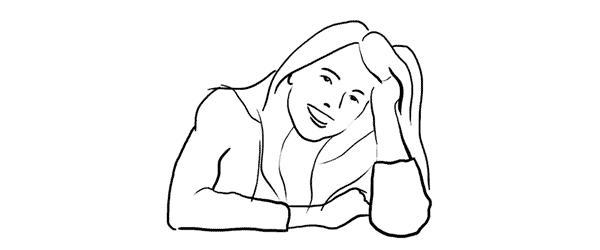
Pose1

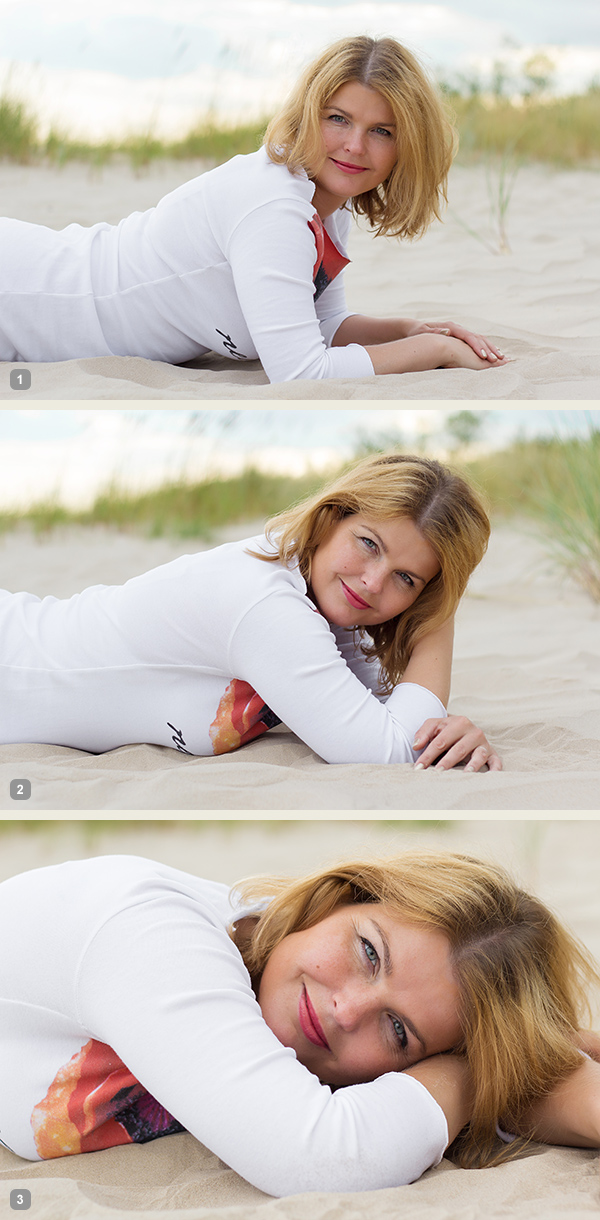
Very simple pose to start with. After getting the model into initial position, ask her to raise the upper body as high as she comfortably can.

7poses3 1

Photo 1: The first picture is the result of recreating this simple pose. Notice that you should shoot from very low angle, nearly from the ground level.

Photo 2: With such a basic pose as this one, you always have different options to variate – different hand placements, head tilts, eye directions and face expressions. In this shot the only difference is hand placement and slightly lowered upper body.

Photo 3: And I continued by asking the model to lower down even more. Notice that tighter crop is also a nice option to differentiate your shots.

Pose 2

Pose2

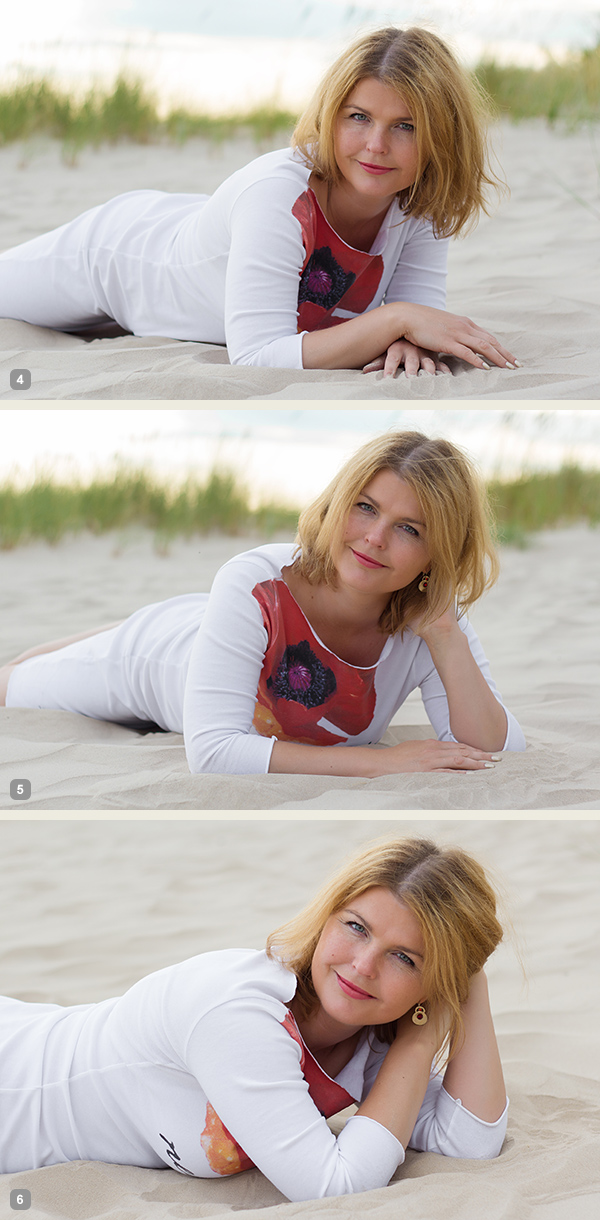
Very similar pose as the first one, but this angle is better for including longer model’s body line in the frame. And notice that one of the model’s legs is bent in the knee. This helps to raise her bum up for a better looking body shape.

7poses3 2

Photo 4: If you compare this shot with the first one, you will notice that it is nearly the same pose, but the changed angle gives different look to the image.

Photo 5: And again I continued with different hand placement. Note that hand doesn’t support the head, it actually doesn’t support anything, it’s just placed in the hair.

Photo 6: And one more hand placement variation and tighter cropping.

Pose 3

Pose3

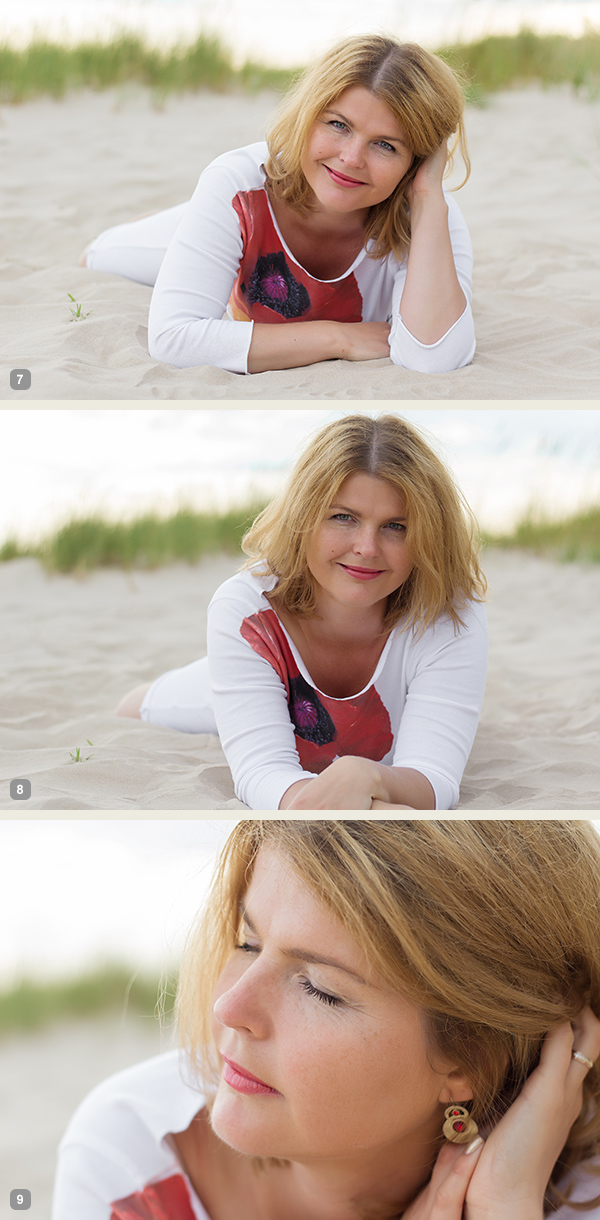
Another very similar pose to the previous ones, the main difference again is the shooting angle – right from the front. At this point the model hasn’t even moved from the initial position, it’s the photographer who moves gradually around her.

7poses3 3

Photo 7: Here the model already started to repeat the gestures from earlier shots. Don’t be afraid to take these nearly similar poses as these minor variations might be invaluable when selecting the final choice of images in post production.

Photo 8: The variations with both hands stretched in front.

Photo 9: And close-up crop again, but this time with the eyes closed.

Pose 4

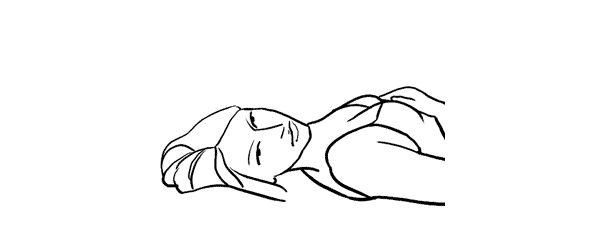
Pose4

We continued with the next easy and straightforward lying down pose.

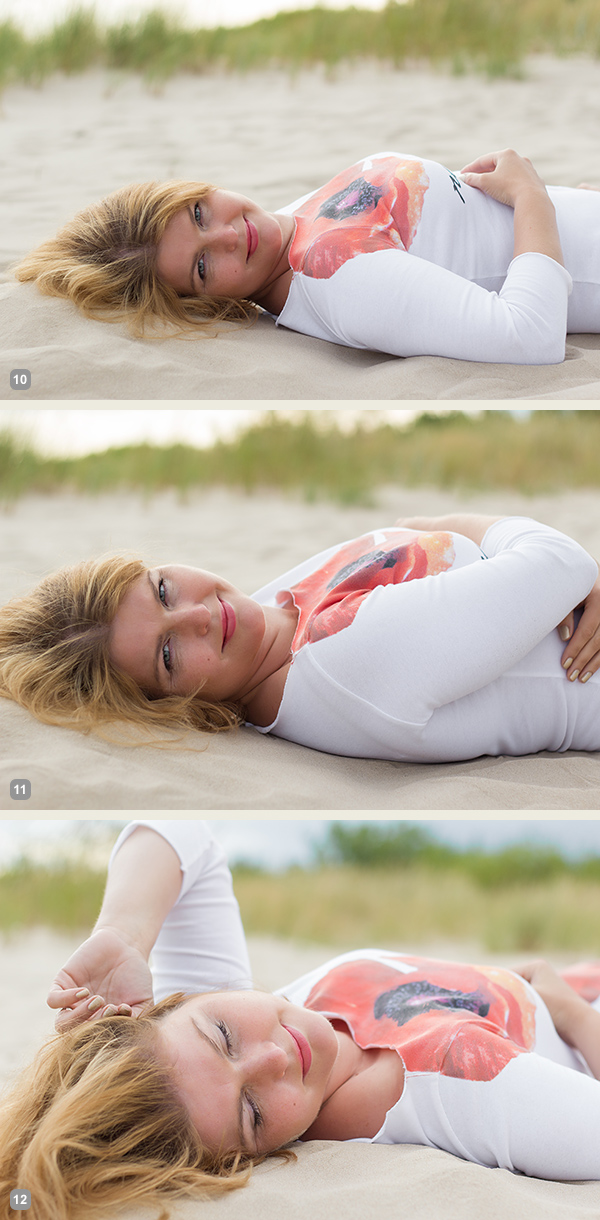
7poses3 4

Photo 10: An easy to describe and really easy to execute pose.

Photo 11: Again, only couple of options to change here. Arms could be connected under the breast line as in this example. The arms could also be stretched back behind the head for another variation.

Photo 12: And in this photo the model tried to achieve kind of dreamy look with eyes closed and hands placed asymmetrically.

Pose 5

Pose5

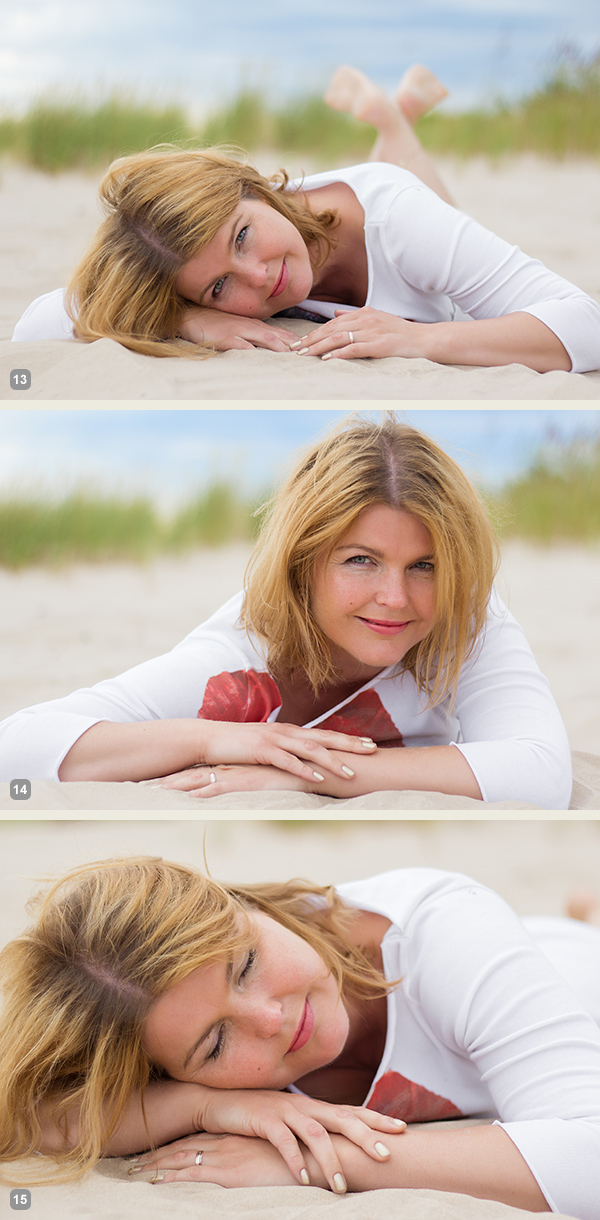
Lying down very low. Works very good as well for close-up portrait shots.

7poses3 5

Photo 13: As my model was lying on the sandy beach, I asked her to support the head on the hand, but in other settings the head might as well touch the ground.

Photo 14: Here I asked the model to raise the head higher and keep the hands placed asymmetrically.

Photo 15: And the next variation was sleeping pose with eyes closed.

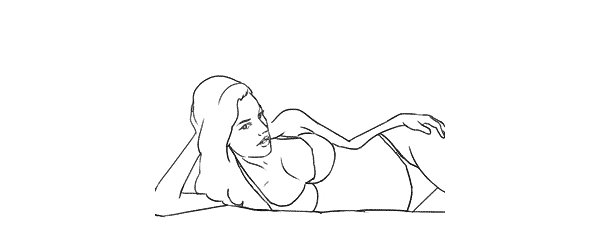
Pose 6

Pose6

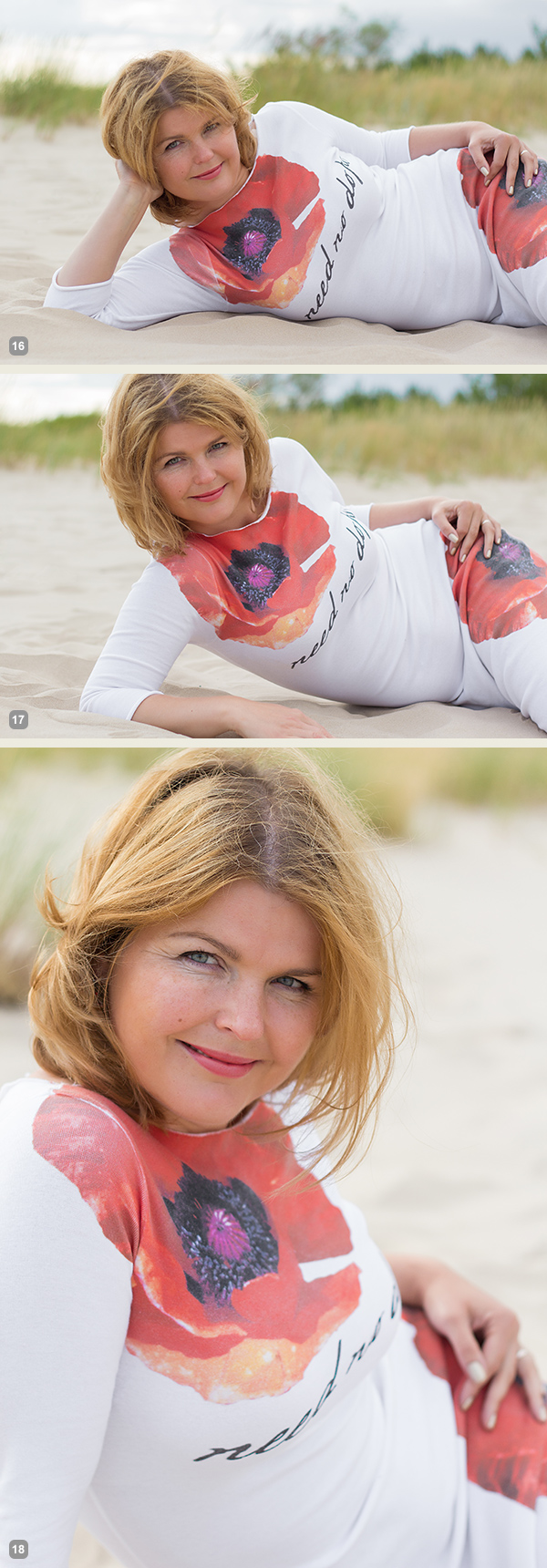
Lying down on the side. Couple of points to check. The left leg is crossed over the right. The left arm is rested on the hip and partly hidden behind the body. The right hand is placed under the head but it supports it with only the tips of the fingers. If the model’s head would be fully supported by the hand the pose would just indicate tiredness.

7poses3 6

Photo 16: Following the previously described instructions, the model easily recreated the sample pose.

Photo 17: Here basically only the right hand’s placement is different. And placing it down on the ground instantly raises her upper body higher.

Photo 18: From there she straightened the supporting hand and raised the body even more higher.

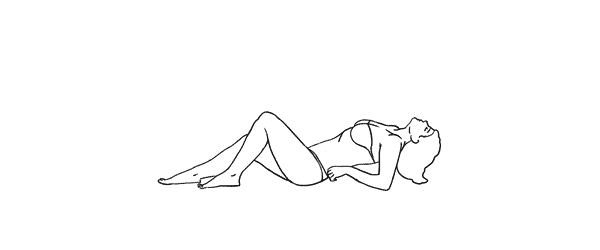
Pose 7

Pose7

And finally a bit more demanding pose. The biggest challenge for the model is to keep an air of relaxation. Ask her to fold her head back as far as possible while slightly facing it to the camera. And this posture for sure works best with eyes closed.

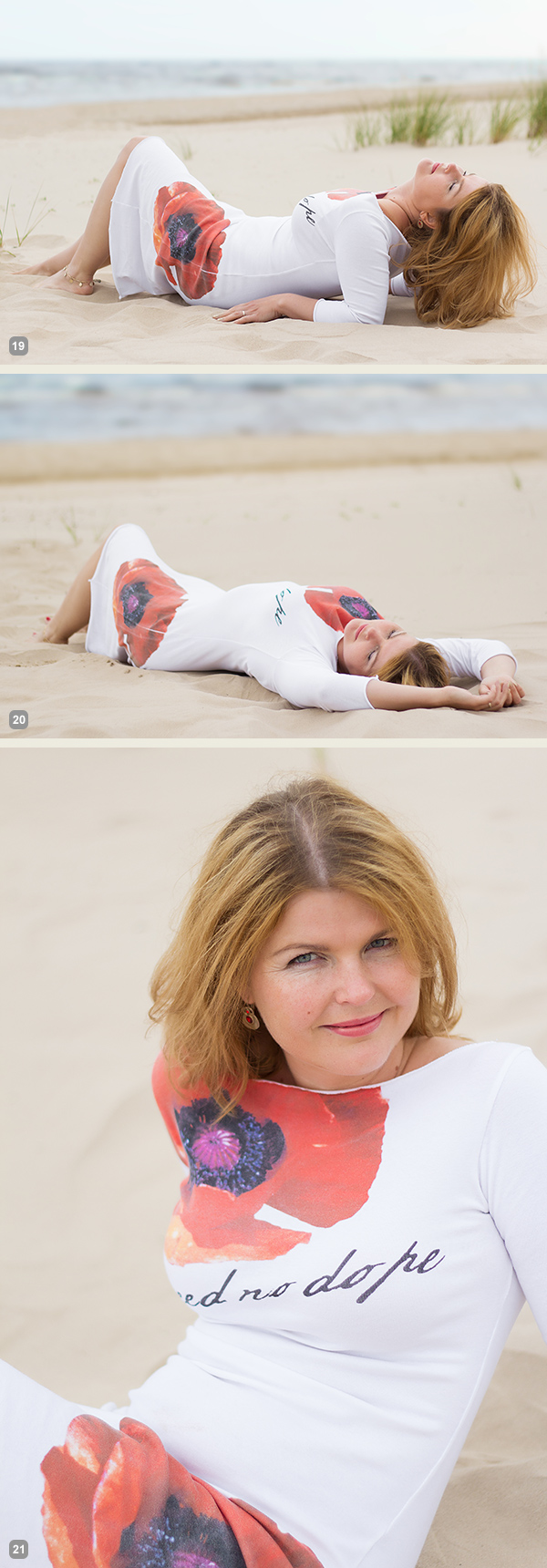
7poses3 7

Photo 19: If the model can manage to look relaxed, the results will be rewarding.

Photo 20: This pose is a nice variation to the previous one as it’s far more simple for the model to recreate.

Photo 21: And here I asked the model to raise higher up and took the shot from above.

So, together with the previous articles – 7 standing poses [Part I] and 7 sitting poses [Part II] – you now have lots of poses to choose from. For more variation and a more dynamic result I would suggest to choose a few from each article and mix them in a single shoot. You will very soon discover that even a small number of starting poses is more than enough to have a great, productive session.

All of these illustrations and many more posing samples are available on Posing App for your mobile devices.

Kaspars Grinvalds is a photographer working and living in Riga, Latvia. He is the author of Posing App where more poses and tips about people photography are available.

Post originally from: Digital Photography Tips.

Check out our more Photography Tips at Photography Tips for Beginners, Portrait Photography Tips and Wedding Photography Tips.

Posing Guide for Photographing Women: 7 More Poses to Get You 21 Different Photos [Part III]


Digital Photography School
 
Comments Off on Posing Guide for Photographing Women: 7 More Poses to Get You 21 Different Photos [Part III]

Posted in Photography