RSS
 

Posts Tagged ‘designed’

Stacked: Cleverly Designed Chinese Hotel Gives Everyone a Unique View

04 May

[ By SA Rogers in Boutique & Art Hotels & Travel. ]

Despite sharing a tiny footprint of land with other guests at this Chinese hotel, you can practically forget anyone else exists altogether thanks to a clever stacked arrangement that points each level in a different direction. Step out onto your private balcony – located on the roof of the room below – and look out onto the peaceful forest of rural Huang Shan, Anhui Province, China. Designed by Shanghai-based architecture firm Bengo Studio, the Qinyushan Tree House is a beautiful use of space.

A spiral staircase runs up through the center of the hotel, which includes two guest rooms, two bathrooms, one living room, and a ‘landscape room’ located at the top of the building. Each room has its own roof access with a glass railing to avoid interrupting views of the trees.

Elevated off the forest floor, the hotel features curvy volumes fanning out in different directions from the central core, capped on each cantilevered end by floor-to-ceiling windows. Guests ascend an enclosed glass hallway to either walk down into the lowest bedroom and bathroom, or ascend to the upper levels.

Its vertical wooden cladding helps it blend into its natural environment, and the minimalist design is an interesting take on modern treehouse-inspired structures.

Share on Facebook


[ By SA Rogers in Boutique & Art Hotels & Travel. ]

[ WebUrbanist | Archives | Galleries | Privacy | TOS ]


WebUrbanist

 
Comments Off on Stacked: Cleverly Designed Chinese Hotel Gives Everyone a Unique View

Posted in Creativity


Harbortronics’ DigiSnap Pro is designed for long-term time-lapse photography

28 Apr

Harbortronics has announced DigiSnap Pro, its new low-power complete system controller for long-term time-lapse photography. The controller supports both networked and autonomous operation and can be used with the company’s Cyclapse Pro, a time-lapse photography system that includes a camera housing and solar panel for use in locations where AC power is unavailable. 

According to Harbortronics, the DigiSnap Pro controller can be used with ‘practically any modern high quality digital camera,’ which is said to include medium format models, mirrorless, and full-frame SLRs. When used with the Cyclapse Classic systems, the company says DigiSnap Pro replaces both the Cyclapse Power Module and the DigiSnap 2700, and that all the cables support the DigiSnap Pro. The new controller can be remotely configured using the company’s Android app and Bluetooth LE, and a network remote configuration option is being developed. 

DigiSnap Pro itself offers all the functions one would typically need for long-term time-lapse photography, according to the company, including power management, automated image transfer and local data storage, and monitoring the system for issues. Status emails are sent when a problem is detected, including issues with the housing door, camera failure, low battery, temperature issues, and more.

Articles: Digital Photography Review (dpreview.com)

 
Comments Off on Harbortronics’ DigiSnap Pro is designed for long-term time-lapse photography

Posted in Uncategorized


Guitar for Modern Nomads: This Digital Instrument is Designed to Travel

18 Apr

[ By SA Rogers in Gadgets & Geekery & Technology. ]

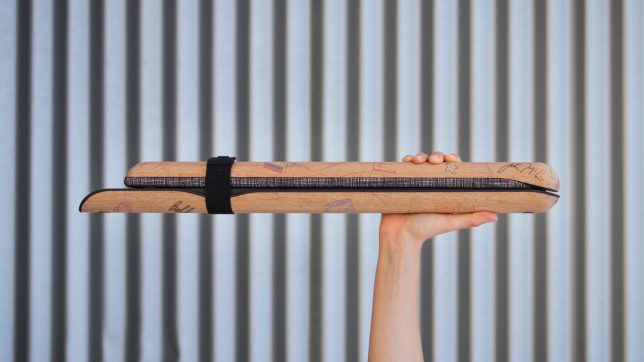
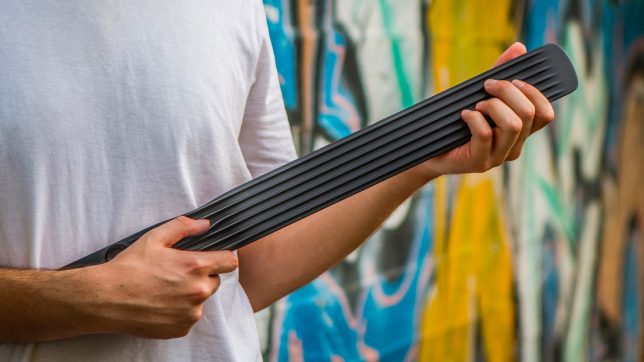
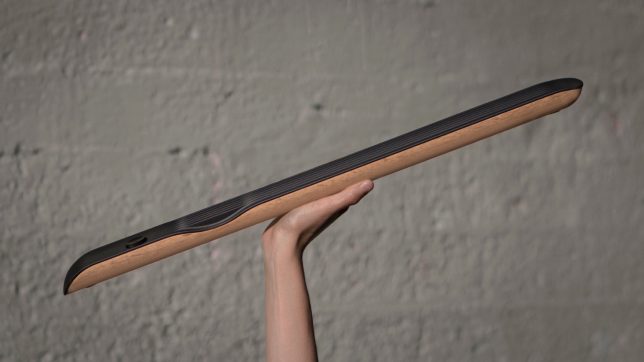
What if you were to eliminate the unwieldy parts of a guitar but maintain its resonant sound and the same exact way of playing, in order to make the instrument are more convenient traveling companion? It might sound ridiculous or downright impossible, but that’s exactly what designer Orit Dolev has done with NOMAD, a compact digital instrument with pressure-sensitive frets and flexible rubber strings to replicate the traditional guitar playing experience.

Dolev came up with the idea for NOMAD after taking a long journey through Asia and South America, where she imagined her guitar would offer a handy and powerful way to make new connections across language barriers. She quickly learned that getting around would be frustrating, noting that she couldn’t just shove it into her backpack, and the strings were constantly breaking and getting out of tune.

Designed to encourage mobility, the NOMAD features a wooden neck for a familiar feel in your hands. It pairs up with an app to play a wide variety of sounds, and you can turn the frets on and off to switch between acoustic and electric guitar modes or even to entirely different string instruments, like sitars. Hook it up to headphones so you can play on train rides or in hotels without disturbing anyone, or play through the accompanying portable amp, which doubles as a case cover.

“Technology is constantly changing the way we are living,” says Dolev. “Powerful mobile devices and widespread connectivity are serving as fertile ground for a new generation of nomads. From urban work-from-anywhere lifestyle to digital nomads roaming the globe freely, new cultural movements are rising. We are more mindful of the objects we surround ourselves with, striving to travel light and collect experiences more than things. Own less, explore more.”

Share on Facebook


[ By SA Rogers in Gadgets & Geekery & Technology. ]

[ WebUrbanist | Archives | Galleries | Privacy | TOS ]

WebUrbanist

 
Comments Off on Guitar for Modern Nomads: This Digital Instrument is Designed to Travel

Posted in Creativity


This CMOS sensor with 3D-printed microlenses is designed to mimic predator vision

23 Feb

A research team at the University of Stuttgart, Germany has proposed utlizing a 3D printer with ultra-short pulse laser-technology to print multi-component microlenses directly onto the surface of a CMOS image sensor. Doing so would create a ‘foveated’ imaging system: one with greater resolving power in the center, similar to the vision of predators in the animal kingdom.

In the research project, lens groups consisting of one of four types of tiny doublet lenses were printed directly onto the chip, after some functional layers like the existing microlenses and the color filters had been scratched off. The individual lenses come with 35mm equivalent focal lengths of 31, 38, 60 and 123mm which together give the system a field of view of approximately 70 degrees but with extra resolution at the center.

The footprint of the optics on the sensor is less than 300 x 300µm and the height of the lenses is 200µm, allowing for the design of highly miniaturized cameras that could be used in areas such as endoscopy, optical scientific instruments, optical sensing, camera drones or security.

Improvements to the current version could include anti-reflective coatings on the lenses, the use of triplets or more lens elements for aberration correction and the inclusion of absorbing aperture stops.

The paper by Simon Thiele, Kathrin Arzenbacher, Timo Gissibl, Harald Giessen, and Alois M. Herkommeris is titled ‘3D-printed eagle eye: Compound microlens system for foveated imaging’ and can be read in its entirety on Science Advances. 

Abstract:

We present a highly miniaturized camera, mimicking the natural vision of predators, by 3D-printing different multilens objectives directly onto a complementary metal-oxide semiconductor (CMOS) image sensor. Our system combines four printed doublet lenses with different focal lengths (equivalent to f = 31 to 123 mm for a 35-mm film) in a 2 × 2 arrangement to achieve a full field of view of 70° with an increasing angular resolution of up to 2 cycles/deg field of view in the center of the image. The footprint of the optics on the chip is below 300  × 300 um, whereas their height is less than 200 um. Because the four lenses are printed in one single step without the necessity for any further assembling or alignment, this approach allows for fast design iterations and can lead to a plethora of different miniaturized multiaperture imaging systems with applications in fields such as endoscopy, optical metrology, optical sensing, surveillance drones, or security.

Articles: Digital Photography Review (dpreview.com)

 
Comments Off on This CMOS sensor with 3D-printed microlenses is designed to mimic predator vision

Posted in Uncategorized


Cyclops 360 4K camera is designed for motorsport adventures

06 Dec

Cyclops Gear has introduced its new Cyclops 360 (CG360), a camera designed to record your motorsport advenuters with a single super-wide lens for recording 360-degree horizontal panoramas. The CG360 can snap 16MP still images and record videos at resolutions up to 4K/30fps; content is saved to an included 32GB microSD card. A compatible waterproof housing allows the camera to be used underwater as deep as 50m / 164ft.

Cyclops 360 features a total of 16 effects and modes, including time lapse, slow motion and loop recording, along with a driving mode that automatically starts recording when you start your engine. The camera can be remotely accessed and controlled via its built-in WiFi and the related CG360 mobile app for Android and iOS. Ten mounting accessories are included with the camera, among them being a magnetic mount for attaching the camera to vehicles for ‘vibration-free’ recording.

Cyclops Gear is only offering the CG360 through power sports dealers, aiming the camera at off-roaders and others who want to record content by mounting the camera on a vehicle. The Cyclops 360 is currently available through Can-Am for $ 350.

Via: Digital Trends

Articles: Digital Photography Review (dpreview.com)

 
Comments Off on Cyclops 360 4K camera is designed for motorsport adventures

Posted in Uncategorized


Binational Megacity: Master Plan Designed to Span US-Mexico Border

18 Sep

[ By WebUrbanist in Architecture & Cities & Urbanism. ]

border city plan

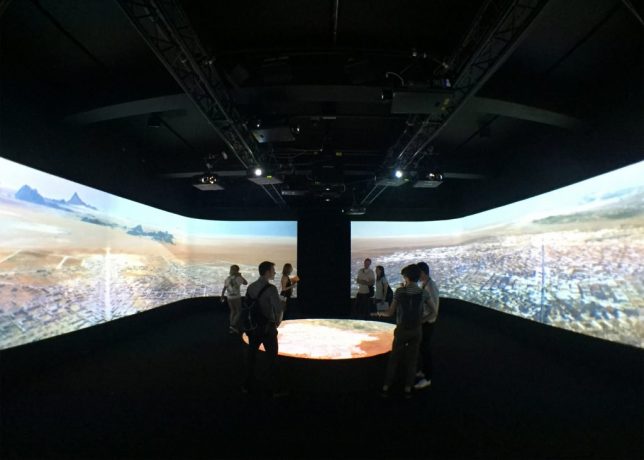
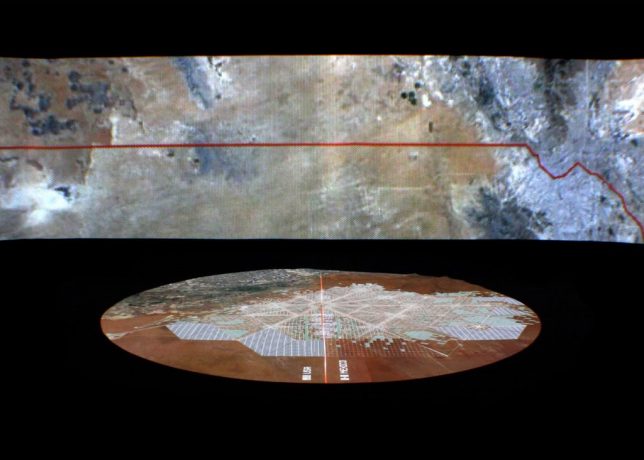
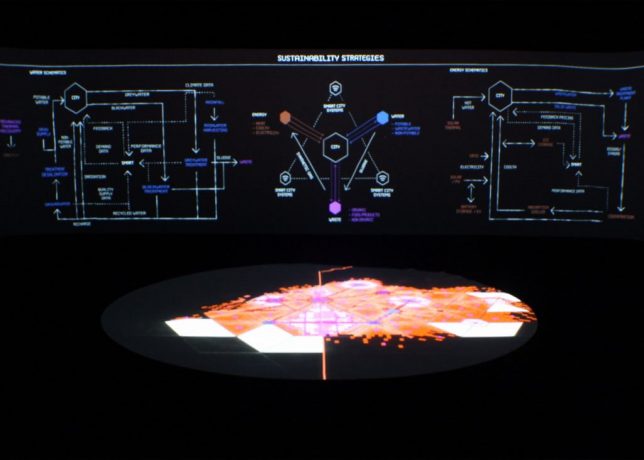
Border City is being designed as a bridge between nations, a novel approach to creating international unity at a time when some politicians call for building walls. Proposed by architect Fernando Romero of the firm FR-EE at the London Design Biennale, this visionary project is to be developed along a region of border covering parts of Texas, New Mexico and Chihuahua.

futuristic border city

The plan is centered around an extant border crossing and aligned with other crossings in the area as well. It may sound far-fetched, but Romero is already negotiating with private land owners in the region as well as developers and investors. He hopes to make the city a reality within a decade.

border city design

Romero believes our existing concept of borders is “primitive” and sees and urgent need to move past binary understandings of such divides. Already, many global centers of economic activity are centered not around cities but rather clusters of metropolitan areas, often along national borders.

border city map

“This is a long-term vision, a vision that is not about building walls but about thinking more ambitiously about the mutual relationship [between two countries] and about what borders really mean between countries” said the architect. It is also a reflection of current reality, where there already “exists a very strong mutual dependency of economies and trades.”

border city installation

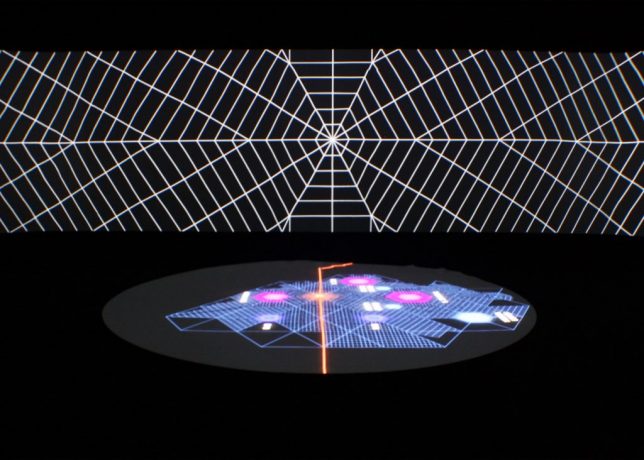
The urban plan consists of interconnected hexagonal-shaped grids, each with their own center and linked to existing transportation corridors and border crossings. If his proposal is fully realized, the city could even become a special economic zone (see also: Hong Kong and Andorra) that would enjoy semi-independent governance.

border city room

Even without that kind of designation and semi-autonomy, however, there would still be big benefits to residents and businesses in terms of easy access between countries due to optimized transit and city planning. Many “twinned” border cities along the Rio Grande have already benefited from close ties despite extant borders, despite the lack of centralized and ground-up plans to optimize connectivity.

border city utopia

“What you’re seeing here is the first binational city to be designed from zero between the United States and Mexico,” said Romero. “This is one of the most active borders in the world in terms of commerce and traffic of goods but also in terms of human activity and employment.”

Share on Facebook


[ By WebUrbanist in Architecture & Cities & Urbanism. ]

[ WebUrbanist | Archives | Galleries | Privacy | TOS ]

WebUrbanist

 
Comments Off on Binational Megacity: Master Plan Designed to Span US-Mexico Border

Posted in Creativity


Canon applies to patent double-sided micro lenses designed for better edge performance

23 Aug

Canon engineers have developed a new design for the micro lenses it uses on imaging sensors that it claims will reduce vignetting and false coloration at the edges of the picture. The new designs have a bi-convex lens that uses the upper surface to collect light and the lower to channel the light more effectively to the photodiode. The patent application shows the lower face of the micro lenses with a convex surface featuring an off-center vertex. Canon says these would be placed at the edges of the sensor to direct light approaching from a steeper angle. The idea is to direct more of the light toward the photodiode than can be achieved with standard single-micro-lens designs.

As pixels have depth it can be difficult to channel light from the camera’s lens down the ‘well’ to reach the photodiode unless it approaches straight-on. When a pixel is positioned at the edge of the sensor array it becomes more difficult because light approaches from an extreme angle and can miss the photodiode, as the refractive index of the micro lens isn’t high enough to bend it directly down the well. Since certain colors experience different refractive indices, some wavelengths of light don’t make it to the photodiode either. Thus, pixels outside the central area can report less light – and false colors – compared to those in the middle of the sensor.

Canon’s new dual micro lens design aims to take more control of the light as it enters and exits the micro lens, and to channel it in a more vertical direction down the well so that less is lost. This should in theory improve both vignetting and false coloration nearer to the edges of the image.

For more information see Canon’s full patent application.

Extract from the patent:

The lower surface 102 of the microlens 103 has an asymmetrical shape with a position nearest to the photoelectric conversion device 104 (a position at which the thickness from a center plane 130 of the microlens 103 is the maximum) shifting from the center position of the microlens 103 to the central side of the pixel array 110A. The lower surface 102 of the microlens 103 has a convex shape with respect to the photoelectric conversion device 104.

Each microlens 103 is formed from a material having a higher refractive index than a material in contact with the lower surface 102 at a position between the microlens 103 and the photoelectric conversion device 104. The microlens 103 is formed from, for example, a color filter material.

The upper surface 101 of each microlens 103 has a convex shape with respect to the incident side of incident light. The incident light 111, incident light 121, and incident light 131 entering the microlens 103 from the same direction as that of the straight line 115 each are refracted by the upper surface 101 of the microlens 103 and focused onto the photoelectric conversion device 104. In this case, if the upper surface 101 of the microlens 103 lacks in refractive power with an increase in curvature radius, the lower surface 102 of the microlens 103 compensates for the refractive power to cause the incident light 111, 121, and 131 to enter the photoelectric conversion device 104. At this time, the refractive power of the lower surface 102 of the microlens 103 is larger than that of the upper surface 101 of the microlens 103. As described above, the microlens 103 can focus incident light onto the photoelectric conversion device 104 by using the upper surface 101 having a convex shape extending upward and the lower surface 102 having a convex shape extending downward with respect to the center plane 130.

Articles: Digital Photography Review (dpreview.com)

 
Comments Off on Canon applies to patent double-sided micro lenses designed for better edge performance

Posted in Uncategorized


COOPH Field Jacket is 100% waterproof, designed for photographers

14 May

$ (document).ready(function() { SampleGalleryV2({“containerId”:”embeddedSampleGallery_5573536821″,”galleryId”:”5573536821″,”isEmbeddedWidget”:true,”standalone”:false,”selectedImageIndex”:0,”startInCommentsView”:false,”isMobile”:false}) });

Cooperative of Photography (COOPH) has introduced the Field Jacket, designed for photographers and made from a fully waterproof Swiss cotton fabric called EtaProof. The jacket features both inner and outer pockets for carrying photography gear, a quick-access smartphone pocket, and a small loop near the collar to fix a cable (from headphones or a microphone) in place.

The jacket’s material was first used to make overalls for WWII British Hurricane pilots, according to COOPH, offering a mixture of comfort and protection against hypothermia by blocking out water. Used to make COOPH’s Field Jacket, the fabric helps keep both photographers and their stowed gear dry without constricting movement or getting too warm. 

The Field Jacket is available in Black and sizes ‘small’ to ‘xx-large’ for €398. COOPH currently ships only within Europe, though some US distribution is becoming available.

Via: PhotographyBLOG

Articles: Digital Photography Review (dpreview.com)

 
Comments Off on COOPH Field Jacket is 100% waterproof, designed for photographers

Posted in Uncategorized


Taboo Town: Architecture Designed to Make You Uncomfortable

15 Dec

[ By Steph in Architecture & Public & Institutional. ]

uncomfortable architecture 1

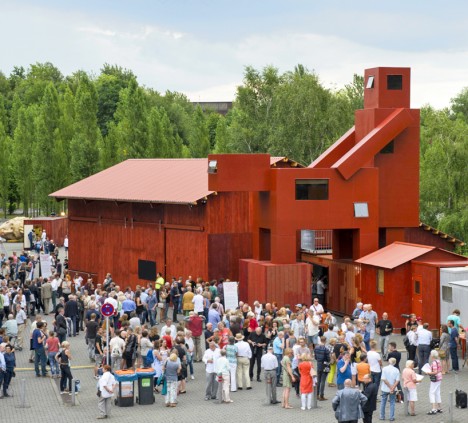
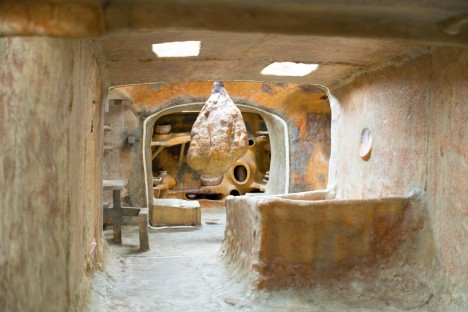
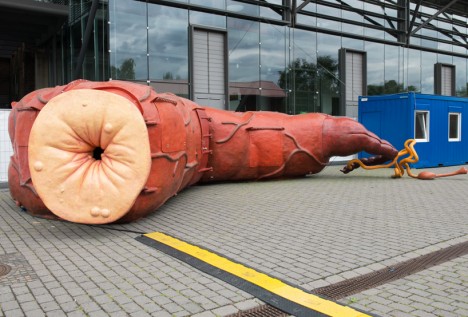
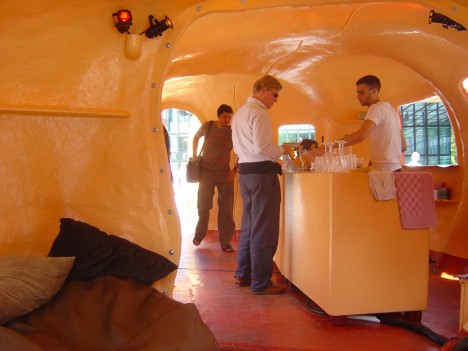
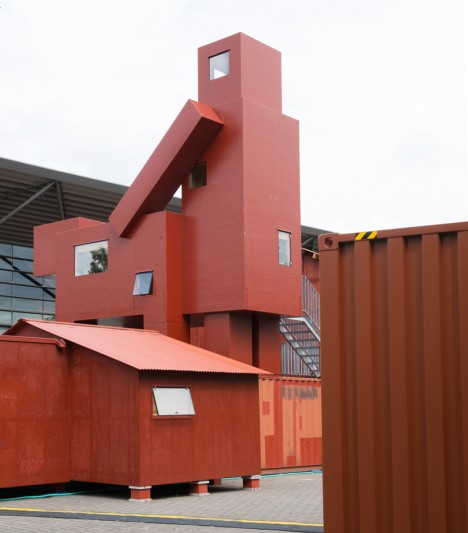
Grab a cocktail inside an oversized rectum and then take in the unsettling sight of a sculptural red building graphically referencing humankind’s dominion over nature. Dreamed into being over a period of nearly twenty years by design collective Atelier van Lieshout, this series of over 20 sculptures and structures became an immersive exhibit at the annual Ruhrtriennale Festival in Bochum, Germany.

uncomfortable architecture 3

uncomfortable architecture 4

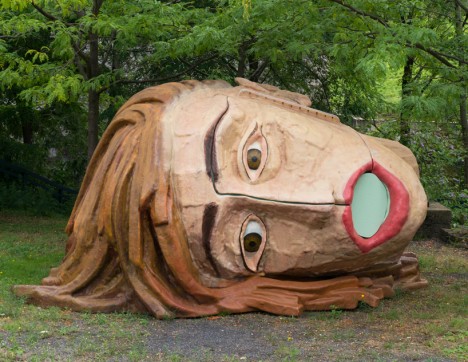
Collectively called The Good, The Bad and The Ugly – also the name of a mobile art lab created by the studio in 1998 – this series really lives up to its name, ranging from the aforementioned visual abstraction of bestiality to a pair of giant inhabitable heads placed horizontally on the grass. The Head Claudio & The Head Hermann call to mind an eerie statue at the abandoned ‘Gulliver’s Kingdom’ theme park in Japan.

uncomfortable architecture 5

uncomfortable architecture 6

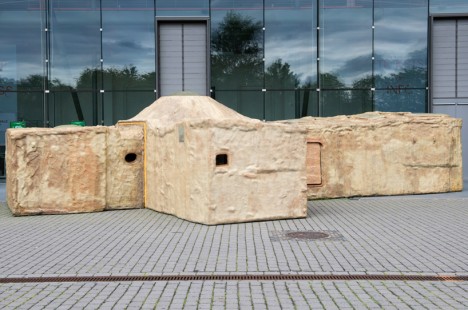
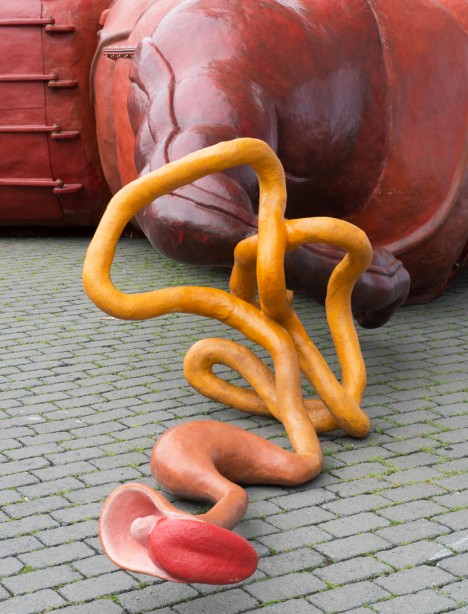
With its lumpy beige textures mottled with red, a fleshy, human-fat-mimicking structure called Hagioscoop could very well be the answer to the question, “What’s the most viscerally disgusting material that a building could be made of?” The ‘Barrectum’ isn’t exactly pretty either, covered in veins and ending in a tangle of intestines that lead to a stomach and finally, a tongue.

uncomfortable architecture 7

uncomfortable architecture 8

uncomfortable architecture 9

But it’s the Domestikator that’s really the star of the show, even if you don’t particularly want to look at it too much. “Domesticator symbolizes the power of humanity over the world,” say the designers. “It pays tribute to the ingenuity, the sophistication and the capacities of humanity, to the power of organization, and to the use of this power to dominate, domesticate the natural environment.”

uncomfortable archictecture 2

“The act of domestication, however, often leads to boundaries being sought or even crossed. Only a few taboos remain, and it is these taboos that the Domestikator seeks to address.”

Share on Facebook


[ By Steph in Architecture & Public & Institutional. ]

[ WebUrbanist | Archives | Galleries | Privacy | TOS ]


WebUrbanist

 
Comments Off on Taboo Town: Architecture Designed to Make You Uncomfortable

Posted in Creativity


Vallerret Photography Gloves are designed for outdoor winter shooting

03 Dec

Vallerret, a Norway-based startup, is looking for funding on Kickstarter for some cold weather photography gloves. Currently in prototype form, the Vallerret Photography Gloves are designed for adventurous photographers who shoot outside in cold temperatures, aiming to eliminate the hassle that comes with bulky, cumbersome gloves while protecting hands from snow and ice.

Vallerret’s gloves are made with ‘flip-tech’ finger caps that can be peeled back when it is time to adjust dials and change settings. The knuckles and cuff are made of neoprene, the interior features a merino wool liner and the palm and inner fingers are coated with a non-slip grip, though there’s no mention of capacitive touch screen capability, which is increasingly common. Catering specifically to photographers, the design includes an SD card pocket just above the cuff and a microfiber strip for cleaning a lens. Vallerret has partnered with a ski glove manufacturer, hoping to tailor the gloves to active photographers who might also wear them snowboarding.

The campaign has raised more than half its funding goal, and offers a pair of Vallerret Photography Gloves for a pledge of 550 kroner, or about $ 64. Shipping is estimated to start in March 2016, assuming the campaign and manufacturing progress as planned.

Articles: Digital Photography Review (dpreview.com)

 
Comments Off on Vallerret Photography Gloves are designed for outdoor winter shooting

Posted in Uncategorized