RSS
 

Posts Tagged ‘Design’

The Porsche Design Book One is a MacBook Pro competitor in a convertible form factor

28 Feb

$ (document).ready(function() { SampleGalleryV2({“containerId”:”embeddedSampleGallery_8985827527″,”galleryId”:”8985827527″,”isEmbeddedWidget”:true,”standalone”:false,”selectedImageIndex”:0,”startInCommentsView”:false,”isMobile”:false}) });

German company Porsche Design has teamed up with industry giants Intel, Microsoft and Quanta Computer to launch the first product in its new Porsche Computing product line, the Porsche Design Book One. 

The Book One is a high-end 2-in-1 convertible device. The screen can be detached from the keyboard section and used as a tablet, or rotated up to 360 degrees using a hinge with stainless steel cog wheels that are inspired by the transmission of a sports car. The milled aluminum housing features a matte anodized surface finish and the minimalist design the brand is known for.

In the interior, the Book One comes with high-end components all around. The Windows 10 Pro operating system is powered by a 7th-generation Intel Core i7-7500U processor and 16GB of RAM. An Intel SSD provides 512 GB of storage via the PCIe slot and the 13.3” QHD+ IPS display offers a resolution of 3200 x 1800 pixels.

For easy expansion and connection of accessories a variety of ports is provided, including two multifunctional USB Type-C ports, two full-size USB 3.0 ports, and one USB 3.1 Type-C/Thunderbolt 3 port which allows for wired image transmission in accordance with the DisplayPort standard. In addition, the 5MP front camera with infrared sensor enables biometric authentication using the Windows Hello facial recognition software.

In terms of input, Book One users can choose from the touch display, a precision touchpad, the detachable keyboard with backlit keys and a Wacom-made digital stylus that attaches magnetically to the housing. With its versatile design and powerful hardware the Porsche Design Book One looks like a great machine for image editing at home or on the road. It will be available in the US in April 2017 at a retail price of $ 2,495.

Press Release:

Porsche Design Adds Exclusive Laptop to Its Product Portfolio

Porsche Design BOOK ONE: The Multifunctional 2in1 Running Windows 10 Pro

Stuttgart, Germany. With the new Porsche Design BOOK ONE, the world’s first convertible and detachable 2in1, Porsche Design adds the category of Porsche Design Computing to its expanding product portfolio. The move sees the premium-lifestyle-brand playing to its strengths, merging form and function to yield a high-performance, multifunctional 2in1.

The Porsche Design BOOK ONE underlines the brand’s focus on technology and innovation, making new strides in the mobile computing segment. The silhouette of the BOOK ONE uses a milled aluminum housing with a matte anodized surface finish and features subtle Porsche Design branding on the top of the tablet and the bottom edge of the screen. The patented hinge, designed entirely by Studio F. A. Porsche, allows the tablet unit of the 2in1 not only to detach, but also rotate 360°.

In keeping with the traditional design philosophy of Professor Ferdinand Alexander Porsche, the well-crafted hinge and its stainless steel cog wheels are inspired by the transmission of a sports car. This approach, which combines superior engineering with modern design, allows Porsche Design to implement the latest in state-of-the-art technology.

The features of the Porsche Design BOOK ONE include:
Versatile functionality: High performance components and cutting-edge technology give the 2in1 its versatile functionality. The device comes with Windows 10 Pro, Microsoft’s most up-to-date, cutting edge OS.

High performance: The powerful 7th-generation Intel® Core™ i7-7500U processor, which clocks in at up to 3.5 GHz, is able to max-imize its potential thanks to the computer’s 16 GB of RAM.

Fast data storage: The noiseless Intel®, SSD with a storage capac-ity of 512 GB, guarantees fast data storage via the PCIe slot.

Eye-popping resolution: With a resolution of 3200 x 1800 pixels, the 13.3” QHD+ IPS display is built to impress, whether working, surfing the web, or simply watching the latest movie.

Convenient connections: The variety of available ports offered includes two multifunctional USB Type-C™ ports, two full-size USB 3.0 ports, and USB 3.1 Type-C™/Thunderbolt 3 port, which not only powers a variety of USB peripherals with just a single cable. It also guarantees fast, hassle-free data exchange, and allows wired image transmission in accordance with the DisplayPort standard. The 2in1 communicates wirelessly via dual-band WiFi and Blue-tooth®.

Biometric authentication: A more secure and simplified login pro-cedure is enabled thanks to the 5-MP camera with infrared sensor, which is seamlessly integrated into the front of the housing and allows biometric authentication using Windows Hello facial recognition software.

The themes of versatility and ease are further emphasized by the laptop’s cutting-edge input capabilities. Both the touch display and the Precision Touchpad for Windows 10 use high-precision, multi-gesture control interfaces. The keyboard, complete with dimming backlit keys, enables endless use in a variety of settings. And the digital stylus, developed by Studio F. A. Porsche to ensure ideal handling, is optimized for use with Windows Ink, providing a natural writing experience with all the benefits of digital connectivity. In order to prevent loss of the stylus, a magnetic holder is integrated into the right side of the tablet.

“The Porsche Design BOOK ONE embodies the DNA of our brand down to the tiniest detail and, as our first 2in1 unit, has expanded our product portfolio by adding a new category: Porsche Design Computing. In Microsoft and Intel, we have two renowned partners who were a great help in implementing this strategically important project,” said Jan Becker, CEO of the Porsche Design Group.

“We’re thrilled to work with Porsche Design – a world renowned premium-lifestyle-brand – that introduces for the first time a finely crafted 2in1 – the Porsche Design BOOK ONE,” said Peter Han, Vice President, Partner Devices and Solutions, Microsoft Corp. “Porsche Design’s first Windows PC combines a well-constructed hardware and functional design with popular Windows 10 features, including Windows Hello and Windows Ink, enabling a rich pen and touchscreen experience.”

The Porsche Design BOOK ONE will be available in the US in April 2017 and available in other countries at Porsche Design Stores and specialty retailers. RRP in the US is $ 2,495 USD.

Articles: Digital Photography Review (dpreview.com)

 
Comments Off on The Porsche Design Book One is a MacBook Pro competitor in a convertible form factor

Posted in Uncategorized


Clone Wars: How Star Architect Frank Lloyd Wright Inspired the Design of Naboo

26 Jan

[ By WebUrbanist in Architecture & Public & Institutional. ]

naboo-architecture

Much of the magic of the Star Wars films derives from the fantastic landscapes and exotic built environments that serve as backdrops for its intergalactic tales of empires and rebellions. But when world-makers like George Lucas create these places, they often draw on real architects and architecture for inspiration, including the last and largest work of starchitect Frank Lloyd Wright.

democratic-design-star-wars

Located north of San Francisco, the Marin County Civic Center consists of a massive rotunda housing a public library, offset by a strong vertical spire and long Hall of Justice (a classic Wright move to emphasize and juxtapose both horizontals and verticals). These same features can be found in the heart of Naboo, a Mid Rim world (near the Outer Rim Territories) featured across a series of Star Wars films.

marin-count-city-civic

royal-palace

As with their cinematic counterparts, Wright’s structures for Marin were designed to relate to the landscape – curved blue roofs pick up on the tones of the sky above while beige/pink walls tie into the earthen surroundings. Arched supports and the voids they create at different scales are also immediately recognizable as similar between the original Terrestrial architecture and its echos in Star Wars scenes.

civic-center-design

views-of-naboo

For Wright as well as Lucas, there is an underlying idea at work in the design: a combining of grandeur worthy of civic architecture but also an aspiration toward something democratic, beautiful but accessible. The settings are also similar: complex and lush landscapes, fitting a similar vision found in both the architect’s and filmmaker’s works: a focus on working architecture into natural settings rather than envisioning dense cities. Lucas has directly acknowledged a debt to Wright for inspiring the architecture found in the Star Wars franchise, but has yet to announce whether he will be working on a sequel story: some of us are still waiting on Starchitecture Wars.

Share on Facebook


[ By WebUrbanist in Architecture & Public & Institutional. ]

[ WebUrbanist | Archives | Galleries | Privacy | TOS ]


WebUrbanist

 
Comments Off on Clone Wars: How Star Architect Frank Lloyd Wright Inspired the Design of Naboo

Posted in Creativity


Leica announces M10 with new sensor, slimmer design

22 Jan

$ (document).ready(function() { SampleGalleryV2({“containerId”:”embeddedSampleGallery_2612408213″,”galleryId”:”2612408213″,”isEmbeddedWidget”:true,”standalone”:false,”selectedImageIndex”:0,”startInCommentsView”:false,”isMobile”:false}) });

Leica has announced the M10, the latest in the company’s venerable M-series line of cameras. At first glance, the M10 looks – unsurprisingly – similar to any other M camera, but there are some major updates both inside and out.

Much of the bulk that came with the M-series’ transition to the digital age has been shed, with the M10 measuring just as thin as a film-era M4 and coming in 20 grams lighter than the previous M Typ 262. The trade-off? A smaller, less powerful battery, and a lack of any I/O ports of any kind. 

Other key updates include an all-new 24MP sensor, an external ISO dial, a new Maestro II image processor, 5fps max shooting, a scratch-resistant 1.04M-dot rear LCD, a larger viewfinder, some environmental protection seals and built-in Wi-Fi. 

The Leica M10 will begin shipping this week for a price of $ 6595/€6500.

M as in Milestone: Leica Camera Introduces the New Leica M10

The M-series’ latest addition impresses with more compact dimensions, improved performance and even more intuitive handling

January 18, 2017 – The iconic camera system sets new standards yet again. The perfect balance of long-established traditions and the latest technical innovation, the Leica M10 embodies the essence of photography like no other camera before. All of its functions have been adapted and updated to meet the precise needs of contemporary photography, while preserving the essential principles of the legendary M-System. Every single component and every technical feature concentrates uncompromisingly on this goal. With its more compact dimensions, improved performance and even more intuitive handling, the Leica M10 sets a new milestone in the ongoing history of Leica M photography.

The form factor: analog dimensions enter the digital age

Many photographers who appreciate the dimensions of analog M-Models, due to their ideal ergonomics and perfect fit in hand, expressed wishes that this carry over to digital M-Cameras. Leica has now brought these dream dimensions to reality – with a top plate depth of only 33.75 millimeters, a whole four millimeters (1/8”) thinner than that of its predecessor, the Leica M (Typ 240). The Leica M10 is now the slimmest digital M of all time.

The rangefinder: a precise window on the world

The rangefinder has always played an extremely important role in the storied heritage of the Leica M-System. A number of important aspects of this legendary focusing technology have now been further optimized in the Leica M10. To improve the view of the subject, the field of view has been enlarged by 30 percent and the magnification factor has been increased to 0.73x. Eye-relief – the optimum distance of the eye from the viewfinder eyepiece – has also been considerably increased. Thanks to a 50 percent increase in this distance, the viewfinder is much more comfortable to use, particularly for photographers who wear glasses.

The sensor: the digital canvas

The key component of the Leica M10 is the all-new 24 MP, full-frame CMOS sensor developed specifically for this camera. Its new technology leads to significant improvements in all parameters relevant to imaging performance: impressive dynamic range, excellent contrast rendition, exceptional sharpness and the finest resolution of details. Its unique pixel and microlens architecture enables optimum results at all apertures, particularly wide open – even rays of light arriving at the sensor from oblique angles are precisely captured by its photodiodes – further improved in comparison to the previous generation. The glass cover plate of the sensor acts as an infrared cut-off filter and thus also avoids undesirable refraction of incoming light by additional layers of glass. The omission of a low-pass filter also ensures that the Leica M10 delivers maximum sharpness. This leads to significantly better imaging results, especially in the case of wide-angles and fast-aperture lenses.

Thanks to the new design of the sensor of the Leica M10, the ISO sensitivity range has been expanded. It now allows exposures at values between ISO 100 and 50,000 with considerably improved noise characteristics at higher ISO settings. The Leica M10 opens up new areas of photography and delivers exceptional imaging performance even in difficult lighting conditions.

Image processing electronics: the next level of quality

The latest-generation Maestro II image processor of the M10 showcases state-of-the-art advanced processor technology. In combination with the equally new 24 MP sensor, this ensures that all exposures captured stand out with exceptionally brilliant image quality. Thanks to a 2 GB buffer memory and continuous burst shooting at up to five frames per second at full resolution, photographers will never again miss the decisive moment. The Leica M10 is the fastest M-Camera ever made.

In addition to this, the faster processor allows the loupe function in Live View mode to be freely positioned anywhere in the frame for even better assessment of sharpness. This new function can be used not only on the camera’s LCD monitor, but also in conjunction with the Visoflex electronic viewfinder (EVF) with 2.4 MP of resolution. The viewfinder features a swivel function for shooting from unusual angles and an integrated GPS module that can be switched on for geotagging image files.

The operating concept: intuitive and reduced to essentials

Since the beginning, Leica M-Cameras have stood for concentration on essential functions. This principle has been conscientiously pursued in the Leica M10, which sets new standards in terms of intuitive handling and rapid access to the settings relevant to photography. For instance, the controls on the back are limited to the directional control and just three buttons for Play, Live View and Menu. The importance of particular settings varies according to personal preferences and photographic needs. In light of this, the Leica M10 also offers a freely configurable Favorites Menu for defining a custom profile of personally relevant functions.

One of the most distinctive new features of the Leica M10 is the ISO setting dial on the top plate. For the first time in a digital Leica M, all essential shooting parameters such as focusing, aperture, shutter speed and ISO value can be selected manually without using the menu – or even switching on the camera. This concept allows for the fastest, most precise control yet seen in a digital camera and enables the photographer to be even less obtrusive when shooting.

The Wi-Fi module: memories are there to be shared and shown

The Leica M10 is the first M-Camera with integrated Wi-Fi connectivity. This enables fast, wireless transfer of pictures to Apple mobile devices (with Android shortly to follow), where they can be edited and, for instance, posted and shared on social networks. The Leica M-App also enables the direct transfer of RAW files in DNG format to mobile devices for further processing with suitable apps from iOS Version 10.2. The Leica M10 can also be remotely controlled via Wi-Fi from a smartphone or tablet. This makes it easy to shoot perfect pictures from unusual angles or avoid camera shake when shooting with longer shutter speeds.

Leica M10: A further step towards perfection

“The Leica M is the heart, the backbone and the soul of Leica Camera. The Leica M10 unites state-of-the-art technology and exceptional optical performance with a conscious focus on the traditional advantages of the unique Leica M rangefinder system. In this, the innovative camera and its concentration on the functions essential to photography set new standards, while its exceptionally lean handling concept takes us a further step towards absolute perfection. Made in Germany by Leica – the Leica M10 stands as an outstanding brand statement for the finest arts of engineering, highest quality and craftsmanship,” explained Oliver Kaltner, CEO, Leica Camera.

“The new M, the M10! Not a camera for everyone – but increasingly a camera for people who love a system that is built for the future while maintaining consistent compatibility with its past. The rangefinder system lets me frame and compose my pictures. The rangefinder system lets me tread in the footsteps of the world’s greatest photographers. The rangefinder system lets me create photographs with my own visual style. The new M10 and the wealth of present and past Leica M-Lenses are products that awaken and fulfil the desires of every photographer,” emphasized Dr. Andreas Kaufmann, majority shareholder and chairman of the supervisory board of Leica Camera.

Availability

The Leica M10 will be available from Leica Stores, Boutiques and selected Dealers starting January 19, 2017.

Leica M10 Specifications

Price
MSRP $ 6595
Body type
Body type Rangefinder-style mirrorless
Body material Magnesium alloy
Sensor
Max resolution 5952 x 3992
Other resolutions 5952 x 3968 (JPEG, 24MP), 4256 x 2932 (12MP), 2976 x 1984 (6MP)
Image ratio w:h 3:2
Effective pixels 24 megapixels
Sensor size Full frame (35.8 x 23.9 mm)
Sensor type CMOS
Processor Maestro II
Color space sRGB
Color filter array Primary color filter
Image
ISO Auto, 100-50000
White balance presets 8
Custom white balance Yes
Image stabilization No
Uncompressed format RAW
File format
  • JPEG
  • Raw (DNG)
Optics & Focus
Manual focus Yes
Lens mount Leica M
Focal length multiplier 1×
Screen / viewfinder
Articulated LCD Fixed
Screen size 3
Screen dots 1,036,800
Touch screen No
Screen type TFT LCD
Live view Yes
Viewfinder type Optical (rangefinder)
Viewfinder coverage 100%
Viewfinder magnification 0.73×
Photography features
Minimum shutter speed 8 sec
Maximum shutter speed 1/4000 sec
Exposure modes
  • Program
  • Aperture priority
  • Shutter priority
  • Manual
Built-in flash No
External flash Yes
Flash X sync speed 1/180 sec
Drive modes
  • Single
  • Continuous
  • Interval
  • Exposure bracketing
  • Self-timer
Continuous drive 5.0 fps
Self-timer Yes (2 or 12 secs)
Metering modes
  • Multi
  • Center-weighted
  • Spot
Exposure compensation ±3 (at 1/3 EV steps)
AE Bracketing ±3 (3, 5 frames at 1/3 EV, 2/3 EV, 1 EV, 2 EV steps)
Videography features
Microphone None
Speaker None
Storage
Storage types SD/SDHC/SDXC
Connectivity
HDMI No
Microphone port No
Headphone port No
Wireless Built-In
Remote control Yes (via cable trigger)
Physical
Battery Battery Pack
Battery description BP-SCL5 lithium-ion battery & charger
Battery Life (CIPA) 210
Weight (inc. batteries) 660 g (1.46 lb / 23.28 oz)
Dimensions 139 x 39 x 80 mm (5.47 x 1.54 x 3.15)
Other features
Orientation sensor Yes
Timelapse recording Yes
GPS Optional
GPS notes via optional Visoflex EVF

Articles: Digital Photography Review (dpreview.com)

 
Comments Off on Leica announces M10 with new sensor, slimmer design

Posted in Uncategorized


Mom Photographer’s Best Helpers: Review of the Peak Design Everyday Bags

14 Jan

I bet at least one bag from the Peak Design Everyday series is on maaany wishlists this year. And if it’s still not, there are good chances you’ll want to add another item to yours after reading this review. Wondering what made me sound as if I’m earning commission from the bag producer? Watch the video below to get a Continue Reading

The post Mom Photographer’s Best Helpers: Review of the Peak Design Everyday Bags appeared first on Photodoto.


Photodoto

 
Comments Off on Mom Photographer’s Best Helpers: Review of the Peak Design Everyday Bags

Posted in Photography


Photographer applies iris design to Aperture Wrench concept

24 Dec

$ (document).ready(function() { SampleGalleryV2({“containerId”:”embeddedSampleGallery_7785582854″,”galleryId”:”7785582854″,”isEmbeddedWidget”:true,”standalone”:false,”selectedImageIndex”:0,”startInCommentsView”:false,”isMobile”:false}) });

Photography hobbyist and industrial designer Jordan Steranka has published images of a new concept tool called the Aperture Wrench, a wrench with a design inspired by a camera’s diaphragm. Unlike an ordinary wrench, the Aperture Wrench features blade-like elements that open and close via a rotating wheel and lock in place with the press of a button.

Steranka’s goal was to design a wrench that could be adjusted to fit any nut size, removing the guesswork involved in finding a correctly-sized wrench. The end result is a tool with aperture blades, an adjustment dial, a locking button, and a built-in light for better visibility. As with any concept, though, it’s possible the design will never make its way into mass production.

Via: DesignBoom

Articles: Digital Photography Review (dpreview.com)

 
Comments Off on Photographer applies iris design to Aperture Wrench concept

Posted in Uncategorized


Canon patent shows curved sensor design

03 Dec

A new patent suggests Canon’s engineers might be working on a curved sensor design to reduce vignetting. Japanese blog Egami reports on a patent that was released on the 24th of November and describes an image sensor design with a flat central portion, where light fall-off from the lens is not much of an issue, and curved edges, where fall-off is generally more noticeable. This approach, rather than using a sensor that’s totally curved, would avoid making the whole unit much thicker.

Such a sensor design could potentially be applied in mirrorless camera models where, due to short flange-back distances, vignetting is generally more of a problem than on conventional DSLRs. Software processing can correct for the effect but only to a certain degree, so it would not be a surprise that manufacturers are looking for hardware solutions.

As with all patents, it’s impossible to know if the technology will ever make it into a production model but it’s good to know manufacturers are looking at innovative ways of improving image quality.

Articles: Digital Photography Review (dpreview.com)

 
Comments Off on Canon patent shows curved sensor design

Posted in Uncategorized


Blackmagic Design announces update to Video Assist monitors

20 Nov

Blackmagic Design has announced a software update to its 5-inch Video Assist and 7-inch Video Assist 4K monitor/recorders. Video Assist 2.3 allows users to load up to six 3D LUTs when monitoring on their devices, making it possible to view output from cameras in a form that approximates the final color grade of the footage.

In addition, the update adds several features to the 5-inch Video Assist that were previously only available 7-inch Video Assist 4K model. These include the ability to record DNxHD and DNxHR files in MXF format, improved compatibility with Avid systems running on Windows, false color monitoring to accurately judge exposure in different parts of the image, and additional options for customizing focus peaking indicators.

Video Assist 2.3 can be downloaded from the Blackmagic website.

Press release:

Blackmagic Design Announces New? Video Assist 2.3 Update

Major update adds new 3D LUTs, focus assist features and improved DNxHD and DNxHR support!

InterBEE 2016, Tokyo, Japan – November 18, 2016 – Blackmagic Design today announced Video Assist 2.3, a major new update for Blackmagic Video Assist customers that adds 3D LUTs to both models. This update also adds features to the 5” Blackmagic Video Assist including improved DNxHD and DNxHR support, false color monitoring, expanded focus options and new screen rotation features. The Video Assist 2.3 update is available for download now from the Blackmagic Design website and is free of charge for all Blackmagic Video Assist customers.

Video Assist 2.3 Update is being demonstrated at InterBEE on the Blackmagic Design booth 8216.

Customers using the Video Assist 2.3 update can now load up to six 3D LUTs when monitoring video on set with their 5” or 7” Blackmagic Video Assist. 3D LUTs have become an important part of digital filmmaking because they transform the camera images into a look that closely approximates the final look the director wants. The benefit of monitoring with 3D LUTs is that the crew can see the footage as the director intends it, and it’s completely non destructive because the original camera footage remains untouched. The six x 3D LUTs can be stored and recalled at any time by the user and this new feature is available on both the 5” Blackmagic Video Assist model and the 7” Blackmagic Video Assist 4K model.

For customers using the 5” Blackmagic Video Assist model, this update adds new features that were previously released only on the 7” Blackmagic Video Assist 4K model.

These new features include the ability to record to DNxHD and DNxHR files in MXF format which improves compatibility with Avid systems running on Windows. In addition, customers can now choose between DNxHD 220, 145 and 45 bit rates, or between DNxHR HQ, SQ and LB formats when recording.

The Video Assist 2.3 update also adds false color monitoring exposure tools to the 5” Blackmagic Video Assist model. False color exposure tools make it easier to properly set exposure in different parts of the image by highlighting specific color ranges of luminance with a solid color overlay. For example, green indicates neutral grey, while pink tones are good references for skin, which is typically one stop over neutral grey. Using false color helps camera operators keep exposure consistent from shot to shot.
In addition, Video Assist 2.3 update also expands the options for focus assist so customers can now choose whether they want to see red, green, blue, black, white or traditional focus peaking indicators. This makes it easier for customers to accurately adjust focus in a wider range of scenes and under a variety of different lighting conditions. Customers will now also have the ability to manually control the screen orientation and turn off the auto rotate feature which makes it easier for customers to use the 5” Blackmagic Video Assist model with handheld gimbals and other equipment designed to move the camera and rig simultaneously.

“Blackmagic Video Assist is perfect for customers that need better monitoring and higher quality recording,” said Grant Petty, CEO, Blackmagic Design. “This new update adds incredible LUT monitoring to both models, and brings some of the same powerful high end features from the 7” Blackmagic Video Assist 4K model to customers that have the 5 inch Blackmagic Video Assist model. We think the massive number of features on the 5 inch Video Assist model is amazing when you consider it only costs $ 495! Thats why Blackmagic Video Assist has become an essential part of every filmmakers toolkit because they help customers shoot and capture higher quality video with everything from DSLRs to older tape based camcorders, and even the latest digital film cameras!”

Availability and Price

Blackmagic Video Assist 2.3 update is available now and is a free download from the Blackmagic Design website.

About Blackmagic Video Assist 4K

Introduced at NAB this year, the Blackmagic Video Assist 4K is a portable all in one monitor and video recorder that can be used to add professional recording and monitoring to any SDI or HDMI camera. It features a bright, high resolution 7 inch screen for checking focus and framing, two high speed UHS-II recorders that work with the latest high performance SD cards for non-stop HD and Ultra HD recording. Blackmagic Video Assist 4K has multi rate 6G-SDI BNC connectors for input and output, HDMI in and out, two extremely high quality XLR microphone inputs for professional audio recording, a built in speaker, DC power, dual slots for two LP-E6 batteries and more.

About Blackmagic Video Assist

Blackmagic Video Assist is a portable professional monitor and recorder that can be used with any SDI or HDMI camera. It features a 5” full resolution HD monitor that helps you get perfect focus and framing, along with a professional ProRes and DNxHD recorder that uses high speed SD cards and saves files compatible with all modern NLE software. Blackmagic Video Assist has multi rate 6G-SDI inputs and outputs via DIN 1.0/2.3 connections, as well as HDMI in and out. It features a single SD card slot for recording HD resolution video. The touchscreen allows settings, histogram, audio meters, timecode display and much more. Blackmagic Video Assist works with DC power and has dual slots for two LP-E6 batteries.

Articles: Digital Photography Review (dpreview.com)

 
Comments Off on Blackmagic Design announces update to Video Assist monitors

Posted in Uncategorized


Lenovo pushing Moto Mod development through design contest and hackathon

05 Nov

Lenovo’s Moto Z series, which was introduced earlier this year, is compatible with a range of accessory modules called Moto Mods. So far the Moto Mod line includes a speaker, a projector, a battery pack and the Hasselblad True Zoom camera module. When we tested the latter we found the Moto Mod concept to be the by far best modular smartphone system we have seen so far. The modules attach magnetically to the phone and work instantly, without a need to reboot the device, configure wireless connections or adjust any settings.

Nevertheless, since the Hasselblad True Zoom we have not seen any new Moto Mods and in the long run the system can only be a commercial success if customers have a large Moto Mod ecosystem to choose from. Lenovo is aware of this and has launched several initiatives to encourage third party hardware and software developers to work on new Moto Mod modules. The Moto Mods Developer Kit (MDK) has been available since the launch of the first modules, but from now until the end of January 2017 hardware developers can design a Moto Mod and enter a competition to win a Moto Z smartphone. Additionally, Lenovo will be hosting a couple of Moto Mod hackathons, one in New York City in December and another in January in San Francisco.

Winners of both the design contest and the hackathons will have the opportunity to meet the Moto Mod development team at Lenovo’s subdivision Motorola in Chicago and potentially receive investment to turn their idea into a product. Developers who design prototypes will also have the chance to launch a crowdfunding campaign on Indiegogo. Experts from Indiegogo will help run the campaign and Moto and Verizon will help promote the best projects with current Moto Z owners.

We really liked the Moto Mod concept when we tested the Hasselblad True Zoom. However, with the latter targeted at a consumer audience, we would like to see somebody design an enthusiast or even pro level camera Moto Mod. What would your ideal camera mod look like? Let us know in the comments.

Articles: Digital Photography Review (dpreview.com)

 
Comments Off on Lenovo pushing Moto Mod development through design contest and hackathon

Posted in Uncategorized


Dear Dairy: 12 Delicious Displays Of Milk Crate Art & Design

10 Oct

[ By Steve in Art & Sculpture & Craft. ]

milk-crate-art-1a

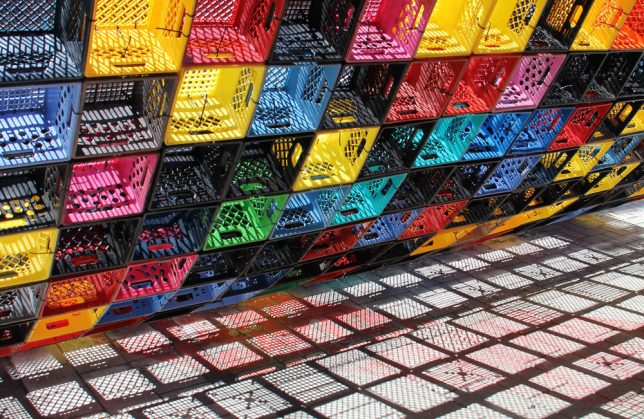
Milk crates are like jumbo LEGO bricks: they’re colorful, lightweight, plentiful, and can be arranged in an infinite number of artful configurations.

milk-crate-art-1b

milk-crate-art-1c

Looking a little like a gargantuan game of true-life Tetris, this monumental milk-crate magic carpet by local artists Philippe Allard and Justin Duchesneau won the Prix Art Public at Montreal’s Gala des arts visuels in 2012. Dubbed “Courtepointe” or “Quilt” in English, the installation was set up at the disused Darling Foundry which has housed and hosted artists studios and an art gallery since the early 2000s. Credit Flickr user taoquay for the above images snapped on July 24th of 2012.

Lactose Lighthouse

milk-crate-art-3

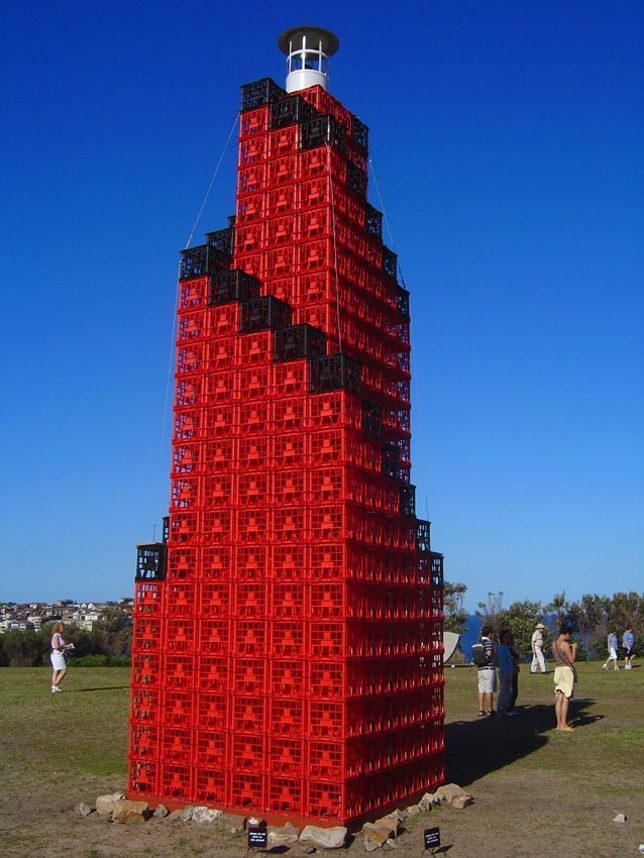
Sculpture By The Sea, held annually in Bondi and Cottesloe, Australia, are said to be “the largest free to the public art exhibitions in the world”. The 2004 edition held along the scenic Bondi to Tamara clifftop walk featured a titanic tower of red and black milk crates built in the form of a lighthouse. No sea cows were harmed during its construction.

Crate Habitat For Humanity

milk-crate-art-4a

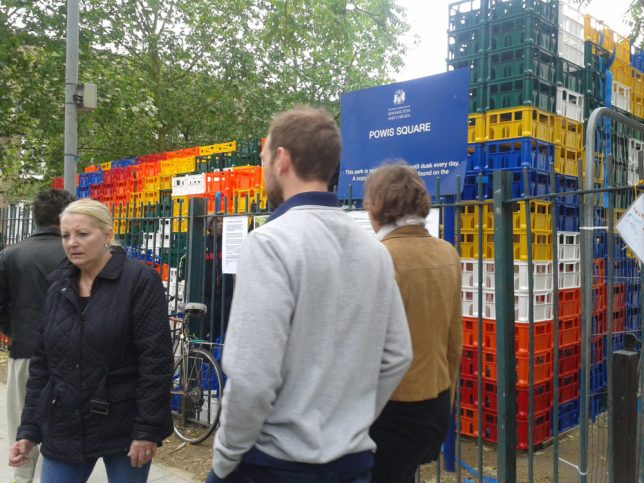
Featured as part of the 2015 London Festival of Architecture, the Art|House was a pop-up commission located in Powis Square. The structure was built using approximately 4,000 milk crates.

milk-crate-art-4b

milk-crate-art-4c

Designed by Jo Hagan and Use Architects/The Institute Of Light, the house was constructed in such a way that the component crates can either be re-introduced to perform their original purpose or packed down, delivered to any new location, and reconstituted as a sustainable shelter. Wonder what happens when it rains, this being England and all.

Branching Out

milk-crate-art-11

By now you might just assume Australia is the center (or “centre”, as the Aussies spell it) of the milk crate art universe, and that assumption would be correct. It would seem the ground down under is already saturated with milk crate artworks so there’s now nowhere to go but up – as in the suspended crate man from Footscray, a suburb of Melbourne, snapped by Kham Tran of Kham’s Blog in September of 2011.

Next Page – Click Below to Read More:
Dear Dairy 12 Delicious Displays Of Milk Crate Art

Share on Facebook


[ By Steve in Art & Sculpture & Craft. ]

[ WebUrbanist | Archives | Galleries | Privacy | TOS ]


WebUrbanist

 
Comments Off on Dear Dairy: 12 Delicious Displays Of Milk Crate Art & Design

Posted in Creativity


Blackmagic Design shows off Video Assist monitor/recorders

23 Sep

We dropped in on indie/pro video camera and grading software maker, Blackmagic Design and were impressed by their Video Assist monitor/recorders.

Alongside demos of various cameras (which now range from Micro Four Thirds mount drone-ready cameras up to the PL-mount, 4.6K global shutter Super 35 URSA) and the latest version of its DaVinci Resolve grading software, Blackmagic Design has a display of its Video Assist models.

The Video Assist and Video Assist 4K are external monitors (HD and 4K respectively) that can be mounted on DSLR and mirrorless cameras to boost their video features and make them easier to work with.

The touchscreen panels are connected via HDMI or SDI connectors (with the option to then output the signal over either connection) and add zebra warnings and focus peaking, regardless of whether that feature is offered by the host camera. With the recently-announced firmware, they also add false color overlays for an alternative means of judging expose.

The units also act as external recorders, meaning you can capture your camera’s HDMI output to SD cards (UHS-II in the case of the 4K model) in more sophisticated codecs than most cameras can, including Apple ProRes 422 HQ or LT, or Avid DNxHD and DNxHR.

At a cost of €549/$ 495 and €979/$ 895 respectively, we think they make an interesting option for the videographer looking to expand beyond their camera’s immediate limitations. We’re hoping to get hold of a sample to see the results, as soon as we can.

Articles: Digital Photography Review (dpreview.com)

 
Comments Off on Blackmagic Design shows off Video Assist monitor/recorders

Posted in Uncategorized