RSS
 

Posts Tagged ‘City’

Paris Safari: Projected Wildlife Gets Chic in the City

17 Sep

[ By Steph in Art & Street Art & Graffiti. ]

paris wildlife 4

Soaring up to six stories in height, these lemurs, deer, gorillas, eagles and other carefully clothed creatures projected onto buildings all over Paris are mocking your fashion choices. The exotic animals – which certainly can’t be found in the streets of the city otherwise – might seem like just a bit of fun, or a statement on the lack of nature in urban environments, but the creator of the project has something a little deeper to say.

paris wildlife 1

paris willife 5

paris wildlife 6

Artist Julien Nonnon has spent all of September beaming his creations onto building facades after the sun sets, in a mix of street art and video mapping. For ‘Safari Urbain,’ Nonnon developed his own tools to project the images anywhere from life size to the full height of towering apartment buildings.

paris wildlife 11

paris wildlife 9

paris wildlife 10

Some of the animals are clad in three-piece suits, others in plaid flannel shirts or hoodies, echoing the fashions seen among the human passersby who stop to gaze up at them. The point, says Nonnon, is calling attention to how we contradict ourselves with what we choose to wear, wishing to be unique while simultaneously marking ourselves as part of a clearly defined group in an attempt to fit in.

paris wildlife 2

paris wildlife 3

paris wildlife 7

“The bestiary coming right out of fashion magazines, questions our behavior… In our way of dressing, we express our vision of the world, while indirectly revealing our social position and financial power. Fashion is nothing other than a means of communication, of integration and belonging to a group.”

Share on Facebook


[ By Steph in Art & Street Art & Graffiti. ]

[ WebUrbanist | Archives | Galleries | Privacy | TOS ]


WebUrbanist

 
Comments Off on Paris Safari: Projected Wildlife Gets Chic in the City

Posted in Creativity


Silicon Greenery: World’s Largest Green Roof to Span City Blocks

16 Sep

[ By WebUrbanist in Architecture & Cities & Urbanism. ]

largest green roof

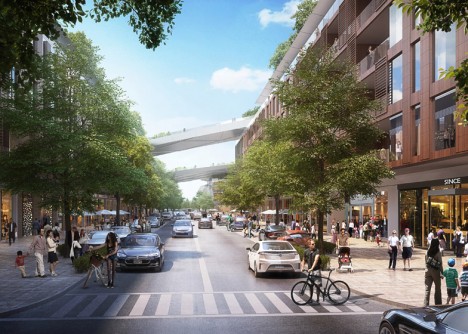
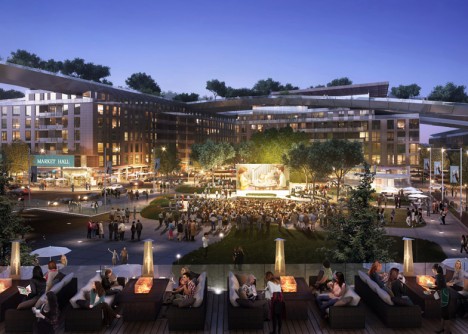
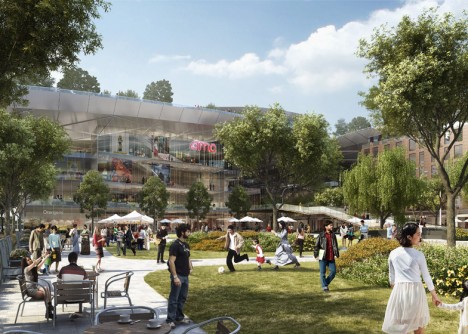
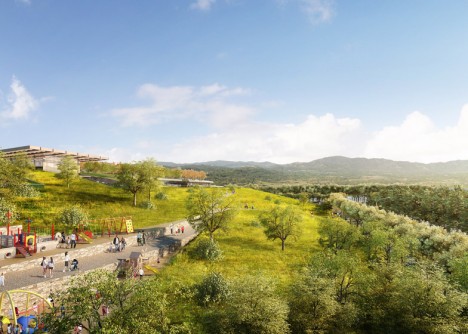
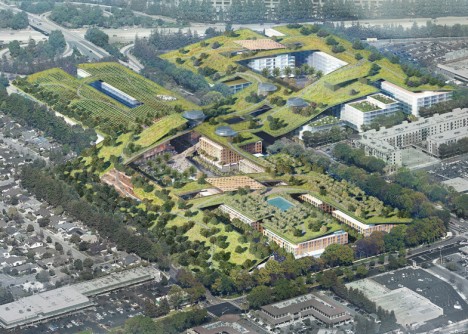
Aiming to turn Cupertino into the green center of Silicon Valley, this expansive green roof design rolls over 30 acres of central urban real estate, capping a massive mixed-use redevelopment project. The resulting street-crossing expanse is set to include miles of walking trails, vineyards, orchards, playgrounds and an amphitheater.

silicon vally green roofs

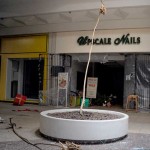
Developers from Sand Hill Property Company assembled the constituent real estate, including a partially abandoned Vallco Shopping Malls, from separate owners.

silicon valley green rooftop

Their proposal to create nearly 1,000 apartments and over a million square feet of office space was developed in part by architect Rafael Viñoly with the assistance of OLIN Landscape Architects.

largest roofs

In the buildings below, a cinema, gym, shopping center and ice rink are slated for construction, revitalizing the downtown area and integrating with outdoor elements above.

silicon valley theater amipheather

“The Hills at Vallco features an unprecedented 30-acre community park and nature preserve, which will not only be the largest community park in Cupertino, but also the largest green roof in the world” according to the developers behind the scheme.

cupertino california silicon valley

The plan has been pitched to the city as a way to secure its position as a hub for technology and innovation in California. The project is currently entering a public review phase. Critics note that feasibility may be an issue, citing the architect’s record with a London skyscraper known for blowing over pedestrians and lighting cars on fire.

Share on Facebook


[ By WebUrbanist in Architecture & Cities & Urbanism. ]

[ WebUrbanist | Archives | Galleries | Privacy | TOS ]


WebUrbanist

 
Comments Off on Silicon Greenery: World’s Largest Green Roof to Span City Blocks

Posted in Creativity


Open Competition: Redesign the World’s Largest Temporary City

01 Sep

[ By WebUrbanist in Architecture & Cities & Urbanism. ]

back rock center camp

Creating a one-of-a-kind opportunity for urban designers and aspiring planners, Black Rock City is soliciting fresh layouts from anyone who wishes to contribute. Winners selected by the BRC Ministry of Urban Planning will be featured in an upcoming publication but will also influence the future shape of this surreal city.

black rock aerial view

As the home of the Burning Man Festival, BRC is unique not only due to its intermittent existence, rising from the desert for just one week every year, but also because of its density and size, with 75,000+ annual residents making their home in less than 2 square miles.

black rock circular layout

The fact that the place is rebuilt anew with each iteration means lessons learned one year can be applied the next, while the absolutely flat desert landscape makes for effectively endless possible layouts. Likewise, the architecture that populates the place is highly varied and ever-evolving, reflecting the radical changes in temperature from day to night and the ever-present threat of rain and dust storms.


black rock city early

While critics and ‘citizens’ alike have strong feelings and differing views about other aspects of the gathering, once attendees have arrived they effectively become residents of a grand urban experiment. Reliant on streets and other public infrastructure, everyone fills into the grid, from individual campsites (often on the fringes) to large theme camps (arrayed primarily around a central circular Esplanade) and core communal functions (generally near the entrance).

fractal pattern

These designs, past through present, reflect the need for clear navigation within the city as well as the desire to foster density and (through that) community interactions, all while maintaining critical services at key places or appropriate intervals.

brc design idea

While leeway is given for creative variation, submitters to the contest are similarly encouraged to reinforce density and interactivity, through fractal patterns or other applicable configurations and shapes. Far-fetched, implausible or even physically impossible entries will still be considered, however, even if they cannot be incorporated in a near-future plan.

brc 99

The shape of the city has changed significantly over time, but certain elements like the centrality of The Man have remained largely the same. Tall relative to its surroundings and aligned with axes of the city, it serves to help orient people (particularly at night) while also providing a central locus around which activity revolves. While it was initially arrayed closely around it, the city pushed back from The Man over the years, creating a broken circle with views to and beyond this center figure.

brc move over time

As the city grew in size, its location also shifted, pushing it deeper into the wide-open desert. However, since 1999, major changes have been fewer and farther between – a fact that may change with the right submission to this competition.

black rock city urbanism

More on the origins of the competition: “We founded the Black Rock City Ministry of Urban Planning with the goal of enabling people to share and discuss ideas for the spatial and geometric possibilities for Black Rock City and regional events, and to give architects and urban designers a platform to participate more directly in this process. Design competitions such as this are a familiar format in these trades, and as such, are an efficient way to get lots of ideas on the table for consideration.”

brc 2015

Types of and evaluation criteria for submissions: “(1) Individual design elements : boulevards, roundabouts, street lights, all of the things that are part of a cityscape that can be incorporated into larger scale plans. Have an idea for a park, or a winding boulevard? Submit this as a design element. (2) Conforming city plans : these are large scale city plans that make adaptations to the existing time + named street coordinate system without altering the fundamental character of the plan. The objective with this type of plan is to make aesthetic or practical improvements to what’s already in place, for example by adding pedestrian boulevards (think Las Ramblas in Barcelona). (3) Non-conforming city plans : here we explore BRC, or a regional event city, as an imagined or science fictional space, and invite people to submit radically new configurations for the city.” (Images via Burning Man, Duncan Rawlinson and Jonathan LaLiberty).

Share on Facebook


[ By WebUrbanist in Architecture & Cities & Urbanism. ]

[ WebUrbanist | Archives | Galleries | Privacy | TOS ]


WebUrbanist

 
Comments Off on Open Competition: Redesign the World’s Largest Temporary City

Posted in Creativity


Lights Out: Hong Kong Bans Iconic Neon Signs from City Streets

30 Aug

[ By WebUrbanist in Art & Sculpture & Craft. ]

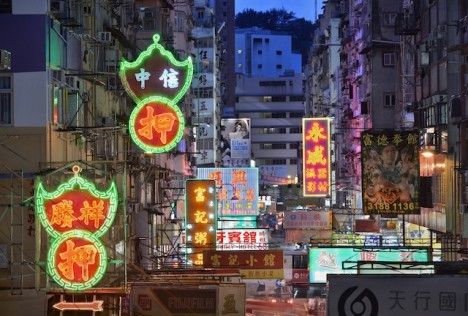
kowloon hong kong lights

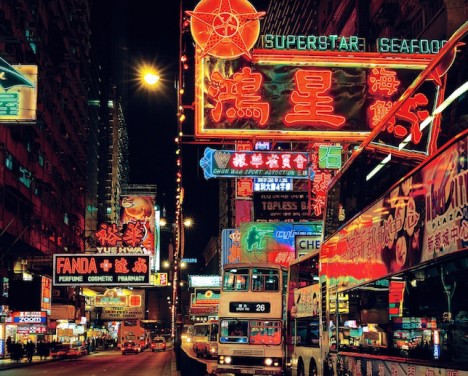
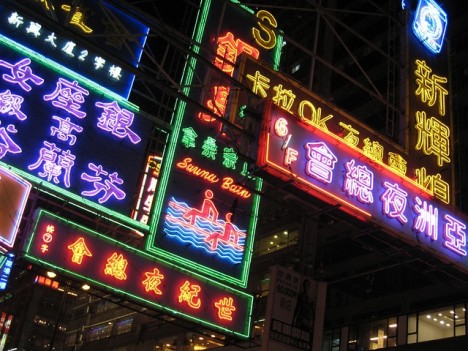
In an effort criticized by local businesses as well as global visitors, Hong Kong has deemed neon signage illegal and is ramping up its systematic removal of these historic place-making lights.

hong kong neon

To fans of the city’s vibrant nighttime glow, such signs define the bustling metropolis as much as any work of architecture or public art, featured prominently in many images taken and movies set on or around Hong Kong Island and Kowloon.

hong kong signage

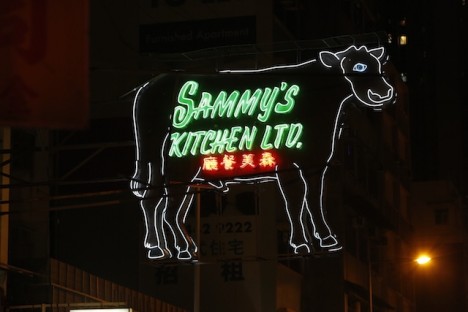
In the last decade, thousands of signs have been removed through incremental city initiatives while preservationists scramble to save, store and display them. Populated with curators and directors from around the world, including the Tate in London and MoMA in New York City, the new M+ Museum is becoming the de facto guardian of many of these castoffs, collecting physical signs as well as videos, images, maps and other documentation.

sammys kitchen sign

More about the digital arm of their endeavor: “Presented by M+, Hong Kong’s museum for visual culture, “Mobile M+: NEONSIGNS.HK” is an online exhibition that celebrates a key feature of the city’s streetscapes by exploring, mapping and documenting its neon signs. Alongside curatorially-produced essays, videos, slideshows and artist commissions, over 4,000 photos were submitted by the public from 21 March to 30 June 2014 to collectively create a unique neon map of Hong Kong. The site will remain as a lasting record and examination of Hong Kong’s fast disappearing neon signs.”

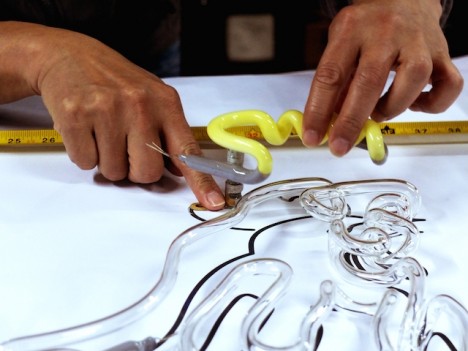
signmaking project

The classic art of neon sign-making involves electrified gas-filled glass pipes, originating in Europe but dating back nearly a century in China. Today, factory-made LEDs are becoming the industry standard. Around the world, the old methods are fading, but many artisanal practitioners continue to fight to restore old signs and keep such practices alive (images by Keith Macgregor, Romain Jacquet-Lagrèze and Mark Pegrum via TheCreatorsProject).

Share on Facebook


[ By WebUrbanist in Art & Sculpture & Craft. ]

[ WebUrbanist | Archives | Galleries | Privacy | TOS ]


WebUrbanist

 
Comments Off on Lights Out: Hong Kong Bans Iconic Neon Signs from City Streets

Posted in Creativity


City Lab: World’s Largest Urban Simulator Spans 26 Square Miles

28 Aug

[ By WebUrbanist in Architecture & Cities & Urbanism. ]

city lab new mexico

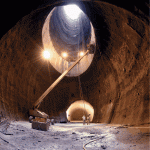
It will be a brand-new, from-scratch American city like any other, with urban, suburban, exurban and rural zones dotted with houses, malls, power plants, police and fire stations, missing only one key ingredient: inhabitants. Currently under construction in the New Mexico desert, the Center for Innovation, Testing, and Evaluation (CITE) is a sort of real-life Sim City, the “first of its kind, in scale and scope,” a unique “fully integrated test, evaluation and certification facility dedicated to enabling and facilitating the commercialization of new and emerging technologies.”

city lab deserted complex

Known informally as City Lab (click to enlarge the diagram above), the 26-square-mile urban laboratory complex has a billion-dollar budget and will host all kinds of tests, including but not limited to: intelligent transportation systems, smart grid technologies and green energy strategies. Wired for data collection and replete with tunnels, system-wide scenarios can be monitored in the minutest detail, a dystopian twist on what might otherwise seem an idyllic mid-sized city capable of supporting 35,000 citizens.

citylabmasterplan

Complete with all the infrastructure of a ‘real’ city, the developer’s target clients include university researchers, federal agencies and commercial enterprises. The facility aims to combine elements of private and governmental test environments like Gravesend, a military and police complex in the UK, Liberty City, a drone-oriented cityscape in the US and Mcity, a newly-built autonomous vehicle testing site in Detroit.

city lab simulation space

If you have one in your town it is a safe bet CITE has one as well, from churches and highways to a city hall and even an airport. While this place contains all a community could ever hope for, the only ‘residents’ of the place will be a staff of over 300 that maintain its infrastructure and supervise experiments. Imagine the reaction of some archeologist from the distant future, seeing a sort of dystopian settlement wired for full surveillance and connected by a vast array of underground tunnels (The Cabin in the Woods comes to mind, poster below), but at the same time oddly unoccupied and devoid of art, brands or billboards.

cabin in the woods movie

Noting the lack of these quintessential hallmarks of modern civilization, a professor at the University of New Mexico decided to ask what kind of public art would fit such a strange and made-to-be-deserted city. Her students solicited proposals from around the country and selected a set of winners. Ingenious ideas included: sculptural mounds made from the dirt displaced during excavation, testing paint colors around the complex for durability and weather resistance and a farcical strategy to sell lots and gentrify the faux city.

city lab public art

More from Pegasus Global Holdings: “As a privately-owned, privately-operated test and evaluation center, CITE is open and accessible to a wide array of public and private customer segments – domestic and international. The structure and policies in place at CITE are specifically designed to remove legal, cultural and budgetary impediments as are currently prevalent in the process of moving beyond basic research and development activities.”

Share on Facebook


[ By WebUrbanist in Architecture & Cities & Urbanism. ]

[ WebUrbanist | Archives | Galleries | Privacy | TOS ]


WebUrbanist

 
Comments Off on City Lab: World’s Largest Urban Simulator Spans 26 Square Miles

Posted in Creativity


Liberty City: Inside an Urban Governmental Drone Test Complex

20 Aug

[ By WebUrbanist in Travel & Urban Exploration. ]

drone system

If you have ever wondered how and where the Department Homeland Security evaluates drones for real-world applications, this Freedom of Information Act request reveals some of the secrets behind the operations taking place at one of these rather mysterious locations. Not to be confused with its video game namesake, tracing back to Grand Theft Auto’s own digital Liberty City, this real-world test site is fascinating to learn about remotely but not somewhere you want to have an actual vehicular adventure.

artifical-street-urban-complex

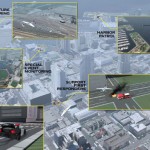
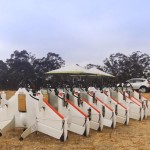
For years, the government has been testing drones for everything from monitoring infrastructure and special events to patrolling harbors and supporting first responders. Run by Robotic Aircraft for Public Safety (RAPS), Liberty City and sites like it let local, regional and national governments deploy different models of drone and decide which best suit their needs. Like Gravesend in the UK (pictured above), officers and troops are also called in on the ground to interact in these remarkably complete but staged environments.

urban drone testing

Variegated urban terrains help those overseeing the tests determine a drone’s ability to identify key objects and individuals in the built environment, distinguish assailants and perpetrators in complex situations and track persons through challenging architectural landscapes. Simulations revolve around everything from ordinary robberies to hostage situations and terrorist attacks. The goal, ultimately, is to figure out what (completely or partially) autonomous vehicle technologies will work both generally and around specific purposes, for applications ranging from emergency search-and-rescue to broader everyday surveillance. While the work they are doing in these places is not classified as such, it is still highly secretive and much of it still remains undisclosed after years of inquiry.

drone testing documents_edited-1

Submitted via MuckRock, the FOIA request behind the details featured here sheds light on the reasons and methods behind these processes and places. Per Shawn Musgrave, “The broad objective of RAPS is to determine whether drones can play a practical role in a broad range of public safety deployments. Such applications include law enforcement, firefighting, disaster response, and search-and-rescue. The RAPS testing program evaluates each drone model for ease of operation, durability and performance in simulated scenarios. Reviewers compile their findings into a database for first responders nationwide to use when weighing a drone purchase.”

Share on Facebook


[ By WebUrbanist in Travel & Urban Exploration. ]

[ WebUrbanist | Archives | Galleries | Privacy | TOS ]


WebUrbanist

 
Comments Off on Liberty City: Inside an Urban Governmental Drone Test Complex

Posted in Creativity


City Museum: Abandoned Warehouse Full of Caves, Rides & Slides

19 Aug

[ By WebUrbanist in Architecture & Public & Institutional. ]

city museum exterior playground

Somewhere between a huge funhouse, playground and circus, the City Museum of St. Louis may be the most entertaining and interactive urban architectural experiment in the world. And if you are not having a good time, you can always hop on the 10-story slide, a remnant of the structure’s days as a shoe factory (originally designed to send products down the side of the building).

city museum bridge

Eclectic from its stylings to its offerings, this unique place features everything from recycled buses and airplanes to giant multi-story slides and artificial caverns as well as more conventional kid-friendly fun in the form of skate parks and ball pits.

city museum ball pit

city museum indoor cavern

Various other imported, salvaged and upcycled oddities can be found throughout, including a vault and safety deposit boxes from a Chicago bank. And the place is constantly changing, being reconfigured and hacked away at by the Cassilly Crew.

city museum slides

What started inside of a derelict structure in the late 1990s has burst from the walls of the building, featuring an array of exterior ‘exhibits’ as well. Visitors can climb ramps, bridges and tunnels to access a high-hanging plane and other repurposed spaces. Up on the roof sits a small Ferris Wheel while a bus hangs over the edge of the building (and of course: people are welcome to climb inside).

city museum roof bus

city museum ferris wheel

The owners boast that they are “always building,” and Gallery Hip summarizes the strange paradoxes of this ever-changing place: “popular among residents and tourists, the museum bills itself as an ‘eclectic mixture of children’s playground, funhouse, surrealistic pavilion, and architectural marvel.’ Visitors are encouraged to feel, touch, climb on, and play in the various exhibits.” Or, as Colossal describes it: “hundreds of feet of tunnels that traverse from floor to floor, an aquarium, ball pits, a shoe lace factory, a circus arts facility, restaurants, and even a bar… because why not?”

city museum bridge system

city museum tower plane

Faced with this amazing place, one is left to wonder: would such an unusual endeavor be approved of were it being started from scratch today, or would safety-minded citizens suck the fun out before it got started? Like Adventure Playgrounds, also more popular in an era now past, it is hard to imagine this kind of project getting off the ground, but thankfully there is a precedent: it is hard to argue with the success of the City Museum.

Share on Facebook


[ By WebUrbanist in Architecture & Public & Institutional. ]

[ WebUrbanist | Archives | Galleries | Privacy | TOS ]


WebUrbanist

 
Comments Off on City Museum: Abandoned Warehouse Full of Caves, Rides & Slides

Posted in Creativity


A Street Photographer’s Guide to New York City

10 Aug
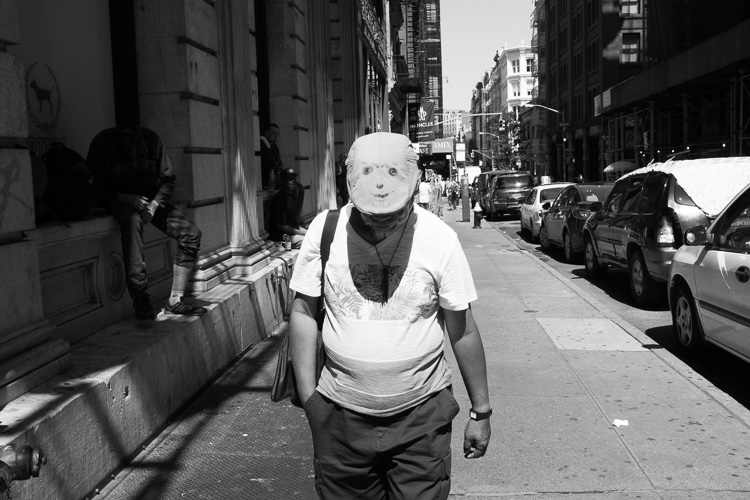
Smiley Face, SoHo, NYC.

Smiley Face, SoHo, NYC.

Street photography and New York City are terms that often go hand in hand. New York is a diverse city of nearly 8.5 million eclectic and vibrant souls, all packed into a tiny island and its surrounding boroughs. Each area of the city has its own unique character and flavor, and there are so many interesting, unique moments that you can see here on a daily basis. It is one of the great locations in the world for this genre of photography.

As a lifelong New Yorker, let me state that it can also be very easy to overrate this city. Street Photography can, and should, be done everywhere and the fact that an image has been taken in New York does not make it any more interesting than an image taken anywhere else. The fact that millions of images are taken here each day makes it that much more difficult to create an one that stands out from the rest, but that is also part of the appeal.

If you live in a less populated place, or are tentative about trying street photography, New York is one of the best places to come to get over those fears. The streets are packed with people who are all in a rush, tourists are constantly photographing so you will not stand out, and most importantly, a lot of people move to, or visit this city, to be noticed. It is an environment ripe to practice and improve street photography.

Here are nine suggestions to keep in mind for doing street photograph in New York City (keep in mind these tip can be applied elsewhere as well).

1. Slow down and don’t try to photograph it all at once
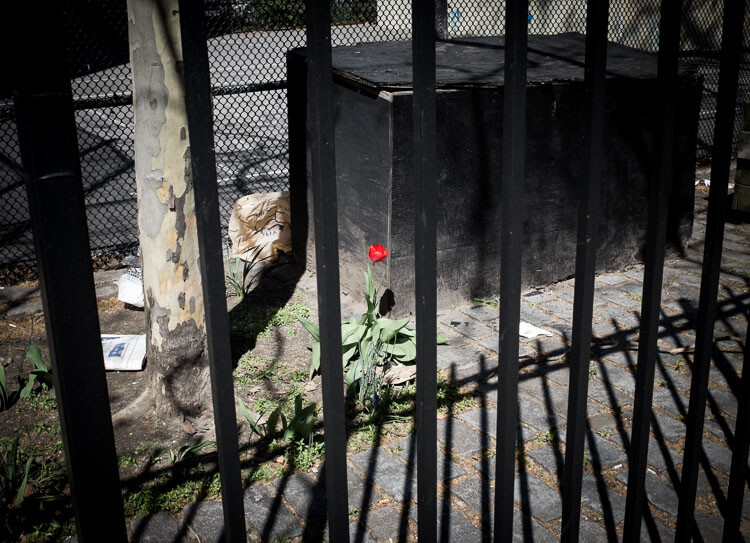
Red Flower, East Village, NYC.

Red Flower, East Village, NYC.

Up, down, left, right, tall buildings everywhere – it is so easy to become trigger happy here. You should experiment and take a lot of images, however, that is also one of the easiest ways to miss the most interesting moments. Sometimes the best moments will be subtle, or they will come upon you in an instant. Look with your eyes first and locate something of interest, then capture it with the camera. Don’t just stick your head in the viewfinder and start shooting away.

Watch your surroundings and take it all in. Explore. Find interesting compositions, look at the light, and get a feel for the people walking around. Try to go beyond only capturing the grand or iconic aspects of the city. Go beyond the images that you have seen in books. Seek out the little details and let the streets surprise you.

2. Put yourself in the middle of the commotion and take what comes to you
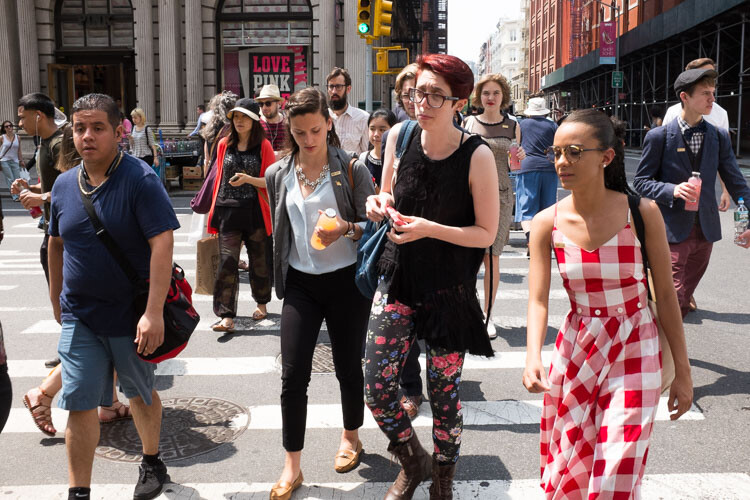
The corner of Prince and Broadway, SoHo.

The corner of Prince and Broadway, SoHo.

Busy street corners are a beautiful thing. Head to one, pick a spot, and suddenly people will start coming at you from every direction. They will start intersecting and interacting with each other. It is what Jane Jacobs referred to as a ballet,

“The ballet of the good city sidewalk never repeats itself from place to place, and in any once place is always replete with new improvisations.”

It you are tentative, choosing a spot in this manner will allow your subjects to enter your personal space, instead of you entering theirs. Since you will not be walking, and your camera will be ready in your hands, it will also make you more able to notice interesting moments and able capture them before they disappear.

Each street corner has a different flavor to it. If you go to SoHo, you will find the trendier crowd. If you go to Wall Street, you will get businessmen. If you go to Times Square, you will get the tourists and people in cartoon costumes harassing young children. Usually, you will get a mix of all types of people, but each corner will have its own identity. Spend a little time each day on a few corners capturing what happens around you.

3. Cut out the preconceived notions of what the city should look like
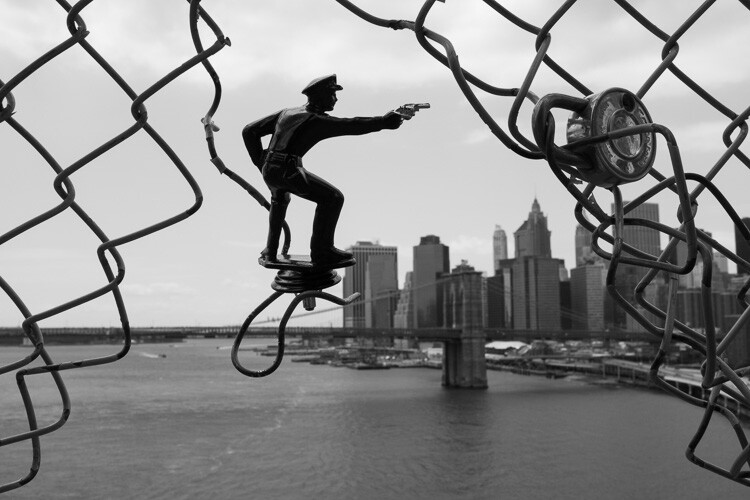
Police, Manhattan Bridge.

Police, Manhattan Bridge.

You’ve probably seen movies and read books about the city, and have expectations for how it is supposed to look and act. The TV shows Friends and Sex and the City are just not realistic interpretations of what New York is actually like.

It can be a good idea to scout images ahead of time, to have an idea how an area looks. It’s also fun to try and recreate images that you love. But on a day to day basis, try to also get those images out of your head. A once in a lifetime image is one that will surprise you, it will be different in some way from all the rest. Allow yourself to notice those serendipitous moments.

There is so much to see here. No matter how much time you have, you can’t see it all. But you haven’t truly seen New York City until you’ve spent at least half a day wandering around, with no end point. Carve out some time, pick a direction or a location, and just walk.

4. Rent a small camera or a prime lens
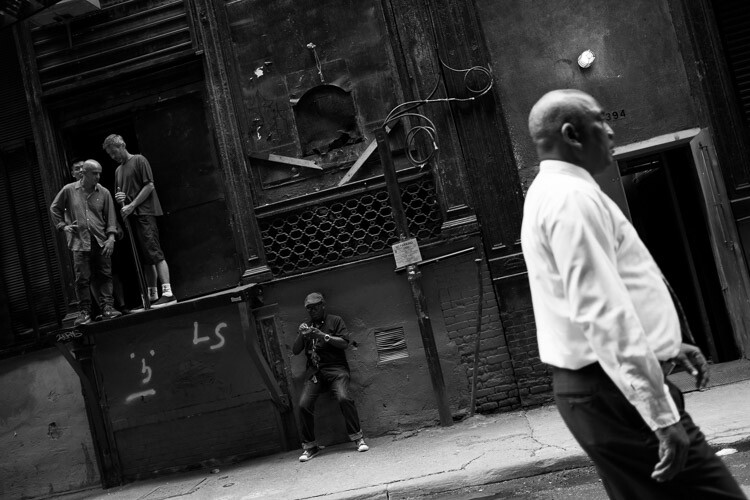
Cortlandt Alley, NYC.

Cortlandt Alley, NYC.

Note: If you have a larger DSLR and a zoom lens, I shot street photography for a long time this way, and it is very possible to do so successfully. However, larger cameras can make it more difficult and cumbersome, and can make things more uncomfortable for your subjects.

New York has an array of great camera shops where you can rent either a light prime lens for your DSLR or am entirely different smaller camera. A light 35mm lens is my favorite tool for street photography. Go for the f/2.8 version over the f/1.8, since it is much smaller and lighter. If you are very nervous about getting close to your subjects, rent a 50mm so you can shoot from a little further away. (Note: If you’re using a cropped or APS-C sensor a 50mm f/1.8 and an 85mm f/1.8 would be equivalent).

Consider trying a mirrorless or micro four thirds camera. See how you like it, and you may never go back. I suggest the Fuji X100 line, but there are a variety of cameras that will do the trick.

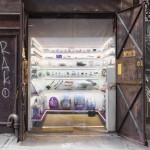
Some recommended camera rental shops in NYC are: Foto Care, CSI, and Adorama.

5. Set up your camera to catch fast moving scenes

The streets of New York move quickly. Interesting moments will appear, and disappear, all around you that is why it is important to set up your camera so that it can freeze scenes successfully. You want to set it up in such a way that you no longer have to worry about the settings, and can just shoot with ease.
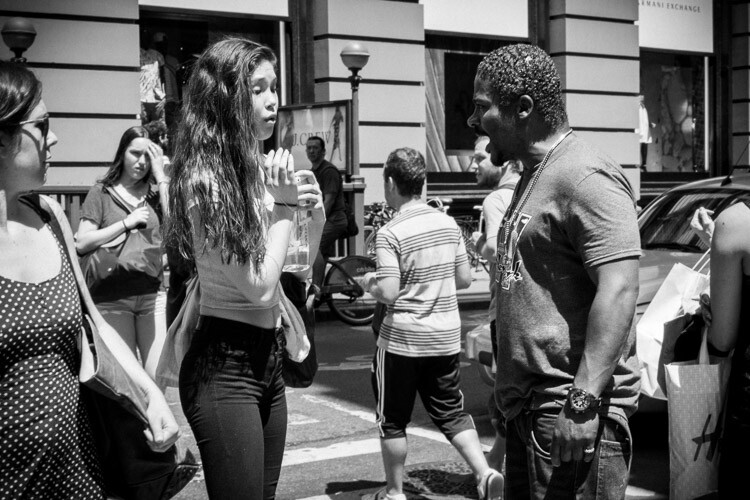
Encounter, SoHo.

Encounter, SoHo.

I prefer using shutter priority for street photography. Many people prefer aperture priority, but the reason for shooting in shutter priority is to have the most control over your aperture. I know that sounds counter-intuitive, but hear me out. To freeze motion, I will usually set the camera to 1/320th or 1/250th of a second. In the bright sun of summer my shutter speed is usually at 1/320th or 1/400th, otherwise I am usually at 1/250th. At dusk and into the night I will go all the way down to 1/125th if it is absolutely necessary. The next step is to raise your ISO. I usually shoot anywhere from ISO 800 to ISO 3200 (and ISO 6400 outside at night). In bright summer sunlight, I am usually around ISO 400.

The goal is to be able to use the smallest possible aperture, while still having a shutter speed that is fast enough to freeze the scene. The smaller the aperture, the more depth of field you will have. This will give you a lot of flexibility if you happen to miss focusing on the subject, which happens frequently. In addition, if you are combining multiple subjects or complex scenes with interesting elements all over the frame, it will make sure that as much of the scene as possible is sharp. Whenever the light is strong enough, I prefer to be at least at f/8, and ideally between f/11 and f/16.

When you become comfortable with all of this, the next step is to try zone focusing. I would suggest that you start with your normal method of focusing until you get comfortable, then give zone focusing a try. When I walk out the door with my Fuji X100S I usually turn the autofocus off and have the camera pre-focused to 2.7 or 3 meters (8.75-9.75 feet). I will then adjust with the focusing ring accordingly (closer or further away) as I come across images, or turn on autofocus to capture scenes where nothing is moving.

6. Try street portraiture

Did I mention that New Yorkers like to be noticed? Find people that catch your eye, and tell them you are creating a photo project of the city. You will be surprised at how many people will allow you to photograph them. This is a great way to get more comfortable on the street, and with portraiture in general. Once you get a couple people to say yes, you will find yourself feeling so much better.

Flattery is always a good idea when asking to take a portrait, and I usually try to spend about 30 seconds getting my shots. Don’t take just one quick photo and run away, but don’t take too long either. Take a quick look at the lighting and the background to make sure that you get a complete image, and try to capture them with an interesting expression if possible.

7. Photograph at night
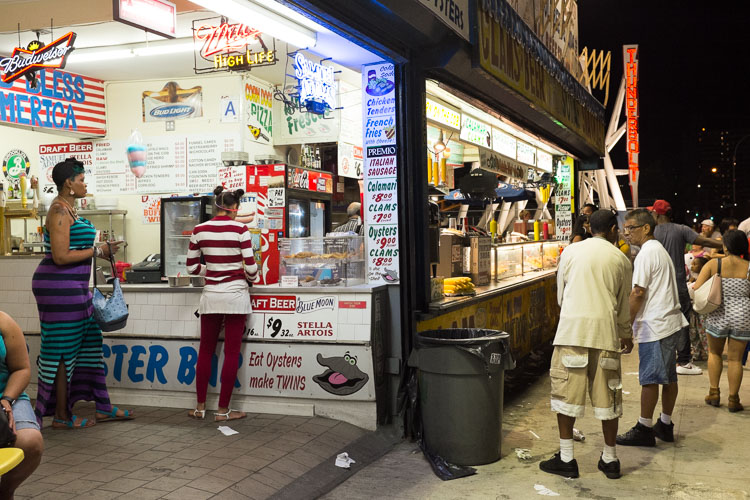
Coney Island at Night.

Coney Island at Night.

Set your camera on 1/160th of a second and ISO 3200 or 6400 and wander. The city glows at night and everything looks more interesting. Forget the heavy tripod unless you are doing architecture images. Instead, find areas that are lit by store signs or street lights, and create your images that way.

New York is extremely safe these days and I photograph at night by myself all the time, but be smart about it. Particularly if you do not know where you are going, it can’t hurt to take a friend along or to stick to high traffic areas. But the areas where most people visit in Manhattan are all very safe at night.

8. Some areas to explore
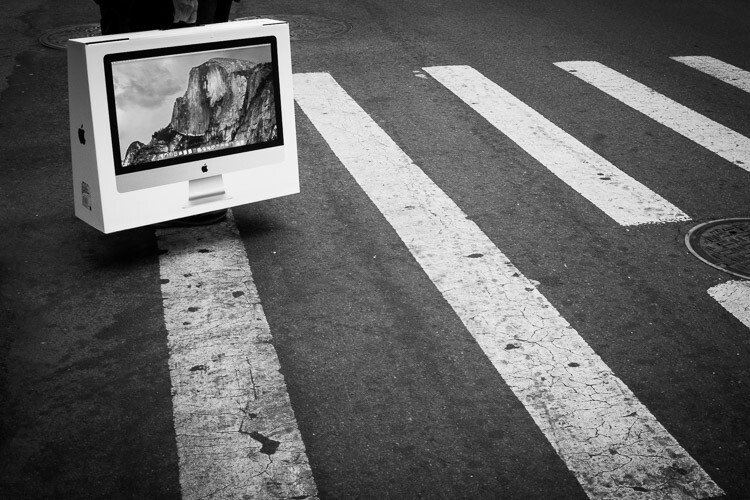
Yosemite, SoHo.

Yosemite, Corner of Prince and Broadway, SoHo.

My favorite locations in NYC are:

  • SoHo: Stop on the corner of Prince and Broadway, one of the busiest and most fashionable corners in the city, and then walk over to Greene Street and head south to see some gorgeous cast-iron architecture.
  • 5th Avenue below Central Park: Stop on each corner from 58th Street to 53rd Street for some of the busiest and most interesting corners in the city. You might bump into the famous fashion street photographer, Bill Cunnigham.
  • The East Village and Lower East Side: Young hipsters, old punk rockers, and about a hundred other demographics gel together in these vibrant neighborhoods. The buildings are old and beautiful, and the streets are interesting and weird. Some great street art is there as well. Stop at VolaVida gallery on 4th Street and Avenue B to purchase an affordable and authentic street art piece.
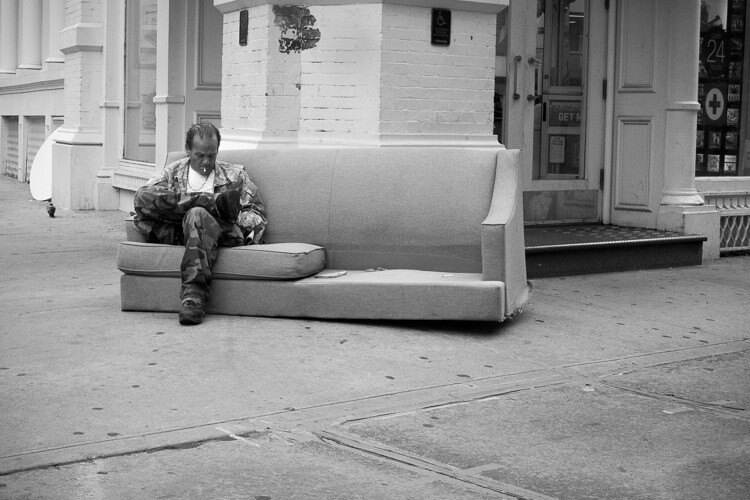
East Village, NYC.

East Village, NYC.

  • Anywhere on Broadway: Literally anywhere. Start at Columbus Circle and walk all the way down Broadway until your feet hurt.
  • Chinatown and Columbus Park: Chinatown has some of the most beautiful streets in New York. Eat dumplings while you photograph and visit Columbus Park, where people go to gamble. Be respectful while you photograph there. Afterward, visit Pell Street and Doyer’s street (nicknamed The Bloody Alley for its nefarious past). These are two of the most beautiful streets in all of New York.
  • Coney Island: One of the most vibrant places in the city, particularly in the warmer months. Photograph the boardwalk and beach, eat a hotdog, and go on a few rides.
  • Grand Central and the 42nd Street subway station: Photograph in Grand Central, then take the shuttle to the 42nd Street station. Walk back, stopping to photograph at Bryant Park and on the steps of the New York Public Library. Pop into the lobby of the Chrysler Building while you are there.
  • Bushwick (Brooklyn): This is one of the centers of street art in New York. Take the L train to Morgan Avenue and explore a handful of blocks in every direction. When you get hungry, stop at Roberta’s for some pizza.

9. Take the typical tourist photos
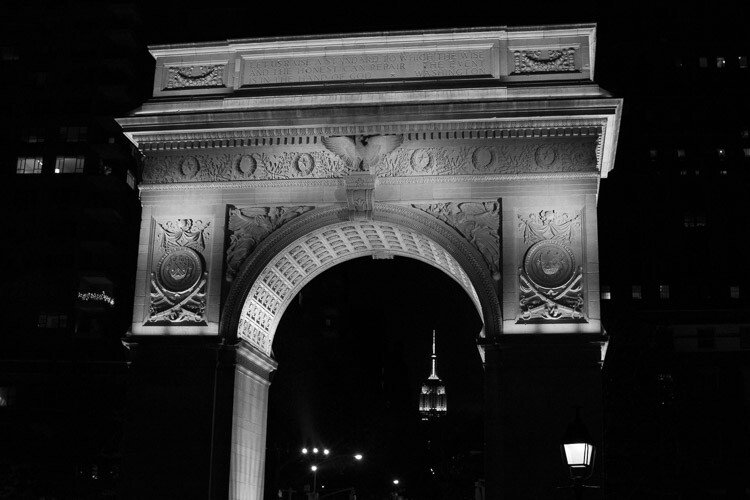
Arch and Empire State Building, Washington Square Park.

Arch and Empire State Building, Washington Square Park.

You are visiting the city for a reason. The architecture and the sites are awe-inspiring, beautiful, and they deserve to be photographed well. History is around every corner. Do not apologize or feel bad, for taking the typical tourist and architecture images of the city. However, whenever possible, try to think of a way to make them stand out in some way. This is not always possible, but occasionally it is, and when you are able to figure out how to take an image like that, it is a special moment.

Just don’t take a selective color photo of a yellow taxi with a black and white background. I beg you. Please, please don’t do that!

googletag.cmd.push(function() {
tablet_slots.push( googletag.defineSlot( “/1005424/_dPSv4_tab-all-article-bottom_(300×250)”, [300, 250], “pb-ad-78623” ).addService( googletag.pubads() ) ); } );

googletag.cmd.push(function() {
mobile_slots.push( googletag.defineSlot( “/1005424/_dPSv4_mob-all-article-bottom_(300×250)”, [300, 250], “pb-ad-78158” ).addService( googletag.pubads() ) ); } );

The post A Street Photographer’s Guide to New York City by James Maher appeared first on Digital Photography School.


Digital Photography School
 
Comments Off on A Street Photographer’s Guide to New York City

Posted in Photography


Robot City: Entire Fake Town Built to Test Driverless Vehicles

23 Jul

[ By WebUrbanist in Technology & Vehicles & Mods. ]

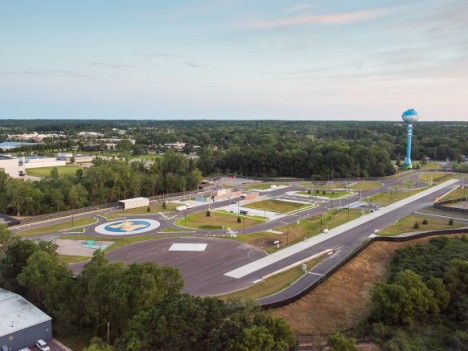
7/15/15               2015 UM Aerials -July                 MCity, North Campus, Munger Grad                            Residency,Campus construction.

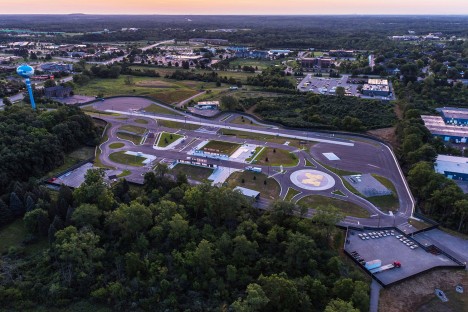
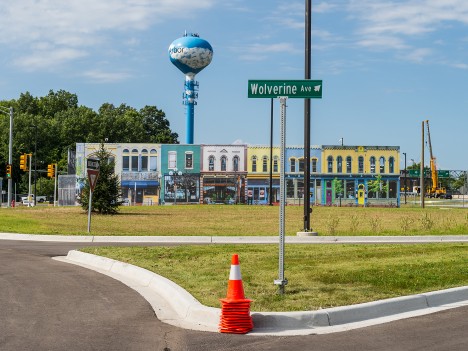
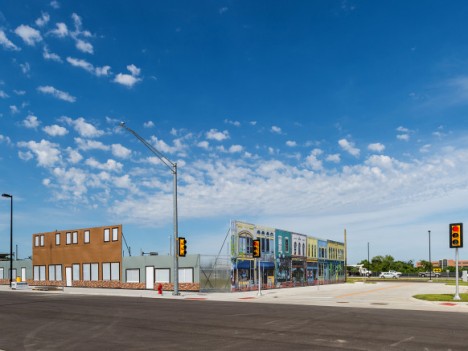
Opening this week, Mcity is a completely artificial village for self-driving cars, bringing the future of automobiles back to Michigan, the historical home of Motor City. Taking lessons from military testing facilities like Gravesend in England or Yodaville in the US, the complex is made to simulate a wide variety of conditions.

fake town driverless cars

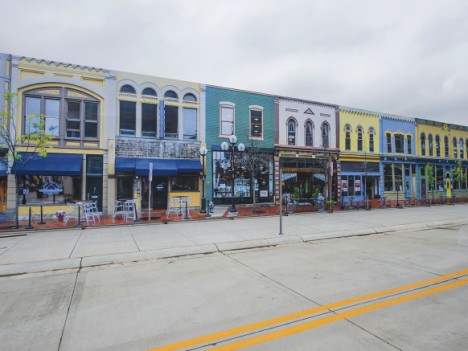
Featuring 32 acres of roads, intersections, sidewalks, streetlights, signals and building facades, Mcity is part of a statewide effort to advance connected technologies and test autonomous vehicles. More than a simulated combination of urban and suburban environments in their ideal forms, these experimental grounds also incorporate stress-testing defects like graffiti and faded lane markings as well as different street terrains, tunnels, roundabouts and multi-lane freeways on a combination of pavement, cobblestones, gravel, grass and dirt.

fake city autonomous vehicles

Given that all crashes to date involving autonomous cars have been caused by human error, it is critical not only to test the vehicles themselves but also the people they will interact with on the road. In addition to its proximity to Detroit, a key benefit of the Ann Arbor area is the varied weather in the area, with everything from hot humid midsummer days to serious rain, snow and hail in the winter. The test area can be reconfigured on demand to simulate complex intersections, blind corners and other real-world challenges.

fake city university michigan

The project represents a $ 10,000,000 private/public partnership between the University of Michigan, local governments and various industries, including but also beyond regional and international automotive powerhouses (Ford, GM, Honda, Nissan, Toyota but also State Farm, Verizon, and Xerox).

7/15/15 Aerials of UM Campus and Ann Arbor.

“We believe that this transformation to connected and automated mobility will be a game changer for safety, for efficiency, for energy, and for accessibility,” said Peter Sweatman, director of the U-M Mobility Transformation Center. “Our cities will be much better to live in, our suburbs will be much better to live in. These technologies truly open the door to 21st century mobility.”

“In addition to Mcity, MTC has three on-roadway connected and automated vehicle deployments underway. With the help of the Michigan Economic Development Corporation, MTC is building on a nearly 3,000-vehicle connected technology project launched three years ago by the U-M Transportation Research Institute to create a major deployment of 9,000 connected vehicles operating across the greater Ann Arbor area. MTC is also partnering with industry and the Michigan Department of Transportation to put 20,000 connected vehicles on the road in Southeast Michigan. The third piece of the plan calls for deploying a 2,000-vehicle mobility service of connected and automated vehicles in Ann Arbor.”

Share on Facebook


[ By WebUrbanist in Technology & Vehicles & Mods. ]

[ WebUrbanist | Archives | Galleries | Privacy | TOS ]


WebUrbanist

 
Comments Off on Robot City: Entire Fake Town Built to Test Driverless Vehicles

Posted in Creativity


Unread: 12 Abandoned Inner City Newsstands

05 Jul

[ By Steve in Abandoned Places & Architecture. ]

abandoned newsstands 0
Once vital fixtures of the urban milieu, these inner city newsstands were abandoned by an information society evolving away from portable print media.

abandoned newsstands 1

abandoned newsstands 1b

abandoned newsstands 1a

Time’s up for this classic green newsstand near the corner of 34th Street and 8th Avenue in New York City. One of many near-identical twins still thrives nearby at 33rd and 7th, however – blame the cold equations of economics driven by the relentless advance of technology.

abandoned newsstands 1f

abandoned newsstands 1d

Flickr user Brecht Bug captured the forlorn state of this formerly ubiquitous inner city icon in early February of 2010. One wonders if its grungy sister stand at 33rd and 7th (above) is still serving commuters the Daily News five years further on?

L.A. Times They Are a-Changin’

abandoned newsstands 2

Our rickety old globe has spun many a time since Globe News, a Los Angeles storefront-style newsstand, locked & lowered its security grating for the last time. According to Flickr user vistavision (who snapped this intriguingly post-apocalyptic tableau), the stand closed for good sometime before July 16th of 2008.

Free At Last

abandoned newsstands 4

An abandoned newsstand in midtown Manhattan presents a uniformly dull and dreary face to a world that no longer cares. Flickr user DeShaun Craddock captured the somber scene in April of 2011 and it’s noteworthy the only bright spot is an ad for a disposable, addictive, carcinogenic product.

Next Page – Click Below to Read More:
Unread 12 Abandoned Inner City Newsstands

Share on Facebook


[ By Steve in Abandoned Places & Architecture. ]

[ WebUrbanist | Archives | Galleries | Privacy | TOS ]


WebUrbanist

 
Comments Off on Unread: 12 Abandoned Inner City Newsstands

Posted in Creativity