RSS
 

Posts Tagged ‘Choosing’

Choosing a Tripod

23 Sep

For lighting photographers, the first thing to consider about a tripod is this: a tripod is your most powerful light.

That’s because time (AKA shutter speed) is what we use to bring up the exposure in a large environment, which we then tweak/improve with judicious use of added flash. It is very difficult to light a large space, so just let the ambient do the heavy lifting and finish it off with your lighting genius.

And even when you are not lighting, you’ll frequently need a tripod for a variety of reasons. And when you do, you want it to hold your camera still.

To that end, every photographer needs good sticks.

There are a couple of schools of thought about how to choose a good tripod. But no matter which way you go, the most important thing is this: don’t waste your time and money on a piece-of-crap version. You’ll just have to re-buy it later.

Ask any photographer who has been around long enough to make mistakes, and you’ll probably hear tales of woe over misspent dollars in an attempt to save money on tripods. Alas, good tripods aren’t cheap and cheap tripods aren’t good.

I just had a direct experience with this problem on a recent series of assignments for Lynda.com, wherein we were traveling around the world shooting and filming in various cities. My (young) shooting partner saved some money by buying an inexpensive, “feature-ladened” tripod.

Actually, scratch that obfuscation. Let’s name names. He bought a “Vanguard” Tripod, and it turned out to be a piece of crap. (Don’t judge. It’s a common mistake.) The Vanguard was wobbly up top, and very quickly, one of the legs would not grab and click into the open position.

(You had ONE JOB, Vanguard tripod…)

After much swearing on Andrew’s part (and general uselessness on that of the tripod) he looked into repairing the probably-not-worth-fixing piece of gear. Though clearly defective—and still in warranty—Vanguard wanted Andrew to pay shipping both ways for the repair. Essentially, he’d be buying the cheap tripod again.

Ugh.

Look, don’t do this. Just don’t. Instead, do your research, ask around, buy a good tripod and be done with it.

To Start…

Independent of the factors listed below, here’s my first advice: go for a name brand with a good reputation.

Manfrotto, Gitzo and Induro are good examples. None of them are cheap, but they are also likely to not let you down. They are supported by a great reputation and solid service, the same way your camera is supported by a good tripod.

Don’t save money by buying a tripod that is spec’d to do less than you need it to do. That’s another mistake. And you may find there is not a one-size-fits-all tripod for you. The optimal tripod for your big bird-watching rig might be overkill for your travel photography needs.

Similarly, a tripod designed for travel photography—even if a quality brand—might be way under-sized for your big lens work.

So like most shooters you’ll probably end up with two tripods. One as a heavy-duty platform and one that is much more portable.

General Purpose Tripods
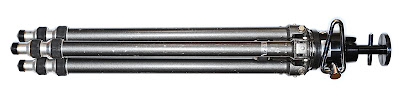
Your first tripod will probably be one that can do everything well, but maybe sacrifices extreme portability. And that’s a good strategy.

Again, go with a good brand and buy enough support for your needs. If money is tight, rather than skimping on the brand I would suggest buying good quality, but buying used.

The 20-yr-old old metal (more on that variable below) Gitzo Reporter Performance pictured above is total, rock-solid support. It was bought used (eBay) reasonably and will last me the rest of my life and well into someone else’s.

Used quality is a better choice than new crap. But if you have the money to spend, by all means take some time and test drive some new tripods in person. You’ll quickly get a feel for the solidity and quality of the various options.

But go with a brand that has a good reputation. Or skimp, curse a little and get it right on round two.

Specialty Tripods
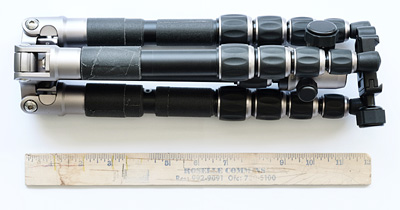
By specialty, we generally mean portability: small, light, reverse-folding, etc. This is the tripod you take with you when you travel, or when shooting smaller mirrorless cameras. Or both, obviously.

For extreme portability in addition to solid support at the mirrorless level, I like the MeFOTO Backpacker, ($ 139 – Amazon) seen above. It is not full-sized, as it only goes to about chest-height.

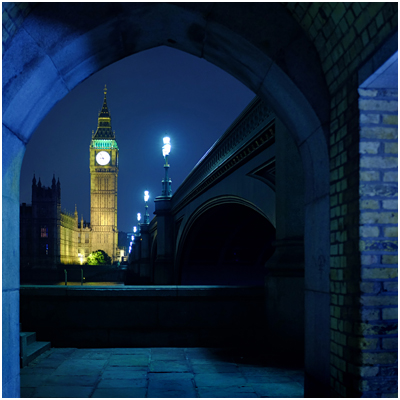
But—BUT—it reverse folds to a very compact 12.6″, which makes it a total win for travel or backpacking (duh, the name) with mirrorless cameras. It is super-compact, and well-built. I used it with a Fuji X100s to make the photo of London’s Big Ben, above.

If you shoot full-sized DSLR, I would suggest stepping up to a MeFOTO GlobeTrotter. It is bigger, more stable, goes up to 64″ in height and has a retractable center column while still keeping the reverse-fold design. Even still, it folds to just 16.1″ long. ($ 209 – Amazon). As a bonus it converts to a monopod, which is nice.

You can spend an extra $ 160 on the GlobeTrotter and go carbon fiber, which saves you a pound. But for that price you can literally buy both and have $ 20 left over. Or $ 160 would get you a great, second general-purpose tripod used.

Speaking of…

Carbon Fiber or Metal?

Tough choice. Carbon fiber is more expensive—sometimes shockingly so. For instance, an Induro (carbon) CT-214 cost $ 400—for just the legs (no head). But you can get the same legs (an AT-214) in aluminum for $ 149.

Those are both great supports. And identical, except for the material used in the legs. But is the weight difference, at 3.3 vs. 4.4 lbs, worth that much to you? Or, perhaps will the size of the tripod itself be the limiting factor in your suitcase or backpack that outs it from travel for you?

If the carbon version really fits your total needs and you can afford the price tag, maybe that’s cool. Or maybe you buy metal for big support and a MeFOTO for travel. You would save money (over $ 100 in this example) in the process.

And honestly, that’s what I’d do.

Either way, the worst, worst, worst thing you can do is to throw money away on a crap tripod. Consider my lessoned learned (and that of literally millions of photographers before you) sufficient warning.

Strobist

 
Comments Off on Choosing a Tripod

Posted in Photography


Choosing a Camera

04 Sep

There is no perfect camera. So get that idea out of your head right now. Far better to think of any camera as a set of compromises. Size, speed, image quality, low-light performance, price, etc., can all be features—and they can all be liabilities.

You want image quality? Get an 11×14″ film camera. Great for detail and tonal range. But sucks for action sequences / portability / low light performance.

Every camera is a compromise in at least one area. So to start, list your most important features on a sheet of paper and let that guide your choosing strategy.
__________

• If you want best-possible image quality, you might sell your car/house/plasma and buy a digital medium format camera.

• If you need super long glass and/or FPS speed (sports, nature, etc.) maybe grab a fast Nikon (or Canon) and a super-telephoto lens.

• If you shoot people, speed and high ISO performance might not matter as much as gorgeous color.

• I you travel a lot you might put a premium on your cameras being small and lightweight, with good low-light performance.

• If you are following a toddler around the living room, continuous AF performance may trump price.

So think about what is important to you (and your budget, of course) and begin your search for cameras using that as a compass point.

If you are old like me, you might be tempted to only consider cameras built around the dated form factor of film cameras to be the only cameras worth serious consideration. That’s an age bias. Have it if you like, but be aware of it. To a twenty-year-old that doesn’t matter any more.

Speaking of age, if I were just dipping my toe into the water I’d strongly consider a late-model used digital camera and a used lens or two. If I was not happy, it would be a cheap marriage to unwind. Within a year I could probably sell the lot on eBay for a couple hundred less than I paid, max.

And if I was happy it would be a great platform to build on. Once committed, my next body might something current and the original body goes to a second/backup. Either way, I would not expect to be using the camera after five or six years.

Point is, you don’t have to jump in the deep end. Buy one body and a lens or two. Maybe buy used from a shutterbug friend, knowing the camera implicitly comes with ad hoc tutoring. (And a good outlet to borrow/lend lenses, bodies, etc.)

I spent over 30 years with Nikon film and digital SLRs as my primary cameras. But the further I got away from shooting for newspapers (which at the time had included lots of sports photography) the more my priorities shifted. Here is what is important to me now: small, lightweight, good image quality, great in low-light and quiet/unobtrusive. That led me to move to mirrorless (Fuji) a couple years back.

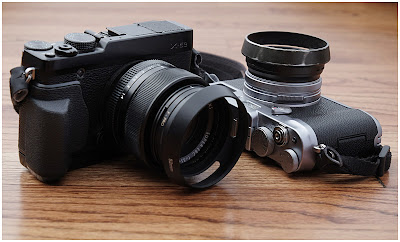
Pictured at top are the cameras that currently get more use than anything else I have (save maybe my iPhone): a Fuji X-E2 and a Fuji X100s.

Whatever camera style/brand you are considering, you can use the ‘net to easily scope out how other photographers are using it and what kind of image quality it has.

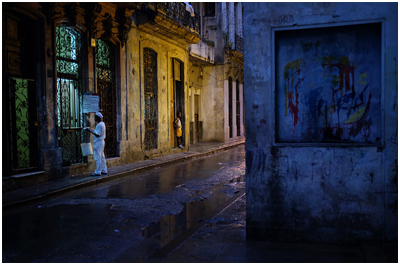
For instance, try this: click on the night photo just above, which will take you to its Flickr page (in a new window). Scroll down beneath the photo’s page where it says “Fujifilm x100s” (or just click here) and you go to a page that will show you lots of different photos shot with exactly that model of camera.

And here’s the thing: clicking on that link from just about any camera icon on a Flickr photo page will quickly show you that you can make amazing photos with just about any current camera. So don’t sweat it or pixel peep too much.

Instead, focus on how you will be using the camera and what features are truly most important. Then let that drive your choices. And understand that the camera you use today probably won’t be the camera you are using in five years.

NEXT: Lenses


Strobist

 
Comments Off on Choosing a Camera

Posted in Photography


Choosing Lenses

03 Sep

If you date your cameras, you marry your lenses. That’s because, unlike digital cameras, a well-chosen lens can serve you for a very long time.

I still have one lens that I bought thirty two years ago. And I bought it used. I doubt that will be the case with any of my digital cameras, ever.

In the past, I was a lens speed freak and was willing to spend great sums of money to have very fast glass. I now realize that lust was misplaced. If I had it to do over again (and I do, and have) I would lean more on reasonably fast primes and here’s why.

Moderately fast primes are (much) lighter, (much) cheaper and often just as sharp (or sharper) than their speedy siblings. For Nikon shooters, the Nikon 28, 50 and 85 f/1.8 trio of lenses are great examples of this. They weigh next to nothing in my bag and offer great performance. Also, I have moved away from primarily using fast zooms. Rather than a fast 24-70/2.8, I’d now opt for a trio of fast-ish primes and a decent, slower zoom to back them up.

This way, you get a stop (plus) faster at each focal length, backups throughout the 24-70mm range and you lose the most daunting aspect of the speed zoom: an expensive single point of failure.

In general, remember this when it comes to ultra-fast DSLR lenses: you pay through the nose for them when you buy them. And then you pay again, in weight, every time you lug them around. Remember that cameras have amazing high-ISO performance these days. And they are just going to get better as we go.

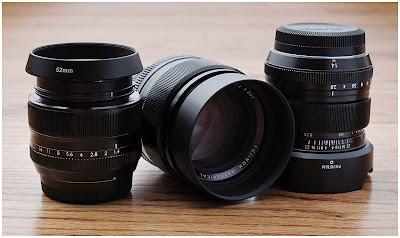
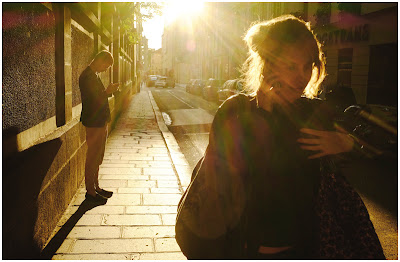
As for my Fuji lenses, it is pretty hard to go wrong with their primes (although I’m not a huge fan of the 60mm macro…) But the others are small, gorgeous and fast. I love the built-in 23mm (35 equiv.) of the X100s. It’s sharp wide open and it has beautiful flare when you point it right into the sun as seen above. It’s my most-used lens. Which is a good thing, given that it’s welded to x100s.

Along with that, the 35/1.4 (50mm equiv., seen at top on left) and 14/2.8 (21mm equiv., on right) are my go-to lenses on the interchangeable lens Fuji bodies. If I am shooting tight headshots, maybe the 56/1.2 in the middle.

As a backup, I like the 18-55 kit zoom (not shown). Which, although not a speed lens at f/2.8->f/4, is great optically and has stabilization.

Good performance from a kit lens (the zoom that often comes packaged with a camera) is not a given, as many of them are crap. If you are using a kit zoom as your main lens, know that it will be be sharpest near the middle of the aperture scale—let’s say around f/8. In fact, most lenses are great at f/8.

If you like to hang out close to wide open, grab a (used, if necessary) prime at your most-used focal length. You’ll be a happy camper—and have a backup if needed.
__________

What to buy? And when? That should be driven by what/how you shoot.

Here’s my thinking on lens progression, driven by how I shoot. Most of the time I am going to go out with a single, prime lens. I like the size, the weight, the speed and sharpness. Actually, I also like the discipline of having a single focal length. It helps me to see better.

With a new system I’d build out my wide/normal/short-tele primes, then get a decent wide- to short-tele zoom as a backup or for times when I would want one-lens variability. Only then do I start going for more exotic lengths if needed.

The reason is simple: most of my work will be done with the bread-and-butter focal lengths of moderate wide to short tele. So I want good quality, speed and backup in those lengths before I start to get crazy with a superwide or whatever.

You can easily try out a lens for no risk. Buy a good example used, from someone with a good return policy. If the lens is a dog, return it immediately. If it is good enough to where you want to keep it and play, you can always resell the used lens for about what you paid for it within a year or two.

So, very little risk. (In fact, if I was going to need to rent a lens for more than a week I’d do it this way. Your rental would be practically free.

And obviously, if you love a lens and decide to marry it and keep it forever that’s best possible case.

NEXT: Lights


Strobist

 
Comments Off on Choosing Lenses

Posted in Photography


Choosing Lights

03 Sep
Because big lights and small lights each bring a different set of considerations to the party, I am splitting my recommendations into speedlights and “studio lights.” (Although I hate that term.)

For speedlights, you have to decide if you wanna drive stick or automatic—AKA manual or TTL. I live in manual mode, which means I sacrifice some convenience for reliability and repeatability. It also means I can pay about a third as much for each of my flashes.

If you live by TTL, you will die by TTL. Or, at least your wallet will die a small, unnecessary death every time you need to purchase a flash.
__________

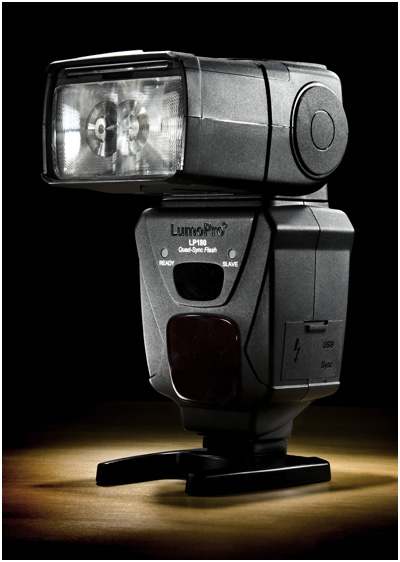
For manual speedlights, I wholeheartedly recommend the LumoPro LP180, about which I go into far more detail here. It’s built like a tank, syncs four different ways, has a fluid and intuitive user interface, a built-in light-stand socket, a built-in gel holder and has a two-year manufacturer’s warranty. No other speedlight comes close to claiming all of those useful features.

That it costs about a third as much as you would pay for an OEM branded flagship TTL flash is icing on the cake. If you can commit to shooting manually, this is your flash.

If you need TTL (and remember, this is the gear acquisition equivalent of joining the TTL mafia) I would consider eschewing the OEM flagship TTL flashes. They can run north of $ 500USD, which is just nuts.

The Phottix Mitros comes in Nikon and Canon variants and sells for about $ 300USD—with twice the warranty length. It does pretty much all the fancy stuff most of the OEM flashes do including the optical TTL triggering of other TTL units, be they other Mitros units or OEM units.

I will say that for the lesser price you will give up some ease of user interface. But this may well be that I was used to the OEM flash user interface and that of the Mitros is pretty radically different.

Finally, for some people the flagship OEM flashes will be just fine. For instance, if your name is Bill Gates they are a perfect choice for you.

On the opposite end of the spectrum, there are a ton of flashes constantly hitting the market from the far east, from a variety of pop-up brands. Some of the brands are recognizable because they bought the rights to use familiar but now bankrupt brands that were formerly trustworthy. They have spotty track records for quality. Factory warranties are short to nonexistent.

Many who read this will be tempted to go that route because of prices that are almost too good to be true. If that’s you, by all means knock yourself out. Some people need to be stung in the wallet to remember a lesson or bit of advice. I know I did when I was young. Good luck with that!
__________

As far as big lights go, there is a completely different set of variables to consider. Big lights are system-oriented, and you would do well to choose wisely in what will likely be a long-term relationship.

I spent a lot of time and money auditioning big lights over the past 25 years. I am really happy where I am now, and would have loved to make this good of a choice from the get-go. I wrote about researching and choosing big lights a couple years ago and at the time settled on a Profoto/Paul Buff hybrid choice.

I loved Profoto’s light mods and quality of light, but they were very expensive. And the battery options insanely so. So instead of battery versions of my Profotos, I went with Profoto plug-ins and a full Paul Buff Einstein setup for portable, battery-powered big lights. Sounds crazy, but for the price of just two AcuteB battery generators you can outfit yourself like an Einstein King.

So for the last couple of years I have had two full systems in my gear closet: Profoto plug-ins and Einstein 640s with portable battery packs. (But they also plug in.) And even though the Profotos are far more expensive, rugged and “professional” (whatever) I found myself again and agin choosing the Einsteins to use.

That’s because inexpensive or not, they are simply amazing flashes. And they come with a 2-year warranty (sensing a trend here?) and legendary factory service. Further, Paul Buff has finally taken some time to develop the modifier system that a good flash deserves. The reflectors and accessories are well-designed—and wonderfully inexpensive.

The caveat here is, this is pretty much a US-based choice/suggestion. One of the main reasons Paul Buff lights are so inexpensive is that he only sells direct, and mostly in the US. There are a couple of dealers outside the US but that starts to erode the value proposition pretty quickly.

So, to beginners looking for a great light at an amazing price in the US, I would suggest you strongly consider Einsteins. Not the similarly shaped and even cheaper AlienBees, however. They look similar, but are not in the same league as the Einsteins. Save your money and go Einstein. It is not that much more.

If you are outside of the US, I am sorry that this choice will be either not available or not nearly as good a value to you. So I would suggest that you look at other reputable flash brands (Bowens, Elinchrom, Hensel, Profoto, etc.) and choose the brand that works best for your needs and your wallet. This advice also holds for people for whom the Einsteins aren’t a good fit.

Again, I would suggest avoiding the temptation of the super-cheap mystery brands from the far east. Personal experience. But if you need some personal experience of your own to dissuade you in the future, by all means go right ahead.

Next: Triggers


Strobist

 
Comments Off on Choosing Lights

Posted in Photography


Choosing Light Stands

03 Sep
Light stands are designed to oppose gravity. Pretty simple. And the designs are, for the most part, pretty similar. I think of light stands as being in three categories: normal stands, compact stands (seen just above) and specialty stands such as C-stands.

For light stands I like LumoPro for many of the same reasons I like the LumoPro LP180 speedlight. Their stands are well-built, reasonably priced and guaranteed out the wazoo. LumoPro has good service, too, should you need to replace a broken knob or bolt or whatever.

Honestly, it makes me wonder why other manufacturers don’t warranty their grip gear like this. Seems like a no-brainer, if you are making good stuff.

For normal, full-sized stands, I like the 10-foot LumoPro LP608. It is air-cushioned, has a five-year warranty and costs $ 45. It is a solid value choice and you can certainly spend more but get less.

Most stands are pretty interchangeable. That’s not to say that there aren’t some cool designs to be had. For a “splurge” light stand I’d consider Manfrotto stackers. They have a unique design that allows them to snap flat together for easy transport and space-saving storage. They are more expensive ($ 84 for 8-foot version and $ 115 for the 12-foot) so you’ll have to make that call. But they are a great upgrade if you frequently lug around a flock of light stands.

If you don’t need all of that functionality, skip the stackers. In fact, many speedlight folks who don’t need a lot of stand height prefer to use “compact” 5-section stands. They rise to about 7 feet and collapse to about 21″.

For that, my recommendation is easy and clear-cut: get the LumoPro LP605, seen above. It is the best-built of the five-section stands, includes ground spikes for more stability in wind and has LumoPro’s outsized warranty.

For $ 40, it is hard to go wrong here. There are more expensive versions of this, but they are not as well-built, have no ground spikes and you won’t get a five-year warranty either. Done deal.
__________

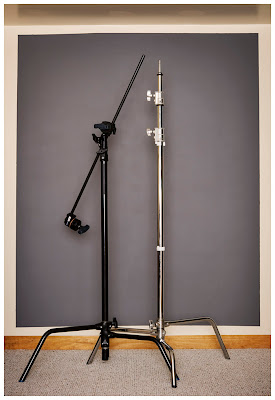
As far as C-stands go (more on what they are, here) they are pretty much all built like tanks. Which is part of their weighty charm. LumoPro C-stands ($ 100 for the riser and another $ 35 for the arm—make sure to get both pieces) are a good value choice as they back up the build quality with their five-year warranty.

If you want to get fancy, Kupo C-stands offer a quick-release mechanism for faster setup. But both are all but indestructable.
__________

While we are on the subject of stands, please do this: Take $ 20 and buy some sand bags. Get the bags from Amazon ($ 13 for 2, shipped). Get a few to start.

And don’t fill them with sand but rather “pea gravel,” from your local home improvement store. It’s super cheap ($ 3.50 worth will fill three sets of sandbags) and way less messy than sand.

You won’t need these cheap insurance policies until a stand comes down in the wind, breaking your flash or your mod or your subject’s noggin. Then you will have needed the sand bags retroactively.

Start with three or four. You’ll probably end up getting more as you go. Cheapest insurance (and piece of mind) policy you’ll ever buy.

NEXT: Soft Modifiers


Strobist

 
Comments Off on Choosing Light Stands

Posted in Photography


Choosing Soft Modifiers

03 Sep
Editor’s note: In 2011 I wrote a full post on my four favorite soft modifiers. No changes since then. These are still my go-to’s, for reasons explained below. So I am reprinting this in the gear selection module. -DH


With the gazillion or so soft light mods out there, it is easy to be overwhelmed by the choices available. And while I have probably shot with more of them that I would care to admit, there are four soft mods that I go back to again and again.

As it happens, these four are reasonably priced, too. (Which may well be what attracted me to them in the first place, of course.)
__________

Soft is Relative

So, which of the light sources above is the softest? The one in the back, right?

Not necessarily. The 60″ source in back is not as soft at 10 feet away from your subject as the 8×9″ source is at 10 inches away. A good rule of thumb to remember is that a light source is soft when it looks large to your subject. This nets out the two variables of size and distance.

Example: Even a bare speedlight looks soft to a subject only a couple inches away.

Long story short, if you want soft light you will have to consider the working distance at which you’ll be using it. The further back your light source, the larger your light mod will have to be.

So front to back, here is the straight dope on the four mods pictured above.

1. The LumiQuest Soft Box III

At 8×9″, the LumiQuest SB-III can be very soft — as long as you are working the light literally right up next to the subject. Case in point, this headshot of Ben I did for an ad for the SB-III when it first came out.

With a flat front edge, the light is easy to feather. This means you can work in the edges of the beam for more interesting (i.e. uneven) illumination.

Pros: The SB-III is small, and folds flat. This means it travels great, hiding in the back flap of my Domke F3 or just about anywhere else. It is also pretty reasonable, at under $ 50. (Especially considering the SB-III has a lifetime guarantee, unique on this list.)

Cons: It’s small size means it is literally soft in only in the knife-fight range. Back it up more than a couple of feet and it starts to get hard. Actually, I tend to use this to my advantage, making the light more versatile just by varying the distance. That is one of the reasons I use it so much.

And speaking of that, most of the time I use an SB-III, I will do so in combination with a fill light. (Example here.) This gives a combination of both shape and detail.

2. Beauty Dish

The next step up, size-wise, gets us to a beauty dish. A broad, shallow reflector, it throws a modestly soft light at portrait distances. There is nothing particularly “beautiful” about it. The dish just has good PR, I guess.

A light this size won’t wrap as much as a giant octa or umbrella when used at the same distance, which can be a good thing. So while some people may think of it as a beauty dish, I tend to think of it as a character dish.

Again, I almost always use it with fill. The shot above (more here) is a good example.

When used when a giant, on-axis fill light, as in this Martin Prihoda cover shoot, the beauty dish really starts to live up to its name. The shadows from a dish are distinct, and controlling their depth with another light source gives you a wide range of possibllity.

Pros: A dish gives you soft(ish) light that can stand up to a breeze. Soft boxes and (especially) umbrellas can turn into a sail in even a light wind. The beauty dish will hold up in a moderate wind — especially when sandbagged. Also, the fact that the dish is circular gives a signature shape on the face as compared to a rectangular soft box. Some people prefer this, but I find it kinda arbitrary.

Cons: Does not fold in any way, so travels like crap. Expect to have to buy a protective case for it. Which only adds to the next downside. Of the four sources listed here, the beauty dish is the most expensive.

I have a few dishes, including one that I got for free from Profoto in a promotion that would have cost me north of $ 300. I did not know which I wanted (silver or white) so I chose silver for more efficiency. In hindsight I should have chosen white, which I now use far more often.

But I was not gonna pony up for another full-price Profoto dish. So I ended up with the white FTX 22″ Beauty Dish ($ 105.00 – $ 130.00) shown above.

Being an aftermarket universal fit dish (one dish, many mounts) it can be a little quirky in some ways. But overall I have been happy with it. They also do a grid for the dish ($ 85.00). So if you are into controlling the beam of the light, the price difference (OEM vs aftermarket) may be even bigger.

3. Westcott Double-Fold 43″ Shoot-Through Umbrella

Usually recommended as the first soft light mod for a space-conscious photographer, the double-fold umbrella practically disappears in your bag. It collapses down to 15″. (Best of all, they are just silly cheap.)


I started out using it in typical fashion, 45 degrees up and over, as do most photographers. These days I am much more likely to fly it over the top of a subject, as in the falconer shot seen above (more here) or literally on the floor, as in this portrait.

Pros: Hello … dirt cheap. Also, travels extremely well. If you are into guerilla lighting, this is your mod. Also can be very powerful, used right up next to your subject. This is something you cannot do with a reflected umbrella because the shaft can get in the way.

Cons: They are pretty fragile. Between the double folding arms and the telescoping hollow shaft, expect them not to last too long. (A little breeze can get them, too.) Also, the light is hard to control — an umbrella spews out light like a frat boy puking at 2:30am after a party. Very little directional control. Raw light can spill past the edge, too.

But for under $ 20, who can complain? I usually grab a couple to be safe.

4. Photek 60″ Softlighter II


Combining the best features of a shoot-through umbrella and a large soft box, I like to think of the large Softlighter II as a poor man’s octa.

It is a convertible shoot-through umbrella that can double as a reflective one due to the removable black backing. And it comes with a very efficient diffuser screen, turning the umbrella into a wonderfully even light source. As a bonus, the umbrella shaft is segmented, so you can remove half of it after you open it. This makes it possible to use it in very close. It is large-octa light quality, for about $ 100.

Actually, I have a 47″ octa, and it gets very little use compared to the Softlighter. Friends usually ask to borrow the octa, which is fine with me — I’d rather have the Softlighter on hand. (If you are an Annie Leibovitz fan, she frequently uses them as her key light, as seen in this video.)

I own and use both the Softlighter II and the new Paul Buff 64″ PLM (with diffuser). The PLM is more efficient than the Softlighter because of its parabolic design, but that is lessened if you do not use the Paul Buff or Elinchrom mount. (They take advantage of perfect positioning.) For speedlights, I prefer the Softlighter, as it does not require a bare-bulb-type light source to be located at the focal point of the parabola. Just slap an umbrella swivel and a speedlight in there and you are good to go. If you primarily shoot WL or Elinchrom, I would suggest the PLM.

Or if you use big and small lights, maybe get both at under $ 100 ea. That is what I did, and frequently use both together (PLM as a key and the less efficient Softlighter as a fill.)

Pros: Way cheap, compared to the octa it largely replaces. Versatile as an umbrella, as described above. Gorgeous light with the diffuser. Very lightweight — easy to boom without expensive gear. Takes a speedlight well. (That’s how we lit the photo above, as detailed here.)

Cons: They are not as heavy-duty as an octa — but to be honest I have yet to kill one. Also, the front is not a clean light source like an octa. You can see the strobe unit. So if you are shooting reflective objects (glass, etc.) this may not be for you.
__________

So those are my Four Horsemen of soft light. You could choose four completely different different mods, but those are the ones I keep going back to. I highly recommend each, for the reasons above.

The main thing is to look at your working distance and see which light source will create the light you want at that distance. Fortunately, as you can see above, you don’t have to spend a ton of money to get versatile, soft light.

NEXT: Hard and Specialty Modifiers


Strobist

 
Comments Off on Choosing Soft Modifiers

Posted in Photography


Choosing Hard and Specialty Modifiers

03 Sep
We tend to start out using soft light at a 45-degree angle because it is an easy fix, and it’s hard to go seriously wrong doing that.

But there are all kinds of light mods, and often choices other than default soft ¾ light can be more interesting. My favorites are snoots, grids and ring adapters.


Snoots are like little tunnels you attach to your flash to block part of the light beam. Snoots are not rocket science — we are just blocking some light. And cardboard works just fine to create tight zones of light that you can use to create something like the photo above.

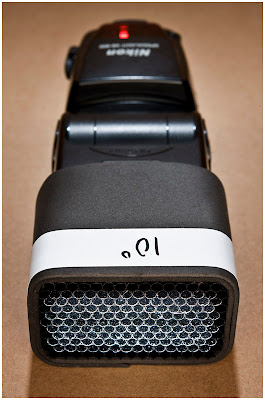
For grid spots, which work like snoots but have a much more beautiful fall-off to the edge of the light, you can DIY them out of straws but it is a pain in the ass and not really worth the effort for many. My advice? Get a Honl eighth-inch grid and be done with it. They are indestructible, and they fit all speedlights.

I’d nix the velcro mounting system, however. Mod it with elastic for quick changes and you’ll be good to go.
__________

A less expensive (but flash-specific) alternative are the DIY-ish grids from SaxonPC. (Seen above, more info on those here.)

Also in the specialty mod category are speedlight ring flash adapters. They turn your small flash into a donut of light that can give you a beautiful, shadowless look for key or fill. My two favorites here are the Orbis. and the RoundFlash. Both have a very good quality of light. Both have advantages and disadvantages.

For the record, I have owned five different commercial ring flashes (and adapters): Profoto, ABR800, Ray Flash, RoundFlash and Orbis. I use the Orbis more than all of the others combined.

Whatever you do, avoid the Chinese knockoffs of the Ray Flash. They are light-sucking pieces of junk, and are rarely anywhere near color correct. But they are cheap!

If you are that broke, you’ll be better off home-brewing a cardboard DIY ring flash adapter.

NEXT: Cases and Carts


Strobist

 
Comments Off on Choosing Hard and Specialty Modifiers

Posted in Photography


Choosing Cases and Carts

02 Sep
You can’t exactly put this stuff in your pocket. And what you get to carry it around will be largely driven by, well, what you care carrying around.

Most of you will end up using two small lights with stands and mods and a modest bag of camera gear. Not that there’s anything wrong with that. You can do a ton of cool stuff with two speedlights. I have gone far past that level of gear in the past, and often to my regret.

If that’s you, grab the shoulder-slung camera bag of your choice. Then augment it with this:

The LumoPro Padded Lighting Case is cheap ($ 30), lightweight, protective and perfect for a two-speedlight lighting kit. It’ll carry two compact stands, speedlights, mods and various doo-dads perfectly.
__________

If you need to go beyond that, I’d take a serious look at ThinkTank bags for your fragile gear and whatever size sling bag you need for the stands/long mods.

ThinkTanks are fantastic: well-built and well-designed (and frequently updated by the thinking photographers who design them.) I absolutely love mine and I recommend them without reservation.

For a camera/laptop backpack (not a roller) I’d say go with the Airport Essentials case. It holds a good amount of stuff, very securely. It’s also the perfect size to curl up with on a plane in coach. Just put it on your lap, wrap your arms around it and rest your head atop it on that Toys-R-Us pillow they give you. That’s the best way I know to sleep on a plane.

If you need more capacity (or wheels) step up to any of ThinkTank’s bigger rollers without hesitation. They are all solid choices. Capacity-wise, they go pretty much from “mirrorless cameras” to “I need to move a body.”
__________

I hesitate to even bring this up. But one day you may find yourself looking at a pile of bags and light stand slings and rollers and you may start thinking, “I need a cart to do all of this in one trip.”

Let me first say that I do not envy you. And second, also say that I have been there myself. Not full-blown McNally-ladened, but too much to carry in one trip. By a long shot.

When that day comes, you’ll start thinking about a folding cart. And rather than endure all of the mistakes (and wasted money) that I did, I am going to suggest you go straight to a Rock-n-Roller MultiCart.

Why? Solid build, folding, expand to a big size if needed, can be a dolly, can hold a board to double as a digital tech’s desk on set—you name it. They rock. And roll.

They make several sizes, but I recommend either the R-8 (smaller) or the R-12 (bigger).

Designed for the music industry, they have been adopted by backache-plagued photographers everywhere. Either of these will likely be the last cart you ever buy.

As a bonus, you will likely (and hopefully) use them more around the house than you even do for work. At least I hope so. Because it kinda sucks to travel with that much gear in tow every day.

But if you are gonna, this is the cart.

NEXT: Books and More


Strobist

 
Comments Off on Choosing Cases and Carts

Posted in Photography


Choosing Triggers

02 Sep
This is pretty simple and straightforward advice. First, start with a wire. Yep, a simple sync cable.

It is cheap and reliable, and a great backup to have for when your wireless triggers decide to go all hinky on you. Which they sometimes will. Because, radio.

If you chose your flash wisely, you’ll not be locked into expensive, proprietary PC-based cords. I live in a one-eighth-inch sync ecosystem and could not be happier with it. As such, my current favorite universal camera-to-flash cord is this little 16-foot baby from FlashZebra.com. I wish everything in my life was this simple.

Next, promise me this: that you will never again buy a flash without a good built-in slave. Every flash I have recommended to you has one. Don’t be without it. That makes triggering multiple units much easier, whether you have wires or radios or whatever. Just makes too much sense. Friends don’t let friends buy flashes without built-in slaves.
__________

For wireless triggers, you can date or you can marry. If you just want to date, there is a new flavor-of-the-week appearing near constantly. They’ll be cheap, but they’ll likely not be long-term compatible with other triggers of the same brand.

I tend to look at remotes as a long-term investment that I can safely add to over time as needed. Seriously, I have been using the same brand of triggers since the early 1990s. And by choosing wisely then, all of my triggers can work well together even though they were purchased over a span of 20 years.

For those reasons I use PocketWizard. And because I am a manual shooter and am not chained to TTL, I can go with the simplest (but still rock-solid) PocketWizard triggers. So I recommend without reservation the ~$ 100 PocketWizard PlusX transceivers.

Why: They are super reliable, simple to operate, run on AAs (huge thing if you have ever been left scrounging for batts in the wild) have ten channels, are auto-sensing receiver/transmitters, have a hard-shell-enclosed antenna, and have wonderful range. (More detail, here.)

PocketWizard make a wide variety of increasingly complex and capable triggers. But if my son or daughter were starting out as a young pro photographer, the PlusX is what I’d buy them. I have owned nearly every model of PW trigger, and these are by far my favorite. For 90% of PW shooters, these will be the best choice.

NEXT: Light Stands


Strobist

 
Comments Off on Choosing Triggers

Posted in Photography


How to Avoid Blurry Photos by Choosing the Right Autofocus Mode

09 Apr

Sometimes the light is perfect, the moment is right, but when you get home you find out that your photo is blurry. Arrgh!

Why are your pictures blurry? One obvious reason might be that your camera isn’t focused properly. Today’s cameras and autofocus lenses can help you quickly take sharp images in a wide variety of situations, provided you choose the right autofocus mode.

Here are some questions to help you diagnose any situation and choose the correct auto focus setting

autofocus modes

Photo by Lynford Morton

Are you using the Auto-area autofocus or Single-point autofocus selection?

Who gets to decide your focus point? That’s the question you are deciding with this option. In an Auto-area autofocus, your camera decides what it should use as your focal point. It usually decides based on what looks most prominent in the viewfinder or closest to the camera. This might work when your subject is obvious and there are no potential distractions.

For more control, choose a Single-point autofocus setting. That mode allows you to choose your specific auto focus point (check your camera’s manual if you aren’t sure how to do this). After all, only you, not your camera, knows where you want to place your subject.

Is your subject moving?

Most DSLR cameras give you four basic options for autofocus settings: single, continuous, auto or manual. To help you choose the right option, ask yourself, “Is my subject moving?”

No, my subject is not moving

autofocus modes

Photo by Lynford Morton

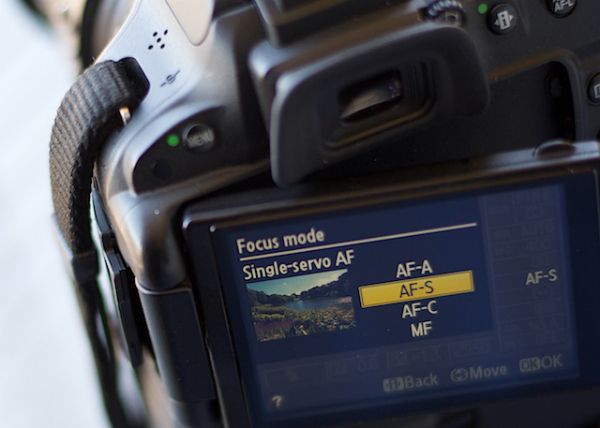
If your subject is not moving, choose “AF-S” for Nikon or “One Shot” for Canon. This mode locks in your focus based on the distance to your subject. As long as your subject stays at that distance, your photo will be in focus. Your subject has to be stationary for this mode to work. In fact, your camera will not take the photo if your subject is moving (or it cannot lock focus).

This mode also allows you to recompose. Let’s say the autofocus point is in the center of the frame, but you want your subject on one side or the other. Keep depressing your shutter button slightly, and focus remains sharp on your subject. Then you can move the camera slightly left or right, recomposing with your subject out of the center of the frame.

Yes, my subject is moving

By Amsterdamized

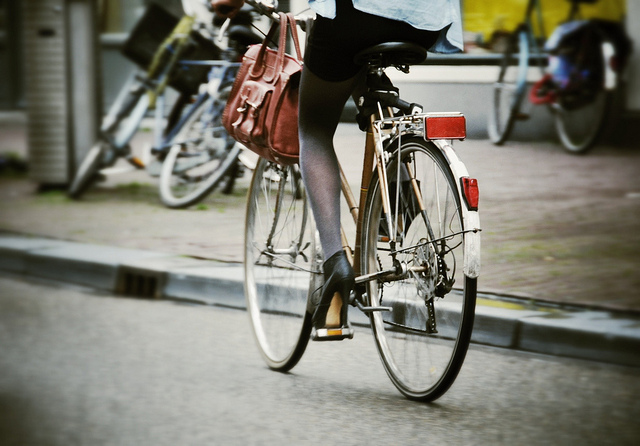
If your subject is moving, use continuous autofocus (AF-C for Nikon or AI Servo for Canon). In this mode, you place your autofocus point over your subject, and focus continues to adjust while you hold down the shutter button, keeping your subject in focus as it moves.

For example, if someone is riding a bicycle, place the AF point on your subject and slightly depress the shutter. As long as you are pressing the shutter, the autofocus will continually adjust to your subject, keeping them in focus as they move. When you are ready to take the photo, depress the shutter completely, and the camera will focus on your subject for a sharp image.

No, my subject isn’t moving, but it might

A third option merges the functionality of the single autofocus and continuous autofocus. This hybrid mode, (AF-A for Nikon or AI Focus for Canon), starts out as a single auto focus. Your camera won’t focus until you lock in on a stationary subject. Once you have your subject in focus, you can take the photo as you would in a traditional single auto focus mode.

If your subject starts moving, however, the autofocus releases and continues to track your moving subject. It gives you the best of both worlds. One note of caution, I have noticed at times, if you recompose a stationary object quickly in AF-A mode, the camera can be fooled into thinking the subject is moving and release the autofocus.

My autofocus just isn’t getting it right

You always have the option of turning off the autofocus function and choosing the Manual setting. If your camera is having trouble detecting your focus point, it might be more efficient to focus the camera yourself.

How about the opposite situation? You turned off your autofocus by accident? Every now and then, when your camera can’t seem to focus, and you don’t hear the motor searching back and forth, check to see if you selected Manual autofocus by accident. This can happen more frequently than you might think.

Other issues to consider

What if you set up your autofocus properly, and the lens still won’t focus? Try these considerations:

  • You might be too close. Try backing away. If you are too near the subject, it might prevent the camera from focusing properly.
  • Your subject might not have enough contrast. Your image needs to have some contrast for many autofocus systems to work. If you try to photograph a solid sheet of white or any single color, most autofocus systems will struggle. Why? The camera compares adjacent pixels and when one is different, it uses that point to determine its focus. If it can’t find any contrast, it can’t focus.
  • You might have an extremely shallow depth of field. In this case, your autofocus is working, but the depth of field is so shallow, it is hard to tell that your subject is in focus.
  • You have camera shake. When you depress the shutter, you move the camera. If the shutter speed is too slow, the camera picks up that movement, and it looks like a blurry photo. Make sure your shutter speed is faster than the equivalent of your focal length. For instance, if you are zoomed to 100mm, your shutter speed should be 1/100th of a second or faster to avoid camera shake.

Why is your picture blurry? If the answer is in your autofocus, your fix could be as simple as choosing the right setting.

Do you have any other autofocus tips or comments you’d like to share? Please do so below.

More tips on sharper images and focus modes:

  • 5 Tips for Getting Sharper Images
  • Understand Exposure in Under 10 Minutes
  • Making Sharper Wildlife Photographs – [Part 1 of 2]
  • Making Sharper Wildlife Photographs – [Part 2 of 2]

The post How to Avoid Blurry Photos by Choosing the Right Autofocus Mode by Lynford Morton appeared first on Digital Photography School.


Digital Photography School

 
Comments Off on How to Avoid Blurry Photos by Choosing the Right Autofocus Mode

Posted in Photography