RSS
 

Posts Tagged ‘Canon’

In a nutshell: a video rundown of the Canon EOS 80D’s features

19 Feb

Don’t have time to read through our rather tech-y hands-on overview of the Canon EOS 80D? We’ve put together a quick primer video on the camera’s features and changes to bring you up to speed. Lend us your ears for a mere 106 seconds and we’ll tell you what you need to know…

Articles: Digital Photography Review (dpreview.com)

 
Comments Off on In a nutshell: a video rundown of the Canon EOS 80D’s features

Posted in Uncategorized


Newly enthused: hands on with the Canon EOS 80D

18 Feb

Announcing the Canon EOS 80D

Canon has announced the EOS 80D, the successor to very capable EOS 70D that, notably, introduced Dual Pixel autofocus. The 80D brings some marked improvements to Canon’s mid-market, enthusiast line, including a new 45-point AF module and updated Dual Pixel AF.

Body-wise, the 80D remains very similar to the 70D, which means a polycarbonate exterior with water and dust resistance. A few things have changed: the Q and Playback buttons on the back have shrunk, a headphone socket has been added, the remote port has been moved downward, and the stereo microphones have been relocated from the top of the camera (near the hot shoe) to the front, with wider separation (note the four small holes just left of the EOS 80D logo). Furthermore, the 80D now has a mirror vibration control system similar to the 5DS and 7D Mark II.

Dual Pixel AF

Possibly the most noteworthy improvement is that it’s the first time Canon has delivered continuous autofocus (AI Servo) in still live view shooting from a Dual Pixel AF camera, and only the second time Canon offers continuous AF in live view for stills at all. Last time we saw it was in the the Rebel T6s (EOS 760D), which offers continuous AF in both stills and movie mode from its ‘Hybrid CMOS III’ sensor. However, its implementation is far from ideal, with significant hunting from Hybrid AF’s reliance on contrast-detect AF in addition to phase-detect AF. (Only some of the imaging pixels on the T6s are masked for phase detection, rather than having split PDAF-capable pixels across the entire sensor.)

Our brief time with the 80D, on the other hand, left us very impressed. You can select your subject by tapping on it, and then as long as you keep the shutter half-depressed, the camera will quickly track your subject in all three dimensions to keep it in focus – no matter where it moves to within the frame. This means your subject tends to already be in focus when you’re ready to take your shot and depress the shutter button. The camera even continues to focus in continuous drive at 5 fps.

Oddly, the much higher-end Canon EOS-1D X Mark II, skimps on this feature, only offering single AF in Live View. Previous iterations of Dual Pixel AF in the 70D and 7D Mark II also did not offer continuous AF.

Metering sensor

The 80D gains the same 7560 pixel RGB+IR metering sensor that we first saw in the Rebel T6s and T6i (EOS 760D and 750D). It’s essentially a low resolution image sensor: a marked improvement over the 63-zone dual layer sensor in the 70D, promising more accurate metering through scene analysis.

In addition to metering, this sensor is also used to give the camera a degree of human subject awareness. Skin tones can be detected – and then tracked (in continuous AF mode) – to aid the AF system in finding and focusing on a human subject. Our initial, informal testing leads us to believe this isn’t nearly as reliable as ‘proper’ face detection – which the 1DX II, and the 80D itself in Live View, offer.

The camera doesn’t offer Canon’s ‘Intelligent Tracking and Recognition’ (iTR) system, that uses the metering sensor as well as distance information to track subjects around the frame. For reliable continuous AF, you’ll want to stick to a single point and try to manually follow your subject.

The metering sensor brings another important benefit: it monitors the characteristics of the scene illumination, not only trying to interpret an appropriate white balance for the scene but also checking for flickering in the light source. If flicker is detected, the camera can delay its shooting during continuous drive such that it always shoots at the brightest point during the light’s flicker cycle; helping to give more consistent results.

New 45-point AF module

The 80D has received a new autofocus module. It’s a big step up from the EOS 70D, now offering 45 AF points – a considerable upgrade from the 19 AF points on the older model. All of these are cross-type, sensitive to both horizontal and vertical detail, giving all points the ability to focus in challenging, low light and low contrast (including backlit) situations. 27 points remain cross-type even when using a lens/teleconverter combination that has a F8 maximum aperture (ideal for birding and wildlife). Impressive.

The central AF point is rated as working down as far as -3EV in Single AF (One-Shot), which should mean the camera remains usable in extremely dark situations. It’s also a dual cross-type, high precision sensor with F2.8 and faster lenses, which brings enhanced accuracy to focus – particularly important when dealing with the shallow depth-of-field associated with fast primes.

Wi-Fi/NFC/GPS

The EOS 70D already included Wi-Fi but the 80D extends the capability by adding NFC (near-field communication). This simplifies the pairing process for Android devices and also provides compatibility with Canon’s Connect Station storage/viewing unit.

The 80D also gains built-in GPS, which adds the ability to capture location data at the point of capture. This can be hugely useful when it comes to managing your files afterwards, as you have an additional, meaningful data point associated with your images, without the need to manually tag or keyword the files.

Video improvements

The EOS 80D gains some significant upgrades when it comes to movie shooting. The most obvious change is the addition of 1080/60p video (and 50p for PAL shooters). In addition, the camera gains a headphone socket for audio monitoring while recording. Importantly, the mic and headphone sockets are angled for good reason: you can swing the articulating LCD and angle it upward or downward without it running into connected audio components. This allows videographers to make full use of the articulating screen while filming.

Add to this little changes like the movement of the built-in mics to the front of the body, rather than the haunches of the hot shoe, and the 80D shows signs that a lot of thought has been put into video.

Sadly there’s no C-Log gamma option (a very flat tone curve useful for color grading), no focus peaking or zebra warnings and no ‘clean’ HDMI output for external recording, making clear this isn’t intended for video professionals. However, the maximum ISO setting has received a boost and, much like the 1D X II, the combination of touchscreen and Dual Pixel AF should make it easier for non-pros to get good results.

New kit zoom with Nano USM

Alongside the EOS 80D, Canon has announced a new version of its 18-135mm F3.5-5.6 lens. The EF-S 18-135mm F3.5-5.6 IS USM makes use of a new type of focus motor that Canon is branding ‘Nano USM.’ The company declined to give any further detail about the technology behind the actuator but said that it’s able to offer the speed of a ring-type USM motor but is as quiet and smooth as the existing STM (stepper motor) designs.

Canon says the latest version will be 2.5x faster to focus than the existing STM version at the wide-angle end of the range and 4.3x faster at the long end of the zoom. We were very impressed in our own informal tests: the lens is able to ‘snap’ into focus almost instantaneously, even from extreme defocus. The Nano USM design is likely to be used on other lenses in future but can only be applied on lenses with single, light focus elements.

The lens’ stabilization is rated a 4 stops by CIPA standards.

PZ-E1 Power Zoom Adapter

Furthering the video capabilities of the 80D+18-135mm USM combination is the PZ-E1 zoom motor. It’s a clip-on unit that allows the 18-135mm to be zoomed in a controlled manner for video shooting. The PZ-E1 offers two zoom speed modes (high and low), both of which then offer variable zoom speed.

In fast mode the drive can take between 2.4 and 14 seconds to zoom from one extreme of the lens to the other, or 9.5-14 seconds in slow mode. This zoom can be controlled via Wi-Fi app or the desktop-based Smart Utility, as well as the on-body controls.

We really like Canon’s approach in offering the PZ-E1 as a separate unit. It means that stills-only shooters don’t end up having to buy a heavier, more expensive lens for a feature they don’t want but, at a list price of $ 150, videographers don’t have to spend too much to gain smooth zooming.

Canon says other lenses will be made compatible with the drive unit in future.

DM-E1 shotgun mic

Canon has also announced a hot-shoe-mounted shotgun microphone. It’s compatible with pretty much any camera that has a 3.5mm (1/8″) socket. There’s nothing camera or brand-specific about it, but it’s interesting that Canon has decided to start offering video-specific accessories. The DM-E1 will set you back around $ 250.

Summary

Canon’s ‘##D’ series cameras have generally been fairly subtle and progressive evolutions, compared to the previous models (with the exception of the lower-priced 60D, but that appears to have been a temporary blip), and the 80D follows this pattern. Almost every aspect of the latest camera has been upgraded, most of which try to make image-taking faster and more consistent. The AF module has significantly advanced from the 70D, particularly for wildlife photographers that will appreciate expansive F8 focusing. Dual Pixel AF has been upgraded to allow continuous live view AF in still shooting that is competitive with some of the best mirrorless cameras. In fact, face detection and subject tracking are so good in live view that those looking for an easy way to shoot human subjects might even opt to shoot in live view rather than through the viewfinder.

We suspect, though, that the biggest impact might be felt by those users who want to shoot video. The bump-up to offering 1080/60p is useful, either for capturing fast motion or giving a bit of a slow-mo option, but it’s the addition of a headphone socket and the optional power zoom adapter that should make it easier-than-ever to shoot in-camera footage (at the expense of some tools more experienced videographers might expect). And Dual Pixel AF remains one of the most compelling video AF solutions to date.

Combine all this with the advantages of an optical viewfinder and thoughtful ergonomics, and you have a solid addition to the ‘##D’ line.

Articles: Digital Photography Review (dpreview.com)

 
Comments Off on Newly enthused: hands on with the Canon EOS 80D

Posted in Uncategorized


Beginner Tip: How to Use the Canon Quick Menu to Change Cacmera Settings

16 Feb

canon-quick-menu-3

When it comes to beginner photographers, one of the first major goals is often to get off Auto. Doing so really is an important step to using your camera to the best of its capabilities. However, the concern that I hear most often from beginners in terms of stepping away from auto mode, is that it takes so long to get their shutter speed, aperture, ISO, white balance, and focal points set, that sometimes they’ve missed the shot that they were hoping for completely. I understand how frustrating that dynamic can be, and I have one Canon tip to share that may make life a little simpler if you’re just starting out.

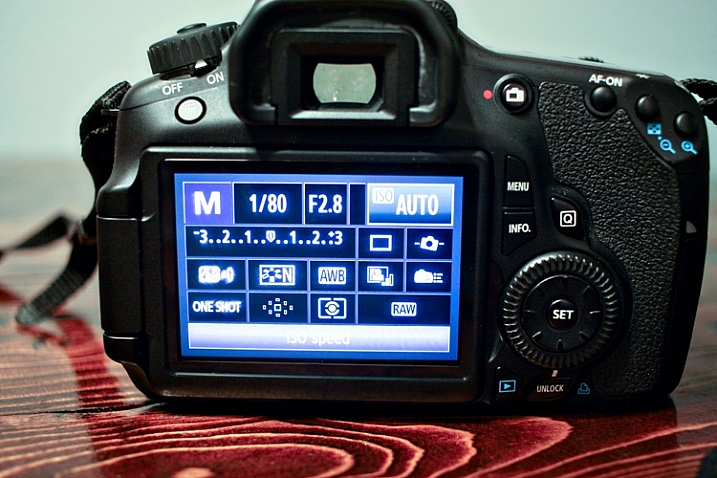
Canon EOS cameras have a feature called the EOS Quick Menu. For the vast majority of EOS cameras, you’ll access the Quick Menu or Control Screen by pressing the button on the back of the camera with the letter Q. For a few older EOS cameras, you’ll have to push the button in the center of the multi-controller (that’s the big wheel on the back of your camera to the right of the screen). Once you hit that button, a very handy screen pops up that looks something like this:

canon-quick-menu-1

Now, you’ve got many of the most commonly changed settings right at your fingertips. You can change shutter speed, aperture, ISO, metering mode, focal point, file type, and several other features, right from the Quick Menu, without having to scroll through several different menus or adjust settings located in several different places on your camera body. You just use the multi-controller to navigate to the setting that you’d like to change, and then press the SET button to access that setting.

It’s worth noting that your available options will change somewhat depending on which camera mode you’re in. In the above image, the camera is set to manual mode and thus there are high number of settings available to be changed.

canon-quick-menu-2

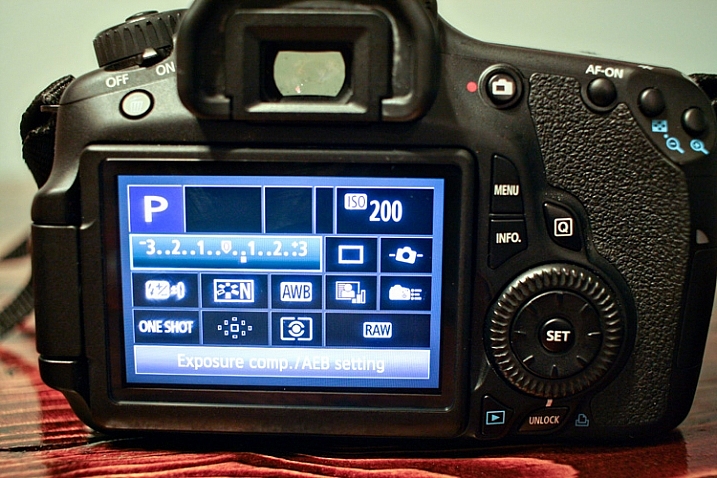
If you switch the camera to Program mode, the option to change shutter speed and aperture vanishes, as those are set automatically by the camera. You still have access to other controls like ISO, file type, metering, and exposure compensation through the Quick Menu in this mode.

canon-quick-menu-4

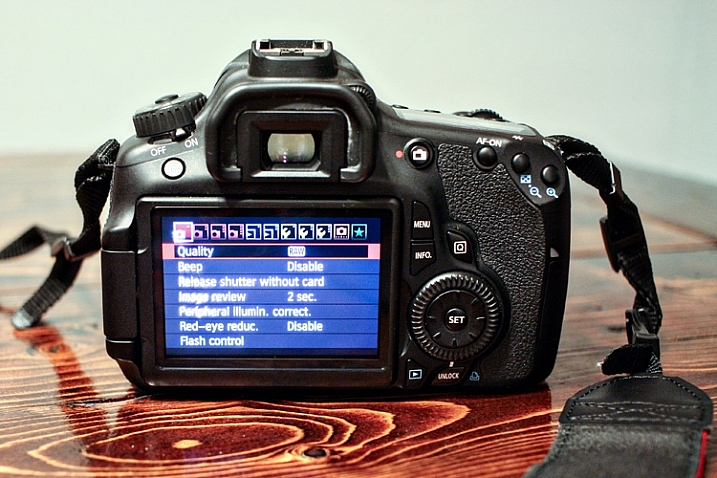
Of course, all of these features can also be accessible via the buttons/dials on the top and side of your camera, or in the standard menu screens. I do think it’s important to learn how to change your settings in those traditional ways, as the Quick Menu may not always be the most effective, or efficient, way to change a particular setting depending on the circumstances. The more you know about your camera, the better you’ll be able to utilize all of its features! That said, it’s never a bad thing to know how to accomplish the same task in more than one way, and the Canon Quick Menu can be a huge help when you’re trying to make changes to your settings in a short amount of time. In my opinion, both shorthand and longhand have their time and place!

If you’re a Canon EOS user, have you found the Quick Menu to be a helpful tool? Are there some settings you still prefer to access and change in other ways? Do you shoot Nikon or another brand of camera – and does it have something similar? Please share in the comments below.

googletag.cmd.push(function() {
tablet_slots.push( googletag.defineSlot( “/1005424/_dPSv4_tab-all-article-bottom_(300×250)”, [300, 250], “pb-ad-78623” ).addService( googletag.pubads() ) ); } );

googletag.cmd.push(function() {
mobile_slots.push( googletag.defineSlot( “/1005424/_dPSv4_mob-all-article-bottom_(300×250)”, [300, 250], “pb-ad-78158” ).addService( googletag.pubads() ) ); } );

The post Beginner Tip: How to Use the Canon Quick Menu to Change Cacmera Settings by Meredith Clark appeared first on Digital Photography School.


Digital Photography School

 
Comments Off on Beginner Tip: How to Use the Canon Quick Menu to Change Cacmera Settings

Posted in Photography


Cambo introduces Canon EOS lens plate with aperture control for Actus view camera system

12 Feb

$ (document).ready(function() { SampleGalleryV2({“containerId”:”embeddedSampleGallery_4644059846″,”galleryId”:”4644059846″,”isEmbeddedWidget”:true,”standalone”:false,”selectedImageIndex”:0,”startInCommentsView”:false,”isMobile”:false}) });

Cambo has devised a new Canon EF/EF-S lens plate for its Actus view camera system that allows users to control aperture settings on Canon EOS lenses. The Cambo Actus system is designed to deliver a view camera style of shooting to some mirrorless camera bodies, consisting of a lens plate and a body plate with bellows and a monorail in between.

As EOS lenses have no manual aperture control, a plain mounting plate will only allow the lenses to be used at their widest aperture setting. The new ACB-CA plate however has electronic contacts that allow it to communicate with the lens, and a finger wheel so the photographer can dial in required aperture settings. An OLED display shows aperture values as well as the focal length in use, even when a zoom is mounted. 

The ACB-CA adapter will provide tilt, shift, swing, rise and fall movements between the front and rear standards with an EOS lens and a mirrorless camera mounted, though other lens systems allow movements with Nikon and Canon DSLR bodies. The Actus-DB system allows digital backs to be used.

The new ACB-CA plate for Canon EOS lenses costs £950 / $ 1299, while the Actus body costs £1400 / $ 1900. For more information visit the Cambo website.


Press release: 

NEW Cambo Actus Canon Auto Lens Mount

Cambo has released the NEW ACB-CA adapter for Canon EF lenses for use on the ACTUS mini view camera. The adapter has built-in electronic controls for setting and operating the aperture of Canon EF lenses.

Normally when a Canon auto iris lens is removed from the camera body the lens aperture is wide open. The ACB-CA communicates with the lens and enables the user to adjust the aperture, giving you full control.

This adapter has an internal battery for continuous use and features an OLED display which shows the preset or set aperture together with the focal length of the lens. The communication is accurate, such that the display will also show the focal length of zoom lenses.

The adapter accepts lenses fitted with Canon EOS bayonet, in combination with the ACTUS view camera. The ACB-CA adapter is finished in black to match the ACTUS-B camera version.

This ACB-CA lens adapter is designed to work with mirrorless* camera bodies, such as the Sony A7 series, Fujifilm X series and Canon M series. When mounted on the Actus the adapter will tilt and swing within the lens image circle that is being used. The rear rise/fall and left/right shift will operate as normal, again within the lens’s image circle.

*Mirrorless camera bodies have the imaging sensor further forward enabling the lens to focus at infinity or closer.

Check via the Cambo Configurator the compatibility between cameras, lenses and adapter when using the Cambo Actus.

The ACB-CA adapter is available now from stock £790.00 excluding VAT and shipment. For further information contact CamboUK on 07863 116150 or cambouk@gmail.com .

Articles: Digital Photography Review (dpreview.com)

 
Comments Off on Cambo introduces Canon EOS lens plate with aperture control for Actus view camera system

Posted in Uncategorized


Kipon to produce Canon EF to Sony E-mount adapter with AF and slot-in ND grads

12 Feb

Chinese lens adapter manufacturer Kipon has said it is producing a new model that will allow Canon EF lenses to fit on Sony E-mount mirrorless bodies while maintaining their AF functionality. The Kipon EF-S/E AF ND lens adapter also comes provided with a slot-in four-stop graduated neutral density filter that can be fitted into the body of the ring. Sitting between the optics and the camera, the filter will be protected from stray light and in theory will remain clean, so it should deliver better image quality than had the same filter been fitted over the front of the lens.

The company has not released very much detail about the forthcoming adapter, but it does promise that the phase detection AF system will operate at ‘high speed’. Perhaps significantly, the company is showing a picture of the adapter alongside a pair of slot-in filters, so we might hope that other filters will become available at a later date.

The Kipon EF-S/E AF ND adapter will go on sale from 15th March 2016, and will cost $ 428.

For more information visit the Kipon website.

Articles: Digital Photography Review (dpreview.com)

 
Comments Off on Kipon to produce Canon EF to Sony E-mount adapter with AF and slot-in ND grads

Posted in Uncategorized


Canon announces flagship EOS-1D X Mark II full-frame digital SLR

02 Feb

$ (document).ready(function() { SampleGalleryV2({“containerId”:”embeddedSampleGallery_9233536181″,”galleryId”:”9233536181″,”isEmbeddedWidget”:true,”selectedImageIndex”:0,”startInCommentsView”:false,”isMobile”:false}) });

Canon has announced its new flagship DSLR, the full-frame EOS-1D X Mark II. It features a new 20.2MP CMOS sensor with Dual Pixel AF, and uses a pair of Dual DIGIC 6+ processors to capture 4K video and shoot continuously at up to 16 fps. The camera has a native ISO of 100-51200, expandable to 409600.

The new 61-point autofocus system has 41 cross-type sensors and 24% larger frame coverage than its predecessor. Its center point is sensitive to -3EV in OneShot AF. In live view the camera uses the latest iteration of Canon’s Dual Pixel AF technology for high-speed focusing in OneShot mode. The metering system has also been updated to use a 360k-pixel RGB+IR sensor, which the company says improves subject – including face – detection and tracking.

As with its predecessors, the 1D X is as rugged a camera as you’ll find. It’s magnesium alloy body is fully weather-sealed and has a shutter that will last for approximately 400,000 cycles. In addition to its large optical viewfinder (now with better, adjustable AF point illumination), the Mark II has a 3.2″ Clear View II LCD with 1.62 million dots, up from 1.04 million dots. The screen is touch-enabled, but only for autofocus point selection in Live View. Another new addition is a built-in GPS (with an e-compass), which sits in a ‘hump’ on the top of the viewfinder. Otherwise, the design of the Mark II is very similar to that of its predecessor.

Performance-wise, the 1D X II can shoot continuously at 14 fps with autofocus, and if you lock the mirror up, you can shoot up to 16 fps with locked focus and exposure. If you’re using the older LP-E4N battery, the top shooting speeds drop to the same frame rates as the 1D X (12/14 fps). If you’re using a CFast card you can take an unlimited number of JPEGs or a whopping 170 Raw images in a single burst, or 12 seconds of shooting at 14 fps. The 1D X II also has a slot for standard CompactFlash cards. When it comes to connecting to a PC you can choose from the camera’s USB 3.0 or Ethernet ports. Wi-Fi requires the use of Canon’s $ 600 WFT-E8 wireless file transmitter.

One of the most significant additions to the 1D X II is support for 4K (DCI) video capture. It can capture 4K video at 60p using the M-JPEG codec (which allows for easy frame grabs) as well as 1080p at frame rates of up to 120 fps. You’ll need to use a CFast card in order to record more than a few seconds of 4K video though. Dual Pixel AF enables continuous autofocus in video, and touch focus makes the experience a breeze. The camera does not offer focus peaking or zebra patterns natively, but they are visible when using an external recorder. As one would expect given its place in Canon’s lineup, the 1D X Mark II has both headphone and mic jacks.

The EOS-1D X Mark II will be available in April for $ 5999 (body only), or bundled with a 64GB CFast card and reader for $ 6299.

Press release:

Fast, Formidable, and 4K, All-in-One Camera: CANON U.S.A. Introduces the EOS-1D X Mark II Professional Digital Camera 

Delivering Precise and Reliable Performance with Versatility for Any Photo or Video Professional

MELVILLE, N.Y., February 1, 2016 – Rising to meet the rigorous and evolving demands of professional photographers and videographers, Canon U.S.A., Inc., a leader in digital imaging, is proud to announce the new EOS-1D X Mark II DSLR camera. With a new 20.2 megapixel 35mm Full Frame Canon CMOS sensor and Dual DIGIC 6+ Image Processors, the EOS-1D X Mark II professional digital camera delivers stunning image quality and speed. Combining the ability to capture high-resolution still images at speeds up to 14 frames per second as well as stunning high-definition video up-to-4K 60P featuring Canon’s proprietary Dual Pixel CMOS Autofocus (AF) technology, the Canon EOS-1D X Mark II camera becomes the ideal camera for any professional image creator. 

The new flagship Canon EOS-1D X Mark II features several firsts for EOS cameras including:

  • Newly developed 20.2 megapixel 35mm Full Frame Canon CMOS sensor;
  • Continuous shooting speeds of up-to-14 frames per second (fps) with Auto Exposure (AE) and predictive AF for viewfinder shooting and up to 16 fps1 in Live View mode; 
  • Dual DIGIC 6+ Image Processors that transfer image data at extremely high speed for extended bursts during continuous shooting – up-to-170 consecutive RAW images at 14 fps. When shooting JPEG images you’re only limited by memory card capacity2
  • Capable of shooting 4K 60P and Full HD 120P video with Dual Pixel CMOS AF;
  • Enhanced wireless functionality (with the optional accessory Wireless File Transmitter WFT-E8) that supports the new high-speed IEEE 802.11ac standard and the  ability to easily transfer photos and videos to compatible smartphones using Canon’s Camera Connect app*
  • Digital Lens Optimizer to help correct aberrations in-camera (a feature that previously required post-processing on an external computer); 
  • Improved 61-point viewfinder AF with expanded coverage and all AF-points selectable and supported to a maximum aperture of f/8; 
  • Improved AI Servo III+ predictive AF algorithm for better accuracy; 
  • Continuous red illumination of all AF points within the camera’s Intelligent Viewfinder II.
  • Compatibility with both CF and CFast memory cards for optimal performance and versatility.

The Ultimate EOS Camera: Continuing a Legacy of High Speed and Performance

Building on the success of the Canon EOS-1D X professional digital camera, the Canon EOS-1D X Mark II camera is designed to deliver high-performance, speed, and image quality, with improved comfort for professional photographers. In addition to the new 20.2 megapixel full-frame CMOS sensor and Dual DIGIC 6+ Image Processors, the new EOS-1D X Mark II DSLR camera includes an improved 61-point High-Density Reticular AF II system with all AF points selectable by the user (and up to 41 cross-type points depending on the lens in use). The improved AF system includes expanded coverage that supports AF at maximum apertures up to f/8 with all 61 points for high precision autofocus even when using EF super-telephoto lenses with an EF extender. The camera also boasts excellent dynamic range and reduced color noise compared to its predecessor throughout its standard ISO speed range of 100 – 51,200. Expansion ISO speeds of 50, 102,400, 204,800 and 409,600 are also available.  A first for the Canon EOS-1D series, this camera also features a 360,000-pixel RGB+IR metering sensor with enhanced precision and performance compared to its predecessor, improving facial recognition and tracking, as well as nature scenes. Additionally, the advanced AE system can detect and compensate for flickering light sources such as sodium vapor lamps that are often used in gymnasiums and swimming pools. When enabled, this anti-flicker system automatically adjusts shutter release timing to help reduce disparities in exposure and color especially during continuous burst shooting.

For filmmakers and photographers looking to do more than still photography alone with a DSLR camera and EF lenses, the EOS-1D X Mark II camera offers high resolution DCI 4K video at frame rates up-to-60p, with smooth movie recording to an in-camera CFast 2.0 memory card. An additional card slot supports standard CF memory cards up to UDMA 7. The built-in headphone jack supports real-time audio monitoring. Two additional EOS ‘firsts’ include 4K Frame Grab and 120p Full HD recording. The camera’s 4K Frame Grab function allows users to isolate a frame from recorded 4K video and create an 8.8 megapixel still JPEG image in-camera. When combined with the EOS-1D X Mark II’s high-sensitivity full-frame CMOS sensor, the new camera’s ability to record Full HD video at frame rates up to 120p will allow videographers to produce high quality slow motion video even in extremely low light. To make video shooting even more intuitive, the Canon EOS-1D X Mark II camera’s touch-screen LCD allows videographers to select the camera’s AF point before and during video recording with Dual Pixel CMOS AF, which provides responsive, accurate and quiet camcorder-like video autofocus to DSLRs.

“The innovations within Canon’s new EOS-1D X Mark II DSLR camera clearly set a new standard for professional cameras,” said Yuichi Ishizuka, president and COO, Canon U.S.A., Inc. “In developing the EOS-1D X Mark II camera, we looked to incorporate user-requested performance enhancements to bring professional photographers the ultimate EOS camera, a camera that has matured and been developed to meet their evolving needs.” 

“Having f/8 capability on all 61 AF points is a tremendous benefit to wildlife photographers,” noted nature photographer and Canon Explorer of Light Charles Glatzer. “In order to capture tight shots of animals without disturbing them, I frequently have to use very long lenses—sometimes with an extender attached, which further diminishes the aperture. The improved AF allows me to frame the shot exactly the way I envision it, without having to compromise.”

“This camera is a huge step forward,” remarked acclaimed photographer and Canon Explorer of Light Damian Strohmeyer. “Shooting sports in a gym at 8,000 ISO, it looked as good as 800 ISO from a generation or two ago. The images are tack-sharp, and the autofocus just doesn’t miss. I’ve been amazed by what I’ve seen so far.”

“The autofocus was awesome,” agreed Peter Read Miller, sports photographer and Canon Explorer of Light.  “The higher frame rate coupled with the speed of the CFast card was a definite advantage. It just never buffered out, even shooting RAW.”

The new EOS-1D X Mark II camera also offers a built-in GPS** receiver with compass for precise geo-tagged information of latitude, longitude, elevation and direction. This is especially valuable to wildlife photographers and photojournalists who need to track their locations, as well as providing sports photographers the ability to sync a multiple-camera setup with extreme accuracy and precision. It is also possible to use the camera’s built-in GPS to automatically sync the camera’s time to the atomic clock, an invaluable feature to professionals.  An improved grip also makes the camera easier for photographers to hold and maneuver while shooting. In response to feedback from professional EOS users, the AF points in the EOS-1D X Mark II camera’s Intelligent Viewfinder II can be illuminated in red for improved visibility, especially when shooting in dark locations. AF sensitivity in low light has been doubled from EV -2 to EV -3 at the center AF point when the camera is set to One-Shot AF, enabling the camera to autofocus in extremely dark shooting conditions such as a moonlit nightscape. Viewfinder AF coverage has also been increased for greater compositional flexibility.

As with all EOS-1D series cameras, the EOS-1D X Mark II’s rugged construction and magnesium alloy body is weather resistant. The camera also features improved controls and more in-camera image quality enhancements than ever before, including a Digital Lens Optimizer function offering high quality aberration correction which can now be achieved without an external computer. This feature makes it easier for professional photographers to deliver finished files to their clients, especially in situations when access to a personal computer is impractical or inconvenient. 

The estimated retail price for the Canon EOS-1D X Mark II is $ 5999 (MSRP) for the body or $ 6299 for the Premium Kit which includes a 64 GB CFast memory card and card reader. The new camera is scheduled to begin shipping to authorized Canon USA dealers in April 2016***. For more information and the full list of product specifications, visit: usa.canon.com/EOS1DXMarkII 

* With the download of the free Canon Camera Connect app. This software enables you to upload images to social network services. Before uploading images, please be aware that image files may contain privacy-related information such as people and places. If necessary, please delete such information. Canon does not obtain, collect or use such images or any information included in such images through this software. 
** In certain countries and regions, the use of GPS may be restricted. Therefore be sure to use GPS in accordance with the laws and regulations of your country or region. Be particularly careful when traveling outside your home country. As a signal is received from GPS satellites, take sufficient measures when using in locations where the use of electronics is regulated.
***Availability, pricing and specifications are subject to change without notice. Actual prices are set by individual dealers and may vary.

1. Continuous shooting speed may vary depending on the shutter speed, the aperture, the lens being used, the battery charge and various camera settings
2. Burst rate using CFast card


EOS-1D X Mark II specifications

Price
MSRP $ 5999 (body only)
Body type
Body type Large SLR
Body material Magnesium alloy
Sensor
Max resolution 5472 x 3648
Other resolutions 4368 x 2912, 3648 x 2432, 2736 x 1824
Image ratio w:h 3:2
Effective pixels 20 megapixels
Sensor photo detectors 22 megapixels
Sensor size Full frame (36 x 24 mm)
Sensor type CMOS
Processor Dual DIGIC 6+
Color space sRGB, Adobe RGB
Color filter array Primary color filter
Image
ISO Auto, 100-51200 (expands to 50-409600)
Boosted ISO (minimum) 50
Boosted ISO (maximum) 409600
White balance presets 6
Custom white balance Yes (5 slots)
Image stabilization No
Uncompressed format RAW
File format
  • JPEG (Exif v2.3)
  • Raw (Canon CR2, 14-bit)
Optics & Focus
Autofocus
  • Contrast Detect (sensor)
  • Phase Detect
  • Multi-area
  • Center
  • Selective single-point
  • Tracking
  • Single
  • Continuous
  • Touch
  • Face Detection
  • Live View
Manual focus Yes
Number of focus points 61
Lens mount Canon EF
Focal length multiplier 1×
Screen / viewfinder
Articulated LCD Fixed
Screen size 3.2
Screen dots 1,620,000
Touch screen Yes (for AF point selection only)
Screen type TFT LCD
Live view Yes
Viewfinder type Optical (pentaprism)
Viewfinder coverage 100%
Viewfinder magnification 0.76×
Photography features
Minimum shutter speed 30 sec
Maximum shutter speed 1/8000 sec
Exposure modes
  • Program
  • Aperture priority
  • Shutter priority
  • Manual
Built-in flash No
External flash Yes (via hot shoe or flash sync)
Flash X sync speed 1/250 sec
Continuous drive 16.0 fps
Self-timer Yes
Metering modes
  • Multi
  • Center-weighted
  • Spot
Exposure compensation ±5 (at 1/3 EV, 1/2 EV steps)
AE Bracketing ±3 (3 frames at 1/3 EV, 1/2 EV steps)
Videography features
Resolutions 4096 x 2160 (60p, 30p, 25p, 24p, 23.98p), 1920 x 1080 (120p, 60p, 50p, 25p, 24p, 23.98p)
Format MPEG-4, H.264, Motion JPEG
Microphone Mono
Speaker Mono
Storage
Storage included CompactFlash + CFast 2.0
Connectivity
USB USB 3.0 (5 GBit/sec)
HDMI Yes
Microphone port Yes
Headphone port Yes
Wireless Optional
Wireless notes requires WFT-E8
Remote control Yes
Physical
Environmentally sealed Yes
Battery Battery Pack
Battery description LP-E19 lithium-ion battery & charger
Battery Life (CIPA) 1210
Weight (inc. batteries) 1530 g (3.37 lb / 53.97 oz)
Dimensions 158 x 168 x 83 mm (6.22 x 6.61 x 3.27)
Other features
Orientation sensor Yes
GPS BuiltIn
GPS notes with e-compass

Articles: Digital Photography Review (dpreview.com)

 
Comments Off on Canon announces flagship EOS-1D X Mark II full-frame digital SLR

Posted in Uncategorized


1.4 and More: Canon EF 35mm F1.4L II comparison

21 Jan

Canon is making some big claims about the development put into its 35mm F1.4L II. Its new Blue Spectrum Refractive optical element is claimed to minimize longitudinal chromatic aberration, and a new 9-blade aperture promises smoother bokeh. Initial MTF charts provided by Canon showed improvements in resolution and sharpness over the old 35 F1.4, and the Sigma 35 F1.4 Art as well. Once a copy landed in our hands, we decided to test these claims.

Sharpness

These shots were all focused wide-open in Live View on the bottom of the Space Needle, and shot within a few minutes of each other with the cameras white balance setting on ‘Daylight.’ They were then processed with no exposure corrections or WB corrections in ACR using the ‘Adobe Standard’ camera profile.

$ (document).ready(function() { ImageComparisonWidget({“containerId”:”reviewImageComparisonWidget-63332475″,”widgetId”:296,”initialStateId”:null}) })

When used wide-open, the differences between these three 35mm F1.4 lenses seem fairly significant. The new Canon shows little to no chromatic aberration on the tower of the Space Needle, an area where the other two struggle. It also shows better performance wide-open in the extremes$ (document).ready(function() { $ (“span#imageComparisonLink-1864”).click(function() { ImageComparisonWidgetLink(1864); }); }) of the image$ (document).ready(function() { $ (“span#imageComparisonLink-1865”).click(function() { ImageComparisonWidgetLink(1865); }); }). At F2$ (document).ready(function() { $ (“span#imageComparisonLink-1872”).click(function() { ImageComparisonWidgetLink(1872); }); }) the Sigma starts to catch up in overall IQ towards the center, and the first version of the Canon starts to narrow the gap at F2.8$ (document).ready(function() { $ (“span#imageComparisonLink-1869”).click(function() { ImageComparisonWidgetLink(1869); }); }), although in this specific area it never quite catches up. There are areas where there is a similar amount of sharpness$ (document).ready(function() { $ (“span#imageComparisonLink-1870”).click(function() { ImageComparisonWidgetLink(1870); }); }) behind the Mark I’s aberrations, and there are places where it is far behind$ (document).ready(function() { $ (“span#imageComparisonLink-1873”).click(function() { ImageComparisonWidgetLink(1873); }); }) the Mark II version. These inconsistencies are part of the wonderful world of copy variation, and these lenses are by no means hand-selected examples. Overall, the Canon EF 35mm F1.4 L II does perform a step above the competition.

Copy Variation

After shooting this comparison on the Canon EOS 5DS R, we were concerned with how poorly the EF-mount Sigma 35mm F1.4 performed off-center. While we didn’t have access to more EF-mount versions at the time, we did have a Nikon F-mount Sigma 35mm F1.4 in the office, which we adapted to a Sony a7R II with a Metabones adapter to re-shoot the comparison. While we were at it, we also threw in the Sigma 24-35mm F2 zoom, to see how it stacks up against two of the best 35 primes in the business. We adapted both the EF-mount Canon 35/1.4L II and EF-mount Sigma 24-35mm F2 to the same Sony a7R II via a Metabones Smart Adapter IV for a fair comparison. Result of this comparison are below. Please keep in mind the general caveats surrounding adapters and adapted lenses, especially around compounded mount tolerances affecting off-axis performance (which we see little evidence of). 

$ (document).ready(function() { ImageComparisonWidget({“containerId”:”reviewImageComparisonWidget-51449040″,”widgetId”:300,”initialStateId”:null}) })

Immediately, we see that a better copy of the Sigma 35mm F1.4 Art performs admirably against the new Canon 35L II, at least matching, if not slightly exceeding, center sharpness wide open$ (document).ready(function() { $ (“span#imageComparisonLink-1926”).click(function() { ImageComparisonWidgetLink(1926); }); }) and even at F2$ (document).ready(function() { $ (“span#imageComparisonLink-1927”).click(function() { ImageComparisonWidgetLink(1927); }); }). The story is a little different at the extremes$ (document).ready(function() { $ (“span#imageComparisonLink-1924”).click(function() { ImageComparisonWidgetLink(1924); }); }) of the scene$ (document).ready(function() { $ (“span#imageComparisonLink-1922”).click(function() { ImageComparisonWidgetLink(1922); }); }): although we see a great improvement in this copy of the Sigma 35mm, it still does fall behind the Canon wide-open with a hint more coma at the extremes. At F2.8$ (document).ready(function() { $ (“span#imageComparisonLink-1925”).click(function() { ImageComparisonWidgetLink(1925); }); }) we see the gap between the Sigma 35mm and the Canon 35mm close, while the 24-35 F2 trails slightly behind.

The Canon 35L II continues to perform better with respect to chromatic aberration, though. The extreme variance in performance from copy-to-copy of the Sigma 35mm F1.4 is certainly concerning, and is a good reminder that discerning buyers should test their copy. Interestingly, Roger Cicala has actually found greater copy-to-copy variation with the Sigma 35mm Art in comparison to the Canon 35L II (see Conclusion of this article). This is also a reminder that any internet shootout (save for Roger’s work) is generally prone to only being valid for the copies tested. We hope to circumvent this issue by – in the future – performing these sorts of shootouts with a copy that represents the performance of the average of a population.

Longitudinal CA

Method

Here we look for longitudinal chromatic aberration (CA), which manifests itself as green or magenta fringing behind or in front of the plane of focus. This is particularly an issue with fast primes, and isn’t as easy to remove in post as one would like. Low amounts of longitudinal CA (LoCA) are, therefore, extremely welcome in fast primes that photographers are prone to shoot wide open, and Canon makes some bold claims in this department with the 35L II.

For this test we used our Lens Align tool, which shows green and magenta fringing quite easily in the horizontal black lines around the plane of focus.* The slight differences in lens size, optical center, and focal length meant moving the camera slightly to hold magnification constant. Focus was set wide-open on the center target in LiveView, then locked in place for the sequence.

$ (document).ready(function() { ImageComparisonWidget({“containerId”:”reviewImageComparisonWidget-20031416″,”widgetId”:295,”initialStateId”:null}) })

Results

It looks like the Blue Spectrum Refractive optical element does what Canon developed it for. The 35L II has the best control of LoCA of them all, and is far ahead of the original 35L which, frankly, really didn’t impress in this arena. While the Sigma Art does hold its own, it still falls behind the new Canon, with the magenta fringing even more obvious in our infinity shots of the Space Needle above. And even at F2$ (document).ready(function() { $ (“span#imageComparisonLink-1874”).click(function() { ImageComparisonWidgetLink(1874); }); }) in our Lens Align chart above, the Sigma hasn’t quite caught up to the 35L II. This, combined with the better across-the-frame sharpness, potentially makes the new Canon the better choice for photographers looking to shoot wide-open.**

Bokeh Comparison

While shooting the Longitudinal CA test, we put a net of Christmas lights a few feet behind our Lens Align tool to create beautiful balls of bokeh, giving us a way to visualize differences between the three lenses’ out of focus characteristics. Hover your mouse over any given aperture of any given lens to have the main image switch to a full-frame view of the resulting shot.

Canon 35 F1.4L 1.4 2 2.8 4 5.6 8 11 16
Canon 35 F1.4L II 1.4 2 2.8 4 5.6 8 11 16
Sigma 35 F1.4 Art 1.4 2 2.8 4 5.6 8 11

16

Comparing the new Canon to the old Canon, we can see the effect of the new 9-bladed aperture. Stopped down, the ‘bokeh balls’ have points to them on the older lens, whereas the new lens produces smooth out of focus areas. The odd number of aperture blades also ensures that the new 35 produces brilliant, multi-pointed sunstars.

It’s important to note that all lenses show relatively similar-sized ‘bokeh balls’, suggesting that subject isolation characteristics should be relatively similar between all these lenses. That said, because bokeh and sharpness fall-off is complex, we can’t make sweeping judgements about overall bokeh characteristics at any given plane; simply that, overall, it’s unlikely that there are drastic difference between these lenses in terms of ability to isolate subjects and throw backgrounds out of focus.

All in all, what theses tests show is that the $ 1799 sticker price of the new Canon EF 35mm F1.4 L II does offer some significant advantages over its predecessor, but only a slight advantage over the Sigma that only high-megapixel bodies can really expose the differences in. The biggest advantage it provides is usable wide-open results with nearly no corrections required, which is getting tougher to achieve as resolution goes up. Hats off to Canon for the achievement, but hats off to Sigma for still remaining competitive at a much lower price.


* The rulers on the top and bottom of the chart are NOT part of the tool and are there for framing purposes only. These rulers are not parallel with the focus plane, and should not be used to judge sharpness in any way.

** We should mention that there are limits to the utility of infinity tests focused at the center for prime lenses typically used to shoot wide aperture portraiture. A photographer is likely to focus on non-central human subjects using a non-central AF point, which may yield different sharpness result compared to our centrally-focused infinity shots (especially for lenses demonstrating significant field curvature). In future lens tests using charts, we’re considering providing results from two different focusing methods: centrally focused vs. focused at each measurement point on the chart. The latter may give a better idea of sharpness for non-central, closer-up human subjects.

Articles: Digital Photography Review (dpreview.com)

 
Comments Off on 1.4 and More: Canon EF 35mm F1.4L II comparison

Posted in Uncategorized


CamFi is an alternative wireless controller for your Nikon or Canon DSLR

05 Jan

CamFi is a new option for those photographers looking to control their Nikon or Canon DSLR wirelessly. The device mounts on the hot shoe of compatible DSLRs and creates a Wi-Fi network that you can connect to using a PC or Mac as well as Android and iOS mobile devices. At $ 130 CamFi is priced well below manufacturer-provided options for high-end DSLRs. Read more

Articles: Digital Photography Review (dpreview.com)

 
Comments Off on CamFi is an alternative wireless controller for your Nikon or Canon DSLR

Posted in Uncategorized


Tokina announces ultra-wide 14-20mm F2 lens for Canon and Nikon crop sensor DSLRs

01 Jan

Kenko Tokina has launched the Tokina AT-X 14-20mm F2 Pro DX lens for Canon and Nikon DSLRs with APS-C sensors. That’s equivalent to 21-30mm on Nikon bodies and 22-32mm on Canons.

This ultra-wide zoom has a pair of super low dispersion elements in the back and a plastic aperhical element in the second group that promise to reduce flare and ghosting. It also sports nine aperture blades, a one-touch focus clutch mechanism and internal focusing.

Pricing and availability have yet to be announced.


Press release:

Kenko Tokina Co., Ltd. is pleased to announce the new AT-X 14-20 F2 PRO DX

Characteristics 

The fast F2.0 Zoom lens of Tokina
Since the maximum aperture of F2.0 is given this lens, it’s possible to support the low sensitivity photography used ISO64 and ISO100 setting. The maximum aperture of F2.0 shows its power for the photography using the blur feeling and photography with the low brightness (In the room, In the night). 

Adopt highly precise Plastic Aspherical lens
The 2nd lens group in this lens is adopted the plastic aspherical lens which improved surface accuracy, and is given antireflection coat. This lens is designed tough against ghost flare. 

Arrange highly precise Glass molded Aspherical lens
2 pieces of super low dispersion glass molded aspherical lens is located in the back goup of the lens, and various aberration are corrected by these lenses. 

Compact Body and Excellent Operability
Tokina’s exclusive One-touch Focus Clutch Mechanism allows the photographer to switch between AF/MF simply by sliding the focus ring, forward side for AF and back toward the camera for MF. This lens is designed as the fast aperture F2.0 in all focal range, but it is a compact body. This lens has a thread in the front frame, so it’s possible to attach filters of 82mm size. 

The new Tokina AT-X 14-20 F2 PRO DX is an ultra-wide-angle zoom lens for the DX(APS-C) size, and has the maximum aperture of F2.0. 

In low brightness situation, use it demonstrates its preeminent power. 

Specifications 

  • Focus distance: 14 – 20 mm 
  • Brightness: F2.0 Canon 
  • Format : APS-C 
  • Minimum aperture: F22 
  • Lens configuration: 13 elements in 11 group 
  • Coating: Multilayer film coating 
  • Angle of view: 91.68° ~ 71.78° 
  • Filter size: 82mm 
  • Shortest Object Distance: 0.28m 
  • Macro maximum magnification: 1:8.36 
  • Focus method: Internal focus 
  • Number of Aperture blades: 9 
  • Maximum diameter: 89.0 mm 
  • Full length: 106.0 mm 
  • Weight: 725 g 
  • Hood (Attached) : BH-823 

Above mentioned specifications are for a Nikon mount. 


Tokina AT-X 14-20mm F2 Pro DX specifications

Principal specifications
Lens type Zoom lens
Max Format size APS-C / DX
Focal length 14–20 mm
Image stabilisation No
Lens mount Canon EF, Nikon F (DX)
Aperture
Maximum aperture F2.0
Minimum aperture F22.0
Aperture ring No
Number of diaphragm blades 9
Optics
Elements 13
Groups 11
Special elements / coatings 2 super low dispersion + multilayer film coating
Focus
Minimum focus 0.28 m (11.02)
Maximum magnification 0.12×
Autofocus Yes
Full time manual Yes
Focus method Internal
Distance scale Yes
DoF scale No
Physical
Weight 725 g (1.60 lb)
Diameter 89 mm (3.5)
Length 106 mm (4.17)
Sealing No
Colour Black
Zoom method Rotary (internal)
Zoom lock No
Filter thread 82.0 mm
Hood supplied Yes
Hood product code BH-823
Tripod collar No

Articles: Digital Photography Review (dpreview.com)

 
Comments Off on Tokina announces ultra-wide 14-20mm F2 lens for Canon and Nikon crop sensor DSLRs

Posted in Uncategorized


Inching forward? Canon PowerShot G5 X review posted

24 Dec

Canon PowerShot G5 X Review

Key Features

  • 20.2MP 1″-type BSI CMOS sensor
  • DIGIC 6 processor
  • F1.8-2.8, 24-100mm equiv. lens
  • Optical image stabilization
  • Built-in ND filter
  • 3″ fully articulating touchscreen LCD
  • 2.36M-dot electronic viewfinder
  • 1080/60p video
  • Wi-Fi with NFC

The PowerShot G5 X is one of the latest members of Canon’s 1″-type sensor family, which began with the G7 X in 2014. It takes what made that camera appealing – namely its sensor, lens, and direct controls, and puts them into a body that adds an electronic viewfinder, fully articulating touchscreen LCD, hot shoe, and additional control dial – all without a large increase in size.

The G5 X’s 20.2MP 1″-type BSI CMOS sensor – designed by Sony and first used in its RX100 II and III – performs very well and, given that the image pipeline on the G5 X is the same as its predecessor’s, should continue to do so. The 24-100mm F1.8-2.8 optically stabilized lens is also the same as on the G7 X, so there shouldn’t be any surprises there, either.

From a feature standpoint, the G5 X is essentially the same as the G7 X. You’ve got your manual exposure controls, customizable buttons and dials, built-in neutral density filter, Raw support, 6 fps continuous shooting (JPEG only), a fun star trail mode, 1080/60p video recording and Wi-Fi with NFC. 

Sadly, two of the G7 X’s most disappointing traits have carried over to the G5 X, namely sluggish Raw shooting performance and lackluster battery life. 

Meet the Family

From left to right: the PowerShot G1 X Mark II, G3 X, G5 X, G7 X, and G9 X

There are now five members in Canon’s premium compact’ family: the G1 X Mark II, G3 X, G5 X, G7 X and G9 X. The G1 X Mark II is the flagship model, using a considerably larger 1.5″-type sensor instead of the 1″-types used by the rest of the group. 

The G7 X is Canon’s original 1″-type sensor camera, and the models that have followed are a variation on the same theme. The G3 X is the long zoom model, the G5 X is for the EVF crowd, and the G9 X is an ultra-compact model with a shorter, slower lens. 

Here’s a quick table to help you sort out the differences between the five models:

  G1 X Mark II G3 X G5 X G7 X G9 X
MSRP $ 799 $ 999 $ 799 $ 699 $ 529
Sensor 12.8MP 1.5″-type CMOS 20.2MP 1″-type BSI CMOS
Lens (equiv.) 24-120mm
F2.0-3.9
24-600mm
F2.8-5.6
24-100mm F1.8-2.8 28-84mm
F2.0-4.9
LCD size/type 3″ tilting touch 3.2″ tilting touch 3″ rotating touch 3″ tilting touch 3″ fixed touch
EVF Optional Yes No
Hot shoe Yes No
JPEG burst 5.2 fps 5.9 fps 6.5 fps 6.0 fps
Video 1080/30p 1080/60p
Audio in/out No Yes No
Battery life (CIPA) 240 shots 300 shots 210 shots 210 shots 220 shots
Dimensions 116 x 74 x 66mm 123 x 77 x 105mm 112 x 76 x 44mm 103 x 60 x 40mm 98 x 58 x 31mm
Weight 553g 733g 377g 304g 185g

That’ll do it for comparisons – let’s dive into the world of the PowerShot G5 X now.

Articles: Digital Photography Review (dpreview.com)

 
Comments Off on Inching forward? Canon PowerShot G5 X review posted

Posted in Uncategorized