
RSS
 

Posts Tagged ‘Camera’

How Low Can you Go? An Illustration of Camera Angle for Wildlife Photography

26 Nov

This is a guest article by photographer Paul Burwell

Whenever I teach wildlife photography, I inevitably go on at some length about the necessity of trying to get your camera near the height of your subject’s eyes.  This concept doesn’t only apply to wildlife photography, it applies equally well to photography of people, pets or hobbits.  When I teach this concept to a group of students, their eyes tend to glaze over until I put some images in front of them that can really illustrate the point.

Safety first

It obviously isn’t always practical or safe to get into a lower shooting position. This is true if you’re dealing with larger animals and especially predators, getting low may trigger their prey response where they start to consider you a potential snack, or in my case a meal.  It isn’t just your health I’m concerned about, as it seems the regular response to some sort of animal attack is for the authorities to track down the offending critter and end its time on earth.  So, when I’m telling you that your pictures will improve if you can get lower and match your subject’s eye level, you do still need to THINK about what you’re doing and the sort of subject you’re dealing with.  No photograph is worth either your health, or the health of your subject.

How camera angle effects your images

I thought I’d use the following images, of the extremely dangerous and elusive Richardson’s ground squirrel, to illustrate how images improve as the angle of the camera to the subject changes in respect to the level of the subject’s eyes.  This is the perfect critter for this topic because, depending on the squirrel’s posture, its eyes are somewhere between one and six inches (2.5 to 15 cm) above the ground.  All of the images below were photographed with my full-frame Canon DSLR along with the Canon 500mm lens with a 2.0x teleconverter on it for an effective focal length of 1000mm.  All of the images were made at an aperture setting of f/9, the standard setting I use on this lens/teleconverter combination when I’m wanting as little depth-of-field as possible while at the same time stopping down a bit to compensate for the sharpness lost by using the teleconverter. 1000mm is roughly equivalent to about a 20x zoom, if you are using a point-and-shoot type camera, from what our bare eyes would normally see.

Examples

This first shot was taken from my vehicle with the lens resting just on top of the window opening.  The extreme focal length (or magnification factor) of images made with a super telephoto lens does help minimize the apparent difference in height (which ended up being about four feet or 1.2 metres) but you can still tell it was shot looking down at the squirrel.

Richardson's Ground Squirrel sitting on the grass - shot from four feet height

Richardson’s Ground Squirrel sitting on the grass – shot from four feet height (1.2 meters)

On this next photo below, using my tripod with the lens about 18 inches (45cm) above the ground, you can really see how the camera angle has changed and how nicely the background resolves into a whole bunch of nothingness (technically called bokeh), but there is still an element of peering down on the ground squirrel.

Richardson's Ground Squirrel sitting on the grass - shot from 18" camera height

Richardson’s Ground Squirrel eating a piece of grass – shot from 18″ camera height

 The effect of getting your lens closer to your subject’s eye level is that the viewer of your images is able to look at the subject without looking down at it and the innate connection between the viewer and the subject is a lot more intimate and compelling.  So what happens when you get even lower to the point where your lens is as close to the eye level of the subject as possible?

Richardson's Ground Squirrel giving a warning signal - 6 inch camera height

Richardson’s Ground Squirrel giving a warning signal – 6 inch camera height

Richardson's Ground Squirrel giving a warning signal - 6 inch camera height

Richardson’s Ground Squirrel giving a warning signal – 6 inch camera height

You can see the image becomes even more compelling with the lens and camera are now at the same level of the squirrel. I was laying in a prone position on the ground for these last two images, with the lens resting on a bean bag.  In the first of the two images above, shot at 6 inches camera height, you can really see the delineation line of what’s in focus and what isn’t (the DOF).  One could argue that the out of focus grass in front of the image is distracting, but, I’d argue that the dreamy effect created adds to the interest of the photo, and the squirrel’s head and eyes are nice and sharp.

Summary and your turn

I hope that these images, along with the accompanying text, help illustrate the point about getting to your subject’s eye-level whenever feasible. It’s not necessary to use a 500mm lens, you will have the same effect with whatever lens you have.

  • Have some feedback on these images?
  • Have questions about different situations?
  • This is the place to ask them or contribute your own thoughts.

Paul Burwell wildlife photographerIn addition to being the owner of the Burwell School of Photography, Paul Burwell is a professional photographer, writer, educator and enthusiastic naturalist with over twenty years experience working with and educating adults. He is a contributing editor and regular columnist with Outdoor Photography Canada Magazine. Paul has been a finalist in the Veolia ‘Wildlife Photographer of the Year’ worldwide competition both in 2009 and 2010 and was named a ‘Top Wildlife Shooter’ by Popular Photography Magazine in 2010. You can find Paul on Google Plus and Paul Burwell.com.

Post originally from: Digital Photography Tips.

Check out our more Photography Tips at Photography Tips for Beginners, Portrait Photography Tips and Wedding Photography Tips.

How Low Can you Go? An Illustration of Camera Angle for Wildlife Photography

The post How Low Can you Go? An Illustration of Camera Angle for Wildlife Photography by Guest Contributor appeared first on Digital Photography School.


Digital Photography School

 
Comments Off on How Low Can you Go? An Illustration of Camera Angle for Wildlife Photography

Posted in Photography


Smartphone versus compact camera: Which is best when it comes to zoom?

13 Nov

1020vsS120_2.jpg

Nokia says it ‘reinvented zoom’ with its Lumia 1020 smartphone, but how does it stack up to the zooming prowess of a compact camera? We put Nokia’s flagship phone up against Canon’s PowerShot S120 in our zoom showdown today on connect.dpreview.com. Click through for more, you may be surprised by the results.

News: Digital Photography Review (dpreview.com)

 
Comments Off on Smartphone versus compact camera: Which is best when it comes to zoom?

Posted in Uncategorized


Looking to Buy a New Camera or Gear? Check Out Our Brand New Guide

13 Nov

dps_covers_gear2

Are you looking to buy a new digital camera, lens, flash or other gear in the next 12 months?

If so – you’re not alone.

Check out these stats:

In a recent survey of dPS readers we found out over the next 12 months:

  • 31% of you were planning on purchasing a new camera body
  • 71% of you were looking to buy a new lens
  • 26% of readers were in the market for a new flash unit
  • 14% of you were looking to buy studio lighting
  • 24% of you were looking for a new camera bag

In fact over 85% of our readers are currently looking to make a significant addition to their gear in the next year.

If you’re one of them – you really need to check out our brand new Guide to Buying and Looking after your photography gear.

It’s the latest edition in our ‘Photo Nuts’ series and is called Photo Nuts and Gear: Know Your Gear and Take Better Photos.

Add to Cart

Why We Published This eBook

Since starting dPS back in 2006 a question that we see on a daily basis is:

“What Gear Should I Buy?”

It’s a tricky question to answer because each photographer has their own unique needs and there are constantly new cameras and accessories on the market.

One of the other common things we’ve heard from readers repeatedly over the year are stories of frustration and remorse over buying the wrong gear – something that can be a costly mistake.

The camera equipment market is a complicated and ever changing thing. There are some great pieces of gear out there but among them are also a lot of poorly constructed, overpriced or unnecessary things that will waste your time and money.

As a result we’ve long wanted to produce a simple yet helpful guide on the topic of choosing the right gear for your needs.

Our Guide: Neil Creek

creek-130510-055-sqThe author of this guide is Neil Creek, a photographer that will be familiar to many dPS readers as he is someone who has authored 4 previous dPS eBooks (including the 3 best selling Photo Nuts eBooks already in our library).

We chose Neil for this topic for a number of readers.

Firstly, Neil is an experienced photographer who knows his stuff and has an ability to explain it clearly (as readers of his previous eBooks will attest to).

Secondly, Neil knows that it’s not ONLY about the Gear. As he says in his introduction – “Vision, passion, creativity, practice, experience and other qualities are far more important than the gear used to create an image.” This is why we’ve put this eBook in our ‘Photo Nuts’ series – because it is just one element in taking great photos.

Lastly, Neil knows and loves gear. He has his eye on all the latest and greatest equipment on the market – but he’s also a discerning fellow and is committed to helping readers of this guide to not only choose great gear, but to decide if they really need it at all.

The aim of Photo Nuts and Gear is to help you understand what camera equipment can do for you, to hope you decide if you need it and to assist you in finding the best of the many options available. Neil’s the perfect author to help you through that process.

What You’ll Discover in Photo Nuts and Gear

This eBook teaches you how to research and buy camera bodies, lenses, tripods, flashes, light modifiers, camera bags and accessories. You’ll be led through clear and practical teaching on:

Do you really need new gear?

  • A reality check: do you really need to buy more equipment?
  • Can you DIY instead?
  • Reasons for buying new gear and justifying your decision.

Finding the right gear for you

  • How to fully unleash the power of the internet.
  • Community support and the wisdom of the crowd.
  • How to read reviews, read between the lines and know which reviews are garbage.
  • Lists of valuable resources for research.
Camera Gear Explained
  • Extensive in-depth look at a wide variety of camera equipment.
  • Many important features explained, in the context of researching your purchase.
  • Advice and help with determining what’s important and what’s not.
  • Covers core and obscure features you might otherwise overlook.
  • Covers the most equipment including camera bodies, lenses, flashes, tripods and more.

Case studies:

  • Examples of real world gear purchasing decisions.
  • Advice on how to choose and buy a telephoto, flash and more.

A Peak inside Photo Nuts and Gear
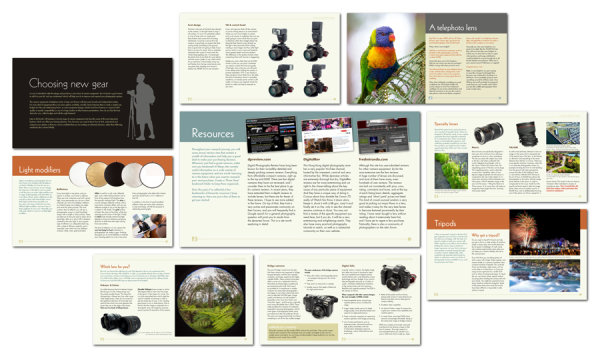
gearpagefan

An eBook Designed to Save You Money

As we planned this eBook one of the wonderful realisations that our team had was that it was something that was going to save those who read it money.

Camera gear is a costly investment and by learning what you really need and buying the right camera, lens, flash or accessory you you’re more than likely to save much more than the purchase price of this guide.

Best of all – coupled with the photographic knowledge that you’re gaining here from dPS and some practice, this eBook will help you to take better photos with gear that is suited to your needs.

Learn more about this eBook or grab a copy by clicking the download button below.

Add to Cart

Post originally from: Digital Photography Tips.

Check out our more Photography Tips at Photography Tips for Beginners, Portrait Photography Tips and Wedding Photography Tips.

Looking to Buy a New Camera or Gear? Check Out Our Brand New Guide

The post Looking to Buy a New Camera or Gear? Check Out Our Brand New Guide by Darren Rowse appeared first on Digital Photography School.


Digital Photography School

 
Comments Off on Looking to Buy a New Camera or Gear? Check Out Our Brand New Guide

Posted in Photography


Blackmagic Pocket Cinema Camera now supports Raw CinemaDNG

12 Nov

Blackmagic.png

Blackmagic Design has announced its Camera 1.5 software update which adds new 12-bit Log CinemaDNG RAW recording to the Pocket Cinema Camera. The CinemaDNG Raw lossless compression works like a ZIP file where the Raw files are compressed during 1080p recording without the loss of any part of the image. This allows videographers to capture files with wider dynamic range for increased flexibility during color correction. 

News: Digital Photography Review (dpreview.com)

 
Comments Off on Blackmagic Pocket Cinema Camera now supports Raw CinemaDNG

Posted in Uncategorized


Canon Korea teases new camera, EOS M2 or SL1/100D?

09 Nov

white100d-1.jpg

Canon Korea has put up a page teasing about a new camera release. Showing a camera covered in a white sheet, the teaser text reads, “November 2013, Canon will start from the white world. Coming soon,” according to a Google translation of the site dicahub.com. Rumors seem to expect an EOS M2 or a pro camera, but applying a few Photoshop tweaks, as dicahub did, reveals a few details that make the camera look an awful lot like a more familiar digital SLR with a new white finish. Click through for more.

News: Digital Photography Review (dpreview.com)

 
Comments Off on Canon Korea teases new camera, EOS M2 or SL1/100D?

Posted in Uncategorized


Adobe releases Camera Raw 8.3 and Lightroom 5.3 release candidates

09 Nov

shared:AdobeLogo.png

Adobe has issued Camera Raw and DNG Converter 8.3 release candidates, along with a similar preliminary version of Lightroom 5.3. ACR 8.3 is designed as different versions for Photoshop CC and Photoshop CS6. DNG Converter is available for free for users of older versions of Photoshop. The latest versions brings support for 15 additional cameras, including most of the latest models from Fujifilm, Nikon, Olympus and Sony. Eight lens correction modules are also added, including support for the Sigma 18-35mm F1.8.

News: Digital Photography Review (dpreview.com)

 
Comments Off on Adobe releases Camera Raw 8.3 and Lightroom 5.3 release candidates

Posted in Uncategorized


Canon offers Dual Pixel AF upgrade for Cinema EOS C100 camera

06 Nov

eos-c100.png

Canon is offering owners of its Cinema EOS C100 the chance to add Dual Pixel AF to this video-centric camera. This will enable continuous autofocus during recording with all Canon EF lenses, and double one-shot AF speed with 104 fully-supported lenses. Interestingly the upgrade doesn’t involve a change of sensor, but instead enables a hitherto-unused hardware capability. However it will require the camera to be sent to a Canon service centre, and in the US will cost $ 500. 

News: Digital Photography Review (dpreview.com)

 
Comments Off on Canon offers Dual Pixel AF upgrade for Cinema EOS C100 camera

Posted in Uncategorized


Robert Capa speaks for himself: ‘The camera was far above my head’

02 Nov

capa100_9.jpg

‘If your pictures aren’t good enough, you aren’t close enough’, said famed photographer Robert Capa. He was certainly close enough to take his iconic ‘Falling Solider’ photograph during the Spanish Civil War. In a recently discovered radio interview from the 1940s, Capa explains how he took the photo that many have since alleged was staged. Learn more

News: Digital Photography Review (dpreview.com)

 
Comments Off on Robert Capa speaks for himself: ‘The camera was far above my head’

Posted in Uncategorized


Rugged new iON camera may be a GoPro killer

31 Oct

iON-Air-Pro-3-Main.png

Another tiny, rugged, HD, WiFi-enabled video camera on the market may offer GoPro some real competition. Able to capture 12MP photos and 1080p video, the Air Pro 3 has a 160-degree lens that can be adjusted to be less extreme, but still very wide, 140- or 150-degree angle. Learn more on connect.dpreview.com.

News: Digital Photography Review (dpreview.com)

 
Comments Off on Rugged new iON camera may be a GoPro killer

Posted in Uncategorized


Measuring the camera capabilities of Samsung’s new Galaxy Note 3

26 Oct

Note3.jpg

Samsung’s Galaxy Note 3 makes good on the promise of the ‘phablet’ thanks to its huge, high-resolution screen and its muscular processing. But how does it fare as a camera? We put the super-sized smartphone through its photographic paces on connect.dpreview.com.

News: Digital Photography Review (dpreview.com)

 
Comments Off on Measuring the camera capabilities of Samsung’s new Galaxy Note 3

Posted in Uncategorized