RSS
 

Posts Tagged ‘Camera’

Lenovo announces Hasselblad True Zoom camera module for Moto Z smartphones

04 Sep

Lenovo offers a range of detachable smartphone accessory modules, called Moto Mods, for its Moto Z series smartphones. So far a power pack, a speaker and a mini-projector have been available. Now the company has launched a new addition at IFA in Berlin that is especially interesting to mobile photographers: the Hasselblad True Zoom.

As its name suggests the True Zoom camera module was developed in cooperation with Swedish camera maker Hasselblad, and with its 10x zoom lens and Xenon flash it converts any Moto Z device into a connected travel zoom camera. Like the other Moto Mods, the True Zoom is attached to the smartphone via magnetic force and can be used instantly – no need to restart the device or pair the phone. Communication between the devices takes place via a range of electronic contact pins.

The True Zoom’s body is made from a plastic material. Inside, images are captured on a 12MP 1/2.3″ CMOS sensor with a 1.55 um pixel size. The zoom lens offers an equivalent range of 25-250mm and a F3.5-6.5 aperture. Optical image stabilization is on board as well, and the module can record 1080p Full-HD video.

Currently compatible smartphone models are the Lenovo Moto Z, Moto Z Force and the just-announced Moto Z Play mid-range phone that comes with a 16MP camera, 5.5″ 1080p AMOLED display and a Qualcomm Snapdragon 625 octa-core processor. We have had the chance to test the Hasselblad True Zoom on a Moto Z Force for a few days – you can read about our experience with the module in our hands-on review.

The Hasselblad True Zoom will ship globally in September and will cost $ 299/€299, or $ 249.99 from Verizon in the US.

Lenovo’s Moto Mod range includes a power pack, a speaker, a projector and now the new Hasselblad True Zoom camera module.

Hasselblad True Zoom Moto Mod key specifications:

  • 12MP 1/2.3″ CMOS sensor with 
  • 25-250mm equivalent 10x zoom lens
  • 12MP
  • F3.5-6.5 aperture
  • ISO 100 to 3200
  • 1080p video
  • 2 built-in microphones
  • Physical two-stage shutter button and zoom lever
  • Xenon flash
  • 145g

Articles: Digital Photography Review (dpreview.com)

 
Comments Off on Lenovo announces Hasselblad True Zoom camera module for Moto Z smartphones

Posted in Uncategorized


Snapseed 2.9 for iOS adds Raw support for 144 camera models

02 Sep

The iOS version of Google’s Snapseed mobile photo editing app just got an update with a major new benefit: full Raw support for 144 cameras and all DNG files. With the update, the app can now be used to edit Raw files from a lengthy list of advanced compacts and interchangeable lens cameras.

A full list of cameras included in the update is available at Google’s Snapseed support website. The website also suggests supported workflows to get those Raw files onto your device, listing EyeFi MobiPro, Google Drive and Apple’s Lightning to SD card reader or USB camera adapter as possibilities. Realistically, a Raw editing workflow will probably make most sense with an iPad Pro.

Version 2.9 also introduces a face tool with various pre-set options to apply different smoothing and brightening effects to detected faces in a photo. Also added is an option to specify the JPEG compression rate applied when exporting photos, and the ability to save a lossless PNG.

Original photo from front-facing camera of an iPhone SE.  ‘Subtle’ face effect. Not usually a fan of ‘beauty’ settings on cameras, but I won’t lie: I am fine with this.

Articles: Digital Photography Review (dpreview.com)

 
Comments Off on Snapseed 2.9 for iOS adds Raw support for 144 camera models

Posted in Uncategorized


Canon announces new flagship EOS C700 cinema camera

02 Sep

Canon has announced a new addition to its Cinema EOS line of professional cinematography cameras, the EOS C700, which appears to be the first camera from Canon to leverage the global shutter CMOS sensor technology the company revealed yesterday. The camera will be available in three variants: the C700, C700 PL, and C700 GS PL.

The EOS C700 and EOS C700 PL feature a Super 35mm 4.5K sensor with wide dynamic range, which Canon says extends to 15 stops of latitude. The EOS 700 GS PL features a Super 35mm 4K sensor with global shutter. Global shutter is a desirable feature for filmmakers as it allows the camera to capture data from the entire sensor at one time. In contrast, most CMOS sensors capture data using what is known as a rolling shutter, in which data is captured line by line as it comes off the sensor, and which is responsible for the ‘Jello’ effect often seen in digital video.

All three cameras support Canon’s standard Log gamma profiles (Canon Log3, Canon Log2, and CanonLog), and support frame rates up to 4K/60p and 2K/240p. Canon has also added the ability to record footage straight to Apple ProRes, a common editing format, in addition to Raw data capture and Canon’s own XF-AVC compressed codec. Additionally, these are the first Cinema EOS cameras to include a de-squeeze feature for live monitoring when shooting with anamorphic lenses.

Owners won’t be locked into a lens mount or sensor; the C700 will allow users to switch between EF and PL mounts, as well as between the standard CMOS sensor and the global shutter CMOS sensor. (Though this work will need to be done at a Canon service facility.) Canon gives users incentive to pair the camera with EF lenses as these will make it possible to take advantage of Dual Pixel autofocus, however those who choose PL mount versions will get compatibility with Cooke/i metadata communication technology.

Finally, Canon has partnered with Codex to provide a fully integrated, no cable workflow option with the Codex CDX-36150 recorder.

These look like impressive tools, and they come with a price tag to match. The EOS C700 and C700 PL are expected to go on sale in December with a list price of $ 35,000, while the EOS C700 GS PL should be available in January (2017) with a list price of $ 38,000.

Press Release:

Canon U.S.A., Inc. INTRODUCES NEW FLAGSHIP EOS C700 CINEMA CAMERA*

Ideal for Major 4K Cinema, Television, and On-Demand Streaming Productions

MELVILLE, N.Y., September 1, 2016 – Canon U.S.A., Inc., a leader in digital imaging solutions, announced today the next step in the evolution of the Cinema EOS family of professional cinematography products with the new EOS C700, EOS C700 PL and EOS C700 GS PL cinema cameras 

Featuring a completely new, customizable, modular design, the EOS C700 meets the demands of today’s productions – from feature films to documentaries to episodic dramas. The EOS C700 and EOS C700 PL cameras feature a Super 35mm 4.5K sensor1 with wide dynamic range, and can be ideal for productions requiring 4K UHD TV or 4K DCI cinema deliverables. The EOS C700 GS PL features a Super 35mm 4K sensor with a global shutter to enable the distortion-free capture of subjects moving at high speeds. In addition to supporting the earlier XF-AVC2 recording format, the cameras also support Apple® ProRes.

Recognizing that customers today demand flexibility and the ability to respond to the changing needs of productions, the EOS C700 allows users to convert between EF mount and PL mounts, and between a standard CMOS image sensor and a global shutter CMOS image sensor at Canon service facilities3. The EF lens mount provides compatibility with Canon’s diverse lineup of over 70 interchangeable EF lenses as well as enabling use of Canon’s Dual Pixel CMOS AF technology. While the EOS C700 PL and EOS C700 GS PL allow use of industry-standard PL lenses and compatibility with Cooke /i metadata communication technology.

For those wanting to shoot and deliver High Dynamic Range (HDR)4 content, the EOS C700 and EOS C700 PL are ideal – providing 15 stops of latitude5, Canon’s proprietary Log Gammas (Canon Log3, Canon Log2 and Canon Log) and renowned color science. Additionally, these cameras seamlessly integrate with Canon’s professional 4K displays (DP-V2420, DP-V2410 or DP-V1770) for on-set color management and review that conforms to SMPTE ST 20846 standards of HDR display.

To complement these powerful new acquisition tools, Canon has turned to its trusted partner Codex to provide a fully-integrated (no cables) recording and workflow option. The combination of the EOS C700 camera with the optional Codex CDX-36150 recorder allows for high-speed 4.5K RAW recording at up to 100FPS, 4K RAW at up to 120FPS, 4K ProRes at up to 60FPS, 2K ProRes at up to 240FPS and XF-AVC at up to 60FPS.

Canon’s new EOS C700, EOS C700 PL and EOS C700 GS PL are the first Cinema EOS cameras to support anamorphic shooting by utilizing a “de-squeeze” function for monitoring7, making possible the creation of images with the 2.39:1 aspect ratio typical of cinema productions. Furthermore, enabling Full HD high-frame-rate recording at a maximum of 240 fps (crop8), the camera enables smooth playback, even when slowed down, for great emotional visual expression. 

Along with the announcement of these cameras, Canon is also introducing optional accessories OLED 1920×1080 Electronic View Finder EVF-V70, Remote Operation Unit OU-700, Shoulder Support Unit SU-15, Shoulder Style Grip Unit SG-1 and B4 mount adapters MO-4E/MO-4P. 

The EOS C700 and EOS C700 PL are currently expected to go on sale in December 2016, while the EOS C700 GS PL is currently expected to go on sale in January 2017. The EOS C700 and EOS C700 PL will have a list of $ 35,000.00 each** and the EOS C700 GS PL will have a list price of $ 38,000.00**.  

†Based on weekly patent counts issued by United States Patent and Trademark Office.

*This device has not been authorized as required by the rules of the Federal Communications Commission. This device is not, and may not be offered for sale or lease, or sold or leased, until authorization is obtained. 

**Availability, pricing and specifications are subject to change without notice. Actual prices are set by individual dealers and may vary.

1 4.5K RAW recording will be supported following a firmware update (currently scheduled to be released at the end of March 2017, see chart below).

2 Canon’s proprietary video format that efficiently compresses video data.

3 Conversions will incur a fee and will be handled by Canon service facilities.

4 High Dynamic Range refers to a technique that enhances the contrast between light and dark values (the dynamic range) of an image.

5 15 stops achievable in EOS C700 and EOS C700 PL models in Canon Log2 mode. EOS C700 GS PL achieves 14 stops.

6 The wide dynamic range imaging standard recommended by the Society of Motion Picture & Television Engineers.

7 A lens that enables shooting with landscape-orientation compression and makes possible a characteristic blur effect.

8 A shooting function that creates a pseudo-telephoto effect using a portion of the sensor area.

Articles: Digital Photography Review (dpreview.com)

 
Comments Off on Canon announces new flagship EOS C700 cinema camera

Posted in Uncategorized


Sony announces Xperia XZ flagship device with triple-sensor camera

02 Sep

Sony has announced its new top-end device in the Xperia Z line at IFA in Berlin and in the camera department the new model comes with what the company calls ‘triple sensor’ technology. In practical terms this means that the Sony IMX300 1/2.3” 23MP image sensor with on-sensor phase detection is accompanied by a laser that measures the distance to the subject and improves AF speed and accuracy in low light; and an RGBC-IR sensor that measures the color values of a scene in order to fine-tune the white balance system. The hybrid AF-system is also predictive and can track subjects in motion.

The Sony G lens comes with a 24mm equivalent focal length and an F2.0 aperture. In video mode the camera can record footage in 4K resolution and the Xperia XZ is also the first device on which Sony has implemented 5-axis electronic video stabilization. At the front there is a 13MP 1/3″ sensor with F2.0 aperture and 1080p video, specifications that would have been worthy of a main camera not too long ago.

The Android 6.01 system is powered by a Qualcomm Snapdragon 820 chipset and 3GB of RAM. 32 or 64GB of internal storage are expandable via microSD card. Intelligent battery management means you are getting as much time as possible out of the 2900 mAh battery which also supports quick-charging. With a 1080p resolution and 5.2” diagonal the display specifications have not changed from previous high-end Xperia devices.

All the technology is wrapped up in an 8.1mm thin metal body with rounded edges, that is water and dust tight (IP65/68). A fingerprint sensor has been integrated into the power button for added security. The Sony Xperia XZ doesn’t offer any huge improvements over previous devices in the series but looks like a solid update. It will be available in Europe from October for €699 (approximately $ 780), there is no word on availability in other regions yet.

Articles: Digital Photography Review (dpreview.com)

 
Comments Off on Sony announces Xperia XZ flagship device with triple-sensor camera

Posted in Uncategorized


Sony Xperia X Compact offers high-end camera in smaller format

02 Sep

Along with the Xperia XZ, Sony has launched the Xperia X Compact. It’s aimed at users who want a powerful camera in a compact body but can live with a slightly less powerful chipset.

The X Compact comes with the same 23MP ‘triple sensor’ main camera with laser-AF and color sensor as the Xperia XZ, but doesn’t offer 4K video and uses a front camera with a lower 5MP resolution, compared to the XZ’s 13MP. Like previous Sony Compact models the new device has a 4.6” display with 720p HD resolution, putting it in direct competition with Apple’s iPhone 6s. The Sony is powered by a Qualcomm Snapdragon 650 chipset and features 3GB of RAM in conjunction with 32GB of internal storage. The latter is expandable via a microSD slot. Power is provided by a 2700 mAh battery, that, like on the larger model, supports smart battery management and quick charging.

The power button doubles as fingerprint reader to ensure secure device access and online shopping. In contrast to the Xperia XZ the Compact model comes with a plastic body that does not feature any environmental protection. However, this is reflected in pricing. The Xperia Z Compact will be available in Europe from September for a more affordable €449 (approximately $ 560).

Articles: Digital Photography Review (dpreview.com)

 
Comments Off on Sony Xperia X Compact offers high-end camera in smaller format

Posted in Uncategorized


Canon announces the XC15 4K video camera

02 Sep
The Canon XC15 camera with included MA-400 microphone adapter, which provides support for XLR inputs.

Canon has announced the new XC15 camera, a 4K UHD camcorder in a compact body.

Though it’s clearly a follow-up to the company’s XC10 model, introduced in 2015, Canon is positioning the XC15 very differently. When the XC10 was announced Canon presented it as a camera that could bridge the gap for those who needed to shoot both video and stills, emphasizing its 12MP still capture capability. In contrast, the press release for the XC15 doesn’t even mention still photos, instead positioning the camera as a high quality, compact 4K camcorder oriented at news and video production, possibly as a B-camera to a Cinema EOS model. Canon hasn’t yet provided detailed specifications, but like the XC10 it uses a 1” CMOS sensor and a 10x optical zoom lens, which appears to be the same 24.1mm-241mm F2.8-5.6 (equivalent) lens found on the XC10.

It appears that Canon is making an effort to respond to one very specific area of feedback from many of its video users: the need for XLR microphone support. The camera ships with Canon’s MA-400 microphone adapter that provides XLR-input compatibility.

The XC15 will be available in September for $ 3000.00

Press Release:

Canon’s New Lightweight, Compact XC15 4K UHD Video Camcorder Ideal for News and Video Production

XLR Microphone Input Provides Audio Support in Addition to High-Quality 4K UHD Video Capture

MELVILLE, N.Y., September 1, 2016 – Canon U.S.A., Inc., a leader in digital imaging solutions, announced today the XC15 4K Video Camcorder, a 4K UHD digital video camcorder for professional use that achieves high-image quality with a lightweight, compact body.

The new Canon XC15, which builds on the XC10 4K UHD digital video camcorder announced in April 2015, enables shooting with an external microphone through an XLR input and features the selection of visual-expression “Look” modes, including modes that allow it to match the look of other Canon professional cameras, making it ideal for use as a “B”-camera as well as for media and video-content productions.

The Canon XC15 ships with the MA-400 microphone adapter that, when attached, enables shooting with XLR-input microphones used in a wide range of media and content-creation applications. As a result, the camcorder supports the production of content that combines both high-image quality and high-sound quality with reduced noise. The MA-400 is also compatible with the EOS C300 Mark II camera.

Thanks to its high-sensitivity one-inch CMOS sensor and DIGIC DV 5 image processing platform with high calculation-processing power, the new XC15 is capable of capturing high-image quality and low-noise 4K UHD video. Additionally, the camcorder features a compact, lightweight body design, measuring approximately 5.0 x 4.1 x 4.8 inches (WxHxD) and weighs approximately 2.1 pounds while also sporting a 10x optical zoom lens ¹, which facilitates shooting in confined spaces and environments that demand mobility.

The Canon XC15 4K UHD professional video camcorder is scheduled to be available in September 2016 for a list price of $ 3,000.00.* For more information, please visit usa.canon.com

† Based on weekly patent counts issued by United States Patent and Trademark Office.

* Availability, prices and specifications subject to change without notice. Actual prices are set by individual dealers and may vary.

All referenced product names, and other marks, are trademarks of their respective owners.

¹ Body and Lens Only

Articles: Digital Photography Review (dpreview.com)

 
Comments Off on Canon announces the XC15 4K video camera

Posted in Uncategorized


DxO releases major firmware update and accessories for DxO One camera

01 Sep

DxO has released a significant firmware update and an expanded range of accessories for its DxO One camera. The improvements include remote operation over Wi-Fi, while the accessories include a waterproof case.

The firmware update finally enables the camera’s Wi-Fi, making it possible to use it remotely. The camera can either create and ad hoc connection to an iOS device or can join an existing Wi-Fi network.

The Wi-Fi system uses the Apple Lightning connector to establish the communication between the two devices. These ad hoc connections should have a range of 10-15m, depending on how much radio traffic there is. Connections across existing Wi-Fi networks work over a greater range but use a slower transfer protocol.

The firmware update also improves both the camera’s battery management and the battery level reporting, meaning you should be able to shoot for longer with the camera and have a clearer idea of how much battery life remains.

Accessories

DxO has also launched a series of accessories that considerably extend the One’s capabilities.

These include a footplate/tripod mount, that allows the camera to sit upright and includes both a standard tripod thread and Arca-Swiss-style flanges. These are closer together than usual, though, so it may not be compatible with all Arca-Swiss heads.

There’s also a rugged case. This comes with two clip-on backs, one of which provides environmental sealing and allows the continued use of the touchscreen and a second that provides full water proofing (to a depth of 45m). The case includes a hinge attachment, making it compatible with many mounts and accessories designed for GoPros.

With the waterproof back attached, the camera’s shooting mode can be changed by holding your hand over the lens for 3 seconds – allowing a degree of control without having to remove the camera from its case.

There’s also a set of adapters to allow 30.5mm filters to be clipped onto the front of the camera. This makes it possible to add diopter lenses or optical filters to the camera easily.

The firmware update and associated iOS app will be free. The tripod stand will cost around $ 24.99/£19.99/€24,90, while the ‘outdoor case’ has a recommended price of $ 59.99/£49.99/€59,90.

Press Release

The DxO ONE award winning camera takes it one step further with two new state-of-the-art features

PARIS and SAN FRANCISCO—August 31, 2016—Camera manufacturer DxO announces major updates to the DxO ONE Miniaturized DSLR-quality Camera for iPhone, including Wi-Fi remote control and a new waterproof Outdoor Shell designed to further extend its elds of use. Upholding their promise to make the camera even better after you’ve bought it, Wi-Fi Remote Control will be available to all existing users free of charge via a forthcoming 2.0 software update. DxO’s accessories ecosystem also introduces an ultra-compact Stand and a snap-on Optical Adapter, enhancing creative possibilities for the DxO ONE which captures pro-quality photos and videos that you can share instantly to Facebook, Instagram, YouTube and more.

DxO’s new Wi-Fi Remote Control implementation is remarkable in that it completely eliminates the cumbersome and altogether frustrating Wi-Fi con guration process that plagues every other Wi-Fi-equipped camera on the market. When attached via DxO’s patented Lightning connector, Apple iOS can seamlessly pass its Wi-Fi authentication credentials from the iPhone to the DxO ONE. In-house or in-of ce, users can take advantage of this unique DxO innovation that lets the camera immediately tap into the Wi-Fi network that your iPhone is already logged onto. And when traveling about, or out in the wilderness, your DxO ONE can just as easily create a direct Wi-Fi connection to your iPhone. By enabling remote connectivity between the DxO ONE camera and your iPhone, photographers are free to explore every conceivable photographic angle, while still having control over every capture setting, and the ability to easily view, edit and share their content to social media sites such as Facebook, Instagram, and YouTube.

“Last year, we revolutionized mobile photography by packing DSLR-quality into a camera design so incredibly small that it could always be available in our pocket,” said DxO CEO and founder, Jérôme Ménière. “And now, thanks to Wi-Fi Remote Control and our new accessories ecosystem, all our users can take the DxO ONE with them absolutely anywhere, without restrictions, and extend their creativity even further.”

The Outdoor Shell, compatible with all existing DxO ONE cameras, is extremely rugged and yet quick and easy to attach. The shell can be equipped with either of two waterproof back doors, one of which is splash proof (IP67), perfect for sailing or walks in the rain. The other is fully submersible and immersion proof to depths of 45m (150 ft) for scuba diving in a reef or just swimming in your pool. The design features a dual clamping system that snaps securely into place to protect your DxO ONE camera from water, dust and shock, while providing access to power switching and multiple capture modes without having to open the shell. Built to stand up to the elements, the Outdoor Shell is made from durable high end polymers and stainless steel. The shell accepts 30.5mm thread optical add-ons, features a 1?4-20 thread for tripod mounting, and can even be attached to popular Action Cam xtures and harnesses. Available in seven exciting colors including yellow, coral, lime, olive, black, white and lagoon, the waterproof Outdoor Shell is the perfect way to protect and personalize your DxO ONE.

The 2.0 software update also introduces Mobile Smart Lighting, a lighter-weight variant of the famed Smart Lighting feature in DxO OpticsPro, which automatically analyzes each scene and applies an intelligent and customizable global tone map—in this instance, to every photo you take with your DxO ONE. The overall effect is similar to having added a ll light to the picture, which dramatically enhances the dynamic range of your images. The automatic 2.0 update also includes signi cant enhancements to battery management and power consumption including an on-demand auto- focus mode similar to that of DSLRs, and an innovative underwater white balance that automatically compensates for the blue cast to achieve a more pleasant rendering in your underwater images.

“It seems every few months the team in Paris automatically updates my DxO ONE with cool new features,” said celebrated motorsports photographer, John Thawley. “Now, with remote Wi-Fi control I’m totally untethered. Combined with the protective shell, I’m free to place the camera in all sorts of new and discreet scenarios. This means I can capture high resolution images that just weren’t possible before… not with any camera!”

An e-store, accessible right from the DxO ONE app, allows you to easily order any of the new accessories including an ultra-compact Stand that uses an ingenious combination of clamps to let you balance your camera on almost any surface or mount it to a tripod. Also accessible via the e-store is a snap-on Optical Adapter that allows standard ND and creative lters, macro lenses, and hoods to be mounted in front of the lens of your DxO ONE camera. And of course, the accessories store also provides one stop access to the waterproof Outdoor Shell that lets you take your DxO ONE miniaturized camera where no DSLR or smartphone can go.

Pricing & Availability

The DxO ONE Miniaturized DSLR-quality Camera for iPhone and iPad is available now for pre-order at dxo.com and Amazon, and other respected retailers for £399 / 499 €. First customer availability is expected second half of September.

Also available in the same timeframe from select retailers, as well as via the new in-app e-store, are genuine DxO accessories designed to enhance the DxO ONE user experience. These include the waterproof Outdoor Shell for £49.99 / 59,90 €, the ultra- compact Stand for £19.99 / 24,90 €, the snap-on Optical Adapter for £19.99 / 24,90 €, and a protective quick-draw Zipped Pouch for £15.99 / 19,90 €.

The DxO ONE 2.0 iOS app and companion Apple Watch app will be made available as free software updates via the iTunes App Store, also available the second half of September. Every DxO ONE user is invited to download DxO Connect for Mac/PC, or on Mac DxO OpticsPro for Photos – DxO ONE camera only, both of which harness the power of the DxO OpticsPro photo engine to make your best DxO ONE photos look even better.

Articles: Digital Photography Review (dpreview.com)

 
Comments Off on DxO releases major firmware update and accessories for DxO One camera

Posted in Uncategorized


Display your camera collection in style with these 3D-printed wall mounts

30 Aug

$ (document).ready(function() { SampleGalleryV2({“containerId”:”embeddedSampleGallery_4952012233″,”galleryId”:”4952012233″,”isEmbeddedWidget”:true,”standalone”:false,”selectedImageIndex”:0,”startInCommentsView”:false,”isMobile”:false}) });

Looking for a sleek, minimalist display for your vintage camera collection? LaudWorks, a purveyor of DIY project tools, has launched a small accessory called Hangie for easily mounting a camera on a wall. The 3D-printed mount is offered in both steel and plastic versions with multiple color options, and is nearly invisible when used, giving the impression that the camera is floating on the wall.

The Hangie mount is simple to install: first, attach the mount to a wall using two screws, then secure the camera using a tripod mount screw. The metal version of Hangie is made from bronze-infused stainless steel and is designed for heavier cameras; LaudWorks says it tested this version with a Canon EOS 7D and a EF-S 17-55mm lens attachment (1500g / 3.3lb). The plastic version, meanwhile, is made from white nylon plastic and is made for ‘small, lightweight cameras.’

Both products are available from Shapeways; the plastic version is $ 4 and the metal version is $ 21. 

Via: PetaPixel

Articles: Digital Photography Review (dpreview.com)

 
Comments Off on Display your camera collection in style with these 3D-printed wall mounts

Posted in Uncategorized


PRVKE 21 is a rugged and versatile camera backpack

30 Aug

Recently we have seen several camera bags that look like anything but camera bags, and Wandrd’s new Prvke 21 is the latest example for this trend. With its roll-top and rugged style it looks like a cross between a bike messenger bag and a mountaineering backpack. The Prvke 21 is made from ballistic nylon, water-resistant Tarpaulin and rugged YKK zippers, the combination of which should keep all your gear dry and safe. Magnetic loops and large buckles allow for easy conversion from backpack to tote. 

The Prvke 21’s design has been based on feedback from users of the original Prvke bag, many of whom were looking for a smaller version. The interior is customizable and its 21 liter capacity, that can be expanded to 25 liters, makes it a good option for the commute bag, for the occasional hike or even a quick weekend trip.  

That said, photographers will probably be most interested in the Prvke 21’s removable camera cube. It holds a mirrorless camera with up to four lenses or a full-frame DSLR body plus two lenses. Integrated straps allow for “hands-free” access to your camera gear and a camera sling keeps your camera ready without having it dangling from your neck. In addition the bag comes with a hidden passport pocket, front pockets for the small stuff, a padded laptop-sleeve and various other small pockets, for keys, mobile phone and memory cards. 

If you like the look of the bag you can now secure one by pledging $ 149 for the early-bird option on the Prvke 21’s Kickstarter page. Delivery is planned by Christmas 2016. More information can also be found on the Wandrd website.

Key specifications:

  • 21 liters capacity (expandable to 25)
  • 2.8 lbs / 1.3kg empty weight
  • 17 × 11 × 6.5 inches / 43 x 28 x 16.5 cm
  • water-resistant
  • $ 149 early-bird price on Kickstarter

Articles: Digital Photography Review (dpreview.com)

 
Comments Off on PRVKE 21 is a rugged and versatile camera backpack

Posted in Uncategorized


FotodioX Lens Adapter – How to Put Your Canon EF Lens on Your Sony E-Mount Camera

29 Aug

One of the big hurdles for DSLR camera owners considering the switch to mirrorless, is the notion of having to buy brand new lenses to accompany their new purchase. While it’s ideal to have brand name lenses that match your camera body, it’s not at all necessary, thanks to third-party lens makers and lens adapters. This article discusses the latter option, specifically, a lens adapter that allows just about any Canon EF lens, to be used with a Sony E-Mount camera.
ony Canon Lens Converter

My Camera Background

As a corporate event and food photographer, the Canon 5D Mark III, plus an array of Canon zoom lenses and a handful of primes, are my go-to choices for professional photo work. However, the desire to carry a smaller camera while traveling casually, led to my recent purchase of a Sony a6300 camera, my first investment in a mirrorless system. While I did opt for a Sony 16-50mm kit lens and a 20mm f/2.8 prime lens, I wasn’t financially ready to invest in any more Sony brand lenses. Instead, research and recommendations from other fellow photographers led me to purchase a lens adapter, which promised the ability to use my existing Canon EF lenses with my new Sony E-Mount camera body.

If you’re in a similar position, where you’ve accumulated a collection of DSLR lenses and are considering adding the Sony a6300 to your kit, this article is for you!

ony Canon Lens Converter

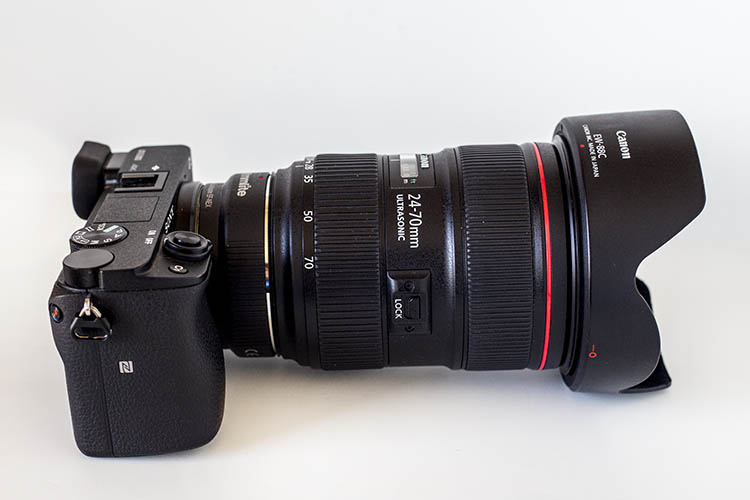
Sony a6300 body with a Canon 24-70mm f/2.8 lens, mounted using the Fotodiox adapter.

Lens Adapter Options

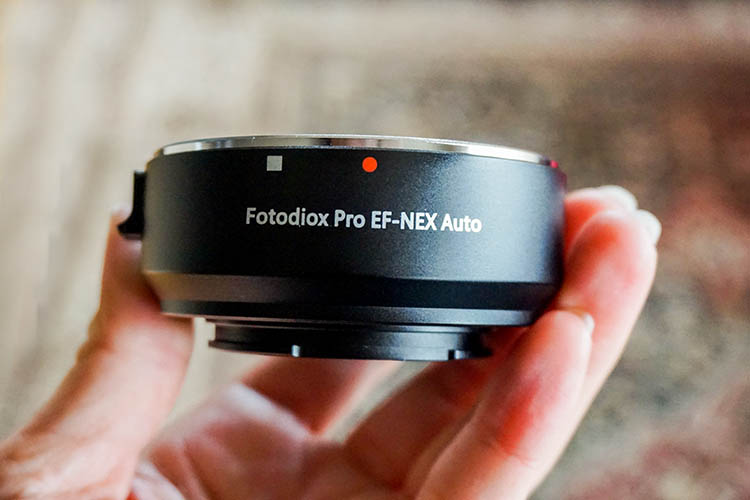
Third-party brands have already hopped on the lens adapter train, and there are quite a few options available, but two main ones that came up in research were the Metabones Smart Adapter IV and the FotodioX AF Adapter. At first glance, both options seemed comparable in their offerings:

  • Compact, lightweight, all-metal design.
  • Allows for automatic focus and aperture control from the Sony E-Mount camera body.
  • Infinity focus allowed if needed.
  • Removable tripod mount included to help distribute the weight.

The main difference between the two products came down to price: the Metabones version is priced at $ 385.99, while the FotodioX option is considerably cheaper at just $ 99.99. In the end, the price was the determining factor, and I went for the FotodioX lens adapter.

ony Canon Lens Converter

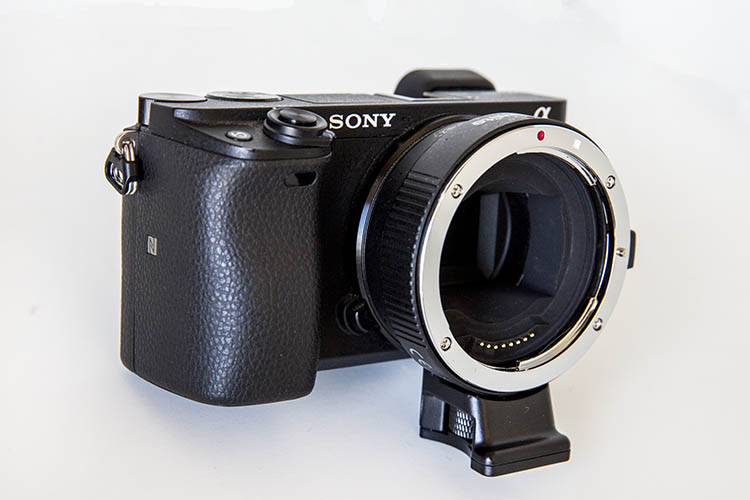
Sony a6300 with the FotodioX AF Adapter attached.

How did it perform?

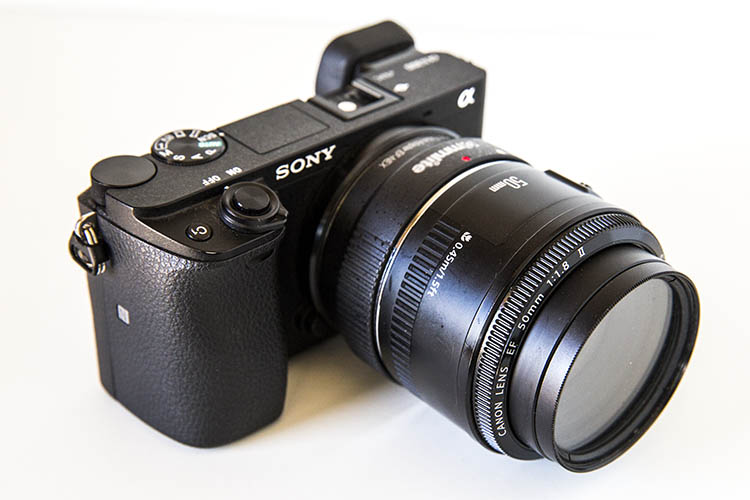
The first thing to note about using an adapter is how it will impact the overall heaviness, bulk, and appearance of your system. The FotodioX adapter itself is truly compact, and isn’t much larger than the Sony a6300 kit lens. As a result, it looks like a natural complement to the a6300 when it’s connected. Adding on Canon EF lenses changes the look and feel of the a6300, depending of course, and which lenses are paired. Small, lightweight, prime lenses such as the Canon 50mm f/1.8 don’t add a lot of bulk to the camera, and also look like a natural fit.

ony Canon Lens Converter

Sony a6300, FotodioX AF Adapter, and Canon 50mm f/1.8 lens.

However, adding larger zoom lenses such as the Canon 24-70mm f/2.8 definitely make the camera more front-heavy, to the point that it makes sense to grip the rig by the lens rather than the camera body. Still, the rig is considerably lighter than pairing the same Canon lenses with a DSLR such as the 5D Mark III.

ony Canon Lens Converter

Apart from aesthetics, the adapter actually performed surprisingly well! There are many reports of adapters causing autofocus to be either painfully slow, or lost altogether. While autofocus was not as snappy and accurate as it was using a Sony brand lens, the a6300 was still decently responsive, even with the FotodioX adapter and a Canon EF lens attached. If autofocus wasn’t working properly, which tended to happen for close-range shots, it was easy to switch the lens to manual focus and still capture a photo. Image quality was also tack-sharp, here are some image examples:

ony Canon Lens Converter

ony Canon Lens Converter

ony Canon Lens Converter

ony Canon Lens Converter

ony Canon Lens Converter

ony Canon Lens Converter

Overall thoughts

Using a lens adapter isn’t a perfect solution. The lagging autofocus was fine for casual use, but eventually became more noticeable and cumbersome when trying to shoot anything that moved. I’d hesitate to rely on an adapter when shooting something where quick autofocus mattered. It also felt like a pretty big tradeoff to not be able to take full advantage of what Sony purports to be the “world’s fastest autofocus” in the a6300. But other than that, the ability to use my existing DSLR lenses with a new camera body made by another manufacturer is a convenient luxury.

Have you tried a lens adapter before? What was your experience like?

googletag.cmd.push(function() {
tablet_slots.push( googletag.defineSlot( “/1005424/_dPSv4_tab-all-article-bottom_(300×250)”, [300, 250], “pb-ad-78623” ).addService( googletag.pubads() ) ); } );

googletag.cmd.push(function() {
mobile_slots.push( googletag.defineSlot( “/1005424/_dPSv4_mob-all-article-bottom_(300×250)”, [300, 250], “pb-ad-78158” ).addService( googletag.pubads() ) ); } );

The post FotodioX Lens Adapter – How to Put Your Canon EF Lens on Your Sony E-Mount Camera by Suzi Pratt appeared first on Digital Photography School.


Digital Photography School

 
Comments Off on FotodioX Lens Adapter – How to Put Your Canon EF Lens on Your Sony E-Mount Camera

Posted in Photography