RSS
 

Posts Tagged ‘Camera’

LG V20 owners report fragile, easily cracked camera glass

26 Oct

Numerous reports have surfaced from LG V20 owners claiming that the glass covering the smartphone’s rear camera is easily shattered. In some cases, the glass reportedly breaks without any direct impacts, leading some to speculate that the LEDs may be the cause. Some users report receiving a new phone with glass that’s already cracked, while others indicate it cracks after only several hours or days of use.

In addition to user reports on Reddit, smartphone durability tester ‘JerryRigEverything’ experienced the same issue. The glass camera covering is shown shattering in the video below a few moments after he rubs it with a pick to test its durability against scratches. LG has not issued a comment on the reported issue. For now, users are advised to keep the protective film covering on the camera glass in an effort to avoid cracks.

Via: TechTimes

Articles: Digital Photography Review (dpreview.com)

 
Comments Off on LG V20 owners report fragile, easily cracked camera glass

Posted in Uncategorized


Oldest existing Nikon I camera goes up for auction with original lens and case

25 Oct

$ (document).ready(function() { SampleGalleryV2({“containerId”:”embeddedSampleGallery_1322935571″,”galleryId”:”1322935571″,”isEmbeddedWidget”:true,”standalone”:false,”selectedImageIndex”:0,”startInCommentsView”:false,”isMobile”:false}) });

The oldest known Nikon camera in existence has gone up for auction at WestLicht. This particular Nikon I, serial number 60924, was made in April 1948 and is notable as being the third camera produced by Nikon. WestLicht describes the camera’s condition as ‘B+,’ and says it includes the original Nikkor-H 2/5cm no.70811 with a matching Nikon cap in ‘fantastic original condition.’

The Nikon I still has its original shutter, according to WestLicht, as well as engravings that indicate the serial number, ‘Nippon Kogaku Tokyo’ and ‘Made in Occupied Japan.’ In addition to the camera itself, the auction includes the original double-strap carrying case; WestLicht describes the case as ‘extremely rare.’ 

The auction’s starting price is €90,000, with WestLicht estimating the camera will sell for between €160,000 to €180,000 (about $ 174,000 to $ 195,750). 

Articles: Digital Photography Review (dpreview.com)

 
Comments Off on Oldest existing Nikon I camera goes up for auction with original lens and case

Posted in Uncategorized


Camera components represent 9.5% of total iPhone 7 material cost

21 Oct
 Image: Chipworks-TechInsight

Analyst firm Chipworks-TechInsight has published its iPhone 7 reverse engineering report, which includes some interesting cost and technology information for more engineering-minded photographers. The analysts estimate the total bill of materials for the iPhone 7 with 128GB of built-in memory to be $ 275. $ 26, or approximately 9.5%, of that total sum are spent on camera and imaging components. This includes the Sony-made Exmor RS image sensors and lenses in front and rear cameras and all processing hardware.

The most expensive component in the device, that retails in the US for $ 749, is Apple’s A10 Fusion CPU at $ 40.  The display and touchscreen add $ 37 to the cost. Given how advanced smartphone camera technology has become, it is surprising that it only represents a relatively small percentage of the total cost of a device (though Apple is famous for its high margins.)

We’d expect the dual-cam in the iPhone 7 Plus to be quite a bit more expensive than the single-lens version in the standard iPhone 7. However, Chipworks has to publish its report on the larger iPhone model. For now, you can download the iPhone 7 report on Chipworks website if you’re happy to provide your contact information and email.

Articles: Digital Photography Review (dpreview.com)

 
Comments Off on Camera components represent 9.5% of total iPhone 7 material cost

Posted in Uncategorized


Keep calm and carry on: tips for safely transporting spare camera batteries

21 Oct

If you read too much news you might believe that Samsung Galaxy Note 7 smartphones are exploding all around the globe like miniature incendiary devices. You might even think that lithium-ion batteries are the work of an evil empire intent on spreading terror throughout the civilized world. Indeed, these combusting batteries have caused a good deal of concern, if not terror, and many consumers are questioning how safe the lithium-ion cells we use in our cameras are.

It is worth pointing out at this stage that of the over 2.5 million Galaxy Note 7s that were shipped before they were withdrawn only around 90 had over-heated, and fewer again had actually caught fire. A 90 in 2.5 million hit rate wouldn’t be reported if we were talking about the phone’s microphone not working, but as the potential is a pocket, handbag, house or hand actually catching fire the frequency of occurrence is obviously way too high. 

The good news is that the lower capacity batteries you pack in your camera bag are much less likely to cause a newsworthy scene than that in the Note 7, and by following some simple precautions you’ll be just fine.

What makes lithium batteries catch fire?

Smartphones need an astonishing amount of power to run the processors that control their multitasking activities, and the battery in the Samsung Galaxy Note 7 is rated at 13.48Wh. That’s a lot more powerful than most camera batteries – the EN-EL15 used to power the Nikon D810 for example is 11.8Wh.

Seen here: a Samsung Galaxy Note 7 that did not burst into flames.

The Note 7 battery is designed to be used in a device that Samsung wants to be as thin and as light as possible, so the battery has to be as thin and light as it can be made. That means we have a lot of charge in a very tight space. Lithium-ion cells are ideal for this sort of task as they are able to hold twice the charge of traditional metal cells such as nickel-cadmium and they are much lighter – lithium is the lightest metal element.

Problems arise in batteries for a number of reasons, but most center around some sort of short circuit between the positive and negative electrodes. Such short circuits allow energy to flow through the cell un-resisted which causes a build-up of heat that can lead to a fire.

In a lithium-ion cell the cathode (positive) and anode (negative) electrodes are immersed in an electrolyte conductive fluid and are kept apart by a porous barrier called a separator. During charging, and while the battery is being used, lithium-ions use the electrolyte fluid to travel between the anode and the cathode, passing through the porous separator on their way. At the same time, electrons pass between the anode and cathode via the device the cell is powering or the charger. If the separator is flawed it might allow electrons to travel between the two electrodes – a short circuit. If this happens the cell will begin to overheat.

This spiraling build-up is called ‘thermal runaway’ and the immense heat generated can make the cell and battery expand or explode

Problems can occur if the electrolyte fluid in the cell is contaminated with metal particles or if the separator is just too weak to do its job. The separator can also begin to break down when external temperatures are very high. The breakdown of the separator and the consequent unimpeded contact between negative and positive electrodes within the cell lead to a build-up of heat that can’t be dissipated, which subsequently leads to further break down within the structure of the cell. This spiraling build-up is called ‘thermal runaway’ and the immense heat generated can make the cell and battery expand or explode.

As most battery packs contain multiple cells to build voltage the breakdown in one will often overheat its neighbors and the reaction will be permeated through the entire unit.
The cell doesn’t need to have a manufacturer’s flaw to catch fire either, as any physical damage to the battery can rupture the separator or the individual chambers, allowing electrons to flow freely within the cells creating a short circuit. It only takes a tiny breach of the separator for thermal runaway to occur, as any breach will create heat that will further damage the separator and make a tiny hole bigger as the temperature rise accelerates.

How does this effect camera batteries?

Camera batteries tend not to pose such a high risk as they don’t contain as much energy as phone batteries do, but they can still be the cause of a fire if they aren’t treated correctly. Airlines allow lithium-ion batteries to be carried in carry-on luggage as if there is a fire it can be dealt with more easily in the cabin than it can in the hold. There are however restrictions on how many batteries can be carried in one place.

Some airlines recommend that the contacts are covered with electrical insulating tape to prevent them coming into contact with anything that might create a short circuit. 

Mail services tend to be most concerned about batteries rated above 100Wh. This doesn’t affect still camera batteries, which tend to be around 14Wh, but some larger video camera batteries can come into this bracket. These need special markings on the outside of the package. You might be required to pack each battery in its own plastic pouch, though taping contacts should be enough. Check with the company you are mailing or flying with for exact requirements. For an example, here are Delta airlines requirements:

Lithium Batteries
As you probably know, traveling with consumer electronic and medical devices containing lithium cells or batteries (e.g. watches, calculators, cameras, cell phones, laptops, camcorders, hearing aids, etc.) is allowed onboard as carry-on. Spare lithium batteries are allowed as carry-on only, and must be individually protected to prevent short circuits.
Tips to properly transport spare lithium batteries:
* Pack spare batteries in carry-on baggage.
* Keep spare batteries in the original retail packaging to prevent unintentional activation or short-circuiting.
* If original packaging is not available, effectively insulate battery terminals by isolating spare batteries from contact with other batteries and/or metal.
* Specifically, place each battery in its own protective case, plastic bag or package, or place tape across the battery’s contacts to isolate terminals.
* Take steps to prevent crushing, puncturing, or putting a high degree of pressure on the battery, as this can cause an internal short circuit, resulting in overheating.
Size Limits for Lithium Batteries:

Passengers are permitted to travel with lithium-ion batteries that contain a maximum of 160 watt hours per battery. Any lithium-ion battery containing more than 160 watt hours is prohibited from carriage on all passenger aircraft. lithium-ion batteries installed in a personal electronic device can be transported as checked or carry on baggage. lithium-ion batteries not installed in a device (spares) must be in carry-on baggage and no more than two (2) spares between 100 and 160 watt hours are allowed.

Keep calm and carry on (your spare batteries)

Fortunately there is no cause for alarm on the part of most photographers. We need to remember that lithium-ion batteries pose a risk if not taken care of and if we are careless about where we buy them. Chances are that if you use the battery that came with your camera and spares from the manufacturer or a well-known third party, you will never have an issue. Just be careful not to puncture the cell and to handle damaged batteries with extreme caution.

Another point worth noting is that the battery in the Galaxy Note 7 was installed in the phone and not designed to be removed, so it had a softer, less protective exterior shell. Most camera batteries are packed in hard plastic casing and are unlikely to split or rupture, or become critically damaged internally as a result of impact.

Camera batteries can catch fire like those used in the Samsung Galaxy Note 7, but you’ll have to go out of your way to make them do so. They won’t explode on their own accord and they are pretty unlikely to even overheat unless you forget to treat them with the respect they are due. 

Articles: Digital Photography Review (dpreview.com)

 
Comments Off on Keep calm and carry on: tips for safely transporting spare camera batteries

Posted in Uncategorized


Fujifilm gives us a glimpse of its upcoming Instax Square camera

20 Oct

We’ve known for a while now that Fujifilm is developing a 1:1 format instant film, which measures 85.6mm x 72mm and provides a 62 x 62mm image, and an accompanying Instax camera. Unfortunately not much detail is known about the camera but now the Japanese manufacturer has released a teaser video on its Instax Square website that gives us at least a glimpse at some elements of the camera.

On the website you get to see some Instax Square sample images but unfortunately most of the video consists of trippy graphics that remind us of a 1990’s techno music video. So watch closely, you don’t want to miss the important parts.

Instant film fans will have to wait a little longer to get their hands on the new toy, as the release of both film and camera is scheduled for the Spring of 2017.

Articles: Digital Photography Review (dpreview.com)

 
Comments Off on Fujifilm gives us a glimpse of its upcoming Instax Square camera

Posted in Uncategorized


Leica introduces ‘Titanium gray’ version of its Q compact camera

20 Oct

Leica has announced that it will release a new version of its Q (Typ 116) full-frame compact camera that will be finished in a gray paint instead of the usual black. The Leica Q ‘Titanium gray’ will be essentially the same camera as the black model, but its metal areas will be a light gray. The material body cover will be a dark gray. The company says that there are other ‘striking design features’ that make the camera different to the standard model, but all that’s evident is the distance scale markings on the lens are picked out in red paint, like the Rolf Sachs Summilux-M 35mm F1.4, instead of Leica’s usual yellow. The strap will also be made of a different material.

The ‘Titanium gray’ model will be available from the middle of November and will cost £3800. The black version usually sells for around £3200/$ 4250, but is rather short supply.
For more information see the Leica website.

Press Release

Leica Q ‘Titanium gray’

A perfect fusion of technology, design and style

Leica Camera has revealed the Leica Q ‘Titanium gray’, bringing a brand new, alternative design to its successful, high-performance compact camera, the Leica Q, which features a fixed fast prime lens and full-frame sensor.

In contrast to the discreet black of the body, lens and leather-style trim of the original Leica Q, this stunning new model offers a titanium grey paint finish on the top and base plate and back of the camera, combining the premium look of precious metal with classic black elements.

Elegant, yet extremely durable, the Leica Q ‘Titanium gray’ includes a series of striking design features not found on the standard model. For example, the distance scale in feet and the focal length on the lens are highlighted in red. Furthermore, the colour-coordinated carrying strap supplied with the camera has been manufactured from strong, robust material most commonly used to make climbing ropes.

Offering the same impressive performance and technical specifications of the black Leica Q model, the Leica Q ‘Titanium gray’ features intuitive handling and an exceptionally fast lens. The perfect camera for street, architectural and landscape photography, its Leica Summilux 28mm f/1.7 ASPH. lens makes the Leica Q ideal for available light shooting and has an angle of view that reproduces scenes with natural perspectives and proportions.

With a 24 MP, full-frame CMOS sensor precisely matched to its lens, the Leica Q ‘Titanium gray’ delivers richly detailed exposures with low noise at optimum quality, at ISO sensitivities of up to 50,000. This outstanding camera allows the greatest possible creative freedom for even the most demanding photographic ambitions, enabling the photographer to switch effortlessly between macro, automatic and manual focusing.

Ensuring the decisive moment is never missed, the Leica Q full-frame compact camera has the fastest autofocus in its class and offers precision focusing almost in real-time. Furthermore, its Leica ultra-fast Maestro II image processor enables continuous shooting at up to ten frames per second at full resolution. Allowing reliable control of subject composition at this speed, the Leica Q also features an integrated viewfinder with a resolution of 3.68 MP – displaying even the finest details without any perceptible lag, as soon as the camera is brought up to the user’s eye.

All functions of the camera are clearly laid out and logically placed, making it exceptionally ergonomic to use. The clear and logical menu provides rapid access to all essential functions and also enables photographers to programme their own personalised settings.

In addition, the Leica Q delivers movie recording in full-HD quality. Depending on the scene and subject, users can choose between 30 and 60 full frames per second for video recording in MP4 format. The camera also features an integrated Wi-Fi module for wireless transmission of still pictures and video to other devices, and remote control by WLAN from a smartphone or tablet.

The Leica Q app enabling these features can be downloaded free of charge from the Leica web site. As well as providing a remote release function and display of the viewfinder image, the app also allows the setting of parameters such as aperture and shutter speed from the device employed.

Full product specifications can be found at: uk.leica-camera.com.

Pricing and availability

The Leica Q ‘Titanium gray’ is scheduled to be available from mid-November 2016, at a suggested retail price of £3,800 including VAT.

Articles: Digital Photography Review (dpreview.com)

 
Comments Off on Leica introduces ‘Titanium gray’ version of its Q compact camera

Posted in Uncategorized


Collector’s cache of Soviet-era camera prototypes stolen in Germany

19 Oct

$ (document).ready(function() { SampleGalleryV2({“containerId”:”embeddedSampleGallery_7277178218″,”galleryId”:”7277178218″,”isEmbeddedWidget”:true,”standalone”:false,”selectedImageIndex”:0,”startInCommentsView”:false,”isMobile”:false}) });

On October 3, camera collector Ilya Stolyar was at the Berlin Central Station in Germany when a thief stole his backpack containing rare Soviet camera prototypes. Stolyar describes these cameras as incredibly rare and highly valuable, the kind that would be sold through auction houses for, in some cases, substantial sums of money.

Stolyar spoke with PetaPixel about the theft, saying, ‘These cameras pretty much are one of a kind factory prototypes that cost some really serious money on collectors market. You can probably trade some of these cameras for cars. Those are pretty much Christie’s-grade cameras.’

Unfortunately, Stolyar has not recovered the cameras at this time, though he is offering a reward to those help get any of the cameras back. His contact information can be found in this forum post. Among the stolen items were the following rare cameras:

  • FED 20 
  • FED Romashka Serial 210120
  • Elicon 35C Prototype
  • Elicon 35C MMZ
  • Zenit 19 Prototype (Belomo)
  • Zenit APK (Belomo)
  • Zenit ET Prototype
  • Agat 18 Belomo
  • and Lens
  • Yantar 5 MCE prototype

Via: PetaPixel

Articles: Digital Photography Review (dpreview.com)

 
Comments Off on Collector’s cache of Soviet-era camera prototypes stolen in Germany

Posted in Uncategorized


‘I don’t use my camera as my memory’: we interview Graham Nash

18 Oct
 Graham Nash, photographed by Amy Grantham.

From Lancashire to California, Graham Nash’s journey has been a long and winding one, both as a musician and a photographer. 

As he prepares for his keynote talk at this week’s Photo Plus Expo in New York, we spoke to Graham Nash about his career as a photographer, and his role in developing modern digital photographic printing.


Graham – most people probably know you primarily as a musician, but when did you start taking photographs?

I’ve been a photographer for longer than I’ve been a musician. The first portrait I took was a picture I took of my mother when I was 11. And it was at that moment that I knew that I saw differently to most people.

You and I both grew up in Northern England. I was born in Yorkshire and you were raised in Lancashire, in Salford.

It’s alright, I’ll still talk to you!

So you’re from L.S. Lowry country – dark, satanic mills, and all that. How did growing up in Salford influence your visual style?

I think it did wonders for me as a person, not necessarily in terms of any talent I may have. When you grow up in that kind of area after World War II, your feet are on the ground. You’re thankful that you’re still alive, that your friends are still alive, and that your house is still standing. Because when I was younger, that wasn’t always the case.

Once you have this sense of having survived, it’s a sense of accomplishment. And also, you know, don’t complain to me about the room not being the right temperature. Talk to me about something more important.

 Johnny Cash, Nashville, TN. 1960. Photograph by Graham Nash, used with permission. 

So being raised in the industrial north of England, coming to America in the 1960s must have been a mind-blowing experience?

Mind-blowing and joyful. I had sunshine, I had music, David (Crosby) and Stephen (Stills) and I were just forming our relationship and falling in love with each other, and each other’s music. Having all that music to make, and records to make, and sunshine and beautiful weather… it was an extraordinary time.

‘I’m interested in those little surreal moments that happen in front of me’

And just visually – even now, America isn’t like anywhere else…

It’s an incredible country. The first time the Hollies came to America, we came to New York. But where I went to live, and where I really thrived was Los Angeles.

The people are very interesting to look at, the countryside is beautiful, but I’m not really one of those photographers. I’m more interested in those little surreal moments that happen in front of me, and they seem to happen in front of me daily. I’m not interested in pictures of kittens with balls of wool, or making an image to match the color of my couch. I don’t take landscapes, and I don’t use my camera as my memory.

Nash’s bandmate David Crosby. Photograph by Graham Nash, used with permission.

So you’ve been taking pictures now for more than 50 years. What would you say the biggest difference – technically or culturally, between when you started taking pictures, and now?

I think it’s more mindless now. People are taking pictures of everything. And nothing is that important. I don’t want a picture of me at Disneyland, pulling the sword out of the stone, or any of that stuff. I’m not interested. I’m not interested in selfies. I’ve been taking self-portraits since 1968. It’s so mindless now and I experience it daily. There’s not a show when I don’t get approached afterwards by someone with 20 albums to sign and a selfie that they want taken, immediately. And often they don’t even ask for permission.

‘I draw inspiration from moments’

As a photographer, do you draw more creative inspiration from people, or from places?

Neither, actually. I draw inspiration from moments. I’ve had so many pictures taken of me, I know when a lens is being turned on me. I know that look. And I can’t stand it. If I take portraits, I want to take pictures when they have no idea when I’m there.

Girl with Uzi, North Hollywood, CA. 1998. Photograph by Graham Nash, used with permission.

What were your earliest photographic influences?

My father was an amateur photographer. He used me and my sister’s bedroom as a darkroom, and it was his enthusiasm and his passion that remains with me even today. I’m still thrilled by the magic of photography, and it really is magic.

For the last 15-20 years I’ve been collecting daguerreotypes. The world’s first photographic format. Daguerre invented himself into a corner, because there was no negative to reproduce the image. That’s what Henry Fox Talbot did – he invented the negative, and therefore invented himself into the future.

‘Fox Talbot invented himself into the future’

You’ve been very influential in the development of what we now call digital photographic printing. Can you give me some context around that?

It was pure selfishness. I used to live with Joni Mitchell, and Joni always loved my images, but I never shared them because I thought of myself as a musician. She had had a really good experience with a gallery in Tokyo. The Parko Gallery. She said why don’t you send them some of your photographs?

I was very hesitant to do that, but she told me to send some pictures to this gallery and see if they’d be interested in doing a show. So reluctantly I made 5 or 6 prints and sent them off, and forgot about it. And then they called me and said they’d love to do a show. They wanted 50 images, which was fine, but they wanted them printed about 3 or 4 feet square, which was a problem.

Dennis Hopper, Kentucky Derby, Louisville KT, 2002. Photograph by Graham Nash, used with permission.

At the same time as I was pondering how to do that, I was introduced to the Iris Printer. And when I saw what that printer was capable of doing, I asked the owner two questions. Could it print in black and white? And would the inks last more than ten minutes?

I bought the machine, it cost about $ 125,000, and my partner Mac Holbert and I voided the warranty immediately because we were modifying it and forcing it to do what we wanted it to do. We opened Nash Editions in the early 90s after a couple of years of research, and we’re still in business.

At that time, in the late 1980s and 90s, as I understand it, the abilities of computers to generate digital images had exceeded the ability of printers to output the files. Is that right?

Exactly. You couldn’t get them off the screen. The honor of having our first printer put into the Smithsonian Museum of American History was a real thrill.


Graham Nash will appear at the Photo Plus Expo 2016 this week, in a conversation with photographer and musician Mark Seliger on October 20th.

Articles: Digital Photography Review (dpreview.com)

 
Comments Off on ‘I don’t use my camera as my memory’: we interview Graham Nash

Posted in Uncategorized


Tips for Getting the Image Right In Camera

17 Oct

I suspect if asked the question “Would you rather be editing your images, or out there photographing that what you love?” only a select few of us photographers will raise our hands for the former! Photography is an incredibly creative art form and as artists, we want to be able to create beautiful imagery every time we click the shutter. For the most part, we want to spend more time creating and less time editing our images. There are several simple steps we can take to try and get the images as close to perfect (as we imagine it), right in camera a.k.a SOOC (straight out of camera).

#1 Pre-visualize the shot you want to achieve

Having an idea of what you want to shoot and planning for the shot can go a long way in helping you achieve the right results the first time around. Like anything else in life, have a plan of when you want to shoot, where you want to shoot, and what kind of image you want to create.

memorable-jaunts-getting-it-right-in-camera-article-for-digital-photography-school-1-sooc

A golden hour shoot where I knew the kind of image I wanted this to be – this is SOOC and a little bit cool but I liked the halo effect on her hair and the framing with the tall grass.

memorable-jaunts-getting-it-right-in-camera-article-for-digital-photography-school-1

With a few simple edits of temperature, contrast, tint and spot removal for some rogue blades of grass, I got the image that I envisioned when I clicked the shutter.

Do you want an image that is light and bright? Then plan on shooting during the day in a wide open space with lots of sunlight. Do you want to create an image that is dark and moody? Then look for locations that are not in direct sunlight, ones that have texture and tones that are on the darker side.

Resist the temptation to arrive at a location and immediately start clicking the shutter just because you want to take a picture of something. This does take some discipline but it can save you a lot of time and effort in the long run. Not to mention the hassle of storing images that really don’t convey a story and are really random in nature.

#2 Limit yourself to a select number of frames

This is a concept that transfers over from film days and I strongly encourage you to go out and shoot a roll or two of film (even a small disposable point and shoot camera). Challenge yourself to really tell a story in a limited amount of frames (typically 24 to 36 for 35mm cameras and even less for medium format cameras). You will immediately feel restricted and limit yourself to only shooting that which is interesting. And you will find yourself paying more attention to composition, lighting ,and technique when you limit yourself to a small number of frames like 16, 24 or 36.

#3 Go into Single Shot drive mode on your camera

If your DSLR has a burst mode capability, deactivate that functionality or change it to Single Shot. When you press the shutter, only one shot will be taken. The ability to hold down the shutter and fire away 5-6 frames is deactivated. Again this will help you focus on technique, technical

memorable-jaunts-getting-it-right-in-camera-article-for-digital-photography-school-2

The image of the horse jumping the poles is soft as I missed the focus on the moving horse.

memorable-jaunts-getting-it-right-in-camera-article-for-digital-photography-school-2-2

But the next rider was caught at the right moment of the jump. And by tracking the previous rider, I knew the general path of the jump and was able to get a sharp image.

Again this will help you focus on technique, technical aspects, and composition of each shot which in turn forces you to slow down and be more intentional with what you shoot. Yes, you may run the risk go having a blurry image, especially if your subject is moving. But after a few tries, you will learn to anticipate and track your subject at exactly the right time to get a sharp image (as seen below).

#4 Utilize the full capabilities of your camera

Most DSLRs today are sophisticated pieces of equipment with advanced computing technology built-in. They are built to read, analyze the scene, and make decisions based on what they have been programmed to do. But at the end of the day, they can still make mistakes by making incorrect decisions. You can avoid these errors by taking control of your camera.

A) Learn to shoot in Manual mode

By shooting in Program or Auto mode, you are relinquishing control to the camera and allowing it to make all the decisions. Shooting in Manual mode gives you, the user, the most amount of control and forces you to think about all the aspects of a good image like light sensitivity, depth of field, and movement before you click the shutter.
memorable-jaunts-getting-it-right-in-camera-article-for-digital-photography-school-3-1

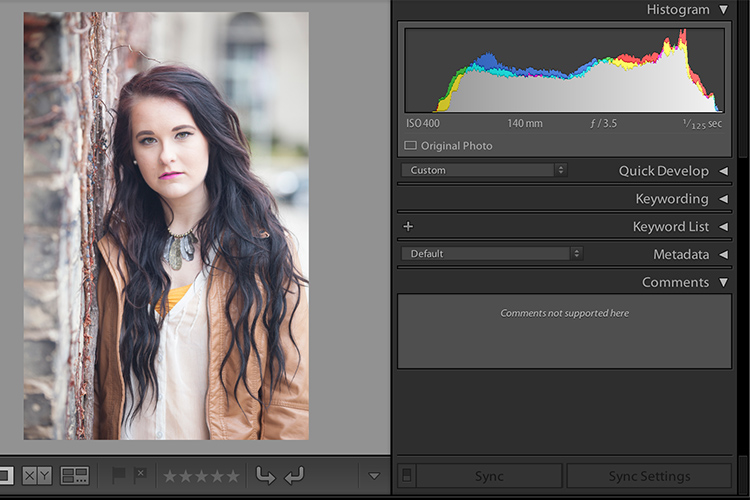
Over time, shooting in Manual mode where all the core elements like ISO, f-stop and shutter speed are adjusted by you the photographer and not the camera, will lead to images that are (almost) perfect right out of the camera. The histogram is a great way to validate if the image is structurally correct (subjective to your shooting style).

B) Use the preview function (LCD screen)

If your camera has a preview function (also known as the playback function), use that to view and analyze the image you have just taken. Is it sharp and in focus? is the properly litm, or is it too dark? If the composition is incorrect, the image is blurry, or the exposure is completely off, you can fix the problem, delete the image and retake the shot. The more you practice fixing the image right then and there, the fewer bad images you will take back with you to try and edit and salvage later in post-processing.

C) Use the histogram

You can take the review functionality up a notch by checking the histogram (if your camera has that information available) via the LCD screen. The histogram shares information like the quality of the shadows and highlights of the scene.

This image was intentionally shot this way - overexposed because I was almost shooting into the sun and I really wanted that sun flare in the bottom right of the image.

This image was intentionally shot this way – overexposed – because I was almost shooting into the sun and I really wanted that lens flare in the bottom right of the image.

I will throw out one caveat here – make sure you practice the art of reading and reviewing the histogram when you are shooting just for yourself or during test shoots, not during paid client gigs. On a client shoot, if you are messing with histograms and excessive review of the LCD, you may appear very unprofessional to your clients. They may perceive it as you don’t know what you are doing and that you lack confidence in your technical abilities. The good news is that by practicing enough on your own time, you will be confident to nail the shot right on the first go!

D) Get out of the mental mindset of, “I will fix it in post-production”

This is one of the worst dialogues you can have with yourself (I too have done this in the past). It encourages a mentality of laziness and the attitude of “spray and pray”. Firing away what appears to be hundreds of shots in the hope that at least a few will be worthwhile. Let post-processing be only for any artistic touches and not as a fix for basic things like exposure, color temperature (white balance), and tonality.

memorable-jaunts-getting-it-right-in-camera-article-for-digital-photography-school-5

I absolutely love this image and the use of negative space. This is how I saw the scene in front of me and I had less than three seconds to take the shot. This is almost SOOC. I only cleaned out some traffic signs and brightened the highlights, an easy 2-second edit in Lightroom.

Conclusion

The basic premise of this article is actually quite simple. If you want to have a perfect or near-to-perfect image right out of the camera, learn how your camera works and behaves. And learn to use it to create images that you envision as representing your true artistic abilities.

googletag.cmd.push(function() {
tablet_slots.push( googletag.defineSlot( “/1005424/_dPSv4_tab-all-article-bottom_(300×250)”, [300, 250], “pb-ad-78623” ).addService( googletag.pubads() ) ); } );

googletag.cmd.push(function() {
mobile_slots.push( googletag.defineSlot( “/1005424/_dPSv4_mob-all-article-bottom_(300×250)”, [300, 250], “pb-ad-78158” ).addService( googletag.pubads() ) ); } );

The post Tips for Getting the Image Right In Camera by Karthika Gupta appeared first on Digital Photography School.


Digital Photography School

 
Comments Off on Tips for Getting the Image Right In Camera

Posted in Photography


Ansel Adams’ Arca-Swiss 4×5 View Camera is the first of its kind at auction

14 Oct

$ (document).ready(function() { SampleGalleryV2({“containerId”:”embeddedSampleGallery_5494411773″,”galleryId”:”5494411773″,”isEmbeddedWidget”:true,”standalone”:false,”selectedImageIndex”:0,”startInCommentsView”:false,”isMobile”:false}) });

Heritage Auctions will soon be the first auction house to ever offer an Ansel Adams 4×5 view camera. The camera is part of a complete outfit including an Arca-Swiss 4×5 View Camera, three lenses, a pair of Graflex graphic film pack adapters, compendium lens hood, extra bag bellows, Wratten gelatin filters, a dark cloth, original carrying/shipping case, tripod and more. 

This view camera collection was used by Ansel Adams from 1964 to 1968, according to the auction house, after which point he gave the camera to his then-assistant Liliane de Cock, who used it as part of her own career. The camera and related accessories were acquired directly from the photographer’s family. Heritage Auction doesn’t list the condition, saying only that it is ‘available upon request.’ However, it estimates the lot as being worth between $ 70,000 and $ 100,000, and is seeking an opening bid of $ 35,000.

You can view the auction listing here.

Via: PetaPixel

Articles: Digital Photography Review (dpreview.com)

 
Comments Off on Ansel Adams’ Arca-Swiss 4×5 View Camera is the first of its kind at auction

Posted in Uncategorized