RSS
 

Posts Tagged ‘Better’

3 Tips to Take Better Landscape Photos Regardless of the Weather

26 Nov

Photographers are a special type of people that usually pay a lot of attention to detail. They’re also known to be patient and perseverant. However, in my opinion, landscape photographers are a unique breed. I’m sure that only a hand full of people are willing to hike 10 miles with 25 pounds of photography gear on their back, just because they hope to seize the perfect moment.

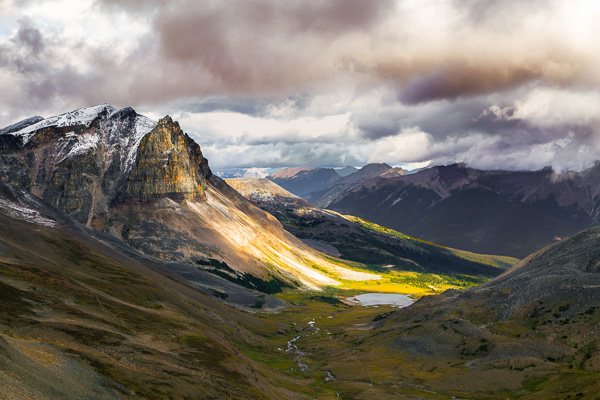
Golden Hour in Pyramid Mountain  Jasper National Park  Alberta  Canada

Generally, in photography, practice leads to improvement. However, practicing landscape photography is a bit trickier since you don’t have control over the light setup, the weather, or the subject. Sometimes, you might plan a trip for three months; you research the best spots, and you bring all your equipment. Then, when it’s show time, you walk outside to face a cloudy, rainy day, if not a snowy mess. All that can be very frustrating. Over the years I’ve learned a few tricks to deal with that. In this article, I will share three simple tips to help improve your images and take better landscape photos, regardless of the weather.

1. Using clouds to avoid harsh light

Let’s start by talking about one of the most important topics in photography, light. Usually, landscape photographers revolve their schedule around the Golden Hour, meaning the early morning or late afternoon. Photographers choose those portions of the day to take full advantage of the magical, warm, rich, natural light available. Yet sometimes, you cannot reach the planned location by car, making a strenuous hike of 10 miles the only available option to get to the desired place. Hiking is great, and if you love landscape photography you probably love the close contact with nature, but sometimes this passion doesn’t translate into mountain exploration at 3:30 a.m. Occasionally, you will find yourself starting your day hike around 6:00 a.m. to reach the desired area around 10:00 a.m., meaning that you will have to work with hard sunlight.

Portrait photographers have an easy fix for that problem, move the model to the shade. I’ve tried using the same approach in landscape; but I’ve never had any luck trying to move mountains and lakes around. Another approach that portrait photographers use to avoid hard light is using light modifiers such as diffusers and softboxes. Unfortunately I don’t believe you can buy one of those big enough to use on a mountain. What you can certainly do is use the clouds as a light diffuser, thus avoiding the harsh sunlight from midday. Depending on how you capture your image, clouds can also help improve your composition by adding depth or a sense of movement. After I grasped this concept my mindset shifted, now I’m always hoping for the perfect cloudy day.

Bald Hills  Maligne Lake  Jasper National Park  Alberta  Canada

2. It’s all about the drama

If this tip wasn’t enough to make you enjoy a cloudy day, let me tell you about a second trick that involves clouds when capturing landscape images. We all like to go online to wonder around photo sharing communities, looking for inspiration, a different point of view or even a new technique. I’m no different. I like to believe that I’m very active in some of those social media channels, however, when I look through pictures, I avoid focusing on landscapes. I like to explore portraits, Black and White, macro, pretty much anything but landscape. I can imagine you asking yourself, “Why would a landscape photographer do that?”. The answer is quite simple; I like to borrow successful techniques used in other fields. Sometimes, when I’m trying to capture an image of a mountain, I don’t face it as a landscape. I try, for example, to approach that image as a portrait. Once you learn how to repurpose techniques from one type of photography to another you will notice an improvement in your art.

In most types of photography, the most striking photos are those with strong contrast; images that harmonize shadows and highlights seamlessly. One side effect of the current advances in digital photography, sensors, and the digital darkroom, is that a lot of landscape artists try to capture everything in one single image. Some will use HDR to bring up the shadows, others will use masking and blending to create a final image. I was no different.

Lately, inspired by the work of great masters such Ansel Adams and Henri Cartier-Bresson, I’m trying to play with the shadow to highlight ratio in my images. Portrait photographers are very good at using artificial light (strobes or speedlights) to create dramatic images. In landscape it might be a bit more difficult to position the sun at a different angle. Still you can use clouds as a light filter, concealing light from distracting spots while revealing patches of bright sunlight that will accentuate your main subject. Once you start to play with this idea you will be able to create very dramatic images during those dreadful cloudy days.

Tekarra Mountain  Skyline Trail  Jasper National Park  Alberta  Canada

3. The path of balance

Finally, keeping up with the idea of creating a dramatic image, photographers must be able to understand an important concept called balance. Not only the shadow and highlights balance, but also color balance, subject positioning, overall image balance and so forth. I remember some of the first photos I took, very often I liked the concept behind the photo, but the final image just didn’t convey what I had envisioned. That was when I discovered the concept of balance.

This concept is very basic, yet extremely powerful. A well-balanced image will stand out on its own and will captivate your audience. Balance, simply put, is how you distribute the elements, colors, and brightness in the frame. There are countless ways to achieve balance, so many that we would probably need another entire article just to talk about it. As a general rule though, a well-balanced picture aims to distribute the elements evenly throughout the image. So next time you are out capturing an image, try noticing how you arrange the elements in the frame. Check if the amount and position of the shadow and highlight are reflecting what you want to show in your photograph. Finally, before you press the shutter, ask yourself if all the elements in the frame are contributing to the overall image. Sometimes, you can get overwhelmed by the landscape, and in an attempt to capture all the beauty you end up with a busy, unbalanced, and unappealing image.

Silence  Banff National Park  Alberta  Canada

I will leave you here, but next time you’re out there during a cloudy day, instead of complaining about it, just try your luck. You might be surprised by what you can achieve when you open your mind to work with whatever mother nature throws at you.

Mountain tops  Banff National Park  Alberta  Canada

Do you have any other cloudy day or landscape tips? Please share in the comments below.

The post 3 Tips to Take Better Landscape Photos Regardless of the Weather by Diego Lapetina appeared first on Digital Photography School.


Digital Photography School

 
Comments Off on 3 Tips to Take Better Landscape Photos Regardless of the Weather

Posted in Photography


4 Tips for Taking Better Holiday Photos

02 Nov

With the holiday season just around the corner, many of us will be toting our cameras to festivals, parties, and family gatherings to preserve our precious memories for years to come. Unfortunately, you might look back at some of your pictures and wonder why they were blurry, out of focus, or just not all that interesting. Whether you have a smartphone or DSLR, here are a few simple techniques you can use to make your photos not only stand out, but help you learn a bit more about photography along the way.

4 tips for taking better holiday photos

ChildChristmasTree

#1 Get down to eye level with the kids

While you might be tempted to pass the time visiting with adults and catching up with friends at holiday gatherings, some of the best photos years down the road often end up being the ones of kids. It’s fun to see them grow and change over time, and when browsing photo collections people will often linger on photos of children for all the memories they bring back. When you have your camera out, though, remember to get on eye level with the little ones! It can feel a bit strange to squat down or sit on the floor to get a good shot of your three-year-old niece while all the adults are visiting in the other room, but the results will be well worth it. It’s tempting to shoot down at kids from your eye level, but this often results in unflattering pictures that seem cold and distant. Putting yourself physically at the same level as the kids offers a much more interesting view of their world, and makes for photos that are far more personal and memorable.

ThanksgivingFriends

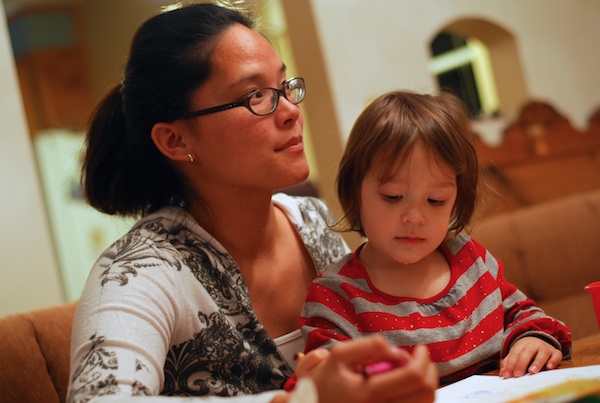
My friend and her daughter before a Thanksgiving feast. I had to crouch down to get on eye level with the girl, but the results make for a much more interesting picture.

#2 Adjust the ISO instead of using the flash

If you leave your camera on Automatic mode, you might notice the flash constantly going off which can result in washed-out colors and unnatural shadows across people’s faces. But if you try to disable the flash, your photos will often come out blurry or out of focus. To fix this, you can set your camera to Program mode instead of Auto, which will allow you to have more direct control over the ISO setting and get better shots in low-light conditions (like indoor holiday parties) without using the flash.

ChristmasEveService

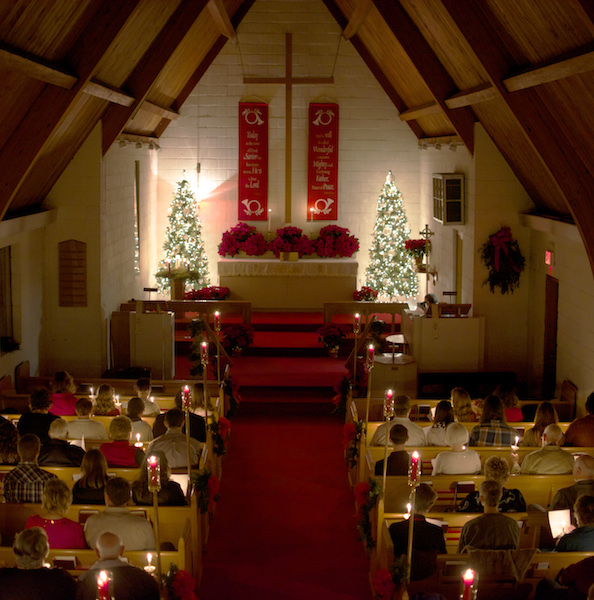
Using a flash would ruin this photo of a candle-lit Christmas Eve service. I got this shot by bumping the ISO up to 3200.

The higher you set your ISO, the less light your camera needs in order to take a photo. This is nice if you want to avoid blinding people with your flash, but the trade-off is that your pictures might look noisy or grainy. Fortunately, most modern cameras do a fine job even at ISO settings as high as 3200 or even 6400 – particularly if you just want to share the photos online or print at smaller sizes like 4×6.

Make sure to practice beforehand so you are comfortable not only setting the ISO, but knowing the limits of what your camera can do. But if used carefully, adjusting the ISO instead of using the flash can result in much better holiday photos with the added bonus of not blinding your guests or having to deal with red-eye corrections later on.

ThanksgivingDinner

If you really want to use your camera to its full potential, ditch Auto or Program mode entirely and try shooting in aperture priority (A or Av) mode where you choose the lens aperture and ISO while your camera calculates the best shutter speed. Or you could try shutter priority (S or Tv) mode, where you choose the shutter speed (1/60 to 1/90 second are good starting points when shooting indoors, such as holiday gatherings) and ISO, and your camera figures out the best aperture. I would recommend getting lots of practice with these modes and making sure you know how to adjust your settings accordingly before the holidays, though. You don’t want to try something new for the first time when everyone is opening presents and have a bunch of dark or out of focus photos as a result!

Finally, it’s worth noting that many modern digital cameras have user-programmable Auto ISO settings. You can use this to tell your camera to select the best ISO when using the semi-automatic (A/Av, S/Tv, or P) modes but stay within a few parameters that you define. For instance, if you know that your camera gets too noisy above ISO 3200, you can set that to be the maximum allowable ISO but let your camera do the rest. Or you can also set a minimum shutter speed before the Auto ISO kicks in.  If you don’t want to shoot anything slower than, say, 1/30 of a second, your camera will do everything in its power to maintain proper exposure by adjusting the ISO in order to stay above that shutter speed.  This can be quite handy at holiday gatherings when you don’t want to spend all night fiddling with your camera’s menus and settings but also want to make sure you get the best shots possible without the pop-up flash constantly blinding your guests.

#3 Shoot moments, not poses

It might be tempting to run around with your camera at holiday parties barking out orders like “Smile,” “Look here!” and “Say Cheese!” But a better option is to be a little more discreet and attempt to shoot moments instead of poses. Capturing the essence of what people are doing – talking, laughing, opening presents, sharing a drink – often makes for much more interesting photos as well as better memories in years to come. There is certainly nothing wrong with posed photos or having people look at you and smile while you take their picture, but these often lack context aside from the clothes people have on. What else was happening? Who else was present? What sort of activities were people doing? By taking a documentary-style approach and shooting pictures of people just being themselves (particularly if you turn the distracting flash off and adjust the ISO instead) you will capture memories that will strike a chord years down the road.

ThanksgivingCardGame

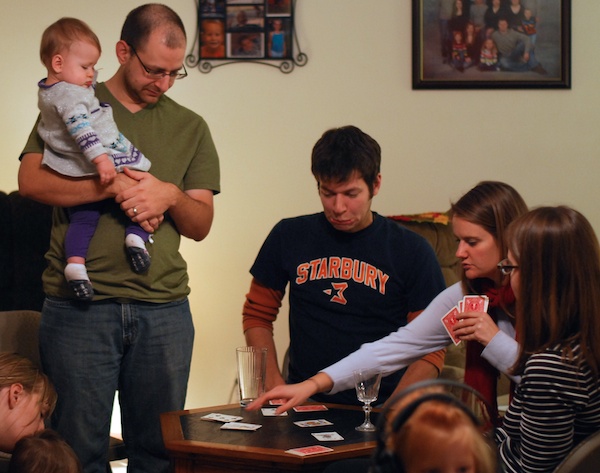
This picture of a game of cards over the holidays carries a great deal more meaning to me than if I had told everyone to look at the camera and smile.

#4 Know when to put your camera down

This might sound counter-intuitive for an article about how to get better holiday photos, but as the saying goes, there is a time for everything under the sun. This includes a time to shoot pictures and a time to just be with friends and family. Rather than 100 photos of your family opening presents, just take a handful and use the rest of your time to simply be with your loved ones and enjoy your time together. Try to be intentional when taking fewer photos, and the result will be more keepers that you want to look at years down the road instead of dozens and dozens of images of the same scene.

ChristmasPresents

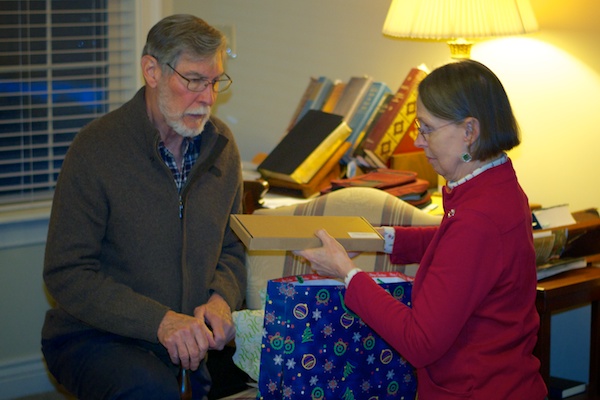
Rather than a boat load of present-opening photos, just a handful will likely suffice and the rest of your time can be used to visit, laugh, and share memories.

Bonus tip: Invest in a prime lens

If you are still shooting with the kit lens that came with your camera, now is a fantastic time to spend a little money on a prime lens and get used to it before the rush of the holiday season. While these lenses don’t zoom in and out, the trade-off is an ultra-wide aperture that lets in so much more light (especially compared to a kit lens) that you will rarely have to use the flash even at lower ISO values. You will get the added bonus of having a lens capable of smooth blurry backgrounds that can capture the beauty of even the most mundane subjects. The Nikon 35mm f/1.8 is a fantastic choice, as is the Canon 24mm f/2.8, but there are plenty of options to suit your needs depending on your camera and shooting style.

TreeOrnament

What other tips do you have for getting good pictures at this time of year? Leave any in the comments below, and maybe share a few of your favorite holiday memories too!

The post 4 Tips for Taking Better Holiday Photos by Simon Ringsmuth appeared first on Digital Photography School.


Digital Photography School

 
Comments Off on 4 Tips for Taking Better Holiday Photos

Posted in Photography


Fall Foliage Photography Guide for Taking Better Autumn Photos

29 Oct

The world is filled with Red and Gold…Get out there and Shoot!!! So, as many of you know, I have never actually lived in a place with true fall. I’m from Los Angeles, lived in Hawaii, both of which basically are perfect always, did an eight year stint in North Dakota, where it’s frigid for ten months, then there’s a Continue Reading

The post Fall Foliage Photography Guide for Taking Better Autumn Photos appeared first on Photodoto.


Photodoto

 
Comments Off on Fall Foliage Photography Guide for Taking Better Autumn Photos

Posted in Photography


Better Star Trails Photographs with StarStaX

28 Oct

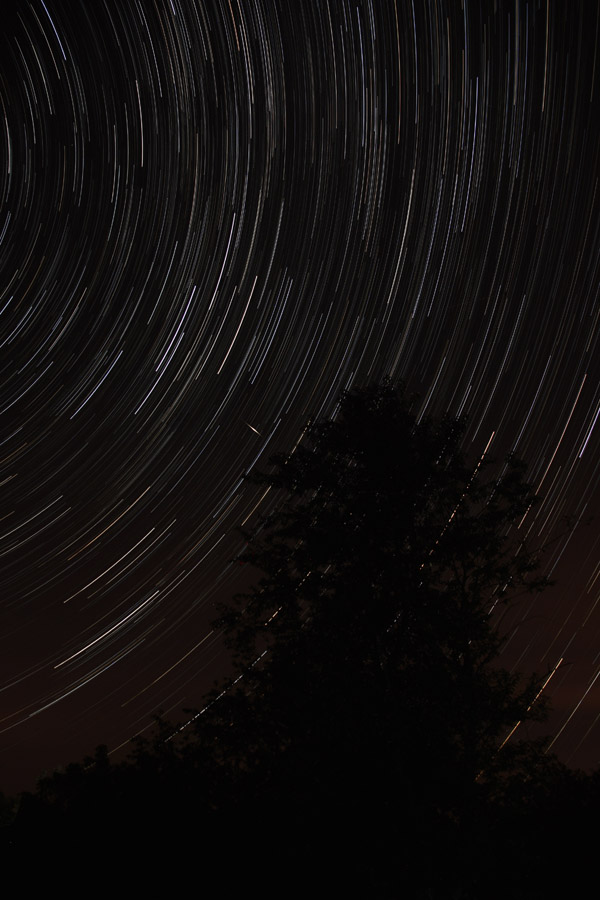
Long, swirling star trail photography is on the bucket list of many photographers. In the film days, this required leaving your shutter open for one continuous exposure on the order of hours and hoping that everything would turn out just right. In the digital era, many photographers rely on a process known as stacking to take a large number of individual frames and combine them into the final image. This article will lay out how to capture incredible star trail photographs and combine them using the free program StarStaX.

StarStax, star photography, stacking, star trails, how to, astrophotography

Shooting Your Individual Star Trails Photographs

Many detailed posts have been written about how to capture individual photographs for star trails stacking, so this article will only provide a quick overview. Check out the linked posts at the end of this article for additional details.

For equipment, you will need your camera, a fast wide angle lens, a sturdy tripod, a remote shutter release, and a full battery or two. A red headlamp or flashlight as well as a folding chair can also come in handy. I recommend a wide angle lens, like 18 mm (or wider), so that you can capture a larger expanse of the sky. A fast lens (one with a wide aperture, like f/1.8) is also preferred so that you can capture more light with each frame. (Most of the photographs in this article were shot at 18 mm and f/3.5 on my Tamron 18-270 mm lens.)

dark sky finder, star trails, astrophotography

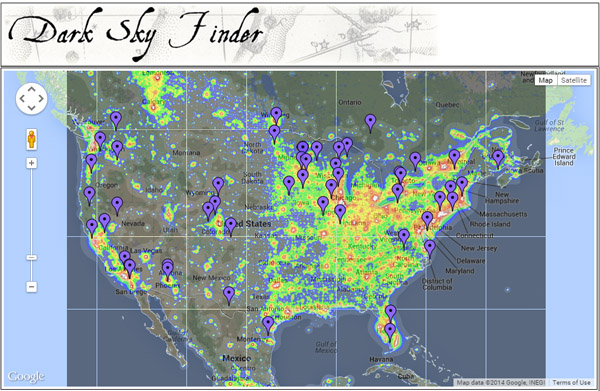
Choose your location and timing carefully. Capturing star trails around the time of the new moon is preferable, so that bright moonlight does not wash out all the stars from the sky. You also want to get as far from artificial lights as possible. You can use the web site Dark Sky Finder to look for possible dark sky locations near you. Once you have chosen a location, you can use the web site Clear Dark Sky to check their 48 hour forecasts about the potential for clear sky in a given location.

Once you are on location, spend some time choosing your final composition. Think about a position that will provide an interesting foreground – an unique tree, a geologic formation, or a body of water – as well as an expansive view of the night sky. If you want an image of the stars swirling around a complete circle, then be sure to include the North Star in your viewfinder (in the Northern Hemisphere). If you want extremely long swirls in less time, then compose for a view farther away from the North Star.

star photography, star trails, astrophotography

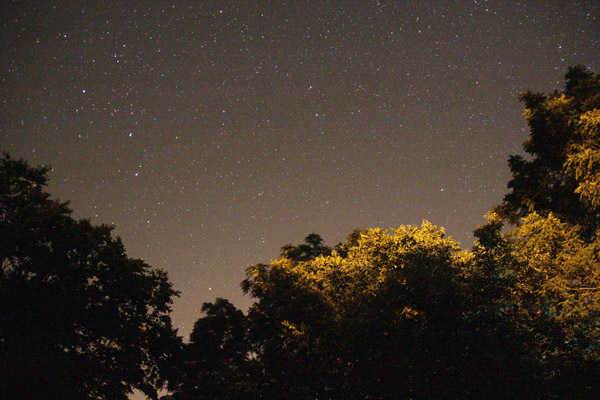
Shoot one photograph with your widest aperture and a fairly high ISO value for 30 seconds. (The image above was shot at 30 seconds, f/3.5, and ISO 6400.) Your image will be quite noisy, but you should get a strong sense for your overall composition.

Once you have your composition nailed down, you want to dial in your final settings using manual mode. Choose your widest aperture (like f/1.8 or f/3.5), a 30 second shutter speed, and a mid-range ISO like 800-1600. (Newer cameras have less noise at higher ISO values, but you may want to use an ISO of 400 or 800 with an older or entry-level camera.) Turn off the autofocus and use manual focus to focus on infinity.

Before you start shooting, cover your lens with a lens cap or piece of black paper and shoot a few frames. These will be your dark frames when you process the images in StarStaX. Dark frames allow the program to subtract digital noise and hot pixels from your final image.

star photography, star trails, astrophotography

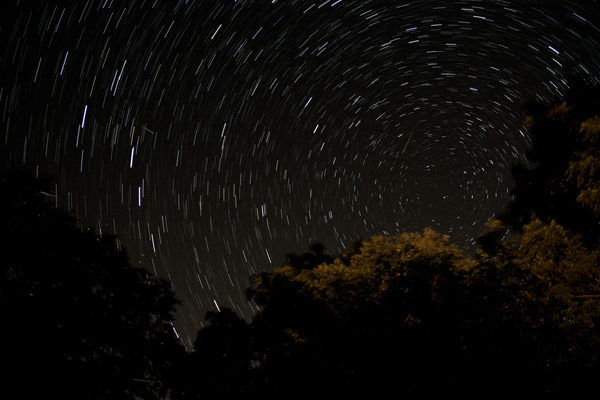
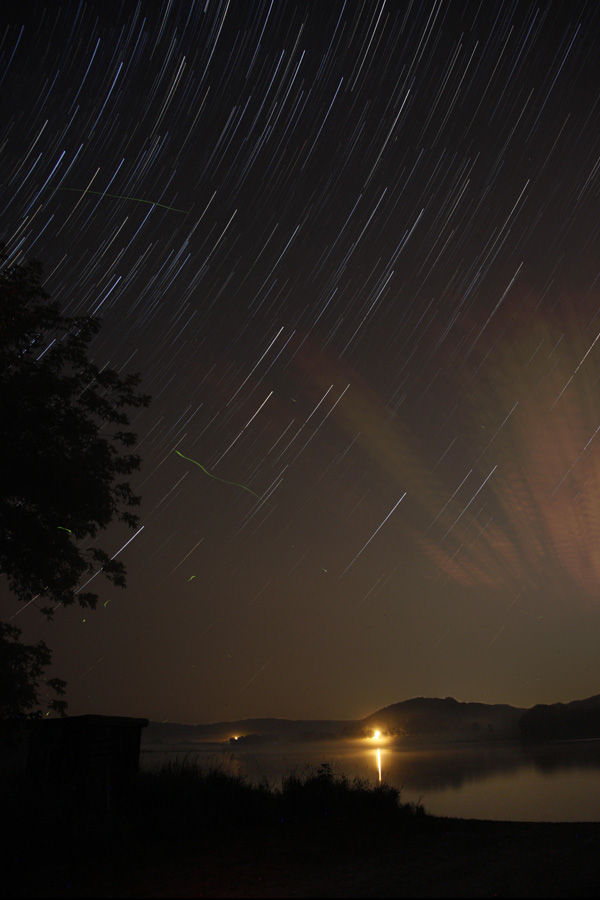
This image is a stack of 26 images shot with 18mm, 30 seconds, f/3.5, ISO 800. The green squiggles are fireflies.

Use your remote shutter release to lock down your shutter. As soon as your camera finishes taking the first 30 second picture, it will start taking the next, and so on. Then pull out your folding chair, sit back, and enjoy the wait. An hour’s worth of shots is a good goal to aim for. The more photographs that you take for your stack, the longer and more defined your final star trails will be.

Once you have finished capturing your shots, remember to take a few dark frames again at the end. Leave your settings the same but cover the lens with the lens cap and shoot a couple more frames.

Preparing Photographs for Stacking

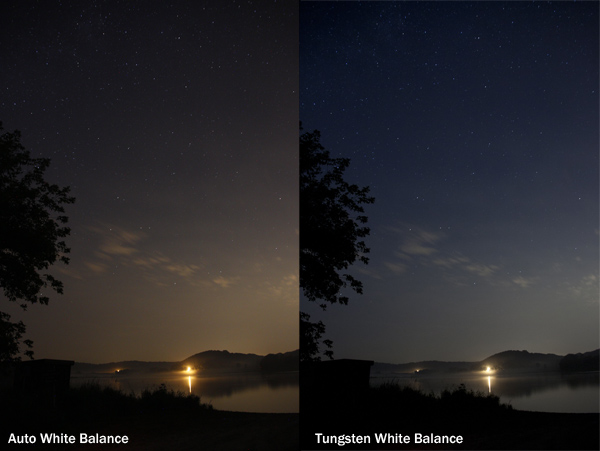
Depending on your photographs and the end result you are envisioning, you may want to do some post-processing on your individual frames before loading them into StarStaX. Whether you use Lightroom, Photoshop, or another post-processing software, you will want to apply a similar treatment to all your images if you choose to do any corrections, such as adjusting the white balance or fixing the colors.

star photography, star trails, how to, astrophotography

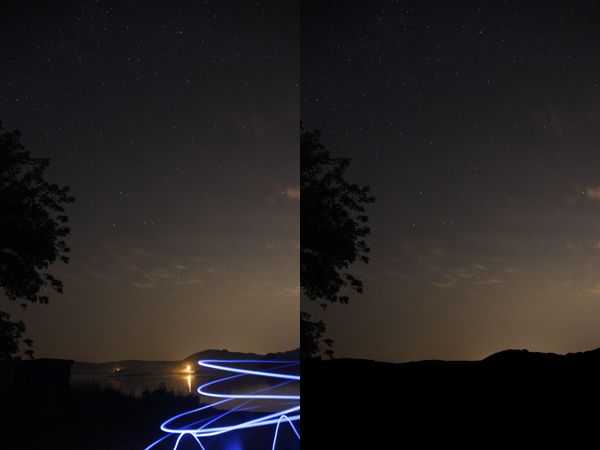
You may also need to do some quick editing of individual shots, especially if you were shooting at a location with unwanted stray light. In the photographs below, you can see that this frame captured the light from passing cars on the far side of the lake. The quickest solution to problems like these is to open these individual frames in Photoshop, set the brush tool to black, and paint over any unwanted light.

star photography, star trails, how to, astrophotography

You can see a big difference in the foreground between these two stacks of the same individual star trails. Painting out the stray light trails in those few individual pictures allows for a more seamless and less distracting foreground, once you stack all the photographs together.

star photography, star trails, how to, astrophotography, StarStax, stacking

Alternatively, you can choose one frame in Lightroom or Photoshop and make any adjustments needed until the non-sky portions of your image are just right. Then, after creating your star trails in StarStaX, you can combine your ideal foreground with your stacked sky using layers and masks in Photoshop.

Stacking Your Star Trails Photographs Using StarStaX

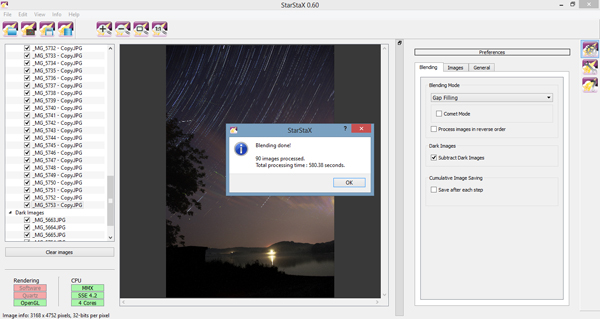
StarStaX was developed by Markus Enzweiler and is available as a free download for Windows, Mac, and Linux computers. (Screen shots courtesy of the Windows 0.60 version.) After downloading and opening the program, the first thing you need to do is load your individual photographs by going to File -> Open Images or hitting the Open Images button. You may select JPEG, TIFF, bitmap, or PNG file types. After selecting your star trails shots, you need to load your dark frames by going to File -> Open Dark Frames or hitting the Open Dark Frames button.

StarStax, star photography, stacking, star trails, how to

Once you have both types of files loaded, it is time to run your first stack. The default options are a good starting point: try lighten mode and check the button for subtract dark frames, if you have uploaded some. Click Edit -> Start Processing or the Start Processing button. The amount of time it will take the program to complete the stacking will vary based on your computer and the number of individual photographs, but it should be on the order of a few minutes at most.

After the program has finished stacking your images, click File -> Save As or the Save button and save your stacked image. Stacks will not save automatically. You can use the zoom tools to look more closely at your stack and see if the results match your expectations.

StarStax, star photography, stacking, star trails, how to, astrophotography

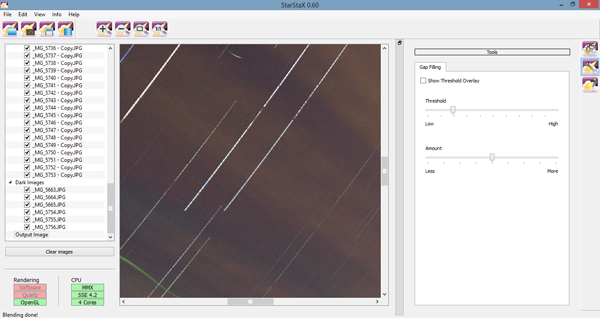
You may notice that there are some gaps in your star trails, which result from the time between one photograph ending and another beginning. In that case, you may want to run the stack again. Your individual photographs and dark frames are still loaded, so just change the blending mode to Gap Filling and start processing your files again.

After your gap filling version has finished processing, there are a few options you can use to adjust the amount of gap filling applied. Click the Images tab and experiment with the different sliders to minimize the appearance of any gaps. Click the 1:1 button to zoom into the pixel level, as in the image below, to see the impact of the Gap Filing sliders.

StarStax, star photography, stacking, star trails, how to, astrophotography

Want a really unique shot? Run the stack again in either Lighten or Gap Filling and click the checkbox for Comet Mode. Your final star trails will each take on the appearance of a streaking comet.

star photography, star trails, how to, starstaX, astrophotography

Stack of 90 images including six dark frames, each shot at 18 mm, 30 seconds., f/3.5, and ISO 800.

Now You Try

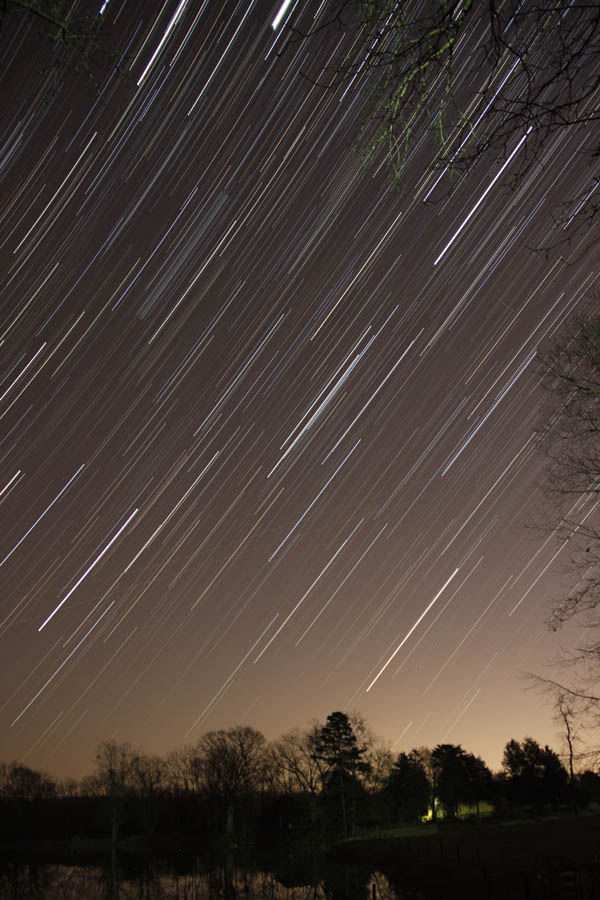
Now that you have the basic idea, you need to find a great location and give it a try! Do not feel discouraged if you are far from any suitable dark sky locations. You might be surprised at what you can capture even under less than ideal settings.

StarStax, star photography, stacking, star trails, how to, astrophotography

Thus photo was taken just outside a city in North Carolina and was a stack of 78 images and seven dark frames, each taken at 30 seconds, f/3.5, and ISO 800.

Have you used StarStaX to capture star trails? Share your thoughts or favorite images in the comments below!

Need more help for shooting your star trails images, try these articles:

  • Tips for Photographing Star Trails
  • How To Photograph Star Trails
  • Photography Under the Stars

The post Better Star Trails Photographs with StarStaX by Katie McEnaney appeared first on Digital Photography School.


Digital Photography School

 
Comments Off on Better Star Trails Photographs with StarStaX

Posted in Photography


Why Prime Lenses are Better Than Zooms

07 Oct
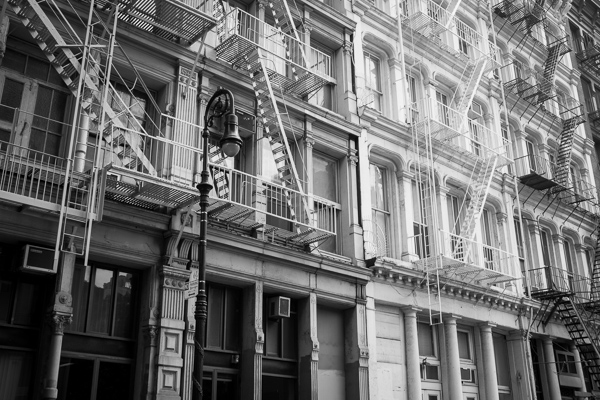
35mm - SoHo Fire Escapes.

35mm – SoHo Fire Escapes, NYC

How heavy is your camera?

If you have an SLR with a zoom lens attached, the answer is pretty damn heavy. A large SLR body, such as a Canon or Nikon with a 24-105mm lens attached feels like a tank; forget the 70-200mm.

Of course there are many situations when using a zoom lens is ideal. However, I’m hoping to try and convince you to ditch the zoom lens for a prime.

But what if I need the zoom? What if I don’t have the perfect focal length? – I have heard those questions more times than I can count. A wise photographer once told me that you will get the same amount of good shots no matter what lens and camera you use; they will just be different. Zoom lenses can be just as limiting as prime lenses, and prime lenses can be much more freeing than zoom lenses.

By walking out the door with a single prime lens, you are limiting yourself. There are certain shots that you will not be able to capture, that is a fact. However, the benefits can far outweigh that single negative. Prime lenses cause you to take more time to compose your shot, since will you need to zoom with your feet. This can make you think more critically about your composition. A prime lens will free you up to focus on the subjects in the range that the prime lens works best at. You will become much better at finding things within that range and your work will be more consistent because of these limitations. A prime lens makes you think in a certain way, since it is tougher to use. The limitation ends up being an advantage in the long run.

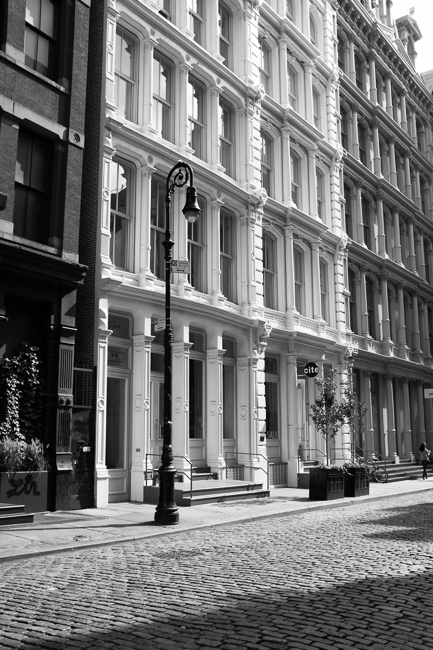
35mm - Cast Iron Building, SoHo

35mm – Cast Iron Building, SoHo NYC

Think about how many famous photographers throughout history used prime lenses.

Prime lenses are lighter. They make your camera more fun to take out. You don’t need a heavy camera bag and you will be able to walk further, explore more, and capture more images. You will have a bounce in your step that you didn’t before. You will be able to bring your camera with you on a daily basis. That will more than make up for missing out on a few shots that a zoom lens could capture. Photography will become more fun! It will become more of an element of your everyday life, versus something that takes planning to do.

After awhile you will learn to see specifically in that focal length, and this is where things really click. It will almost feel like the camera isn’t there. You will be faster and more intuitive as a photographer. This is all because you ditched the zoom in favor of the more limited prime lens.

Oh, and did I mention that prime lenses are cheaper than zooms? Any money that you will spend purchasing a new prime lens will be saved in medical bills from your neck and back eventually giving out from the weight of that gigantic zoom lens that you use now.

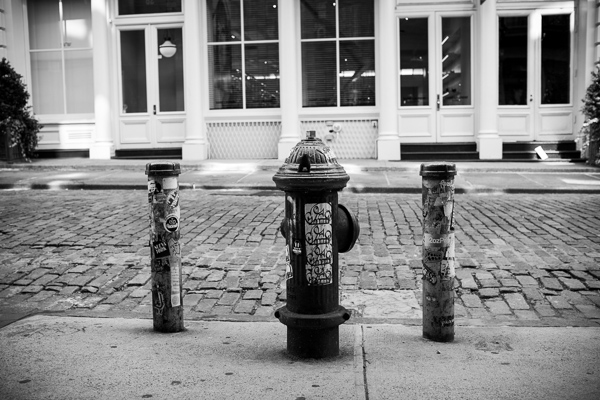
35mm - Fire Hydrant, SoHo

35mm – Fire Hydrant, SoHo NYC

So what focal length should you choose? I prefer a 35mm lens (on a full frame). It is just wide enough to work well anywhere but not too wide. Other common focal lengths are 28mm, 50mm, and 85mm (which is a fantastic focal length for portraits). Rent a few lenses and try them to see what you like best.

After a few days of using a prime you may realize that the real limitation was with your zoom lens.

The post Why Prime Lenses are Better Than Zooms by James Maher appeared first on Digital Photography School.


Digital Photography School

 
Comments Off on Why Prime Lenses are Better Than Zooms

Posted in Photography


7 Tips for Interacting with People to Create Better Portraits

30 Sep

Sassy kid

Interaction is the basis of a portrait session, in every single way. In the most obvious ways, for example, you must interact with the client to set up the session, during the session, and when the images are done.

The portrait session is also an interaction with self, both for you the photographer and for your subject. You the photographer, who is creating with integrity, must meet with yourself inside to bring about bold creativity. The subject, likewise, is faced with many insecurities that they may have very little experience with in their day to day lives. They are in a vulnerable position. The portrait session brings about all kinds of internal interactions.

The photos themselves are a form of interaction with the future. The way a portrait portrays someone goes a long way to communicating who they are – or, at least, who they’d like to be seen as, which is important in its own right.

It’s for this reason that developing habits for skillful human interactions is so important. They make everyone more comfortable, but, more so, it means capturing images of someone who is comfortable at the moment the image was taken.

The way someone responds to you is the way they will look in their images. The difference may be imperceptible to a stranger, or when simply viewed at a glance; but a strained smile, or nervous eyebrow might be clear as day to the people who care about them. You as a photographer are not a plumber who can still fix the pipes, even if your subject is having a bad time. Among the most important tools you have is the one that elicits an honest and flattering response from the subject:

The way you interact with people is key
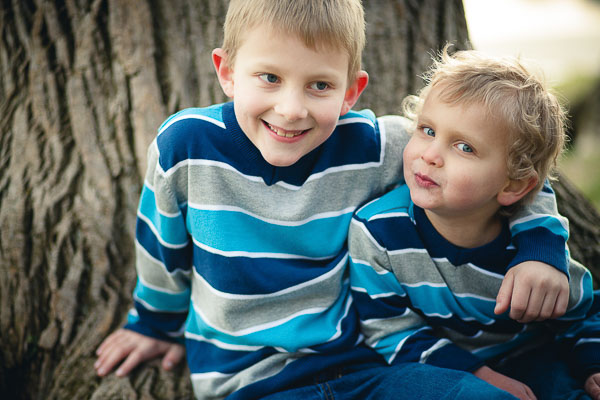
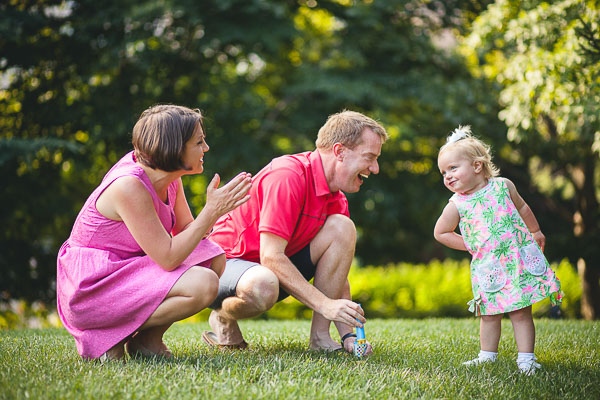
Casual kids

Everyone is a Little Kid

If you who wish to bring about a truth and transparency in your subjects, you can take a clue from the rules of photographing little kids; don’t slow the child down for your shot – you keep up with the kid!

Your goal is to keep your subject engaged and having a good time during their session, so what is true of working with children is also true for adults. It’s important to move at their pace. Adults get bored when you move too slowly and then you have pictures of bored adults trying really hard not to look bored. When you’re moving too fast, adults get anxious. They start having trouble understanding and interpreting your instructions. Then, you have photos of anxious adults trying really hard not to look anxious.

Getting a sense of your subject’s natural pace is all about how you interact with them. You can’t simply bark orders at your subject. You can’t withdraw into a technical and creative cocoon, sticking your lens out just far enough to take their picture. You have to actually engage with them personally. Allow time in between arrangements and locations to chat. Be open with your subject; make yourself vulnerable to them. Remember, that is the challenging posture a portrait session puts the subject in: vulnerability.

Pay attention to the things your client is saying, and the jokes they are making. If they say something like “I’m sorry, I must be terrible to work with” pay attention! They are blaming themselves, but it is likely because you are moving too fast and failing to communicate. The client is likely to blame themselves since they have seen all of your amazing photos and assume that all those people must have been able to keep up. Take this as a personal critique to communicate more openly and slow down.
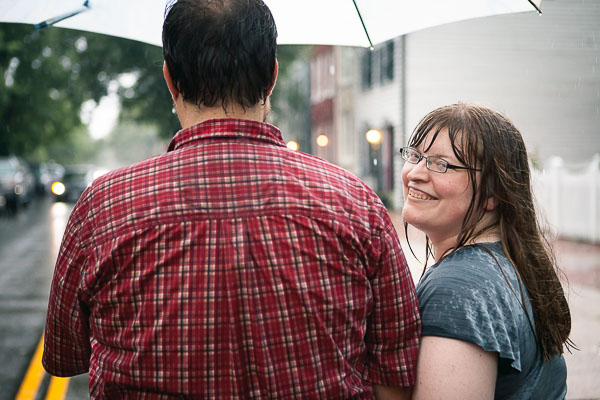
Unexpected circumstances

Learn to Speak in Positive Terms and Say Positive Things

As you are open and communicating with your subject, remain positive as much as possible. When you have to be honest about something challenging or difficult, do so in positive terms. This takes practice, but it’s beneficial to your own well being as well.

I’m not advocating lies, or even twisting the truth. I’m talking about finding a legitimate perspective in whatever you’re saying, so that some form of positivity is also in view.

For example, say you’re shooting in a local park and the shot you’re working on just isn’t working the way you want. When you know the shot that you wanted is dead, there’s no reason to keep wasting time; you should just move on. If you say “Ugh, this spot just isn’t working out, let’s look somewhere else”, you would be telling the truth, but in a negative way, with the focus on what isn’t working right. That’s not the important part. Instead, if you say “Hmm, this spot isn’t turning out how I’d hoped, I think there might be something even better over in that direction” it sounds more hopeful, positive, and encouraging.

Both of those statements are essentially the same. But in the first, the emphasis is on a problem right then and there. In the second statement the problem is acknowledged, but the emphasis is on something positive “over in that direction”.

Keeping an attitude like this helps your subject remain optimistic about the result, which is important. As your subject’s optimism goes down, they will have to work harder to appear comfortable and relaxed. So even if you’re struggling in the beginning, and your subject might have objectively good reason to become more pessimistic, if you allow that to happen, you’ll be damaging your chances of recovering later.

Stay positive!
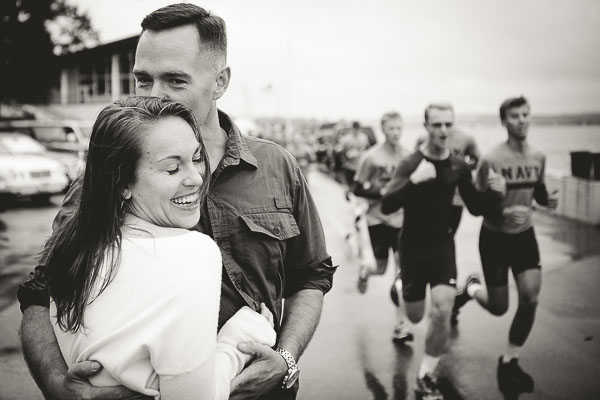
Naval Academy Runners Romance

Use Humor as a Diffuser

The situation your subject is stepping into is a vulnerable one. It’s your job to scrutinize how they look in order to present them in their most flattering light. Most of us feel uncomfortable being under the microscope like, especially concerning the way we look. People don’t like their looks being judged poorly and they spend a great deal of time, energy and money to avoid it. In fact, hiring you might itself, be a part of that desire.

So part of your job is to diffuse that feeling. You need to keep your subject comfortable, which typically means obscuring the overt need to scrutinize them and the way they look. An excellent method for this, without having to resort to being deceitful, is to place yourself under their microscope.

If you make a mistake, be open about it and laugh it off. By presenting your own momentary shortcomings, you make yourself vulnerable, and by contrast make them feel less vulnerable. You’re not lying, or manipulating them. You’re just levelling the playing field.

Likewise, if your subject has said or done something embarrassing, you can use humor to turn the embarrassment on yourself. For example, if my subject accidentally steps in a puddle of water and seems embarrassed, I might use the opportunity to tell them about the time I fell in the water during a portrait session. It’s humanizing.

By positively applying humor to your own shortcomings, you’re able to change the tone of the session from one where the subject feels that they must perform for you, into one where they must engage with you.
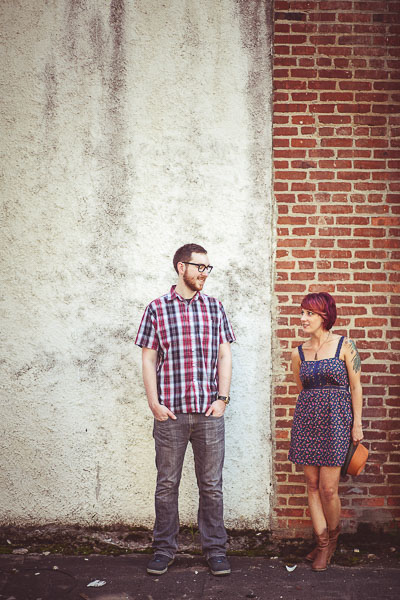
Engaged couple two tones

Speak in Terms Relative to Your Subject

In many cases, unless your subject has been trained as a model, they’re going to spend a fair amount of their mental energy trying to interpret what you’re telling them to do.

If you say, “tilt your head”, that means a lot more to your subject than that specific thing you want them to do, so for them, it has almost no meaning at all. Instead, you could say “tilt your forehead toward your toes”, or “bring your left ear closer to your left shoulder”. The same goes for the direction they’re facing and movements you need them to make. If you tell them to “step forward” they will often move in whichever direction their feet are facing, or they’ll feel confused about what you want them to do, and shuffle around awkwardly. Instead, you could say, “take a step toward me”.

These are specific instructions which are relative to your subject, rather than your vision. Giving subject-relative instructions also sounds a bit funny to many people at first so it acts as an excellent ice breaker too.

If you master no other subject-relative language, master your subject’s left and right. Instead of saying “step to the left”, say “step to your left”. By giving your subject terms that they do not have to interpret, they can devote more mental energy to the intangible elements of the shoot – like having a good time, or interacting with you.
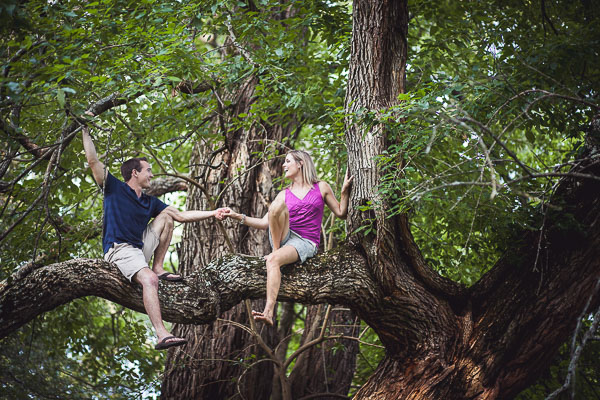
Engaged couple in a tree

Demonstrate Posing

This is an extension of speaking in subject-relative language, except it takes it one step further. Taking a moment to demonstrate how you’d like your client to pose can have multiple benefits.

First, demonstrating a pose can often act as an icebreaker, since the motions you will ask your subjects to carry out sometimes feel a little silly, even though they look great in a photo! When you demonstrate the pose, the subject has a chance to see you feeling a little silly, or not feeling silly and also not minding.

Second, as with speaking in terms relative to them, demonstrating a pose helps remove a big chunk of the subject’s need to interpret what you want them to do. They can more easily just go for it and try, rather than timidly wondering if they’re “doing it right”.
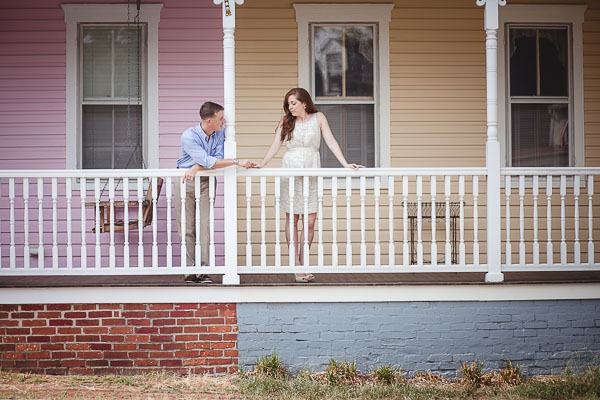
Relaxed romance

When I demonstrate a pose for a subject, I tell them what I’d like them to do, as I do it.

So, I may sit down in the spot I’d like my client in and say, “Okay, I’d like you to sit right about here”. Then I’ll sit down and say, “You can cross your legs like this, or something like this, if it feels more natural for you” as I demonstrate a couple of different acceptable positions for their legs. Then I might point over to where I’m planning on shooting from and say “I will be shooting from right over there, so you’ll want to look in that direction”.

By the time the client sits down, they have a kind of template for what to do and can act more confidently in giving it a try. This also has the added benefit of allowing you to help your subject find their way into a pose that is more natural for them, rather than putting them in a position you’d never see them use in real life.

For more on posing check out this dPS eBook – Portraits: Striking the Pose

Be a Constant Stream of Affirmation for Your Subject
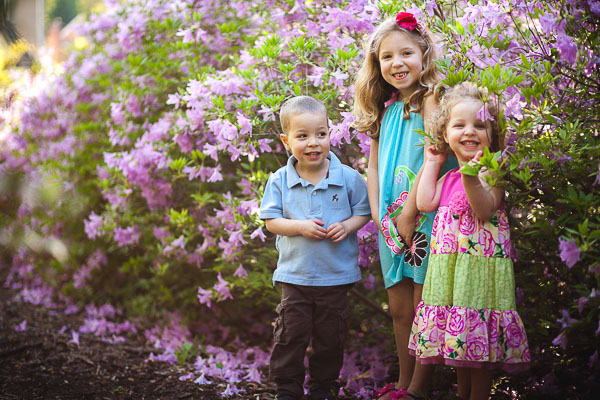
Hide and seek

I’ll say it again; remember what a vulnerable situation your subject is in when they’re in front of your camera. One of the simplest ways to offset that feeling for your subject is to be a constant stream of affirmation.

  • Thank you!
  • You’re doing a great job
  • Yes! That’s perfect, hold onto that!
  • You’re looking great!

Of course, you’re walking a line here, because what if your client isn’t doing a “great job” and they are in fact making your job a lot more challenging. Well, get over it. It’s your job as a photographer to work with who your customer is; some people are easier going with pictures, others need more attention, but the images will be yours and so the responsibility is too.
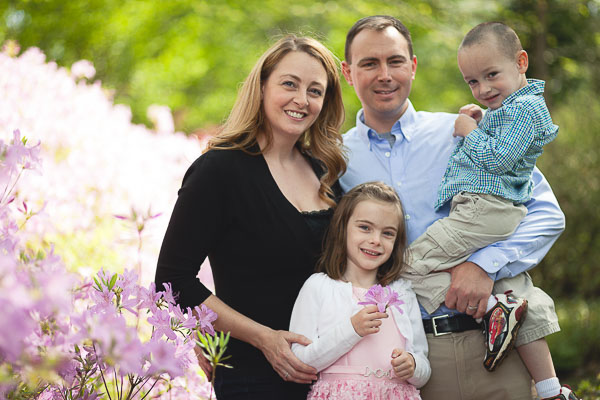
Friendly family

I wouldn’t advise lying if you’re struggling to get something you like while working with your subject. But affirmation is still important. Perhaps even more so. The thing about affirmation in this context is that it doesn’t necessarily have to be affirming anything the subject themselves is doing. Of course, that certainly works best to mitigate the feelings of a subject who is insecure about their appearance, or feels bad at photos. But simply affirming that the shoot is going well and you are excited is often enough to let the subject relax. Keep them coming – seriously, about every 15-20 seconds while you’re behind the camera.

  • Wow, this shot is coming out even better than I expected!
  • I love this background!
  • You and I are like a dream team!
  • The textures in this foreground are so interesting and juxtapose just right with your dress!

Easing a subject’s sense of vulnerability by making positive exclamations about the shoot makes sense logically too. By helping the subject to realize that they are only a part of what you’re paying attention to will relieve the pressure, and let them relax.
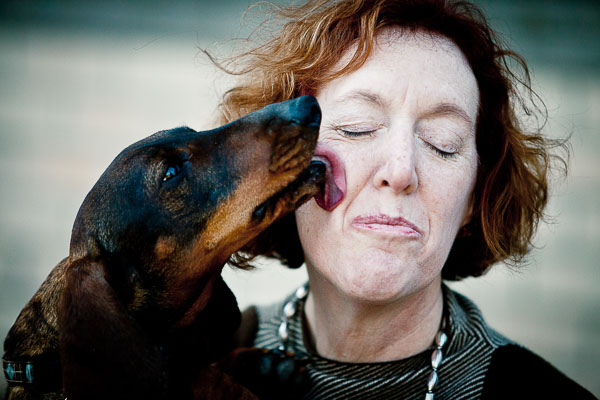
Dog kisses

Don’t Laugh at Anything that Shows up on the Viewfinder

Here’s what I want to leave you with. This advice, I believe, carries with it the heart of everything I’ve said here.

Never laugh at something that shows up on your camera’s screen.

I’m sure you can understand why – your subject’s vulnerability, of course. How might they interpret your laughter? It’s possible that you’ve cultivated an atmosphere of humor. Maybe you have consistently made yourself the butt of many jokes, and your subject might have joined in the fun and so maybe at this point it’s okay to laugh a little, as long as you’re laughing together. But let’s be honest, the average subject is pretty insecure. They’ll probably think you’re laughing at them and they’ll clam up.

But all of that is quite obvious. People don’t like to be laughed at. That’s not what is so important about this though. It’s not that you’re laughing, it’s not even why you’re laughing. It’s why your subject thinks you’re laughing. Truth is not important, your subject is going to respond to what they think, regardless of whether that is true or not.

It’s not that laughing is a problem. It’s that the subject thinks you’re laughing at them in some way. And it’s not just about laughing.

Let’s say you’re having some annoying problem with your camera for some reason. As you’re trying to work it out, you become visibly frustrated. Your subject probably doesn’t know what camera problems look like and their sense of vulnerability is causing them to take on a lot of blame. It’s not that you’re frustrated, it’s that you’re subject thinks you’re frustrated because of them.

Subjects place themselves in a position of vulnerability with photographers to a degree few other professions have access. Doctors and lawyers are a good example example. Doctors need access to the skin and the stuff underneath. Patients have to reveal their bodies to doctors – a vulnerable feeling indeed. Defence lawyers need access to the minute and truthful details of a defendant’s life. You as a photographer need access to their spirit – people must be who they really are with you.

You must take great care not to trample the spirit of your subjects. You must do mental, emotional, and creative gymnastics to avoid crushing the delicate structure of trust and assured respect. That allows their spirit to be reveal itself in honest smiles, cracked jokes, and a temperament of self-confidence standing in front of the camera.

Without your subject’s spirit, there is little reason for the photo.

Do you have any other tips for working with people and taking better portraits? Please share them and any stories you have in the comments below.

The post 7 Tips for Interacting with People to Create Better Portraits by William Petruzzo appeared first on Digital Photography School.


Digital Photography School

 
Comments Off on 7 Tips for Interacting with People to Create Better Portraits

Posted in Photography


DIY How to Build and Use a Reflector to Take Better Portraits

09 Sep

Photography is essentially capturing light. Beginners to photography can find the learning curve quite steep. To start with, there is the technical side. You need to understand what the camera can do and its limitations. Then there is the theory aspect, simply put you need to know what exposure is and how to achieve this with your camera if you want to get that creative shot.

About four years ago, I was shooting a couple of models in my city of Dublin outdoors with a few fellow photographers. The day was overcast and I was just hoping it wouldn’t rain. Thankfully, it didn’t. One of the photographers had this big reflector, a 52 inch, translucent one. I was amazed at how effective it was, especially as it added these wonderful catchlights in the model’s eyes.

Model with catchlights

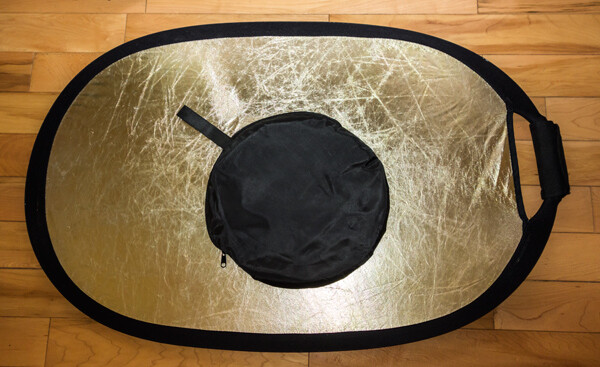
Think in terms of directing the light when photographing your subject or object. This is why a collapsible reflector is an excellent piece of additional camera gear. They are relatively inexpensive to buy, so portable, and lightweight. They do come in various sizes but a 42″ 5-in-1 collapsible reflector can be bought online for under $ 40 USD.

Collapsible Reflector 36x24 GoldSilver

Recently, at a family get together, my sister wanted me to take some headshots of her. We were outdoors, it was early in the evening around 6 p.m., and the sun was a ball of amber. I positioned her with the sun behind and it had created a wonderful rim light on her hair. But I didn’t have enough fill-light on her face.

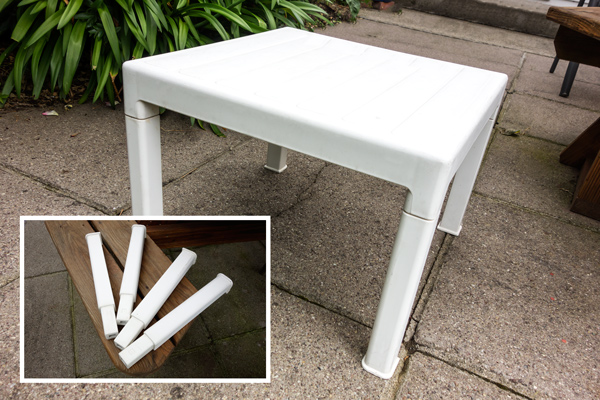
Then I realized, I didn’t have my reflector with me. On this occasion I had simply forgotten to bring it with me. After all, I wasn’t on a professional assignment. Anyway, I saw the small white plastic garden table. I grabbed it, turned it upside down and yanked the legs off. I got my youngest daughter to hold the table top slightly to the right and below my sister’s face.

Small white plastic garden table

Technology is speeding along at a very fast pace. The latest DSLR/mirrorless camera of today is fast becoming yesterday’s news in a relatively short time. As a newcomer to photography, it can be difficult to choose what gear and accessories to buy.

The basics of exposure havn’t changed with technology, nor has light. So practice with the camera that you have and learn to shoot with it in available light, and low light. Learn to see the different ways light can make a difference to your imagery.

I came up with five DIY options to serve as a reflector and tested them out. Here are some tip on how to use a reflector to take better portraits:

  1. White mount card from an art or hobby craft shop, size A1(33.1 x 23.4inches) 300g
  2. Kitchen aluminum foil crumpled up before fixing it on the back of the white card using spray
    adhesive
  3. Radiator reflective foil
  4. White plastic garden table
  5. Silver car mats

I still have, and use, the white card for demo purposes when I give workshops for beginners. It is so simple and affordable ,and the impact is quite dramatic. This option is the easiest to buy for a few dollars(USD). This piece of card can enhance your shots whether you are inside or outside. It’s great.

A simple indoor set-up for a portrait shoot using the white card

Have your model or subject seated (or stand) beside a large window. The model will be facing the camera, so one side of his or her face will be in shadow. Take a shot. Then have someone hold the white card near the model’s shadow side, at an angle so that a nice even light is cast across your subject’s face. Take numerous shots as you will need to direct your assistant on how close or far they hold the card up to the model. When you have taken a number of shots, you will get a clearer understanding of how to reflect the light upon your subject in a more pleasing manner. When you have uploaded your images to the computer, you will have the initial shot as your frame of reference to see the difference.

Tip – if the surface of your card starts to get grubby, I have covered up dirt marks using white interior matt paint.

Using kitchen aluminum foil is really simulating a silver reflector, which adds a cool light on your subject.

Becky silver reflector

If you don’t have spray adhesive or photo mount, an alternative method would be to water down a little PVC glue and paint this on one side of the white card. Then lay the aluminum foil (crumpled first) on top and smooth it out. This needs a good 24 hours to set. Also be careful when reflecting the light onto your model. Keep your distance as it reflects a large amount of light.

This roll of radiator reflector foil was inexpensive to buy. I can’t remember exactly but I think it was less than ten dollars (USD). Similar to above, this option works in the same way.

Becky radiator reflector foil

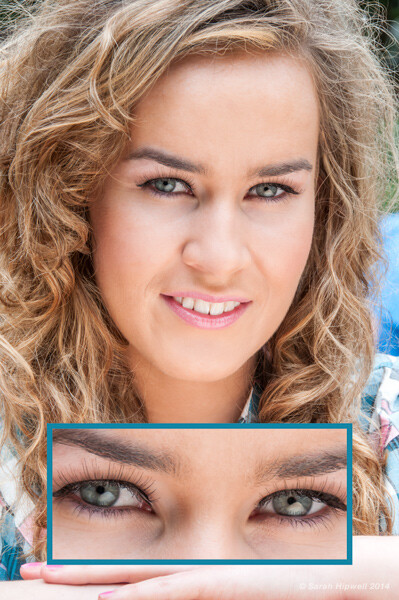
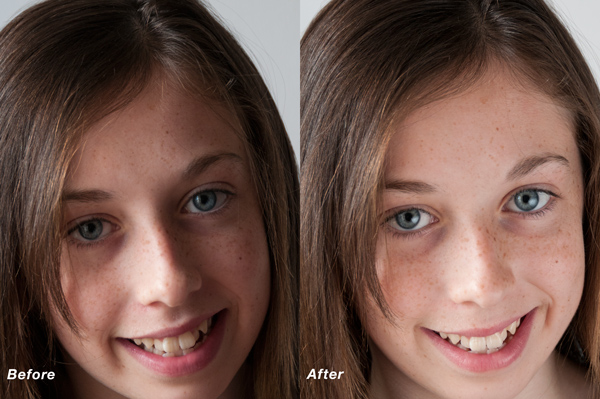
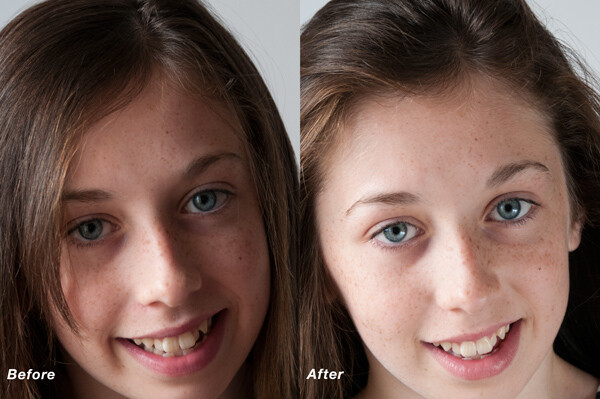
I recreated a similar test of my daughter in my Mum’s back garden using the small white plastic table. Unfortunately, I didn’t have the wonderful sun shining in the background, like I had for my sister’s shot. This was a quick test but as you can see there is an improvement in the after image. The light was cast more evenly across her face. Catchlights were created in the eyes which are key to good portraiture and shadows were eliminated under the chin.

Amy before and after small table

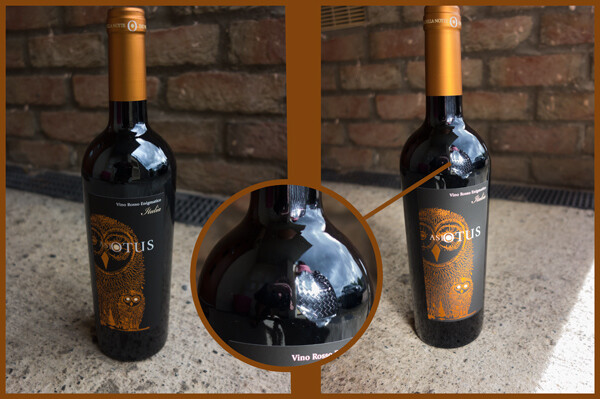
I included the silver car mats more as a tongue-in-cheek test! However, I decided to test them out to see would they actually work. I chose a bottle of wine so that you could see the silver car matt reflected in the bottle.

Wine bottle

Have you tried using a reflector before? What are your thoughts? Please give it a try if you haven’t and share your results and comments below.

The post DIY How to Build and Use a Reflector to Take Better Portraits by Sarah Hipwell appeared first on Digital Photography School.


Digital Photography School

 
Comments Off on DIY How to Build and Use a Reflector to Take Better Portraits

Posted in Photography


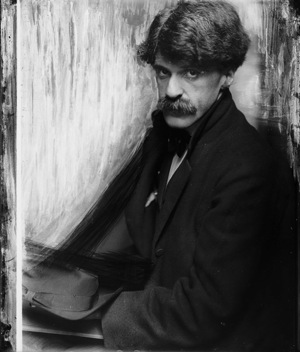
Cartier-Bresson and Stieglitz – Study the Masters of Photography to Become a Better Photographer

02 Sep

There is an unnervingly common trait among photographers, image makers, picture people, etc. Sometimes we forget that the reason we have access to such awesome gear and techniques, is because those who came before us in our trade figured them out, practiced them, advance them, and then left us a legacy of knowledge. The further we go back through the history of photography, the more prevalent this apathy becomes. What do you have to learn from someone who used a camera less advanced than a garage door opener? Well, as it turns out, we stand to learn a lot. Maybe not from a technological standpoint, but rather in a more intangible way that’s more difficult to appreciate, and easy to miss.

This is not to say that you can’t improve your photography from studying the methods of some of the masters. Their gear was varied and less advanced, but that only makes their work more extraordinary, and their skill even more humbling.

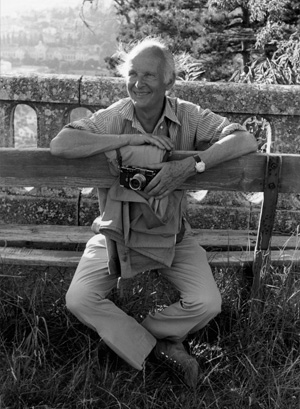
Henri Cartier-Bresson

Bresson

Image by Gertrude Käsebier

Even if the name doesn’t ring some little bell in your memory, chances are you most likely have viewed his work at some point. He was literally the inventor of the photojournalistic style… let that sink in for a minute or three. Before Cartier-Bresson, proper street photography as we know it and “still life reportage” as he called it was not a well practiced, or validated form of photography.

Born into a relatively well placed upper-class French family in 1908, Cartier-Bresson, like so many well known photographers, didn’t start out intending to be such. Painting was his major pursuit before picking up a camera. That all changed in 1931 when he set his eyes upon a photograph made by Hungarian photographer Martin Munkacsi. It was an image of three young boys in the surf of a lake in Africa. Cartier-Bresson said that he “couldn’t believe such a thing could be caught with a camera” and that he “suddenly understood that a photograph could fix eternity in an instant.” The photograph drove him to relinquish painting, and start making photographs. He was thoroughly a recorder of the spontaneity of human experience. There is much you can learn from Henri Cartier-Bresson to improve all aspects of your photo making.

Lessons you can learn from Henri Cartier-Bresson:

Strive to be invisible

When you’re working as a photographer it doesn’t take long to understand that humans tend to drastically change once they realize they are being photographed. Their mannerisms, expressions, and appearances all become noticeably different. Conspicuousness steals away realism very quickly if you are not careful. Cartier-Bresson understood this and moulded himself into somewhat of a photographic ninja. He shot with relatively small cameras, usually Leica 35mm Rangefinders. You have to understand that most photographers of his time were using larger format cameras which practically screamed “Hey, I’m making a photograph of you!!!” Anonymity allowed him to capture the essence of any scene in a way that was raw and unobtrusive.

Cartier-Bresson went so far as to conceal all the shiny surfaces of his gear with black paint to further decrease his footprint as a photographer. You might not want to go that far, but it will help you to capture better images if you blend into your surroundings. Plan for your sessions in a practical way. Don’t take more gear than you need, and keep a low profile. Try to wait until you’re ready to make an exposure before you raise your camera. Practice using your camera’s controls and memorize their placement. Also, avoid using a flash if it will likely interfere with your subject. Cartier-Bresson supposedly never used a flash for his images as he saw them as impolite and distracting. Photography, especially photojournalism, depends on the earnest capture of life in all its beauty, and regrettably, its occasional misery. Try to keep it real, literally.

Compose in camera

I know, I know. You’ve probably heard this before, and are most likely tired of having that phrase hurled at you. I feel your pain. I would always roll my eyes any time a seasoned photographer or well intentioned writer would talk about the importance of getting things right in-camera. Let’s be real here. It’s so easy to crop an image on the computer instead of using the camera’s viewfinder. It’s so much more convenient to salvage a less than correctly exposed image than to think through your aperture and shutter combinations.

Composeincamera

Post-processing photographs is a wonderful thing. Completely changing a photograph, however, is not always ideal. Cartier-Bresson was absolutely anti photo manipulation and believed any photograph should be cropped in the viewfinder before it was captured. Nearly all of his photographs were printed full-frame and even included about one millimeter of the unexposed negative so that his finished prints sported a thin black border to further prove the absence of cropping.

Any image is only as good as the ingredients put into its making. So try to put the best possible ingredients into your work so that your finished product will be something you will be proud to display and say “I made this”.

Focus as much on the art as the science

What we do as photographers would have been considered magic in an earlier time. Even at the basic level it is an amazing science. We record light that is completely unique and fleeting. You will never make the exact same photograph twice. The science of image making is an essential part of our creative process, but it must never be viewed as the only part.

Artandscience

Surprisingly, Cartier-Bresson expressed, on multiple occasions, his almost complete lack of interest in the more technical portion of making photographs. The developing and printing of his negatives, actions so carefully controlled and guarded by most serious photographers of the time, were valid only to him in the cases where they allowed more effective expression of his vision. He saw the camera as a tool, and development and printing as merely a means to a much anticipated end. He said “people think far too much about techniques and not enough about seeing”.

You can lose your direction during the of making an image. Sometimes we let technical perfectionism overshadow our initial vision. Thorough knowledge of your gear is essential to grow as a photographer. However, like Cartier-Bresson tells us, don’t allow yourself to become so focused on your tools that you forget your craft.

Alfred Stieglitz

Stieglitz

Alfred Stieglitz was born into this world on January 1, 1864 and left it on July 13, 1946. Anything else that I can tell you about the impact of man’s life upon the world of photography and creative art will fall unbelievably short of the full measure of gratitude we owe him as photographers. That’s not hyperbole. Before Stieglitz, photography was not considered a form of artistic expression. There were no real schools of photography, and it certainly was not considered high art on the level of painting and sculpture. Stieglitz gave artists an outlet to show their work to the public, and was the catalyst that helped begin the careers of many celebrated artists including the paintings of Georgia O’Keeffe, and the legendary photographs of the great Ansel Adams. Stieglitz was always open to new techniques and innovative thinking towards art.

His work is removed from our time by nearly a century, and many of the technical mechanisms he used are now obsolete. Still, there is much insight to be gained from Alfred Stieglitz, and his contributions. We can learn from his approach to the art world as a whole, to better ourselves as photographers.

Lessons you can learn from Alfred Stieglitz:

Express yourself when you can

Stieglitz created a series of images called “Equivalents”. It is a collection of photographs that show a variety of different cloud formations. Each image was a self-reflection of the thoughts, emotions, and experiences that he was feeling at the time the frame was exposed. That made each image unique to only him. He was the only person who truly understood how he felt during each release of the shutter. So go out and photograph something that makes you happy. Share it with others if you want, or just keep it for yourself. Go and make photos of something that is only beautiful, or meaningful to you. The act in itself is very freeing.

Expressyourself

This spot has special meaning only to me. I made this photo for myself and no one else.

You might be thinking “I express myself with all my work”, but really think about it for a moment. Do you ever make a photograph and immediately consider how it might be accepted or rejected by other people? Do you sometimes share an image that you personally think is outstanding but no one else seems to care about? We have all done it more often than we might comfortably admit.

Break the rules if you want

Simply put, any photograph that has ever been produced, resulted from of a combination of the following variables: size of aperture, shutter speed, depth of field, focal length, image receptor sensitivity and composition (film, digital sensor, ect) and that’s all. The key to making a great image is putting all those pieces together in such a way that they convert what was only visible within your own mind, into a photograph. Those are the only iron clad rules in photography. In the end it’s you who make the choices and operate the camera.

Bendtherules

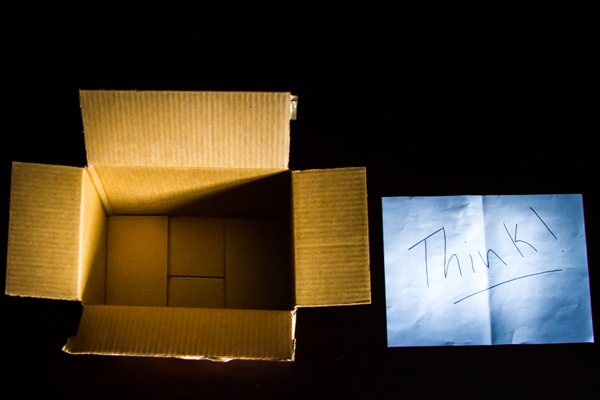
Don’t be afraid to think outside the box!

Some really great work has resulted from stepping outside the mainstream. There are many stunning images that completely ignore the rule of thirds, leading lines, horizons, and so forth. Never completely cast aside guidelines, but don’t convince yourself that you are permanently tied to them either. Learning, and practicing, the tested and proven building blocks of strong photography will help you greatly. Just remember that ground breaking work often arises from the bending of rules.

Look for inspiration everywhere

Stieglitz promoted all art forms. He opened galleries to display the works of painters, sculptors, and of course photographers. He didn’t limit himself to only photography, or painting or to works fashioned from stone and clay. Instead, he drank it all in. He recognized that it was all tangled together and intertwined.

As photographers we are able to almost instantly project what sometimes takes other artists days or weeks, or even months to create. However, this relative ease of creation can gradually place blinders on our creative thinking. We can reach a point when we only look at other photographs for inspiration. That kind of thinking limits our scope as artists. This mindset is especially dangerous for new photographers and can lead to frustration, disappointment and even worse, emulation that festers into plagiarism.

Don’t let yourself have artistic tunnel vision. Begin to look for inspiration everywhere to fuel your photography. Black and white sketches, paintings, wood carvings, architecture, kids finger-painting – everything has the potential to give you a smack of creativity that you can mould into photographic inspiration. The truth is that you really never know what will inspire you.

Please share your questions and comments below. Have you heard of these two masters before? Have they influenced your photography?

The post Cartier-Bresson and Stieglitz – Study the Masters of Photography to Become a Better Photographer by Adam Welch appeared first on Digital Photography School.


Digital Photography School
 
Comments Off on Cartier-Bresson and Stieglitz – Study the Masters of Photography to Become a Better Photographer

Posted in Photography


Capturing Better Portraits Between Poses

13 Aug

1-Mike_Bataki

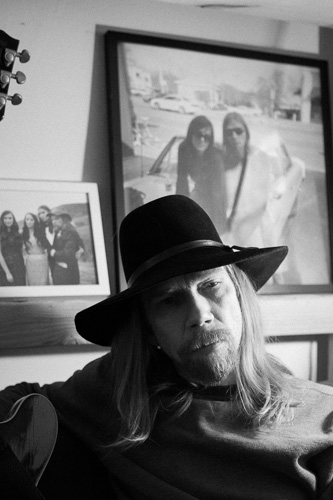
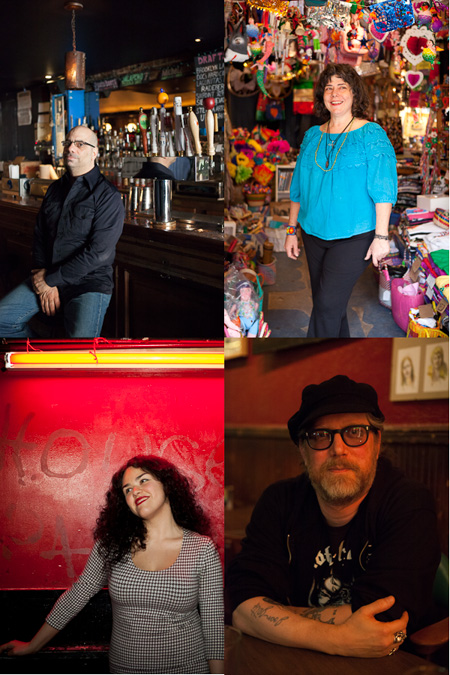
If you do portraiture of any kind you are probably used to people giving one look when the camera is away from them and another when it is on them. This is the unfortunate game of the portrait photographer.

For my own work, I find that many of the most poignant portraits of people are the ones in between the actual ‘portraits’ taken during a session. These are the moments when your subject is at ease, in their element, thinking about something, and when they have the most interesting expressions.

So how do you capture these and take better portraits?

Paul KostabiThere is an important reason for taking your time to do a portrait session. It gives your subject time to get comfortable with you and the way you work. You can go through multiple backgrounds and ideas, and it is common for subjects to get over the initial portrait trepidation as the time goes on. That deer in headlights look will often (but not always) go away as they get used to how you work and what you want from them. This is the reason that you do not want to start off right away with your best idea because that will often be at their most uncomfortable moment.  Wait until they seem comfortable and in the right mindset.

Give them direction, especially at first. When people do a portrait session they want to be told what to do, even if you want them to just be natural. Talk to them about what you’re doing and what you want from them. Do you want them to give you an emotion? How are their hands and arms? How is their posture?  Where should they stand? I personally prefer to engage the subject and get them standing and interacting in a natural way, but often I will pose people at the beginning just so they feel confident that I know what I’m doing. Then over time I will start trying to get them to pose in ways that feel the most natural for them, as they get more comfortable with what they are doing.

The main key to this is that you want to get them interacting with you. Some types of shots are better posed of course, but you want them in some sort of moment. When they feel something, or think about something interesting, that feeling will shine through in the photograph.

Talk about the person’s life. Get to know them. Ask them questions and get them thinking introspectively. Tell them this is part of the process so they don’t feel uncomfortable or unsure of what to do when they are talking. This is one of the reasons that I sometimes like to interview people as part of portrait sessions. Then, within the interview, right after they have finished talking about something interesting or emotional, I will stop them and ask them to stay just like that and I will take their photo.

Portraits

Sometimes you even have to fake people out. Tell them that you are just taking a few shots to test the light and to relax for a moment. Some of my best images have been taken that way.

There are ebbs and flows in a portrait session. Sometimes it makes you feel like a boxer, bobbing and weaving with what they give you. Other times you will feel like a psychiatrist, trying to bring something out of them. If someone starts to look more and more uncomfortable, don’t keep photographing them hoping they’ll start to get better. Break them out of it by asking them to move to another location or take a break. Keep them on their toes and engaged.

All subjects are different and will react differently to you, but the key is always that you must find ways to get through to them . Then to have the wherewithal to be able to catch the moment once they finally give it to you, because often the best moments are quick and fleeting.

The post Capturing Better Portraits Between Poses by James Maher appeared first on Digital Photography School.


Digital Photography School

 
Comments Off on Capturing Better Portraits Between Poses

Posted in Photography


Tables turned: Photo series depicts children getting the better of their nightmares

09 Aug

Photographer Laure Fauvel’s series ‘Terreurs’ turns an age-old rivalry on its head. The retouched photos depict children fighting back – and winning by the looks of it – against the monsters that typically terrorize them in the night. Children wielding toy weapons keep the nightmarish creatures cowering in closets and under beds with fearful expressions. See gallery

Articles: Digital Photography Review (dpreview.com)

 
Comments Off on Tables turned: Photo series depicts children getting the better of their nightmares

Posted in Uncategorized