RSS
 

Posts Tagged ‘Best’

Top 5 Best Leica Digital Cameras

05 Jun

The digital era is here and photography has taken many strides into the future of artificial intelligence, thanks to camera lenses that beat human imagination. That is not all. There are many different brands to choose from such as Nikon, Canon, Sony, Olympus among others. But, does it mean everything you are going to buy should be automated and have Continue Reading

The post Top 5 Best Leica Digital Cameras appeared first on Photodoto.


Photodoto

 
Comments Off on Top 5 Best Leica Digital Cameras

Posted in Photography


2019 Buying Guide: Best instant cameras

21 May

Looking to get in on the instant camera fun? We tried every model and think the Fujifilm Instax Mini 70 strikes the right balance between price and features – the Instax Wide 300 is our choice if you crave a larger format.

Articles: Digital Photography Review (dpreview.com)

 
Comments Off on 2019 Buying Guide: Best instant cameras

Posted in Uncategorized


What are the Best Phones for Photographers?

18 May

Many photographers own two cameras – a DSLR plus lenses for ‘serious’ photography and a compact camera of sorts to carry around for unexpected photo opportunities. Or else they may opt for a so-called ‘bridge’ camera with a built-in zoom lens. Some of these are almost the size of a DSLR which may then lead to the need for a Continue Reading

The post What are the Best Phones for Photographers? appeared first on Photodoto.


Photodoto

 
Comments Off on What are the Best Phones for Photographers?

Posted in Photography


On the trail of the best Texas BBQ with the Sony a7R III

07 May

Sony’s a7R III is a high-resolution flagship camera, and a showcase for some of the company’s most innovative imaging technologies. In addition to 42MP resolution and advanced on-sensor autofocus with face and eye tracking, the a7R III also offers 4K and high-speed HD video capture.

$ (document).ready(function() { SampleGalleryV2({“containerId”:”embeddedSampleGallery_3448927577″,”galleryId”:”3448927577″,”isEmbeddedWidget”:true,”selectedImageIndex”:0,”isMobile”:false}) });

Photographer Chad Wadsworth has been working with the a7R III and Sony’s FE 24mm F1.4 GM in Texas, on the hunt for the best barbecue in the state. From traditional family-run joints in Lockhart, to the trendy new generation pit-masters of Austin, Chad captured the experience every step of the way. Watch our video for a flavor of the experience, and check out a gallery of his images, above.


This is sponsored content, created with the support of Amazon and Sony. What does this mean?

Articles: Digital Photography Review (dpreview.com)

 
Comments Off on On the trail of the best Texas BBQ with the Sony a7R III

Posted in Uncategorized


Sony a6400 vs Fujifilm X-T30: Which is best for you?

28 Apr

Introduction

The Sony a6400 and Fujifilm X-T30 are the two company’s mid-priced mirrorless cameras. They’re 4K-capable cameras with similar resolution APS-C sensors: 24MP on the Sony, 26MP on the Fujifilm.

Both build on the legacies of Gold Award-winning predecessors, which helps establish them as presumed big hitters. And, having tested both cameras extensively, this is a fair assumption: they’re both class-leading cameras. Chris and Jordan from DPReview TV have already looked at their various strengths and weaknesses, so we’re going to look at how they compare for different types of photography.

Spec comparison

From a specs point of view the a6400 and X-T30 look pretty similar: they’re both 4K-capable APS-C mirrorless cameras with very similar price tags. Both cameras offer similar resolution (24MP on the Sony, 26MP on the Fujifilm), both have 2.36M-dot viewfinders and both can shoot at an impressive frame rate 11 fps with autofocus on the Sony, 20 or 8 fps on the Fujifilm (depending on whether you’re in a situation that allows the use of electronic shutter).

The moment you pick them up, it becomes apparent that they’re very different creatures

And yet, the moment you pick them up, it becomes apparent that they’re very different creatures. Differences in performance and radically distinct design philosophies mean picking between the two becomes much more complex than simply ‘which feels more comfortable’ or ‘which has the lenses that I need?’

Handling comparison

The difference in design philosophy is immediately apparent just by looking at them: the Fujifilm is studded (perhaps overwhelmed) with direct control points, including a mixture of dedicated dials and customizable function wheels. By contrast, the Sony has fewer buttons and only the two control dials, which point to a camera that doesn’t invite (or, perhaps, require) such a degree of engagement with its settings.

The Fujifilm is studded (perhaps overwhelmed) with direct control points, the Sony has the more complex menu system

Conversely, the Sony has the more complex menu system, with vast numbers of options lodged in a structure that relies on user memory more than most (though, once configured, your need to delve into the menus can be minimized). The Fujifilm’s menus are crowded but they’re better laid-out and have more indication of where each setting is likely to be found. Both have customizable ‘My Menu’ tabs if you find yourself needing regular access to menu-only options.

The other major difference is in autofocus. Not so much in terms of performance (though the Sony is, as good or better across the board), but in terms of complexity and usability. The Fujifilm has a series of different AF modes that you’re likely to swap between, depending on what you’re trying to shoot, and the choice of using the AF joystick or touchscreen to choose a subject. The Sony also has a wide range of AF area modes but, for most shooting situations, can be left in one mode, pointed at your subject and trusted to follow it, requiring little user input or mode-changing.

Other contenders

The most direct video/stills competitor to the Sony/Fujifilm duo is probably the Panasonic Lumix DC-G95 (G90 or G91 outside North America). It’s also a 4K-capable stills/video camera, but one that brings an image-stabilized 20MP Four Thirds sensor to the table, rather than the unstabilized APS-C chips of the other two. We wouldn’t rule it out just yet, but our initial impressions are that its video and autofocus aren’t up to the same high standards as the pair we’re discussing here.

Canon appears to have retreated from this section of the market for now: it’s more enthusiast-friendly M5 and M6 models now looking rather long in the tooth and lacking 4K video. Olympus’s OM-D E-M10 III is a less-expensive alternative and lacks the AF performance of the more recent APS-C models.

Sports and wildlife

Processed and cropped in Adobe Camera Raw 11
Sony a6400 | ISO 640 | 1/640 sec | F4

Sports and wildlife is a relatively comfortable win for the Sony. The Fujifilm’s AF system is more than up to the job of shooting sports (especially if you tune the AF behavior, manually follow the action and keep your subject under a Zone AF region), but the Sony system does well without the need for so much intervention, and is especially good at subject tracking.

Lens choice may be the deciding factor here. Both systems offer fairly expensive 100-400mm F4.5-5.6 lenses if you need a lot of reach, but Fujifilm’s APS-C-only version is both smaller and less expensive. Fujifilm offers a 50-140mm F2.8 zoom whose 70-200mm F4-like equivalent behavior is arguably more useful than Sony’s similarly-sized 70-200mm F4 (which ends up behaving more like a full-frame 105-400mm F6 if you mount it on the a6400).

Family and moments

Out-of-camera JPEG
Sony a6400 | ISO 1000 | 1/125 sec | F1.4

The Sony is the clear winner here, primarily for how easy its autofocus is to use and how well it understands human subjects (focusing on an eye if it can see one, but reliably keeping focus on the same person if they look or turn away). The tenacity with which the a6400 will maintains focus on the person you’ve chosen is simply unequaled.

Both systems include the option of 18-135mm lenses, which provide huge amounts of flexibility

The Fujifilm still makes a handy family camera, though. It requires a little more patience and more user input, but can be paired with lenses such as the 18-55mm F2.8-4.0 OIS, which is a much better and more flexible zoom than the Sony 16-50mm F3.5-5.6 power zoom.

Both systems include the option of 18-135mm lenses, which provide huge amounts of flexibility, though their F3.5-5.6 maximum apertures may not give the shallow depth-of-field or low light advantages over using a good smartphone. Of course, if you don’t regularly zoom-in on your smartphone, it’s worth looking at the available prime lenses for both systems.

Landscape

Processed and cropped to taste in Adobe Camera Raw 11
Fujifilm X-T30 | ISO 160 | 1/100 sec | F4

There’s not a huge amount to choose between the two cameras in terms of landscape shooting. The Fujifilm lens lineup includes a series of nice zooms and a good choice of high-quality F1.4 prime lenses, which might just tip the balance in its favor.

They’re fairly evenly balanced in terms of battery life and portability, and both have rear screens that tilt up for tripod use. There’s not much to choose between the cameras in terms of Raw performance: not all Raw converters do a great job with Fujifilm’s X-Trans sensor pattern, but conversely Sony insists on applying damaging compression to its files, which slightly reduces their flexibility.

Neither camera is especially easy to operate with gloves, though if you deactivated the command dials, the Fujifilm’s dedicated shutter speed, aperture and exposure comp dials are easier to use than the Sony’s rear dial, which is fiddly at the best of times.

Lifestyle and social

Out-of-camera JPEG
Sony a6400 | ISO 100 | 1/320 sec | F1.8

The Fujifilm’s attractive JPEG output and selection of lenses makes it a very credible choice for lifestyle and social photography. It has face and eye detection and can offer shallow depth-of-field images if you pair it with the right lens. A wide selection of prime lenses (with a choice of F2 or F1.4 in several focal lengths), makes this pairing easier.

The Sony comes out in front, for us, though, especially on the ‘social’ side of things. Its AF system is more responsive and easier to use when trying to shoot spontaneous photos, particularly of photos with people in them. Added to this, Sigma’s trio of F1.4 lenses may well include a focal length that works for your style of photography.

With its screen that flips all the way up, the Sony is also the clear winner if you want to take selfies.

Formal portraits

Processed in Adobe Camera Raw 11
Pre-production Fujifilm X-T30 | ISO 320 | 1/200 sec | F2

When it comes to posed portraiture, again it’s probably a slight win to the Sony. Its uncannily sticky eye-detection system can be entirely relied upon, freeing up the photographer to concentrate on their lighting, their composition and engaging with their subject. Stick the comparatively affordable Sigma 56mm F1.4 on the front and the camera will do much of the rest.

It’s only a slight win, though. Fujifilm’s 56mm F1.2 APD is a lovely portrait lens, as is its 135mm-equiv. 90mm F2 (though neither comes cheap). Eye detection works well, especially with a single subject and the X-T30’s choice of film-mimicking color modes makes it easy to deliver attractive results.

Sony has stronger native flash options, with a radio-frequency remote flash system, but both are well supported by third-party makers, making it easy to find flash heads that can be remotely triggered.

Candid and street

Processed in Adobe Camera Raw 11
Pre-production Fujifilm X-T30 | ISO 640 | 1/125 sec | F4

Both the Sony and Fujifilm are pretty small cameras, and can be paired with fairly small lenses (though it’s worth checking whether there’s a small prime lens available in your favored focal length). Both have rear touchscreens that tilt upwards for from-the-hip shooting and both have relatively quiet shutter mechanisms. They both offer completely silent electronic shutter modes, with the Fujifilm exhibiting less rolling shutter distortion in that mode.

Both cameras make it pretty simple to transfer your images to a smartphone, with the Sony offering NFC in addition to Bluetooth, which makes it a little quicker to use with Android devices.

Again the Sony’s simpler, more precise AF system may give it a bit of an edge, particularly for candid people pics. It’s also a little smaller and more discreet.

Video

The Sony a6300 was one of the first sub-$ 1000 cameras to offer really detailed 4K capture, but video performance (and our expectations of it) have been one of the areas of greatest improvement since then. It’s much easier to spot the rather poor rolling shutter performance now that a range of cameras can offer the level of detail capture that once rather dazzled us.

Fujifilm matches the Sony for detail capture but with much less rolling shutter and no crop (as the a6400 does when shooting 30p). And that’s before you consider the Fujifilm’s array of attractive and useful Film Simulation modes (including the flexible Eterna mode and the option of Log capture with a downloadable LUT to make processing easier). Unlike the Sony, the Fujifilm can offer headphone monitoring via a USB-C adapter.

The a6400’s video is easier to point-and-shoot: again thanks to its impressive tap-to-track autofocus, though the X-T30 can track human subjects fairly well. The Fujifilm is the better video tool overall, if you’re serious about videography and are willing to manual focus. There’s even the option to output 10-bit footage if you get serious enough to buy an external recorder.

Conclusion

Looking at these two cameras through the lens of specific photographic applications is an interesting exercise, with the importance of the simplicity and reliability of the a6400’s AF system shining through (when assessing them in general terms we concluded there wasn’t a lot to choose between them).

The a6400’s updated AF system is genuinely phenomenal

We’re still not big fans of the experience of shooting with the Sony: its two command dials are undermined by the need to stop and adjust your grip every time you want to use the lower one. Its menus are still difficult to navigate and its touchscreen is poorly utilized. That said, its updated AF system is genuinely phenomenal, removing, at a stroke, one of the things you previously would have had to mess around with. If your photography benefits from fast, precise focus (particularly for human subjects), the Sony is the stronger choice.

Both these cameras are significantly better than the already good cameras they replace, so there’s no wrong choice here

We still really like the X-T30, though. It looks pretty, is engaging to use and produces attractive JPEGs and consistently better video than the Sony. It’s not without its own usability flaws: the joystick and Q buttons are awkwardly placed and the pressable command dials are fiddly and easily knocked. Overall there are arguably too many control points for such a small camera, but it’s a camera that can be set up to be really enjoyable to use.

Both these cameras are significantly better than the already good cameras they replace, so there’s no wrong choice here. So which is more important to you: the experience of photography or the certainty of getting the shot?

Articles: Digital Photography Review (dpreview.com)

 
Comments Off on Sony a6400 vs Fujifilm X-T30: Which is best for you?

Posted in Uncategorized


Buying Guide: The best lenses for Fujifilm X-mount mirrorless cameras

25 Apr

Whether you’ve bought an inexpensive Fujifilm X-A5 with a kit lens, or a higher-end body like the X-T3, at some point you’re going to want some new glass. Whether you’re shooting portraits or want a versatile travel zoom, we’ve got you covered.

Before we go on, keep in mind that these lenses are for X-series cameras only. Fujifilm’s GFX medium format bodies use a different mount, which we’re not covering in this buying guide.


For each of the categories below the winner was the lens which we found to offer the best combination of quality and value. In most cases, we’ve also provided a more budget-friendly option, as well as a choice for those with more to spend.

  • Best kit lens replacement
  • Best prime / single focal length lens (all-around)
  • Best prime / single focal length lens (for portraits)
  • Best wide-angle zoom lens
  • Best telephoto zoom lens
  • Best macro lens
  • Best lens for travel

Here at DPReview we use a lot of lenses, but we can’t test every single product on the market. So if we’ve excluded your favorite lens, or if you disagree with any of our selections, please let us know in the comments below.


Best kit lens replacement

Standard (kit) zooms are just what they sound like – versatile, general-purpose lenses that start with a fairly wide angle of view and allow you to zoom in to a focal length traditionally used for portraits.

Our pick: XF 18-55mm F2.8-4.0 R OIS LM

If your camera didn’t already come with it, we’d suggest upgrading to the excellent 18-55mm F2.8-4.0 OIS. The 18-55mm is a significant step up from Fujifilm’s XC 16-50mm and 15-45mm kit lenses, albeit not quite as wide as either.

Check prices | More info

Also consider:

Money no object:
XF 16-55mm F2.8 R LM WR

It’s big, it’s heavy, it’s unstabilized, but more importantly, the 16-55mm F2.8 is optically excellent. It’s one of the most powerful ways to get the most out of your camera.

For more flexibility:
XF 18-135mm F3.5-5.6 R LM OIS WR

At time of publication, the 18-135mm is the best way of adding a lot more flexibility to your camera. Just bear in mind that it has a slightly slower aperture than the 18-55mm and doesn’t go any wider, so think carefully about what you’d gain.

Check prices | More info Check prices | More info

Best prime / single focal length lens (all-around use)

Removing the complexity of a variable focal length often allows for prime lenses to be smaller, lighter and sharper, while letting more light through and being more useful in dimly lit situations.

For all-around use we’d recommend a semi-wide-angle lens that can lend itself to a range of subjects.

Our pick: XF 23mm F2 R WR

The 23mm F2 isn’t the sharpest lens in the Fujinon lineup, but it’s small, relatively fast and sensibly priced. It makes for a respectably small combination with most X-series cameras and provides decent low light performance and some control over depth-of-field. The equivalent focal length of 35mm makes this a perfect everyday lens for walk-around shooting.

Check prices | More info

Also consider:

Small/light/affordable:
XF 27mm F2.8

The 27mm lens offers a 40mm equiv. field-of-view, which can be great fun to shoot with. At F2.8 it’s not going to give much of a benefit in terms of light capture or depth-of-field compared with a kit zoom. Its major appeal is size: it’s convenient and discreet when paired with most X-series cameras.

Money no object:
XF 23mm F1.4 R

The Fujifilm 23mm F1.4 is optically excellent, making it a great do-everything prime. It’s not especially fast to focus but if you want the quality and improved low light performance it brings, then that’s the trade-off.

Check prices | More info Check prices | More info

Best prime / single focal length lens (for portraits)

Prime lenses are just a single focal length; removing the complexity of a zoom often allows for these lenses to be smaller, lighter and sharper, while letting more light through and being more useful in dimly lit situations.

For portraits we’d recommend a mid-telephoto lens that lets you shoot head-and-shoulders shots from a comfortable working distance.

Our pick: XF 56mm F1.2 R

The 56mm F1.2 is designed to give the same angle-of-view and depth-of-field as a classic 85mm F1.8 lens does on full frame. It’s one of the slower-focusing lenses in the system, but it’s impressively sharp and well-matched for portrait shooting. There’s a more expensive ‘APD’ version if you need smoother background blur.

Check prices | More info

Also consider:

For a bit more breathing room:
XF 90mm F2 R LM WR

The 90mm F2 isn’t cheap, but it’s extremely sharp, is faster to focus than the 56mm and gives plenty of control over depth-of-field. It also gives a longer working distance, which some people will prefer.

The inexpensive option:
XF 50mm F2 R WR

The 50mm’s equivalent focal length of 75mm is a bit shorter than the 56mm’s, but the magnification difference is minimal in normal use and it’s much less expensive, faster to focus and still pleasantly sharp. It’s also small enough to carry with you at all times.

Check prices | More info Check prices | More info

Best wide-angle zoom lens

Wide-angle lenses are often useful for taking photos of interiors, landscapes and architecture.

Our pick: XF 10-24mm F4 R OIS

The 10-24mm F4 is a mid-range stabilized zoom that extends out to a usefully-wide 15mm equivalent. It’s not cheap but the optical quality, solid build, constant aperture and inclusion of OIS help explain the price.

Check prices | More info

Also consider:

Money no object:
XF 8-16mm F2.8 R LM WR

If you need to go wider or brighter than the 10-24mm, there’s the 8-16mm F2.8. It’s well-corrected and generally superb optically. Just be aware: it’s big, heavy, and cannot accept screw-in filters.

Check prices | More info


Best telephoto zoom lens

Telephoto lenses start out being fairly zoomed-in, and allow you to zoom in even further so you can fill your frame with more distant subjects.

Our pick: XF 55-200mm F3.5-4.8 R LM OIS

Although the range makes it sound like a budget ‘two lens kit’ filler, the Fujinon 55-200mm is a well built, fast-to-focus mid-price option. We used it as our autofocus test lens for many years and were impressed with its performance.

Check prices | More info

Also consider:

Budget option:
XC 50-230mm F4.5-6.7 OIS II

The 50-230mm is a low-cost stabilized tele-zoom. Be aware of that F6.7 maximum aperture at the long end of the zoom: it’s not going to let in a lot of light, so your images are likely to be noisy in all but the best light.

Money no object:
XF 50-140mm F2.8 R LM OIS WR

The 50-140mm F2.8 makes a lot more sense when you realize it covers roughly the same range as the classic 70-200mm sports lenses do on full-frame cameras. It’s fast, well-built and offers image stabilization, and is much easier to wield than most lenses with this focal length.

Check prices | More info Check prices | More info

Best macro lens

Macro lenses allow you to focus very close to small subjects, which is handy for photographing flowers or bugs.

Our pick: XF 80mm F2.8 R LM OIS WR Macro

The 80mm F2.8 Macro is sharp, stabilized and gives a useful working distance, meaning you’re not bearing-down on your subject. A flexible, attractive choice for close-up shooting.

Check prices | More info

Also consider:

Money no object:
Zeiss Touit 50mm F2.8M

We’ve been impressed by what we’ve seen of the Zeiss Touit series but they’re significantly more expensive than their Fujinon counterparts. We prefer the 50mm Macro to Fujifilm’s rather slow-to-focus 60mm F2.4 if you need something wider than the 80mm.

Check prices | More info


Best travel zoom lens

If you want a versatile lens that can handle most shooting situation, then consider a travel zoom. You still start out with a fairly wide field-of-view and can zoom in almost as much as many telephoto lenses. This is convenient, but these lenses tend to let less light through them, so aren’t as useful in dimly lit situations, and they may not always give you the sharpest results.

Our pick: XF 18-135mm F3.5-5.6 R LM OIS WR

The 18-135mm offers a flexible range for whatever you encounter while traveling, which is fortunate, since it’s essentially your only choice at present. It would be nice if it went a little wider, but it covers a hugely useful range, offers image stabilization and a weather-resistant design, making it a solid choice for traveling.

Check prices | More info

Also consider:

Worth waiting for?
XF 16-80mm F4 R OIS WR

If you haven’t got a specific trip already planned, it might be worth waiting for the forthcoming 16-80mm F4. Constant F4 may not sound too exciting on an APS-C camera but the 24-120mm equivalent range may prove more useful than the 27-203mm equiv reach of the 18-135, especially if the quality is better.

Articles: Digital Photography Review (dpreview.com)

 
Comments Off on Buying Guide: The best lenses for Fujifilm X-mount mirrorless cameras

Posted in Uncategorized


The Best Fujifilm X-Series Kits for Travel Photography

20 Mar

The post The Best Fujifilm X-Series Kits for Travel Photography appeared first on Digital Photography School. It was authored by Matt Murray.

Travel has always been my first love. In 1994 I bought my first camera – a Pentax Zoom 90 WR point and shoot – because I was going to Europe for a two-year working holiday. The only way to share photos with family back then was to have the film developed and post the prints home!

While photography (and technology) has changed remarkably in the last 25 years, what you should look for in a camera for travel photography is much the same: small, light, capable of great results and preferably weather resistant.

I’ve used all sorts of camera brands over the years. However, for me, Fujifilm X-Series cameras and lenses are the perfect travel companions. Whether it’s a trip to the Australian outback, visiting remote Buddhist temples in the Javanese jungle, photographing puffins in the Faroe Islands or capturing traffic trails in Taiwan, my X-Series cameras have always produced stunning results. Here are my recommended Fujifilm X-Series kits for your next big adventure.

Best minimalist kit

Camera: Fujifilm X100F
Lens: Fixed F2 Fujinon lens
Weight: 469 grams

The best minimalist kit choice was easily the stunning Fujifilm X100F. This is the best compact digital camera ever made. Yes, it really is that good!

Many photographers – including diehard users of other brands – use this as their “take everywhere” shooter. The X100F is small and quiet, and the fast f/2 Fujinon lens creates beautiful images. It may be small, but it boasts an impressive array of features including a leaf shutter and built-in neutral density filter.

Like all the cameras I feature in this article, the X100F can shoot RAW alongside Fujifilm’s array of stunning JPG film simulations, that replicate the look of classic films such as Provia and Velvia. Fujifilm cameras produce the best JPGs I’ve seen straight out of the camera.

This choice is a little unusual as it has a fixed lens. That’s right. You can’t take it off and swap it for another lens. If the 23mm focal length (35mm in full-frame terms) isn’t your preferred choice, the system also has wide-angle conversion and telephoto converter lenses. However, these do add extra weight to your kit. One of the few downsides to the X100F is that it’s not weather resistant. But, at least it’s small enough to fit in your pocket during a downpour.

One body plus one lens kit

Camera body: X-T30
Lens: XF 18-55mm F2.8-4 R LM OIS lens
Approximate weight: 693 grams

If you only have space to take one body and one lens on a trip, I would recommend the brand new Fujifilm X-T30 with the XF 18-55mm F/2.8-4 R LM OIS lens. I’ve been using this line of cameras since buying the X-T10 as a second body back up to my X-T1, and I’ve also used the X-T20. The X-T cameras with a “0” after them are lighter, cheaper, non-weather resistant versions of the flagship models, but usually feature much of the same technology. For example, the X-T30 has the same 26.1MP X-Trans 4 CMOS sensor as the X-T3.

Alternatives for the camera body would be the X-T20 and the X-E3. The X-T20 gives you a screen that tilts up and down for overhead and low to the ground shots. Whereas, the X-E3 is the more minimalist choice, and features a joystick that controls where the focus point is in the frame. The X-T30 and the X-T3 have both of these features.

My choice of lens for this kit is the XF 18-55mm F/2.8-4 R LM OIS. Not only is it one of my favorite Fujifilm lenses, but it’s also the lens that I’ve used the most over the last three years.

Often sold with camera bodies, many newcomers to the X-Series remark that the XF 18-55mm F2.8-4 R LM OIS lens is “surprisingly good for a kit lens.” In no way is this lens like the subpar beginner kit lenses produced by other manufacturers. The XF 18-55mm F/2.8-4 R LM OIS is a stunningly sharp lens in its own right and has produced some of my favorite images ever.

It may not be weather resistant, but it does feature OIS (optical image stabilization) to ensure your shots are as sharp as possible at lower shutter speeds. It’s a variable aperture zoom lens, meaning that the maximum aperture changes as you zoom through the range. However, you can still shoot at f/2.8 at the 18mm focal length, and f/4 at the 55mm end. It’s a top lens for landscape, cityscape, and portraits.

Best kit under 1kg

Camera body: X-T30
Lenses: XF 18-55mm F/2.8-4 R LM OIS + XF 35mm f/1.4 R
Approximate weight: 880 grams

My picks for the best kit weighing under 1kg include the same choices as the ‘One body plus one lens’ kit above, with the addition of the XF 35mm f/1.4 R. The first time I used this lens, I was blown away by its sharpness and stunning bokeh. It’s a top lens for portraits, still life subjects and even street shooting.

It did have a reputation of being slow to focus, but with Fujifilm’s ongoing firmware updates to both lenses and camera bodies, this has greatly improved. I wouldn’t hesitate to use it in any situation. This lens has a fast maximum aperture of f/1.4 that enables you to shoot images handheld at night without raising the ISO too high or lowering the shutter speed too low.

One zoom, two fast primes kit

Camera bodies: X-T30
Lenses: XF 18-55mm F2.8-4 R LM OIS + XF 35 1.4 R + XF 60mm f2.4 R Macro
Approximate weight: 1.095kg

For a lightweight travel kit weighing just over 1kg and featuring two fast prime lenses, add the XF 60mm f/2.4 R Macro to the kit above. This is another option often overlooked by newer lenses on the block, but it offers superb image quality for portraits and macro shots.

Although it’s not a true macro lens (it offers 1:2 magnification rather than the standard 1:1 magnification for a true macro lens), it is an incredibly light option for close up shots. It weighs less than a third of the weight of Fujifilm’s XF 80mm F/2.8 R LM OIS WR Macro lens.

Best weather resistant kit

Camera bodies: X-T3
Lenses: XF 16mm F1.4 R WR, 23f2, XF 50-140mmF2.8 R LM OIS WR.
Approximate weight: 2.6 kg check

The best weather resistant kit features Fujifilm’s newest X-Series flagship camera. The X-T3 has won high praise from users and critics alike since its release in mid-2018. It is an impressive performer, having the fastest autofocus in the X-Series lineup and a continuous shooting rate of up to 20 frames per second. I’ve really enjoyed using this camera alongside my X-T2, which is still an excellent camera.

The newcomer to this kit is the XF 16 f/1.4 WR lens – often praised as the best lens in the X-Series lineup. Weather resistant, the lens is optically stunning, and a solid performer for landscape, cityscape, and low light shots. With a close focusing distance of 15cm, the XF 16 f1.4 WR lens is highly versatile. I’ve loved using it for food photography.

Best travel kit with zoom lenses

Camera bodies: X-T3 and X-T30
Lenses: XF 18-55mm F/2.8-4 R LM OIS and XF 50-140mm F/2.8 R LM OIS WR.
Weight: 1.8kg

This kit gives you the best of both worlds: the light X-T30 with the XF 18-55mm F/2.8-4 R LM OIS lens, and a weather resistant combo of the X-T3 with the stunning XF 50-140mm F/2.8 R LM OIS WR lens.

Weighing in at 995 grams, you might actually question why I would choose this lens as part of a travel kit? I’ve even been laughed at when I’ve suggested this lens for travel. Although it’s heavy, this lens is a must-have in my travel photography kit.

Like an equivalent focal range 70-200mm, the lens has a constant maximum aperture of f/2.8, meaning that you can shoot with a shallow depth of field throughout the zoom range. This is particularly helpful during low light situations, or to achieve shallow depth of field at any time.

This XF 50-140mm F/2.8 R LM OIS WR lens also features OIS (optical image stabilization) and has a pleasing bokeh. I’ve used this lens for landscape, cityscape, and portraits. If I could only pick one lens for travel, I’d have to flip a coin to choose between the two amazing zooms in this kit.

If you have different weight or budget considerations, you could substitute the excellent XF 55-200mm F/3.5-4.8 R LM OIS lens in this kit. I’ve never regretted taking this lens along with me on trips, but if you plan on shooting in low light at the far range of the zoom, you will be shooting at a maximum aperture of f/4.8, which may slow down shutter speeds. Thankfully, this is another lens with OIS (optical image stabilization).

My favorite kit

Camera bodies: X-T3 and X-T2
Lenses: XF 16mm F/1.4 R WR + XF 18-55mm F/2.8-4 R LM OIS + XF 35mm f/1.4 R + XF 50-140mm F/2.8 R LM OIS WR
Approximate weight: 2.9 kg

This is my favorite kit. It may be the heaviest listed in this list, but this is what I would typically take on my travel adventures. It pairs two weather resistant camera bodies with my two favorite zooms and two favorite primes. This kit has a reach from 16-140mm (24-210 in full-frame terms) and covers many shooting situations. The XF 50-140mm F/2.8 R LM OIS WR lens may not be the longest in the X-Series lineup, but it’s still capable of capturing stunning wildlife images.

X-Series options I don’t recommend for travel kits

X-T100

In 2018, Fujifilm released the entry-level X-T100. Although this attractive looking camera looks very much like the rest of the X-Series line-up, its autofocus can’t match the cameras I’ve featured above.

18-135mm lens

The XF18-135mm lens is often on the list of recommended lenses for Fujifilm travel photography. Having owned and used one, it doesn’t make my list. For a slower, all-in-one travel zoom, I don’t think it has enough reach.

27mm lens

The 27mm F/2.8 pancake lens is sharp, and you can often buy them at a bargain price. It’s a firm favorite amongst many Fujifilm photographers, but it doesn’t make my list as it’s the only lens in the lineup not to have a ring on the lens to change aperture.


Conclusion

The Fujifilm X-Series range is perfect for travel photographers for so many reasons.

With an impressive lineup of prime and zoom lenses for all budgets, the X-Series has you covered for a wide range of situations including low light photography and adverse weather conditions. The camera bodies feature retro charm and excellent ergonomics, and no other system can match the beauty of Fujifilm’s straight out of camera JPGs.

Whether it’s a day trip near home or the trip of a lifetime, Fujifilm X-Series is my number one recommendation for travel photography.

Do you use Fujifilm Cameras for your travel photography? Let us know what you use in the comments below.

The post The Best Fujifilm X-Series Kits for Travel Photography appeared first on Digital Photography School. It was authored by Matt Murray.


Digital Photography School

 
Comments Off on The Best Fujifilm X-Series Kits for Travel Photography

Posted in Photography


Fujifilm X-T30, Sony a6400 added to ‘Best Cameras under $1000’ buying guide

15 Mar

We’ve added the Fujifilm X-T30 and Sony a6400 to our ‘Best Cameras under $ 1000’ buying guide. Both of these cameras offer a lot of bang for your buck, with impressive stills and video capabilities for $ 900 body only.

While we’re yet to publish our full reviews of these cameras, we’ve added our initial impressions on both cameras in this updated guide. Look for our final reviews of both cameras in the near future.

Best Cameras under $ 1000 buying guide

Articles: Digital Photography Review (dpreview.com)

 
Comments Off on Fujifilm X-T30, Sony a6400 added to ‘Best Cameras under $1000’ buying guide

Posted in Uncategorized


Your Guide to the Best Poses for Engagement Photos

11 Mar

The post Your Guide to the Best Poses for Engagement Photos appeared first on Digital Photography School. It was authored by Jackie Lamas.

Engagement sessions can be really fun, but it can get a little repetitive posing the couple together again and again throughout the session. Here are great poses that work for all couples during an engagement photo session.

1 - Guide to the Best Poses for Engagement Photos

Begin with foundation poses

A foundation pose is a pose where you set the couple in the exact spot facing a specific direction. Foundation poses are great to lead into different variations as you begin to build upon the poses. For example, you start with both people facing the camera. From this foundation pose, you can build so that the couple holds hands, look at each other, and in the end, you can capture them walking toward each other slowly.

2 - Guide to the Best Poses for Engagement Photos

From each foundation pose, you can get at least five different variations without having to move the couple all that much! This is helpful especially when you find yourself in tight spaces or pressed for time.

However, you don’t always have to stay in one spot. Depending on the location, feel free to move around and use all of the interesting nooks at the location of the session.

3 - Guide to the Best Poses for Engagement Photos

Posing facing each other

This is probably the most comfortable pose for all couples because it’s the most natural. Have the couple face each other, and with their arms furthest from the camera, have them wrap them around each other. This leaves the pose open from the front so that you can capture them looking at each other.

From here, have them hold hands loosely or play with their hands up with interlocking fingers. You can also have one person play with the other person’s hair while you get creative angles on the pose.

4 - Guide to the Best Poses for Engagement Photos

Have them give each other a good squeeze to help loosen nerves and get the most natural laughs and expressions out of the couple. Have them kiss if they’re comfortable with that.

You can also give them a little space so that they are directly facing each other. Here the couple can stand with their hands at their side and then hold hands. Have them lean in to kiss each other and let them move in closer if they need to.

5 - Guide to the Best Poses for Engagement Photos

From this pose, you can also ask that they get really close together – tummy to tummy – and have one person lay their heads on the other person’s shoulder/chest. This pose is romantic and sweet.

The “T” pose

The “T” pose is a variation on the prom pose and gives a more romantic feel to the photo. Have the taller person stand facing 45-degrees from the camera. Ask the other person to stand with their shoulder’s perpendicular to the other person. Have them get close and wrap their arms around each other.

This pose is great for all couples because it keeps the faces at an angle where the couple can look at one another, hug, kiss, and enjoy each other at close proximity.

6 - Guide to the Best Poses for Engagement Photos

Try photographing this pose with a wide-angle lens, like a 35mm, and place the couple in the center. This technique makes the pose much more interesting! Especially if you’re at a breathtaking or unique location.

When your clients are in this T pose, you can ask one person to look at the camera while the other closes their eyes or looks off into the distance. Get in close to take a beautiful portrait of the person looking at the camera.

7 - Guide to the Best Poses for Engagement Photos

This is also a perfect pose to get a nice ring shot while the couple’s arms are wrapped around each other. Try getting more of the couple’s bodies in the frame with the rings in focus and the rest out of focus.

Prom pose with variations

While the prom pose isn’t all that popular these days, you can still use the foundation pose to build on and get great photos of the couple. One variation is to get the shorter person to stand behind the taller. Here, they can hold onto the taller person’s arm and look at the photographer.

You can also have them loosely hold hands in this position and look off into the distance. The person in the front can look back or down while the person in the back can look at the camera. This is a romantic and sweet pose that can be taken full length or from a closer angle. Take both focal lengths to get more variety from the pose.

8 - Guide to the Best Poses for Engagement Photos

This pose can also stay in its original form where the shorter person stands in front and arms are wrapped around the waist. However, it’s best if you change it up a bit and have the hands of the person in front caress the face of the person behind. Here the pose becomes more romantic and has more connection rather than staying in its original form.

Ask the person in the back to wrap their arms up high around their beloved. Make sure that in this pose, the heads are not directly above one another. Move the front person to either side of the neck to avoid having the pose look stiff and disconnected.

9 - Guide to the Best Poses for Engagement Photos

From here, move around the couple and get different angles. Have the couple look off into the distance and enjoy the moment. Perhaps tell a joke to get them to laugh a bit.

To create a little bit more movement, from this pose, ask the couple to hold hands while the person in front moves towards the camera creating some distance from the other person. It will appear like they’re walking while holding hands. It’s a more creative take on the pose and adds beautiful movement.

10 - Guide to the Best Poses for Engagement Photos

Action poses

Action poses are fun and a great way to loosen nerves and get the couple more comfortable with being in front of the camera. These can include the couple walking, either holding hands or at a distance, climbing, dancing, or just talking with one another.

11 - Guide to the Best Poses for Engagement Photos

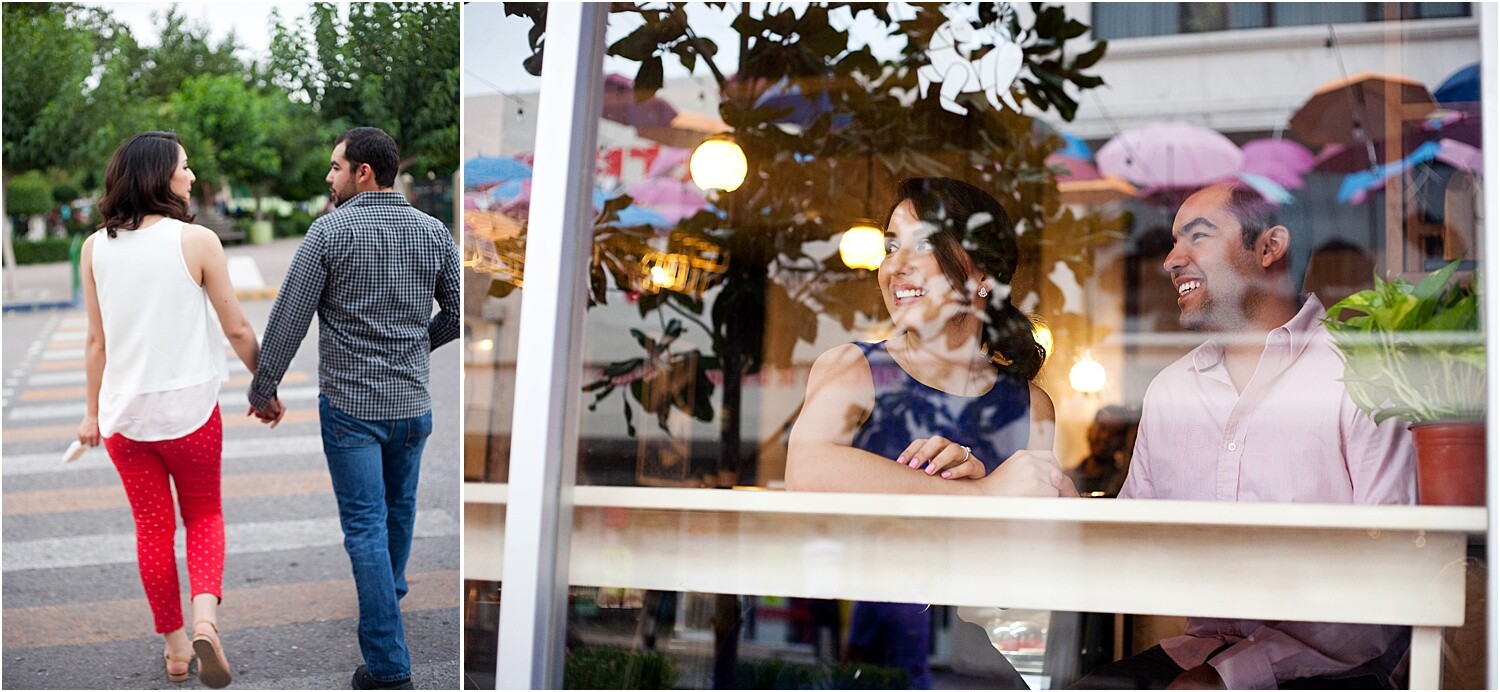
Starting with action poses can be more comfortable for a couple that is not necessarily big on kissing or being affectionate. If you’re in a location where there are activities, like an amusement park or coffee shop, have the couple do what they usually would if you weren’t around. This could be playing games, getting a coffee, enjoying some music together, walking, dancing, and talking.

12 - Guide to the Best Poses for Engagement Photos

You can also have the couple walk toward the camera while you’re out photographing the engagement session. Have them walk two or three times as you get different focal lengths and angles. Ask the couple to talk with each other or smile at one another because this looks more natural as they are walking.

Facing away from the camera

Having the couple face away from the camera can create more interesting photographs and keep the mood more romantic resulting in less posed and more natural looking photographs.

13 - Guide to the Best Poses for Engagement Photos

For one pose, have the couple stand at a distance facing away from the camera. Have the couple take one step forward and hold it as if they were walking. Have one person look back toward the camera and the other person looking down or to the side. You could have them do this as the couple is walking away from the camera. Just make sure that there is nothing in the way that could provoke a fall.

14 - Guide to the Best Poses for Engagement Photos

Another pose is having the couple face away from the camera but gets in close to each other. Here they can look at one another, hold hands, or kiss the forehead all while you are photographing from behind. Try getting the couple from a high angle, so it looks like you’re looking down at them.

Allow poses to develop naturally

While you set foundation poses and build different variations, allow the poses to develop into their own naturally. What I mean by this is that let the couple take charge in some of the poses with the kissing and getting close. Allowing for the couple to feel like they can move around within a pose can create more authentic and romantic expressions.

15 - Guide to the Best Poses for Engagement Photos

Couples feel most uncomfortable when they can’t be themselves, so during the session let them know that they are free to move and enjoy the moment. You are there to capture their love and excitement for their wedding day.

Once they have this liberty to move about in a pose, you’ll get real emotions and might even progress naturally through poses you may have thought of doing anyway!

16 - Guide to the Best Poses for Engagement Photos

Make sure to go with the vibe of the couple

Some couples aren’t romantic types and feel silly or uncomfortable doing lots of kissy or huggy shots. Try and get a feel for how the couple is. Are they playful? Active? Romantic? If after a few silly poses, you find that the couple is more on the romantic side, go for those types of poses.

17 - Guide to the Best Poses for Engagement Photos

Here are some ideas for each type of couple:

Romantic: Go with poses where the couple is close to each other. Either facing each other or hugging. Lots of closed eyes and enjoying the quiet moments of love between them. Try and photograph with a longer lens to give them space to be intimate with one another. Have them say something they love about one another while you photograph their reactions.

Fun/silly: Here you can get the couple talking and being overall silly. Try and get them to dance, tell jokes or play around at the location of the session. For example, having the couple make silly faces at one another or have one person tell a joke and get the reaction of the other person. Pose them with a little distance while holding hands to create a connection but not too close to where they feel uncomfortable having their photo taken so intimately.

Active: This couple will appreciate a good walk or even run! Have them jump, dance, climb, or even have one person piggy-back on the other! This couple is fun and needs to move around to keep them active by having them move around.

Not all of the poses have to be active if the couple is active, or romantic if the couple is the romantic type. Usually, after the first half hour, the couple has lost their nervousness and are more open to other poses. Just make sure that you keep an eye out for their natural personalities and go along with that vibe.

18 - Guide to the Best Poses for Engagement Photos

Being a little intuitive to the personality of the couple helps you create more authentic photos that they will love. An important note to remember is that some couples will be easy to pose, and others will need more direction.

In any case, let the couples know that they can move around and to not worry about holding poses for too long. Remind them to enjoy the moments and do what feels natural to them as a couple. This helps to calm nerves, and you’ll get much more real expressions than forced ones.

19 - Guide to the Best Poses for Engagement Photos

In conclusion

The best poses for engagement sessions are where you set a foundation pose and then build upon that depending on the vibe of your clients. Aim to give them a real and fun experience and document their personalities during the session. Pose them but let them feel free to move around and be themselves. They will have a great time and love their photos after!

The post Your Guide to the Best Poses for Engagement Photos appeared first on Digital Photography School. It was authored by Jackie Lamas.


Digital Photography School

 
Comments Off on Your Guide to the Best Poses for Engagement Photos

Posted in Photography


Best Vlogging Cameras for 2019

13 Feb

The post Best Vlogging Cameras for 2019 appeared first on Digital Photography School. It was authored by Suzi Pratt.

What’s the best vlogging camera for 2019? That’s a tough question to answer given the wide variety of cameras on the market. In this article, I’ll talk about traditional vlogging camera rigs. I’ll also introduce three non-traditional cameras that also serve as modern vlogging options. Which is the best for you? Read on for some ideas, and let me know your thoughts in the comments below!

best vlogging camera

Traditional vlogging cameras

Before we go any further, let’s define vlogging as a video blog. The traditional way to film a vlog is to point the camera at oneself, while also inserting B-roll (supplemental footage). Thus, most modern vloggers need a camera that allows them to film themselves, and also gather alternative shots.

Popular vloggers such as Casey Neistat and Peter McKinnon use traditional vlogging tools: a DSLR camera with a wide angle lens and shotgun mic, all attached to a Gorilla Pod. This is a tried and true vlogging rig, but it can also be modernized or made simpler by switching out the camera. Mirrorless cameras such as the Panasonic GH5 and Sony a6400 offer a slightly smaller footprint while also giving you a flip screen to monitor yourself. Or you can opt for even smaller point and shoot cameras such as the ever-popular Canon G7X or Sony RX100.

Modern vlogging cameras

While the traditional vlogging cameras mentioned above are still ubiquitous among vloggers, there are newer, more modern cameras worth considering. Here are three fairly new cameras that might fit the role as best vlogging camera of 2019.

GoPro Hero 7 Black Review

Contender #1: GoPro Hero 7 Black

GoPros are traditionally known as action cameras. However, many people use GoPros for everyday usage, including vlogging. This actually makes a lot of sense given GoPro’s tiny footprint, and its wide-angle lens that is perfect for capturing the first-person perspective. The brand new GoPro Hero 7 Black also adds several new features that work in a vlogger’s favor.

HyperSmooth and Timewarp

First, HyperSmooth. GoPro claims gimbal-like stabilization when HyperSmooth is in use, and it’s hard to argue. When shooting in HyperSmooth, bumpy footage is nearly completely eliminated. This means you can walk, run, drive, or perform just about any movement and get buttery smooth video. You can also shoot at up to 4K 60 frames-per-second with HyperSmooth enabled. Second, Timewarp. This is basically a timelapse video with HyperSmooth applied, resulting in a stabilized moving timelapse. It’s perfect for shooting B-roll and transitional scenes for a vlog or video.

GoPro Hero 7 Black Review

Vastly Improved Sound

GoPros have always had atrocious sound quality. For a long time, this was due to the fact that GoPros had to be put into a plastic cage to become waterproof. All of this changed with the Hero 5, which was the first GoPro camera to be waterproof without the cage. The Hero 7 Black is also waterproof without a cage, and it adds much-improved sound. There are now 3 microphones dispersed throughout the camera, and they do a pretty good job at picking up voices. The Hero 7 Black is still without a built-in microphone jack, but if you really need one, GoPro sells a (rather ridiculous and expensive) mic jack adapter.

Contender #2: DJI Osmo Pocket

Brand new to the camera world is the DJI Osmo Pocket. Made by the same manufacturers of DJI drones, the Osmo Pocket employs nearly the same camera found on the Mavic Pro drone. The camera has just a 1/2.3-inch sensor with a f/2.0 aperture. It can shoot at up to 4K/60fps at 100 Mbps. It can even shoot 12-megapixel photos. Best of all, the camera comes mounted on a 3-axis gimbal so that you can record buttery smooth footage.

There are a host of other features worth mentioning about the Osmo Pocket. But two features in particular that relate to vlogging are FPV and Active Track. FPV allows you to quickly reorient the camera to face yourself, while Active Track is intelligent in-camera tracking. Both of these features are incredibly handy for vlogging. And just in case the Osmo Pocket screen is too small for you, you can also plug in your phone for a much bigger touchscreen interface.

best vlogging camera DJI Osmo Pocket

Two Downsides

There are two major downsides to the Osmo Pocket as they relate to vlogging. The first is that the built-in sound quality is bad. No matter what side of the camera you’re on, it doesn’t pick up voices very well, especially if you’re filming in a noisy area. Currently, there are also no adapters or ways to install a microphone to enhance the sound. The second downside is the Osmo Pocket’s fixed 24mm camera lens. While 24mm is great for taking more cinematic footage without distortion, it’s not the best focal length for vlogging. You have to hold your arm out pretty far to get yourself in the frame, and even further if you have a buddy.

Contender #3: Modern Smartphone

A third camera to consider using to vlog is any modern day smartphone. Phones today are jam-packed with impressive camera specs with both front and rear-facing cameras. Many phones such as flagship Apple and Samsung phones also have in-camera stabilization, and the ability to shoot 4K video. They also have superior built-in sound since they are still phones, after all. You can also purchase a few accessories to take your smartphone photography and videography a step further. Investing in a smartphone gimbal gives you added stability, while Moment lenses increase image sharpness and offer wider angles.

The only real downside to using your phone to vlog is that you can’t use your phone to do other tasks while filming. Smartphone videos can also take up tremendous space on your phone, eating into your storage.

best moment lens for smartphone review

In Conclusion

So what is the best vlogging camera? It comes down to your shooting preferences. Personally, I find myself oscillating between the GoPro Hero 7 Black and my Samsung Galaxy S8 with a fisheye Moment Lens. These two cameras are so compact and easy to take anywhere, and they have been great for spontaneous vlogging.

If you’re looking for the best vlogging camera in 2019 and beyond, the good news is that you have lots of options. You can opt for tried and true DSLR or point-and-shoot rigs. Or you can look at modern, super compact options such as the GoPro Hero 7 Black or DJI Osmo Pocket. Or you can use the camera you have on you – a modern-day smartphone – and buy a few extra accessories to make your phone a pretty awesome vlogging rig. The choice is yours!


?

You may also find this articles helpful:

Essential Tools for Making Videos on Your Mirrorless Camera

Equipment List for Making Better Smartphone Videos

The post Best Vlogging Cameras for 2019 appeared first on Digital Photography School. It was authored by Suzi Pratt.


Digital Photography School

 
Comments Off on Best Vlogging Cameras for 2019

Posted in Photography