RSS
 

Posts Tagged ‘being’

5,000 Residents Being Evicted from World’s Tallest Vertical Slum

29 Jul

[ By WebUrbanist in Architecture & Cities & Urbanism. ]

tower david shelf wall

A forced relocation is underway as thousands of squatters are moved by authorities out of their homes and the city of Caracas, some of whom have called the infamous half-finished Tower of David home for as long as seven years.

tower of david view above

Rumors began a few weeks back as Chinese bankers expressed interest in purchasing the unfinished structure in Venezuela, with the intention of turning it back toward the (official and licensed) commercial and office uses for which it was originally intended. Currently, however, over 1,000 families live and work in the first few dozen floors of this 44-story skyscraper.

tower of david ground floor

With surprising speed over the past week, the government has already shifted over 100 of these to a settlement outside of town (three floors a time) and is set to displace everyone living in the building, primarily to Valles del Tuy in the state of Miranda.
tower david tall pic

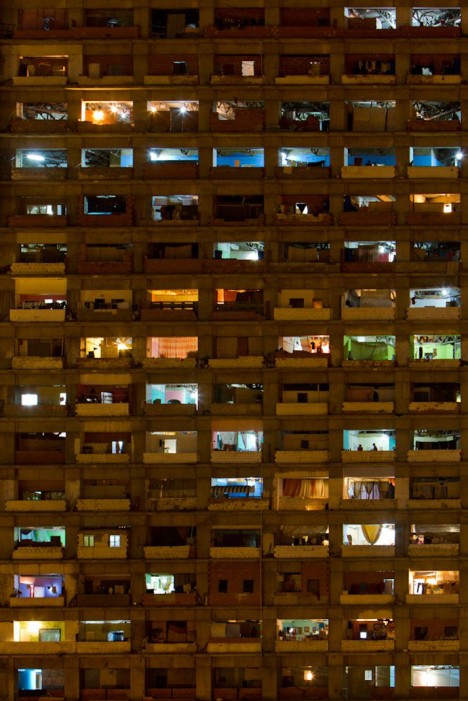
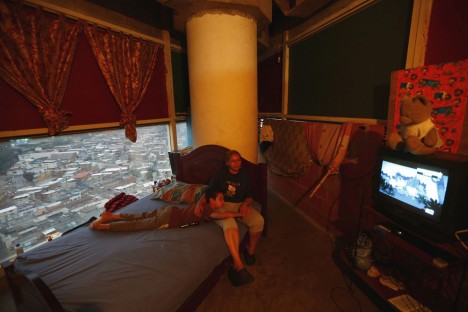
The tower was originally abandoned mid-construction in 1990 and eventually taken over by informal inhabitants who created not just homes but stores, offices, gyms, groceries, tailors, factories, churches tattoo parlors and even internet cafes within its walls.
tower of david room tv

Without an elevator (and with missing windows on the top levels), its most prized spaces for occupants have been on the lower floors, with scooter taxis that ferry people up ramps to some levels adjacent to the parking structure. Like Kowloon Walled City, the place has its own rules and informal systems of bringing in and sharing resources, including limited water and power.

tower of david exterior view

The Urban Think Tank, which spent years studying the building (and writing Torre David: Informal Vertical Communities), has weighed in on the significance of the building and its occupants as well as its sudden shift in direction: “What we found was neither a den of criminality nor a romantic utopia. Torre David is a building that has the complexity of a city. It merges formal structure and informal adaptation to provide urgently needed solutions, and shows us how bottom-up resourcefulness has the ability to address prevailing urban scarcities.”

More from UTT: “When dealing with informal settlements, infusions of money for major public works and other approaches that involve large-scale rapid change – such as the razing of slums and relocation of poor populations – have generally failed in the complex setting of the city. The commercial housing market simply does not supply enough homes. There are too few units of social housing, and the majority of these are far beyond the reach of low-income families.”

“The dire asymmetries of capital in the global south do little to help; yet various forms of structural neglect have not always diminished great entrepreneurial vigor. Shunned by governments and the formal private sector, city dwellers, like those in Torre David, have devised and employed tactics to improvise shelter and housing.” Images via The Atlantic and Torre David: Informal Vertical Communities.

Share on Facebook


[ By WebUrbanist in Architecture & Cities & Urbanism. ]

[ WebUrbanist | Archives | Galleries | Privacy | TOS ]


WebUrbanist

 
Comments Off on 5,000 Residents Being Evicted from World’s Tallest Vertical Slum

Posted in Creativity


Three Tips for Being Ready to Shoot Faster so you Never Miss a Shot

11 Jul

We’ve all heard one of the cornerstones of making better photographs is to slow down; be deliberate and take your time. This is very true. In no way am I advocating not being purposeful in your shooting. However, sometimes there are situations when the difference between getting a good image, instead of a blurred and washed out frame, is separated by only a few precious seconds. This is especially true when it comes to working in action filled situations like sports or street photography, but it can also be just as easy to miss moments in nature and landscape photography if you go into situations ill prepared.

Here are three tips that can improve your reaction time and make you more ready to obtain quality images for processing when you find yourself in those “shoot from the hip” scenarios.

Being Ready to Shoot Faster – Never Miss a Shot

Be Self Aware

Knowbeforeyougo

“Know thyself.” No, Socrates wasn’t a photographer (though I’m sure he would have been awesome). In this case, the saying of “know thyself” means becoming aware of your surroundings more so than having a deep introspective understanding of your own self, although that’s a good thing to have, usually. We exercise this on a daily basis, albeit almost unconsciously. You notice a stain on your shirt, or you see the little boy chasing a ball towards the street, or you see a dark alley that’s just a little too dark to walk down alone. You can incorporate this same inherent awareness into your photography to make you a faster shooter.

Here’s an example: Let’s say you find yourself taking an afternoon to work on your street photography. When you first begin your expedition, it’s very bright outside. You are probably still able to shoot at a reasonably fast shutter speed and low ISO. As the evening starts giving way to night, there is of course less available light. So, a good idea would be to begin thinking about bumping up your ISO so that you can maintain the same exposure settings. Or alternatively, slowing down your shutter speed or increasing the size of your aperture (remember, low F-number means a bigger opening and more light into the lens such as f/2.8). Keep in mind however, that a higher ISO will introduce more noise into your final image, but it will have less of an overall impact than changing the shutter and aperture settings.

In photography, your surroundings are in a state of constant flux. So, to be a good photographer, you must be aware of the changes in your surroundings and mould yourself the best you can in order to produce consistent and quality work. This means learning to understand what is happening around you, whether it be: changing lighting conditions, approaching weather, wind, the presence or absence of people and objects, – the list goes on indefinitely. Anticipate what is going to happen next and make adjustments now, to save time later.

Shoot Comfortably

This would seem to go without saying, but you still see many photographers looking down right uncomfortable or awkward while they’re out shooting. Sadly, the majority of the pain is self-inflicted. To shoot faster and to be ready for the shot when the time is right, your camera must be available for use at a moments notice without restricting your movement or causing discomfort. One of the best ways to make this happen is to have your camera suspended from a quality camera strap. Camera straps, like most things, can become a very personal item for new and seasoned photographers alike. Don’t buy a strap because its got pretty flowers embroidered on it or because its made from the latest space age whatever-foam. Do a quick search for “camera strap” here on dPS and you will find a large number of reviews and write-ups of great camera straps. But don’t stop there. Shop around, read reviews, ask your photographer friends and sift camera forums. Being able to comfortably retrieve your camera quickly is key to not missing great images.

Have a budget? Most of us do, even more of us can’t afford to spend thousands on the latest lens or camera body that we dream of owning. Luckily, the majority of the accessory market is crammed with makers competing to sell you their wares. It’s easier than ever to strike a balance between what you need and what you can afford. If you can, have more than one camera strap in your kit so you can choose what fits best for a particular outing.

Badstrap

Prepare Beforehand

This is the big one, yet many people don’t seem to understand that preparation is golden. A close cousin to situational awareness, research and preparation prior to any photo work should become second nature and will pay huge dividends. It will also make you a faster shooter and help to prioritize your workflow, not to mention make you appear more competent as a photographer.

Preparedness

Know what you’re walking into beforehand and prepare accordingly. Are you going on a hike? Find out what wildlife and plants are native to the area and pack your bag with long lenses so you can get close to your subjects from a distance. Travelling abroad? Be sure to read up on the local attitudes towards photography before you start snapping away to avoid any awkward confrontations or worse. Of course, the most unpopular, but useful, aspect of being well prepared is practice, practice, pactice. Practice, and then practice some more. Want faster and more smoother lens changes? Practice at home, so you lose less time in the field and have fewer fumbles. Practice finding your camera adjustment buttons without looking. This will save you loads of time and frustration when you find yourself shooting at night. If you haven’t figured it out by now, the key word here is practice. Practice everything and you will be amazed at how much easier quicker most things suddenly become.

Do you have any other tips for shooting faster and being ready? Please share them in the comments below.

The post Three Tips for Being Ready to Shoot Faster so you Never Miss a Shot by Adam Welch appeared first on Digital Photography School.


Digital Photography School

 
Comments Off on Three Tips for Being Ready to Shoot Faster so you Never Miss a Shot

Posted in Photography


Being Madame Butterfly With Tina Wong

16 Jun

Tina Wong shares her latest work from her photo series "Madame Butterfly" as featured on Fashion Photography Blog (FashionPhotographyBlog.com)FashionPhotographyBlog.com was able to catch up with another of our past Photo of The Week winners, the fashion photographer, stylist and fashion editor, the triple threat talent that is Tina Wong. I was so glad to have her drop in to catch up and see what she has been up to since taking the winning photo from her “J’adore” series in her round of Photo of The Week.

It seemed that Tina had been making great strides with her career, as she revealed that, “There have been so many great experiences. The past few seasons I’ve been able to shoot at New York Fashion week, working on the 100-women print publication was a great experience as the photos were printed in a coffee table type magazine, I’ve been able to shoot for amazing clients in Miami and photos were used for large print advertisements.”

With all her successful achievements to date, where is Tina now at as a photographer? She shared that she has been “Shooting Fashion for 7 years now and I still have a way to go! I feel like with the saturated market for fashion photography, not only do you have to have talent and work very hard to master your craft but you need to know how to market yourself and get exposure with the various publications and clients. I work with a lot of smaller commercial clients and magazine editorials but feel like it’s time to take the next step but it will take proactive actions from my part to get there.”

So what has the difference been between shooting her winning photo and how she shoots now? Tina explained that “I feel like my style has matured through the years and my unique voice is emerging. It’s gone from bright lifestyle-like commercial photography to a quieter more romantic one. I call it quiet beautiful, when you look at someone and you try to admire them like a flower in a vase in an empty room, and then you see an unshielded unfiltered beauty. I know my equipment more and I know how to control my lighting more as well which is something that comes with time.”

Speaking of lighting, I asked if there has been any change to how the photographer set up her lights since taking her winning photo, Tina nodded and explained that “I think I’ve become a minimalist. I used to try more than 1 Profoto head to light the model and create different effects but I’m starting to like just 1 head or natural light with a reflector.”

While discussing her lighting preferences nowadays, Tina also shared with me one of her recent works from a series entitled “Madame Butterfly”. A truly beautifully crafted photograph, I was intrigued to uncover the story behind it. The photographer explained that the “Inspiration behind the butterfly photo was to try to capture how a rose looks like when a butterfly is on it… still and beautiful. I wanted a darker edgier undertone, not just pretty butterflies. Some of the photos on the series almost had her smoking a butterfly like a cigarette, also, I used the butterflies as her brows and whited out her entire face to create a more ghastly and eerie feel to it.” To shoot this photo the photographer used 1 Profoto head (Profoto Prohead Plus), a 5ft Octobox, 2 foam cores.

You can find out more about this shoot and contact Tina Wong’s via her website (www.tnastudios.com) or email at photography@tnastudios.com


Fashion Photography Blog

 
Comments Off on Being Madame Butterfly With Tina Wong

Posted in Uncategorized


Being Too Beautiful With Nicole Luneburg

28 May

Photographer Nicole Luneburg interviews with Fashion Photography Blog (FashionPhotographyBlog.com)

FashionPhotographyBlog.com was able to catch up with another of our past Photo of The Week winners, Australia-based photographer, Nicole Luneburg. We were curious to discover what she has been up to since taking the photo that won her the title of photo of the week and we were delighted to hear about her more recent work.

I asked Nicole where in her photography journey does she think she is at now, she kindly told that “It has taken a few years with many up and down periods.  I’ve finally reached a new place where I’m consistently able to produce quality work. I’m also able to access a larger amount of creative minded people and models who want to work with me. It’s a great feeling! I’m looking forward to seeing where this year and the future will take me!”

Photographer Nicole Luneburg interviews with Fashion Photography Blog (FashionPhotographyBlog.com)

How has her photography changed since taking “Pretty In Pink”, the photo that won her Photo Of the Week, I was curious to ask. I wanted to know what is different now in the way that she shoots, she revealed that, she has evolved as a photographer since ”I used to put a lot of pressure on myself. Now I accept the things I cannot control on the day of the shoot, I’m able to adapt much better now. No that’s a little lie I still put pressure on myself ;). I focus less now on the technical side of photography and try to capture and post process to create what I love in the first place, creating what my mind sees.”

Photographer Nicole Luneburg interviews with Fashion Photography Blog (FashionPhotographyBlog.com)

In regards to shoots that Nicole shot recently, she shared with us some of her stories. She told us that “I did a nude shoot with model Amy Heather and makeup artist Ali Stewart was inspired by amazing artists Julie Bell and Boris Vallejo. I wanted an emoting image that showed the realization of a woman’s own feminine beauty, absolutely free and without shame. I specifically picked a model who I knew would be able to realize this image for me perfectly.

Another recent shoot with black and white images of a blonde with a cigarette and a Minolta X-300 was with model Olivia Meehl and makeup artist Mel Philippou. I was inspired by the style of Priscilla Presley and Lana Del Rey combined. I modernized it a bit and applied my style to it with a sense of the scene being a movie still. It was a very exciting thing for me to do. “

Photographer Nicole Luneburg interviews with Fashion Photography Blog (FashionPhotographyBlog.com)

To shoot these shoots and for her more recent work, Nicole explained that “A large amount of my work was taken with the Canon 350D and a Canon 50mm lens. In the past 2 years, I’ve been using the Canon 5D Mark II and the lenses I use are predominantly the Canon 135mm and Canon 50mm. I also use a Canon 580 EX II through various light diffusers.”

Nicole continues to detail that the change in photography equipment also meant a change in the way she approaches lighting, “I shoot with a Canon 580 EX II usually through a soft box or a beauty dish. More recently I have been getting into natural light. It’s something I like to do when I want to focus back into my zone – just me and the model, no one else, no lighting. Once I’m back in touch with what I feel is the pureness of what I love to do, I am able to continue again with the various forms.

So after all the shoots she has done over the year, what has been Nicole’s top accomplishment to date you might ask? Well, the photographer says that it would have to be her portfolio, “I think my greatest achievement is having a body of work that people can see and allows them to put a lot of trust in me to photograph for them. I’m very proud of this as it means the hard work and effort I and my team mates have put into my work has opened up a lot of creative opportunities for me.”

Photographer Nicole Luneburg interviews with Fashion Photography Blog (FashionPhotographyBlog.com)

To find out more about Nicole Lüneburg and her work, you can visit her website: http://www.nicoleluneburg.com or via her Facebook page “Nicole Lüneburg Photography

Photo Credits:

Photographer – Nicole Luneburg

Pictures 1 & 2: Justin @ The Couturist (designer), Anita Rutter (MUA), Lauren Frensham (model) & Mark Boros (BTS)

Picture 3: Shannen Buckland (model)

Do you like Nicole’s new work now compared to her previous entry? Please comment below.


Fashion Photography Blog

 
Comments Off on Being Too Beautiful With Nicole Luneburg

Posted in Uncategorized


Waterproof camera returns to owner after being lost at sea

04 Apr

Lost-camera.jpg

An Olympus camera lost by a Finnish diver on a trip in Thailand has made its way back to its owner. Reported by the travel site Sail In Finland, in January the Finnish diver’s tethered camera floated away after some rough weather. The point-and-shoot was found the next day by Krzysztof Torzynski, a Polish diver from Denmark who was in the same waters. He then used photos on the camera to look for the owner. Learn more

News: Digital Photography Review (dpreview.com)

 
Comments Off on Waterproof camera returns to owner after being lost at sea

Posted in Uncategorized


28 October, 2013 – The Master Never Stops Being The Student

28 Oct

Following Michael’s bemoaning the banality of this year’s PhotoPlus Expo in New York City, Nick Devlin writes that he attended the show, and can’t disagree that this was a slow year for new bling. But in a corridor of meeting rooms below the gear-porn, the art of photography was alive and well. 


  WIN AN ANTARCTIC EXPEDITION
WORTH USD $ 15,000 


The Luminous Landscape – What’s New

 
Comments Off on 28 October, 2013 – The Master Never Stops Being The Student

Posted in News


When to Stop Being a Photographer and Start Being a Photo Editor

03 Sep

At some point, every photo shoot comes to an end.  Every portrait session, cookbook shoot, family vacation, ad campaign, college graduation, wedding, and photo essay eventually gets to the point when it’s time to put the camera down and see what you’ve got.  Congratulations–  You’ve just become a photo editor.  To be clear, I’m not talking about correction or manipulation in Lightroom, Photoshop or any of the other image editing software packages available.  I’m talking about the task of sitting down with the 367 images that you’ve just downloaded and being able to look at your own work with an objective, critical eye, and whittle them down to your best work.  Truthfully, this is one of those benchmark qualities that defines the term “professional photographer.”  Some people define the term based on the gear, while others base it on whether you are paid for your photography (and if so, how much).  For me, I define it in large part based on the photographer’s ability to at least temporarily sever their emotional tie to the work and realize that they shouldn’t be uploading ten images of the same sunset to their Flickr or 500px accounts simply because the angle is ever so slightly different in each.

I first learned this lesson several years ago when I started out as a second shooter for a high-end wedding photographer.  I showed up at the studio one Monday morning after a big weekend wedding, all excited to help with The Culling.  The preliminary critique the night of the wedding had been very positive, so I was feeling good.  Until we started going through the images.  “You’re deleting THAT one?  Seriously?  Wait a minute– what was wrong with THAT one!?!”  By the time we were done I was seriously questioning my new career choice.  My boss tried explaining that when the bride started going through the proofs she was going to get overwhelmed (and not in the good way) by having so many similar photos, that picking her favorites and placing an order would be an insurmountable task.  There wasn’t enough that was different about them.

As much as I didn’t want to admit it, he was right.  I hate it when that happens.

The bottom line was that the bride really didn’t need five 3/4 portraits with varying degrees of tilt when two– MAYBE three– would more than suffice.  The point of the lesson was learning to edit yourself by thinking like a client.  It’s a lesson I’ve tried carrying with me on every assignment since.  Think about it like this– have you ever had to sit through a three-hour marathon session of being forced to look at each and every photo your best friend took on their summer vacation?  Of course you have.  We’ve all been there.  How much better would it have been if they had edited themselves down to their twenty best?  See where I’m going with this?

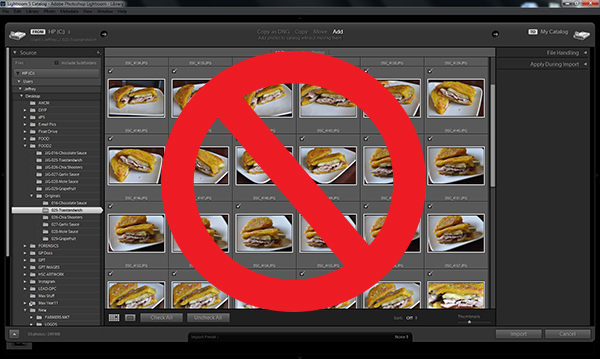
This was a Lightroom import from last week while I was shooting the last four dishes of the thirty I’d been commissioned to shoot for an upcoming cookbook.  I seriously overshot this one.  The screen capture only shows 24 of the 39 frames I shot of a sandwich.  Thirty-nine frames of a sandwich!  Not only do I not want the client to have to go through that many images to select the one that will go in the book, I don’t want them knowing that it took me 39 frames to take a picture of a sandwich!  Knowing how to edit yourself is crucial.  Unfortunately, not enough photographers learn how to do it well.

Editing-001-copy

The rule of thumb here is not to only show your best.  It’s to show the best of your best.  If I’ve taken 100 photos, chances are that maybe 50 go in the “selects” folder.  Of those 50, maybe 30 are really good.  Keep cutting your numbers in half as you move from “really good” to “THAT’S what I’m talking about!”  If I’m your client, I’ve already spent considerable time and money in hiring you.  I know you’re good.  Show me just how good you are by not wasting my time and showing me your best.  As soon as you can take your own emotions out of the equation you’ll be thinking like a photo editor and will be much better prepared to present only your best work, whether the client is a bride, a band, or a book publisher.  (As a side note, the same advice applies to entering photography competitions.  Think like the judge, not the photographer).

I see some you nodding your heads, but some of you are still skeptical.  “I got up at 3:00 in the morning to get to the location and set up just in time to see the sun come up over the crest of the mountain…”  Stop right there.  Rule #1 of critique with my photography students is “No talking once your photo is up on the screen.  The old cliche that every picture tells a story is true, but you need to let the picture tell it.  I don’t care about how difficult it was to get the shot or that you were happy/depressed/angry/indifferent when you took it.  While the result always matters,  you can’t necessarily say the same for the back story.  Save the stories for when you write your book some day.  For now, the work needs to speak for itself.

Learning to edit yourself pays dividends across the board.  If you are a professional photographer, your clients will appreciate both your quality and professionalism.  Professionals, hobbyists, and enthusiasts can not only get better at selecting the cream of the crop, but can also eventually start mentally editing themselves before they even push a shutter button.  Digital has made it easier than ever to walk away from a shoot with several hundred images.  That’s great, I suppose, but why create so much extra work for yourself?  Learn to think like a photo editor and all that extra work goes away.


Post originally from: Digital Photography Tips.

Check out our more Photography Tips at Photography Tips for Beginners, Portrait Photography Tips and Wedding Photography Tips.

When to Stop Being a Photographer and Start Being a Photo Editor


Digital Photography School

 
Comments Off on When to Stop Being a Photographer and Start Being a Photo Editor

Posted in Photography


Grow Your Photography Business By Growing As A Human Being

07 Nov

Most articles which talk about improving your photography business will tell you about how to become a better photographer. Some will tell you about the need to improve your business skills. Sure, those are important. But I think they’re missing something. And it’s ironic that they’re missing the most obvious and most important part of your business – you. You Continue Reading
Photodoto

 
Comments Off on Grow Your Photography Business By Growing As A Human Being

Posted in Photography


Being Creative and Getting the Shot

04 Nov

In this fun and informative seminar fashion photographer Frank Doorhof shows you some simple tips and tricks that can make your images speak. Frank’s Website www.frankdoorhof.com
Video Rating: 4 / 5

 
Comments Off on Being Creative and Getting the Shot

Posted in Photography Videos


Being on Time – Enhancing Intercultural Dialogue

29 Oct

The video is a sample from training material about ‘Diversity in the European Workplace’ produced by the European Intercultural Workplace Project (www.eiworkplace.net). The right for uploading this sample has been granted by the EIW consortium member pro-kompetenz (www.pro-kompetenz.de). The video is used as illustrative material for the module “Intercultural and Foreign Language Competencies for Innovation” available at www.innosupport.net.
Video Rating: 4 / 5

Use Photoshop CS4 to brighten and enhance eye color and depth, even out skin tone, and make a distracting background more harmonious!

 
Comments Off on Being on Time – Enhancing Intercultural Dialogue

Posted in Retouching in Photoshop