RSS
 

Archive for July, 2019

5 Must-Know Photoshop Tricks For Photographers

18 Jul

For every photographer, it is a dream to get everything right in the camera. However, it is not possible every time, you cannot always get your shots right. Sometimes, magnificent moments happen in a flash. In such cases, you cannot meticulously adjust your camera setting and look for the perfect lighting to get the perfect picture. For example, if you Continue Reading

The post 5 Must-Know Photoshop Tricks For Photographers appeared first on Photodoto.


Photodoto

 
Comments Off on 5 Must-Know Photoshop Tricks For Photographers

Posted in Photography


6 Great Lightroom Tricks You Probably Didn’t Know About

18 Jul

The post 6 Great Lightroom Tricks You Probably Didn’t Know About appeared first on Digital Photography School. It was authored by Kav Dadfar.

Adobe Lightroom is an essential tool for any photographer. Whether you are a professional or amateur, Lightroom can make your workflow faster and more efficient. But there are also a whole host of editing tools available. Some of which you may not even know existed. So here are 6 great lightroom tricks that you probably didn’t know about.

Crop overlay options

Cropping your photos can sometimes mean the difference between a good photo and a great one. You can access the Lightroom crop tool by pressing R on your keyboard in the Develop module. Perhaps you already knew that, but what you may not have known is that when your cropping tool is open, you can change the overlay that shows on your image.

By pressing “O,” you will be able to get a whole host of different overlays on the image to help you crop effectively. Everything from the “Rule of Thirds” to the “Fibonacci Rule” can be accessed to help turn an okay photo into a great one.

Lights Off Mode

Sometimes when you are editing a photo, it is easy to get distracted by all of the side panels and options available. A great way to really see your photo is by looking at it in the “Lights Out” mode. By pressing the “L” key once on your keyboard, everything dims except your image. Pressing it one more time, you will see just the image on a black background without the distracting side panels. Press it a third time to make the side panels re-appear.

Great-Lightroom-Tricks-You-Probably-Didnt-Know-About-2

Full-Screen Mode

Another useful trick, especially when working on smaller screens such as laptops, is to view your image at full screen. Because of the screen size, naturally the actual photo you are working on looks pretty small on a laptop screen.

To get a better view hit “F” on your keyboard and you’ll get to see the image as big as possible on the screen.

To come out of full-screen mode press Esc on your keyboard.

Know if your image is clipped

One of the key elements of taking a photo or post-processing it is to ensure that your highlights and shadows are not overexposed or underexposed to the point where there is no detail in those areas. This is a term that is known as clipping.

It can be difficult to judge by eye if any areas of your photo suffer from this. Thankfully, Lightroom’s clever tool can make it much easier to see where this occurs.

Click the little triangles on the corners of your histogram, and if there are clipped areas in your photo, they will show in red for highlights and blue for shadows. You can then tweak the different sliders to correct these issues. You can also access the clipping highlights by pressing “J” whilst in the Develop module.

Great-Lightroom-Tricks-You-Probably-Didnt-Know-About-3

Please note that on older versions of Lightroom these sliders might be different.

Pick and organise

I have over 100,000 photos in my collection. They are for a variety of assignments and clients, and they need organizing in a way that makes it easy for me to access them. One of the most useful aspects of Lightroom is being able to organize and flag your photos effectively. The three easy ways to organize your photos are 1) flagging them (i.e., putting a flag on the ones you want to), 2) adding 1 to 5 stars, 3) color-coding them in red, yellow, green, blue and purple.

You can access these by using the following shortcuts:

  • “P” flags a photo (to unflag a photo press “U”). You can also reject a photo by pressing “X”
  • Add stars by using the relevant number key between 1 – 5 (press zero to remove stars)
  • Color code your image by pressing 6 – 9

How you use these ultimately depends on your workflow. However, for example, you may decide to utilize the colors like a traffic light system (i.e., Green for the ones that you love, yellow for the okay ones and red for rejects). Alternatively, you may simply star the ones you really like with 5 stars. The choice is yours.

Speed up your editing

Often whenever you are at a location, you will take multiple photos. Sometimes you may even take a set of photos from the same scene. When it comes to editing them, it wouldn’t be very efficient to edit each one individually as the light and conditions won’t change much in a few seconds. Lightroom has a couple of great options to help.

Whilst in the Develop module, if you click on the “Previous” button (at the bottom of the right-hand panel), Lightroom pastes the same settings as the last image you were on to the selected image.

If you select multiple images on the film strip in the Develop module, you’ll notice that the “Previous” button changes to “Sync.” Press this and whichever image is selected will be used as a basis to paste the adjustment from to all images you’ve selected.

Once you have clicked on “Sync,” you’ll get a pop up where you can select which settings you want to add. This is a great option when, for example, you shot a scene in burst mode where all the conditions are similar from one photo to the next. You can always make further adjustments to a photo if needed.

Great-Lightroom-Tricks-You-Probably-Didnt-Know-About-4

Conclusion

These are just some of the simple yet effective editing tools that you may not have known about in Lightroom. There is so much more Lightroom can do. If you learn how to use it, it will become an invaluable software in your workflow.

Don’t forget to let us know your great Lightroom tricks below.


great-lightroom-tricks

The post 6 Great Lightroom Tricks You Probably Didn’t Know About appeared first on Digital Photography School. It was authored by Kav Dadfar.


Digital Photography School

 
Comments Off on 6 Great Lightroom Tricks You Probably Didn’t Know About

Posted in Photography


Steps For Better Product Photography in Natural Light

18 Jul

The post Steps For Better Product Photography in Natural Light appeared first on Digital Photography School. It was authored by John McIntire.

Taking photos of products can seem like a daunting task. If you look at a lot of advertising, you will find yourself inundated with a lot of high-end product photography that can seem (and probably is) out of reach for a novice. The thing is, not all product photography is equal. In many cases, a much simpler approach will do the job just fine.

This article will guide you through a process that can get you started taking product photos with minimal equipment. In these examples, you don’t even need a studio, just a backyard, and decent weather. You will also see that you can replace some dedicated kit (reflectors and diffusers in this case) with some basic and cheap substitutes.

What you need

With one optional exception, you will only need some basic kit to go through the process outlined here.

Camera – There’s not much to say about this one. You will need a camera.

Lenses – To get the best results you will want to choose a lens with a close focusing distance (if your products are relatively small) and a focal length that will give you the option to fill the frame.

If the products that you are photographing are quite small, you may want to opt for a macro lens. Fast lenses aren’t much of a concern here as you will want to choose an aperture that ensures complete focus on all parts of your subject.

Tripod – Because this is still-life photography, you absolutely should use a tripod. The reason should become clear as this tutorial progresses, but it will make your life so much easier.

An outdoor space – As for the where, all you need to get started with this tutorial is an open outdoor space. Even a small backyard will do. Anywhere that will lend you a decent, clean background will do.

Tissue paper – In lieu of a dedicated diffuser, you can use tissue paper. For ease of use, you can mount this in a frame of some description with clips or a bit of tape. This allows you to control and manipulate the natural light in your photos. I did use a dedicated diffuser in this tutorial, but tissue paper will work just as well.

White and black card (foamcore works well) – Use these as reflectors and flags respectively to give you further control over the manipulation of the light.

Backgrounds (optional) – Using the environment as a background will be fine a lot of the time, but sometimes you may need something different.

Don’t want to rely on what’s there? Bring your own backgrounds, such as these purpose-made boards or use plain colored paper. The choices are endless.

Color Management – Depending on what you are photographing and whom you are creating product photography for, color management may be optional, or it may be a legal requirement.

Tools like the ColorChecker Passport are indispensable for getting accurate colors in your images.

Even if it’s not necessary for your situation, it’s still a good idea.  The word ‘product’ implies that you are selling something. Even if you’re only creating an eBay or Facebook Marketplace listing, ensure an accurate representation of what you are selling. It is a means of treating the people you are selling to with respect. If you’re providing commercial services to a paying client, then that accurate representation of the product may be a legal requirement. Do your research and find that out before you get started.

Note: While you can use tissue paper and foamcore to great effect, I still believe you should buy a 5-in-1 reflector or two. These give you access to white and silver reflectors, diffusers and flags. Godox sells one for $ 15, so there’s no excuse. You can also use 5-in-1 reflectors as a background in a pinch.

Getting started

With your gear collected, this process is relatively straightforward.

Step 1: Find a space

better-product-photography-5

Finding a space that gives you plenty of room to work and gives you a decent background may be the most important step in all of this.

As long as you are photographing small(ish) objects, where you choose to set up isn’t very important. Since the focus of your image is solely the product, other elements like the background won’t be taking up very much space in your frame in most cases. As long as you can find a space that gives you a clean background (or somewhere to place your own) and gives you plenty of room to work, you will be fine.

If you are working with small objects at a close distance to the camera, work with small apertures like f/16. If you want an out of focus background, you will want to ensure there is a good distance between your subject and the background.

Without going into the math, the closer your camera is to the subject, the shallower the depth of field becomes. When you are really close (especially with macro lenses), the focal plane reduces to a tiny sliver. To combat this, use small apertures.

In terms of lighting, as long as there is light, you will be fine. If you have all of the equipment listed at the top of this article, you will be able to manipulate the light in most situations.

Broad daylight? No problem. Shade? No problem. Any time of day will work except for the night where you would probably need to add an external light source of some description.

Step 2: Set up

better-product-photography-4

As this spot was lit by direct sunlight, I put the diffuser up before doing anything else.

Now that you are in your space, pick where you want to set up and decide where you are going to photograph your product. Place your camera on a tripod and ensure that you have a good idea of how you are going to frame your product.

You can now evaluate your lighting. If you’re in open daylight, setup the tissue paper as a diffuser over where your product is going to be. You can fine-tune this later, but any diffusion you may be using should be in place before you start anything else. Diffusion material is going to affect the color of your images. Having it in place allows you to see the light as it’s going to appear in your photos while you are working on your composition.

Step 3 – Color Management

better-product-photography-3

With the light diffused, take your steps towards color management. You want to do this before placing your subject to avoid moving it.

If you are opting to replicate accurate colors, do it now. Place your grey card (or whatever tool you’ve chosen) where your product will be under the exact lighting conditions that your final images will be created with. Take a photo of the card. If you’re setting the white balance in-camera, do it now. If you’re using a tool like the ColorChecker Passport shown in the example images, you can save it for the software later.

Step 4: Place your subject

Place your subject where you want it for your desired composition. Once that’s done, you can begin modifying the lighting. (This image is with the diffusion panel removed)

The next step is to place your product in situ for the composition that you want. Adjust the subject and the positioning of the camera until you have your desired effect. I find it is important to get this right at this stage. With this done, you are free to adjust everything else (such as the lighting) while being able to compare any test shots. It also allows you to blend multiple exposures later (providing it would be permissible to do so).

Step 5: Choose your aperture

better-product-photography-2

Details are essential when you are selling something. The image on the left is shot at f/4 and you will see many of the details are concealed by depth of field. In the right-hand image, all details are present, but the background is less obscured.

With products, most of the time, you will want to choose an aperture that provides maximum focus on the whole of the subject. Since the depth of field is most affected by the distance of the camera from the subject, small objects close to the camera (particularly with a macro lens) will lead you to use much smaller apertures than you might typically use in other situations. If you need to, take a few test shots at various aperture settings. Review the results until you have the desired effect. Depending on your camera, you may find the depth of field preview button useful here as well.

Shooting tethered is also a great way to be able to see if there is enough depth of field in your images.

Step 6: Evaluate the lighting

Here, the subject is lit with unmodified light. You can see that the contrast is high and there is missing detail in both the shadows and highlights.

With everything in place, you’re just about ready to go. Here is where you can fine-tune your lighting to your heart’s content.

Adding the diffuser above the subject helped to even out the exposure between the background and the subject. All details are now present.

Reflective

Use your white card(s) to fill in any shadows that may be providing too much contrast in your images. The beauty of using a card is you can cut it into any size and shape to match any need you have so that you are only reflecting where the extra light needs to be. For the most part, you are going to want to avoid heavy contrast in product photos, so feel free to use reflectors generously.

A bit of white mount board at camera left has filled in that side of the subject just a tiny amount. It makes the exposure evener.

Subtractive

In the event that there’s light falling on your subject where you don’t want it, use your black card as flags. For example, if the main source of light is coming from behind your subject, you can use a flag to shape that light so that it is only falling on your product where you want it. You can also use flags to darken areas around your subjects, such as the surface it is resting on, to put more emphasis on the product itself.

Introducing a flag to camera right has darkened that side of the subject. It has increased contrast just a bit and reduced the impact of the specular highlight on the droid’s head.

This step may seem optional, and to be fair, it pretty much is, but if you want your images to stand out, this is by far the most important step. The more attention to detail and effort you place into getting the lighting right, the better your photos are going to be.

It pains me to suggest that you could to move your camera at this point. However, as a last resort, if you’re having problems controlling the contrast in your images, you can set your camera to spot metering mode and evaluate where your reflectors need to be from there.

That said, if your light is suitably diffused, you shouldn’t have to resort to that. Alternatively, you could use a second body or a light meter if your subject is big enough.

Step 7: Final shot

better-product-photography-1

The final image with minimal post-processing.

With all of the prep work done, you can now take your final shot. If all has gone well, you should have a well-lit, well-exposed image in the composition of your choice. Going through all of these steps should also mean there is very little to do in terms of post-processing.

That’s it

Is this the only way to take photos of products? Absolutely not. It’s not even close to the only way to do things outdoors. This is just one easy method to help you get results with minimal gear.

Hopefully, you’ve come to the conclusion that you don’t need a fully decked out studio and a myriad of specialist and obscure equipment to achieve better product photography results. Basic equipment, basic camera craft and attention to detail can take you a long way and get you results that will help you to sell whatever it is you are trying to sell.


better-product-photography-natural-light

The post Steps For Better Product Photography in Natural Light appeared first on Digital Photography School. It was authored by John McIntire.


Digital Photography School

 
Comments Off on Steps For Better Product Photography in Natural Light

Posted in Photography


Kinetic Light Painting vs Light Painting

16 Jul

The post Kinetic Light Painting vs Light Painting appeared first on Digital Photography School. It was authored by Simon Bond.

One of the most exciting techniques in photography is light painting. This is an area of photography that can be carried out in several ways. In this article, you’ll learn about both kinetic light painting and regular light painting, what the difference is, and the different techniques employed by these styles. So engage the hyperdrive and put your creativity up to light speed today!

What is light painting?

This photo has used camera rotation to add more interest to this photo of some skyscrapers.

Light painting happens when a source of light moves across the frame of a camera during a long exposure. You’ll almost certainly need a tripod to practice good light painting photography, though there are some abstract light paintings you can do handheld.

The exposure time is typically between two and thirty seconds in length, but some photos expose for much longer and use the bulb function.

The simplest light painting you can do is to use a torch to spell your name. The complexity of light paintings can then go up as different tools are used to produce increasingly complex and beautiful light patterns. Light painting has a cousin though, and that’s kinetic light painting. This works slightly differently.

How does kinetic light painting differ?

With regular light painting, your camera will stay completely still, while a light source in front of the camera gets moved. However, with kinetic light painting, the camera or elements of the camera are moved, while the light source stays completely still. The movement of the camera is the reason this is called kinetic light painting.

The two main methods available to move the camera are moving the lens or moving the camera body.

Light painting techniques

Let’s look at the different light painting techniques you can try. These almost certainly need a tripod to carry out correctly.

Light writing

This is often considered the simplest of the light painting techniques. A regular torch is all that’s needed, along with a camera and tripod. You don’t have to use a torch; a sparkler or the glowing embers at the end of a piece of wood work too.

You now need to write your word, or perhaps a shape in the sky. Make sure you use a long enough exposure to complete the light writing you’re going to attempt. Also note that you’ll need to write as a mirror image, so when you write the “S” or any other letter, make sure it’s backward.

In this photo, embers were used to spell the country name, India.

Lighting an object

Instead of aiming your light source at the camera, you’re going to aim it away from the camera so it can light up an object. It’s likely you’ll also be stood behind the camera when you’re lighting up an object, but in some cases, you will need to stand in front of the camera. When stood in front of the camera, ensure no part of the light source shines towards the camera; it’s likely to ruin the photo.

Now stroke over the object you wish to paint – literally – as if your light source was a brush. Ensure you get an even distribution of light. You can experiment with sidelight if you wish to bring out more textures in your object. This technique will likely involve longer exposures of ten or more seconds.

Light orbs

These are created by attaching a light source to a piece of string and then spinning it.

The typical light you’ll use for this is a torch, LED light, or fairy lights bunched together. In addition to spinning the light source, you’ll need to rotate around the central point of rotation. Imagine your hand is the central point. You need to orbit your hand while spinning the light source.

It can be tricky to create the perfect light orb, so you’ll need to practice this technique.

Light orbs look great in photos, they take a bit of practice to get right though.

Light Spirograph

This is similar to creating a light orb, and once again you’ll be placing a light source on the end of some string. This technique is carried out indoors. The string is attached to a hook, with the hook attached to the ceiling.

Place the camera directly below and in line with the light source. Turn the lights in the room out, and ensure no outside light is shining into the room from a window.

Now set the camera to expose for 10 or 15 seconds. Pull the string back, and allow the light source to spin in an elliptical shape. Now check your result, and repeat if needed.

This shows interesting patterns from a light Spirograph.

Created your own light trails

This is the area of light painting that’s perhaps the most fun. There are lots of tools out there you can use. Anything that lights up will work. This is where the patterns can get more complex, but the key to good light painting is to keep it simple.

Have a look at some of these tools, and see which one appeals to you.

  • Lightsaber – These don’t emit a strong point of light, but you will be able to use them to create smooth panels of light. As the light isn’t strong, it’s likely you’ll see the scene behind the light painted area, sometimes a desirable trait.
  • Glow stick – These work in a similar way to a lightsaber, and the amount of light they produce are low so you’ll need to use this in a dark place.
  • Wire wool – Pack some fine wire wool into a whisk, attached to some string. Now set the wire wool on fire and spin! Sparks will fly, but take care not to cause a fire or burn yourself.
  • Fairy lights – Use battery operated fairy lights for light painting. Use them to create a light orb, or attach them to a stick and make your own D.I.Y. light stick.
  • LED light stick – This is your all-in-one light painting mega tool. It’s expensive but you’ll be able to produce more or less any light painting effect. And you only need one device to do it.
  • Hula-hoop light – These are a little like the LED light sticks. Only instead of a stick, the programmable lights are now in a hula-hoop. They’re often used by dancers but also work very well in photography as well.

In this photo, you can see light patterns created using an LED light stick.

Light trails

You don’t always need to make your own light trails. There are plenty of opportunities to photograph moving lights created by others! You have no control over how these lights move, however, you can choose places with predictable light trails, and you can choose where to stand.

The following are examples of where you can photograph light trails.

  • Traffic trails – The most obvious and easiest light trail is formed by moving vehicles. It’s nice and predictable as well, as everything will move along a road network.
  • Boat lights – Boat light trails are a little more difficult to photograph. Choose a location with regular boat traffic, perhaps a river taxi area. Finally, be prepared to take several exposures, and merge them together in Photoshop. Boats move a lot slower than cars, so they won’t move through your frame in a single 30-second exposure.
  • Stars – Use a series of 30-second exposures and stack them together to form one photo. It’s best to aim at the north star or southern crux, this will lead to stars rotating across the sky.

Car light trails are one of the easiest and most popular form of light painting.

Kinetic light painting techniques

While regular light painting often needs additional equipment, kinetic light painting only needs a camera, lens, and a tripod. The lens you’ll need is a factor; you’ll learn about that in a moment.

The following are the different ways you can move your camera to create light paintings.

Camera zoom

This is a technique that uses the movement of a zoom lens to produce a light painting. The idea is that you use a long exposure and that during the exposure, you move the focal length of the lens. With nighttime light painting, it’s best to zoom out, starting at the lenses longest focal length. The best lens to use here is a superzoom 18-300mm lens since this gives you more choice over the focal distance range you’ll use for the photo. If this lens isn’t available a wide or mid-range zoom lens is the next best option.

  • Abstract – To create this type of photo, zoom in on some lights. Now expose for two or three seconds, and continuously zoom out during the exposure.
  • Two-step – With this approach, you’re going to combine the abstract zoom burst described above with a regular photo. To do this, first pre-compose your photo at the final focal length you’ll finish your photo at, and focus in manual mode. Now zoom into the central area you’ll zoom out from. Take a 30-second exposure. The first 2-3 seconds will be the zoom burst, and the remaining exposure time will be the regular exposure.
  • Flash – You can combine zoom with flash photography as well. The flash will freeze your subject, usually a person, and then you can zoom out for the remaining part of the exposure. Use a shorter one-second exposure for this method.

This photo has used a zoom burst to create light patterns. The photo is cropped in so that the central zoom area is off-center.

Camera rotation

Another type of kinetic light painting is camera rotation.

This works best when rotating from the head of a tripod, and for that reason, you’ll often be using a worm’s eye perspective for this photo. Once again, you can take this as an abstract, two-step or you can combine it with flash. This type of photo really needs a wide-angle lens. You might even experiment with a fisheye lens.

  • Abstract – Look for a light source that’s tall and vertical, preferably lit from top to bottom. A skyscraper or tower is ideal. Use a two to three-second exposure and continuously rotate the head of the tripod during the exposure.
  • Two step – Once again, you’re going to combine the abstract photo described above with a regular nighttime long exposure. This time when pre-composing, make sure you make a note of the angles of degree on your tripod head that you begin the exposure at. Now take a 30-second exposure, once again rotating the camera head during the exposure. However, this time, when you reach the number on your tripod head that you started the exposure, it’s time to lock the camera in position for the remaining exposure time.
  • Flash – Use a one-second exposure time, and aim the flash at your subject. Now smoothly rotate the camera around the central point of your photo. This must be done handheld, making this a tricky technique to get right.

You can use flash in combination with a zoom burst, as seen in this photo.

Random camera movement

The two above techniques use controlled movements of the camera for light painting. The moving part can only move in one way, so you get smooth lines through the photo.

It’s also possible to use random movements of the camera to produce light paintings as well. You can even do this using the two-step approach used for zoom and rotation.

The abstract approach is easiest. Use some fairy lights and randomly move your camera in front of them. To use the two-step approach, you’ll need to move the camera around in some random motion. Once finished, lock the camera in position for the remaining exposure time.

Other movements can be used for kinetic light painting. The risk is the photo becomes too busy.

Conclusion

There are many forms of creativity in photography, especially at night. Light painting is a great technique to experiment with, and kinetic light painting is an interesting sub-genre of this that’s really worth exploring.

Have you tried light painting before? How about kinetic light painting?

Here at digital photography school, we’d love you to share your experiences of these techniques, together with any photos you have taken, or will take having read this article.


kinetic-painting-vs-light-painting

The post Kinetic Light Painting vs Light Painting appeared first on Digital Photography School. It was authored by Simon Bond.


Digital Photography School

 
Comments Off on Kinetic Light Painting vs Light Painting

Posted in Photography


Alternative Automotive Photography: Capturing the Details

16 Jul

The post Alternative Automotive Photography: Capturing the Details appeared first on Digital Photography School. It was authored by Charlie Moss.

Cars and photography often seem to go hand in hand. Whether you’re a car owner with a camera or a photographer with a passion for the classics, the perfect automotive photo can often seem just out of reach.

Automotive photography can be both tricky and expensive. To get catalog-ready images of cars, the top commercial photographers often utilize huge specialist studios with large banks of powerful lights and massive pieces of equipment to block or reflect light. Each shot can take days to set up even with a team of assistants.

Realistically, most car enthusiasts don’t have this kind of space or equipment at their disposal. Instead, we seek out opportunities to photograph cars at racetracks or other gatherings. These events rarely offer “perfect” conditions to create flawless images of cars, so a bit of creative thinking is usually required!

The Rallye Monte Carlo Historique stops in Banbury every year so that enthusiasts can see these classic cars up close. But the backdrop is far from ideal for beautiful photos!

Car meets can often be busy affairs with cars parked close together, uninspiring backdrops, and lots of people milling around. Concentrating on the details is one way to get around some of these problems and still come away with shots that you love and can feel proud adding to a portfolio. Detail shots often do well on platforms like Instagram too where the small format allows close-up images to shine.

So with that in mind, here are some ideas for bagging great pictures of the cars you see on your travels if you can’t shoot them in a location of your choice.

Get up close… closer than you think!

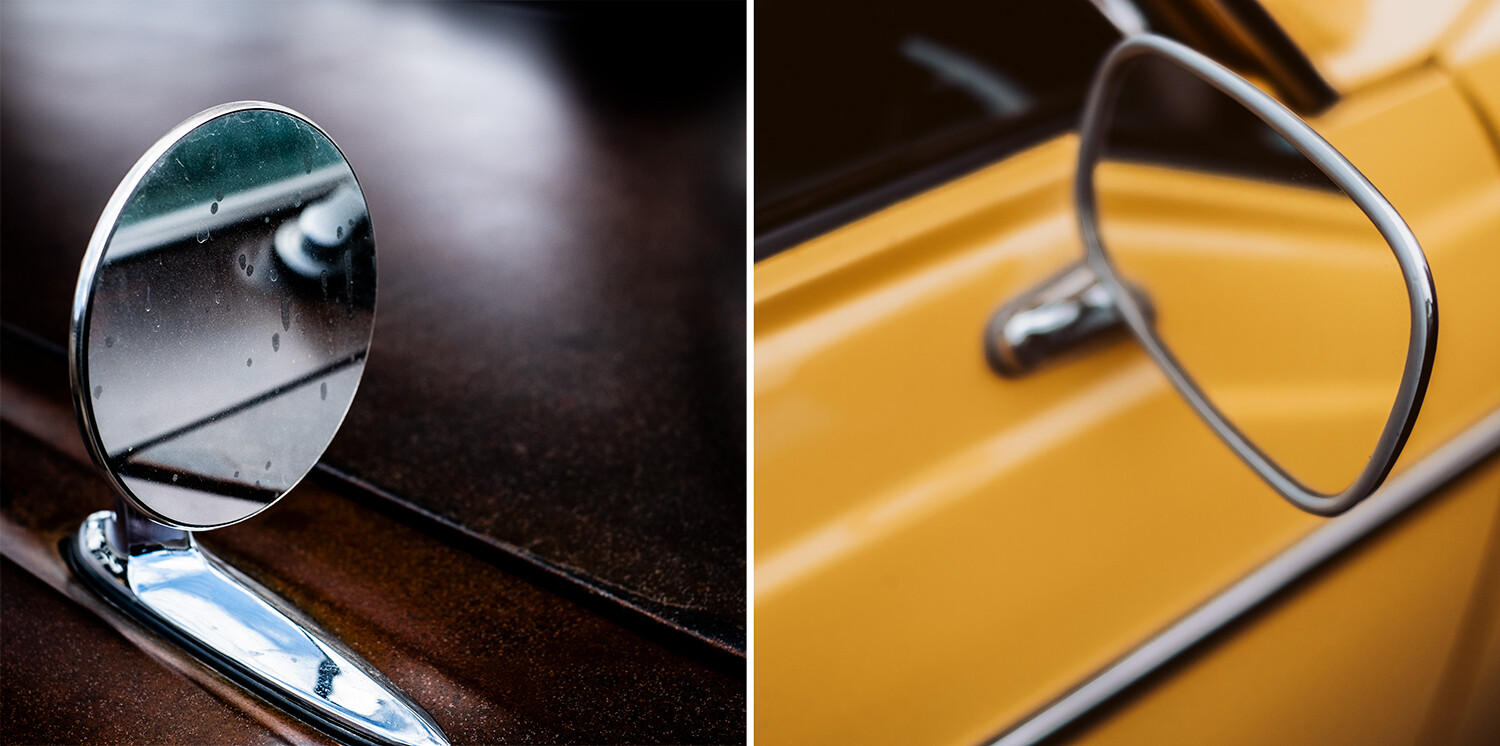
By getting in close you eliminate many of the problems that would otherwise sneak into your picture; other cars in the background, or people in the corner of your shot. Focussing on just one small part of a car can remove all of those distractions.

Alternative-Automotive-Photography-1

Not having to take into consideration the background also frees you up to concentrate more on composition. No more worrying about if the backdrop will compliment the car, or what the sky is doing!

You can also use a shallow depth of field to blur out distracting elements in your photographs. Use just enough depth to highlight the detail that you’re photographing. Everything else will then melt away into the background, keeping your viewer looking just where you want them to.

Pick a theme

At some point over the years, I’ve picked up a habit of shooting the wing mirrors on cars. I don’t know which one was my first, but I soon started noticing the way that they were all different. Each mirror was only a small part of the car, but they pack a big punch when it comes to design! Now I can’t seem to walk past a classic car without taking a photograph of its mirrors!

Alternative-Automotive-Photography-2

By picking a theme, it will challenge you to go looking for shots that are different from what everyone else is shooting. Also, you’ll start to notice other details as you train your creativity. Before long, you will seek out creative and different images without even really having to think about it.

Shoot iconic details

Pick out just one detail to highlight and then try to take the perfect shot of just that part. Perhaps it’s a classic Cadillac fin or an elegant Rolls Royce grid that catches your eye. Whatever it is that you love most about a car, or is most iconic and well-known, use that as your starting point when you’re working out what pictures you want to take.

Alternative-Automotive-Photography-3

Cars are more than just machines that get us from A to B. The most iconic are beautiful and remarkable pieces of design that the original designer has spent hundreds of hours perfecting. Nothing on a great car is an accident; everything was designed to be exactly how you see it.

The good thing about iconic details is that they’re often instantly recognizable. It tells people what the photograph is of, even though it might be an abstracted close-up.

Portray the luxury

Beautiful cars are a luxury; there’s no debate to be had there. So challenge yourself to convey the luxury through your photographs.

Alternative-Automotive-Photography-4

Lifestyle photography with shallow depth of field, out of focus foregrounds, and toned colors are really in vogue right now for luxury brands. Now is the time to try this style out if you can get up close and personal with some top of the range machines!

Make sure that your focus is right on the nail if you’re attempting shots with a shallow depth of field. If you miss the focus even slightly, the shot won’t be worth keeping.

Stick to a neutral focal length

Extreme wide-angle photographs can look cool, there’s no doubt about it. And I know every car photographer has, at least once, got down at the front corner of a car with a wide-angle lens to try and make it look more imposing and dramatic.

But wide-angle focal lengths distort cars and change the carefully designed, and often iconic lines and features. Instead of grabbing the easy (and predictable) win when it comes to creating a dramatic image, try sticking to a neutral focal length and challenging yourself.

Keeping to a focal length like 50mm means shooting images that are much closer to how the human eye naturally sees the world. Using a focal length around 50mm means that you keep the cars much closer to the designer’s original vision when you photograph them.

This might mean that you have to work harder to look for different ways to produce impact with your photographs. However, it also means that you represent the cars in the way that they’re meant to be seen. It gives an element of authenticity to your images.

I’ve never been one for believing that photography is simply about recording the world around you exactly how it is. But when it comes to the design of cars, I’m pretty sure that the original designer knows more about how the car looks best than I do. So distorting it with wide-angle lenses is rarely high on my priority list!

Embrace reflections… and wear black

In ideal conditions, you’d be able to use black and white cards, and lights, to block and place reflections exactly where you want them on a car before you took a photograph. Realistically, though, you’re rarely going to get the opportunity to work with this kind of precision in the great outdoors.

Carry a 5-in-1 reflector in your kit by all means. Sometimes you just need to lift a shadow on a bit of paintwork or cut out a reflection in some chrome. But instead of trying to eliminate every reflection you dislike, try embracing them instead!

Reflections of the sky or foliage around you can make some interesting patterns when they reflect in the glass of a car. In the right conditions, with a well-polished car, they can even reflect in the bodywork. Use the reflections to add interest to your shots. They can focus the viewer’s attention exactly where you want them to look. Also, a well-placed reflection can blank out something messy that you don’t want to distract.

On that note, wear black when you go out with your camera to photograph cars! Too often have I ruined my own photographs by shooting the perfect image and then noticing afterward my own reflection while wearing a bright colored jacket. Wearing black won’t remove you from the image completely, but it will make you an awful lot less distracting when you do manage to capture yourself in a reflective surface.

Next time you head out to a car show to take some pictures, think smaller and capture the details for alternative automotive photography! And share them with us in the comments below.

Do you have any other tips you’d like to share?


alternative-automotive-photography

The post Alternative Automotive Photography: Capturing the Details appeared first on Digital Photography School. It was authored by Charlie Moss.


Digital Photography School

 
Comments Off on Alternative Automotive Photography: Capturing the Details

Posted in Photography


Peak Design Travel Tripod Review

15 Jul

The post Peak Design Travel Tripod Review appeared first on Digital Photography School. It was authored by Simon Ringsmuth.

Ever since Peak Design launched their Capture Clip in 2011, they have carved out a unique and important niche for themselves in modern photography. From their systems for securing your gear to their line of bags to store it all, Peak Design has everything a photographer on-the-go could want. However, the one thing missing from their lineup is a portable, compact device for holding your camera steady on a beach, boardwalk, or windswept mountainside. That all changed in May of 2019 when they launched their first-ever Travel Tripod.

peak-design-travel-tripod-review-2

The Peak Design Travel Tripod

I’ve had a few tripods over the years, and the one I use most often is a set of Manfrotto 055XDB legs mated to a Manfrotto 496EC2 ball head. It works great for almost any situation with the main drawback being size and weight.

Traveling with that tripod is a chore, and even simple actions like extending the legs can be cumbersome. My Manfrotto rig supports my full-frame camera with a battery pack and 70-200 f/2.8 lens like a champ, but I wish it were easier to transport and set up.

That’s why I was so intrigued at the Peak Design Travel Tripod. It appeared to be a great solution for someone like me who wants a small, light, yet rugged and durable tripod. It would, in theory, be great for holding everything from my Fuji X100F to my Nikon D750 with a big, heavy lens. If it were as practical, transportable, and durable as Peak Design claimed, it just might be the only tripod I would need.

Since this tripod is designed specifically for travel, I wanted to put it through its paces in an authentic manner. I took it with me when my family flew cross-country to see relatives in Minnesota, and it performed amazingly well. In one week, I shuffled it in and out of airplane carry-on luggage, used it for several group photos at houses, cabins, and parks and photographed the Independence Day fireworks.

Aside from a few nitpicks here and there, I can confidently say that the tripod performed its duties with aplomb.

After our trip, my wife and I discussed how there would have been no way to get so many of our vacation pictures without the Travel Tripod. Our Manfrotto tripod was too big to take, and our GorillaPod was too small to be useful for outdoor group photos.

The Peak Design Travel Tripod made it possible to get shots of friends and family we only see every few years. It allowed us to capture memories we would otherwise have had no way of photographing.

Size

The first thing I noticed when I got my hands on the Peak Design Travel Tripod was how diminutive it was. It’s barely bigger than my GorillaPod. But with the legs fully extended, it’s just as tall as a regular tripod.

When collapsed, the tripod is about the size of a 70-200 f/2.8 lens with camera attached.

Peak Design opted for a six-sided construction for the legs. This design lets them fold up close and minimize the amount of unused space in the middle. They also created a unique ball head that sits extremely low to the legs. This is a stark contrast to other ball heads which often feature a center column protruding upwards and thereby increasing the total height of the tripod.

Upon closer inspection, I found plenty of classic Peak Design touches implemented to make this as small as possible. The housing for each leg hinge has been shaped to hug the center column. Cam levers sit right next to the legs but offer plenty of leverage when extending them. Even the knob that allows the center column to extend is diminutive and unobtrusive – almost a little too much, as my fingers had trouble gripping it from time to time. (But more on that in a bit.)

peak-design-travel-tripod-review-3

After using this Travel Tripod, I don’t think I want to go back to my other tripod even when I’m not necessarily on the go. The convenience of something so small and light is hard to beat, especially when it can still hold my full camera rig.

Build quality

Having owned other Peak Design gear, I thought I had a good idea of what to expect in terms of construction and build quality. Despite that, I found myself pleasantly surprised when I started putting it through its paces. The carbon fiber unit I tested feels solid, sturdy, and very well made

peak-design-travel-tripod-review-4

It’s difficult to tell how well this will hold up over the years. However, all the mechanical pieces on the tripod, from the cam levers that extend the legs to the collar that locks the ball head in place, feel extremely robust. Certainly just as good as any other tripod, and a lot better than some. The ball head has a satisfying chunkiness to it without being overbearing. Also, the overall quality of construction certainly inspires a great deal of confidence.

My wife and I have an Everyday Messenger and an Everyday Backpack – both of which get used daily. Even after years of use, those bags are holding up marvelously, with only a couple signs of wear and tear. As such, I expect the same level of quality and longevity from the Travel Tripod. From what I have seen thus far, I don’t think it’s unreasonable to expect that this device would serve busy photographers for many years.

With the legs and center column fully extended the Travel Tripod is almost the same size as most standard tripods.

Ease of use

Small and lightweight are nice bullet points to have on the side of a box, but if a tripod is clunky and cumbersome, it will end up spending more time in a dark closet than out in the real world. This is an area where the Peak Design Travel Tripod excels, albeit with a few caveats. Setting up the tripod is a breeze, and you can have it ready to shoot within seconds. And that’s not an exaggeration.

Operations such as adjusting the position of the ball head, extending the center column, opening the cams to let the legs out, and attaching and detaching a camera, are all simple and fast. You can perform many of these operations with one hand in a matter of seconds. Moreover, when you combine that with the tripod’s total weight of about 3 pounds (a little more for the aluminum version, a little less for the carbon fiber version), it makes for a highly compelling product.

Ball head

Fitting your camera to the top of the ball head is a breeze. Attach the mounting plate to your camera, and pop it on to the tripod with a satisfying click as the spring-loaded clip latches it in place. You can then turn a collar at the base of the head to adjust the tension of the spring clip to make extra sure your camera won’t fall out.

I must admit, it took me a few tries to get the hang of this particular ball head. It was a little trickier than other ball heads I have used. However, the trade-off is a tripod head that is significantly smaller and more compact. If you’re using this device for travel, then you will be quite happy with the results.

Mounting plate

The tripod ships with a Peak Design mounting plate that requires a hex-screw, which means you need to use a small wrench to attach the plate to your camera. The tripod ships with the wrench, which looks about the same as the small hex-key wrenches you might find with IKEA furniture. It even has a little pocket in the tripod bag for storage.

Attaching and removing a camera from the tripod is easy. Attaching and removing the mounting plate from the camera requires a bit of work – at least in the current version.

The downside to this arrangement becomes apparent every time you want to move your mounting plate to another camera, which could be several times during a given photo shoot. You have to locate the wrench, unscrew the mounting plate, stow the wrench, get your other camera, grab the wrench, and hold everything in place while you attach the plate.

It doesn’t sound like much, but within a few days of using the tripod, I had already misplaced the wrench a couple of times. It mars what is an otherwise quite simple setup. Of course, you could just get another mounting plate too. It is compatible with Arca-Swiss plates, so you might already have some that would work.

Peak Design has heard a great deal of feedback about this issue since the unveiling of this Travel Tripod. They are currently working on a solution to likely involve a custom-designed hex-key that attaches to the tripod itself rather than stowing it in a bag. The final version was not available for testing, but I am quite confident that it will address most of the concerns that exist with the current setup.

I had to quickly reposition my camera to capture this fireworks shot, which was easy thanks to the size and weight of the Peak Design Travel Tripod.

My solution was simple; I just left the mounting plate attached to my camera for the duration of our visit to Minnesota. The only time I removed it, was when I had to change the battery. Otherwise, the plate was unobtrusive. In daily use, I didn’t really notice it on the camera. It allowed me to snap my Fuji X100F on to the tripod at a moment’s notice.

As far as general usage goes, I found the Travel Tripod to be a top performer. It was solid and held my camera gear in place easily. Adjusting the position of the ball head and locking it in place is easy once you get the hang of it, and extending the legs is quick and simple. As a daily driver on demanding photoshoots, there might be better options that can take the constant weight and abuse of full-time photography.

However, as a travel solution, this tripod is outstanding.

Shooting in portrait orientation

Some online reviews have mentioned that the ball head doesn’t allow you to shoot in portrait orientation as easily as others, but I never found this to be the case. Granted, I rarely shoot in portrait orientation when using my tripod, but when I did, I just adjusted the position of the mounting plate or rotated the tripod a bit. It honestly wasn’t an issue for me. Though, I’m not saying it wouldn’t be an issue for everyone. Your mileage may vary, but I don’t see that this is a problem at all.

peak-design-travel-tripod-review-5

The ball head allows you to easily position your camera to the left for portrait orientation….


…but if you tilt it to the right, your movement is limited. It’s an inconvenience, but not a deal-breaker.

Features

Peak Design products are known for little flourishes that might not be noticeable at first but can leave you pleasantly surprised over time. Their bags come filled with hidden pockets, magnetic closures, and thoughtfully-placed loops and straps. These things make them eminently practical in ways that I don’t often see in other bags.

This Travel Tripod continues that tradition. It comes with added accouterments like a cell phone holder stowed in the center column – accessible with a quick twist of the ballast hook.

None of these are reason enough to purchase a tripod, but they are nice to have in a pinch. The realization that you can mount a cell phone easily, remove the center column quickly, and attach anchor links securely, added a little more value to an already outstanding device.

Some of these, like the cell phone holder, are tucked away so well you might forget where they are or how to access them. However, once you figure out where everything is and how to use it, you might start to feel a little less like a photographer and a little more like Q from the James Bond movies.

One anecdote that illustrates the Peak Design philosophy has to do with the tension knob, which lets you extend the center column. I found it challenging to grasp at first, and it was a chore to use because of its placement so close to the actual column.

It seemed like such an obvious oversight, and at first, I was disappointed in how Peak Design chose form over function in this regard. That is until I realized that the knob is held close to the column magnetically. Just pop it out, twist it, and pop it back in where it stays out of the way. I don’t see this attention to detail on a lot of other products, and it speaks the thoughtful creation of this tripod.

The knob to extend the center column pops out to make it easier to grip.

Verdict

Deciding whether this tripod is right for you might very well come down to a question of value.

Is it a solid, well-made tripod that can come along with you on your adventures? Definitely.

Is it worth the money? Possibly.

Was it the perfect travel tripod for my trip to Minnesota, along with my daily use at home? Absolutely.

Will it be the ideal solution for you? It’s likely, but that’s a question I can’t answer for you.

peak-design-travel-tripod-review-6

There’s no getting around the fact that this is an expensive tripod. If you opt for the carbon fiber version, you will spend ten times as much as a GorillaPod, which has been a constant companion for traveling photographers for years.

There are other travel tripods on the market which offer similar features for less money, but also plenty that cost a lot more too. Fortunately, if you want all the features of this tripod in a slightly heavier package, the aluminum weighs slightly more but costs 40% less.

Peak Design has built up a reputation for putting out quality products that meet the needs of demanding photographers and, in my experience, stand the test of time. The Travel Tripod continues that tradition admirably, and I am happy to recommend it.

Ratings:

Size: 5/5

Build Quality: 5/5

Ease of Use: 4/5

Features: 4.5/5

Overall: 4.5/5


peak-design-travel-tripod-review

The post Peak Design Travel Tripod Review appeared first on Digital Photography School. It was authored by Simon Ringsmuth.


Digital Photography School

 
Comments Off on Peak Design Travel Tripod Review

Posted in Photography


5 Photos to Take with Auto Mode

15 Jul

The post 5 Photos to Take with Auto Mode appeared first on Digital Photography School. It was authored by Mat Coker.

Were you disappointed when you bought a fancy camera and it didn’t take good pictures for you? It happens to a lot of people.

But even when you know nothing about how your camera works, it’s possible to take a good photo on Auto Mode.

Auto Mode isn’t the place to stay, so once you get the hang of it, you can move on to aperture mode, shutter mode, and manual mode. You can also learn about exposure compensation, metering and all sorts of other fun things!

But first, let me show you how to take 5 different photos on Auto and then how to put the finishing touches on them using Lightroom.

  • Portrait with bokeh
  • Golden hour nature photo
  • Silhouette
  • Freeze a splash
  • Food photo

Portrait with bokeh

Auto mode portrait with bokeh

He is standing about 20 feet away from the tree in the background and I zoomed in to 140mm.

It’s actually pretty easy to take a portrait with bokeh (out of focus background).

I’m assuming that you have an 18-55mm kit lens, but maybe you even have a telephoto lens that zooms to 200mm or 300mm.

You’ve got your camera on auto mode. To achieve an out-of-focus background, bring your subject away from the background. Zoom your lens in all the way because this increases the bokeh effect.

It’s really that simple. The soft, overcast sky made a good light source for this photo. The photo would be even better if his expression were more authentic and there were catchlights in his eyes.

Golden Hour nature photo

Many people like to photograph flowers and nature, but they choose the worst time of day to do it. The harsh afternoon light is not always the best time to photograph a flower. The light is intense, the shadows are harsh, and you won’t likely be impressed with your photo.

Try taking nature photos during golden hour instead. The light will look much more pleasing in your photos. Even on Auto Mode, you’ll likely be happy with how some of your photos turn out.

These are all unedited Auto Mode photos.

Golden hour flower photo on auto mode

This photo was taken about an hour before sunset. The sun is behind the flower and you can see how the warm light causes this blossom to glow.


Golden hour nature photo

Auto mode lens flare

Freeze a splash

You’ll likely end up with blurry photos on Auto Mode if the light is dim. That is because you need lots of light if you want to freeze the action. It’s fun and easy to freeze water splashes when you’re outdoors in bright light.

That is the key to freezing motion on auto mode; lots of light.

Freezing a water splash

I had my kids ride through mud puddles so that I could get a shot of the water spraying up. The bright outdoor light allowed the camera to have a quick shutter speed and freeze the movement.

Silhouette

Let’s start with accidental silhouette photos. Your eye sees something pretty but the photo turns out like this:

Silhouette on auto mode

This birdhouse looked really cool, so I snapped a picture. Unfortunately, it turned out as a silhouette. That’s not what I wanted.

If the background is really bright, you’ll likely end up with a silhouette. Had I wanted this birdhouse to look brighter, I should have moved to the other side where the light was actually hitting it.

But let’s suppose you want a silhouette photo. How do you do it? It’s pretty easy to get a silhouette photo on Auto Mode. Just make sure the background is really bright and that you’re standing on the shady side of the object.

Silhouette photo on Auto Mode

This silhouette photo was intentional. I put the camera on Auto and knew that it would be a silhouette because of the bright sky in the background. I chose to make this a silhouette because I like how the pattern in the leaves and the clouds play off each other.

Food photo

Many bloggers purchase an expensive camera and are disappointed with the results of their photography. Let’s consider somebody who blogs about food but only knows how to use Auto Mode. Is it possible to take a decent food photo on Auto? Yes.

The key to a good food photo is light. Normally, you want the light to come from beside or behind the food in order to bring out the texture. A window is a great light source.

It can be a little tricky and you will likely want to do a basic edit of the photo (particularly exposure and clarity).

Food photography on auto mode

This is an unedited photo taken on auto mode. You can see that it is warm light coming from the side. I placed the cookies next to a window with late day, soft sunlight coming in.


Auto mode food photography

I set this sugar-topped muffin next to a window, hoping that the backlight would bring out the texture. Unfortunately, the photo is underexposed. The plate and the window sill are bright white and caused the camera to create a darker exposure. It’s almost a silhouette.


Edited food photo

You can see that with some simple brightening in Lightroom the photo looks a lot better.


Food photo

It’s a lot better to understand how your camera works so that you don’t have to rely on Auto Mode. But until then, do the best you can with side or backlight and then use a program like Lightroom to put the finishing touches on your photo.

Adding finishing touches using Lightroom

I use Lightroom to edit my photos, but just about any editing program will work fine.

There are two ways to think about editing. The first is fixing a photo that didn’t turn out right. Hopefully, you can avoid this approach as much as possible. If you find yourself having to fix the same sort of mistake over and over (say underexposed or misfocused photos), then you know it’s time to learn to get it right in-camera.

But if your photos are turning out nicely, then you can think of editing as putting the finishing touches on your photo. I’ll show you how I do that.


Lightroom portrait edit

You can see that I didn’t do a whole lot to edit this photo. I added some warmth, brought up the exposure, and decreased the blacks to add a little contrast. Very simple finishing touches.


Lightroom edit

I was a little heavy-handed with adjustments to this photo. First, I increased the overall exposure but then decreased the highlights because some parts of the photo had become too bright. The shadows were also increased, allowing for more detail to be seen. The clarity is increased to see the water droplets more clearly.

When to move off Auto

Keep track of the problems that you keep running into. These problems are clues about when to move away from Auto Mode and what settings you need to begin learning about. Don’t try to learn everything – just what you need to know to overcome problems you’ve been facing.

You’ll want to explore:

  • ISO
  • Aperture
  • Shutter speed
  • Metering
  • Exposure compensation
  • Manual mode

These are all dull-sounding words, but when you explore and learn the concepts, you’ll overcome challenges and have far more creative control over what you’re doing.

Keep pursuing creative elements and technical knowledge, and you will grow over time.


photos-to-take-with-auto-mode

The post 5 Photos to Take with Auto Mode appeared first on Digital Photography School. It was authored by Mat Coker.


Digital Photography School

 
Comments Off on 5 Photos to Take with Auto Mode

Posted in Photography


How to Make Three Instagram-Inspired Filter Effects in Photoshop

14 Jul

The post How to Make Three Instagram-Inspired Filter Effects in Photoshop appeared first on Digital Photography School. It was authored by Megan Kennedy.

Instagram has taken the world by storm. The image-based social media platform allows users to post images and videos, and receive feedback from others across the globe.

Instagram also offers a large number of filters, giving users the option to customize their media before uploading to Instagram.

However, there are downsides to leaning on Instagram for image-editing. Uploading to Instagram sacrifices resolution and the ability to share filtered images to other media is limited.

In this tutorial, we’ll apply Nashville, Amaro and Brannan-Instagram-inspired filter effects to your photographs in Photoshop that are non-destructive and can be used anywhere. Plus they look good too!

Nashvillle

The Nashville filter warms highlights and adds a blueish tint to darker areas of an image. It also decreases contrast and increases exposure.

Instagram-inspired-Filter-Effects-7

Step one:

First, open your image.

Keep in mind that throughout this tutorial, the efficacy of each Instagram-inspired filter can differ from image-to-image. While I’ve provided specific settings as a guide, don’t be afraid to experiment a little for optimum results.

Step two:

Create a Curves Adjustment Layer by clicking on the Curves icon in the Adjustments panel. If you aren’t sure what icon means what, rest your mouse over an icon and a description will appear. If you can’t see an Adjustment panel at all, click on Window -> Adjustments to bring it up.

In the Curves Adjustment Layer panel, select the Green channel from the RGB dropdown menu and set the Input to 15 and the Output to 40 (you may need to click on the Curve line to activate the text boxes).

Then select the Blue channel and set the Input to 84 and the Output to 140

Instagram-inspired-Filter-Effects-6

Step three:

Go to Layer->New Fill Layer->Solid Color.

Click OK at the first prompt.

In the Color Picker window, select a cream tone. For this image, I used the HEX code #fedfb9, which produces nice a warm glow. You can copy the HEX code I selected by clicking on the lowest text box in the Color Picker (next to the hash symbol) and entering “fedfb9.”

Click OK and change the Blending Mode of the Color Fill layer to Multiply. Blending Modes are located in a drop-down menu in the Layers pallet, next to the Opacity drop-down menu.

Step five:

Create a Brightness/Contrast Adjustment Layer and set the Brightness slider to 5 and the Contrast slider to 90.

Instagram-inspired-Filter-Effects-5

Finally, create a Levels Adjustment Layer and enter 1.50 in the Midtone text box and 235 in the Highlights text box.

And there you go!

You can crop your image to a square format for an extra level of Instagram authenticity, or leave as is.

Instagram-inspired-Filter-Effects-4

Amaro

Amaro is a popular filter with a film-inspired appearance and a dark vignette to draw attention to the center of an image.

Step one:

Open your selected image in Photoshop.

Step two:

Create a Brightness/Contrast Adjustment Layer and set the Brightness value to 50 and the Contrast to 30.

Instagram-inspired-Filter-Effects-3

Step three:

Next, go to Layer->New Fill Layer->Solid Color and click OK at the first prompt.

In the Color Picker, select a cream tone. For my image I used #fef7df. Click OK and set the Blending Mode of the color fill layer to Multiply.

Step four:

Create a Levels Adjustment Layer and in the default RGB channel, enter 25 into the left Output Levels text box. In the Blue channel, enter 60 into the left Output Levels text box.

To adjust the intensity of your colors, open a Color Balance Adjustment Layer. Under Midtones, increase the Red slider to 20. You can also decrease the Green and Blue values to around -15.

Crop your image if you like.

Step five:

Then, to add a vignette, right-click on your image layer and select Duplicate Layer.

With your duplicated layer selected click Filter->Lens Correction->Custom and adjust the Vignette sliders.

For my image, I set the Amount slider to +65 and the Midpoint to +23.

Click OK and you’re done!

Instagram-inspired-Filter-Effects-2

Brannan

Brannan boosts contrast and exposure, adding a yellow tint to an image.

Step one:

Begin by opening your image.

Open a Levels Adjustment Layer. In the RGB channel, set the left Output Level text box to 25.

Step two:

Open a Brightness/Contrast Adjustment Layer. Set your Brightness to 10. Then set your Contrast from around 70 to 100.

Step three:

Go to Layer->New Fill Layer->Solid Color…  Select a soft yellow color. I used the HEX code #f5f1a3.

Step four:

Change the Blending Mode of the Fill Layer to Multiply. Then set the yellow layer’s Opacity to around 50 or 60%.

Brannan is a high-contrast filter. Depending on your image, an additional Curves Adjustment Layer may be required to boost your contrast further.

Step five:

Crop the image to a square if you like and add a vignette by duplicating your image layer, selecting Filter->Lens Correction->Custom and adjusting the Vignette sliders.

Then, you’re done!

Instagram-inspired-Filter-Effects-1

Conclusion

Filters add a new dimension to any Instagram photograph. By applying Instagram-inspired adjustments to your images in Photoshop, you can emulate the Instagram feel of a filter without compromising on flexibility or image quality.

Go out and try some of these Instagram-inspired filter effects and share with us in the comments below.


instagram-inspired-filter-effect

The post How to Make Three Instagram-Inspired Filter Effects in Photoshop appeared first on Digital Photography School. It was authored by Megan Kennedy.


Digital Photography School

 
Comments Off on How to Make Three Instagram-Inspired Filter Effects in Photoshop

Posted in Photography


21 Tips for Doing Stock Photography

14 Jul

The post 21 Tips for Doing Stock Photography appeared first on Digital Photography School. It was authored by Kevin Landwer-Johan.

Being a stock photographer is a bit like being in a band. Not many make it to rock star status, but they love what they do and enjoy earning some extra cash on the side.

Producing photos to sell through stock photo agencies can bring more purpose to your photography. It can help you focus and build your skills more than if you are doing photography purely as a hobby.

21 Tips For Stock Photography Back Packer On The Train

© Kevin Landwer-Johan

Over the years the digital stock photography industry has gone through many changes. In the past, it was arguably easier to make some decent money, even very good incomes. But the percentage of contributors who made a full time living selling stock photos was proportionately very small.

Approach stock photography with a healthy attitude and without grand expectations. You may be surprised at how much you learn, how much you enjoy it and even how much you can earn.

Here are a few tips for doing stock photography that I’ve put together. They will encourage those of you thinking of dabbling in the stock photography market.

1. Treat it like a business

The more business-like you treat stock photography, the more success you will have with it. A casual approach will bring casual returns. There’s no problem with this if it’s what you want.

If you’re serious about making real money from stock photography set up a business right from the start. Make a plan and stick to it. Keep records of your expenditure and earnings. Dedicate time regularly to focus on the mechanics that will make it work.

Having no plan and a relaxed attitude towards producing stock photos will not get you very far. Maybe you don’t have the time or inclination to make it a full-time occupation. Having some kind of plan in place and a business attitude about what you are doing will still help.

21 Tips For Stock Photography Merlion Park, Singapore

© Kevin Landwer-Johan

2. Choose your niche

One of the biggest challenges you’ll face is getting your images noticed. The stock photography market is so saturated that it can be difficult to get your photos in front of buyers.

Choosing your niche, a few topics and concepts to concentrate on can help this. Pick some subjects you are passionate about. Purposefully become an expert at photographing them. Build up a portfolio of photographs that will grab attention.

21 Tips For Stock Photography Burmese Dancer

© Kevin Landwer-Johan

3. Study design trends

Designers buy stock photos. Study the current trends and stay up to date as they change. Look at styles, colors, and image usage to see what buyers need.

Flip through magazines. Browse websites. Watch TV. You’ll begin to see stock photos everywhere. Take note of the ones you like the best and mimic them.

21 Tips For Stock Photography Boy With A Note Book

© Kevin Landwer-Johan

4. See what’s worked before

Spend time on stock photography websites. Look at the best selling images and think about why they are so popular. What makes them work? Why have so many people bought them? How can you improve on them?

Trends and fashions change. Think about how you can rework older stock photos that have been very popular to make them more current.

21 Tips For Stock Photography Tropical Palm Tree Sunset

© Kevin Landwer-Johan

5. Aim at the market

Know your market. Find out what people are buying. Fill the gap with what’s missing.

Learn about the potential market for your niche. Study it and supply the type of images that will be popular. You may have to try different styles and ideas for a while before you hit on some that work. Experiment until you have a breakthrough.

21 Tips For Stock Photography Commuters

© Kevin Landwer-Johan

6. Check out the masters

Find rockstar stock photographers. Look at their portfolios. How have they made it a successful enterprise?

If you can find successful stock photographers who work in the same niche as you, this is great. Search for trends and patterns in their work. Seek to find fresh ideas. Don’t copy, make sure you add your own flare.

21 Tips For Stock Photography Dancing Shoes

© Kevin Landwer-Johan

7. Polish your technique

Having technically strong photographs will mean more of them are accepted by the stock agencies. Standards appear to have slipped over the past years. This is still no excuse for not submitting technically correct photos.

Modern cameras, even on phones, and new software make it very easy to create high-quality photographs. The higher your standard, the higher your sales will be.

21 Tips For Stock Photography Sunrise Dinghy

© Kevin Landwer-Johan

8. Use lots of light

One trend that never has gone out of fashion in stock photography is photos with an abundance of light. Well-lit images often convey positive emotion. Advertisers like this and will buy feel-good photos.

Make sure to produce some photos from every session that have more light than you would normally use, especially if your photos tend to be dark and moody. There’s room for that style of image to sell as stock, but bright photos often sell better.

21 Tips For Stock Photography Empty Water Bottles

© Kevin Landwer-Johan

9. Make sure it’s sharp

Good sharp images will always sell. Clarity in your photographs is important to buyers. Too many images in your portfolio with a shallow depth of field will make it of limited appeal.

Be precise with your focus too, especially when using a shallow depth of field. Your photos must be sharp in the right place or they are not likely to make it through the inspection process.

21 Tips For Stock Photography Thai Sunset

© Kevin Landwer-Johan

10. Compose for copy space

Stock photos are often used in advertisements or design layouts which include text. Leaving some negative space in your compositions can make them much more practical for designers.

Experiment with your compositions. Leaving more space around your subject can mean the photo is more useful to a designer.

21 Tips For Stock Photography Red Umbrellas on a Tropical Island Beach

© Kevin Landwer-Johan

11. Take a series of photos

Whenever you’re creating a new set of photos for stock, make sure to take a whole series. Look at your subject from as many different angles as you can. Vary your compositions and aim to provide variety for the buyer.

Don’t only take the first angle you think of. Consider how the photo might be used and look at it in different ways. Producing a series of photographs is more practical for buyers as it gives them more choice.

21 Tips For Stock Photography Thai Traditional Costume

© Kevin Landwer-Johan

12. Be prolific

The more photos you take, the more you can upload. The more you can sell.

Make sure you supply a good variety of images as often as you can from a subject or concept. Building a strong portfolio of photos means you give buyers more options.

21 Tips For Stock Photography Thai Model and Elephant

© Kevin Landwer-Johan

13. Be practical

Don’t imagine producing photos set in a hospital or commercial kitchen if you don’t have ready access to such locations.

If you want to take product photos, set yourself up a good studio space, so it’s easy to take this style of photo. The more hassle-free you can work, the more photos you can take with less expense. Your profit will increase.

21 Tips For Stock Photography Old Bibles

© Kevin Landwer-Johan

14. Develop your own style

Style takes time to develop. Have a plan and purpose, and a clear idea of the type of photographs you want to produce. This will lead to the development of your own personal style.

Don’t stress over this. Letting it come about naturally will make it more distinctive. When buyers see your style consistently represented in your portfolio, they will watch what you do and buy from you more often.

21 Tips For Stock Photography Karen Grandma

© Kevin Landwer-Johan

15. Post-process consistently

The look and feel of your photos created during post-production have a lot to do with the development of your style.

Presets can help make this easier. Using the same set of preset actions to govern the way your images are rendered will help tie your portfolio together.

21 Tips For Stock Photography Sad Young Asian Woman

© Kevin Landwer-Johan

16. Diversify the agencies you upload to

If you have time, it’s a good idea to send your images to more than one or two stock photo agencies.

When you are starting out, this can take up a lot of your time. By uploading too many, you will see which ones sell and which ones do not sell so well. Look at the statistics, not only for your sales, but also for how many views your photos receive on each platform. If your images are not being looked at, consider uploading less to that site or not at all.

21 Tips For Stock Photography Hanging Asian Lanterns

© Kevin Landwer-Johan

17. Stick with one agency to save time

If your time is limited, you might find it’s best to enter into an exclusive contract with one agency.

Some stock photo agencies offer incentives if you only upload to them. This may mean they pay you a higher percentage of each sale.

21 Tips For Stock Photography Young Couple

© Kevin Landwer-Johan

18. Learn about copyright issues

Understanding copyright will help you when you are deciding what to photograph. There are two basic types of stock photo license. Commercial licenses restrict photos which are subject to copyright. Editorial licenses are less restrictive, but the use of the photos is more limited.

Any photo with;

  • A trademark,
  • design made by someone else,
  • commercial branding
  • or recognizable people

means you need a property or model release to sell them with a commercial license because of copyright laws.

21 Tips For Stock Photography Airport Plane

© Kevin Landwer-Johan

19. Use model release forms

Have every person you photograph sign a standard model release form. This means you can sell these photos with a commercial license. Having model releases makes photos of people more practical for buyers.

These forms are readily available on stock photography websites. A good generic release form can be used when uploading to multiple agencies.

21 Tips For Stock Photography Mad Scientist With Red Liquid

© Kevin Landwer-Johan

20. Keyword well

Good keywording of your images is essential. There is no point uploading photos if you don’t add appropriate keywords. Without them, your photos will never be seen.

Spend some time to research how to add the right words. Don’t load your photos with too many, just enough relevant information about them so they will show up in search results.

21 Tips For Stock Photography Gears

© Kevin Landwer-Johan

21. Upload a little and often

Uploading a few images every day will help keep your portfolio fresh. Stock photography agencies reward constant uploaders by making their photos float to the top of search results.

If you only upload occasionally, you will not sell so many. If you’ve had a major photo session and produced a lot of images, spread out when you upload them. As you start to post-process them, upload them in batches rather than waiting until the whole project is complete.

21 Tips For Stock Photography Close Up Table Setting

© Kevin Landwer-Johan

Conclusion

Experimentation is essential to find out which of your photographs will sell the best. Try different approaches using the tips I have outlined here, and find what works for you.

Stock photography is not a get rich quick scheme. It takes time and a lot of hard work to be very successful. The more methodical you are at creating images to sell, post-processing, and keywording them well, the more you will sell.

Do you have any other tips for doing stock photography that you’d like to share with us in the comments below?


21-tips-for-doing-stock-photography

The post 21 Tips for Doing Stock Photography appeared first on Digital Photography School. It was authored by Kevin Landwer-Johan.


Digital Photography School

 
Comments Off on 21 Tips for Doing Stock Photography

Posted in Photography


Weekly Photography Challenge – Fireworks

13 Jul

The post Weekly Photography Challenge – Fireworks appeared first on Digital Photography School. It was authored by Caz Nowaczyk.

This week’s photography challenge topic is FIREWORKS!

Photo by Rick Ohnsman

Well, the 4th of July has just passed by and I’m sure there were plenty of fireworks going off in cities near you. Hopefully, you got out there with your camera and snapped some shots of the display. Share them with us! We’d love to see them.

Photo by Rick Ohnsman


Check out some of the articles below that give you tips on this week’s challenge.

Tips for Shooting FIREWORKS

8 Tips for Better Fireworks Photos

How to Photograph Fireworks

15 Tips for Successful Fireworks Photography

How to Edit Fireworks Photos Creatively

Neutral Density Filter Fireworks Photography

How to Use Bulb Mode for Long Exposure Photography

6 Tips for Shooting Long Exposure Night Photographs


Weekly Photography Challenge – FIREWORKS

Simply upload your shot into the comment field (look for the little camera icon in the Disqus comments section) and they’ll get embedded for us all to see or if you’d prefer, upload them to your favorite photo-sharing site and leave the link to them. Show me your best images in this week’s challenge.

Share in the dPS Facebook Group

You can also share your images in the dPS Facebook group as the challenge is posted there each week as well.

If you tag your photos on Flickr, Instagram, Twitter or other sites – tag them as #DPSfireworks to help others find them. Linking back to this page might also help others know what you’re doing so that they can share in the fun.

The post Weekly Photography Challenge – Fireworks appeared first on Digital Photography School. It was authored by Caz Nowaczyk.


Digital Photography School

 
Comments Off on Weekly Photography Challenge – Fireworks

Posted in Photography