[ By WebUrbanist in Art & Drawing & Digital. ]

Taking to the skies in Berlin, a set of color-coded drones aims to make the biggest spray-painted mural ever made (at least by robots) using unmanned aerial vehicles equipped with programmed paintings. And this is just the beginning: painting drones could enable civic artwork in hard-to-reach places, and eventually serve practical applications, re-coating infrastructure and architecture.
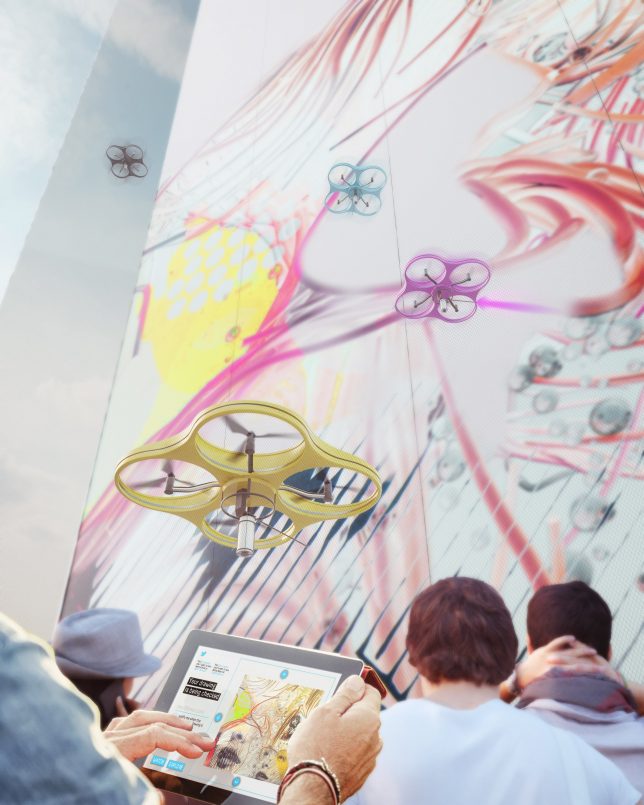
Designed by architect (and director of MIT’s Senseable City Lab) Carlo Ratti’s, the Paint By Drone system employs sets of four drones, each loaded with its own paint tank. Like a CMYK (Cyan, Magenta, Yellow, Key [Black]) system much like modern printers, each contributes a layer to the piece. Together, these layers can add up to a full spectrum of color possibilities.
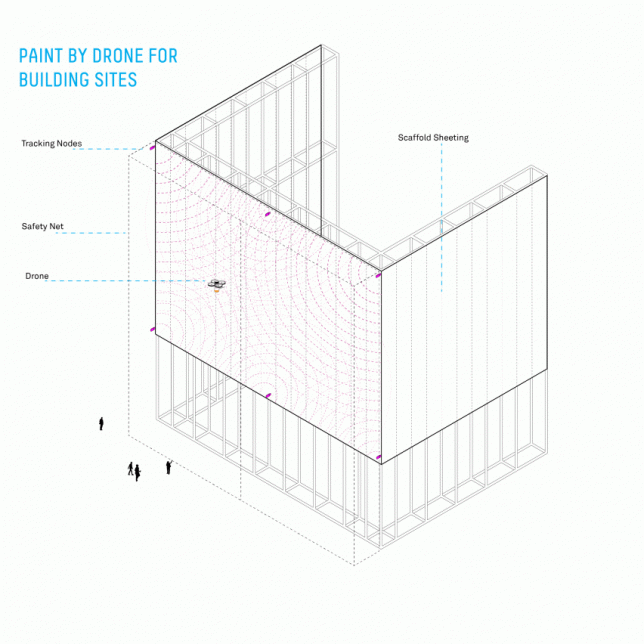
Ratti’s team has used drones before — as tour guides at MIT, for instance — and is now experimenting with ways to engage them with other activities in the built environment, testing their limits in a more public and large-scale setting. In this case, the sheeting that wraps scaffolding, ordinarily left blank and dull (or used for advertising) can be dynamically turned into something beautiful.
The drones can be adapted to work with different inputs, allowing passers by to submit designs, for instance, or to select sections of canvas to paint. For now, they are being deployed on a surface stretched across scaffolding, but the idea is to ultimately enable public art in more places — precision-guided small drones can reach high up on (or under) structures like bridges that would be difficult (and dangerous) for people to access directly.
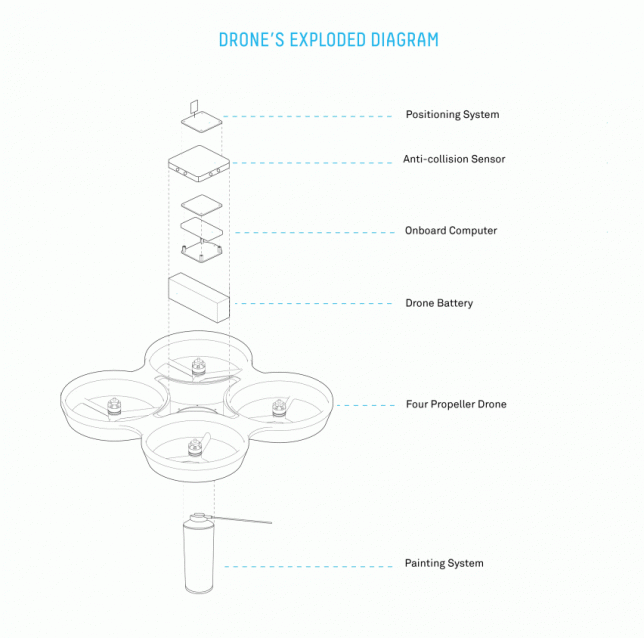
More on the mechanics of the system: “A central management system regulates the drones’ operations in real-time, from image painting to flight, using an advanced monitoring system that precisely tracks the UAV’s position, detecting multiple devices simultaneously. Furthermore, a protective net placed on the scaffolding’s’ cover allows the drones to move into a safe space. Drones can draw content submitted digitally, via an app. The artistic input can come from either crowdsourced platforms or from a curator orchestrating the contributions of several people.”
“Paint by Drone represents a next step,” in their research, reports Carlo Ratti Associati, “on both vertical drawing and open-source design, which includes projects such as OSARC (Open Source Architecture) at the 2012 Istanbul Design Biennial and the Vertical Plotter system featured at Milan Expo 2015’s Future Food District, which entered the Guinness World Record as the world’s largest plotted image. The new concept pushes the previous boundaries of time and space, having the potential to be installed in just a few hours in a city and paint on any surface.”



[ By WebUrbanist in Art & Drawing & Digital. ]
[ WebUrbanist | Archives | Galleries | Privacy | TOS ]



Instagram’s new AI-powered comment filter tackles trolls and spam
Instagram is getting serious about keeping the trolls away from your photos. Earlier today, the company announced that it will be rolling out an enhanced comment filter that uses artificial intelligence to squash rude, spammy, and otherwise inappropriate comments.
The news, along with an in-depth breakdown of how the technology was designed and works, was initially announced on Wired, but you can get the important bits from Instagram’s own blog post.
The tool acts by automatically and intelligently detecting and removing comments it believes are either inappropriate or spam, and hiding them from everyone except the poster him or herself. They have no idea their comment is invisible, but nobody else can see it.
The same goes for the spam filter, which can detect ‘obvious spam in comments’ in a total of 9 languages: English, Spanish, Portuguese, Arabic, French, German, Russian, Japanese and Chinese.
If for some reason you don’t want these comments filtered, the intelligent filter can be turned off by clicking on the ‘…’ menu on your profile page and flipping the ‘Hide Offensive Comments’ slider off.
Both tools are powered by machine learning, meaning that, over time, they’ll get better at detecting inappropriate comments and leaving inappropriate seeming (but actually okay) comments alone.
“Our team has been training our systems for some time to recognize certain types of offensive and spammy comments so you never have to see them,” reads the IG announcement. “We believe that using machine learning to build tools to safeguard self-expression is an important step in fostering more inclusive, kinder communities.”
As the algorithms improve, Instagram is promising to make both filters available in more languages. For now, offensive comments will only be filtered in English, but expect ongoing updates.
Articles: Digital Photography Review (dpreview.com)
Posted in Uncategorized