RSS
 

Archive for July, 2017

Panda Power Plant: Shaped Solar Panel Array Forms China’s National Animal

06 Jul

[ By WebUrbanist in Drawing & Digital & Gadgets & Geekery & Technology. ]

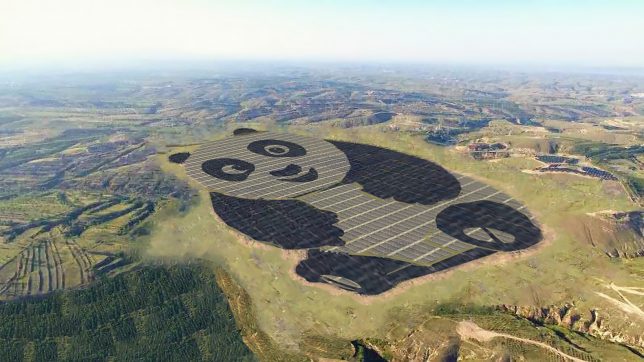
The world’s largest solar power-producing nation is showing off its record-setting green energy production through an adorable new array shaped like a giant panda bear, the national animal of China.

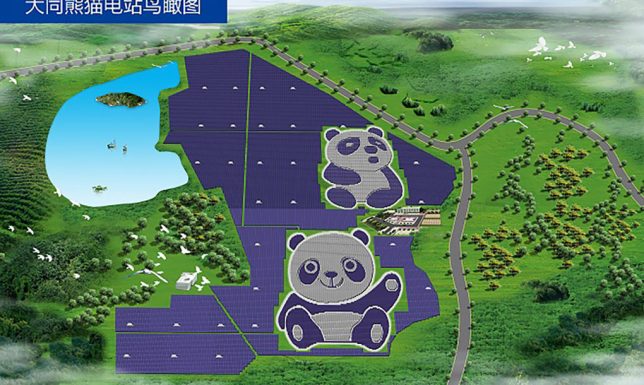
This Panda Power Plant in Datong, China, is the brainchild of Panda Green Energy in partnership with the United Nations Development Program. And this first sections of this huge creature-shaped station mosaic have just been hooked up to the grid.

The plant also going to grow — currently at 50 megawatts, the installation will have a capacity of 100 MW upon completion. Over the next 25 years, the array is estimated to provide as much power as a million tons of coal and to reduce CO2 emissions by over 2.5 million tons.

The whole panda figure is part of the power production process: darker parts of the animal shape (like legs and arms) are made up of monocrystalline silicone solar cells — gray areas (face and torso) are thin-film solar cells.

An educational center alongside the Panda Power Plant aims to teach children about the advantages of solar power and other forms of sustainable energy. Meanwhile, more panda plants are in planning phases as well across China, and some may also end up outside the country.

Share on Facebook


[ By WebUrbanist in Drawing & Digital & Gadgets & Geekery & Technology. ]

[ WebUrbanist | Archives | Galleries | Privacy | TOS ]


WebUrbanist

 
Comments Off on Panda Power Plant: Shaped Solar Panel Array Forms China’s National Animal

Posted in Creativity


Lighting 103: Avoiding Cross Contamination

06 Jul

Abstract: When complementary-gelled lights are falling on the same plane, they can easily rob each other of color. So it is important to make sure your lights are hitting different areas, with minimal overlap.

Above is a two-speedlight portrait against a white wall. White walls are the natural enemy of a gel, and practically live to wash out your color. Especially when using two flashes with dense, complementary gels. Knowing how to keep your multi-colored lights operating on different planes will help you retain more saturated color.

Let's walk through the portrait above to get a better look at how our two lights are working separately—and together—in a variety of ways.Read more »
Strobist

 
Comments Off on Lighting 103: Avoiding Cross Contamination

Posted in Photography


You mean they made cameras, too? A tribute to the Samsung NX10

06 Jul

When Samsung left, it left quietly. I was reminded recently by a senior executive that the company never announced that it was officially exiting the camera industry, but even so, right now the chances of us ever seeing an NX2 seem pretty slim. Which is a shame, because the NX1 was a great camera, and a rumored full-frame NX2 might have been just the shot in the arm that the camera industry badly needs.

But there’s no point wishing on what might have been. Samsung may only have been in the mirrorless interchangeable lens camera business for a little over five years, but it achieved a lot in that short time. And it all started with the NX10.

Traditionally, the camera industry has been a bit dismissive of Samsung. Even after the premium-priced NX1, the company never entirely managed to shed its ‘they make fridges, don’t they?’ image. A slight hint of cynicism towards Samsung’s attempts to be taken seriously as a camera maker can even be detected in DPReview’s coverage of its first mirrorless model, the NX10. In retrospect, that tone is hard to justify.

The NX10 was the first mirrorless model from any manufacturer to offer an APS-C sensor (Sony’s NEX system was launched later the same year), and the ~50% increase in sensor area compared to Micro Four Thirds was a pretty significant technical achievement. The NX10 also offered a fairly high resolution (for the time) electronic viewfinder, a fixed OLED rear screen, and excellent build quality. This – ahem – ‘little Korean camera’ (in the words of our announcement coverage) packed a lot of technology into its impressively compact body.

Samsung NX10 Samples Gallery (2010)

$ (document).ready(function() { SampleGalleryV2({“containerId”:”embeddedSampleGallery_5616261218″,”galleryId”:”5616261218″,”isEmbeddedWidget”:true,”standalone”:false,”selectedImageIndex”:0,”startInCommentsView”:false,”isMobile”:false}) });

The NX10 was announced immediately before CES 2010, and we took a working sample to the show. I had recently joined the DPReview team, and Richard, Lars and I added a couple of days of vacation in LA’s Koreatown to the trip.1

Our plan was to get some sunshine, enjoy some of the area’s famous food, and shoot enough images on the NX10 to create a samples gallery.2 During that time, the NX10 was mostly in my possession, and I ended up really liking it. Samsung’s lens lineup was paltry at the point of announcement, but the tiny 30mm F2 pancake was (and remains) a lovely lens for casual everyday shooting with such a small camera.

The Getty Center, in the hills overlooking Los Angeles. It’s worth visiting LA for the Getty Center alone. I certainly wouldn’t go back for the breakfasts.

Flashback to the mid 2000s: Back when it was still rebadging Pentax DSLRs, Samsung used to run private brainstorming sessions in the UK (and I assume elsewhere) with technologists and industry journalists to come up with ideas for the future of camera design over dinner. It also used to sponsor competitions in design schools, to the same end. Possibly as a result of the prodigious consumption of free booze3 the results of these consultations and design experiments invariably ended up looking something like the famous Luigi Colani concepts for Canon, which eventually became the delightfully curvy (but still basically SLR-shaped) T90 in the early 1980s.

Another shot from the Getty Center. I really like the Getty Center.

Having attended a couple of those brainstorming sessions in 2007/8 (hey – I enjoy a free dinner as much as anyone) I remember being a bit surprised that the NX10 ended up looking so conventional. Like the contemporary Panasonic Lumix DMC-G2, it looked and handled like an unusually small DSLR. That said, the NX10 was a perfectly pleasant camera to use, with very few significant frustrations.

Overall, the NX10 offered very good image quality, fast, responsive AF (‘DSLR-speed’ as we admitted in our review) and for the time, an excellent rear display. We complained about its Auto ISO implementation and aggressive noise-reduction4 and the video mode had some kinks that needed to be worked out, but for a first attempt, it must be said that Samsung got a lot right.

In pretty short order, the NX10 became the NX20, which became the NX30. Then in 2015 came the NX1. And the rest is (sadly) history.

Read our Samsung NX10 review (2010)


1. I’m pretty sure the location was just a coincidence, but Richard’s boundless enthusiasm for puns may have extended to the trip planning – my memory is unclear on this point.

2. Barring one memorably unpleasant Denny’s breakfast, we succeeded in all three aims, despite what sounded like a near riot in the early hours of the morning at our very cheap and not at all secure hotel.

3. On the part of the industry insiders, I mean, not the design students. Although let’s be honest, we’re talking about design students here – they were probably even more hammered than we were.

4. Remember that we’re talking about DPReview in 2010 – when complaining about Auto ISO systems and noise reduction represented a large portion of our total site output.

Articles: Digital Photography Review (dpreview.com)

 
Comments Off on You mean they made cameras, too? A tribute to the Samsung NX10

Posted in Uncategorized


Underground Illusions: Anamorphic Parking Lot Turns Flat Paint into Sculpture

06 Jul

[ By SA Rogers in Art & Installation & Sound. ]

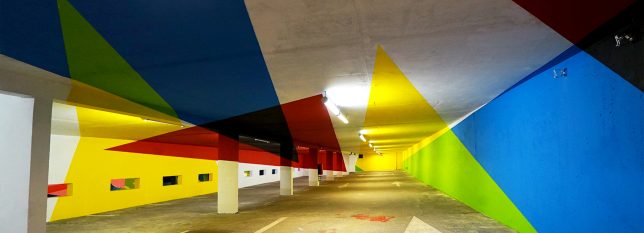
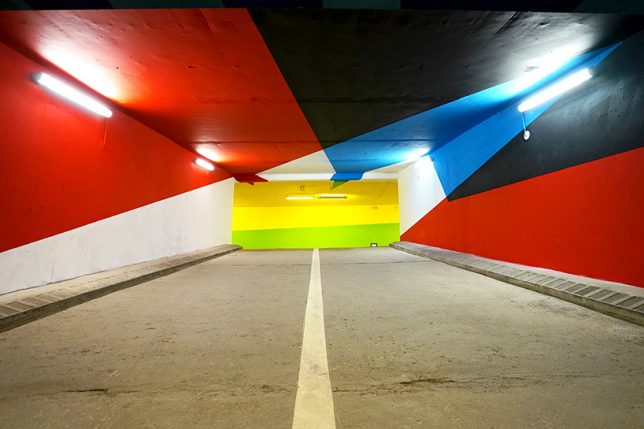
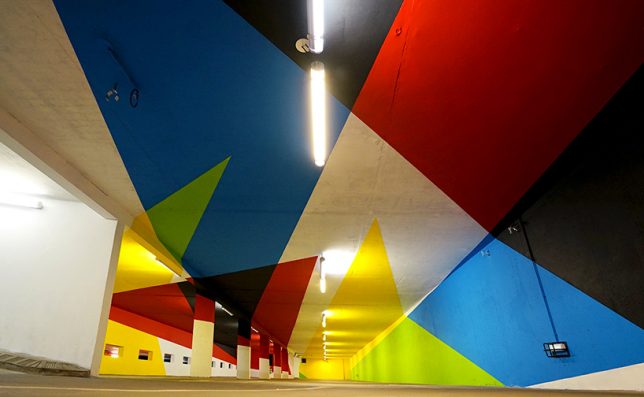
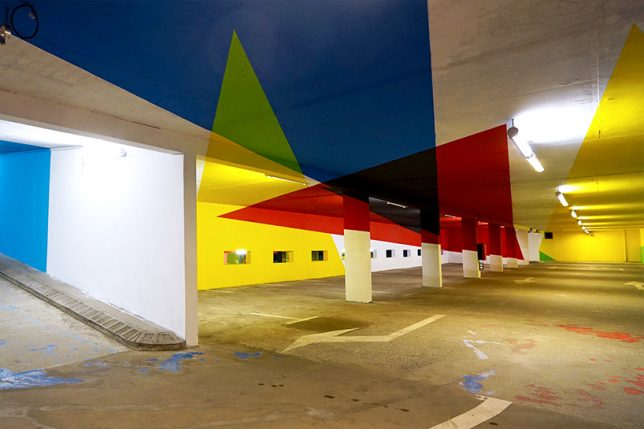
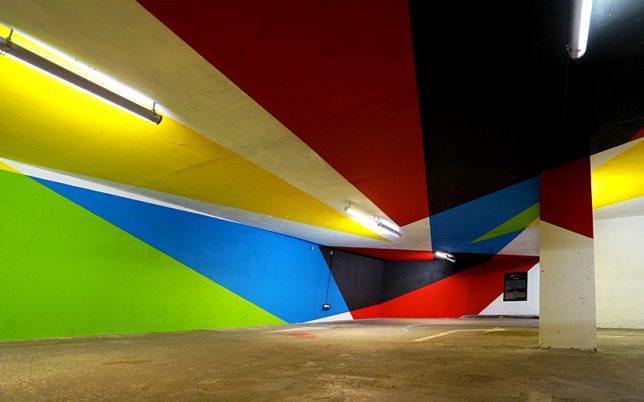
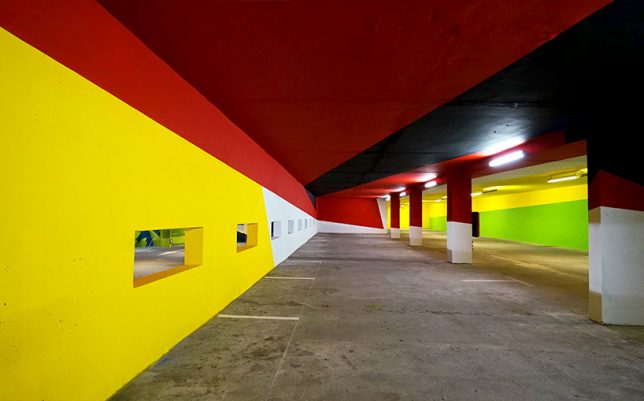
You’re driving through an underground parking garage when suddenly, the colorful geometric shapes splashed all over every surface pop out into three dimensions. Try not to crash your car! When optical illusions line up right, they can be really disorienting, and it’s always cool to see them carried out on a large scale. Argentinian artist Elian Chali got to take over an entire parking lot in the Saint-Gervais Mont Blanc region of France, transforming it into a trompe l’oeil canvas.

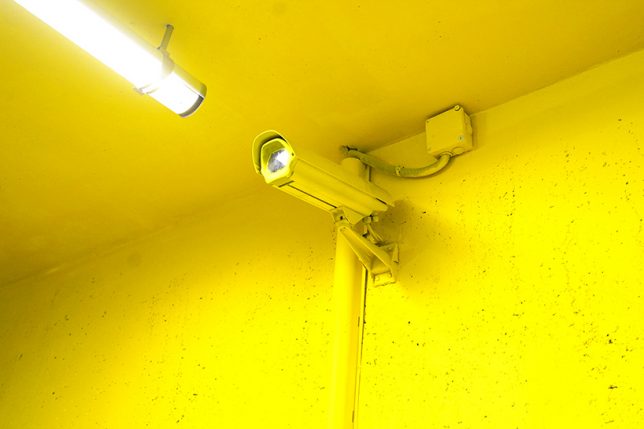
“This artwork, which uses basic geometry and primary colors, makes use of the architectural factors where it inhabits,” says Chile. “Each element adopts a new function and the space becomes a huge sculpture. The relationship with the environment is not easy to achieve, therefore not only the walls will be intervene, but the painting will invade everything that you find in your way in order to offer to the users of the parking, the possibility of breathing inside a work of art.”


It’s a pretty cool effect, with some triangles stretching dozens of feet and crossing ceilings, support pillars and walls to end on the floor. Presented by 2KM3 Contemporary Art Platform and curated by Hugues Chevallier and Zoer, the piece comes together as an optical illusion when you hit just the right spot while driving through.

Chali is known for applying his signature vivid style to buildings around the world in the form of massive murals, often taking up entire multi-story facades. Each one takes its respective environment into account in its composition, paying homage to the history of the building and its setting, the materials it’s made of, and the ways in which it has aged or weathered. Keep up with his work on Instagram.

Share on Facebook


[ By SA Rogers in Art & Installation & Sound. ]

[ WebUrbanist | Archives | Galleries | Privacy | TOS ]


WebUrbanist

 
Comments Off on Underground Illusions: Anamorphic Parking Lot Turns Flat Paint into Sculpture

Posted in Creativity


Hiking Cameras Compared

06 Jul

If you’re looking for the best hiking camera to take with you on your future treks, then you’re going to need one that’s fit for hiking. There’s a difference between a good camera and a good camera for hiking, and this is what this guide is going to be able to answer for you. First, we need to look at Continue Reading

The post Hiking Cameras Compared appeared first on Photodoto.


Photodoto

 
Comments Off on Hiking Cameras Compared

Posted in Photography


Motorola shows off ‘DSLR’ and 360° camera Moto Mods at Ghana event

06 Jul

Motorola has big plans for Moto Mods—the company’s snap-on accessories for the modular Moto Z smartphone. The company recently showcased some new Moto Mods at an event in Ghana, and according to TechDroider they included a 360-degree camera mod and a ‘DSLR’ mod with interchangeable lens support.

Popular leakster Evan Blass also recently tweeted a photo showing the alleged 360 camera Moto Mod unveiled in Ghana:

Assuming the 360 camera mod leak shows the actual product, the Moto Mod will feature a dual-lens camera module attached to the top of the Moto Mod, which itself attaches to the back of the Moto Z smartphone. The ‘DSLR’ mod is a bit more of a mystery, appearing in one very rough photo from TechDroider as a Moto Mod with a mount for attaching removable lenses.

No further information about either mod—including specs, pricing or availability—are known at this time, but we’ll keep you updated. Chances are good the products won’t stay exclusive to the little country of Ghana.

Articles: Digital Photography Review (dpreview.com)

 
Comments Off on Motorola shows off ‘DSLR’ and 360° camera Moto Mods at Ghana event

Posted in Uncategorized


Tread Lightly: 16 Clearly Stunning Transparent Floor Designs

06 Jul

[ By SA Rogers in Drawing & Digital. ]

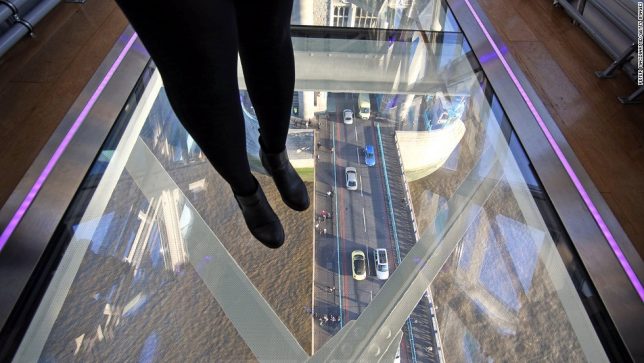
Glass floors give us a glimpse at what’s beneath our feet – whether that’s the historical bones of a building, a swimming pool on the next floor, the city streets or the bottom of a canyon – while freaking us out over the potential of breakage. And yes, sometimes these glass floors really do crack, no matter how ‘unbreakable’ they’re supposed to be, including those situated hundreds of feet above the ground.

2 Glass-Bottomed Bridges in China

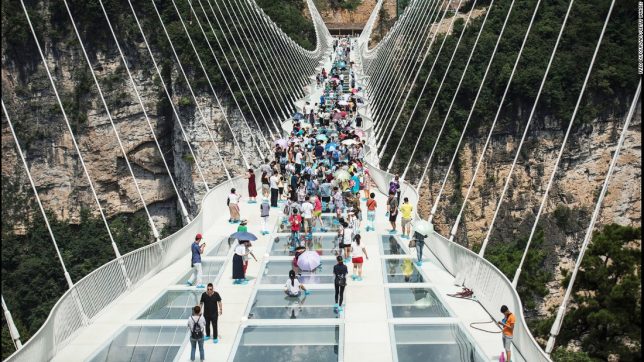
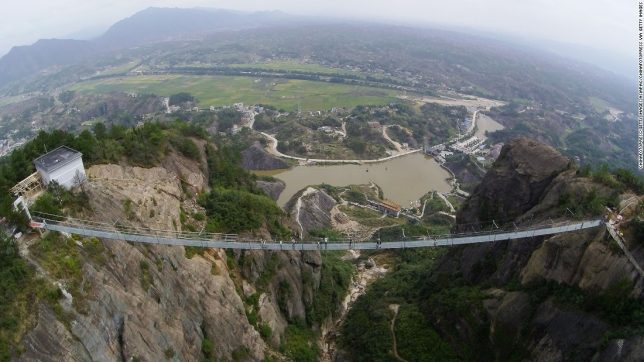
You’d better not be afraid of heights if you’re gonna cross this glass-bottomed bridge in China, suspended a stomach-turning 590 feet above ground level in China’s central Hunan Province. Known locally as Haohan Quiao, the bridge features glass panels measuring 24 millimeters thick, which are supposedly 25 times stronger than regular glass. But this isn’t the only such bridge in China. The second is the structure hanging 1350 feet over the bottom of Zhangjiajie Grand Canyon – and this bridge really did crack at one point under an unexpected volume of visitors, forcing its closure. This one is officially the world’s longest glass bridge.

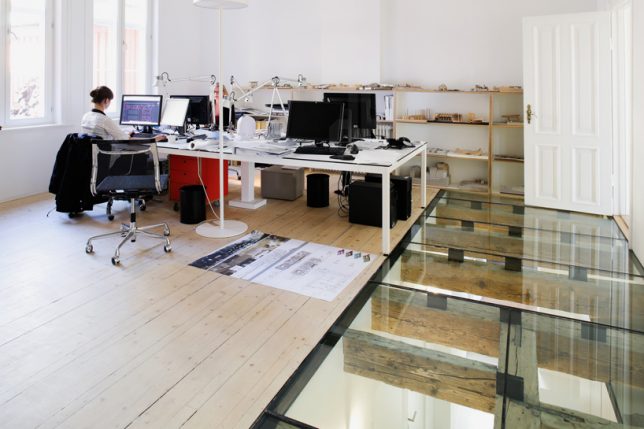
Office in Oslo by Reiulf Ramstad

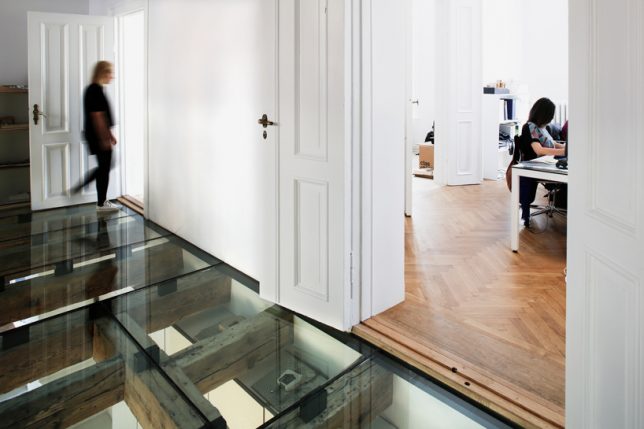
A 19th century villa gets a modern update by architect Reiulf Ramstad, while this transparent section of floor reveals the old beams hidden beneath the newer materials for a reminder of the building’s history.

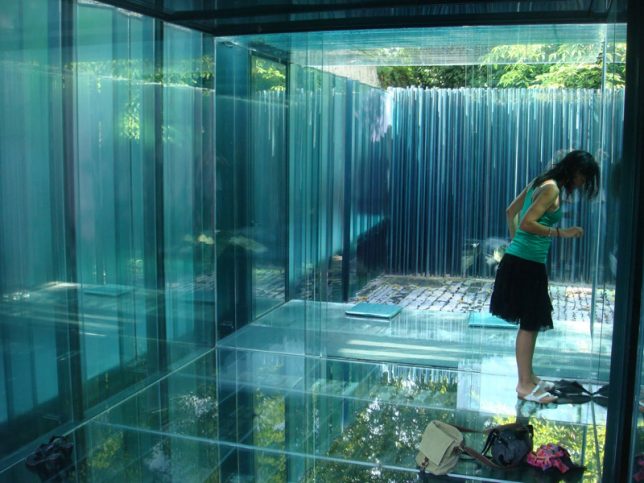
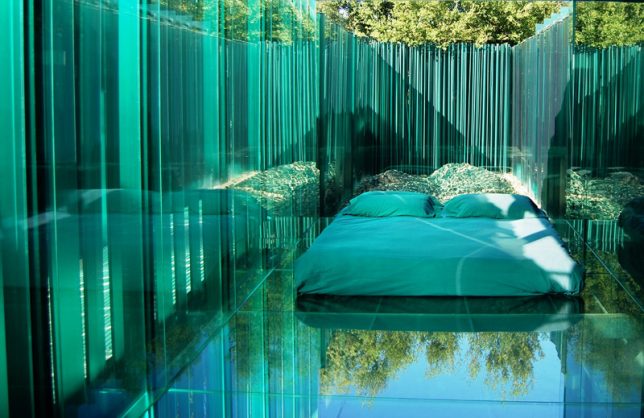
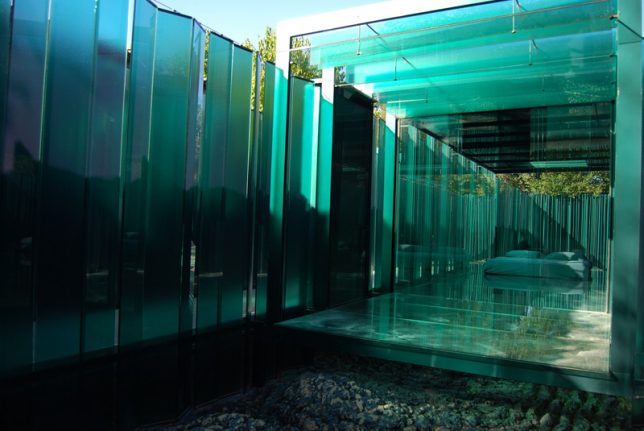
Hotel Les Cols Pavellons

You’d never guess that just beyond the traditional-looking 13th century farmhouse at hotel Les Cols Pavellons in the Catalan town of Olot is a series of ultramodern glass pavilions. These ‘zen’ hotel rooms are like crystal cubes housing almost nothing but a bed, a glass table and chairs and a bath for a minimalist experience that’s all about experiencing the design.

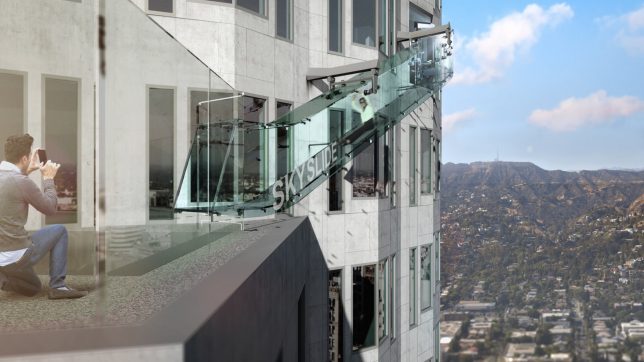
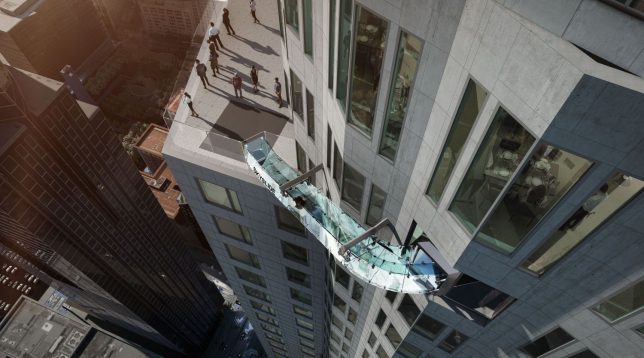
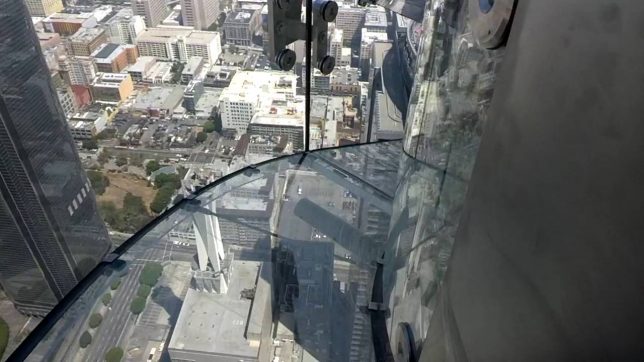
Glass-Bottomed Sky Slide in Los Angeles

More than just a glass-bottomed observation deck, which is becoming more common all over the world, this attraction at the U.S. Bank Tower in downtown Los Angeles is a fully functioning slide that chutes guests 45 feet from a window on the 70th story to a terrace on the 69th.

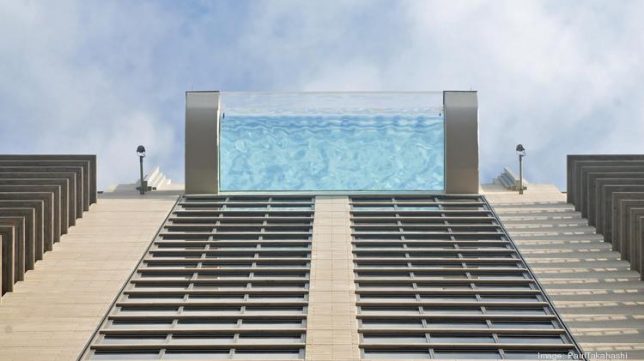
Glass-Bottomed Suspended Pool in Houston

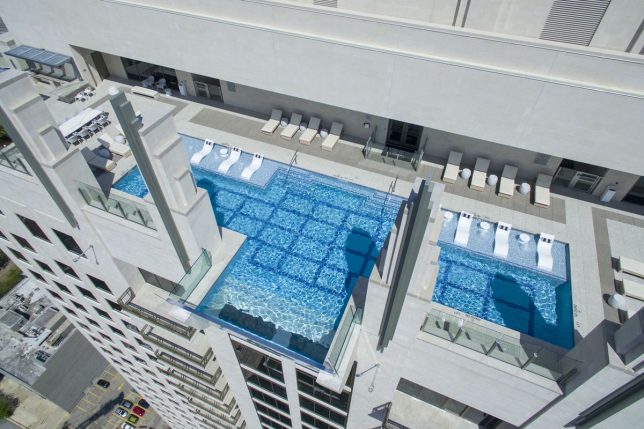
Houston is home to an awesome plexiglass pool that cantilevers 10 feet past the edge of the building, 500 feet above street level. Installed at the new Market Square Tower apartment building by Jackson & Ryan Architects, the skypool offers views of the Houston skyline, and stops passersby in their tracks on the sidewalk below.

Next Page – Click Below to Read More:
Tread Lightly 16 Clearly Stunning Transparent Floor Designs

Share on Facebook


[ By SA Rogers in Drawing & Digital. ]

[ WebUrbanist | Archives | Galleries | Privacy | TOS ]


WebUrbanist

 
Comments Off on Tread Lightly: 16 Clearly Stunning Transparent Floor Designs

Posted in Creativity


FAA may develop a remote drone identification system for law enforcement

05 Jul

Despite present drone regulations in the US, identifying the operator of any given drone in the sky is nearly impossible, making it difficult for law enforcement to deal with drones that are being misused. To address this issue, the Federal Aviation Administration has developed the new UAS Identification and Tracking Aviation Rulemaking Committee (ARC), which just recently wrapped up its first meeting.

According to the FAA, this initial meeting was used to discuss law enforcement concerns related to drones, to present regulations concerning drone tracking and identification, as well as possible legal issues and air traffic drone management. Existing drone ID tech was reviewed, and ‘preliminary…identification parameters’ were created.

Speaking on the behalf of unnamed sources, Recode reports that law enforcement agencies are concerned about their inability to identify drones from the ground; this concern has reportedly delayed an FAA proposal related to flying drones over people. The FAA is said to be using this committee to develop a system in which law enforcement will be able to identify a drone from the ground, addressing the agencies’ concerns.

Such a system may involve the drone itself broadcasting its identification to a law enforcement system, enabling police to ID the drone’s operator or, at the very least, its owner. Such an identification system would likely require small non-commercial drones to be registered, however, marking a deviation from current drone regulations.

At the moment, only commercial drones must be registered with the FAA.

Articles: Digital Photography Review (dpreview.com)

 
Comments Off on FAA may develop a remote drone identification system for law enforcement

Posted in Uncategorized


Panono no more: 360-degree camera maker sold after ‘amazing but also exhausting journey’

05 Jul
Jonas Pfeil demonstrates the size and design differences between the working prototype Panono camera (right) and the design model of the final production unit (left). In a letter to backers he has confirmed that the company is to be sold, after only delivering around 400 cameras.

It’s official: Panono, maker of an innovative 360-degree camera, is to be sold after only managing to deliver around 400 cameras to its backers. The company filed for bankrupcy in May, but in a letter to backers, co-founder Jonas Pfeil has confirmed that the sale of Panono’s assets is expected to be finalized very soon.

As he explains, ‘assets’ in this context means ‘inventory, software, the rights to the hardware, almost all employee contracts, IP rights etc., […] but not the obligations towards external parties’. External parties like the Indiegogo backers that funded the Panono camera. In other words: if you backed Panono and you didn’t get your camera yet, you’re officially out of luck.

Thanking backers for their support and understanding, Pfeil called the experience ‘an amazing but also exhausting journey’. He stressed that, as shareholders, ‘the [outgoing] founders will […] not profit from this sale, as the money will be used by the insolvency administrator to pay outstanding invoices and other debt first.’

Meanwhile, there’s some good news for the 400 or so backers that did get their cameras – after some initial uncertainty, it seems that the cloud service supporting the device will continue to be maintained.

We really liked the Panono when we tested it last year, and we’re sorry to see it go. Were you one of the backers? Did you receive a camera? We’d like to hear from you.

Read our review of the Panono 360-degree camera (July 2016)

Articles: Digital Photography Review (dpreview.com)

 
Comments Off on Panono no more: 360-degree camera maker sold after ‘amazing but also exhausting journey’

Posted in Uncategorized


Domke F-803 and F-5XB review

05 Jul

Domke F-803 & F-5XB Shoulder Bags
$ 80-150/£63-118 | www.tiffen.com | Buy Now

The small camera bag has long had a place in the hearts of serious photographers. Yes, most of us all have giant backpacks, bags and even hard rolling cases that get used for the ‘big’ jobs. But many of us also appreciate the ease of a small, unobtrusive shoulder bag and the simplicity it represents. Could it be the long memory of the classic National Geographic photographers and their Leica rangefinders? Or is it just that we’re tired of breaking our backs with big F2.8 zoom kits all the time?

For almost 40 years now, Domke has been in the business of making no-nonsense hard-wearing bags for photojournalists and working photographers. Unsurprisingly, many of their bags quickly found favor with enthusiast photographers as well. This has been particularly true of some of their smaller bags. The satchel style F-803 and the compact shoulder bag F-X5B are two examples of smaller Domke bags that have been popular with many photographers. In fact, a black canvas F-803 was one of the first camera bags I owned and it has seen many miles of use with rangefinder, and nowadays, Micro Four Thirds gear.

Specifications

F-803

  • Exterior: 34.29 x 8.89 x 24.5 cm / 13.5 x 3.5 x 10.0″
  • Interior: 30.48 x 7.62 x 22.86 cm / 12.0 x 3.0 x 9.0″
  • Weight: .89 kg (1.9 lb)

F-5XB

  • Exterior: 25.4 x 11.4 x 18.4 cm / 10.0 x 4.5 x 7.25″
  • Interior: 24.1 x 10.2 x 15.2 cm / 9.5 x 4.0 x 6.0″
  • Weight: 0.56 kg (1.2 lb)

Both bags come in most of the combos of classic Domke canvas (sand, black, olive) as well as their newer RuggedWear waxed canvas (brown, military green). Some special editions such as those for Fujifilm or Best Buy (the green RuggedWear bags pictured here) may have leather trim/accents.

In use

F-803

The F-803 has a single main compartment with light padding. It is most typically sold with a single padded insert, the FA-280. There are two pockets on the front of the bag with velcro closures sized for small accessories such as batteries or a cell phone.

There is also a document pocket along the back however, this pocket has no closure and as such, you may not want to put anything of value or that could be damaged if it fell out. That said, I typically find it useful for maps, papers and a pen or two.

The main section is covered by a flap closure with a single metal buckle and a stiffening bar with a handle along the top. I find the single buckle simple to operate with one hand and this makes access quick and easy. The handle is very useful, but due to the fact that it attached to the flap itself, it doesn’t work as well if the buckle isn’t clipped.

Photo courtesy Tiffen

The stiffening bar is a little unfortunate as it does not allow the bag to conform to your body as well as it might otherwise, but it is a minor issue and if it really bugs you can be removed with a minor bit of ‘bag surgery’. To be honest, while I’ve thought about it from time to time, I’ve never gotten around to bothering to remove the one in my bag.

The F-803 is very lightly padded on the sides and bottom, with no padding on the front or back. The pockets on the front provide a measure of protection as does anything you have stuffed into the back document pocket. But it cannot be stressed that this bag, like many of Domke’s bags, is not for those who require complete protection for their gear.

As you might expect, storage in a bag this slim is going to be tight. The F-803 is sized well for just about any mirrorless system. A DSLR will work, I’ve even used a 6D in there. But it gets a bit tight for my taste, particularly with zoom lenses, and I would encourage you to try before you buy if this is your intended use. The FA-280 doesn’t help matters. Because of its narrow and full-height design, it can really only reasonably fit a mirrorless body with a slim to medium sized prime lens.

Storage in a bag this slim is going to be tight

My solution was to attach the insert over to the left or the right and then put my body/lens into the open space and an extra lens into the insert. One thing I particularly liked about this layout is that my body lays on its side and I felt like this made it quicker to grab the grip and start shooting.

Another solution that is popular, but I myself have not tried, is to purchase the Domke FA-230 insert.The FA-230 is a three compartment design with dividers that are not full-height. This allows you to insert many body + lens combos in a lens-down orientation. The FA-230 will run you an extra $ 23, however. It is also more padded than the F-803 itself and while this does give you additional protection, it also takes up internal space and makes the bag feel bulkier.

The F-803’s biggest asset is its slimness and light padding. On a crowded subway or slipping through a crowd at a sold-out concert, you won’t feel like you’re at risk of smacking people with your camera bag at every turn. This can also be a drawback as the F-803 will not stand up on its own in most situations; if you try to set it down, it will topple right over. Couple this with the fact that the light padding doesn’t give all that much protection, and you have to understand that you can’t go tossing it around like you might with a bulkier bag.

It also doesn’t look much like a camera bag at all, If anything, it looks like a small messenger or laptop bag. Now, is a laptop less enticing to thieves than a camera bag? Who knows. But for those who don’t want to look like they are carrying a camera bag, the F-803 has you covered.

F-5XB

First off, it must be pointed out that the F-5XB is quite a small bag. While it may be possible to use the F-5XB for a small DSLR, this bag is really a better bet for mirrorless system users. An Olympus Pen and a few lenses fit perfectly. The front back and bottom of the bag are lightly padded with sewn-in foam, the sides are unpadded. The strap is Domke’s standard canvas-with-rubber-threads ‘gripper’ style that you will either love because it stays on your shoulder or hate because it won’t slide around your body.

Photo courtesy Tiffen

Two dividers are included and realistically, I’m not sure you need more in a bag this size. Access is via a velcro flap cover with an additional zipper that can be closed or left open. The zipper is big and easy to use with quality YKK teeth/pulls. Honestly, I rarely use the zipper –only when I’m not going to be using the camera for a bit and want an added measure of protection against anything falling out.

There is also a belt-strap pass-through on the back in case one wants to make the F-5XB into a waist/hip bag instead of a shoulder bag. I can’t imagine using this myself, but others may feel differently. I would have preferred to see that area used for another small pocket or two. On that note, organizational pockets are at a premium on the F-5XB, with just one on the front of the bag that can’t hold much more than a couple pens or a spare battery.

I’ve rarely used bags this small in the past. They seemed too little and purse-like for me to fit into either my gear organization or shooting style. Even when I was using tiny Leica rangefinders back in my film days, I preferred something like the F-803 over a little box like the F-5XB. But now, a few years (and camera systems) down the road, I find myself surprised as just how useful the F-5XB is in some situations. It’s a handy ‘grab and go’ size for taking to a picnic, birthday party, or wedding where you aren’t worried about ergonomics or stealth and just want a way to carry a body and lens or two.

I find myself surprised as just how useful the F-5XB is in some situations

What was even more of a surprise to me was how useful it was for stashing in my luggage for a business trip. I frequently take a camera and a couple small lenses on even the most boring of trips. But I typically have them in my overloaded laptop messenger or backpack carry-on. Bringing the F-5XB along meant that I could lighten my load and just use it for a morning or evening photo adventure. It’s a use I wouldn’t have thought to specifically get a bag for otherwise, and the F-5XB worked perfectly for the task.

The strong velcro on the flap is the most common ‘dislike’ mentioned by photographers about the F-5XB, and I’d have to agree. The amount of velcro is overkill for the size and use of the flap.

This is an instance where it would have been nice to see the velcro ‘silencers’ used on some of Domke’s newer bags. Or, even better, the ‘silent’ velcro that Tenba uses on some of its bags.

Perhaps more strangely, for some reason, the velcro on the flap and bag doesn’t line up when the flap is folded over. I’m not sure if this is a design feature or a bug, but it is odd. I suppose one advantage is that less of the velcro is engaged, making for less of a rrrrrriiippp sound when you open it?

It’s also a bit of a shame that a bag of this size and design doesn’t have a grab handle of some sort. If my use is any guide, there are going to be a lot of times when you aren’t using this bag on your shoulder and are just grabbing it to pick up or set down. I think if I were going to use this bag a lot, I would fashion one of the basic webbing-style handles like those on the Domke J2/F2/etc that clip onto the strap rings.

There is no avoiding the fact that the style of this bag won’t appeal to some

Finally, there is no avoiding the fact that the style of this bag won’t appeal to some, as it looks very much like a ‘camera bag’. A nondescript camera bag, to be sure, but a camera bag nonetheless. In fact, the only other thing you could perhaps convince someone that it was, is a small purse. Either way, it’s not going to suit some photographers for this reason alone. Us camera nerds can be a picky bunch.

What’s the bottom line?

First things first, as I’ve repeated a couple of times, these are small basic bags that feel more at home with mirrorless systems than even compact DSLRs. They do not have expanding water bottle pockets or laptop sleeves or weight distributing straps. Anyone looking for all-day comfort or highly customizable organizational options will be disappointed. They are for unobtrusively carrying a small camera kit and little else, in a tough non-descript package. But what they do, they do quite well, and if my experience is any guide, will keep doing so after years of hard use.

Anyone looking for all-day comfort or highly customizable organizational options will be disappointed

While the two bags aren’t exactly similar, I will say that the F-803 is the clear winner here for me as far as a small bag for a mirrorless system. This is not surprising when you consider the fact that I’ve owned and used an F-803 for the better part of two decades now. While the F-5XB was handier than I thought it would be, I can’t say that it fits my needs as well and I find its design in need of some updating. That said, it is a quite popular bag and I’m likely to hear about how wrong I am in the comments. So, read both sets of opinions and come to your own conclusion based on what your requirements are.

F-803

What we like:

  • Slim
  • Very nondescript
  • Easy access with a single buckle closure
  • Proven simple tough design
  • Made in the USA

What we don’t like:

  • Can’t stand up on its own
  • Not much padding
  • Few organizing pockets

F-5XB

What we like:

  • Compact size
  • Zipper close is easy to use, single flap is easy to open
  • Can use as an insert inside luggage when traveling
  • Made in the USA

What we don’t like:

  • Too much velcro on flap, yet doesn’t line up properly
  • Appearance will not suit some
  • Not for large cameras/lenses
  • Only a single small pocket
  • No top handle

F-803

F-5XB

Articles: Digital Photography Review (dpreview.com)
 
Comments Off on Domke F-803 and F-5XB review

Posted in Uncategorized