RSS
 

Archive for May, 2017

SID is a 3D camera that promises shake-free VR videos

13 May

Chinese company Weeview, maker of the Eye-Plug camera dongle for Android phones, has launched a Kickstarter campaign for a 3D camera. The new SID model features a pair of stereoscopic cameras that, when used together, produce 3D videos suitable for VR applications and headsets. Weeview says its new camera produces ‘shake-free’ footage, and that the stereoscopic effects can be adjusted with a mobile device during post-processing.

The SID camera works in conjunction with a mobile app that supports live 3D video streaming, as well as functions like ‘Auto Follow’ for tracking a subject in the video and ‘Highlight’ for zooming in specific parts of the shot. The model offers a total maximum video resolution of 2880 x 1440 (3K) at 30 fps, as well as 32MP 8064 x 4032 still photos. Both sensors sport an F2.4 lens with a 160-degree field-of-view. The camera itself contains 802.11n WiFi for wireless connectivity, micro USB for charging, and a microSD card slot for content storage.

Joining SID is the SID Camera Kit, a bundle that includes a motorized handheld gimbal and a smartphone mount. The gimbal can pan 320-degrees, roll 120-degrees, and tilt 320-degrees. Weeview says its new camera is also compatible with GoPro gimbals. 

The SID camera is currently being offered to Kickstarter backers who pledge at least $ 179, while the gimbal is included in the bundle for backers who pledge at least $ 269. Shipping to these backers is estimated to start this upcoming August.

Via: Kickstarter

Articles: Digital Photography Review (dpreview.com)

 
Comments Off on SID is a 3D camera that promises shake-free VR videos

Posted in Uncategorized


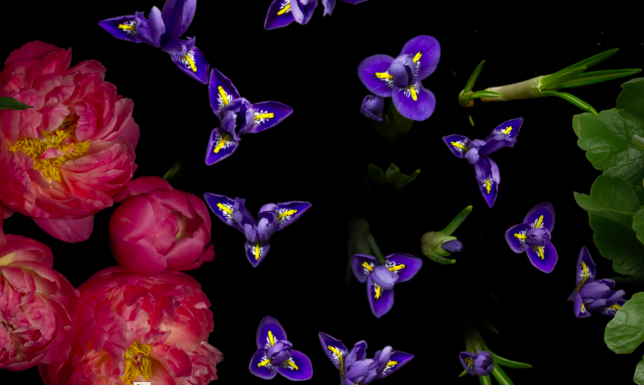
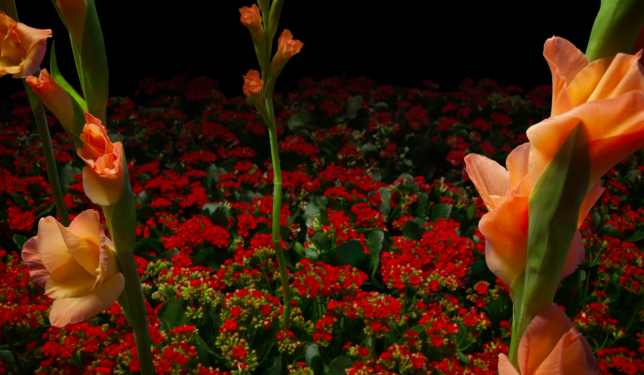
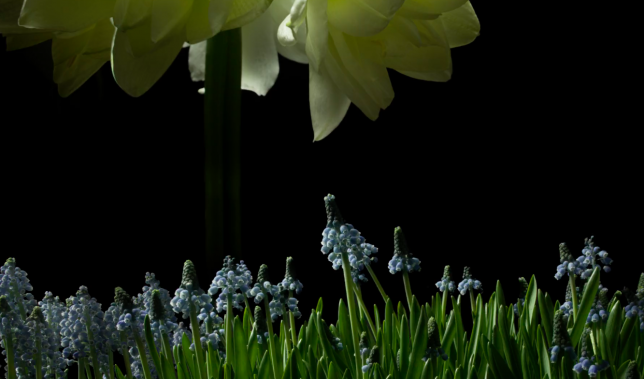
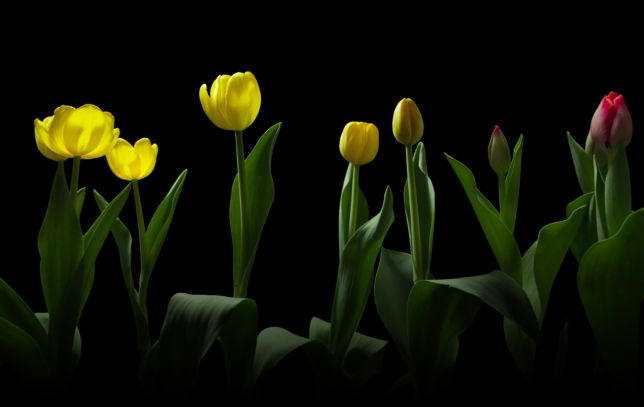
Spring on Speed: Time-Lapse Video Captures 3 Years of Blooming Flowers

13 May

[ By SA Rogers in Art & Photography & Video. ]

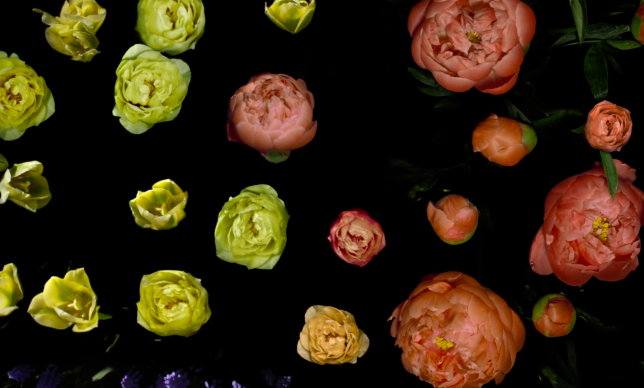
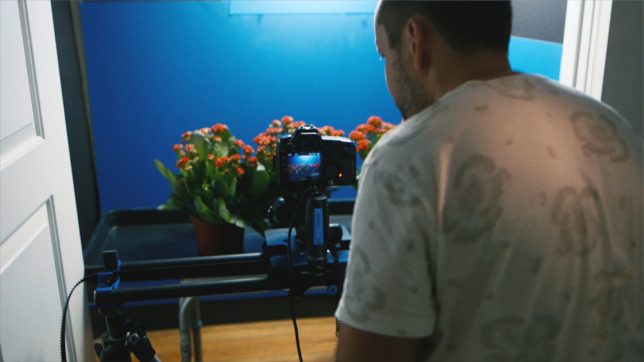
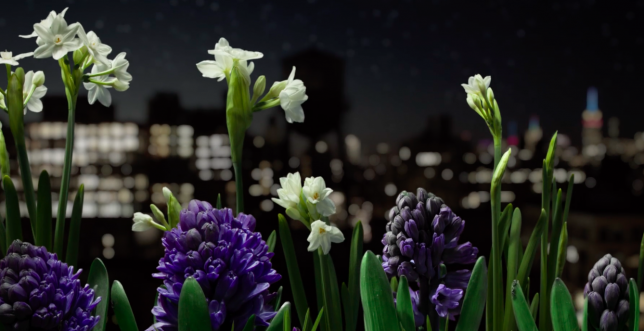
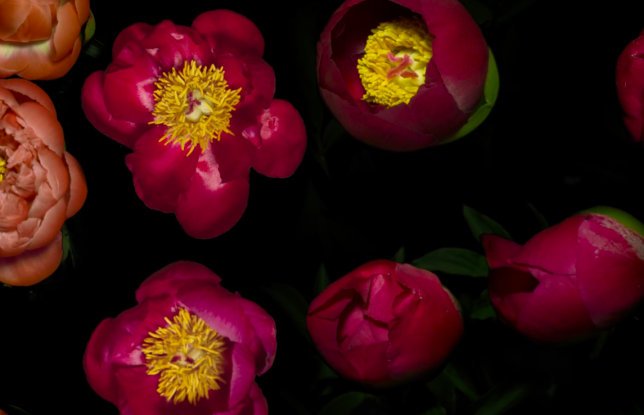
A single sweeping shot seems to capture an entire spring season of blooming flowers in this artfully directed time-lapse video, which took three years to record and complete. Filmmaker Jamie Scott captured almost all of the footage on a soundstage in the closet of his New York home, often against a black backdrop, placing the flowers in stark relief as they unfurl.

The sped-up result almost makes them look like sea creatures waving around under the sea, tentatively opening and then closing again as the camera passes over them. Scott started out filming the flowers from the front, but realized the effect was more dramatic if he shot them from above instead, shifting focus as he went.

In a behind-the-scenes interview with F-stoppers, Scott explains that he made the film in contrast to his previous time-lapse work entitled Fall. The difference between the two films isn’t just the season, but also the close-up shots, shallow depth of field, classical score and placing the camera on a slider.

Share on Facebook


[ By SA Rogers in Art & Photography & Video. ]

[ WebUrbanist | Archives | Galleries | Privacy | TOS ]


WebUrbanist

 
Comments Off on Spring on Speed: Time-Lapse Video Captures 3 Years of Blooming Flowers

Posted in Creativity


Upper Yosemite Falls Moonbow – Getting The Shot

12 May
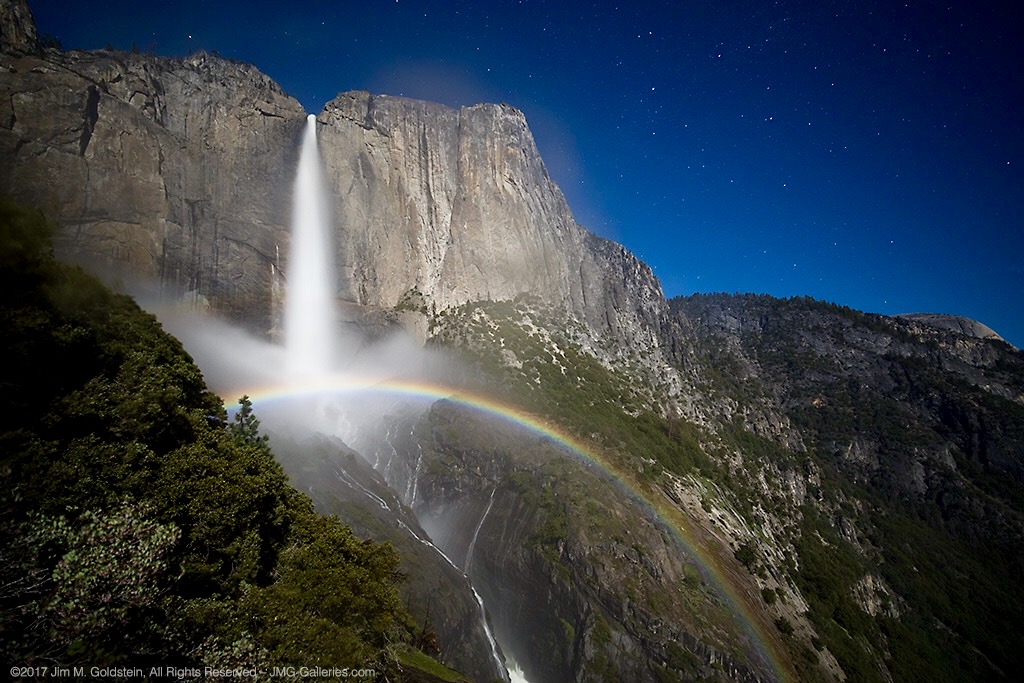
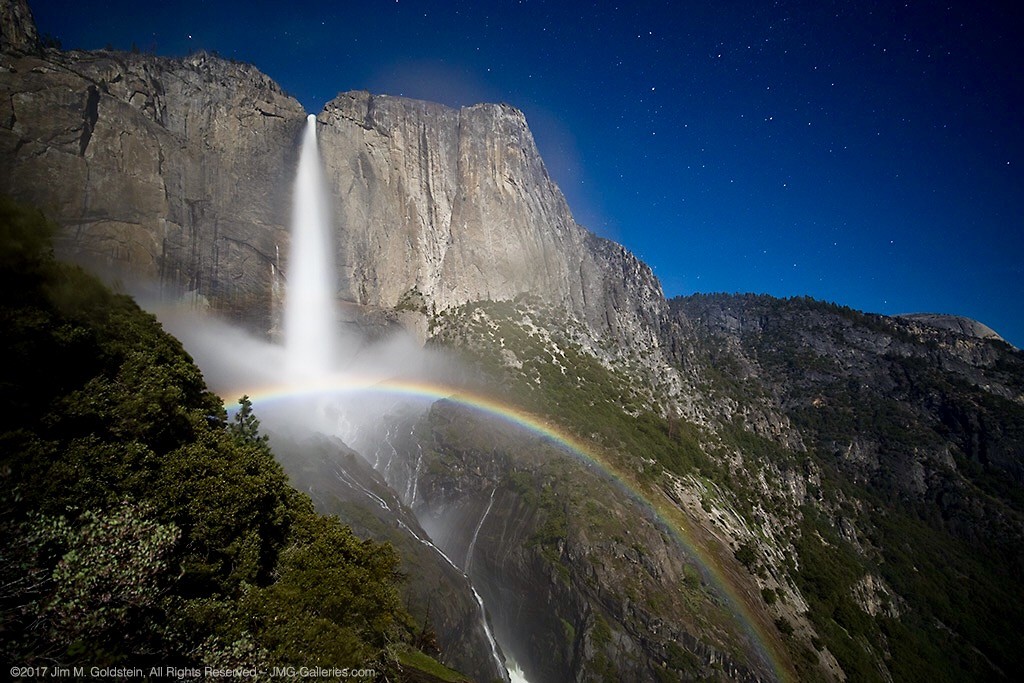
Upper Yosemite Falls Moonbow - May 9 2017

A large moonbow arcs across the mist from Upper Yosemite Falls, Yosemite National Park

There are quite a few photos in my portfolio that I look back upon and question my sanity due to the absurd conditions I’ve endured to capture them. This particular photo is up there on the insanity scale.  This past winter has seen extraordinary snowfall levels in the Sierras and now that Spring has rolled around the water levels are quite high in Yosemite Valley due to the snow melt.  That translates to huge waterfalls and under the right conditions moonbows (rainbows at night via moonlight).

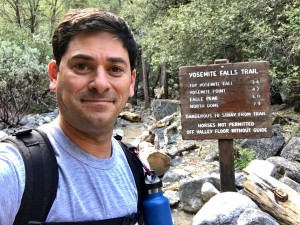
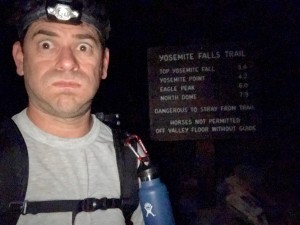
I’ve taken moonbow photos from the Upper Yosemite Falls trail several times, but this year was like none other. I took up position in a new spot this year with a good friend Brian Hawkins. Our hike started off innocently enough with a hike that started at 4:30PM and later ended at 5:30AM. The reason for the long duration of the shoot was a combination of bringing a lot of gear (3 Canon DSLRS, 2 tripods and 4 lenses plus extra layers of clothes) and the interest in shooting multiple time lapses + stills. Time lapse sequences run a couple hours and the moonbow wasn’t going to appear until 11:30PM.

Start of the Upper Yosemite Falls moonbow hike (4:30PM)
End of the Upper Yosemite Falls moonbow hike (5:30AM)

Now that I type it all out It really is rather nuts. I of course don’t think this before the hike because I have selective memory issues or quite simply my elevator doesn’t go to the top floor when it should.

Hiking with a full photo backpack means slow going on a hike that is 1.5 miles with a 1250 foot elevation gain. Leaving “early” affords me the time to properly stake out the right location, set up all 3 camera, eat and start shooting. On the way up the focus is squarely on the task at hand and making it to the setup spot early.

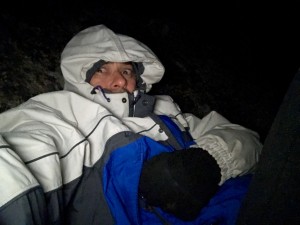
Waiting in heavy mist and gusty winds.

Are we having fun yet? Waiting in heavy mist and gusty winds. Only 4 hours to go.

The most painful part of the excursion is the wait. This year this was particularly true given the setup spot quickly became inundated with heavy mist from the falls when the wind kicked up (10mph gusts). Without exaggeration we were waiting in a windy rainstorm. A sane person might consider moving to avoid the heavy mist, but once you’ve invested the time to setup multiple cameras and climb down steep side trails it quickly becomes a less attractive option. This of course was constantly second guessed through out the night as conditions remained miserable. Eventually we called uncle and left the cameras running but took shelter an 1/8th of a mile away on the main trial to stay dry.

So what does one think during the hours of waiting for the moonbow to appear and during the moonbow sequence run? Let me tell you in order of thought.

  1. I am so freaking wet and cold.
  2. I should have brought more layers to stay warm and dry.
  3. It’s so wet I’m not sure any of this footage will come out.
  4. I don’t think I could have carried anything more.
  5. What the f*ck are you thinking that this would be a good idea!
  6. I’ve never seen conditions so good for moonbows, but it’s too good. There’s too much water.
  7. What was that noise!? F*ck it better not be a mountain lion. Crap it was just my jacket hood rubbing against my head.
  8. I can’t feel my fingers. I should use those hand warmer things. Cr*p they’re in my camera bag back in the heavy mist. Forget it I’d rather have cold hands than get wet again.
  9. I wonder if my batteries died. I better go check.
  10. Upon returning repeat all the above thoughts
  11. I am so freaking cold. I am never going to do this again. I don’t know what I was thinking.
  12. Now that it’s so wet and windy how am I going to retrieve all my gear
  13. Holy sh*t! I can’t believe I’m here at 3AM

Then after all of this I get to my camera to see the most amazing sight, Yosemite Falls roaring full of water with the biggest moonbow I’ve ever seen. All those earlier thoughts are lost as I get more stills taken. The results, like the photo above, are like a narcotic that wipes my mind clear. With the photo high in place packing up is less cringeworthy albeit still miserable. Trying to remember, pack and not leave behind gear and accessories for 3 cameras is tough enough, but particularly mentally challenging when cold and tired. Fortunately years of experience and more importantly being a little too anal for my own good make this a little easier.

Unlike years past the extra effort of trying to dry off gear took some extra time. It also required another round of gear packing. By the time this was all complete the hike down could begin at 3:50AM.

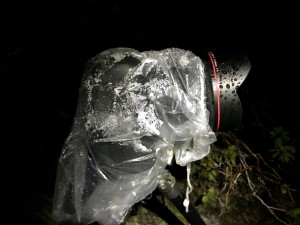
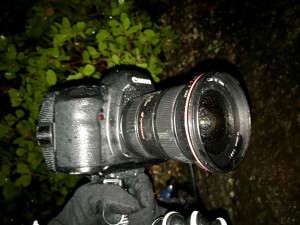
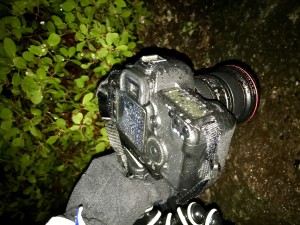
Canon 5D Mark IV + Canon 11-24 drenched from the heavy mist off the falls.
Canon 5D Mark II + Canon 16-35mm Mark II drenched from the heavy mist off the falls.

The hike down was cold, but dry and thus in my mind warm. On the way down thoughts of mountain lions hiding in the shadows quickly subside, instead focusing on not twisting an ankle due to fatigue or carelessness. Also important is to not step on the many millipede that crawl across the trail. In between dodging millipedes I’m left wondering how well my footage and still came out. Cold and tired I’m thinking it’s doubtful anything could have come out and back to questioning why I thought this was a good idea.

Fast forward 7 hours as I write this and it’s become apparent several shots came out, but I won’t know how much until I’m back home. Between three cameras it’s likely it worked out. I really shouldn’t do this again, but come next year I’m sure all this will be mentally blocked and I’ll be making a similar hike / moonbow shoot just like I did in 2011, 2012, 2013, 2014, 2016 and this year. Apparently I’m a slow learner.

Authors Note: Excuse the typos if any as I typed this on my phone and I’m still very sleep deprived.

The post Upper Yosemite Falls Moonbow – Getting The Shot appeared first on JMG-Galleries – Landscape, Nature & Travel Photography.


JMG-Galleries – Landscape, Nature & Travel Photography

 
Comments Off on Upper Yosemite Falls Moonbow – Getting The Shot

Posted in Equipment


National Geographic highlights early ‘People’ entries to Travel Photographer of the Year 2017 competition

12 May

Travel Photographer of the Year 2017: People entries

National Geographic’s Travel Photographer of the Year competition is open once again for entries, and its editors have shared a few of their favorite early contenders in the ‘People’ category. Submissions are being accepted until June 30th, and a Grand Prize win will get you a ten-day trip for two to the Galápagos Archipelago with National Geographic Expeditions.

Photo and caption by Brandon Kusher / National Geographic Travel Photographer of the Year Contest

Slam Dunk. A basketball player flies high through the air attempting a slam dunk in which he puts the ball between his legs first!

Travel Photographer of the Year 2017: People entries

Photo and caption by Akiomi Kuroda / National Geographic Travel Photographer of the Year Contest

M. Portrait of Miho

Travel Photographer of the Year 2017: People entries

Photo and caption by Jobit George / National Geographic Travel Photographer of the Year Contest

Bridging Generation. A beautiful photo of a father and son sitting in white traditional attire with beautiful blue sky on the day of Eid al-Fitr in a mosque in New Delhi, India. The photo shows the beautiful bond which these two generation have been building up in a very simple and lovable manner.

Travel Photographer of the Year 2017: People entries

Photo and caption by Lorraine Yip / National Geographic Travel Photographer of the Year Contest

Retro Ride. Traveling through Cuba in a vintage 1950 Chevrolet with a speedometer which no longer works. We were passing by the city of Camagey known for its winding streets. The modern American Hawaiian hula figure and yellow taxi cab sign on the dashboard adds to the time travel-esque element of the classic Chevrolet, set against the backdrop of an old and perhaps dilapidated , but not forgotten, Cuba.

Travel Photographer of the Year 2017: People entries

Photo and caption by Hua Zhu / National Geographic Travel Photographer of the Year Contest

Old and Young. This photo was taken in a small village in Wuyuan, China. It estimates that there are about 250 million countryside people living in the big cities. Many young people are making money in the cities, leaving their parents and kids at their hometown.

Travel Photographer of the Year 2017: People entries

Photo and caption by Pradeep Raja / National Geographic Travel Photographer of the Year Contest

Ramadan Prayers. This is a shot of women praying inside Istiqlal Mosque, Jakarta which is the biggest mosque in Southeast Asia during the month of Ramadan.

Travel Photographer of the Year 2017: People entries

Photo and caption by Lauren Breedlove / National Geographic Travel Photographer of the Year Contest

Lady Havana. During a recent visit to Cuba, I encountered this bold woman on the street while strolling around Old Havana. Something about her just struck me, like her eyes held a million stories. Not having any cash on me, I borrowed some change from a friend and approached the woman with it, asking to take her photograph. She nodded and posed like a boss, stogie and all.

Travel Photographer of the Year 2017: People entries

Photo and caption by Mattia Passarini / National Geographic Travel Photographer of the Year Contest

Tibetan’s soul smile. This monk was running back to his room after the afternoon prayer. I was chasing him trying to get a nice shot, but he kept covering his face. In Chinese i called after him: (pai yi zhang ba) “just one shot!” He looked back and started to laugh..
Tashi Lhunpo Monastery, Tibet

Articles: Digital Photography Review (dpreview.com)

 
Comments Off on National Geographic highlights early ‘People’ entries to Travel Photographer of the Year 2017 competition

Posted in Uncategorized


Comparing a 50mm Versus 85mm Lens for Photographing People

12 May

As a writer for Digital Photography School, one of the most frequently asked questions I receive from beginner and intermediate photographers is, “If I have to choose just ONE lens to buy right now, which one should I choose?” We’ve previously discussed the differences between a 24mm lens and a 50mm lens for photographing people, and in that same vein, it’s time for another lens showdown!

lens photographing people

In this article, we’ll be discussing the differences between an 85mm and a 50mm lens for photographing people. Once again, I’ll walk you through several sets of similar images taken with each lens so that you can easily see the differences between the two. Hopefully, you can walk away with a better understanding of which lens might be the best upgrade for you.

To keep things consistent, all images in this article were taken with a Canon 60D, and either the Canon 50mm f/1.8 lens or the Canon 85mm f/1.8 lens. The Canon 60D is an APS-C sensor (cropped sensor) camera, so in order to determine the functioning focal length of these lenses on this camera, multiply the lens focal length by 1.6 (multiply by 1.5 if you use Nikon). So on a cropped sensor camera, the 50mm lens functions roughly as an 80mm lens, and the 50mm lens functions as a 136mm lens.

1. Differences in Depth of Field

lens photographing people

This image was taken with Canon 85mm lens at f/1.8.

One of the biggest differences between the 85mm lens and the 50mm lens is the distance that you’ll need to stand from your subject. With the 85mm lens, the minimum focusing distance is 2.8 ft, and with the 50mm lens, the minimum focusing distance is 1.15 ft.

This means that in general, you will be standing further away from your subject with the 85mm lens, than you will with the 50mm. In turn, this decreases the depth of field, which means that images shot with the 85mm lens tend to have much blurrier bokeh than images shot with the 50mm lens, even when using the same aperture.

lens photographing people

This image was taken with a Canon 50mm at f/1.8.

You can see the difference clearly in the cherry blossoms in the background of the two images above, both of which were shot at f/1.8. The cherry blossoms are fairly well blurred in both images, but the shape of the blossoms is more defined in the image taken with the 50mm lens, and the blossoms are significantly more blurred and creamy in the image that with the 85mm lens.

Of course, everyone has a different preference when it comes to bokeh. Some prefer the more uniform creaminess that the 85mm lens offers, while other photographers prefer to have a little more definition in the background.

lens photographing people

Left: 85mm lens | Right: 50mm lens.

You may even find that you prefer different approaches in different applications! For example, I usually favor the more uniform bokeh of the 85mm lens. However, when I’m photographing in the grass, I prefer the bit of texture which the 50mm lens provides (see the examples above).

This is purely a matter of preference, so start making mental notes about which type of images you tend to prefer when you look at other photographers’ work. If you find that you are always drawn to the creamier texture, then the 85mm lens may be a better fit for you. If you prefer a bit more texture in the background, you may want to consider the 50mm lens instead.

2. Differences in Framing

lens photographing people

This image was taken with 50mm lens.

In addition, spend some time thinking about the content of your backdrops. Using an 85mm lens will result in an image that is more closely framed on your subject. On the other hand, shooting with the 50mm lens will result in an image that includes more of the background (though not nearly as much as shooting with the Canon 24mm lens).

Do you happily hike up to the top of a mountain for a photo session? You might want to consider the 50mm lens in order to more fully capture the trees and vistas in the background behind your portrait subject(s).

lens photographing people

This image was taken in exactly the same place as the previous one, only using the 85mm lens instead of the 50mm.

On the other hand, do you often find yourself trying to disguise the background in your images? Do you shoot on location with backgrounds that are sometimes out of your control and/or unpredictable?  In that case, you may want to consider the 85mm lens.

When you combine the decreased depth of field of the 85mm lens with the closer framing of your subject, the 85mm lens is stellar at creating beautiful portrait images at almost any location.

3. Differences in Shooting Distance

lens photographing people

This image was taken with 50mm lens.

Remember when I said that when you’re using an 85mm lens you’ll be standing further away from your subject than you would be using a 50mm lens? Here’s another reason why that’s important to know, I almost never use my 85mm lens inside our home.

Our house is just over 1,000 square feet, and depending on the room, sometimes I physically cannot back up far enough to use my 85mm lens. Aside from official photography business, it’s important to me to be able to capture little day to day moments of our family, and so having a fast lens that I can use indoors is a must-have for me.

As much as I love my 85mm lens, it just isn’t a great fit for that purpose given the size of our home. Your mileage may vary.

Lens photographing people

This image was taken with 85mm lens.

On the other hand, when we’re outdoors I often prefer my 85mm lens. In that situation, standing further away from my subjects is a good thing. I can let my kids play and have fun without being all up in their business. Having a bit more space between them and the camera means that they’re able to relax more easily, which in turn leads to more genuine expressions and candid smiles.

Conclusion

As you can see, both of these lenses are great for capturing portrait-style images of people – I personally keep both in my camera bag and use them with near equal frequency.

That said, if you’re only able to purchase one lens right now, both lenses have situations in which they outshine the other, so it’s important for you to think realistically about your preferences and the way you’ll use a portrait lens most often in order to get the most bang for your buck!

If you have one of these lenses – which do you use the most for people photography?

The post Comparing a 50mm Versus 85mm Lens for Photographing People by Meredith Clark appeared first on Digital Photography School.


Digital Photography School

 
Comments Off on Comparing a 50mm Versus 85mm Lens for Photographing People

Posted in Photography


Fantastic footage of fjords with the DJI Mavic Pro

12 May

This footage, filmed by CreateOne film production on a DJI Mavic Pro high above Norway has us all checking our vacation days and airline ticket prices. The processing is a little heavy in some places and there’s a couple of odd jello-tastic shots, but it’s well worth the two minutes of your time if you’re looking for a quick break from your day.

Articles: Digital Photography Review (dpreview.com)

 
Comments Off on Fantastic footage of fjords with the DJI Mavic Pro

Posted in Uncategorized


How to Organically Grow Your Instagram Following

12 May

Instagram is unquestionably one of the biggest social networks today, and it’s undeniable that every photographer should have a presence here. But if you’re like me, you’ve probably struggled to amass a following beyond your existing friends and colleagues. So how do you truly (and organically) grow your Instagram following? Here are some tips.

Instagram followers

1. Keep your Instagram posts consistent

When I first started my personal Instagram account, my posts were all across the board. From pictures of my breakfast to photos of a recent vacation or cute dogs I met in my neighborhood, there was no consistency to my Instagram feed. My followers didn’t know what to expect when they looked at my feed, and thus there was no incentive to follow me. As a result, I decided to revamp my approach to Instagram.

My personal Instagram shifted to focus purely on food, restaurant, and event photos as an extension of my professional photography portfolio. Since making this shift, my personal account has seen a drastic jump in followers, as well as interaction with my individual posts. I’ve also built a community of food, restaurant, and event Instagrammers, many of whom I’ve even met in real life at InstaMeets (more on this below). As for my travel photos, those now live on a brand new Instagram account that I’m still growing from scratch. While overall followers for this account are still minimal, interaction with posts has steadily gone up using the rest of the tactics below.

How to Organically Grow Your Instagram Following

The lesson here is that keeping your posts consistent in either style or subject matter will give people a clear incentive to follow you. People will follow you when they’re interested in the photos that you post, so you must give them an idea of what to expect, and when to expect it. Make sure you post at least several times a week, or maybe even more often if you can come up with enough content or have a larger following. Also pick one or two themes to focus your photos on, for example, food photography or travel photography. This will help you pick out relevant hashtags to post.

Use Add Accounts if you have multiple accounts

Many Instagram users are electing to have at least two separate accounts; one for their personal posts, and one for their more professional, targeted posts. If you go this route, Instagram has made it easy to switch from viewing and posting from multiple accounts via Options > Add Accounts. You’ll have to sign in to your second account; afterward, a dropdown menu will appear under your profile name and you can flip between your accounts.

Instagram Add Account

2. Hashtags are key

In order to have your posts be seen on any social network, you have to understand how new content gets discovered. For Instagram, it’s all about hashtags. But don’t just invent hashtags out of thin air. Instead, you leverage existing hashtags that are both relevant to the photo you are posting, and hashtags that have been used by other people. Note that Instagram allows a maximum of 30 hashtags per post, so add as many as you can!

So where do you find relevant hashtags to use? Here are some ideas.

Websta – Top 100 popular hashtags

Check out the Top 100 Popular Hashtags section on Websta. This will give you a sense of how popular certain hashtags are. The more photos or posts that are tagged with these popular hashtags, the more eyeballs are scanning them, meaning there’s a higher chance of gaining more likes for your content. However, you’re also more likely to get spam comments on your posts, which is why you should not only use super popular hashtags but also drill down into more niche hashtags, per the steps below.

Find hashtags on leading Instagram profiles

As mentioned above, it’s important to focus your Instagram posts around specific topics, such as food or travel. Not only does it help you figure out what types of photos to post, but it also gives you ideas of other Instagram profiles to emulate. For example, an account focusing on food photography might look up Instagram handles for leading food publications such as Bon Appetit and Food and Wine. Follow these handles and also study their Instagram posts. Do they use a bunch of hashtags? Consider using them too. And most importantly, check to see if they offer a hashtag that you can use for a chance to be featured on their account. If so, start using it! More details on leveraging Instagram hubs over in

For example, an account focusing on food photography might look up Instagram handles for leading food publications such as Bon Appetit and Food and Wine. Follow these handles and also study their Instagram posts. Do they use a bunch of hashtags? Consider using them too. Most importantly, check to see if they offer a hashtag that you can use for a chance to be featured on their account. If so, start using it! More details on leveraging Instagram hubs over in this article.

Instagram followers Instagram hashtags

Pro tip

It’s totally fine to reuse the same hashtags on your posts, as long as they are relevant to each photo. But instead of typing in your hashtags over and over, consider keeping them in your note-taking app (ie. Evernote) and simply copying and pasting them into your new Instagram posts. Yes, it’s time-consuming, but it is much more efficient than typing in your 30 hashtags to every new post.

3. It’s all about engagement

When it comes to Instagram, you have to give a little in order to receive. While experimenting with my brand new Instagram account, I noticed that simply adding hashtags to my photos simply wasn’t enough. My very first Instagram posts had a bunch of hashtags, but only gained 6 or 7 likes. Suddenly, my third post jumped up to 39 likes. What changed?

Instagram likes

One of my first Instagram photos, posted before doing any interaction.

Immediately after I published that post, I spent five minutes scrolling through my Instagram feed and interacting with as many posts that caught my eye. The interaction was simple in the form of adding likes and a quick comment or emoji. This not only gave me new ideas of accounts to follow but also seemed to bring more people to my profile since the number of likes on my posts immediately skyrocketed. The bottom line; be an active Instagrammer, not only by adding new posts, but also interacting with your followers or new people you discover.

Instagram

Another Instagram photo, posted the same week with many more likes thanks to interaction with other Instagrammers.

4. Attend InstaMeets and Meetups

The absolute best way to organically grow your Instagram followers is to meet them in real life. Thankfully, Instagram has picked up on this and has a section on their site where you can find local InstaMeets or even coordinate one for your area. Also, consider checking Meetup for local Instagram meetups or photography clubs that might hold an Instagram-specific meetup. Attend these events to connect with local photographers, and be sure to follow each other on Instagram and interact with each others’ posts.

5. Cross post on other platforms

One of the best ways to get more viewers (and hopefully follower) of your Instagram account is to put it in front of as many people as possible. There are many ways to do this. Here are a few ideas:

Cross publish to other social networks

When you make a new Instagram post, cross-publish it to other networks such as Facebook, Twitter, Tumblr or Flickr by selecting the respective icons when you create a new post.

Instagram Linked Accounts

Setting up linked accounts on Instagram.

Instagram

Add an Instagram widget to your website or blog

If you have a website or blog, there’s a good chance that you attract brand new visitors via search engines on occasion. Make it easy for these website visitors to connect with you on social media platforms like Instagram by embedding your feed into your website. For websites hosted on WordPress, there are many free Instagram embed plugins that can do this for you.

Instagram

Add Instagram to your email signature

Whenever you send emails, there’s an opportunity to get your Instagram in front of the email recipient via your email signature. Use a service such as WiseStamp to include a link to your profile or even embed your feed into your email signature. Just make sure that your Instagram feed is full of images and content that you don’t mind being seen by people you email.

Instagram feed

6. Try out Instagram’s newest features

Like most other social networks, Instagram occasionally rolls out new features. While not all of these features may stick around or be worth your while, you could certainly experiment with them to see if they can work to your advantage. At the time of this writing, here are two brand new features worth trying out.

Instagram Stories

Instagram Stories is like Snapchat where you can post a photo or video that can only be viewed for a limited period of time before it is deleted. What’s the point? For professional photographers or brands, Instagram Stories can be great for posting behind-the-scenes shots from photo shoots. They’re also great for posting mediocre photos that might not be worth permanently adding to your Instagram portfolio but assist in building your brand’s personality.

Instagram stories

Multiple Photos

Finally, Instagram is allowing users to post up multiple photos at a time. If you’re thinking, “Wait, Instagram already lets me do this with the Layout By Instagram Collage app,” this is slightly different. Instead of displaying photos in a collage format, you can view up to ten photos in a slideshow This gives you greater flexibility in publishing longer form visual stories and not having to choose just one photo out of a batch.

Instagram collage app

Posting multiple photos via Layouts by Instagram Collage app.

Instagram multiple photos

Posting multiple photos via the multiple photos feature.

Bonus Tip: Enable your Instagram Business Profile

Another new feature Instagram recently rolled out is the ability to convert your personal account into a business profile. Currently, this feature is only enabled if you link your Facebook page to your Instagram account; after doing so, a button should appear at the top of your profile asking if you want to switch to a business profile.

Why switch to a business profile? Well, you’ll get some enhanced features that can help you craft a better Instagram strategy such as:

  • The ability to add custom buttons to your Instagram profile that allow visitors to go directly to your website, call you, or find directions to your location.
  • Get Insights or stats on your most popular Instagram posts, total impressions, and basic demographics about your followers.

Instagram business profile

In Conclusion

Organically growing your Instagram followers isn’t as difficult as it may seem. But don’t expect it to happen overnight. Craft a consistent, long-term approach that incorporates some of the tips above and your Instagram interaction will slowly but surely start to increase!

Do you have any tips for growing your Instagram following? Please share them in the comments below! Follow dPS on Instagram here too.

The post How to Organically Grow Your Instagram Following by Suzi Pratt appeared first on Digital Photography School.


Digital Photography School

 
Comments Off on How to Organically Grow Your Instagram Following

Posted in Photography


Tips for Location Scouting to Get the Perfect Sunset Photograph

12 May

Location scouting to find the ideal spot is just as important as what camera settings you use. Don’t miss this important first step in order to get your perfect sunset photograph.

Scouting is part of the photography process

“Hi. Are you a photographer?” a young voice called to me.

“Hello,” I turned back and replied to a smiling and inquisitive face. It was a little girl with a point-and-shoot camera.

“Yes, I am,” I nodded in affirmation. The backpack and tripod were a dead giveaway.

“This is so beautiful,” and after a moment of watching me, “Aren’t you going to take a photo?” the girl continued, as she scrutinized me searching for something in between granite boulders on the beach but not taking photos.

location scouting

Composing for the water channel.

Mother Nature had put on a mesmerizing show of stormy clouds and light at Camps Bay Beach in Cape Town, and it seemed that almost everyone had their cameras and cell phones pointed towards the far horizon. Our brains are programmed to do routine work subconsciously, like changing gears of a car.

For a landscape photographer, scouting for a good location is part of the job. It can be a challenging, albeit fun routine, and I was doing exactly that an hour prior to what was going to be a stunning sunset. In fact, I find it quite therapeutic to search for a good spot. You pay attention to details and discover small wonders in the process.

Tips for Location Scouting to Get the Perfect Sunset Photograph

Lightning strike while location scouting.

The question from the little girl triggered a lot of possible answers in my mind. “I am trying to make a good photo,” could be one of the answers, but it would have confused her even more, so I told her that I was looking for an interesting pattern of rocks for my sunset shot. My quest resumed after she and I finished chatting.

Tips for Location Scouting to Get the Perfect Sunset Photograph

Nature’s wonder.

What makes a good photo?

In my journey of landscape photography thus far, I have learned that the main characteristics to look for are good light and composition. After you find these, you need good camera settings and technique to capture the moment.

What can you do to take a better photo?

The light is not within your control. But you need to gain knowledge of the terrain, keep an eye on the weather and clouds, and possibly go around dawn or dusk to get softer colors and light.

The choice of composition is yours based on your own style and preferences. As a landscape photographer, you need to have an aesthetic sense that attracts viewers to your images, a style that will become your own. Composition is a topic in itself, but obviously, the key is choosing a location that provides good subjects (e.g. a waterfall, mountains, icebergs, boulders, trees, rocks) or something that appeals and possibly tells a story.

Camera settings and techniques come with experience. Do not compare it to the value of the equipment you own – the simplest equipment can take a great shot. The only way you can get better is by taking photos, learning more about the basics, and correcting yourself after making mistakes. If you can invest in the best camera, filters, tripods and other accessories, then that’s a bonus. Whatever equipment you own, you must know its full capabilities and how to make good use of it.

Tips for Location Scouting to Get the Perfect Sunset Photograph

Camp Bay boulders.

How did I make a good photo that day?

The day I met the girl, I was at one of the most picturesque beaches in the world, Camps Bay. The location and subjects were there, but I still had to work to narrow down my composition for the sunset.

I needed to make decisions such as; Am I going to set up on the sand or in between the boulders? Should I go on the mossy rocks or stand in the water?

The light, as per my assessment of the weather forecast, was going to be perfect if the clouds allowed the sun to peek through the horizon. I brought the lens and camera of my choice, filters, shutter release, and tripod to take photos in low light.

After some exploration, I settled upon a water channel between two massive granite boulders. My test shot looked promising. My hunt for an agreeable foreground was finally over. The water would make interesting patterns through that small ally, and the leaden clouds and orange sun would be my background.

Tips for Location Scouting to Get the Perfect Sunset Photograph

Test shot with minimal post-processing.

I took another test shot and soon realized that the sun was going to be behind the boulder on the left, and I would miss it in my photo as I had miscalculated the angle. I re-evaluated the scene and adjusted my perspective to align the composition with the drowning sun. Careful use of camera settings, a polarizer, and a soft graduated ND filter yielded a result that I was satisfied with. Mission accomplished!

Tips for Location Scouting to Get the Perfect Sunset Photograph

The water channel.

Conclusion and video

As you will see in the video (and image) below, I took an additional photo of this channel from a higher vantage point as well.

So the next time you see a landscape photographer rushing to and fro on a location, you must know that he is busy making a photo, as pressing the shutter button is only the last part of the job!

I hope these tips are helpful. Please share your questions and comments below.

Tips for Location Scouting to Get the Perfect Sunset Photograph

Water channel from above.

The post Tips for Location Scouting to Get the Perfect Sunset Photograph by Mujahid Urrehman appeared first on Digital Photography School.


Digital Photography School
 
Comments Off on Tips for Location Scouting to Get the Perfect Sunset Photograph

Posted in Photography


Sigma releases updated firmware for 30mm F1.4 APS-C lens for Sony E-mount

12 May

Sigma has released an updated firmware version for its 30mm F1.4 APS-C lens for the Sony E-mount. Firmware version 0.2 brings the following improvements:

  • Improved peripheral brightness correction when an aperture value of F1.7 is selected on the Sony a6300 camera.
  • Fixed the AF operation when using focus points in peripheral areas of the frame with the Sony a6300 camera
  • Fixed freezing and not properly operating touch focus feature on the Sony a5100 camera 

Firmware Version 0.2 for the Sigma 30mm F1.4 APS-C lens for Sony E-Mount can now be downloaded from the Sigma support website. 

Articles: Digital Photography Review (dpreview.com)

 
Comments Off on Sigma releases updated firmware for 30mm F1.4 APS-C lens for Sony E-mount

Posted in Uncategorized


Dude Be Nice – Mastering the Art of Constructive Criticism

12 May

Several years ago, one of the local high schools near me put on an anti-bullying campaign called “Dude, Be Nice!” During the time that the campaign was going on, I’d often see students, parents, and teachers wearing navy blue t-shirts with the slogan in huge white lettering across the front. I loved seeing those shirts around town because they served as a reminder to me that I almost always have a choice as to whether my words tear someone down or build them up.

Since then, the phrase “Dude, Be Nice!” has become a kind of life motto for me (I even managed to get my hands on one of those t-shirts), and I think it is an especially relevant foundation for learning how to offer quality feedback in photography. Being nice is always the most important part in offering constructive criticism that is meaningful and will be heard.

Here are a few other tips that will help you master the art of constructive criticism:

Be Conscious of the Setting

Dude Be Nice - Mastering the Art of Constructive Criticism

Have you ever seen a photographer share an image on social media, saying how much they love this particular image, only to have some random person comment with criticism? Sometimes the comments may be constructive criticism, other times they’re just plain criticism like, ‘This photo sucks, and you’re a terrible photographer.” We don’t need to get into the dynamics of what might cause someone to leave the latter sort of comment because that’s just not worth any of our time.

One thing that we should spend a bit of time thinking about is whether the person you’re responding to is actually asking for constructive criticism. There are a lot of great Facebook groups for new photographers to give and receive constructive criticism. That’s an appropriate place to offer thoughtful feedback about another person’s image. However, a photographer’s personal Facebook page may not be an appropriate place for that sort of feedback. You obviously have the freedom to say whatever you’d like, but I’d argue that offering criticism (even if it is constructive) when it hasn’t been asked for is very rarely helpful.

Use a Compliment Sandwich

Dude Be Nice - Mastering the Art of Constructive Criticism

Most of us have heard about the concept of a compliment sandwich before. This idea isn’t new or groundbreaking, but I want to reiterate just how effective it can be in terms of providing constructive criticism that is actually heard by the recipient. For example, if we take my own image above, here’s an example of how to offer the same piece of criticism in several different ways:

Straight Criticism: Your composition sucks. The baby should be either in the center or following the rule of thirds.

Constructive Criticism: The photo would be stronger if you composed it differently. I would have put the baby in the center of the frame so that there was the same amount of greenery on either side.

Compliment Sandwich:  The vibrant colors of the flowers are a really unique and fun contrast to the usual neutrals you see in newborn photos, I like it a lot! One thing that could make the image stronger would be to adjust your composition so that the baby is in the center of the frame. Or, you could adjust the other direction so that the baby is more off-center, following the rule of thirds, which would make your composition look more intentional instead of accidental. Overall though, good job on exposure, focus, and coloring!

As you can see, the essential criticism is the same in all three examples. However, when you use a compliment sandwich, that same criticism is framed in a way that serves to build the recipient up which will make it more likely that they are able to hear and internalize your feedback.

Ask a Question

Dude Be Nice - Mastering the Art of Constructive Criticism

Another really good method of offering constructive criticism is to phrase your criticism in a question. For example, you might ask something like, “Why did you choose to apply a matte treatment to this image?” Or, “Why did you decide to focus on the left petal of that flower rather than the center of the flower?”

Framing something that may be a criticism in the form of a question helps to diffuse the psychological impulse that when we receive criticism, we’re being attacked. In addition, it requires the photographer to think about whether the element that you’re asking about was a conscious decision or an accident. This will help determine whether the criticism is coming from a stylistic difference (more on that in a minute!), or whether it was not an intentional decision, and an element that they may not have thought about before.

Be Aware of Stylistic Differences

Dude Be Nice - Mastering the Art of Constructive Criticism

The novel, “The Road” by Cormac McCarthy received a Pulitzer Prize for fiction in 2007. It also breaks almost every conventional grammar rule known to man. Does the fact that it doesn’t follow the traditional rules mean that it’s less valuable? Nope. On the other hand, does the fact that it won a Pulitzer mean that it’s going to be everyone’s cup of tea? Again, nope.

Whether you’re talking literature, art, music, or photography, there are lots of different styles or genres that will appeal to different people. The fact that I don’t personally prefer HDR photography doesn’t mean that there’s no value to HDR images.

When giving constructive criticism, it’s important to consider whether or not your criticism is rooted in stylistic differences. For the most part, I’ve found that constructive criticism based primarily on stylistic differences is not a productive use of anyone’s time.

Offer a Suggestion or Solution

I’m a firm believer that learning how to offer constructive criticism is beneficial to both those giving and receiving the feedback. It forces the giver to think about an image in greater detail, and to really identify things that you like and dislike about an image (and why). When constructive criticism is done well, it allows the recipient the opportunity to hear from others about their photography, affirming the things they do well and identifying areas that may need improvement.

Dude Be Nice - Mastering the Art of Constructive Criticism

One of the ways that you can make your feedback even more beneficial to the person on the receiving end is to offer advice as to how to either correct or prevent the problem that you’re providing the feedback on, in the future. Whether you’re suggesting a remote shutter release in order to prevent camera shake in astrophotography or cropping an image in post-production to improve composition, giving someone else the tools to better their craft is one of the qualities that separates constructive criticism from quality constructive criticism that is likely to make an impact.

It also makes YOU a better photographer, as it forces you to think in advance about how you’d handle different challenges and circumstances in advance, and create a game plan for how you’d handle them.

Conclusion

If you’re offering someone else constructive criticism, don’t forget that it is really hard to put yourself out there! Be kind, and encourage one another. Make sure that constructive criticism is actually wanted before you offer it. Utilize a compliment sandwich when possible. Frame your criticism in the form of a question, and be aware that some criticisms boil down to stylistic differences. Most importantly, if you want to offer quality constructive criticism, offer a suggestion or solution that will help to correct or prevent the issue you’re seeing.

Then, chime in below–what was the most helpful piece of constructive criticism you’ve ever received? Why was it helpful? What was the least helpful? Why?

The post Dude Be Nice – Mastering the Art of Constructive Criticism by Meredith Clark appeared first on Digital Photography School.


Digital Photography School
 
Comments Off on Dude Be Nice – Mastering the Art of Constructive Criticism

Posted in Photography