RSS
 

Archive for April, 2017

Nikon D7500 vs Nikon D500: Which is better for you?

13 Apr

D7500 vs D500

The launch of the D7500 presents an interesting quandary for camera buyers: should I buy the D500 or save some money and get the D7500?

We’ll look at the differences between the two, to help illuminate the question for you. Which one is ‘best’ will be a choice for you, of course, since it’ll depend on what you shoot and what you need.

Image quality

With the same sensor and the same generation of processing, there’s no reason to expect there to be any difference in image quality between the D7500 and D500. The 20MP sensor in the D500 is very good (albeit not significantly different from the D7200’s chip, when viewed at the same size), and Nikon knows a fair bit about generating JPEGs.

Autofocus

For us, one of the most significant factors will be how closely the D7500 can match the D500’s autofocus. It gains the much higher resolution metering sensor used for subject tracking, along with nominally the same processing (though Nikon’s Expeed naming system doesn’t necessarily mean they have the same chip).

However, the D7500 doesn’t gain the AF module from the D500, which means it can only offer 51 AF points, rather than 153 points. Critically, 99 of the D500’s AF points are cross-type, compared with just 15 of the D7500s, which is likely to give the bigger camera a huge advantage when you use off-center AF points. The difference in AF module also means it misses out on the incredibly broad AF coverage that the D500 offers.

Even so, the processing and meter module should ensure the autofocus and, in particular, the subject tracking, works better than the already rather good D7200. It remains to be seen whether it can match the uncannily good performance of the D500.

Speed

On top of whatever difference there proves to be in terms of autofocus, the D500 is a faster camera. It can shoot 10 frames per second, to the D7500’s 8 and, at 200 uncompressed Raws in a burst, can keep shooting for four times as many frames as the D7500. If high-speed action is your thing, it’s a pretty simple choice.

The hardware enabling that extra speed is visible everywhere: the D500 uses XQD and UHS-II SD cards, while the D7500 makes do with a single, UHS-I compatible slot. The D500 also offers a USB 3 connector, rather than the D7500’s USB 2.0 socket, which leads to faster transfer, if you’re not using a card reader for some reason.

Viewfinder

The D7500 has the same viewfinder as the D7200, which is a rather nice pentaprism finder with 0.94x magnification and 100% coverage. This makes it one of the largest viewfinders you can get for the money. However, this is still smaller than the D500’s finder which, at 1.0x magnification (0.67 in full frame terms), and 100% coverage is the largest viewfinder we’ve ever encountered on an APS-C camera.

This may sound like a small difference, but it’s a difference you’ll benefit from, every frame you shoot with the camera. That may not, in itself, swing the balance for you (it’s probably not, in itself, a $ 700 feature), but it’s not an insignificant difference.

Higher-end body

The physical differences between the two cameras are relatively minor but are exactly what you might expect to distinguish between an enthusiast model and an enthusiast/pro crossover one. Probably the biggest difference is that the D500 has a joystick for positioning AF point, rather than relying on the multi-way controller on the rear panel.

The D500 body is also a little bigger and has a better grip and its construction feels a little more solid. Again, much as you’d expect. For action shooters who like to back-button focus, it has a dedicated AF-ON button, which the D7500 lacks. For low light shooters, the buttons on the left-hand rear of the D500 are illuminated.

The more expensive camera has a 2.34m dot (1024 x 768 pixels) rear LCD, rather than the 920k dot (640 x 480) panel on the D7500. Both are mounted on tilting cradles but the D500’s screen has a more rugged-seeming surround, rather than cover glass that extends out to the edge of the cradle.

The final big ‘pro level’ feature the D500 gets which is missing from the D7500 is a shutter rated to survive 200,000 cycles, rather than 150,000. This extra 33% shutter life is likely to be significant for anyone who’s using the D500’s 10fps shooting and 200 shot-per-burst buffer, day in, day out.

Flash

Somewhat perversely, the D7500 might have an advantage when it comes to strobery. For a start it has a built-in flash, which the D500 lacks. The built-in unit in the D7500 can be used as a commander, allowing the use of the infra-red version of Nikon’s Creative Lighting System of wireless flash control and triggering.

The other potential advantage of the D7500 is the absence of a 10-pin connector on the front of the camera. Why is the absence of a connector a good thing? Quite simply it means you can attach Nikon’s WR-R10 radio frequency dongle without having to buy the WR-A10 adapter. The WR-R10 allows access to the newer, more robust radio-based ‘Advanced Wireless Lighting’ system.

Of course, leaving the WR-10 hanging out of the side of the D7500 is less secure than plugging it into the 10-pin socket on the front of the D500. However, given the WR-A10 adapter isn’t the sturdiest thing in the world, the difference might not be that huge. Either way, it means the D7500 can be used to radio control SB5000 speedlites just as well as the D500 can.

Video

As with image quality, there’s little to choose between the D500 and D7500 in terms of video. Both offer 4K UHD output from a 1.5x crop of their sensors and both record with the same codecs and formats. There’s little to separate the two cameras, beyond the fact that the D500 comes with a small clip to retain an HDMI lead if you’re shooting with an external recorder.

It’s also good to see that the D7500 has gained power aperture: a means of controlling the aperture when in live view mode. Like the D500, the D7500 has two function buttons on the gripward side of the lens mount, which can be assigned to open and close the aperture while shooting video. Both camera have the Flat Picture Profile, which is intended to offer a little extra flexibility in the grading process but in a way that’s not as unfamiliar to stills shooters as a true logarithmic response would be.

Other differences

The remaining differences are subtle. The D500 has NFC, which makes the initial configuration of the SnapBridge Bluetooth/Wi-Fi system quicker. This benefit only exists for Android users, though, since Apple doesn’t let you use the NFC capabilities of its devices. Once it’s set up, for better or worse, SnapBridge should work in the same way on both cameras.

Finally, the D500 is rated as having more battery life. However, its 1240 shots-per-charge rating is helped by not having a built-in flash. The D7500 manages to get 950 shots per charge (including flash) out of its battery, but we doubt there’s much difference in the real world if you use them the same way.

Kit lens

If none of the differences up to now haven’t swayed you, you may find the decision ends up depending on where you live.

Say what!?

One of the biggest factors in choosing a camera is what lens it comes with. Even if you already have a bag full of Nikkors, a new camera can often be bought bundled with a kit lens at a competitive price, which is worth buying even if you intend to list it on eBay.

Nikon Europe offers the D7500 in a kit with the 16-80mm F2.8-4.0 VR, whereas Nikon USA doesn’t, as yet. As its specs suggest, it’s a really useful and flexible lens. It’s also pretty small and light, which just increase that utility. If no other difference has already made the decision for you, then we’d suggest getting a D7500 with a great all-round lens is a better choice than spending a similar amount of money on the D500.

Articles: Digital Photography Review (dpreview.com)

 
Comments Off on Nikon D7500 vs Nikon D500: Which is better for you?

Posted in Uncategorized


Picasso in 3D: Famous Paintings Transformed Into Physical Objects

13 Apr

[ By SA Rogers in Art & Drawing & Digital. ]

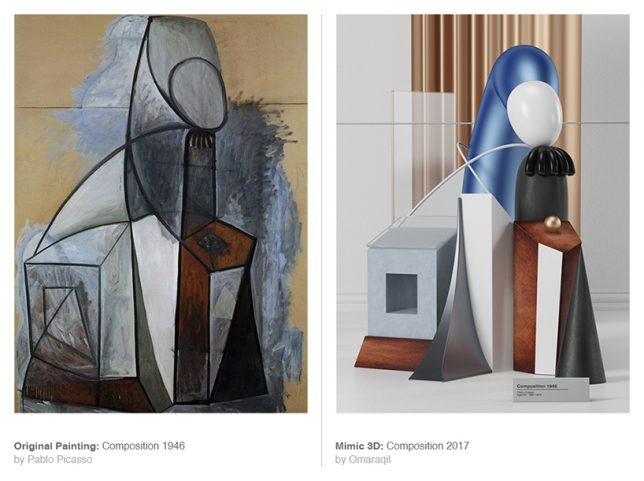
What would Pablo Picasso think if he saw that another artist had transformed his two-dimensional Cubist works of art into three-dimensional form? While the MIMIC series by Omar Aqil was created digitally and doesn’t exist as physical objects, it’s easy to imagine each piece as a sculpture you can walk around and examine from all angles, and it certainly offers an interesting perspective on the originals.

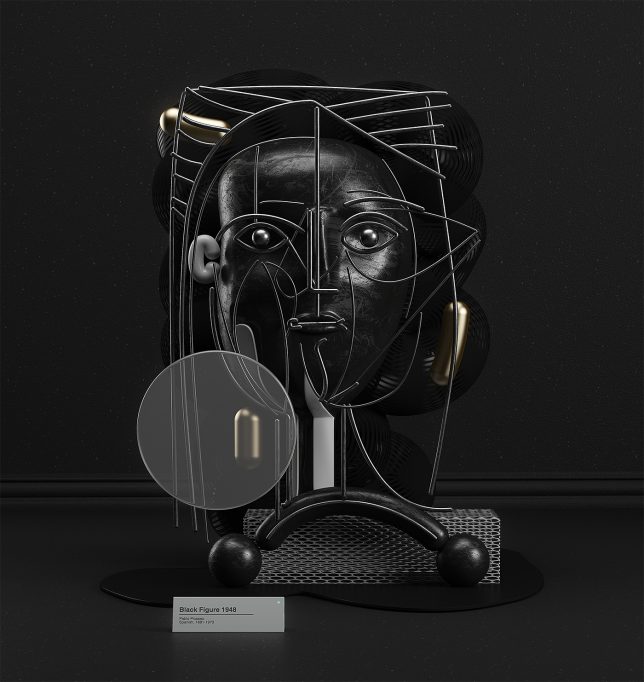
Aqil used Photoshop, Illustrator and Cinema 4D-Ray to reimagine six of Picasso’s most dynamic, angular paintings, including Buste de femme dans un fauteuil (1949), Seated Woman (1930), Black Figure (1948), Visage (1928) and Composition (1946). Aquil explains that he’s been studying Picasso’s work since beginning his career in art, and has always found the abstract visual language inspiring.

“MIMIC is a series of new visual experiments using art from the past,” says the Pakistan-based artist. “In this project I have randomly picked 6 paintings from the Pablo Picasso’s (one of the greatest and most influential artists of the 20th century) work and recreate them into modern 3D visuals. In this visual mimicry I have shown, how the skill responds when it come across the complexity of someone’s thought and how the meanings of the shapes and forms have been changed and create new physical realities. It’s propose to give a new implication of Picasso’s artworks with a series of hyper-realistic visuals.”

The choice of ‘materials’ used in the renderings is interesting in and of itself; while some might have given them textures and finishes resembling more classic sculptural materials like stone, Aquil’s sculptural visions seem to be made of plastic, as if they could be sold as tchotchkes in museum shops.

Considering that Picasso is famously quoted as saying “Good artists copy, great artists steal,” perhaps he wouldn’t have minded.

Share on Facebook


[ By SA Rogers in Art & Drawing & Digital. ]

[ WebUrbanist | Archives | Galleries | Privacy | TOS ]


WebUrbanist

 
Comments Off on Picasso in 3D: Famous Paintings Transformed Into Physical Objects

Posted in Creativity


Underpass Art & Parks: 15 Fun Projects Reclaiming Disused Urban Space

13 Apr

[ By SA Rogers in Architecture & Cities & Urbanism. ]

Climbing walls, skate parks, art installations, theaters and even miniature marinas take advantage of the cathedral-like spaces beneath highways and bridges, revitalizing formerly disused and depressed square footage in urban areas. In cities around the world, underpasses are often fenced off, strewn with trash and generally unappreciated, but these intervention projects reclaim the space in fun and creative ways that benefit the community.

Folly for a Flyover by Assemble, England

“Starting with the idea that how spaces are imagined is often as important as their physical characteristics in determining their use, the Folly reclaimed the future of the site by re-imagining its past,” says ASSEMBLE of its ‘Folly for a Flyover’ installation beneath a disused motorway underpass in Hackney Wick. “The new ‘fairy tale’ for the site described the Folly as the home of a stubborn landlord who refused to move to make way for the motorway, which was subsequently built around him, leaving him and his pitched roof stuck between the East and Westbound lanes. The Folly hosted an extensive program of cinema, performance and play… by day the Folly hosted a cafe, events and boat trips exploring the surrounding waterways; at night, audiences congregated on the building’s steps to watch screenings, from blockbusting animation classics to early cinema accompanied by a live score.

A8ernA, Zaanstad Underpass Installation by NL Architects

Another underpass project offering access to the adjacent waterway is A8ernA by NL Architects, located on the river Zaan in the Zoog aan de Zaan village near Amsterdam. The architects describe the new highway, built on columns, as a “brutal cut in the urban tissue.” Their installation attempts to heal this cut while taking advantage of the cathedral-like space, creating an “optimistic intervention” encouraging a new type of urban life, and includes a supermarket, flower and fish shop, parking, a park and a ‘graffiti gallery.’ There’s also a skate bowl, a mini-marina, a soccer field and a small hilly park.

Underpass Park, Toronto

Toronto’s Underpass Park is not only the most extensive park to ever be built beneath an overpass in Canada, but one of the most unusual parks of its kind throughout the world. Transforming a derelict and underused space into a new urban neighborhood feature and pedestrian passageway, the park turns what was formerly a barrier between the north and south parts of the community into a connection. Murals by world-renowned graffiti artists, playgrounds, sculptural installations, sports fields and other amenities draw locals in to engage with the space on an unprecedented level.

Ballroom Luminoso Installation by JB Public Art, San Antonio

The I-35 freeway underpass in San Antonio briefly became ‘Ballroom Luminoso’ thanks to a public art installation by JB Public Art, featuring six color-changing chandeliers made of recycled bicycle parts and sprockets. After dark, the lanterns would light up, casting intricate gear-shaped shadows all over the concrete structure.

Seattle’s Fremont Troll

Frequently popping up in movies and television shows set in Seattle, the Fremont Troll is a public sculpture by four local artists set beneath a bridge in the Fremont neighborhood. The piece won a neighborhood competition in 1990 as an idea to revitalize what was, at the time, a dumping ground. The troll sculpture is clutching an actual Volkswagen Beetle.

Next Page – Click Below to Read More:
Underpass Art Parks 15 Fun Projects Reclaiming Disused Urban Space

Share on Facebook


[ By SA Rogers in Architecture & Cities & Urbanism. ]

[ WebUrbanist | Archives | Galleries | Privacy | TOS ]


WebUrbanist

 
Comments Off on Underpass Art & Parks: 15 Fun Projects Reclaiming Disused Urban Space

Posted in Creativity


Adobe Lightroom CC 2015.10 and ACR 9.10 now available

12 Apr

Adobe has announced the availability of Lightroom CC 2015.10 and Adobe Camera Raw 9.10, adding 22 new lens profiles to both applications, as well as new camera support and bug fixes. According to Adobe, both new software versions are intended to expand camera raw and lens profile support, as well as fix bugs including unavailable color presets in Lightroom, trouble loading Hasselblad H6D-50c files in Camera Raw, and others.

In addition to the new camera support listed below, which applies to both the new Lightroom and ACR versions, Adobe has also added lens profile support for lenses from Apple, Canon, Nikon, Leica, Minolta, Sigma, M42, and Sony. New Lightroom versions for Android and iOS have also been released, both adding support for the lenses and cameras listed for Camera Raw 9.10.

New camera support:

  • Canon EOS M6
  • Canon EOS Digital Rebel T7i (EOS 800D, EOS Kiss X9i)
  • Canon EOS 77D (EOS 9000D)
  • Pentax KP

The full list of new Lightroom lens profile support can be found here.

Articles: Digital Photography Review (dpreview.com)

 
Comments Off on Adobe Lightroom CC 2015.10 and ACR 9.10 now available

Posted in Uncategorized


Pros And Cons Of Working As A Wedding Photographer

12 Apr

If you love taking pictures of people in extraordinary social situations, wedding photography might be for you. Being part of such an important event in your clients’ lives is both an honor and a huge responsibility. But before you jump in with both feet, there are some things you should know to make sure that you’re choosing the right profession. Continue Reading

The post Pros And Cons Of Working As A Wedding Photographer appeared first on Photodoto.


Photodoto

 
Comments Off on Pros And Cons Of Working As A Wedding Photographer

Posted in Photography


Nikon D7500: What you need to know

12 Apr

Nikon D7500: What you need to know

The Nikon D7200 was, and still is, an extremely capable camera. So for Nikon to truly make its successor worth its salt, something other than a granular update was needed. Fortunately, the new Nikon D7500 features enough improvements, including a lot of tech pulled from the APS-C flagship D500, that all signs point to it being the successor we’d hoped for.

After all, it uses the same 20.9MP sensor with no optical low pass filter as the D500, as well as its Expeed 5 image processor. This new processor is 30% faster than the Expeed 4 processor in the D7200, a speed advantage that gives the D7500 a leg up in a few key areas like: burst speed, buffer depth, video capability and native ISO sensitivity.

Nikon D7500: What you need to know

Before we jump into tech specs, let’s talk about the body of the D7500, because some minor changes should add up to an improved user experience, including a 3.2” 922k-dot tilting touch LCD. Sure it’s slightly lower resolution than the 1.2M-dot LCD of the D7200, but the touch capabilities are a welcomed inclusion. They can be used for selecting an AF point in live view, or navigating the camera menus.

The D7500 is also 35 g / 1.2 oz lighter than its predecessor and its body is slightly more narrow. The slimmer body design results in a marginally deeper grip. Weather-sealing on the camera has also been beefed up over its predecessor, though the camera loses its second memory card slot.

Nikon D7500: What you need to know

The D7500 is now capable of 4K video capture in 30, 25 and 24p. Users can now also shoot 4K UHD timelapses. But don’t expect your lenses to offer the same field of view when shooting video as they do for stills, because like the D500, the camera uses a 1.5x crop of the sensor when capturing 4K (that’s a total crop factor of 2.25x relative to full-frame). Recording time is similarly cut off at 29:59.

That processing speed boost also translates to an increased burst rate of 8 fps (up from 6 fps on the D7200) with a buffer depth of 50 14-bit Raw files or 100+ full-size JPEGs. The ISO range is 100-51,200, and expandable from ISO 50 to 1.6M – the same as the D500.

Nikon D7500: What you need to know

When shooting in movie mode, users can make use of both Auto ISO as well as power aperture to maintain exposure in a smooth manner. The camera also features helpful video tools like a flat picture profile (similar to log gamma) and zebras. In addition to 4K it can also shoot Full HD in 60p down to 24p, with no additional crop. And when in HD capture there is an electronic VR option to help stabilize footage. Users can also use Nikon’s Active D-Lighting (in HD only).

Nikon D7500: What you need to know

Other gains from the D500 includes its 180k-pixel RGB metering sensor for more accurate focus tracking and metering. The D7500 also now offers Nikon’s much-loved highlight-weighted metering mode.

Not everything is borrowed from its big brother though: The D7500 uses the same 51-point AF system with 15 cross-type points as its predecessor, as opposed to the 153-point AF module found in the D500. That means more potential for hunting in challenging light with off-center points. It also does not support UHS II media, like the D500.

Nikon D7500: What you need to know

Despite using the same AF system as the D7200, there are important improvements to the overall AF experience. For instance the camera gains the D5/D500’s ability to fine-tune lens precision using Live View, thanks to ‘Auto AF Fine Tune’.

And the updated 180k-pixel RGB metering sensor should allow for very precise subject (including face) recognition and tracking to maintain focus on subjects that move, even erratically, around the frame. Additionally, the camera gains Nikon’s group area AF mode.

Nikon D7500: What you need to know

Users can record 4K UHD directly to an external recorder via HDMI out, while also capturing compressed 4K to a memory card. The camera also offers a USB 2.0, microphone, headphone and a remote control port.

The D7500 is also now compatible with Nikon’s radio transmitters for flash control.

Nikon D7500: What you need to know

The viewfinder remains the same as its predecessor, offering .94x magnification with nearly 100% coverage. Like the D500, the viewfinder uses an OLED info display for easy viewing.

The camera’s shutter is rated for 150k shots and now features a shutter monitor, which automatically adjust shutter speeds to keep them accurate.

Nikon D7500: What you need to know

SnapBridge compatibility should come as no surprise in the D7500: it offers both Wi-Fi and Bluetooth connectivity for transmitting images and shooting remotely. However NFC has been removed. Speaking of transmitting images, the D7500 now offers an in-camera batch Raw processing option.

Nikon D7500: What you need to know

There is also a new Multiple Exposure mode that combines 10 images into one (but saves each of the 10 images individually as well). As well as a new Auto Picture Control function that analyzes the scene to provide a pleasing tone curve.

Other improvements come in the form of a new battery, the EN-EL15a, which apparently manages power better than previous EN-EL15 batteries. Fortunately it is both backward and forward compatible. Less fortunate: the D7500 offers lower battery life than the D7200: CIPA rated 950 shots per charge vs 1110.

Nikon D7500: What you need to know

The Nikon D7500 will be available this coming summer for a body-only price of $ 1250 and a kitted with the Nikkor 12-140mm F3.5-5.6 ED VR for $ 1750.

Articles: Digital Photography Review (dpreview.com)

 
Comments Off on Nikon D7500: What you need to know

Posted in Uncategorized


Nikon Museum 100th Anniversary Special Exhibition showcases prototype cameras

12 Apr

The Nikon Museum has launched its second 100th Anniversary Special Exhibition called ‘Prototype Cameras — Developers’ Memories.’ This exhibit, which will be running from April 4th through July 1st, showcases about 40 of the maker’s prototype cameras spanning dates from the 1940s through the 1980s, including its notable Nikon Model I Prototype 1 unit.

This exhibition includes rare prototypes of cameras that never entered mass production, says Nikon, giving the general public a chance to check out cameras otherwise sealed away from public view. The museum is also offering special commentaries for the Nikon F3 prototype and the Nikon F prototype from 1975 and 1957, respectively. Those commentaries are by Nikon’s Imaging Product R&D Laboratory lab manager Tetsuro Goto.

The Nikon Museum is located in Shinagawa, Tokyo. Those unable to make the trip in person can check out photos of the museum and the prototype exhibition here.

Via: NikonRumors

Articles: Digital Photography Review (dpreview.com)

 
Comments Off on Nikon Museum 100th Anniversary Special Exhibition showcases prototype cameras

Posted in Uncategorized


Raining Pitchforks: Artist Lures Visitors Under 300 Spikey Forks of Doom

12 Apr

[ By WebUrbanist in Art & Installation & Sound. ]

When someone exclaims “It’s raining pitchforks and hammer handles out there” they rarely mean it quite so literally. Dubbed The Crusher, this installation sounds as much like a pro wrestler or horror movie as a piece of art. And as the ominous name suggests: it is something to be awed … and perhaps at least a little bit feared.

British artist Simon Birch works in a variety of mediums, but this installation in a Los Angeles is a bit of a departure from his safely-on-the-canvass oil paintings. The 300 suspended forks feature three to five prongs for a total of over a thousand points on which one could be impaled.

Visitors to this site-specific work are invited to view it now just from the side but also from beneath. The rundown appearance of the surrounding structure and variety of aged potential death traps above do little to assuage one’s anxiety while going below (or watching others do so).

So far, the work has been hugely popular, but one has to wonder: what if there were an earthquake, or one of the forks slipped loose somehow?

Simon Birch “has also ventured into film and installation work … These large multimedia projects integrated paintings with film, installation, sculpture, and performance housed in specifically configured spaces” (via MMM).

Share on Facebook


[ By WebUrbanist in Art & Installation & Sound. ]

[ WebUrbanist | Archives | Galleries | Privacy | TOS ]


WebUrbanist

 
Comments Off on Raining Pitchforks: Artist Lures Visitors Under 300 Spikey Forks of Doom

Posted in Creativity


Meet Your New DSLR

12 Apr

Ooooh, fancy new DSLR you got there!

(Or maybe you’re thinking of getting one, this guide is for you too).

There are a lot of knobs and buttons on that thing, and some day you’ll get to know them all.

But, for now, day one, we’re here to tell you our top tips for getting off of auto-mode (that’s what your phone was for!) and getting to know your new best friend.
(…)
Read the rest of Meet Your New DSLR (1,248 words)


© laurel for Photojojo, 2017. |
Permalink |
No comment |
Add to
del.icio.us

Post tags:


Photojojo

 
Comments Off on Meet Your New DSLR

Posted in Equipment


GoPro launches camera trade-up program in the US

11 Apr

Action-camera manufacturer GoPro has launched a trade-up program for its US-customers. Existing GoPro owners can receive $ 100 off a new HERO5 Black, or $ 50 off a HERO5 Session when they trade in any older GoPro HERO model.

To participate in the program you should visit the Trade-up website, select the new camera of your choice, and follow instructions to return your old camera. Once GoPro has received the latter, it will process the discount and send you a brand-new HERO5 Black or HERO5 Session camera.  The company says returned cameras will be recycled responsibly via zero landfill and recycling methods appropriate to material type. 

“Our HERO5 cameras are the best we’ve ever made. And when paired with GoPro’s new software, they unlock the simplest, most powerful mobile storytelling solution yet,” said CJ Prober, GoPro’s Chief Operating Officer. “Our Trade-Up Program allows us to introduce existing customers to the modern GoPro experience and prepare our community for the new software enhancements ahead.”

The HERO5 Black and HERO5 Session currently retail for $ 399.99 and $ 299.99, so the trade-in discount can cut a nice chunk from that. If you own an older GoPro and like the idea of trading it in, you can find all the information on the GoPro website. 

Articles: Digital Photography Review (dpreview.com)

 
Comments Off on GoPro launches camera trade-up program in the US

Posted in Uncategorized