RSS
 

Archive for January, 2017

Voice-controlled photo editing: coming soon to Photoshop?

12 Jan

Adobe Research is experimenting with a voice-controlled photo editing virtual assistant. A demo video uploaded to Adobe’s YouTube account shows how the tool might function, performing and undoing basic edits to an image, and exporting the final product to Facebook – all achieved through spoken commands. 

The demo shows this feature being used for extremely basic editing functions (cropping, flipping an image), which Adobe calls ‘a first step towards a robust multimodal voice-based interface’ for its mobile applications. 

Given that voice control is popping up in just about every gadget you can think of, it seems logical for Adobe to be considering adding voice control to its apps. The Internet of Things is rapidly turning out to be the Internet of Shouting at Things, so voice-controlled photo editing seems inevitable. 

Do you think Adobe could make voice control sophisticated enough for the complex needs of serious photo editing? Let us know in the comments.

Articles: Digital Photography Review (dpreview.com)

 
Comments Off on Voice-controlled photo editing: coming soon to Photoshop?

Posted in Uncategorized


Mobility Vision: Hyundai Concept Connects Smart Home to Driverless Car

12 Jan

[ By SA Rogers in Technology & Vehicles & Mods. ]

mobility-vision-1

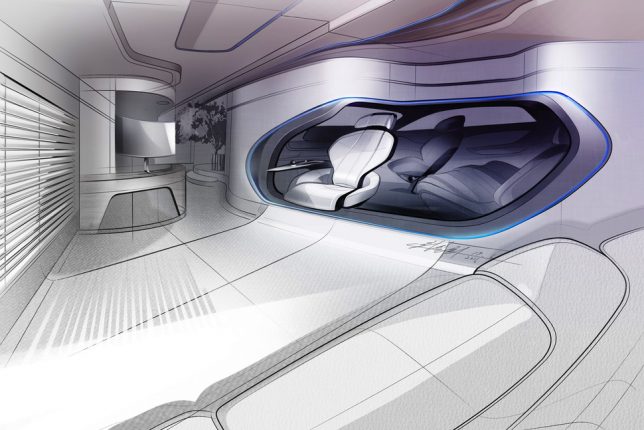
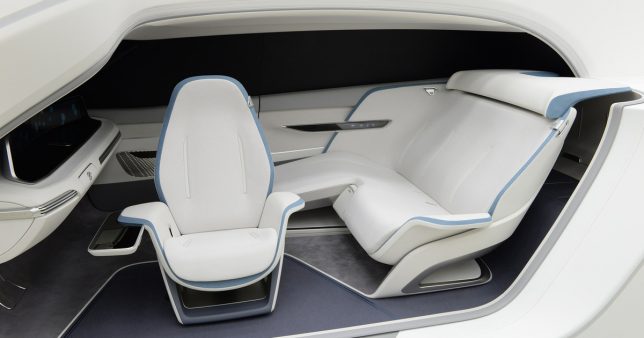
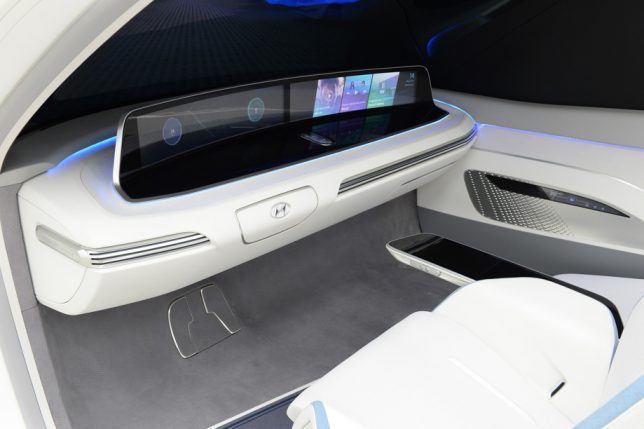
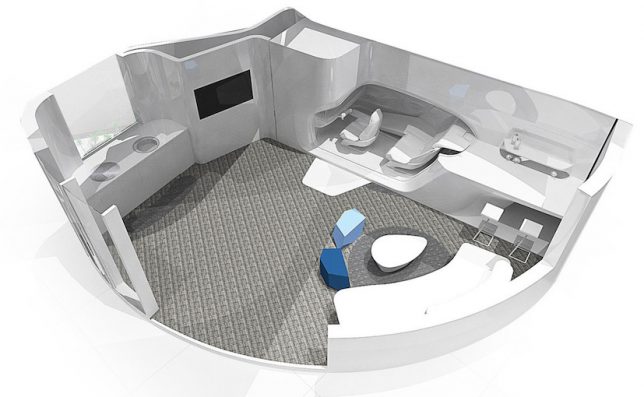
Who needs a garage when your autonomous vehicle could simply pull up into a port inside your home and seamlessly integrate itself with the interior? Hyundai wants to give us all another reason to spend hours inside our cars by effectively turning them into furniture when they’re not in use. Its ‘Mobility Vision’ concept, unveiled at this year’s CES (Consumer Electronics Show) in Las Vegas, blurs the lines between architecture and automobiles more than ever.

mobility-vision-2


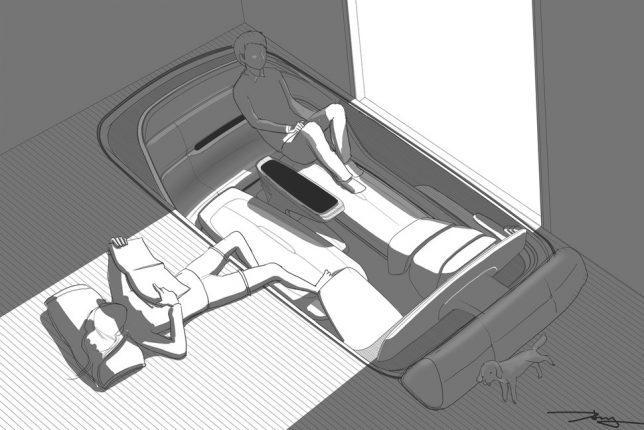
The driverless car essentially plugs into the house when you’re done with a trip, and then the driver’s seat, which is mounted on a pivoting arm, can slide right into the living space for use as a chair. The idea is never having to stop what you’re doing and metaphorically shift gears between travel time and home time; stuff you leave in the car is easily accessible, babies can continue sleeping in their carseats, and there’s no fumbling for keys.


mobility-vision-4

A single door, almost the height and width of the entire car, opens upward to delineate the space between the car’s interior and the living room. You can even run the car’s heat or air conditioning to adjust the temperature of your house, and use the car stereo to play music at home. Perhaps the most important detail: the car is powered by a hydrogen fuel cell, so it’s quiet, and there’s no danger of breathing unhealthy fumes.

mobility-vision-7

mobility-vision-6

It’s just a concept, and not likely to become a reality anytime soon – but could it be a glimpse into what mobility will look like in the not-so-distant future? It seems entirely possible, but it’s not clear how many people want to just sit around in their cars for no reason when there’s probably a perfectly good couch just a few feet away.

Share on Facebook


[ By SA Rogers in Technology & Vehicles & Mods. ]

[ WebUrbanist | Archives | Galleries | Privacy | TOS ]


WebUrbanist

 
Comments Off on Mobility Vision: Hyundai Concept Connects Smart Home to Driverless Car

Posted in Creativity


DxOMark gives RED Helium 8K sensor a record-breaking 108 score

12 Jan

DxOMark has given RED’s 35.4MP Helium 8K sensor its highest overall score ever: 108. This makes the prototype sensor the second ever to exceed the 100 point milestone, joined only by the RED Epic Dragon prototype, which scored 101. DxOMark says the Helium is a ‘solid upgrade’ over the Epic Dragon, offering better color depth, less noise, improved low-light ISO and a greater dynamic range.

DxOMark explains that while both the Dragon and Helium sensors are ‘physically similar,’ the Helium ultimately offers more densely packed pixels at approximately 3.65 microns each. Less impressive is the organization’s assessment of the dynamic range, which measured at 15.2 stops versus RED’s advertised 16.5+ stops. That is still greater than the Epic Dragon’s DxOMark dynamic range rating of 14.8 stops, however. 

Because both the Helium 8K and Epic Dragon tests were performed with prototype devices, neither model will be officially added to DxOMark’s device ranking list. The company does present a ‘simulation’ ranking that shows where the two models would fall if they were included, however: above the Sony a7R II, Nikon D810, Sony Cyber-shot DSC-RX1R II, and the Pentax K-1.

Via: DxOMark

Articles: Digital Photography Review (dpreview.com)

 
Comments Off on DxOMark gives RED Helium 8K sensor a record-breaking 108 score

Posted in Uncategorized


Not Your Grandma’s Kitchen: 17 Modern Designs for the Discerning Cook

12 Jan

[ By SA Rogers in Design & Fixtures & Interiors. ]

futuristic-kitchen-ora-1

If these designs are any indication, the kitchen of the future is modular, minimalist, mobile and so unobtrusive that it can practically blend into the furniture in your living room. Whether you love a more rustic handcrafted aesthetic or want your house to look like the interior of a spaceship, these modern kitchen designs radically depart from contemporary interiors for the sake of both looks and functionality.


Invisible Kitchen by i29 Architects

invisible-kitchen-2

invisible-kitchen-3

invisible-kitchen-4

When it’s not needed, the kitchen in this historic Parisian apartment disappears altogether, blending into the wall. The top surface of the center island measures just about an inch thick to add to the sense of lightness, making the room’s classic woodwork its focal point. Dutch firm i29 Architects developed the ‘Invisible Kitchen’ system to be adaptable, so the front facade always mimics another wall in the room.

Aquarium Kitchen Island by Robert Kolenik

aquarium-kitchen

aquarium-kitchen-2

The ‘Ocean’ kitchen island by Robert Kolenik not only places an island countertop on an oversized aquarium, but also includes a mechanism that lifts the top vertically to provide access to the tank for feeding and maintenance.

Transparent Cookspace by Tokujin Yoshioka

transparent-kitchen

transparent-kitchen-2

transparent-kitchen-3

transparent-kitchen-4

Cooking implements, tableware and other small objects are partially visible yet still obscured in a translucent cook space by Tokujin Yoshioka, developed for Toyo Kitchen Style.

Sculptural ICE Kitchen by Tom Dixon

ice-kitchen

ice-kitchen-2

ice-kitchen-3

Departing radically from the look of a typical contemporary kitchen, ICE by Tom Dixon consists of monolithic triangular prisms in various shapes and sizes that form the base of a luxurious kitchen made of ‘caesarstone’ premium quartz surfaces.

Next Page – Click Below to Read More:
Not Your Grandmas Kitchen 17 Modern Designs For The Discerning Cook

Share on Facebook


[ By SA Rogers in Design & Fixtures & Interiors. ]

[ WebUrbanist | Archives | Galleries | Privacy | TOS ]


WebUrbanist

 
Comments Off on Not Your Grandma’s Kitchen: 17 Modern Designs for the Discerning Cook

Posted in Creativity


Fotodiox LED100WB-56 quick review

11 Jan

The LED100WB-56 is a wall-powered, dimmable LED light source with that should be a little bit different. Fotodiox has done quite a bit, not just to negate the issued of using LEDs for continuous lighting but also to address some inherent issues of using continuous lighting in general. This is enough to warrant a closer look, as it could make these more useful for a wide number of users.

Included with the 3-light kit that we tested are three lights, reflectors, slip-on diffusion covers, ballasts/power adapters with XLR cables (not pictured), and a set of remotes. The kit also includes a set of light stands as well (not the short one pictured above), making the 3-light kit an entirely complete set for those getting started, as you are given more flexibility with three lights for a key, fill, and hair light, than you are with two.

One inherent issue with LED lights is the source itself. Bright LEDs are never a single diode: they’re often an array of diodes arranged closely together. At first we saw LED panels grow in popularity, which spread single individual diodes in a grid to create a big and bright source. The issue is the individual diodes when spread out act like a series of point light sources, with each diode creating its own set of shadows. These complex shadows get distracting very quickly, and the bare bulbs are tough on the eyes.

As time has moved on, the diodes have shrunk down to a tight grid on a wafer, much like the chips in our cameras, just not quite as dense. Fotodiox has taken a panel like this and then put it back behind a glass lens with a frosted back. The back of this lens becomes the single light source instead of the hundreds of individual LED spots, creating an even light source with a single shadow, much like a classic tungsten source. 

Speaking of ‘classic’ tungsten sources, one of the biggest advantages of LED lights over these sources is heat production. Anyone who has used even a120-watt modeling light knows these things get extremely hot. So hot, in fact, that any skin contact with the bulb will leave behind oil residue that creates a hotspot – eventually resulting in the bulb’s failure. While the Fotodiox does produce some heat, a small quiet fan keeps inside temperatures steady. During use, no outside part of the light becomes hot to the touch.

Another historic issue with the LEDs as a photographic light source is color – or lack thereof. This handy YouTube video dives a bit more in to the issue:

The Fotodiox is rated at 95+ CRI, which is quite a high rating for the price. This is also a drastic improvement over Fotodiox’s own LED100WA, which is only rated at 85 CRI. CRI isn’t a perfect way to assess color output but the spectrum Fotodiox shows for the lamps shows a fairly consistent output across most colors, with the only significant spike being in the blue region, meaning there shouldn’t be any nasty surprises.

So these lights promise to take care of the light source and color issues, what else? How about flicker? All lamps flicker to some degree if they’re powered by the alternating current of mains electricity but different lighting technologies have different dimming characteristics during the ‘off’ half of the power cycle. Tungsten bulbs stay fairly hot (and hence bright) throughout the cycle while poorly-designed LEDs abruptly switch on and off as the power cycles. You won’t always notice this with the naked eye but set your shutter speed faster than the frequency of the lights and the difference can become apparent.

This effect can be seen with the Sony a7R II in ‘low light’ mode with ‘electronic shutter’ and maximum ISO in our studio scene – the line-by-line readout of the sensor happens at different parts of the light’s power cycle, resulting in exposure differences that render as bands across the frame, despite the use of a tungsten bulb.

Fotodiox claims its LED100WB lights are flicker free, so we tried it out for ourselves by shooting some super slow-motion with two of the lights and a Sony RX10 III.

In these clips, the lights were at full power with their intensity controlled by their distance from the subject. When the lights are partially dimmed banding does begin to happen at 960fps/1000sec shutter speeds, but at full power there was no banding to be seen.

So, these lights are looking pretty good so far right? They also work quite well for portraits, especially when diffused or modified. The mount is the classic Balcar type, better known as the Paul C. Buff mount. This mount not only has a lot of affordable modifiers from Paul C. Buff, but also has adapters made for mounts like Bowens (which is what we own).

In use:

You’ll find this shot on the back of Dan’s debut bestseller novel (if he ever writes one). Olympus E-M1 Mark II, 75mm F1.8 lens, 1/200 sec, F2.2, ISO 200

This portrait of Dan was lit with just one LED100WB shot through an adapted Bowens mount beauty dish and two sheets of foam core: black for the background, and a white ‘fill card’ to the left of the camera. The light was at full power, and wasn’t placed very far from Dan’s head. That short distance meant the light was intense enough for a short shutter speed and soft enough to be flattering and smooth. However, the requirement for the short distance means that a lot of the light’s output was being lost in the beauty dish, so those hoping to use existing light modifiers may find the LED100WB lacking in power in certain scenarios.

Using the lights outdoors on a dim day can also be an interesting experience, especially when a camera is left in any sort of priority mode where it can control either shutter speed or aperture automatically. Here’s why: It essentially makes the ‘B’ button on the light’s remote an overall exposure control. Let’s look at this shot of Carey to explain further:

The lights can easily balance with lower light conditions, and the 5600K temperature balances relatively well with daylight and overcast conditions. Sony a6500, 50mm F2.8, ISO 100 1/60sec F4

What I wanted to achieve with this shot was to combine an F4 portrait (where this particular lens is very sharp) while also bringing attention to the shape of ‘bokeh’ balls in the background. After putting one of the LED100WB’s with its diffusion sock where I wanted it relative to Carey (just over my head and a little to the left), I let the camera control shutter speed as I adjusted the light with the remote and watched the exposure change through the viewfinder.

When the lights were dimmed the camera’s evaluative metering was mostly reading the brightness of Carey’s face, and as the light was turned down the background got brighter. As the lights were brightened, the background got darker as the camera shortened the exposure time to keep Carey’s face from over exposing. I ended up somewhere in the 25-50% power area to brighten up the ‘bokeh balls’ in the background.

While these lights can be used in limited cases for stills, the best application for the 3-light kit is for video. A 3-light kit gives photographers or videographers a key, fill, and hair light ready to go. Plus, their extremely quiet operation means they don’t get in the way of a simple sound setup. We ended up using them when shooting our Game Boy Camera video a few months back:

One frustration we encountered was with the remotes. Having them was extremely handy but the implementation is a little clunky: each light has its own dedicated remote, which can make using multiple lights at once a bit fussy to use. Also, the buttons are just labeled alphabetically, with no indication of their function. The ‘A’ button works as on/off. The ‘B’ button cycles through 25%, 50%, 75%, and 100% power levels. The ‘C’ and ‘D’ buttons act as an incremental adjustment up and down, with ‘C’ being brighter and ‘D’ being dimmer. That said, they’re better than nothing, and came in handy several times while using the lights.

Conclusion

At the end of the day these lights are some of the easiest to use continuous lights we’ve encountered. Their nearly flicker-free output allows use of extremely high shutter speeds. Their lack of heat output means they can be used with any Balcar mount light modifier, not just special expensive ones made to withstand the heat of a tungsten bulb. Plus, the remotes make it easy to adjust power level, even when the lights have been placed out of reach.

For beginners, continuous light is a great option for mastering studio work, as you get to see the light as you shape it, and with mirrorless cameras you get to preview the results constantly. For photographers that need to match or even overpower bright ambient light, these lights aren’t always powerful enough, so strobes would be a better choice. However, in the studio where ambient light can be controlled, these LED lights find many uses quite quickly, and for photographers looking for a set of lights to accompany them on a foray in to the video world, this 3-light kit is a great place to start.

Articles: Digital Photography Review (dpreview.com)

 
Comments Off on Fotodiox LED100WB-56 quick review

Posted in Uncategorized


HMD Global releases Nokia 6 Android smartphone

11 Jan

HMD Global, the Finnish company that acquired the exclusive Nokia brand licensing rights for mobile phones in late 2016, has released its first model under the legendary Nokia moniker. The Nokia 6 is best described as an upper mid-range device with an unibody that is machined from a solid block of 6000 series aluminum and would not look out of place on a top-end smartphone. 

Images can be viewed and displayed on the 5.5” Full-HD IPS LCD display with 2.5D Gorilla Glass and the Android 7 Nougat OS is powered by a Qualcomm Snapdragon chipset and 4GB of RAM.  The device also features 64GB of expandable storage and dual amplifiers in combination with Dolby’s Atmos surround technology should be capable of delivering excellent sound.

Juho Sarvikas, Chief Product Officer, HMD Global said: “We have set ourselves a mission to deliver the best possible smartphone experience, with a beautiful premium design touch, to everyone, at every price point. By building on true Nokia phone hallmarks of leading design and materials, an obsessive focus on the latest technology and solving real-life issues, we believe we have a unique proposition for consumers. The Nokia 6 marks the first step on our journey, with more to come in 2017.”

In the camera department the Nokia 6 packs a 16MP camera with 1.0 µm pixel size, F2.0 aperture and phase detection AF. The 8MP unit at the front also has an F2.0 aperture and at 1.12 µm slightly larger pixels. Both cameras can record 1080p video at 30 frames per second.

The Nokia 6 will, at least to start with, be exclusively available through JD.com in China and set you back approximately $ 245. On paper at least, the Nokia 6 looks like a very solid device at an attractive price point and a good first step for re-establishing the Nokia brand in the marketplace. That said, we are still hoping to see Nokia’s rumored camera super-phone revealed at MWC at the end of February. 

Press Release:

HMD Global launches first smartphone, the Nokia 6 in China

  • Nokia 6 will be available exclusively in China through JD.com. Available in early 2017, Nokia 6 is 1699 CNY
  • New design philosophy embraces much-loved Nokia phone hallmarks of quality, superior craftsmanship and relentless focus on the consumer experience
  • Nokia 6 marks the first step for the Nokia brand into Android smartphones with more to come in H1 2017

Espoo, Finland – 8 January 2017: After securing the exclusive Nokia brand licensing rights in mobile phones in late 2016, HMD Global Oy (“HMD”) is proud to announce the launch of its Nokia 6 smartphone in China. The Nokia 6 marks the first step in HMD’s ambition to set a new standard in design, material quality and manufacturing innovation across every tier of its products by building on the hallmarks of a true Nokia phone experience. The device, which is designed explicitly with the needs of users in mind, combines quality and in-built durability to deliver a real-life premium smartphone experience at a price point for the highly aspirational Chinese consumer.

The decision by HMD to launch its first Android smartphone into China is a reflection of the desire to meet the real world needs of consumers in different markets around the world. With over 552 million smartphone users in China in 2016, a figure that is predicted to grow to more than 593 million users by 20171, it is a strategically important market where premium design and quality is highly valued by consumers.

With the arrival of Nokia 6, consumers will see superior craftsmanship and design quality in action. It takes 55 minutes to machine a single Nokia 6 from a solid block of 6000 series aluminium. It then receives two separate anodising processes, taking over ten hours to complete, with each phone being polished no less than five times. The end result is an aluminium unibody with the highest level of visual and structural quality.

Delivering quality to the core, the Nokia 6 display has a bright hybrid in-cell 5.5” screen with full HD resolution and incredible colour reproduction wrapped in 2.5D Gorilla Glass. The display stack is laminated together with a polarizer layer enabling excellent sunlight readability and slim form. The build is completed with the latest generation Qualcomm Snapdragon™ 430 processor with X6 LTE modem designed for excellent battery life and superior graphics performance.

The Nokia 6 has 4GB RAM and 64GB storage with which to run the latest version of Android Nougat and is packed with entertainment to bring to life the latest that Android has to offer. The dual amplifiers deliver a 6dB louder sound than a regular amp, giving higher voice, deeper bass and unmatched clarity. Dolby Atmos creates powerful, moving audio that seems to flow all around users. The Nokia 6 packs a 16MP phase detection auto focus rear camera for sharp detailed pictures, and an 8MP front camera. The f/2.0 aperture lenses and exclusive camera UI with automatic scene detection make it easy to take great shots every time.

Arto Nummela, CEO, HMD Global said: “Just a short while ago we announced the launch of HMD Global. From the outset we have stated that we intend to move with speed to establish a position as a player in the smartphone category and create products that truly meet consumer needs. The Nokia 6 is a result of listening to our consumers who desire a beautifully crafted handset with exceptional durability, entertainment and display features.

Our ambition is to deliver a premium product, which meets consumer needs at every price point, in every market. We start today, with our premium, high quality Nokia 6; built to deliver a fantastic core user experience for Chinese consumers. We look forward to unveiling further products in the first half of this year.”

Nestor Xu, Vice President Greater China, HMD Global said: “China is the largest and most competitive smartphone market in the world. It is no coincidence that we have chosen to bring our first Android device to China with a long-term partner. JD.com is known for its upwardly mobile customer base and it has for many years believed in the Nokia brand and sold millions of our products to Chinese customers. Launching our first smartphone device, in such a strategically important market, with JD.com a trusted online retailer marks a signal of intent.”

Juho Sarvikas, Chief Product Officer, HMD Global said: “We have set ourselves a mission to deliver the best possible smartphone experience, with a beautiful premium design touch, to everyone, at every price point. By building on true Nokia phone hallmarks of leading design and materials, an obsessive focus on the latest technology and solving real-life issues, we believe we have a unique proposition for consumers. The Nokia 6 marks the first step on our journey, with more to come in 2017.”

Shengli Hu, President of 3C Business Unit, JD.com, said: “The Nokia 6 marks a new milestone for the iconic brand, and JD.com is proud to work with HMD on this exclusive launch in China. Our 200 million active consumers come to JD.com to shop for guaranteed high-quality products from the world’s leading brands, and we are proud to provide a trusted outlet for them to reconnect with Nokia phones.”

Nokia 6 will debut exclusively through JD.com in early 2017 in China. Competitively priced for the aspirational smartphone user, the Nokia 6 is 1699 CNY at JD.com.

Articles: Digital Photography Review (dpreview.com)

 
Comments Off on HMD Global releases Nokia 6 Android smartphone

Posted in Uncategorized


Is this drone-toting concept car the future of photojournalism?

11 Jan

$ (document).ready(function() { SampleGalleryV2({“containerId”:”embeddedSampleGallery_3973428980″,”galleryId”:”3973428980″,”isEmbeddedWidget”:true,”standalone”:false,”selectedImageIndex”:0,”startInCommentsView”:false,”isMobile”:false}) });

Photojournalists, especially those embedded or covering remote and/or dangerous regions of the world would likely benefit from a vehicle specifically designed to help them overcome the daily challenges they face. Dillon Kane, an automotive design student at Lawrence Technological University, seemed to think so too. He recently won Magna International’s ‘Main Event’ design competition for his concept called ’30 degrees West,’ a futuristic car that we can only describe as an Inspector Gadgetmobile for visual journalists.

The competition is held annually prior to the North American International Auto Show, and this year, judges asked young automotive designers to dream up a new vehicle that might debut in the year 2030.

Sure, the vehicle rendering looks a bit like a riding lawnmower, but it would actually be packed with intelligent technology and design. Kane’s design features compartments for gear located on all sides of the vehicle (that apparently open and close in near silence) and a ladder pops out from the back of the vehicle to allow journalists a higher vantage point. Of course, if standing on the roof still isn’t high enough, the vehicle has a built in drone, also located on the roof, that can be launched for aerial coverage. Because duh, it’s the future and drones.

Additionally, the vehicle would be covered with smart sensors and cameras to record information about one’s environment, and a built-in ‘gentle light’ is also included in the design to create some flattering light for portraits on the fly. While some aspects of its design may seem like they need more hashing out (like the fact that it is not autonomous and must be piloted), it’s pretty cool to see a vision for a car designed specifically with photographers in mind.

So what do you think of Kane’s design, is it something you’d drive? Or better yet, how would you improve upon it to make it truly meet the needs of traveling photographers? Let us know in the comments!

Articles: Digital Photography Review (dpreview.com)
 
Comments Off on Is this drone-toting concept car the future of photojournalism?

Posted in Uncategorized


2017 Oskar Barnack award offers €80,000 prize fund

11 Jan

The Unbearable, the Sadness and the Rest
Clémentine Schneidermann
Winner of the Leica Oskar Barnack Award Newcomer 2016

Leica has announced that entries for its 2017 Oskar Barnack award will be accepted from 1st March and that the winner will receive €25,000 in cash and €10,000 worth of M-system equipment comprising a body and lenses. The theme for this year is ‘the interaction between people and their environment’ and entrants are expected to submit a series of between ten and twelve images that were all or mostly shot during 2016-17.

In addition to the main prize, there will be a Newcomer Award for 25s and under that will consist of €10,000 of cash and €10,000’s worth of M-system camera and lenses. Ten other photographers will receive a prize of €2,500 for being in the shortlist.

The competition is open to professional and, in the case of the Newcomer Award, prospective professional photographers and there is only one entry per person. Images do not have to have been shot on Leica equipment.

Entry closes on April 10th and the winners will be awarded their prizes at a ceremony in Berlin. For more information and to see the winners from previous years visit the Leica Oskar Barnack Award website.

Press release

Leica announces Oskar Barnack Award 2017

Dates confirmed for prestigious annual Leica Camera AG photographic competition

Now in its 37th year, Leica has announced the opening dates for the Leica Oskar Barnack Award 2017. Those wishing to enter the renowned international competition for professional photographers, in addition to the ‘Leica Oskar Barnack Newcomer Award’ (for up-and coming photographers under the age of 25), can submit their entries between 1 March and 10 April 2017.

The competition calls for the submission of a self-contained series of between ten and twelve images, in which the photographer perceives and documents the interaction between people and their environment in a creative and ground-breaking style. Eligible for submission are portfolios of photographs captured in 2016 and 2017, or work from long-term projects including at least some images taken within this period. From 1 March 2017, entry forms and the terms and conditions of entry, will be available on the competition website at www.leica-oskar-barnack-award.com.

As in the previous year, the presentation of the awards to the winners in both categories will take place at a gala ceremony in Berlin. Oskar Barnack, the inventor of the revolutionary and iconic ‘Ur-Leica’ 35mm camera, began his career in the German capital. Indeed, in 1959, close to the Giesensdorfer Schule in Berlin – attended by Barnack as a child, and where children are still taught today – a street was named ‘Barnackufer’ to commemorate the school’s most famous pupil.

With prizes amounting to a total cash value of 80,000 euros, the ‘Leica Oskar Barnack Award’ is one of the industry’s most prestigious photographic competitions. The winner in the main category will be honoured with a cash prize of 25,000 euros and Leica M-System equipment (a camera and lens) valued at an additional 10,000 euros. The winner of the Newcomer Award will receive a cash prize of 10,000 euros and will also receive a Leica rangefinder camera and lens. In addition to the two main categories, a further ten submissions to the competition will each be honoured with prizes of 2,500 euros. The portfolios entered by all finalists will be published on the www.leica-oskar-barnack-award.com website and in a magazine published specially for the competition.

Further details will be announced during the year.

Articles: Digital Photography Review (dpreview.com)
 
Comments Off on 2017 Oskar Barnack award offers €80,000 prize fund

Posted in Uncategorized


How to Create a Dynamic Zoom Burst Photograph

11 Jan

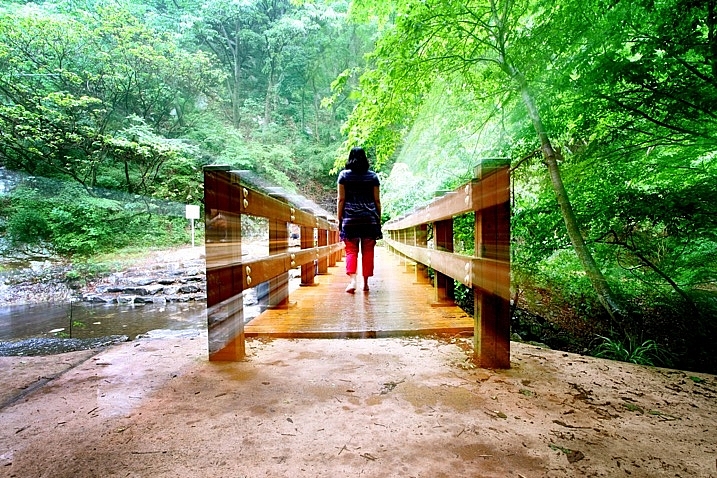
Who doesn’t love warp speed? In this article, you’ll go hurtling into the future at warp speed nine, and you don’t need any federation star fleet spaceships to do it! A DSLR camera with a zoom lens and a tripod is the only equipment you’re going to need for this exciting technique. There are similarities to light painting by camera rotation, and the zoom burst is indeed another form of kinetic light painting. Let’s take a look at this technique, what it will give to your photos, and how to do it.

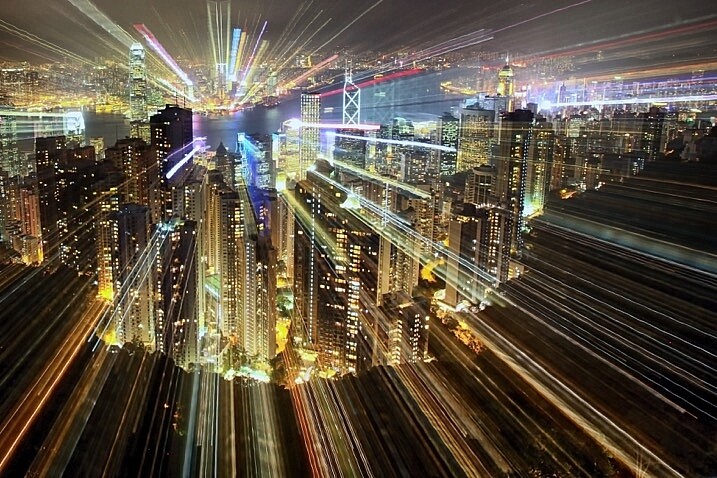
zoom burst photo cityscape

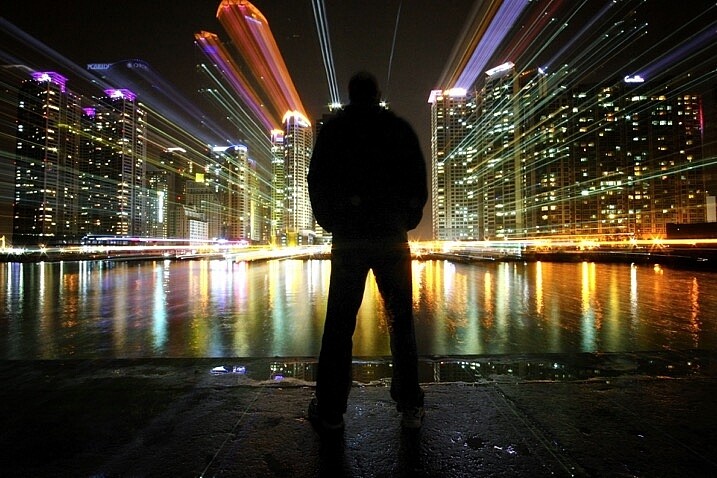
In this photo, a friend stood still in front of Marine iCty in Busan.

What does this technique add to your photograph?

Put simply, this gives a still frame a much more dynamic edge. This article will look at how you can apply zoom bursting to architectural photos and is best used in an urban environment. The nature of still frames is of course that they’re a single moment, by changing the focal length during long exposure you can add movement and urgency to your frame. The zoom also produces leading lines within your frame that all lead up to your main subject within the frame.

How to take zoom burst photographs

Taking a zoom burst photo is a simple technique, in fact, you can even do this handheld. The effect is achieved by changing the focal length of your camera lens during a long exposure. Follow these steps:

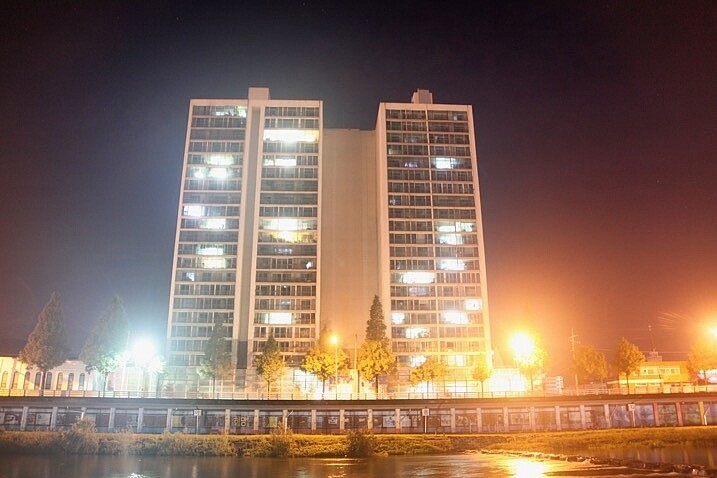
  1. Choose a scene that has mixed areas of light. You can use a forest with mottled light, or an apartment building where some lights are on and some are off.
  2. The exposure should be between half a second and 2 seconds long.
  3. You can take this photo handheld but it’s better to use a tripod.
  4. Change the focal length of the lens during the exposure. Zooming out tends to work better during the night for longer exposures, and zooming in works better during the day.
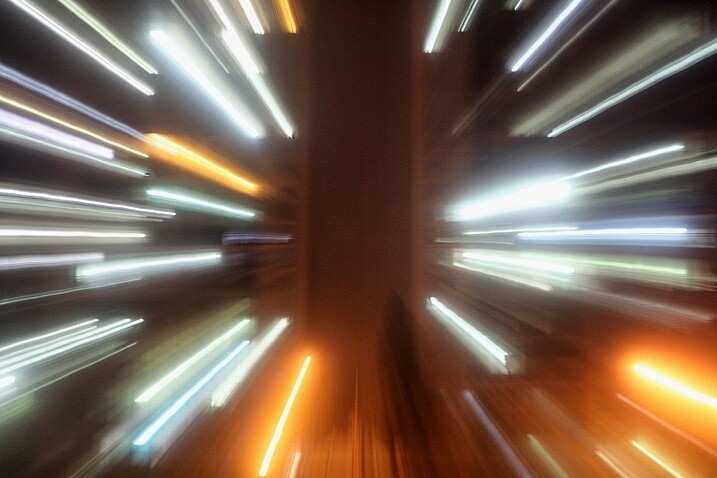
zoom burst lights

A photo that uses zoom with no stationary phase. This photo is colorful and abstract.

How to take zoom burst photos that show structures

Now that you know how to make a simple zoom burst, which looks abstract in nature, it’s time to move a step further. Now you are going to see how you can introduce architectural structures into this frame.

1 – Choose the correct location

Not all locations work well for zoom bursts, especially if they’re too cluttered. You need to choose a building that’s well lit and not surrounded by others. There are other options you can look at as well such as Ferris wheels or sculptures. Any location you choose should allow you to zoom into the structure, and then zoom out on the lights that surround it.

zoom burst too many buildings

When there are too many building in the frame, the zoom burst shot can get busy.

2 – Set the camera on a tripod

If this is going to be a long exposure of 25 or 30 seconds, you will have to use a tripod. You need to secure the tripod in position, making sure it doesn’t move about. A lot of tripods let you hook your camera bag to the extendable center, doing so will steady the tripod. Apply the same logic you would use to attain a sharp image. The focal length movement of the lens will prevent you getting maximum sharpness, though.

3 – Select the right lens

The best lens for this type of photo is a super zoom, one that goes from 18mm-300mm. A super-zoom gives you maximum flexibility over composition and allows for more creative photographs. If you don’t have a zoom with this kind of range, you can use a kit lens. The 18-55mm lens works very well for the zoom burst.

4 – Focus the camera using Live View

Now compose your photograph in the position you intend to finish your zoom burst. The final composition will be at the wider or widest end of your lenses focal length. Turn the camera’s Live View function on, and zoom into the central structure you wish to focus on. Use the lens’s manual focus so that the image on the Live View screen is sharp. Keep the camera lens in manual focus to prevent loss of focus during the exposure. Keep a mental note of the focal length where you focused, especially if that isn’t the widest part of the lens.

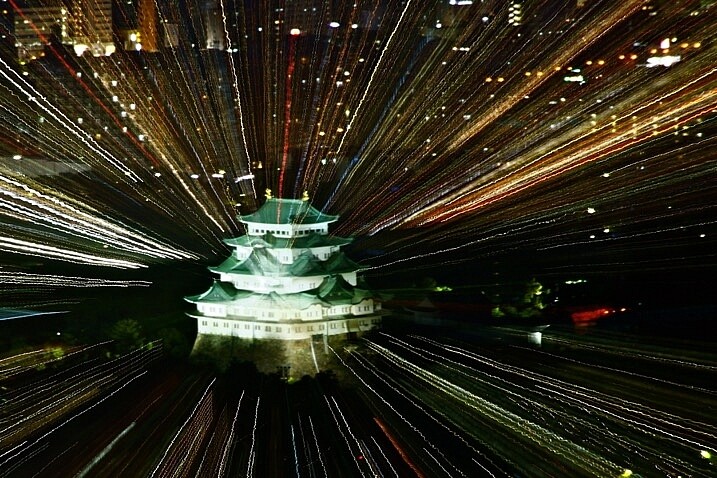
castle zoom burst photo

In this photo, Nagoya castle was focused on using a zoom. I zoomed into the castle.

5 – Zoom into the target area

Select the area of the scene you want to have as the center of your zoom, this should have been decided already during initial scene composition. Ensure that all your settings remain the same, as this is the final step before you begin the exposure. Set the camera to expose for 25-30 seconds, at f/8 or f/11. You can use a smaller aperture if you need to in order to get a longer exposure.

6 – Carry out the zoom burst

Set the camera to the 2-second timer (or 10 seconds if you want to prepare yourself for the zoom). Hit the shutter button to begin the countdown to the exposure. At the point when the shutter is about to open begin slowly zooming out. As the camera is exposing, continue to zoom out keeping it as smooth as possible to avoid camera shake.

You should be zooming out for between two and five seconds, the longer the zoom is the more pronounced the light trails will be in the image. As you zoom keep an eye on the focal length of the lens so you finish at your composed position.

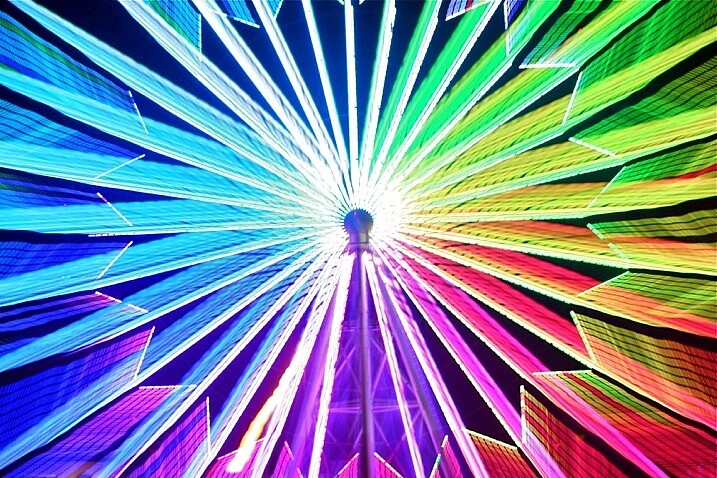
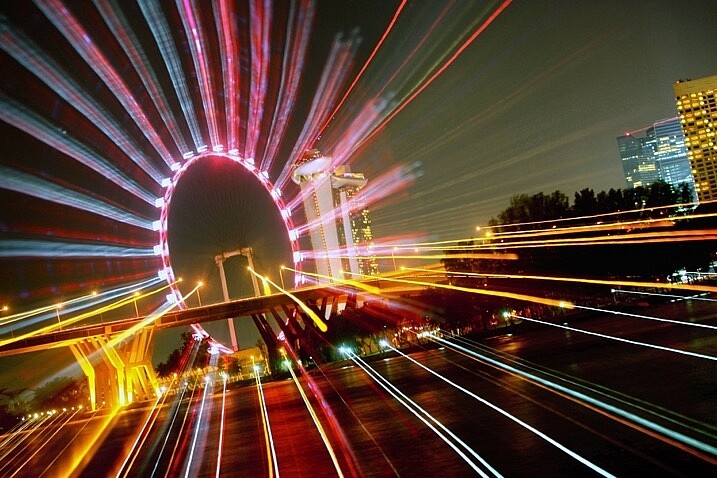
The ferris wheel is a great subject for zoom bursts. The middle is empty, and there is a ring of light to zoom out.

The Ferris wheel is a great subject for zoom bursts. The middle is empty, and there is a ring of light to zoom out.

7 – Allow the camera to finish the exposure

Once you have finished the zoom remove your hand from the lens, without moving the camera. The camera will continue to expose for 20-25 seconds depending on the exposure time you used. The image will now show zoom burst lights and architectural structures in the same exposure.

8 – Carry out post-processing work on the photo

The result in-camera will look nice, but adding contrast in post-processing is important. The image has “lost” five seconds of exposure time, so adjusting the contrast helps. You can use NIK color efex, which has a filter called pro-contrast and is an excellent choice for this type of photo. The centered position of the zoom can’t be adjusted in camera, though cropping the photo in post-processing allows you to move the zoom to an off-center position.

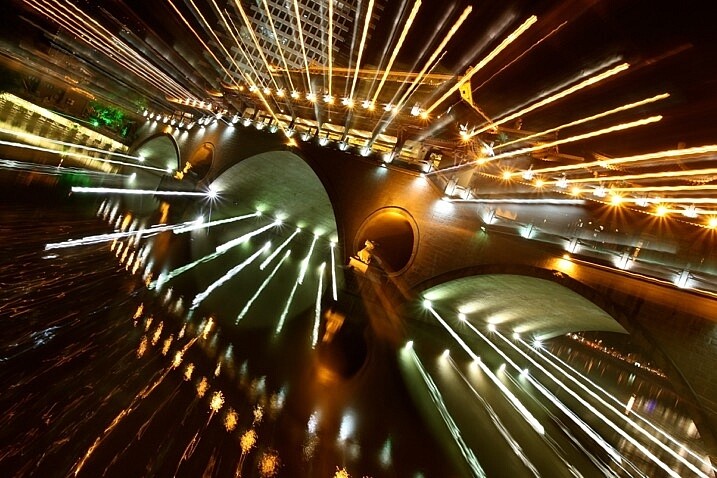
The bridge lit with many lights is a good subject for a zoom burst.

The bridge lit with many lights is a good subject for a zoom burst.

Where should I go to take zoom bursts?

The best place to take this type of photograph is in a city, one that’s well lit, and has interesting architecture. A Ferris wheel is a great structure to use as it’s circular, which helps with the centered nature of the zoom burst. Other architecture can also work as long as it’s alone and not surrounded by other structures. A cityscape with many buildings can look too busy with too many light streaks in one frame.

You can even take zoom burst photos during the day, but you will need an ND filter to do this. An ND filter that allows you to shoot for 30 seconds will allow you to create a zoom burst using the steps listed above, though the zoom should last longer.

img_2957

I look forward to seeing your photos using this zoom burst technique, please post any images you have in the comments section below.

This is a good example of a lone building with lights on.

This is a good example of a lone building with lights on.

In this photo only zoom is used, there is no stationary phase.

In this photo only zoom was used, there was no stationary phase.

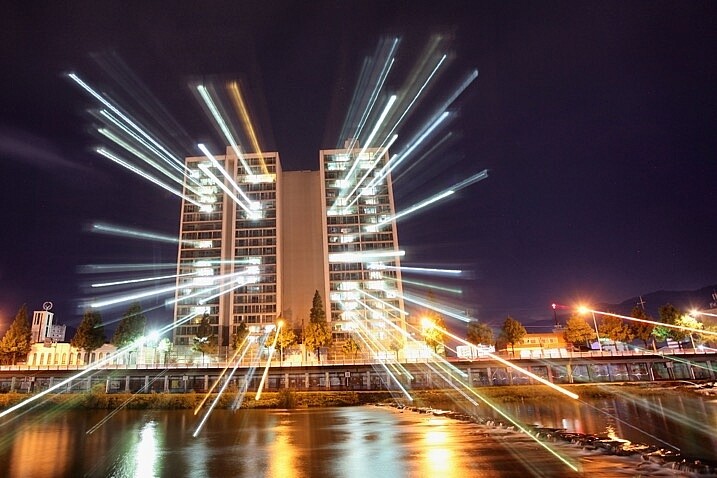
This photo shows how a zoom burst and static phase produces an image.

This photo shows how a zoom burst and static phase produces an image combining light streaks and architecture.

googletag.cmd.push(function() {
tablet_slots.push( googletag.defineSlot( “/1005424/_dPSv4_tab-all-article-bottom_(300×250)”, [300, 250], “pb-ad-78623” ).addService( googletag.pubads() ) ); } );

googletag.cmd.push(function() {
mobile_slots.push( googletag.defineSlot( “/1005424/_dPSv4_mob-all-article-bottom_(300×250)”, [300, 250], “pb-ad-78158” ).addService( googletag.pubads() ) ); } );

The post How to Create a Dynamic Zoom Burst Photograph by Simon Bond appeared first on Digital Photography School.


Digital Photography School

 
Comments Off on How to Create a Dynamic Zoom Burst Photograph

Posted in Photography


Kodak CMO says the company is ‘looking into’ reviving Kodachrome

11 Jan
Photo by pittaya via Flickr. Used under CC license

During CES 2017, Kodak announced it would revive the film stock it discontinued in 2012, Ektachrome. The announcement was well received, and was itself the result of an uptick in professional film sales, something that has also spurred Kodak toward another possible revival: Kodachrome. Eastman Kodak’s President of Consumer Film division and Chief Marketing Office Steve Overman confirmed as much during a recent The Kodakery podcast.

The Kodakery team spoke with Overman from the Kodak booth during CES, and near the end of the discussion they mentioned the Ektachrome revival. That topic snowballed into a confirmation from Overman that Kodak is likewise looking into bringing Kodachrome back, but plans to do so haven’t been finalized at this time.

Overman works for US-based Eastman Kodak but it seems likely the company would follow the pattern seen with its recent Ektachrome announcement, and work with UK-based company Kodak Alaris to release a stills version of the film to photographic markets.

It took less effort and time to bring Ektachrome film back, Overman explained, which is why it was given precedence. He went on to say, though, that ‘people love Kodak’s heritage products and I feel, personally, that we have a responsibility to deliver on that love.’ 

Via: PetaPixel

Articles: Digital Photography Review (dpreview.com)
 
Comments Off on Kodak CMO says the company is ‘looking into’ reviving Kodachrome

Posted in Uncategorized