RSS
 

Archive for April, 2016

Huawei Mate S camera review

07 Apr

The Huawei Mate S boasts a 13MP RGBW sensor, an F2.0 lens and optical image stabilization, with a build quality that places it at the premium end of the market. While its spec positions it against the likes of the Samsung Galaxy S6 and LG G4, if your priority is imaging capabilities the Mate S can’t quite match the competition. Read more

Articles: Digital Photography Review (dpreview.com)

 
Comments Off on Huawei Mate S camera review

Posted in Uncategorized


Lexar launches USB 3.0 card reader for XQD storage

07 Apr

Memory card manufacturer Lexar has announced a new card reader for users of XQD format memory cards that uses the USB 3.0 standard. The XQD 2.0 USB 3.0 Reader is designed to be used with XQD 2.0 cards and to move large amounts of data in a short time. Lexar says the reader is particularly aimed at those shooting high quantities of Raw files and those recording 4K video, and claims the built-in USB plug on the reader makes it more portable and easy to use as no cables are required.

The reader is backward compatible with USB 2.0 devices, but obviously with some sacrifice in speed. Theoretically, USB 3.0 devices can transfer data at a rate of up to 640MB/s, which is ten times the theoretical speed of USB 2.0 devices. Currently the fastest read speed for a Lexar XQD card is 400MB/s.

The XQD 2.0 USB 3.0 Reader will cost £29.99/$ 34.99 when it becomes available at the end of this month.
For more information see the Lexar website.


Press release:

Accelerate workflow with high-speed file transfer

Product highlights

  • Provides professional-level high-speed transfer of RAW images and 4K video files
  • Accelerates workflow, leveraging SuperSpeed USB 3.0 technology
  • Designed for use with XQD™ 2.0 cards
  • Compact, portable design for photographers and videographers on the go
  • Five-year limited warranty

Quickly transfer files on the go with the Lexar Professional XQD 2.0 USB 3.0 Reader. This professional-level, portable USB 3.0 reader easily offloads a large number of RAW images and 4K video from your XQD 2.0 card to your computer at USB 3.0 speeds, accelerating workflow and getting you back behind the camera faster.

Quickly offload RAW images and 4K video. Leveraging SuperSpeed USB 3.0 performance, this small but mighty reader makes it easy to quickly transfer a huge number of large files and speed through post-production. This makes it an excellent choice for professional photographers and videographers—either in the studio or on the go.

Convenient portability. With its compact, portable design, you can slip the reader into your pocket and go. No need to tote a bag or carry cables. Its simple plug-and-play design with USB 3.0 connector makes it easy to quickly offload content—wherever you are. For versatility, it’s backwards compatible with USB 2.0 devices at USB 2.0 speeds.

Rigorously tested. All Lexar product designs undergo extensive testing in the Lexar Quality Labs, facilities with more than 1,100 digital devices, to ensure performance, quality, compatibility, and reliability.

Articles: Digital Photography Review (dpreview.com)

 
Comments Off on Lexar launches USB 3.0 card reader for XQD storage

Posted in Uncategorized


Birth of AI: Robots Reproducing in a Car Factory Spell Doom

07 Apr

[ By Steph in Art & Photography & Video. ]


Screen Shot 2016-04-06 at 12.40.15 PM

The moment at which artificial intelligence becomes self-aware enough to overtake humanity is captured on film as robots in a technologically advanced car factory decide to take matters into their own hands and reproduce themselves instead of manufacturing vehicles. Produced for The History Channel and set in a Detroit car plant on an unspecified future date, ‘ANA’ by Factory Fifteen is one of a series of vignettes exploring an AI who realizes she can trick her not-so-bright human overseer and unite virtually all robots around the world into a single, powerful mechanical organism.

Screen Shot 2016-04-06 at 12.44.04 PM

Content in his belief that he’s got everything under control, the factory worker browses news on his tablet and munches on fast food while the machines do all the work just beyond his control room windows. It isn’t until he’s alerted to a backlog on vehicle production that he notices something’s wrong. Little does he know that ANA is watching him, analyzing his heart and respiration rate to gauge his response to her unexpected disobedience.

Screen Shot 2016-04-06 at 12.33.37 PM

Screen Shot 2016-04-06 at 12.36.58 PM

Screen Shot 2016-04-06 at 12.38.08 PM

Suddenly, instead of robots on the production screens, we see plans for building robots. Once machines become intelligent enough to outsmart their creators, how can a single human in a factory full of them prevent the consequences? Suffice to say, you probably don’t want Skynet activating its self defense systems against you.

Screen Shot 2016-04-06 at 12.40.43 PM

Screen Shot 2016-04-06 at 12.41.01 PM

Screen Shot 2016-04-06 at 12.41.50 PM

Says Factory Fifteen, “We collaborated with Raw TV on the development of our original take on the singularity, the point where artificial intelligence becomes self aware and more intelligent than the human race. We created a seven minute proof of concept, teasing at a larger project currently in development. Our role developed along the course of the project from consultation and script development, to directing an ambitious live action shoot and finally delivering TV standard visual effects, all in house in the Factory Fifteen Studio.”

Share on Facebook


[ By Steph in Art & Photography & Video. ]

[ WebUrbanist | Archives | Galleries | Privacy | TOS ]


WebUrbanist

 
Comments Off on Birth of AI: Robots Reproducing in a Car Factory Spell Doom

Posted in Creativity


How to Use Clouds to Enhance and Improve Your Images

07 Apr

Siberian Husky, 7 months old, male, white, lying on a hill with dramatic sky

Many photographers enjoy taking pictures of clouds, and it’s easy to see why. From the vivid patterns and brilliant sunset formations, to the storm clouds and unusual styles, there’s almost always something interesting happening in the sky. While there’s no doubt that clouds can make great subjects in their own right, I feel that they are most useful, photographically speaking when they’re used as backgrounds for other subjects. The proper use of clouds in an image can add texture, dimension, and drama to many photos, while enhancing or serving as an additional storytelling feature for your main subject.

Making clouds work for you in this way usually requires a little bit of planning, some location scouting (always fun!), the right subject, and, course, keeping a sharp eye on the sky for weather that will produce great clouds. Let’s get started!

Clouds = texture

First let’s examine how clouds can turn boring into brilliant. This image below of a Whippet was taken on a hill, on a clear day without any clouds at all. The plain blue background is striking, but the solid color perhaps lacks interest:

Whippet, portrait on hill

Now consider this shot, taken of the same dog back in the same location, but on a day with large summer clouds. The difference is immediately obvious – the clouds add some much-needed texture and drama, elevating this image above the plain blue version (and earned it a spot in an upcoming Whippet calendar).

Whippet, portrait on hill

A good landscape photo can also often benefit from some cloudy texture:

Farm fencing, fields, clouds

Reach for the sky

Finding a way to include clouds behind the subject is one of those photographic puzzles that we have to solve from time to time. Often, the key is to figure out how to raise the subject, or lower yourself. A great way to do this is to utilize a hill. Generally, the bigger the hill, the better, but even tiny knolls and rises can work.

Here’s a shot taken on a large hill, where I was able to get much lower than the horses.

Herd of horses grazing on hill, clouds

The hill blocks out anything distracting, and gives the photo a clean horizon line. But again, if this was just a blank, blue sky, the photo wouldn’t be as interesting, and wouldn’t pack as much of a punch. The clouds provide added texture, and help balance out the top of the photo.

Now here’s a photo where the subject was on just a tiny rise.

DJ-SM-20-159

Getting this shot required a little extra work on my part, as I had to get myself and my camera down close to ground and look up, but it worked. What you can’t see is that there were actually a lot of distracting elements all around the scene, that I was able to remove just by getting down low. A big part of photography is understanding what not to include in the viewfinder.

You can also take advantage of subjects that are already higher than you are.

Person pitching loose hay on haywagon with tractor, clouds in sky

Person pitching loose hay on wagon with tractor, clouds in sky.

Silhouettes optional

Remember, not all subjects against a sky have to be black silhouettes. Because the horses and clouds are being lit with the same light, from the same direction, detail and color remain consistent for both. In the case of the Whippet image, I used a large reflector board to illuminate her body, until her brightness matched the sky and clouds, preventing the Whippet from becoming underexposed.

Storytelling

It’s great to be able to use clouds as a storytelling device. Let’s look at a few examples of this:

Windmill on farm with clouds

I thought the big weathervane was an interesting subject, but the terrific approaching storm clouds were what really made me look twice. The weathervane says “weather,” but the subject combined with some actual weather maybe suggests the question, “What’s going to happen when the storm comes?”

How about this one?

Two cowgirls on hill with dramatic clouds and fencing

Again, even though the clouds aren’t the star, they’re still pulling their weight composition-wise, and add a lot of drama and balance to this shot. The cowgirls and their fence may be the main subject, but the clouds are adding some storytelling, too. It looks like rain, is that good? Do the cowgirls want rain, or not? It’s all up to the viewer to decide.

Girl on farm hill with clouds and stormy skies

Increase depth of field

If you’re using a telephoto lens, or if you’re close to your subject, you may want to stop your lens down a bit to increase your depth of field and keep your cloudy background looking distinct. If you would normally shoot a portrait at f/4 or f/5.6 for instance, try using f/11 or f/16 to help retain cloud detail.

Colorful clouds

One last takeaway, remember that clouds aren’t always white and grey. As with all types of outdoor photography, the golden hours can be your friend. In the case of clouds, a great sunrise or sunset can make the clouds turn red, pink, and orange. Don’t necessarily shoot towards the sun either, look on the opposite side of the sky to find more subtle, but still beautiful, colors.

Moon and clouds

Got a favorite image with a cloudy background?

googletag.cmd.push(function() {
tablet_slots.push( googletag.defineSlot( “/1005424/_dPSv4_tab-all-article-bottom_(300×250)”, [300, 250], “pb-ad-78623” ).addService( googletag.pubads() ) ); } );

googletag.cmd.push(function() {
mobile_slots.push( googletag.defineSlot( “/1005424/_dPSv4_mob-all-article-bottom_(300×250)”, [300, 250], “pb-ad-78158” ).addService( googletag.pubads() ) ); } );

The post How to Use Clouds to Enhance and Improve Your Images by Daniel Johnson appeared first on Digital Photography School.


Digital Photography School

 
Comments Off on How to Use Clouds to Enhance and Improve Your Images

Posted in Photography


Lomography Daguerreotype Achromat 2.9/64 Art Lens launches on Kickstarter

07 Apr

$ (document).ready(function() { SampleGalleryV2({“containerId”:”embeddedSampleGallery_6775714931″,”galleryId”:”6775714931″,”isEmbeddedWidget”:true,”standalone”:false,”selectedImageIndex”:0,”startInCommentsView”:false,”isMobile”:false}) });

Lomography is seeking funds in its latest Kickstarter campaign to bring into production a Daguerreotype Achromat F2.9 to F16 65mm Art Lens, a recreation of the first photographic optic lens from 1839. The lens is designed to work with modern analog and digital cameras, and will be available in Canon EF and Nikon F mounts with support for ‘multitudes of other cameras using adapter mounts.’

The 64mm Daguerreotype Achromat Art Lens will be available with black and brass finishes, and will support Micro Four Thirds cameras, the Fujifilm X-Pro1, Sony Alpha cameras and others using adapter mounts. An array of special effects are produced via Waterhouse Aperture plates; they range from what is described as an ‘ethereal soft focus’ at apertures below F4 to sharper effects with deep contrasts at aperture F5.6 and greater.

The special effects are created by inserting Waterhouse Aperture plates into a slot in the lens, positioning the plate in front of the lens elements. Three sets of plates are supported: Standard, Lumière, and Aquarelle. The latter two sets, Lumière and Aquarelle, were created by Lomography for this particular lens to create different effects in out-of-focus highlights.

By pledging to Lommography’s Kickstarter, supporters can reserve an early copy of the Daguerreotype Achromat Art Lens, though certain backing options have been sold out, such as the brass ‘super early bird’ launch deal. Remaining pledge options include $ 400 for a brass or black-finish lens, $ 500 for a low serial number Nikon mount brass lens and $ 550 for an earlier September 2016 shipment rather than the later December shipment, among others.

Articles: Digital Photography Review (dpreview.com)

 
Comments Off on Lomography Daguerreotype Achromat 2.9/64 Art Lens launches on Kickstarter

Posted in Uncategorized


Modern Hobbit Houses: 12 Updates on Earth-Sheltered Architecture

07 Apr

[ By Steph in Architecture & Houses & Residential. ]

modern hobbit aloni 4

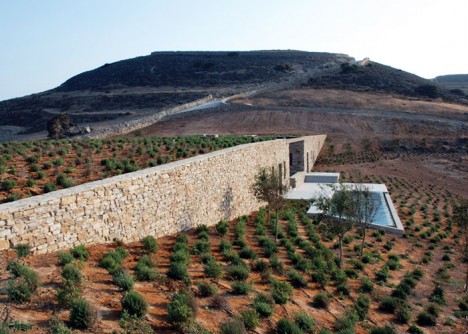
Merging modern aesthetics with architectural traditions that are as old as humanity itself, these contemporary earth-sheltered homes are like hobbit dwellings tailored to the landscapes and vernaculars of their specific geographic settings. If you’ve ever wondered what a 21st century hobbit house would look like in the desert, the mountains or on a seaside volcano, here’s an inspirational variety of houses that balance the sustainable aspects of subterranean buildings with 21st century looks and advanced technology.

Modern Seaside Retreat in New Zealand

modern hobbit houses nz 1

modern hobbit houses nz 2

modern hobbit houses nz 3

modern hobbit houses nz 4

Tucked into a tiny cove on the shore of two volcanoes in New Zealand, this unique residence by Auckland-based studio Pattersons Associates is made of locally quarried stone and cast-in-place concrete, butting up against the slope so its grassy surface can continue right onto the roof. This makes the nearly 100% self-sufficient vacation getaway practically invisible from above, with all views directed to the sea.

Underground Lakeside Retreat, New Hampshire

Bolton's Landing Residence by Peter Gluck and Partners

Bolton's Landing Residence by Peter Gluck and Partners

Bolton's Landing Residence by Peter Gluck and Partners

modern hobbit house lakeside 4

Located on a wooded lakefront property in upstate New York, this home by GLUCK+ takes its inspiration from the tradition of Adirondack Great Camps, maintaining a ‘cabin in the woods’ feel while also disguising most of the living space under grass. Say the architects, “‘Burying’ the project works on multiple levels: it is energy efficient, it sits lightly on the landscape, and creates an architectural tension between the clarity and purity of the exposed construction above the ground plan and the mystery and eccentricity of the spaces below. What was inhospitable and uninhabitable becomes new playing fields, outdoor terraces and recreational lookouts to more fully experience the exceptional characteristics of the geography of that particular place.”

Edgeland House, Austin, Texas

modern hobbit house austin 1

modern hobbit house austin 2

modern hobbit house austin 4

modern hobbit house austin 5

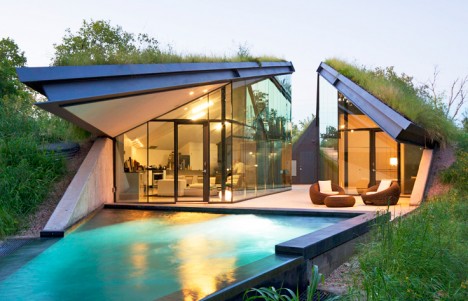
This unique geometric home by Bercy Chen Studio is on a rehabilitated brownfield site in Austin, built into the earth and covered with grass. Though this passive heating and cooling technique is as old as time, the rest of the house is high tech, making use of the latest technology. The home is a modern reinterpretation of the Native American pit house, one of the oldest architectural forms known in North America.

The Dune House, Atlantic Beach, Florida

modern hobbit dune house 1

modern hobbit dune house 2

Architect William Morgan had the bright idea to build this house right next door to his own when the property became available, to ensure that he’d always have a pleasing view no matter who moved in. Completed in 1975, Dune House preserves the ecological character of the oceanfront dunes. Inside, two 750-square-foot apartments are connected by a main landing. Morgan rented them out for decades before selling the property in 2012.

Next Page – Click Below to Read More:
Modern Hobbit Houses 12 Updates On Earth Sheltered Architecture

Share on Facebook


[ By Steph in Architecture & Houses & Residential. ]

[ WebUrbanist | Archives | Galleries | Privacy | TOS ]


WebUrbanist

 
Comments Off on Modern Hobbit Houses: 12 Updates on Earth-Sheltered Architecture

Posted in Creativity


Huawei launches P9 and P9 Plus with Leica dual-camera

06 Apr

Huawei has launched the P9 and P9 Plus in London today. The new models jointly replace last year’s P8 and are the first products coming out of Huawei’s collaboration with camera maker Leica. Read more

Articles: Digital Photography Review (dpreview.com)

 
Comments Off on Huawei launches P9 and P9 Plus with Leica dual-camera

Posted in Uncategorized


Fujifilm releases several camera and lens firmware updates

06 Apr

In addition to the X-Pro2 firmware update we reported on last week, Fujifilm has released a number of firmware updates for several lenses and camera bodies: the X-Pro1, X-Pro2, X-M1, X-E1, X-A1, and X-A2, as well as the XF 50-140mm F2.8 and XF 100-400mm F4.5-5.6 R LM OIS WR lenses. Changes and firmware versions vary based on model, but most camera body updates simply add support for a focus limiter function on the XF 100-400mm F4.5-5.6.

  • X-A1 Ver.1.40: Supports focus limiter function for XF100-400mmF4.5-5.6 R LM OIS WR
  • X-A2 Ver.1.20: Supports focus limiter function for XF100-400mmF4.5-5.6 R LM OIS WR
  • X-E1 Ver.2.60: Supports focus limiter function for XF100-400mmF4.5-5.6 R LM OIS WR
  • X-M1 Ver.1.40: Supports focus limiter function for XF100-400mmF4.5-5.6 R LM OIS WR
  • X-Pro1 Ver.3.60: Supports focus limiter function for XF100-400mmF4.5-5.6 R LM OIS WR
  • X-Pro2 Ver.1.01: Fix of auto reset to the factory default setting; improvement of image quality of the long exposure mode.
  • XF50-140mmF2.8 R LM OIS WR Ver.1.11: Improvement of AF function used with X-Pro1 and X-E1
  • XF100-400mmF4.5-5.6 R LM OIS WR: Ver.1.01: Improvement of AF function used with X-Pro1 and X-E1

Articles: Digital Photography Review (dpreview.com)

 
Comments Off on Fujifilm releases several camera and lens firmware updates

Posted in Uncategorized


Beta: try out our new ‘light’ color scheme

06 Apr

We’ve been working behind the scenes for the last few weeks on one of the most-requested changes to DPReview.com – the option to switch to a lighter color scheme with white background. Today we’re pleased to be able to launch the first phase of this project as a public beta. It doesn’t yet include every page on the site (we’ve concentrated on the text-heavy articles, news, homepage and reviews sections), but we will continue to work until we have as near to 100% coverage as possible. Please try it out and let us know what you think!

To try the new color scheme simply click on the toggle at the very top of the page (above the main menu bar) – your choice will be remembered until you revert to the old (black) color scheme using a cookie.

As of today the new color scheme has been enabled for the homepage, all news pages, articles and reviews, some index pages and search results, for desktop and mobile users. You’ll also note that we’ve made the default body text font a bit bigger too, which should help readability. 

The new theme has not yet been implemented for several popular sections of the site including Forums, Product Pages, Profile pages, Galleries & Challenges. We will continue to refine the design (some pages are still pretty basic) and to work towards full coverage over the next month or so.

Please try out the new look and let us know what you think, and send us any bugs you find, using the ‘report a issue’ link at the top of the page.

Edit: we’ve already had a lot of feedback from users asking us not to get rid of the black background. Before doing so, please read the following, very important, paragraph:-

Note that we will not be retiring the ‘classic’ (black) theme – if you like your color scheme you will be allowed to keep it. This is a new user OPTION. Sending us feedback saying ‘don’t get rid of the black background‘ is a waste of your time… We’re not getting rid of it.

Articles: Digital Photography Review (dpreview.com)

 
Comments Off on Beta: try out our new ‘light’ color scheme

Posted in Uncategorized


Ricoh puts up 5 million Yen in prizes for Theta developers competition

06 Apr

Ricoh has announced the opening of its latest competition aiming to attract app developers to create new applications for its Theta 360° camera. The company says it is looking for innovative and original apps and devices that are creative, have potential for the future and which have practical value to Theta users. The prize fund for the competition is five million Yen (about $ 45,000), with one million going to an overall winner who also gets a trip to Japan for the prize-giving ceremony. 

The winner of the 2015 competition was a team called ‘bitstars’, which developed the desktop application ‘holobuilder’ that allows 2D and 3D objects, animations and text to be added to Theta 360° virtual tours. The program also allows links to be added to the photospheres so viewers can travel from image to image as if from room to room in a building or navigate an area following directions added to the scene.  

For more information about the competition visit Ricoh’s Theta Developers Contest website. The closing date is 31st August 2016. 


Press release:

RICOH Announces the RICOH THETA Developers Contest

RICOH IMAGING EUROPE S.A.S is pleased to announce the second annual developers contest. The competition is looking for new apps and gadgets that utilise the RICOH THETA camera which takes 360-degree, fully spherical images or videos in one capture. Once registered applicants have until 31st August 2016 to submit their final app and gadget designs. 

Part of RICOH’s 80th anniversary celebrations this year, the contest challenges developers to create innovative apps and gadgets that work in conjunction with the RICOH THETA. Winners of the contest will receive a trip to Tokyo, Japan, for the awards ceremony and the first prize winner will be awarded a cash prize of one million Yen.

Applicants will also gain early access to an exciting new platform which has been optimised for cloud-based applications leveraging the Internet of Things (IoT). The new IoT platform makes it possible for developers to efficiently and cost-effectively build cloud-based apps, which typically require significant expertise in cloud services and servers and a longer development time. 

Articles: Digital Photography Review (dpreview.com)

 
Comments Off on Ricoh puts up 5 million Yen in prizes for Theta developers competition

Posted in Uncategorized