RSS
 

Archive for February, 2016

Rumors hint at super-fast Sigma 50-100mm F1.8 Art lens for APS-C DSLRs

20 Feb

Rumors suggest Sigma is getting ready to launch a 50-100mm F1.8 lens for APS-C cameras. Full specifications and convincing images of the lens have been leaked, suggesting the lens will be part of the company’s impressive ‘Art’ range. Such a lens would offer a fast partner to the company’s 18-35mm F1.8 Art lens, giving the same angle-of-view, depth-of-field and total light gathering capability as a ~75-150mm F2.8 lens on full-frame.

Specifications reported on Digicame-info.com seem plausible, so we’re looking forward to next week’s CP+ show in Yokohama, Japan, to see if the rumors are true. We’ll be reporting from the show, so stay tuned for all the details.

Lens construction (elements/groups) 21/15
Filter size 82
Minimum focus distance 95cm
Aperture blades 9
Length 170.7mm (mount not specified)
Diameter 93.5mm
Weight 1490g

 The site suggests a price of ¥167,400 (~$ 1500) and a launch date of April 22nd.

Articles: Digital Photography Review (dpreview.com)

 
Comments Off on Rumors hint at super-fast Sigma 50-100mm F1.8 Art lens for APS-C DSLRs

Posted in Uncategorized


Modern Masters: 10 Installations by Artist & Activist Ai Weiwei

20 Feb

[ By Steph in Art & Installation & Sound. ]

weiwei forever 1

China has incarcerated him, put him on house arrest and made every attempt to shut artist and activist Ai Weiwei up, but they haven’t stopped him from expressing his scathing criticism of the country’s rapid industrialization and cultural oppression at every turn. Known for investigating government corruption and cover-ups, Weiwei was arrested on highly questionable tax evasion charges and held in a tiny, constantly-lit room overseen by two guards around the clock, and wasn’t allowed to leave the country for a year after his release. He remains under heavy surveillance, and his moments are restricted, but through his art installations around the world, he’s still able to express the views Chinese officials find so threatening. Here are 10 of Weiwei’s most striking projects addressing everything from the current refugee crisis to the ‘Made in China’ phenomenon.

Safe Passage: Life Jackets on the Konzerthaus, Berlin
weiwei life jackets 1

weiwei life jackets 2

weiwei life jackets 3

weiwei life jackets 4
Life jackets left behind by refugees when they reach the shores of the Greek island of Lesvos adorn the columns of Berlin’s landmark Konzerthaus in a poignant installation completed on February 15th, 2016. Weiwei retrieved the jackets himself and in doing so, was present as even more refugees landed. Drawing attention to the humanitarian crisis, the project provides a striking visual representation of the scale of the problem, with the 14,000 jackets standing out in safety orange.

Forever Bicycles: Scotiabank Nuit Blanche, Toronto

weiwei forever 2

weiwei forever 3

weiwei forever 4

weiwei forever 5
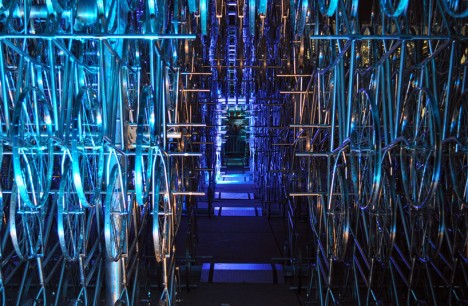
3,144 interconnected bicycles come together into one big 3D structure in Toronto’s Nathan Phillips Square in this reinterpretation of Weiwei’s ‘Forever Bicycles’ exhibition. Presented by Scotiabank’s Nuit Blanche in 2013, the sculpture is made of frames from China’s biggest bicycle brand, and represents the rapid changes that are taking place in the nation and across the world.

Er Xi: Silk Dragons at Le Bon Marché, Paris
weiwei paper dragons

weiwei paper dragons 2

weiwei paper dragons 3

weiwei paper dragons 4

weiwei paper dragons 5
Figures from Chinese mythology blend with symbolism from Ai Weiwei’s own portfolio in ‘Er Xi’ (Child’s Play), a serene exhibition of three-dimensional white silk and bamboo sculptures at Paris’ Le Bon Marché department store. The display combines 2,000-year-old tales told to Chinese children with the kite making tradition, presenting the narratives in the front store windows and continuing them in the atrium with interpretations of Shan Hai Jing woodcuts.

An Archive: 6,830 Tweets on Rice Paper
weiwei archive

weiwei archive 2

weiwei archive 3
Tweets may seem ephemeral and unimportant in the grand scheme of our culture, but what if they were carefully preserved for future generations as a real documentation of the current era? With ‘An Archive,’ Weiwei makes his own history of 6,830 Twitter posts dating back to 2005 into a tangible chronicle of his thoughts, printing them on rice paper sheets and laying them out like a traditional Chinese textbook. “Social media is annoying and distracting in certain ways because we are familiar with an older lifestyle,” says the artist. “The world today is very different. You can sit at your computer and, within minutes, you can see the best ideas and research on any topic. This is in conflict with our old habits, but there can be nothing better than this. Human beings are not created equal and we have never had that opportunity. Technology, especially with computers and the internet, has gone further than anything else in leveling the field.”

Next Page – Click Below to Read More:
Modern Masters 10 Introspective Installations By Ai Weiwei

Share on Facebook


[ By Steph in Art & Installation & Sound. ]

[ WebUrbanist | Archives | Galleries | Privacy | TOS ]


WebUrbanist

 
Comments Off on Modern Masters: 10 Installations by Artist & Activist Ai Weiwei

Posted in Creativity


Finding your story: National Geographic grant winner Max Lowe

19 Feb

‘If you want to be a better photographer, stand in front of more interesting stuff.’
– Jim Richardson, National Geographic Photographer

Born into a family with a taste for the ‘restless life,’ Max Lowe was indoctrinated into a life of far-flung travel basically at birth. ‘Traveling,’ Lowe says, ‘more than anything, has inspired me.’

It was during his years in college in Salt Lake City that Lowe first picked up a camera. In addition to bringing his camera along while he and friends were ‘chasing pow,’ Lowe found that pitching himself as a photographer often allowed him access to live musical performances for free. ‘This was really the first time I experienced photography as a tool that could take me to these places that I wouldn’t be able to access otherwise,’ Lowe says. ‘It was an addicting thing.’

After receiving his first payment as a photographer in the form of a gift certificate to a local pizza joint (‘the pizza was great’), Lowe decided to explore photography as more than a hobby. He began to experiment with combining his natural inclination for travel with his photography to actually build a career. It was while traveling through India that Lowe received word back from National Geographic that he had won the ‘Young Explorers’ grant. He was to leave India and travel to the Khumbu region of Nepal to document the influence of Western tourism culture on the native Sherpa people. And Lowe’s journey with National Geographic continues from there.

‘I found stories living in the experiences I already craved,’ Lowe says. ‘Find your story. Find something you’re truly hungry for. The rest will follow suit.’

Articles: Digital Photography Review (dpreview.com)

 
Comments Off on Finding your story: National Geographic grant winner Max Lowe

Posted in Uncategorized


The long, difficult road to Pentax full-frame

19 Feb

Pentax’s road to full-frame has been long, winding and not without a few wrong turns. But it could all have been so different. 

Way back in 2000, when the 21st Century was just beginning to find its feet and photography journalists were starting to get used to putting a ‘D’ into ‘SLR’, Pentax announced that it was making a full-frame (D)SLR. Had it shipped, that camera – which was developed out of the company’s then-flagship film model the MZ-S – would have predated anything from Canon, Nikon, Kodak or (unthinkable at the time) Sony. And Contax, too, but the less said about that, the better. 

Ambitious, powerful, innovative and ultimately doomed, the original Pentax full-frame DSLR was in some ways the Spruce Goose of cameras, but tragically it never even achieved the short, thrilling first and final flight of Howard Hughes’ most famous creation. 

The progenitor. The original, unnamed Pentax full-frame DSLR, which was to be based around a 6MP Phillips CCD sensor, and was originally intended to ship in spring 2001. Officially, the camera (which has become known as the MZ-D) was canceled due to concerns over cost, but it’s likely that the poor performance of the sensor (which made it into the very poorly received Contax N1) played a part.

Instead, like Hughes himself the camera withdrew from public view amid a swirl of rumors. Whispers around the glass case at PMA in 2001 hinted at problems with the troubled 6MP Phillips CCD sensor (later confirmed in the woeful Contax N1). The camera would be too costly to produce, became the official line. The brash confidence behind its announcement at Photokina the previous autumn faded into memory. Meanwhile, Pentax’s projected ship date of spring 2001 came and went, and other full-frame cameras stole the headlines. A nurse was called for, the screens were drawn, and they remained drawn for almost 15 years. 

And we never even knew its name.

Over time, people forgot about the Pentax full-frame DSLR. Pentax representatives (and later, representatives from Hoya and Ricoh) didn’t seem to like talking about it, when they admitted to remembering it at all. A whole generation of tech journalists emerged whose only experience of full-frame photography with a Pentax camera was that one roll of film they tried to put through that old K1000 they found in a junk shop that time. 

And Pentax moved on. 

In 2003, Pentax created the *ist D, its first APS-C DSLR and in 2005, the company announced that it was leapfrogging full-frame altogether in favor of developing a medium-format DSLR. A couple of years later and with no shipping MF camera in sight, the company was acquired by Hoya. Shortly after the takeover we heard that actually, medium format digital was no longer a priority, but two years after that, in 2010, the 645D – with updated specs in the five years since its development was first announced – was officially unveiled.

In 2011, a full ten years after the original Pentax full-frame DSLR should have shipped, the company was bought again, this time by Ricoh. 

The original 645 model, the 645D, saw Pentax branching out into the medium format digital market. The 645Z, which succeeded the original 645D, has proven very popular. 

And all the while, through the course of two buyouts, Pentax was doing what it did best – creating a string of capable, solid, workman-like DSLRs and compact cameras that attracted a small and loyal customer base but which didn’t do much to bother the fortunes of the bigger players in the camera market. The company’s one and (so far) only large-sensor mirrorless camera, the K-01, was not a success, but the medium format 645D did well and was followed by the excellent 645Z. It seemed for a while that with some solid differentiators in the APS-C and medium format spaces, Pentax didn’t really need to create a full-frame camera.

But now, almost 16 years after that fated Photokina announcement, that’s exactly what Pentax (or rather Ricoh) has done. 

‘So why now, and who is the K-1 for?’

So why now? Ricoh claims that the timing is very deliberate. The company seems to recognize that after the late-2000s its chances of making a meaningful dent in the full-frame market were very slim. After leaving the full-frame space to its competitors for more than a decade, it made more sense for Ricoh to attack the much less competitive medium format digital market, and position the Pentax brand as a serious but affordable player in a marketplace that for years has been dominated by stupendously expensive systems from Hasselblad, Phase One and others. 

Meanwhile, although Ricoh / Pentax never managed to wrest a particularly big share of the APS-C market from its competitors, cameras like the K-3 II quietly introduced a host of impressively innovative features. These days we take image stabilization for granted, but Pentax deserves credit for iterating on the basic principle of in-body stabilization over several generations of DSLRs, ultimately leading to the various imaginative and effective sensor-shift features that grace the K-3/II and, now, the new K-1. 

The K-1 becomes the first conventional DSLR to offer a stabilized full-frame sensor. But as well as image stabilization, the K-1’s sensor can also be shifted by minute degrees for higher color resolution capture, AA filter simulation, and star tracking. 

So after all this time, who is the K-1 for? In conversations with DPReview, Ricoh representatives have never tried to deny the fact that after 15 years of inactivity in the full-frame space, a lot of their customers (especially semi-professional and professional photographers) have defected to Canon, Nikon and Sony. But some of these professionals have rediscovered Pentax – and others have discovered it for the first time – thanks to the 645D and 645Z. 

When I spoke to Kazunobu Saiki, general manager of Ricoh’s Marketing and Communication department last year in Japan, he told me that the company’s forthcoming full-frame DSLR was aimed at ‘our existing customers’. I.e. those new 645D/Z fans and a whole generation of DSLR photographers (especially in Asia) who love Pentax cameras for their features, pricing, and custom color options. Plus of course the ultra loyalists around the world who have stuck with the Pentax brand over the years and refused to switch systems in the hope that one day, a camera like the K-1 would eventually be produced. I know they’re out there. They send me emails. 

‘The K-1 is primarily a camera for Pentax fans, and there’s nothing wrong with that at all.’

At this point in time, Mr Saiki’s strategy makes perfect sense. The K-1 is primarily a camera for Pentax fans, and there’s nothing wrong with that at all. It seems highly unlikely that anyone who’s been happily using a full-frame camera from another manufacturer for the past few years will suddenly throw it all away and buy a K-1. The K-1 looks like a pretty good camera, and $ 1800 is a pretty good price, but it’s still a considerable chunk of change, and that’s not including lenses. 

And lenses, it seems to me, is where Ricoh has a real battle on its hands, not only in terms of attracting potential system switchers but (probably more importantly) also catering to its existing user base.

It has been 13 years since the last full-frame Pentax camera, and understandably, neither Pentax nor third-parties have had much incentive to release full-frame K-mount lenses in the intervening time.

The existing audience of digital Pentax users may very well have a collection of autofocus lenses for their DSLRs, but most are designed for the APS-C format (and many contain the notoriously troublesome SDM focus motor). They’ve got modern coatings, they’ll fit on the K-1, and some will offer almost a full-frame imaging circle. But like training wheels on a bicycle, I suspect that most self-respecting photographers will be keen to stop using them as soon as possible in favor of a more authentic, grownup experience. Why rumble along at 15MP when you could be enjoying 36?

I suspect that a lot of former Pentax users still have one of these in a closet somewhere – the 50mm F2 was bundled with mid-range Pentax SLRs in the 70s and 80s, and still gives ok-ish, more-or-less-acceptable performance on digital cameras. As long as you don’t look too closely, especially at the edges.

Before you leave an angry comment, I know there are plenty of better manual focus lenses in Pentax’s historical lineup (we just happened to have this one lying around the office), and the K-1 will work with pretty much all of them. 

But what about the legacy manual focus lenses? Ah yes. With decades of compatible K-mount lenses, Pentax users are very well-served. In theory. I have a collection of 70s and 80s-vintage Pentax primes, and I can’t wait to try them out on the K-1. Unfortunately, while putting old glass on high-resolution cameras is a lot of fun, it does tend to show up the defects in that glass pretty glaringly. There are some excellent lenses in Pentax’s historical lineup, but there is a very real risk that a zoom or even a prime that always delivered lovely 6×4 inch prints on film might not quite live up to customer expectations when paired with a 36MP sensor. 

And unfortunately for the proud new K-1 owner, Pentax K-mount lenses are their only option. Like Nikon F, the Pentax K mount is old, and cursed with a particularly long flange-back distance. What this boils down to its that lenses from other mounts cannot be adapted to work on the K-1 (not without the addition of extra corrective elements, at any rate). So unlike the Sony a7R II, for instance, which will accept pretty much any lens you can think of, made by anyone, ever, with the correct adapter, that’s just not possible with the K-1. 

‘Once you’ve bought a couple of lenses to go with your new K-1, that fairly reasonably $ 1800 has turned into a much, much bigger investment.’

Which for a quality-focused enthusiast K-1 owner arguably leaves only one genuinely safe option. Buy a set of new Pentax full-frame zoom lenses. The new 15-30mm and 24-70mm seem to perform well (they should do, since they’re most likely based on proven Tamron lenses with the stabilization mechanics removed and some proprietary coatings) and we enjoyed using the 70-200mm when we shot with the K-1 recently. But once you’ve bought a couple of lenses to go with your new K-1, that fairly reasonably $ 1800 has turned into a much, much bigger investment.

All that being said, I want the K-1 to succeed, and I think it deserves to. It’s truly innovative, bold, and represents a brave move by Ricoh (and one that I suspect was motivated by a certain amount of justifiable pride on the part of the engineers). To an extent, my investment in the K-1 is emotional. My first proper camera was a Pentax MX, and along the way I’ve owned various other Pentax cameras (including for a few brief, glorious weeks, an LX) all of which I have enjoyed. I was genuinely excited when Ricoh told us, some time ago now, that a full-frame Pentax DSLR was once more being prepared for launch. Hopefully this time it will get a little higher off the ground – and hey – at least this time it has a name. 

Articles: Digital Photography Review (dpreview.com)

 
Comments Off on The long, difficult road to Pentax full-frame

Posted in Uncategorized


11 Premium & Free Resources for Photographers (Bundles, eBooks, Courses)

19 Feb

How do I start my own photography business? How can I improve my shooting skills? What do I need to edit images faster? There’s no lack of information to answer these and other questions photographers may face. But then again, choosing the right eBook, email course, or Lightroom preset collection from an overwhelming amount of available resources may be quite Continue Reading

The post 11 Premium & Free Resources for Photographers (Bundles, eBooks, Courses) appeared first on Photodoto.


Photodoto

 
Comments Off on 11 Premium & Free Resources for Photographers (Bundles, eBooks, Courses)

Posted in Photography


26 Images with a Hunger for a Good Meal – Photos at the Dinner Table

19 Feb

Whether it be a fancy feast at a special occasion, a romantically set table for two, or burger and fries on a plate – the following images satisfy a hunger for not only a good meal, but some great photos at, and around the dinner table.

Are you one to photograph your food in restaurants? Entire Instagram accounts are made up of such images. Note: remember to follow dPS over on Instagram! Even if you aren’t prone to that kind of photography, let’s see if these photos at the dinner table can inspire you, and/or make you hungry too!

This is actually my photo taken of someone else's sandwich in Trinidad, Cuba. It just looked so amazing!

This is actually my photo taken of someone else’s sandwich in Trinidad, Cuba. It just looked so amazing I had to photograph it!

Radiowood

By radiowood

Antonin Rémond

By Antonin Rémond

Snugg LePup

By Snugg LePup

Dave Hensley

By Dave Hensley

Ron Frazier

By Ron Frazier

The Hamster Factor

By The Hamster Factor

JAPANKURU

By JAPANKURU

Ames Lai

By Ames Lai

Jitter Buffer

By Jitter Buffer

Shawn Harquail

By Shawn Harquail

Laura Thorne

By Laura Thorne

Marketa

By Marketa

Adam Wyles

By Adam Wyles

Mark Manguerra

By Mark Manguerra

Zlatko Vickovic

By Zlatko Vickovic

Tobias Lindman

By Tobias Lindman

Gunilla G

By Gunilla G

Kai Chan Vong

By Kai Chan Vong

Brian Wolfe

By Brian Wolfe

Foodswings

By foodswings

Brook Ward

By Brook Ward

Elias Quezada

By elias quezada

Stijn Nieuwendijk

By Stijn Nieuwendijk

Georgie Pauwels

By Georgie Pauwels

Renaud Camus

By Renaud Camus

googletag.cmd.push(function() {
tablet_slots.push( googletag.defineSlot( “/1005424/_dPSv4_tab-all-article-bottom_(300×250)”, [300, 250], “pb-ad-78623” ).addService( googletag.pubads() ) ); } );

googletag.cmd.push(function() {
mobile_slots.push( googletag.defineSlot( “/1005424/_dPSv4_mob-all-article-bottom_(300×250)”, [300, 250], “pb-ad-78158” ).addService( googletag.pubads() ) ); } );

The post 26 Images with a Hunger for a Good Meal – Photos at the Dinner Table by Darlene Hildebrandt appeared first on Digital Photography School.


Digital Photography School

 
Comments Off on 26 Images with a Hunger for a Good Meal – Photos at the Dinner Table

Posted in Photography


Canon offers EF-S 18-135mm F3.5-5.6 IS USM, power zoom adapter and directional microphone

19 Feb

$ (document).ready(function() { SampleGalleryV2({“containerId”:”embeddedSampleGallery_4897863870″,”galleryId”:”4897863870″,”isEmbeddedWidget”:true,”standalone”:false,”selectedImageIndex”:0,”startInCommentsView”:false,”isMobile”:false}) });

Introduced alongside the Canon EOS 80D is an updated 18-135mm F3.5-5.6 IS USM, offered separately and as a kit with the camera. The 18-135mm offers a new ‘Nano USM’ motor and boasts between 2.5x (wide-angle) and 4.3x (telephoto) faster performance compared to the previous STM version. 

Canon has also announced the PZ-E1 Power Zoom Adapter for the lens, a detachable device that can smoothly and silently operate the zoom at 10 different speed levels. The adapter can also be used remotely with Canon’s Camera Connect app.

Emphasizing the 80D’s appeal to video enthusiasts, Canon has introduced its first external microphone for use with DSLRs, the Canon Directional Stereo Microphone DM-E1. It ships with a wind screen and offers a response range of 50Hz to 16kHz. 

The EF-S 18-135mm F3.5-5.6 IS USM will ship in March for $ 599.99. The PZ-E1 Power Zoom Adapter will be sold for $ 149.99 and the DM-E1 Directional Microphone will be offered at $ 249.99; both will be available in June.

Press release:

SHARE YOUR PASSION THROUGH IMAGES USING
THE NEW EOS 80D DSLR CAMERA AND EF-S 18-135mm NANO USM LENS

Designed to Help Unleash the Creative Potential in Us All, New Imaging Technology
Will Help You Shoot & Share Amazing Images and Video

MELVILLE, N.Y., February 17, 2015 – Artists looking to turn their passion into popular online videos or to show the world their unique perspective through social networks now have a new tool available to them that helps them tear down creative barriers and produce dynamic visual content for both still and video.  Canon U.S.A., Inc., a leader in digital imaging solutions, is proud to introduce the new Canon EOS 80D Digital SLR camera, featuring an new 45-point AF system1, 24.2 megapixel CMOS sensor for crisp images with fine detail. For the budding videographer or online video star, the camera features Dual Pixel CMOS Autofocus (DAF) technology coupled with an intuitive touchscreen capability for easy focusing when shooting video.

Canon is also introducing a new EF-S 18-135mm f/3.5-5.6 IS USM lens optimized for high-speed autofocusing when shooting stills and quiet and smooth zoom when shooting video. The lens is also compatible with Canon’s new Power Zoom Adapter for smooth cinematic ‘pulls’ when changing focal length on a subject, and responsive adjustments at the push of a button for stills or video.

Updated features in Canon EOS 80D DSLR Camera include: 

  • New 45-point all cross-type AF system 
  • Intelligent Viewfinder with approximately 100% viewfinder coverage 
  • Newly Developed 24.2 Megapixel (APS-C) CMOS sensor
  • DIGIC 6 image processor for enhanced image quality
  • Improved Dual Pixel CMOS AF for smooth, fast and accurate autofocus with video and stills 
  • Built-in Wi-Fi®2 and NFCTM2 capability for easy transfer of images and movies to compatible mobile devices
  • 1080/60p Full HD video to capture brilliant results in MP4 format for easy movie sharing on select social networking sites
  • Vari-angle Touch Screen 3.0-inch Clear View LCD II monitor enables flexible positioning and clear viewing even outdoors 

“In today’s world, where everyone is a photographer or videographer, we at Canon are looking to provide the tools and features that help creative-minded people stand out from the pack and get noticed. The right technology cannot make someone creative, but it will help bring a creative vision to life,” said Yuichi Ishizuka, president and COO, Canon U.S.A., Inc. “The right combination of camera and lens helps those with a vision stand out and be recognized. We look forward to seeing what this new generation of passionate artists will create with these new tools.” 

New AF System and Dual Pixel CMOS AF
The 45-point all cross-type viewfinder AF system in the new Canon EOS 80D DSLR camera, compared to 19-points in the Canon EOS 70D DSLR camera, is now wider both horizontally and vertically for easier compositions with off-center subjects. Low light AF performance has been improved all the way down to EV-3 at the center point to achieve sharp results even in extreme low-light situations. The camera’s AI (Artificial Intelligence) Servo AF II autofocusing system utilizes color tracking with a 7,560-pixel RGB+IR metering sensor that automatically detects skin tone and colors to enhance tracking sensitivity, even with moving subjects that are rapidly changing pace or direction.  Enhancing the ease-of-use of the new AF system is the Canon EOS 80D’s new Intelligent Viewfinder which features approximately 100% viewfinder coverage. The full coverage helps prevent photographers from missing objects that are in the corners of the scene, which can reduce the need to crop images later on. 

Dual Pixel CMOS AF employs a new Canon CMOS sensor with which all of the effective pixels are able to perform both still imaging and phase-detection AF simultaneously to achieve dramatically improved AF performance during Live View and video shooting. The Dual Pixel CMOS AF technology in the Canon EOS 80D camera features enhanced tracking sensitivity and is compatible with the full line of Canon EF Series lenses, including the new Canon EF-S18-135mm f/3.5-5.6 IS USM  standard zoom lens. 

High-Quality Still and Video Image Performance
Featuring a new 24.2 megapixel APS-C Canon CMOS sensor and Canon’s superb DIGIC 6 Image Processor, as well as an improved still image ISO range of 100–16000 (Video ISO range 100–12800, both expandable to 25600), the Canon EOS 80D DSLR camera is capable of producing sharp, detailed images and videos even in low-light conditions. High-speed continuous shooting up to seven frames per second (fps) combined with the 45-point all cross-type AF allows photographers to capture fast moving subjects easily and accurately, while the camera’s Scene Intelligent Auto Mode delivers optimized photos and offers outstanding scene detection for amazing results even when shooting in low light. HDR mode provides creative filter effects, such as natural, art standard, art bold, art vivid and art embossed. For added convenience, the Canon EOS 80D camera features Anti-Flicker shooting, similar to that found in the EOS 7D Mark II DSLR camera. Anti-Flicker shooting produces consistently high-quality results even when shooting in areas with fluorescent lighting or other flickering light sources by detecting the flicker cycle of the light source and shooting when brightness is near its peak. 

When users select the EOS Movie mode, the Canon EOS 80D DSLR camera offers the ability to shoot in 1080p Full HD video up to 60 fps, compared to 30 fps in the Canon EOS 70D, in MP4 format and in either ALL-I or IPB compression modes with optional embedded time code. For expanded creativity the Canon EOS 80D DSLR camera features HDR movie and Time-Lapse movie modes and Movie creative filters like fantasy, old movie, memory, dramatic monochrome and miniature. Movie Servo AF custom settings allow users to speed up or slow down focusing speeds, enhancing creativity and artistic expression. For added flexibility, the Canon EOS 80D digital SLR camera also features a built-in headphone jack, a built-in stereo microphone with manual audio level adjustment, and an additional stereo microphone jack.

News Lens, Power Zoom Adapter, and Directional Stereo Microphone Enhance Video Quality
In addition to the new Canon EOS 80D DSLR camera, Canon U.S.A., Inc., is also introducing the Canon EF-S18-135mm f/3.5-5.6 IS USM Lens, a newly designed lens with a premium exterior design that will serve as the kit lens for the new Canon EOS 80D camera. This the first Canon lens equipped with Nano USM, a new type of focusing motor that combines the benefits of a ring USM (ultrasonic motor) for high-speed AF during still photo shooting and lead-screw type STM (stepping motor) for smooth and quiet movie AF, and improved AF speeds up to 4.3x (Tele) and 2.5x (Wide) faster than the previous model. The Canon EF-S18-135mm f/3.5-5.6 IS USM Lens also provides up to four stops of optical image stabilization. A new lens hood, the EW-73D, is included with the new lens.

To further enhance the ease-of-use when shootings movies with a Canon DLSR or Cinema EOS cameras, Canon is introducing the Power Zoom Adapter PZ-E1, specifically constructed to be compatible with the design of the new Canon EF-S18-135mm f/3.5-5.6 IS USM Lens. The Canon Power Zoom Adapter PZ-E1 is the world’s first detachable zoom adapter that provides silent and smooth zoom and can adjusted incrementally to 10 different levels of zoom speed3. Additionally, the PZ-E1 can be controlled remotely using the Canon Camera Connect app4.  

In addition to the new lens and power zoom adapter, Canon is introducing the first Canon-branded external microphone for the EOS system, the Canon Directional Stereo Microphone DM-E1. This new accessory microphone will help improve sound quality while shooting video, allowing users to rotate the direction of the microphone up and down from 90 to 120 degrees depending on the shooting situation. The DM-E1’s durable shock mount construction helps to reduce camera operation noise and lens drive sounds and is built to withstand the rigors of a variety of shooting situations. Featuring a frequency response range of 50Hz to 16kHz, the DM-E1 comes with a wind screen to help limit peripheral sound from wind and other outside factors, allowing shooters to utilize the microphone in a broad amount of shooting situations. Featuring a built-in power supply from a single “button-type” lithium cell battery, the DM-E1 also has a power indicator lamp allowing users to easily check its battery level. 

Availability
The Canon EOS 80D Digital SLR camera and EF-S18-135mm f/3.5-5.6 IS USM Lens are currently scheduled to be available in March 2016 for an estimated retail price of $ 1,199.00 for the body only, $ 1,799.00 with the new EF-S18-135mm f/3.5-5.6 IS USM Lens and $ 599.99 respectively. 

The Canon Power Zoom Adapter PZ-E1 and Directional Stereo Microphone DM-E1 are currently scheduled to be available in June 2016, for estimated retail prices of $ 149.99 and $ 249.99 respectively.  

For more information visit, www.usa.canon.com/eos.

1 The number of AF points, cross-type AF points and dual cross-type AF points vary depending on the lens used.

2 Compatible with iOS® versions 7.1/8.4/9.0, AndroidTM smartphone and tablet versions 4.0/4.1/4.2/4.3/4.4/5.0/5.1.  Data charges may apply with the download of the free Canon Camera Connect app. This app helps enable you to upload images to social media services. Please note that image files may contain personally identifiable information that may implicate privacy laws. Canon disclaims and has no responsibility for your use of such images. Canon does not obtain, collect or use such images or any information included in such images through this app.

3 As of 2/17/ 2016.

4Data charges may apply with the download of the free Canon Camera Connect app. This app helps enable you to upload images to social media services. Please note that image files may contain personally identifiable information that may implicate privacy laws. Canon disclaims and has no responsibility for your use of such images. Canon does not obtain, collect or use such images or any information included in such images through this app.

Canon EF-S F3.5-5.6 IS USM specifications

Principal specifications
Lens type Zoom lens
Max Format size APS-C / DX
Focal length 18–135 mm
Image stabilisation Yes
Lens mount Canon EF-S
Aperture
Maximum aperture F3.5 – F5.6
Minimum aperture F22.0 – F38.0
Aperture ring No
Number of diaphragm blades 7
Optics
Elements 16
Groups 12
Special elements / coatings One UD and one aspherical elements
Focus
Minimum focus 0.39 m (15.35)
Maximum magnification 0.28×
Autofocus Yes
Full time manual Yes
Focus method Internal
Distance scale No
DoF scale No
Focus distance limiter No
Physical
Weight 515 g (1.14 lb)
Diameter 77 mm (3.03)
Length 96 mm (3.78)
Materials Plastic barrel, metal mount
Sealing No
Colour Black
Zoom method Rotary (extending)
Power zoom No
Zoom lock No
Filter thread 67.0 mm
Hood supplied Yes
Hood product code EW-73D

Articles: Digital Photography Review (dpreview.com)

 
Comments Off on Canon offers EF-S 18-135mm F3.5-5.6 IS USM, power zoom adapter and directional microphone

Posted in Uncategorized


Canon PowerShot G7 X Mark II boasts faster performance and improved ergonomics

19 Feb

$ (document).ready(function() { SampleGalleryV2({“containerId”:”embeddedSampleGallery_3326063429″,”galleryId”:”3326063429″,”isEmbeddedWidget”:true,”standalone”:false,”selectedImageIndex”:0,”startInCommentsView”:false,”isMobile”:false}) });

Canon has introduced the PowerShot G7 X Mark II with a new DIGIC 7 processor, bringing much-needed improvements to camera performance. Maintaining its predecessor’s 20.1MP 1″-type CMOS sensor and 24-100mm equiv. F1.8-2.8 lens, the G7 X II brings some updates to the camera’s exterior as well, with a re-designed grip, bottom-hinged 3″ 1.04M-dot LCD and a front control dial that can switch between clicking or smooth-turning operation.

The new processor allows for face registration and better subject detection in scenes of low saturation or similar colors. In addition, it dramatically speeds up camera performance, with Canon claiming continuous 8 fps Raw shooting. Battery life is also 25% better than the original G7 X, with a CIPA-rated number of 265 shots per charge.

Full 1080/60p HD video is offered, as in its predecessor, along with Wi-Fi and NFC. The G7 X II provides Picture Style processing modes borrowed from the EOS DSLR line, and time-lapse movie mode is included.

The Canon PowerShot G7 X Mark II will be offered for $ 699 with availability in May.

Press release:

TAKE THAT CAMERA TO GO!  CANON U.S.A LAUNCHES COMPACT POWERSHOT G7 X MARK II AND POWERSHOT SX720 HS DIGITAL CAMERAS

Newest Canon PowerShot Digital Cameras Offer Outstanding Quality in Convenient Compact Size 

MELVILLE, N.Y., February 17, 2016 – Ideal for both advanced amateur and pro photographers looking for a convenient, high performance compact camera with the ability to connect to compatible digital devices, Canon U.S.A. Inc., a leader in digital imaging solutions, proudly introduces the compact PowerShot G7 X Mark II1 and lightweight PowerShot SX720 HS digital cameras.

Canon’s new PowerShot G7 X Mark II digital camera pairs a 1.0-inch, 20.1 Megapixel* CMOS sensor with Canon’s new DIGIC 7 Image Processor to help reduce noise and deliver outstanding image quality, even in low light shooting situations. The PowerShot SX720HS digital camera boasts a new 40x Optical Zoom lens (equivalent to 24-960mm), providing outstanding performance, reach and resolution for everyday use and when shooting memorable family events, while easily slipping into a pocket or purse.

“In today’s world, compact cameras must work well with other devices and still offer superb quality. The PowerShot G7 X Mark II and PowerShot SX720 HS cameras both provide outstanding image quality with amazing optical zoom lenses and they easily connect with compatible phones, tablets and other smart devices so great images can be shared and enjoyed” stated Yuichi Ishizuka, president and COO, Canon U.S.A., Inc.  

Sleek and Sophisticated 
The first Canon camera to feature Canon’s new high-speed DIGIC 7 Image Processor, the PowerShot G7 X Mark II digital camera is a model of compact sophistication and speed with a high-quality sleek body and optimum comfort grip. Building on the success of Canon’s PowerShot G7 X digital camera, the PowerShot G7 X Mark II digital camera features a fast startup and improved RAW continuous shooting speed of up to eight frames per second (fps) with short intervals between shots. Additional features include: 

  • Bright f/1.8 (W) – f/2.8 (T), 4.2x (24–100mm equivalent) optical zoom lens with Canon’s Intelligent Image Stabilizer (IS) and a 9-blade iris diaphragm;
  • Multi-angle 3.0-inch capacitive touch panel LCD with a screen resolution of 1.04 million dots and tilt options of 180° up and 45° down;
  • Ability to capture 1080p Full HD video in MP4 format with stereo sound;
  • Built-in Wi-Fi®** and Near Field Communications (NFC™)*** capability with a dedicated Wi-Fi button for easy sharing and transferring of images and videos;
  • Picture Style function that offers superb command of in-camera color, contrast, and sharpness;
  • In-camera RAW conversion, making it possible to preview customized image processing modifications on the camera, without the use of a computer;
  • Convenient control ring lever that enables users to quickly switch between stepped and continuous ring movement; 
  • Time-Lapse Movie feature to help capture images at preset intervals and combine them to create a short movie clip;
  • Panning feature that allows the camera to lock onto the main subject using Canon’s Intelligent IS technology to automatically adjust the shutter speed for beautiful background blur.

The Canon PowerShot G7 X Mark II digital camera is currently scheduled to be available in May 2016 for an estimated retail price of $ 699.992.

Powerful Zoom Delivers Virtually Shake-Free Images
The Canon PowerShot SX720 HS digital camera is equipped with a new powerful zoom lens and is the ideal choice for amateur photographers looking to take a step up from a smartphone or entry-level digital camera to a lightweight, compact camera. The PowerShot SX720 HS digital camera’s new 40x Optical Zoom lens (24-960mm equivalent focal length range) uses one Hi-UD, three UD and three aspheric lens elements to help achieve high image quality and high magnification, while also utilizing Canon’s Intelligent Imaging Stabilizing (IS) technology for greater optical performance. 

As the successor to Canon’s PowerShot SX710 HS digital compact camera, the PowerShot SX720 HS digital camera features increases its zoom range while maintaining compact size for maximum convenience. Additional features include:

  • A dedicated Wi-Fi® button for easy sharing and transferring of images and videos utilizing the camera’s built-in WiFi and NFCtechnology;
  • 20.3 Megapixel* CMOS sensor with Canon’s DIGIC 6 Image Processor to help deliver outstanding image quality, even in low light;
  • 1080p/60 Full HD video capture with stereo sound;
  • 3.0-inch LCD (approx. 922,000 dots) to allow for easy viewing, even from a wide angle;
  • Zoom Framing Assist that allows the lens to automatically zoom in or out while the camera follows subject movement  and helps keep it in focus;
  • Story Highlight feature that enables the camera to automatically compile images and videos3 from a certain day or event into a mini-highlight reel with music and effects;
  • Creative Shot mode that uses composition, color and lighting from an original image to create artistic images.
  • Canon’s PowerShot SX720 HS digital camera is currently scheduled to be available in March 2016 for an estimated retail price of $ 379.992.  

1 This device has not been authorized as required by the rules of the Federal Communications Commission. This device is not, and may not be offered for sale or lease, or sold or leased, until authorization is obtained.

2 Availability, pricing and specifications are subject to change without notice.  Actual prices are set by individual dealers and may vary.

3 Videos must be shot in Hybrid Auto or Short Clip.

* Image processing may cause a decrease in the number of pixels.

** Compatible with iOS® versions 7.1/8.4/9.0, AndroidTM smartphone and tablet versions  4.0/4.1/4.2/4.3/4.4/5.0/5.1.  Data charges may apply with the download of the free Canon Camera Connect app. This app helps enable you to upload images to social media services. Please note that image files may contain personally identifiable information that may implicate privacy laws. Canon disclaims and has no responsibility for your use of such images. Canon does not obtain, collect or use such images or any information included in such images through this app.

*** Compatible with Android smartphone and tablet versions 4.0/4.1/4.2/4.3/4.4/5.0/5.1.

PowerShot G7 X Mark II specifications

Price
MSRP $ 699
Body type
Body type Compact
Sensor
Max resolution 5472 x 3648
Other resolutions 5472 x 3080, 4864 x 3648, 4320 x 2880, 4320 x 2432, 3840 x 2880, 2304 x 1536, 2048 x 1536, 1920 x 1080, 720 x 480, 720 x 408, 640 x 480
Image ratio w:h 4:3, 3:2, 16:9
Effective pixels 20 megapixels
Sensor photo detectors 21 megapixels
Sensor size 1″ (13.2 x 8.8 mm)
Sensor type BSI-CMOS
Processor DIGIC 7
Color space sRGB
Color filter array Primary color filter
Image
ISO Auto, 125-12800 (expandable to 25600)
Boosted ISO (maximum) 25600
White balance presets 8
Custom white balance Yes
Image stabilization Optical
Uncompressed format RAW
JPEG quality levels Super fine, fine
File format
  • JPEG (EXIF v2.3)
  • Raw (Canon CR2, 12-bit)
Optics & Focus
Focal length (equiv.) 24–100 mm
Optical zoom 4.2×
Maximum aperture F1.8 – F2.8
Autofocus
  • Contrast Detect (sensor)
  • Multi-area
  • Center
  • Selective single-point
  • Tracking
  • Single
  • Continuous
  • Touch
  • Face Detection
  • Live View
Autofocus assist lamp Yes
Digital zoom Yes (4x)
Manual focus Yes
Normal focus range 5 cm (1.97)
Macro focus range 5 cm (1.97)
Number of focus points 31
Screen / viewfinder
Articulated LCD Tilting
Screen size 3
Screen dots 1,040,000
Touch screen Yes
Screen type TFT LCD
Live view Yes
Viewfinder type None
Photography features
Minimum shutter speed 15 sec
Maximum shutter speed 1/2000 sec
Exposure modes
  • Program
  • Shutter priority
  • Aperture priority
  • Manual
  • Custom
Scene modes
  • Self Portrait
  • Portrait
  • Panning
  • Star Portrait
  • Star Nightscape
  • Star Trails
  • Star Time-Lapse Movie
  • Handheld Night Scene
  • High Dynamic Range
  • Underwater
  • Fireworks
Built-in flash Yes
Flash range 7.00 m
External flash No
Flash modes Auto, on, slow synchro, off
Continuous drive 8.0 fps
Self-timer Yes (2 0r 10 secs, custom)
Metering modes
  • Multi
  • Center-weighted
  • Spot
Exposure compensation ±3 (at 1/3 EV steps)
AE Bracketing ±3 (3 frames at 1/3 EV steps)
Videography features
Resolutions 1920 x 1080 (60p, 30p, 24p), 1280 x 720 (30p), 640 x 480 (30p)
Format MPEG-4, H.264
Videography notes Also has time-lapse (normal and star), miniature effect, and digest modes
Microphone Stereo
Speaker Mono
Storage
Storage types SD/SDHC/SDXC (UHS-I compatible)
Connectivity
USB USB 2.0 (480 Mbit/sec)
HDMI Yes (micro-HDMI)
Microphone port No
Headphone port No
Wireless Built-In
Wireless notes 802.11b/g/n with NFC
Remote control Yes (via smartphone)
Physical
Environmentally sealed No
Battery Battery Pack
Battery description NB-13L lithium-ion battery and charger
Battery Life (CIPA) 265
Weight (inc. batteries) 319 g (0.70 lb / 11.25 oz)
Dimensions 106 x 61 x 42 mm (4.17 x 2.4 x 1.65)
Other features
Orientation sensor Yes
Timelapse recording Yes
GPS None

Articles: Digital Photography Review (dpreview.com)

 
Comments Off on Canon PowerShot G7 X Mark II boasts faster performance and improved ergonomics

Posted in Uncategorized


Canon EOS 80D updates Dual Pixel AF, bumps resolution with 24MP sensor

19 Feb

$ (document).ready(function() { SampleGalleryV2({“containerId”:”embeddedSampleGallery_6720371049″,”galleryId”:”6720371049″,”isEmbeddedWidget”:true,”standalone”:false,”selectedImageIndex”:0,”startInCommentsView”:false,”isMobile”:false}) });

Canon has updated its prosumer DSLR line with the EOS 80D, offering a newly developed 24.2MP APS-C sensor, 45-point all cross-type autofocus module, updated Dual Pixel AF for live view still and video recording, and Wi-Fi with NFC.

Canon claims its new AF module, a notable improvement over the 70D’s 19-point system, is capable of focusing in low light conditions down to -3EV at the center point. Dual Pixel AF now offers continuous focus, and all pixels are able to perform phase detection focus while being used for still imaging. Video recording is offered at an improved 1080/60p.

The 80D uses a DIGIC 6 processor and provides a native ISO range in stills shooting from 100-16,000, expandable to 25,600. Burst shooting at up to 7 fps is on par with the 70D. The 80D is equipped with an approximately 100% coverage optical viewfinder and a fully articulated 3″ 1.04M-dot touchscreen LCD, as well as built-in Wi-Fi with NFC.

The Canon EOS 80D will be available in March for $ 1199 body-only or $ 1799 bundled with an updated EF-S 18-135mm F3.5-5.6 IS USM kit lens.

Press release:

SHARE YOUR PASSION THROUGH IMAGES USING
THE NEW EOS 80D DSLR CAMERA AND EF-S 18-135mm NANO USM LENS

Designed to Help Unleash the Creative Potential in Us All, New Imaging Technology
Will Help You Shoot & Share Amazing Images and Video

MELVILLE, N.Y., February 17, 2015 – Artists looking to turn their passion into popular online videos or to show the world their unique perspective through social networks now have a new tool available to them that helps them tear down creative barriers and produce dynamic visual content for both still and video.  Canon U.S.A., Inc., a leader in digital imaging solutions, is proud to introduce the new Canon EOS 80D Digital SLR camera, featuring an new 45-point AF system1, 24.2 megapixel CMOS sensor for crisp images with fine detail. For the budding videographer or online video star, the camera features Dual Pixel CMOS Autofocus (DAF) technology coupled with an intuitive touchscreen capability for easy focusing when shooting video.

Canon is also introducing a new EF-S 18-135mm f/3.5-5.6 IS USM lens optimized for high-speed autofocusing when shooting stills and quiet and smooth zoom when shooting video. The lens is also compatible with Canon’s new Power Zoom Adapter for smooth cinematic ‘pulls’ when changing focal length on a subject, and responsive adjustments at the push of a button for stills or video.

Updated features in Canon EOS 80D DSLR Camera include: 

  • New 45-point all cross-type AF system 
  • Intelligent Viewfinder with approximately 100% viewfinder coverage 
  • Newly Developed 24.2 Megapixel (APS-C) CMOS sensor
  • DIGIC 6 image processor for enhanced image quality
  • Improved Dual Pixel CMOS AF for smooth, fast and accurate autofocus with video and stills 
  • Built-in Wi-Fi 2 and NFC2 capability for easy transfer of images and movies to compatible mobile devices
  • 1080/60p Full HD video to capture brilliant results in MP4 format for easy movie sharing on select social networking sites
  • Vari-angle Touch Screen 3.0-inch Clear View LCD II monitor enables flexible positioning and clear viewing even outdoors 

“In today’s world, where everyone is a photographer or videographer, we at Canon are looking to provide the tools and features that help creative-minded people stand out from the pack and get noticed. The right technology cannot make someone creative, but it will help bring a creative vision to life,” said Yuichi Ishizuka, president and COO, Canon U.S.A., Inc. “The right combination of camera and lens helps those with a vision stand out and be recognized. We look forward to seeing what this new generation of passionate artists will create with these new tools.” 

New AF System and Dual Pixel CMOS AF
The 45-point all cross-type viewfinder AF system in the new Canon EOS 80D DSLR camera, compared to 19-points in the Canon EOS 70D DSLR camera, is now wider both horizontally and vertically for easier compositions with off-center subjects. Low light AF performance has been improved all the way down to EV-3 at the center point to achieve sharp results even in extreme low-light situations. The camera’s AI (Artificial Intelligence) Servo AF II autofocusing system utilizes color tracking with a 7,560-pixel RGB+IR metering sensor that automatically detects skin tone and colors to enhance tracking sensitivity, even with moving subjects that are rapidly changing pace or direction.  Enhancing the ease-of-use of the new AF system is the Canon EOS 80D’s new Intelligent Viewfinder which features approximately 100% viewfinder coverage. The full coverage helps prevent photographers from missing objects that are in the corners of the scene, which can reduce the need to crop images later on. 

Dual Pixel CMOS AF employs a new Canon CMOS sensor with which all of the effective pixels are able to perform both still imaging and phase-detection AF simultaneously to achieve dramatically improved AF performance during Live View and video shooting. The Dual Pixel CMOS AF technology in the Canon EOS 80D camera features enhanced tracking sensitivity and is compatible with the full line of Canon EF Series lenses, including the new Canon EF-S18-135mm f/3.5-5.6 IS USM  standard zoom lens. 

High-Quality Still and Video Image Performance
Featuring a new 24.2 megapixel APS-C Canon CMOS sensor and Canon’s superb DIGIC 6 Image Processor, as well as an improved still image ISO range of 100–16000 (Video ISO range 100–12800, both expandable to 25600), the Canon EOS 80D DSLR camera is capable of producing sharp, detailed images and videos even in low-light conditions. High-speed continuous shooting up to seven frames per second (fps) combined with the 45-point all cross-type AF allows photographers to capture fast moving subjects easily and accurately, while the camera’s Scene Intelligent Auto Mode delivers optimized photos and offers outstanding scene detection for amazing results even when shooting in low light. HDR mode provides creative filter effects, such as natural, art standard, art bold, art vivid and art embossed. For added convenience, the Canon EOS 80D camera features Anti-Flicker shooting, similar to that found in the EOS 7D Mark II DSLR camera. Anti-Flicker shooting produces consistently high-quality results even when shooting in areas with fluorescent lighting or other flickering light sources by detecting the flicker cycle of the light source and shooting when brightness is near its peak. 

When users select the EOS Movie mode, the Canon EOS 80D DSLR camera offers the ability to shoot in 1080p Full HD video up to 60 fps, compared to 30 fps in the Canon EOS 70D, in MP4 format and in either ALL-I or IPB compression modes with optional embedded time code. For expanded creativity the Canon EOS 80D DSLR camera features HDR movie and Time-Lapse movie modes and Movie creative filters like fantasy, old movie, memory, dramatic monochrome and miniature. Movie Servo AF custom settings allow users to speed up or slow down focusing speeds, enhancing creativity and artistic expression. For added flexibility, the Canon EOS 80D digital SLR camera also features a built-in headphone jack, a built-in stereo microphone with manual audio level adjustment, and an additional stereo microphone jack.

News Lens, Power Zoom Adapter, and Directional Stereo Microphone Enhance Video Quality
In addition to the new Canon EOS 80D DSLR camera, Canon U.S.A., Inc., is also introducing the Canon EF-S18-135mm f/3.5-5.6 IS USM Lens, a newly designed lens with a premium exterior design that will serve as the kit lens for the new Canon EOS 80D camera. This the first Canon lens equipped with Nano USM, a new type of focusing motor that combines the benefits of a ring USM (ultrasonic motor) for high-speed AF during still photo shooting and lead-screw type STM (stepping motor) for smooth and quiet movie AF, and improved AF speeds up to 4.3x (Tele) and 2.5x (Wide) faster than the previous model. The Canon EF-S18-135mm f/3.5-5.6 IS USM Lens also provides up to four stops of optical image stabilization. A new lens hood, the EW-73D, is included with the new lens.

To further enhance the ease-of-use when shootings movies with a Canon DLSR or Cinema EOS cameras, Canon is introducing the Power Zoom Adapter PZ-E1, specifically constructed to be compatible with the design of the new Canon EF-S18-135mm f/3.5-5.6 IS USM Lens. The Canon Power Zoom Adapter PZ-E1 is the world’s first detachable zoom adapter that provides silent and smooth zoom and can adjusted incrementally to 10 different levels of zoom speed3. Additionally, the PZ-E1 can be controlled remotely using the Canon Camera Connect app4.

In addition to the new lens and power zoom adapter, Canon is introducing the first Canon-branded external microphone for the EOS system, the Canon Directional Stereo Microphone DM-E1. This new accessory microphone will help improve sound quality while shooting video, allowing users to rotate the direction of the microphone up and down from 90 to 120 degrees depending on the shooting situation. The DM-E1’s durable shock mount construction helps to reduce camera operation noise and lens drive sounds and is built to withstand the rigors of a variety of shooting situations. Featuring a frequency response range of 50Hz to 16kHz, the DM-E1 comes with a wind screen to help limit peripheral sound from wind and other outside factors, allowing shooters to utilize the microphone in a broad amount of shooting situations. Featuring a built-in power supply from a single “button-type” lithium cell battery, the DM-E1 also has a power indicator lamp allowing users to easily check its battery level. 

Availability
The Canon EOS 80D Digital SLR camera and EF-S18-135mm f/3.5-5.6 IS USM Lens are currently scheduled to be available in March 2016 for an estimated retail price of $ 1,199.00 for the body only, $ 1,799.00 with the new EF-S18-135mm f/3.5-5.6 IS USM Lens and $ 599.99 respectively. 

The Canon Power Zoom Adapter PZ-E1 and Directional Stereo Microphone DM-E1 are currently scheduled to be available in June 2016, for estimated retail prices of $ 149.99 and $ 249.99 respectively.  

For more information visit, www.usa.canon.com/eos.

1. The number of AF points, cross-type AF points and dual cross-type AF points vary depending on the lens used.

2. Compatible with iOS® versions 7.1/8.4/9.0, AndroidTM smartphone and tablet versions 4.0/4.1/4.2/4.3/4.4/5.0/5.1.  Data charges may apply with the download of the free Canon Camera Connect app. This app helps enable you to upload images to social media services. Please note that image files may contain personally identifiable information that may implicate privacy laws. Canon disclaims and has no responsibility for your use of such images. Canon does not obtain, collect or use such images or any information included in such images through this app.

3. As of 2/17/2016.

4. Data charges may apply with the download of the free Canon Camera Connect app. This app helps enable you to upload images to social media services. Please note that image files may contain personally identifiable information that may implicate privacy laws. Canon disclaims and has no responsibility for your use of such images. Canon does not obtain, collect or use such images or any information included in such images through this app.

Canon EOS 80D specifications

Price
MSRP $ 1199 (body only), $ 1799 (w/18-135 lens)
Body type
Body type Mid-size SLR
Body material Magnesium alloy
Sensor
Max resolution 6000 x 4000
Image ratio w:h 1:1, 4:3, 3:2, 16:9
Effective pixels 24 megapixels
Sensor photo detectors 26 megapixels
Sensor size APS-C (22.5 x 15 mm)
Sensor type CMOS
Processor DIGIC 6
Color space sRGB, Adobe RGB
Color filter array Primary color filter
Image
ISO Auto, 100-16000 (expands to 25600)
Boosted ISO (maximum) 25600
White balance presets 6
Custom white balance Yes
Image stabilization No
Uncompressed format RAW
JPEG quality levels Fine, normal
File format
  • JPEG (Exif v2.3)
  • Raw (Canon 14-bit CRW)
Optics & Focus
Autofocus
  • Contrast Detect (sensor)
  • Phase Detect
  • Multi-area
  • Center
  • Selective single-point
  • Tracking
  • Single
  • Continuous
  • Touch
  • Face Detection
  • Live View
Autofocus assist lamp Yes
Manual focus Yes
Number of focus points 45
Lens mount Canon EF/EF-S
Focal length multiplier 1.6×
Screen / viewfinder
Articulated LCD Fully articulated
Screen size 3
Screen dots 1,040,000
Touch screen Yes
Screen type TFT LCD
Live view Yes
Viewfinder type Optical (pentaprism)
Viewfinder coverage 100%
Viewfinder magnification 0.95×
Photography features
Minimum shutter speed 30 sec
Maximum shutter speed 1/8000 sec
Exposure modes
  • Program
  • Shutter priority
  • Aperture priority
  • Manual
  • Bulb
Scene modes
  • Food
  • Kids
  • Candlelight
  • Night Portrait
  • Handheld Night Scene
  • HDR Backlight Control
  • Portrait
  • Landscape
  • Close-up
  • Sports
Built-in flash Yes
Flash range 12.00 m (at ISO 100)
External flash Yes (via hot shoe)
Flash X sync speed 1/250 sec
Drive modes
  • Single
  • High speed continuous
  • Low speed continuous
  • Silent single shooting
  • Silent continuous shooting
  • 10/2 sec self-timer/remote ctrl
Continuous drive 7.0 fps
Self-timer Yes (2 or 10 sec)
Metering modes
  • Multi
  • Center-weighted
  • Spot
Exposure compensation ±5 (at 1/3 EV, 1/2 EV steps)
Videography features
Resolutions 1920 x 1080 (60p, 30p, 24p), 1280 x 720 (60p, 30p)
Format MPEG-4, H.264
Videography notes Choice of ALL-I or IPB codecs
Microphone Stereo
Speaker Mono
Storage
Storage types SD/SDHC/SDXC (UHS-I support)
Connectivity
USB USB 2.0 (480 Mbit/sec)
HDMI Yes (mini-HDMI)
Microphone port Yes
Headphone port Yes
Wireless Built-In
Wireless notes 802.11/b/g/n with NFC
Remote control Yes (Wired, wireless, or via smartphone)
Physical
Environmentally sealed Yes
Battery Battery Pack
Battery description LP-E6N lithium-ion battery & charger
Battery Life (CIPA) 960
Weight (inc. batteries) 730 g (1.61 lb / 25.75 oz)
Dimensions 139 x 105 x 79 mm (5.47 x 4.13 x 3.11)
Other features
Orientation sensor Yes
Timelapse recording Yes
GPS None

Articles: Digital Photography Review (dpreview.com)

 
Comments Off on Canon EOS 80D updates Dual Pixel AF, bumps resolution with 24MP sensor

Posted in Uncategorized


In a nutshell: a video rundown of the Canon EOS 80D’s features

19 Feb

Don’t have time to read through our rather tech-y hands-on overview of the Canon EOS 80D? We’ve put together a quick primer video on the camera’s features and changes to bring you up to speed. Lend us your ears for a mere 106 seconds and we’ll tell you what you need to know…

Articles: Digital Photography Review (dpreview.com)

 
Comments Off on In a nutshell: a video rundown of the Canon EOS 80D’s features

Posted in Uncategorized