RSS
 

Archive for February, 2016

Review of the Vü Professional Filter System

21 Feb

Filters are wonderful little tools that help modify the light coming through your camera lenses, and alter what is recorded onto the sensor or film, whichever the case may be. Different filter types exist for varying purposes; polarizing filters deepen sky color and remove glare and reflections from shiny surfaces, a UV filter screens out ultraviolet light and adds a protective surface over the camera lens, while a graduated neutral density (GND) filter allows you to expose a foreground properly while avoiding a bright, blown-out sky.

The Vü filter system represents the higher-tier of camera accessories in this segment of hardware, and I was fortunate enough to have a couple of weeks using them.

VU_Layout_wLogo

Image courtesy of Vü Filters

Upon opening the complete set of the company’s filters, the first thing I noticed was the quality and attractiveness of the packaging. All of the boxes were constructed of very sturdy material, clearly marked, and conveyed a great sense of style.

The set I received consisted of several filters and accessories, including a filter holder, drop-in filters, and lens adapters for the lenses I specified when ordering (in this case, a Canon EF-S 50mm f/1.8, and Canon EF-S 24mm f/2.8 STM). As my time was limited, I restricted my use to the screw-on Circular polarizing Filter ($ 59-126 depending on filter size)), the 10-stop Neutral Density (ND) Filter ($ 144) and Drop-in Filter Holder ($ 150).

If you’re looking for a quick, overall thought on the system, it’s generally good. The filters are high-quality and are very well constructed.

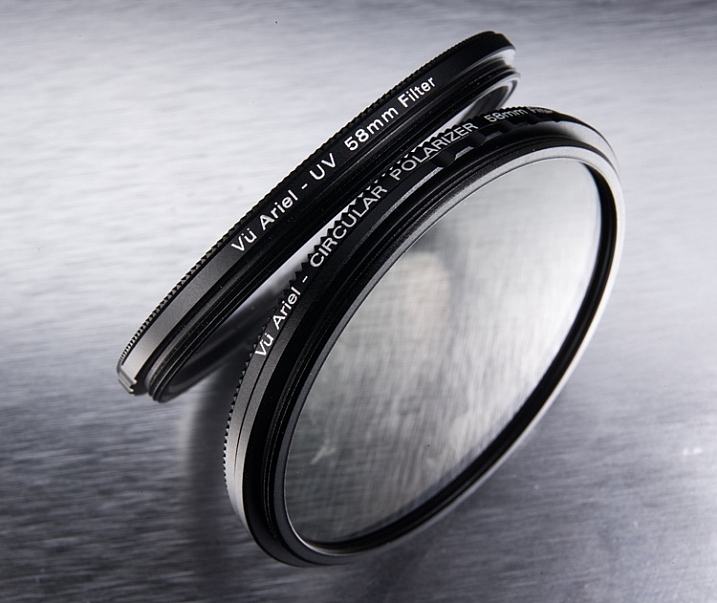
Circular Polarizing Filter
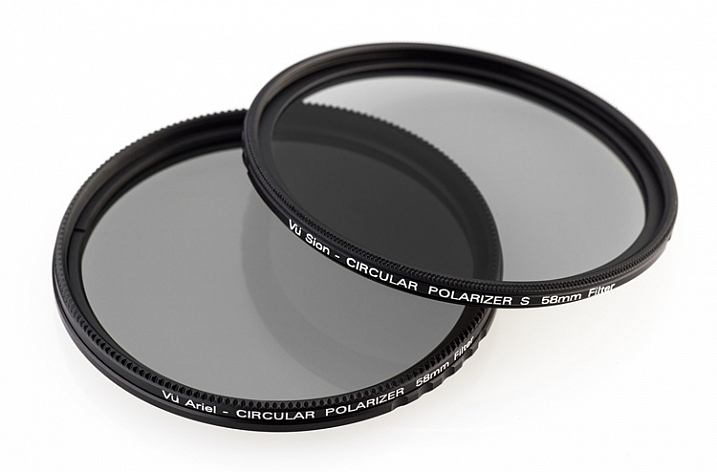
Vu_CPOL_Group_Left

Image Courtesy of Vü Filters

The circular polarizing filter did just what I expected. It darkened the desired areas in my photo, removed any extra shininess from the image, and generally smoothed the photo over, giving it a look that is hard to discern or describe, but which definitely exists.

The circular polarizer tends to smooth out rough points, darkens skies, and removes some of the reflective properties of shiny surfaces.

The circular polarizer tends to smooth out rough points, darkens skies, and removes some of the reflective properties of shiny surfaces.

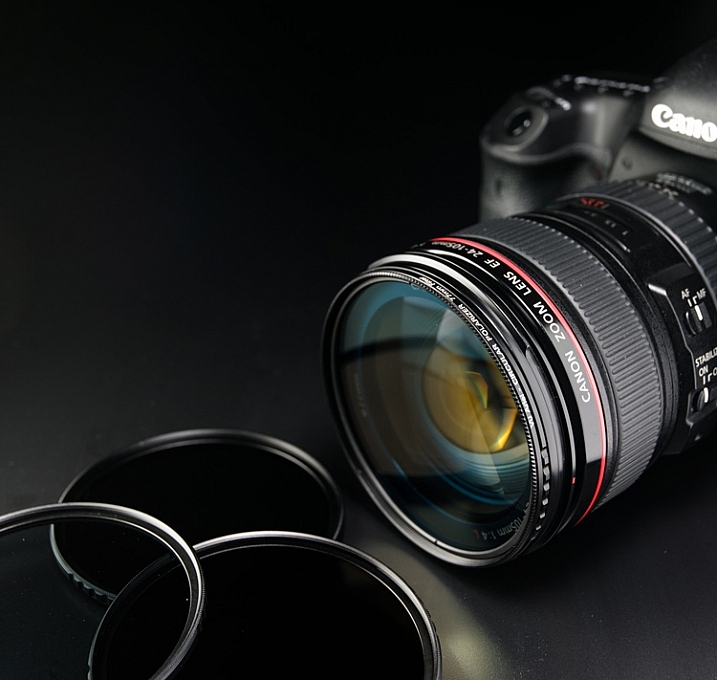
Using this filter was the easiest, as it only required I that connect it to the step-down adapter for my particular lens size, and then screw that assembly onto the lens itself.
Ariel_Lens_01

Image courtesy of Vü Filters

As with all polarizing filters, this one works best when light is coming from the right angle, in this case, about 45 degrees. Using it when light is directly in front of, or behind you, won’t yield much or any of an effect on your image.

Again, the polarizer helped darken this sky a bit more to where I wanted it to be.

Again, the polarizer helped darken this sky a bit more, to where I wanted it.

10-Stop Neutral Density Filter
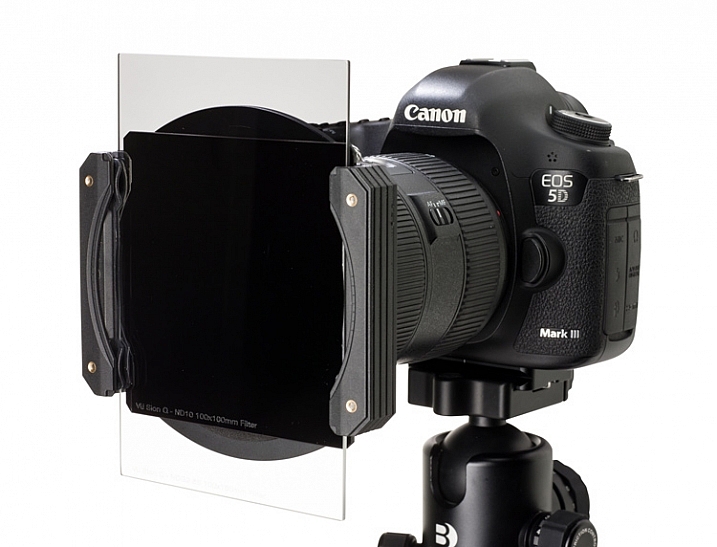
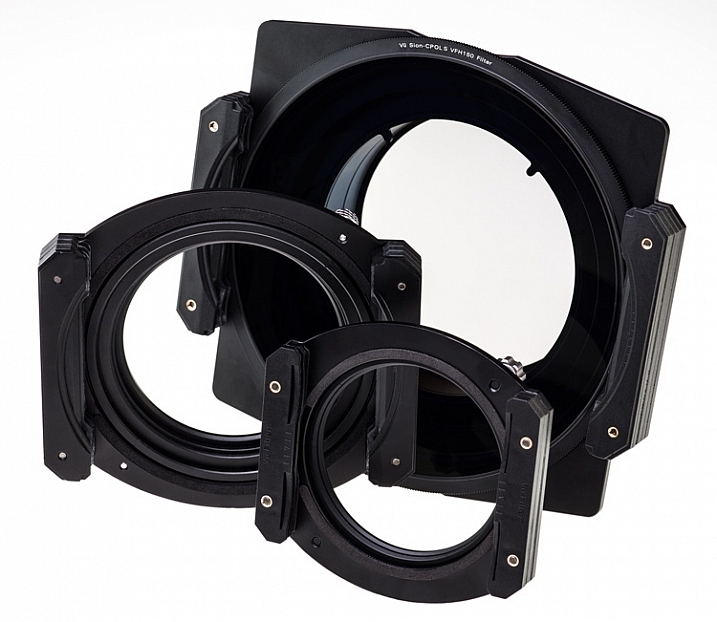
VFH100_CanonFront_CPOL_NDGrad

Image courtesy of Vü Filters showing the filter holder, 10-stop ND, and Graduated drop-in filters mounted on a Canon lens.

I was most excited to try the 10-stop neutral density filter. The purpose of this filter is to reduce the amount of light coming through the lens. As you might imagine, this particular filter reduces that amount by 10 stops of light, which is quite a bit. The beauty of it, is that you can use a much slower shutter speed in daylight, and capture long exposure images when it would normally be impossible.

I tried this myself using the Vü 10-stop ND filter, and was extremely happy with the results. I was able to capture the ebb and flow of the ocean waters at our nearby beach, well after the sun had risen. With the filter, 25 and 30 second exposures were possible, which produced shots that I would never have thought possible.

The 10-stop neutral density filter allows you to take long-exposure shots when there is plenty of light available.

The 10-stop neutral density filter allows you to take long exposure shots when there is still plenty of light available.

The Vü ND filter fortunately does not suffer from common ailments of other dark, lower quality filters, such as color shifting near the corners of the lens. Tones remain faithful and consistent across the entire image.

To me, that’s the grand measure of the usefulness of this system; shots that would have been impossible, or extremely difficult to create, can now be accomplished using these types of accessories. As a photographer, it opens up a multitude of ideas and situation I can now explore.

Drawbacks of the system

Of course, everything can’t be roses, and I did have a couple of complaints about the Vü system.

First and foremost, as wonderfully performing and artfully constructed as the system is, I’m afraid that some novices may get a bit lost figuring out how to use them, creating a barrier to entry that could easily be avoided.

The boxes of filters, and bags of adapters, come devoid of any instructions, inside or out. An advanced user that has experience with different filter systems will figure it out rather quickly, but someone who lacks this experience will likely fuddle around until they eventually understand how everything fits together.
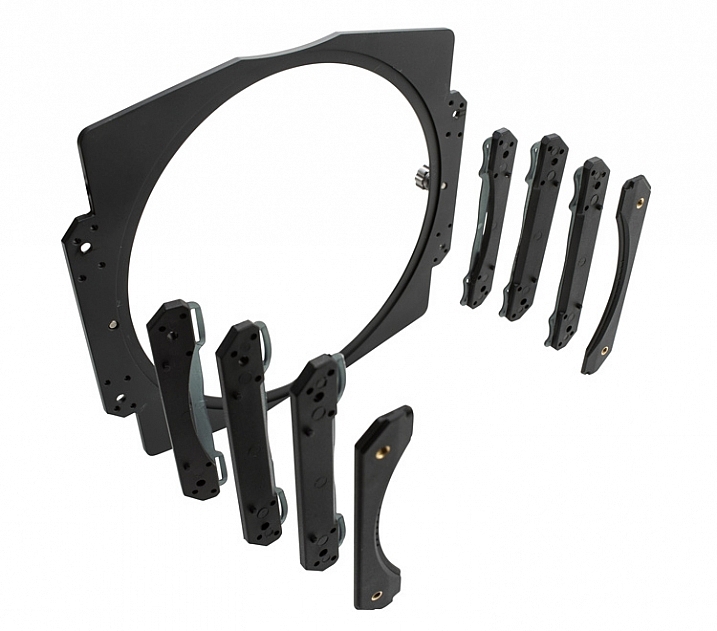
VFH150_Parts Vu_FilterHolder_Group_02

As an example, attaching the 10-stop ND filter to my camera’s lens (a Canon 60D with the Canon EF-S 24mm 2.8 STM) was a bit of a chore. The large metal filter holder was required, since this particular filter is the drop-in type, meaning the filter is a large square piece of thick glass. The filter slides vertically into the holder attachment, which is then attached to the lens via an adapter ring, suited for your lens’s filter size.

Another example of long-exposures at daytime with the neutral density filter.

Another example of long-exposures at daytime with the neutral density filter.

It took several tries to get this right, and in the end was no small feat. I wasn’t positive after I was done that I had attached it correctly, but it functioned without any issues, so I’m assuming I did. A simple set of instructions for each piece would negate this problem altogether in my opinion.

The Vü website gives details and information about the products themselves, but I couldn’t find a support section where a user could quickly fetch instructions.
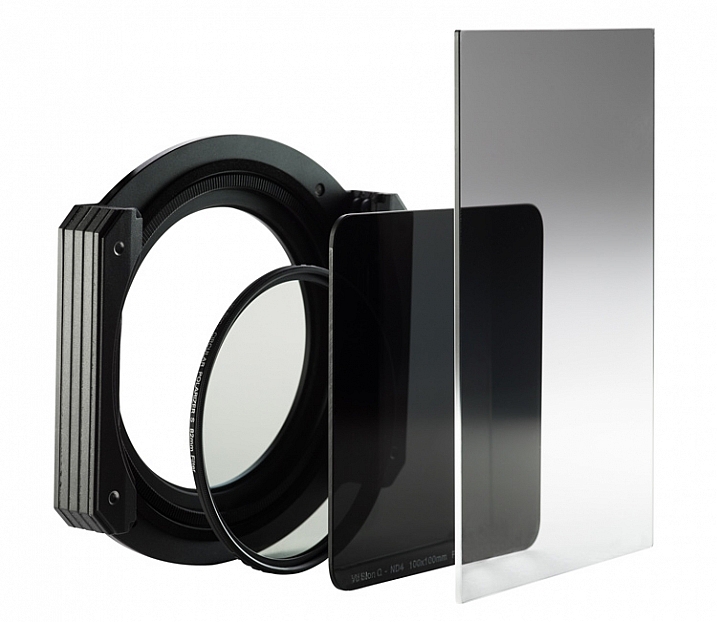
VFH100_FilterGroup

Once you figure out how to attach the product to your camera, and put them together, the filters and holder feel very solid and well constructed. Several sizes of adapter rings are available, to ensure the filters will fit almost any lens, and additional accessories for the system are also available. The holder, as I mentioned before, is large and a bit unwieldy, and using it without a tripod would be difficult.

My contact at the company was very helpful and knowledgable, and made sure everything got to me as quickly as possible.

Editor’s note: the video below was provided by the supplier when we discussed this issue with them. This should help solve the problem.

Summary

At the end of the day, regardless of any assembly difficulties I might have experienced, I found the filters very attractive from several standpoints. The filters were obviously made with the serious photographer in mind, and didn’t skimp on materials, strength, or quality.

VU_TableTop_06 Ariel_Hero_f32

Pricing is, in my opinion, below what you would expect for this level of craftsmanship. Ordering their whole line would be expensive, but picking and choosing individual filters within the system, would prove affordable for most photographers.

Most importantly, the filters themselves work fabulously, and produce very good images. Some in the industry still consider filters to be a degradation to image quality, but after seeing the images these filters can produce, I slide off the fence into the more positive side of the field, and would use these accessories in all of my work.

Have you given Vü filters a try? Sound off below and tell us your experience!

Learn more about Vü filters, including the full product line, and you can purchase them online at Amazon.

googletag.cmd.push(function() {
tablet_slots.push( googletag.defineSlot( “/1005424/_dPSv4_tab-all-article-bottom_(300×250)”, [300, 250], “pb-ad-78623” ).addService( googletag.pubads() ) ); } );

googletag.cmd.push(function() {
mobile_slots.push( googletag.defineSlot( “/1005424/_dPSv4_mob-all-article-bottom_(300×250)”, [300, 250], “pb-ad-78158” ).addService( googletag.pubads() ) ); } );

The post Review of the Vü Professional Filter System by Tim Gilbreath appeared first on Digital Photography School.


Digital Photography School

 
Comments Off on Review of the Vü Professional Filter System

Posted in Photography


Air Bonsai: Magnetic Levitation Kit Lets You Float Little Trees

21 Feb

[ By WebUrbanist in Design & Furniture & Decor. ]

floating air bonsai plant

Taking bonsai approaches to the next level, a Japanese company based out of Kyushu has raised over half a million dollars so far for its levitating (and rotating) tree system.

floating tree collection

The fauna in question span quite a range, from flowering plants to pine trees to mosses. The magnetic levitation tech supports up to 250 grams of whatever species you prefer (up to a few inches in width), powered via a simple AC adapter.

floating plant diy kit

floating tree demo

Of course, you can further decorate your little floating worlds however you like, with ceramic figures, lava rocks or other scene-setting touches.

floating bonsai tree system

The system comes as a DIY kit priced starting at around $ 200, depending on whether you wish to get both the mechanical system and a starter plant or just the technology portion. There are also both modern and traditional-looking, hand-crafted bases, depending on your aesthetic preferences.

Share on Facebook


[ By WebUrbanist in Design & Furniture & Decor. ]

[ WebUrbanist | Archives | Galleries | Privacy | TOS ]


WebUrbanist

 
Comments Off on Air Bonsai: Magnetic Levitation Kit Lets You Float Little Trees

Posted in Creativity


Week in Review: One for the history books

21 Feb

Week in Review: One for the history books

It was a Wednesday like any other Wednesday. The sun rose in the East. The DPReview staff made their morning coffee run. They sat down at their desks. And then they wrote. They wrote. For unlike another Wednesday, this Wednesday would see the introduction of a historic camera: the Pentax K-1. Memories of Pentax’s first promise of a full-frame DSLR were all but a distant memory, but Pentax would finally step into the world of full-frame digital photography. 

To say it was a busy week is an understatement. The world didn’t only get full-frame Pentax this week, it got so many more things: a Canon EOS 80D! A kit lens with a strange detachable power zoom accessory! A Panasonic GF-series update made just for selfies! 

Just to be sure you didn’t miss anything, you better take a look back with us.

It’s all gonna be O-K

After years of promises and months of teasing, this week Ricoh finally unveiled the Pentax K-1, a 36.4MP full-frame DSLR built around the K lens mount. At a very enticing body-only MSRP of $ 1800, the K-1 offers 5-axis IS, built-in Wi-Fi and 4.4 fps burst shooting. We took a look back at the long and winding road Pentax has taken to full-frame, and while the K-1 shows a lot of promise, we think Ricoh still has a tough road ahead.

Subtle video upgrades

Just hours after the K-1 announcement, Canon swooped in and dropped the EOS 80D, G7 X Mark II, an updated 18-135mm F3.5-5.6 and a couple of interesting accessories (more on that in a second).

The 80D is a fairly incremental update to the 70D, but it does offer updated Dual Pixel AF with continuous focus as well as an upgraded 45-point all cross-type AF system. Subtle enhancements in the video department, like the addition of 1080/60p recording and a headphone socket, nudge the camera 80D toward video enthusiasts, but don’t hoist it into the ranks of video-centric cameras like the Sony A7S and Panasonic GH4. Still, it should offer plenty to help a non-pro get good results.

In this week’s unusual innovations we saw Canon introduce the PZ-EI Power Zoom adapter, the first OEM-branded accessory of its kind, specifically built for its new 18-135mm. For just an extra $ 150, prospective 80D owners who are interested in shooting video with their new kit can pick up a PZ-E1 and gain control over zoom speed by way of physical controls or Canon’s Smart Utility app. It’s a neat solution and relatively inexpensive solution for video shooters, rather than building power zoom functionality into the lens and raising the cost (and weight of the lens) for everybody.

Know thy selfie

Speaking of long and winding roads, the introduction of the selfie-tastic Panasonic Lumix DMC-GF8 this week underscored just how far that series has wandered from where it started. The GF8’s brightly colored accents (or ‘unisex’ silver and brown, if you prefer), beauty re-touch features and 180-degree articulated selfie-friendly LCD are all a far cry from the pioneering little GF1. That camera’s enthusiast features long ago drifted and evolved into the GX-series, while Panasonic seems to be making a Casio-esque play with its entry-level GF-series to capitalize on shoppers interested in selfie-centric features in some Asian countries. To each his own, right?

Two good?

It’s easy to get excited about the Sony RX1R II‘s potential. A compact 42MP full-frame camera with updated AF and a Zeiss 35mm F2 lens has that effect. But it’s also easy to suffer a case of sticker shock when you realize it’s $ 3300. Our full review, published this week, digs into the camera’s performance to see if the problems that plagued the RX1R persist, and whether it’s a $ 3300 well spent. There’s just one way to find out…

Go wide

Yeah, we’ve heard it before: a 75-100mm focal length is more flattering for portraits than wide-angle lenses. But what if we all stepped away from our 85mm portrait primes for a minute and embraced a different perspective? Tech Editor Rishi Sanyal does just that in our lens technique video. Using the Sigma 24-35mm F2 Art to make his case, he captured some environmental portraits at sunset in Seattle’s gorgeous Discovery Park (the nice part, not the bit by the sewage treatment plant). 

Rumors of new lenses are coming fast and furious, including this rumored Sigma 50-100mm F1.8 Art for APS-C. It would seem that the timing is right, too, what with CP+ starting next week. We’ll be in Yokohama covering the show, so tune in next week as we separate rumors, fact and fiction. 

Articles: Digital Photography Review (dpreview.com)

 
Comments Off on Week in Review: One for the history books

Posted in Uncategorized


PhotoPills: The Photographer’s Swiss Army Knife

20 Feb

It’s 6pm, it’s cold, and the sun is on its way to set. The tripod is placed, the composition is done – now I just have to wait for the big show that Mother Nature puts on every day to happen again. The sky is threatening, but with a little luck, the sun will pierce the clouds to pass above the lighthouse in front of me.

Image 1

If I think about the first time I went out with the tripod on my shoulder, it makes me smile. I knew more or less where to go, I had no idea of the exact time at which the sun would set, nor where. Failure was inevitable!

Years have passed since then, and many things have changed. But the biggest and decisive one is in my hands right now: PhotoPills – photo planning app.

What is PhotoPills?

PhotoPills is like having a Swiss Army Knife for all photography matters in your pocket, at your service. Whether you’re a seasoned photographer, or someone who’s barely touched a camera, PhotoPills has you covered. You have a question, you get the answer.

Image 2

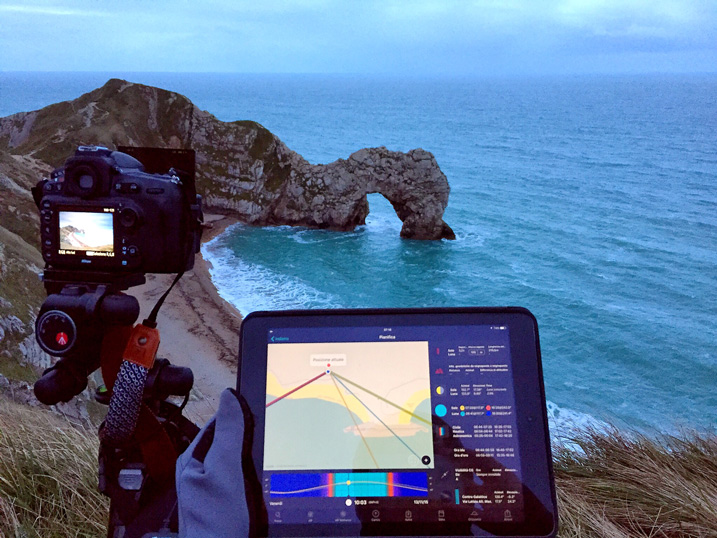
Using PhotoPills at Durdle Door (UK)

Beginners will love it. I see it in every single workshop I run. There, in the field, before deciding the frame and the shooting spot, people enjoy using the Augmented Reality views, to easily track the position and the path of the Sun, the Moon, and the Milky Way. It’s the simplest way to understand what’s going to happen next.

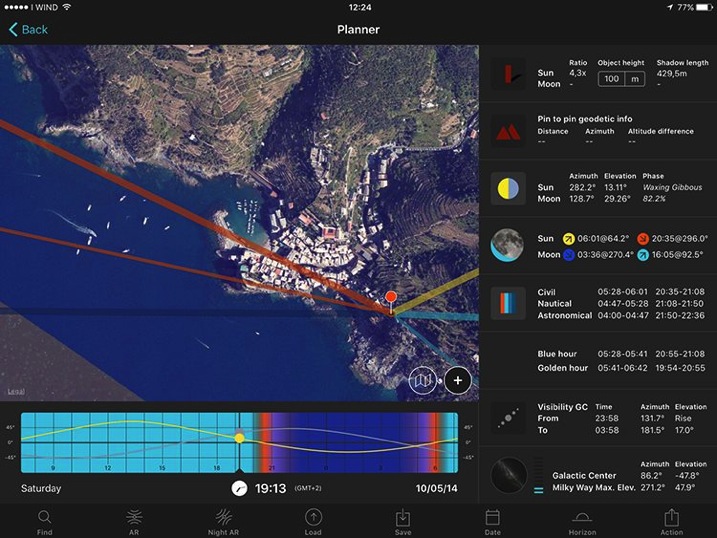
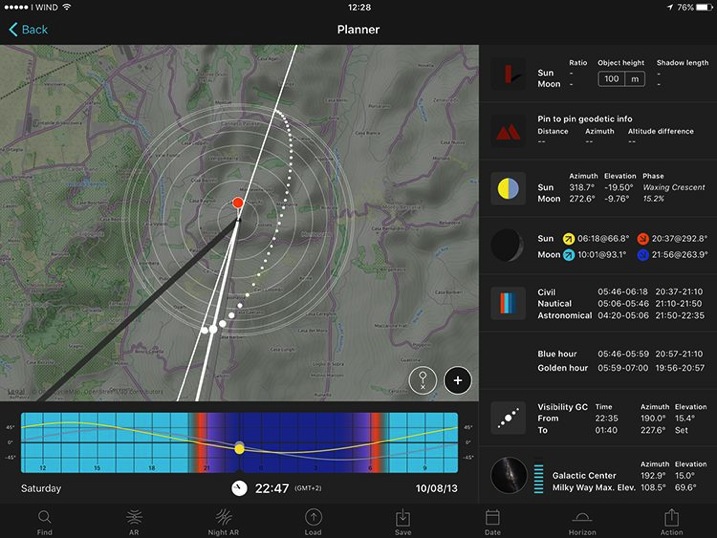
On the other hand, on a more advanced level, being able to plan your shots directly on a map, even the Milky Way shots, saves a ton of time. PhotoPills’ Planner is so well designed, that you can quickly figure out the perfect shooting spot, date, and time for any scene you imagine.

Image 3

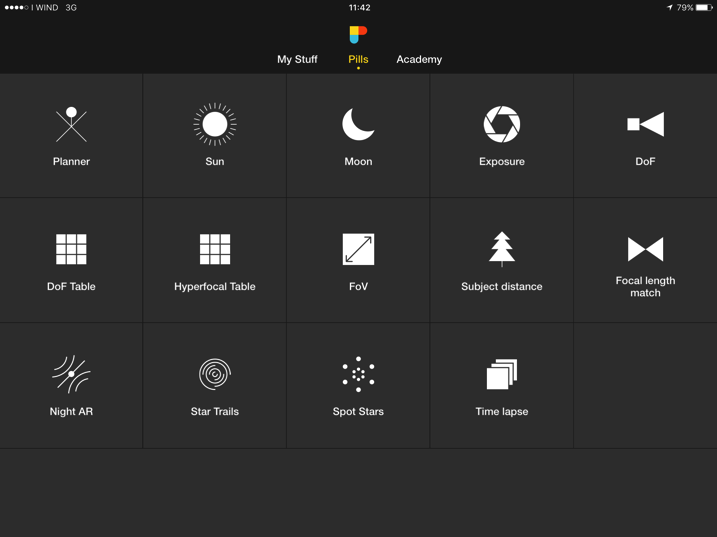
PhotoPills screen menu

Everything starts from a clean and user friendly interface.

You can choose between three menus, simply through a swipe to the right or left at the top of the interface. After choosing your camera, the map type, and other settings in “My Stuff” menu, you can enter the main section called “Pills” where you have the access to all the available modules.

The possibilities are almost endless, and in this article, I’ll do my best to describe some of the things you can do with this app. Are you ready?

Widgets

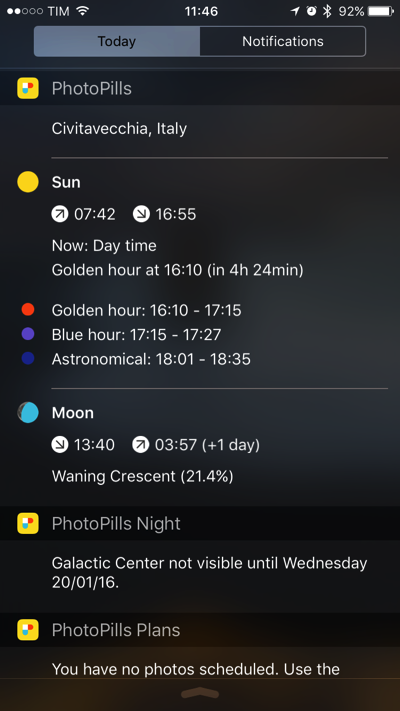
Imagine that you’re going to bed (at home, or anywhere in the world) and want to know at what time the sun will rise tomorrow, when the golden hour starts, or when the Moon will rise, or what about the the galactic center visibility times?

The first thing that I love in this App, is that all you have to do is to pull down from the top of the screen and enable the three PhotoPills widgets in the notification center. If you do so, you’ll have all the key light, sun, moon and Milky Way information in just one swipe. Also, you’ll have access to the five upcoming photo plans you’ve saved using the Planner.

Image 4

I love using the widgets when I’m traveling, since it’s so easy to have everything I need on one single screen. A cool feature is that it works offline too. As it happens with the Augmented Reality views, PhotoPills doesn’t need an internet connection to give you all the key data you need.

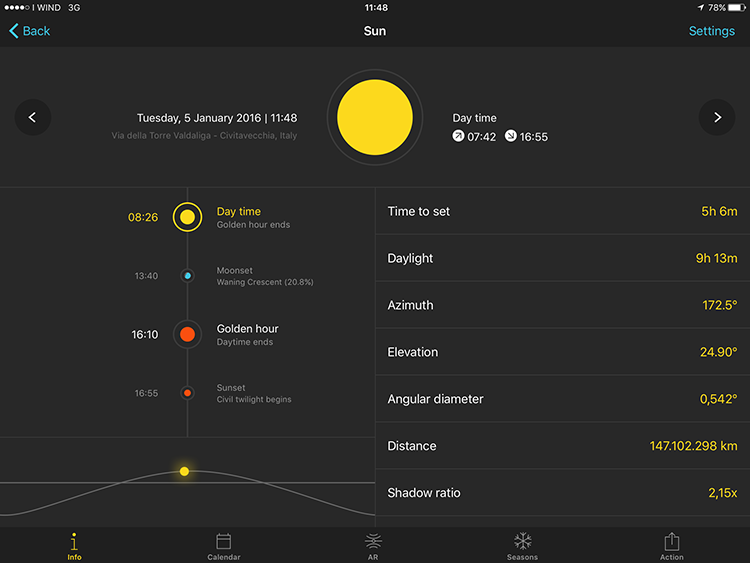
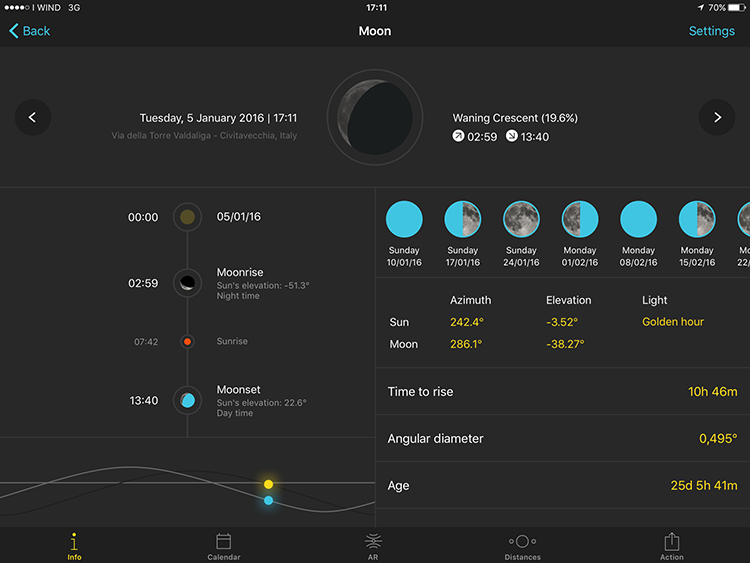
But that is not all, in the case you want to have all this information (and much more) for a different location or date, just use the new Sun and Moon Pills. So easy, and so nice to have everything together. I really hope that an Apple Watch version will be implemented soon too.

Image 5A

Sun Pill

Image 5B

Moon Pill

Augmented Reality

In a landscape image, composition is more than fundamental. How many times have you arrived at your shooting location, and wondered where the sun would set? For me, every time – but before using PhotoPills, I was never able to have a precise answer.

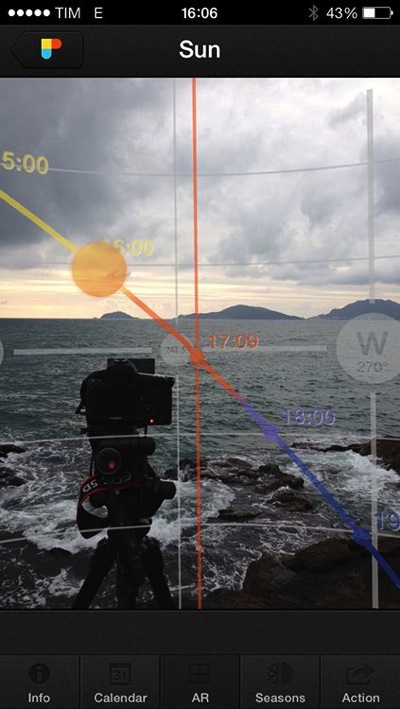
The Augmented Reality (AR) module included in the App, makes things so easy. Just point your phone at a subject, and use the AR tools available within the Sun, Moon and Night AR pills to see where the Sun, the Moon or the Milky Way will be in the image.

Image 6

Sun AR in action

Besides, and this is particularly clever, you can change the time to see how everything evolves, just by scrolling on the screen with your finger.

The application is also useful for all the star hunters out there – with the Night AR view it is easy to plan star trails shots. For example, if you’re planning to shoot a circumpolar, the Night AR view will also help you locate the North Star (Polaris). And, if you live in the southern hemisphere, PhotoPills will give you the position of the south celestial pole, right where you need to frame.

Image 7 1

A Milky Way shot planned using Night Augmented Reality

Planner

If the Augmented Reality tools are my students’ favorites, I simply love the Planner. I use it to plan every shoot.

Image 8

No matter if it’s a sunset in Vernazza (above), a moonrise in Iceland, or the Milky Way in Yosemite National park, the PhotoPills Planner helps me find the right time, for the alignments I’m looking to happen. It’s my imagination’s best ally.

Image 9A

Planning Pill for Vernazza shot above

Image 9B

Planning Pill for Milky Way shot above

A lovely feature, is that once I’ve figure out the shooting spot and shooting time, I can save the plan in my To-Do list of planned photos. Then, every time I have an idea, I plan it and save it in my list. This way, I make sure not to miss any of my favourite shots.

Location Scouting

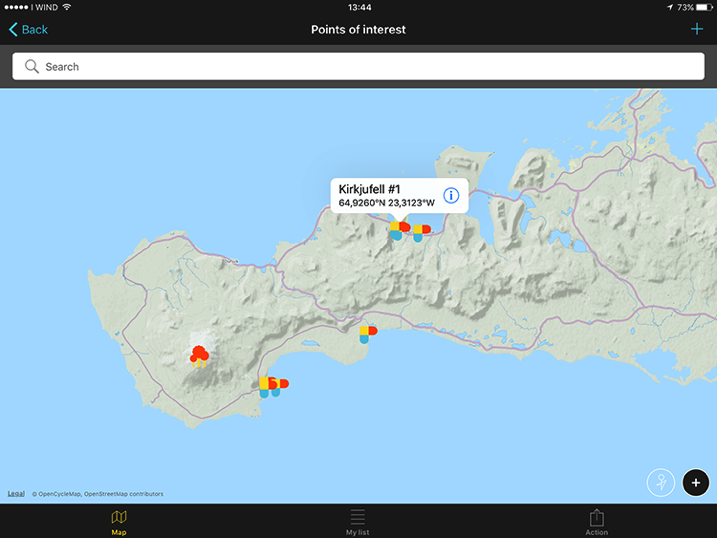
We’re all exploring new locations all the time, looking for new possibilities, and to be able to store the most valuable places in our own database is just a must. So, every time I find a place I’d like to remember and study for a possible shot, I use PhotoPills to save it as a Point of Interest.

Another useful feature is that I can upload to PhotoPills all my .kmz files, so I can bring with me all the plans already made with Google Earth!

Image 10

Point of Interest visualized on map

Calculations

Knowing the shooting time and spot is obviously the first step, but you also need to make many more decisions before pressing the shutter – this is where PhotoPills is brilliant.

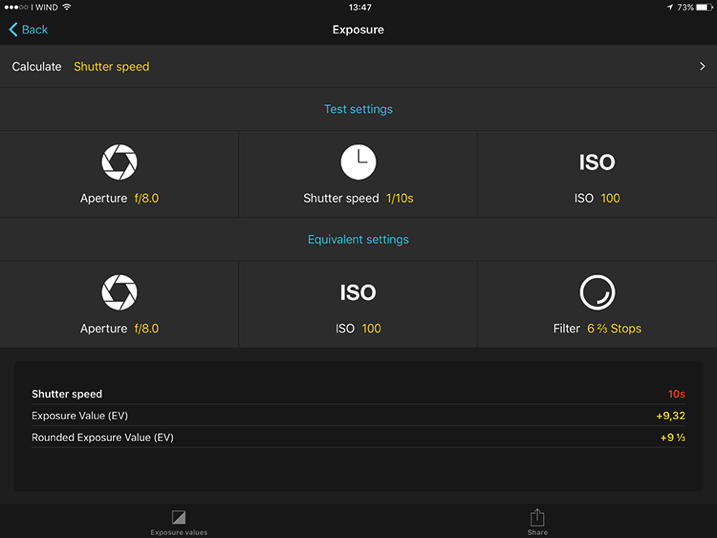
These are just four of the numerous calculators I use to figure out the settings I need:

Image 11A

Long Exposure calculator

Long Exposure calculator: You already know, my favorite one! With this module I’m able to calculate the exact exposure time when using ND and GND filters. By the way, PhotoPills has the only Long Exposure calculator that allows you to convert the shutter speed for non-standard f-stop reductions.

Spot Stars calculator: When shooting the Milky Way, it helps determine the maximum exposure time that allows me to capture the stars as big bright spots. The longer the exposure time, the more light is collected by the camera sensor, and the brighter the stars will appear in the image. If I go beyond this exposure time, stars will begin to appear as trails in the image, which is something I want to avoid at all costs.

Time lapse calculator: If you’re doing time lapse photography, this calculator will save you lots of time. Just set the frames per second (24fps), the duration of the event you’re shooting (example 6 hours), the desired clip length (30 seconds) and the image size (4Mb) to get the shooting interval (30 seconds), the number of photos (720) and the total memory usage of the SD card (2.81Gb). I used to need 15 minutes to figure out all those numbers, before I started using PhotoPills.

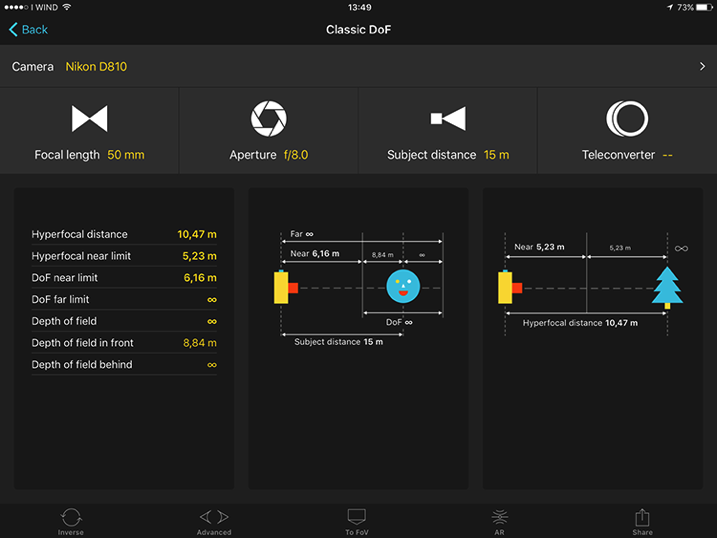
Depth of Field calculator: I use it to calculate the distance where to focus, to maximize depth of field (hyper focal distance). This becomes very useful in my night shots, since I want everything in focus, from the foreground to the stars. I simply calculate the hyperfocal distance and then I make sure to focus my lens at a slightly longer distance. This assures me that I’ll have the stars in sharp focus.

Image 12

DoF Calculator

Conclusions

PhotoPills is definitely a must have for (but not only) landscape photographers. The features are many and well-maintained, and the difficulties that you can encounter at the beginning, can quickly be overcome thanks to the Academy (a virtual university of PhotoPills where you can follow video tutorials, and read insights on each function of the application to really turn our ideas into real images).

The price of $ 9.99 in the App Store is higher than average, but is ridiculous compared to the large amount of features and practical uses, as PhotoPills replaces much of the paid, and free apps, in one go.

It must be mentioned that PhotoPills is currently available only for iPhone and iPad, but the Android version has been announced to launch in 2016.

After many months of use, now I cannot imagine a photographic adventure without this application. Once you fall into the Imagine-Plan-Shoot creative loop, you won’t be able to stop pushing your imagination, and this will lead you to discover a new world of possibilities.

Definitely, give it a try!

Pros:

  • Clean and friendly user interface
  • Many different tools in a single application
  • Cached maps for offline use
  • Possibility to import POI from .kmz files
  • Localized languages
  • Tons of tutorials

To be considered:

  • Android version still in development (release expected in 2016)

Do you use PhotoPills or another photography planning app? Please share your experiences and tips in the comments below.

googletag.cmd.push(function() {
tablet_slots.push( googletag.defineSlot( “/1005424/_dPSv4_tab-all-article-bottom_(300×250)”, [300, 250], “pb-ad-78623” ).addService( googletag.pubads() ) ); } );

googletag.cmd.push(function() {
mobile_slots.push( googletag.defineSlot( “/1005424/_dPSv4_mob-all-article-bottom_(300×250)”, [300, 250], “pb-ad-78158” ).addService( googletag.pubads() ) ); } );

The post PhotoPills: The Photographer’s Swiss Army Knife by Francesco Gola appeared first on Digital Photography School.


Digital Photography School

 
Comments Off on PhotoPills: The Photographer’s Swiss Army Knife

Posted in Photography


Monument is an intelligent personal photo storage device

20 Feb

Cloud photo storage services are abundant, but not all photographers are willing to pay the monthly fees associated with large storage amounts. Monument, a project currently seeking crowdfunding, aims to bring the organization and syncing features found in cloud services like Google Photos to a photography-centric storage device that you keep in your own home. Read more

Articles: Digital Photography Review (dpreview.com)

 
Comments Off on Monument is an intelligent personal photo storage device

Posted in Uncategorized


Ricoh adds 15-30mm F2.8 SDM WR and 28-105mm F3.5-5.6 ED DC WR to full-frame lens range

20 Feb

$ (document).ready(function() { SampleGalleryV2({“containerId”:”embeddedSampleGallery_1703565933″,”galleryId”:”1703565933″,”isEmbeddedWidget”:true,”standalone”:false,”selectedImageIndex”:0,”startInCommentsView”:false,”isMobile”:false}) });

Ricoh has expanded its full-frame lens range, announcing the HD Pentax-D FA 15-30mm F2.8 and FA 28-105mm F3.5-5.6 alongside the introduction of the full-frame K-1 DSLR. The 15-30mm F2.8 brings a fast, constant wide-angle zoom to the lineup offering a Supersonic Direct-drive Motor, rounded nine-blade aperture, and close focus distance of 28cm. The 28-105mm offers a DC motor and a minimum focus distance of 0.5m.

The ‘WR’ in their names means that these lenses are weather-resistant, with SP (Super Protect) coatings on the front lens element to repel water.

The 15-30mm F2.8 and 28-105mm F3.5-5.6 join two Pentax full-frame lenses announced last year, the HD Pentax D FA* 70-200mm F2.8 and FA 150-450mm F4.5-5.6.

Press releases:

Ricoh announces HD PENTAX-D FA 15-30mm f/2.8 lens for new PENTAX K-1 full-frame DSLR

Weather-sealed, ultra-wide-angle zoom lens, ideal for landscapes and nightscapes

DENVER, Colo. February 17, 2016 – Ricoh Imaging Americas Corporation today announced the HD PENTAX-D FA 15-30mm f/2.8ED SDM WR lens. This new lens is designed to work seamlessly with the full-frame sensor of the new PENTAX K-1 camera, also announced today.

When mounted on the PENTAX K-1 camera body, the lens covers a focal-length range from 15mm ultra-wide-angle to 30mm wide-angle.(Note: with a PENTAX  APS-C-size digital SLR camera body, the lens covers a focal-length range from 23mm to 46mm.) Its exaggerated ultra-wide perspective and state-of-the-art optical design enable capturing high-resolution, dynamic, sweeping views of subjects, ideal for landscape photography. Treated with PENTAX-developed HD Coating, the lens produces well-defined, fine-detailed images with ample light levels even at the edges of the image field, while effectively reducing chromatic aberration and distortion to a minimum. 

Its large f/2.8 maximum aperture is also well-suited for photographing nightscapes and starry skies. The built-in SDM (Supersonic Direct-drive Motor) provides quiet, high-speed autofocus operation.

| Pricing and Availability | 

HD PENTAX-D FA 15-30mm f/2.8ED SDM WR lens will be available in April 2016 at www.ricohimaging.com and retail outlets nationwide for a manufacturer’s suggested retail price of $ 1,499.99.

Main Features

1. Exceptional imaging power

When mounted on the PENTAX K-1 35mm full-frame digital SLR camera body, the lens provides an ultra-wide-angle focal-length coverage from 15mm to 30mm. Its exaggerated perspective helps the photographer produce spectacular landscape photographs. With a 30mm focal length at the telephoto end, the lens is also well-suited to portrait and street photography.

2. State-of-the-art optical design

The zoom lens incorporates three ED (Extra-low Dispersion) glass optical elements and three aspherical optical elements in its 18-element, 13-group optics to deliver high-resolution images rich in contrast even at the edges of the image field, while effectively minimizing chromatic aberration, distortion and coma. 

3. Large-aperture zoom lens, with a maximum aperture of f/2.8

Since this zoom lens provides a maximum aperture of f/2.8 over its entire zoom range, it is versatile enough to be used for many different subjects and scenes, ranging from sweeping landscapes to nightscapes and starry skies. Despite its ultra-wide-angle perspective, it can capture the subject with an excellent bokeh (defocus) effect on the background. Even in macro photography from its minimum focusing distance of 28 centimeters, it can capture subjects with a well-defined sense of depth.

4. Built-in SDM (Supersonic Direct-drive Motor)

The incorporation of a new-generation SDM (Supersonic Direct-drive Motor) assures that this zoom lens provides quiet, high-speed autofocus operation, letting the photographer react swiftly to all types of subjects.

5. Weather-resistant construction

Special seals applied throughout the lens body provide this zoom lens with dependable weather-resistant construction, effectively preventing the intrusion of water into the lens interior. By pairing it with a weather-resistant PENTAX digital SLR camera body, the photographer has a durable, dependable digital imaging system that performs superbly under demanding shooting conditions — even in the rain or mist, or at locations prone to water splashes or spray.

6. HD Coating to improve image description

The lens is treated with high-grade, multi-layer HD (high-definition) coating. Compared with conventional multi-layer coatings, this PENTAX-original coating assures higher light transmittance and less reflection to deliver bright, high-contrast images free of flare and ghost images, even under demanding lighting conditions such as backlight. 

7. Other features

  • Quick-Shift Focus System for instant switching from autofocus to manual-focus operation, by holding the shutter-release button halfway down and turning the focus ring after the subject is captured in focus by the camera’s AF system.
  • Rounded diaphragm with nine blades produces a smooth, beautiful bokeh (defocus) effect, while minimizing the streaking effect of point light sources.
  • SP (Super Protect) coating applied to the front surface of the lens to effectively repel water and grease.

Ricoh announces 28-105mm lens for new PENTAX K-1 full-frame DSLR

Compact, lightweight and weather-sealed lens offers popular zoom range, is ideal companion to new PENTAX K-1 full-frame DSLR

DENVER, Colo. February 17, 2016 – Ricoh Imaging Americas Corporation today announced the             HD PENTAX-D FA 28-105mm f/3.5-5.6ED DC WR lens. This new, compact and lightweight zoom lens provides the most frequently requested focal-length range for general photography, from wide angle to medium telephoto.

This versatile zoom lens is designed to cover the large full-frame sensor found in the new PENTAX  K-1 camera, incorporating state-of-the-art optics and high-performance optical elements. When mounted on the K-1 camera body, it delivers high-resolution imaging power, and is an ideal every day-use lens for the new camera.

| Pricing and Availability | 

The HD PENTAX-D FA 28-105mm f/3.5-5.6ED DC WR lens will be available in April 2016 at www.ricohimaging.com and retail outlets nationwide for a manufacturer’s suggested retail price of $ 499.99.  

| About Ricoh Imaging Americas Corporation |

Ricoh Imaging Americas Corporation is a subsidiary of Ricoh Company Ltd., a global technology company specializing in office imaging equipment, production print solutions, document management systems and IT services.  Headquartered in Tokyo, Ricoh Group operates in about 200 countries and regions.

The company now known as Ricoh Imaging Americas Corporation, was originally founded in 1919, under the name Asahi Optical Joint Stock Co. and launched its first SLR camera in the 1950s under the PENTAX name. Today, Ricoh Imaging Americas Corporation continues to produce the heritage-rich, award-winning line of PENTAX DSLR cameras, lenses and sport optics equipment as well as Ricoh’s offering of stylish and compact digital cameras, known for their wide-ranging, rich set of features.

For further information, please visit www.ricohimaging.com/pentaxff

Main Features

1. Standard zoom lens covering most frequently-used range

This standard zoom lens accommodates the image circle of a 35mm full-frame image sensor, and covers focal lengths between 28mm wide angle and 105mm medium telephoto. By incorporating the latest optics and a number of high-performance optical elements, it retains a sufficient brightness level even at edges of the image field, while effectively compensating for aberrations. It delivers high-resolution images by optimizing the imaging power of the PENTAX K-1 camera’s approximately 36.4 effective megapixels. Its compact, lightweight body and excellent cost performance make this lens a perfect companion lens to the PENTAX K-1.

2. Excellent image resolution, complementing the PENTAX K-1 full-frame digital SLR camera performance

With 15-element, 11-group optics, this zoom lens incorporates two high-precision aspherical optical elements, one ED (Extra-low Dispersion) glass optical element and one anomalous-dispersion glass optical element to deliver bright, sharp images with minimal chromatic and spherical aberrations. The optics are designed to deliver ample resolving power for the large, high-pixel image sensor, producing well-defined, fine-detailed images.

3. HD Coating to improve image quality

This lens is treated with the high-grade, multi-layer HD (high-definition) coating. Compared with conventional multi-layer coatings, this PENTAX-original coating assures higher light transmittance and less reflection to deliver bright, high-contrast images that are free of flare and ghost images, even under demanding lighting conditions such as backlight. 

4. Quick-Shift Focus System

This PENTAX-developed system allows for flawless, delay-free switching from autofocus to manual-focus operation, after the subject is captured in focus by the camera’s AF system.

HD Pentax-D FA 15-30mm F2.8 SDM WR and FA 28-105mm F3.5-5.6ED DC WR Specifications

  HD PENTAX-D FA 15-30mm F2.8 ED SDM WR HD PENTAX-D FA 28-105mm F3.5-5.6 ED DC WR
Principal specifications
Lens type Zoom lens
Max Format size 35mm FF
Focal length 15–30 mm 28–105 mm
Image stabilisation No
Lens mount Pentax KAF3
Aperture
Maximum aperture F2.8 F3.5 – F5.6
Minimum aperture F22.0 F22.0 – F38.0
Aperture ring No
Number of diaphragm blades 9
Optics
Elements 18 15
Groups 13 11
Special elements / coatings Three ED and aspherical elements + HD and SP coatings One ED and two aspherical elements + HD and SP coatings
Focus
Minimum focus 0.28 m (11.02) 0.50 m (19.69)
Maximum magnification 0.2× 0.22×
Autofocus Yes
Motor type Ultrasonic Micromotor
Full time manual Yes
Focus method Internal
Distance scale Yes
DoF scale No
Physical
Weight 1040 g (2.29 lb) 440 g (0.97 lb)
Diameter 99 mm (3.9) 73 mm (2.87)
Length 144 mm (5.67) 87 mm (3.43)
Sealing Yes
Colour Black
Power zoom No
Filter thread 62.0 mm
Hood supplied Yes
Hood product code PH-RBC62
Tripod collar No

Articles: Digital Photography Review (dpreview.com)

 
Comments Off on Ricoh adds 15-30mm F2.8 SDM WR and 28-105mm F3.5-5.6 ED DC WR to full-frame lens range

Posted in Uncategorized


Weekly Photography Challenge – The Dinner Table

20 Feb

Photos of food, when done well, serve to make the viewer hungry or at the very least make the food in the photo look appetizing. Often food is photographed right at the table.

Stéphanie Kilgast

By Stéphanie Kilgast

Laura Thorne

By Laura Thorne

Weekly Photography Challenge – The Dinner Table

Your goal for the photography challenge this week is to photograph some food. It could be your meal, or like this image of mine I shared previously, someone else’s that looked appealing.

This is actually my photo taken of someone else's sandwich in Trinidad, Cuba. It just looked so amazing!

This is actually my photo taken of someone else’s sandwich in Trinidad, Cuba. It just looked so amazing!

Interpret the theme – the dinner table – however you want. It could be even just the table and place setting, maybe a candle or two, or an entire spread of food. Include people eating and enjoying the food, or for scale and perspective. Get close up on one item, or shoot the whole plate. The choice is yours.

Gwaar

By gwaar

Dan Foy

By Dan Foy

Robert S. Donovan

By Robert S. Donovan

Scott  Norris

By Scott Norris

Stacy Spensley

By Stacy Spensley

Ari Helminen

By Ari Helminen

Equipe Integrada

By Equipe Integrada

Share your images below:

Simply upload your shot into the comment field (look for the little camera icon in the Disqus comments section) and they’ll get embedded for us all to see or if you’d prefer upload them to your favourite photo sharing site and leave the link to them. Show me your best images in this week’s challenge. Sometimes it takes a while for an image to appear so be patient and try not to post the same image twice.

googletag.cmd.push(function() {
tablet_slots.push( googletag.defineSlot( “/1005424/_dPSv4_tab-all-article-bottom_(300×250)”, [300, 250], “pb-ad-78623” ).addService( googletag.pubads() ) ); } );

googletag.cmd.push(function() {
mobile_slots.push( googletag.defineSlot( “/1005424/_dPSv4_mob-all-article-bottom_(300×250)”, [300, 250], “pb-ad-78158” ).addService( googletag.pubads() ) ); } );

The post Weekly Photography Challenge – The Dinner Table by Darlene Hildebrandt appeared first on Digital Photography School.


Digital Photography School

 
Comments Off on Weekly Photography Challenge – The Dinner Table

Posted in Photography


Here at last: Ricoh unveils the Pentax K-1 full-frame DSLR with 36MP sensor for $1800

20 Feb

$ (document).ready(function() { SampleGalleryV2({“containerId”:”embeddedSampleGallery_9218187924″,”galleryId”:”9218187924″,”isEmbeddedWidget”:true,”standalone”:false,”selectedImageIndex”:0,”startInCommentsView”:false,”isMobile”:false}) });

After years of development, not to mention months of teasers, Ricoh has made its Pentax K-1 full-frame DSLR a reality. The first 35mm format Pentax-branded DSLR (the first to make it to market, anyway), the K-1 offers a 36.4MP CMOS sensor, 5-axis sensor-shift image stabilization, a ‘nearly 100%’ optical viewfinder and 33-point AF system with 25 cross-type points. The 3.2″ 1.04M-dot LCD uses a new flexible tilting design which allows for horizontal, vertical and diagonal movement while keeping the screen in alignment with the lens axis.

The Pentax K-1 doesn’t have a conventional anti-aliasing filter, instead, like the K-3 II, offering a simulated AA filter by way of minute sensor vibrations. The K-1’s sensor is capable of moving in all directions, supporting Ricoh’s Pixel Shift Resolution system. This does not increase linear resolution, but as in the K-3 II, it shifts the sensor slightly to record full color information at each pixel, utilizing a motion correction function in an effort to neutralize the effect of moving subjects in the frame.

The K-1 provides a dustproof and weather-resistant construction along with built-in Wi-Fi, 1080/30p video, 14-bit Raw capture, 4.4 fps burst shooting for up to 23 images in Raw or 70 in JPEG.

The long-awaited Pentax K-1 will cost $ 1799 body-only when it ships it in April.

Press release:

Ricoh defines full-frame benchmark with new PENTAX full-frame DSLR offering

PENTAX K-1 camera offers innovations not available in any other DSLR

DENVER, Colo. February 17, 2016 – Ricoh Imaging Americas Corporation today announced the PENTAX K-1 full-frame digital single-lens reflex (DSLR) camera. The K-1 combines the performance of a full-frame sensor with unique, user-friendly PENTAX technology and convenience features loved by professional and serious amateur photographers the world over.  

The foundation of the PENTAX K-1 is its large, full-frame image sensor. This AA-filterless CMOS sensor with 36.4 effective megapixels sets the stage for ultimate creativity, facilitating super-high-resolution images rich in gradation and superb in high-sensitivity rendition. 

Built around the full-frame sensor is a compact, high-performance weather-sealed and dustproof body with features only found in PENTAX cameras. “The K-1 is a blend of advanced, full-frame performance with the kind of features and advancements that PENTAX users have come to know and love,” said Jim Malcolm, president, Ricoh Imaging Americas Corporation. “As a result, the K-1 creates a solution for full-frame shooters that is unique in the industry.”

Within its compact body, the PENTAX K-1 features several advanced technologies that help the photographer to produce top results in a wide variety of challenging conditions. SR II Shake Reduction is a newly refined and highly sensitive five-axis shake-reduction system that is capable of reducing camera shake with a compensation range of up to five exposure steps, allowing photographers to freely move and compose – and to focus on their subjects, not the gear. SR II also facilitates other advanced PENTAX-unique features such as AA Filter Simulator, which effectively eliminates moiré effect without the need for an anti-aliasing filter, while increasing sharpness and overall image quality. Key to great autofocus performance on the K-1 is the new SAFOX 12 autofocus mechanism with 33 autofocus points, assuring fast and accurate autofocusing, even in the most demanding shooting situations.  A newly-designed optical viewfinder equipped with the famous PENTAX Pentaprism boasts a bright, nearly 100-percent field of view.

In addition to a long list of technological advancements, the PENTAX K-1 also features a number of convenience features, making camera operation fast and easy. Designed to move in ways never before imagined is the new Flexible-tilt LCD monitor—a first for any DSLR camera. This rugged yet highly adjustable display can be positioned to the desired angle horizontally and vertically, making it easy to shoot at challenging angles. Other significant firsts include the K-1’s Operation Assist Lights – small, white LEDs that facilitate camera operation in low-light environments, making it easy to change lenses, swap memory cards and adjust back-of-camera controls, and a Smart Function dial that allows photographers to easy select frequently-used functions without going into the LCD menu. 

Current PENTAX lens owners will appreciate that they can incorporate their APS-C lens collection into their new PENTAX K-1 full-frame camera kit by utilizing the K-1’s Crop Mode, which offers settings in-camera for either APS-C or Full-Frame sized shooting, regardless of the attached lens. There is also an “auto” mode that detects the lens type and sets the camera accordingly. 

Upon launch, PENTAX is offering 12 full-frame compatible lenses, including two new models being announced concurrent with the K-1 camera: the HD PENTAX-D FA 15-30mm f.2.8 ultra-wide angle zoom lens and the HD PENTAX-D FA 28-105mm f/3.5-5.6 compact, lightweight zoom lens. (Note: separate news releases have been issued today to provide details on each lens).

| Pricing and Availability | 

The PENTAX K-1 camera will be available April 2016 at www.ricohimaging.com and retail outlets nationwide for a manufacturer’s suggested retail price of $ 1,799.95.

For further information, please visit www.ricohimaging.com/pentaxff


Main Features

1.  High-resolution, fine-gradation images supported by approximately 36.4 effective megapixels 

The K-1 features an AA (anti-aliasing) filterless design that prioritizes image resolution, as well as the new PRIME IV imaging engine, which is capable of 14-bit RAW-format image recording. The    K-1’s unique full frame sensor and imaging engine design also allows for super-high-sensitivity shooting up to ISO 204800, producing beautiful, high-resolution images.

2. New-generation SR II five-axis system

  • In-body SR II mechanism assures optimal shake reduction performance
    The SR II (Shake Reduction II) five-axis mechanism enables accurate control of the large full-frame image sensor with all compatible PENTAX interchangeable lenses.* In addition to camera shake caused by pitch and yaw, it effectively compensates for camera shake caused by horizontal and vertical shift, as well as camera shake caused by roll, which is difficult to deal with by lens-installed shake reduction mechanisms. Even when taking a panning shot, this system automatically detects the direction of the camera’s movement, and efficiently controls the SR II unit to always produce the best image possible.
  • Pixel Shift Resolution System with a new motion correction function
    This system uses the latest super-resolution technology, which captures four images of the same scene by shifting the image sensor by a single pixel for each image, then synthesizes them into a single composite image. Compared to the conventional Bayer system, in which each pixel has only a single color data unit, this innovative system obtains all color data within each pixel. It incorporates a new motion correction function, which automatically detects a moving object during continuous shooting.
  • Innovative AA filter simulator to minimize moiré
    By applying microscopic vibrations to the image sensor, the K-1’s AA (anti-aliasing) filter simulator provides the same level of moiré reduction as an optical AA filter.
  • Supportive shooting functions
    Since the K-1’s SR II unit has a flexible design that tilts the image sensor unit in all directions, it provides a host of handy shooting functions, including auto level compensation, image-composition fine-adjustment, and AstroTracer, which simplifies advanced astronomical photography using a built-in GPS module.

3. Flexible tilt-type LCD monitor to accommodate various shooting angles

The K-1 features a newly designed, Flexible-tilt LCD monitor, which tilts horizontally, vertically or diagonally with a single action, without deviating from the lens’s optical axis. 35 degrees of horizontal and 44 degrees of vertical adjustment can be achieved; the LCD panel can even be laid flat up or down. The 3.2-inch LCD monitor features a tempered-glass front panel for added durability, a unique air-gapless construction effectively reduces reflection, and a new Outdoor View Setting mode allows the user to instantly choose the desired monitor brightness level.

4. Newly developed SAFOX 12 with 33 sensor points and full-frame-proportioned AF frame

The SAFOX 12 AF sensor module features 33 AF sensors (25 cross-type sensors positioned in the middle). The center sensor and the two sensors located just above and below it are designed to detect the light flux of an F2.8 lens, making it easy to obtain pinpoint focus on a subject when using a large-aperture lens. 

5. Upgraded PENTAX Real-Time Scene Analysis System, with application of artificial  intelligence technology 

The K-1’s advanced PENTAX Real-Time Scene Analysis System performs near-instant analysis of exposure, color, movement and other factors. Combined with a breakthrough artificial intelligence technology called deep learning, the K-1 instantly optimizes settings for even the most difficult shooting situations.

6. Easy-to-focus optical viewfinder with nearly 100-percent field of view

Newly developed for its 35mm full-frame design, the K-1’s optical viewfinder provides a nearly 100-percent field of view and an approximately 0.7-times magnification. A Natural Bright Matt III focusing screen allows ease of focusing and a true-to-life rendition of defocused areas in the viewfinder image.

7. High-speed continuous shooting with a top speed of approximately 4.4 images per second

The K-1 has a larger shutter unit that easily accommodates the camera’s full-frame image sensor and provides high-speed, high-accuracy control of the mirror unit. A high-speed data transmission system incorporated in the PRIME IV imaging engine allows the user to continuously record as many as 17 images in the RAW format (or a maximum of 70 images in the JPEG Best format) in a single sequence, at a top speed of approximately 4.4 images per second. 

8. Supportive shooting functions to improve picture-taking efficiency and operational comfort

  • Operation assist light function, which provides LED lights above the lens mount, behind the LCD monitor, at the memory car slot, and at the cable switch terminal to facilitate fast and easy operation in poorly lit settings.
  • Key lock function, which prevents erroneous operation of the four-way controller and other exposure-related control buttons.
  • Smart function, which allows the user to swiftly choose and set desired functions using just the function dial and the set dial on the camera’s upper panel, without referring to the menu screen on the LCD monitor.
  • Control panel customize function allows the user to change aspects of the on-screen menu.

9. Compact, solid body with dustproof, weather-resistant construction

Constructed of sturdy yet lightweight magnesium alloy with the inclusion of 87 sealing parts in the body, the K-1 also boasts a dustproof, weather-resistant and cold-resistant construction.

Other Features 

  • Wi-Fi operation allowing camera control and image transfer to tablet or smartphone via the free ImageSync app
  • Full HD movie recording at 1920 x 1080 pixels in the H.264 recording format
  • Built-in GPS module and electronic compass
  • High-grade DR II (Dust Removal II) mechanism for effective elimination of dust on the image sensor using ultrasonic vibration
  • Crop mode with a choice of image area from AUTO, FF (Full Frame) and APS-C, to accommodate different types of lenses
  • Clarity control and Skin Tone correction functions, a pair of the latest image processing technologies developed by RICOH Central Laboratory
  • HDR (High Dynamic Range) shooting mode with RAW-format data filing, usable in handheld shooting
  • The PENTAX-invented hyper operating system for quick, accurate response to the photographer’s creative intentions
  • Dual SD card slots for memory card flexibility (compatible with SDXC UHS-1 speed class in SDR104 buss speed mode)
  • Compensation of various parameters: lens distortion, lateral chromatic aberration, diffraction, and brightness level at image-field edges. Fringe effect compensation is also available in RAW-format processing.
  • Compatibility with PENTAX Image Transmitter 2 tethering software (Software update required from RICOH IMAGING official website) 
  • Digital Camera Utility 5 software (latest version) included

Optional Accessory

  • D-BG6 Battery Grip
    This battery grip is designed to facilitate vertical-position shooting with the PENTAX K-1 camera body. It provides a shutter release button, a set of control buttons (AE lock, AF, ISO, exposure compensation, green), a preview lever, and dual electronic dials — just like those provided on the camera body. It also features the dustproof, weather-resistant construction identical to the PENTAX K-1 camera body. In addition to the dedicated lithium-ion rechargeable batteries, it also accepts six AA-size batteries.

Ricoh Pentax K-1 Specifications

Price
MSRP $ 1799/£1599 (body only)
Body type
Body type Mid-size SLR
Body material Magnesium alloy
Sensor
Max resolution 7360 x 4912
Image ratio w:h 3:2
Effective pixels 36 megapixels
Sensor photo detectors 37 megapixels
Sensor size Full frame (35.9 x 24 mm)
Sensor type CMOS
Color space sRGB, Adobe RGB
Color filter array Primary color filter
Image
ISO Auto, 100-204800
White balance presets 8
Custom white balance Yes (3 slots)
Image stabilization Sensor-shift
Uncompressed format RAW
JPEG quality levels Best, better, good
File format
  • JPEG (Exif v2.3)
  • Raw (PEF/DNG)
Optics & Focus
Autofocus
  • Contrast Detect (sensor)
  • Phase Detect
  • Multi-area
  • Center
  • Selective single-point
  • Tracking
  • Single
  • Continuous
  • Face Detection
  • Live View
Autofocus assist lamp Yes
Manual focus Yes
Number of focus points 33
Lens mount Pentax KAF2
Focal length multiplier 1×
Screen / viewfinder
Articulated LCD Tilting
Screen size 3.2
Screen dots 1,037,000
Touch screen No
Screen type TFT LCD
Live view Yes
Viewfinder type Optical (pentaprism)
Viewfinder coverage 100%
Viewfinder magnification 0.7×
Photography features
Minimum shutter speed 30 sec
Maximum shutter speed 1/8000 sec
Exposure modes
  • Program
  • Aperture priority
  • Shutter priority
  • Aperture and shutter priority
  • Sensitivity priority
  • Manual
Built-in flash No
External flash Yes (via hot shoe or flash sync port)
Flash modes Auto Flash Discharge, Auto Flash + Red-eye Reduction, Flash On, Flash On + Red-eye Reduction, Slow-speed Sync, Slow-speed Sync + Red-eye, P-TTL, Trailing Curtain Sync, Contrast-control-sync, High-speed sync, Wireless sync
Flash X sync speed 1/200 sec
Drive modes
  • Single Frame, Continuous, Self-timer, Remote Control, Bracketing, Mirror- up, Multi-Exposure, Interval Shooting, Interval Composite, Interval Movie Record, Star Stream
Continuous drive 4.4 fps
Self-timer Yes (2 or 12 sec, custom)
Metering modes
  • Multi
  • Center-weighted
  • Spot
Exposure compensation ±5 (at 1/3 EV, 1/2 EV steps)
AE Bracketing ±5 (2, 3, 5 frames at 1/3 EV, 1/2 EV steps)
Videography features
Resolutions 1920 x 1080 (60i, 50i, 30p, 25p, 24p), 1280 x 720 (60p, 50p)
Format MPEG-4, H.264
Microphone Stereo
Speaker Mono
Storage
Storage types Dual SD/SDHC/SDXC (UHS-I)
Connectivity
USB USB 2.0 (480 Mbit/sec)
HDMI Yes (micro-HDMI)
Microphone port Yes
Headphone port Yes
Wireless Built-In
Wireless notes 802.11b/g/n
Remote control Yes (wired, wireless, or smartphone)
Physical
Environmentally sealed Yes
Battery Battery Pack
Battery description D-LI90 lithium-ion battery & charger
Battery Life (CIPA) 760
Weight (inc. batteries) 1010 g (2.23 lb / 35.63 oz)
Dimensions 137 x 110 x 86 mm (5.39 x 4.33 x 3.39)
Other features
Orientation sensor Yes
Timelapse recording Yes (Still or video)
GPS BuiltIn

Articles: Digital Photography Review (dpreview.com)

 
Comments Off on Here at last: Ricoh unveils the Pentax K-1 full-frame DSLR with 36MP sensor for $1800

Posted in Uncategorized


Canon PowerShot SX720 HS boasts new 40x zoom lens with a compact form factor

20 Feb

$ (document).ready(function() { SampleGalleryV2({“containerId”:”embeddedSampleGallery_4085564708″,”galleryId”:”4085564708″,”isEmbeddedWidget”:true,”standalone”:false,”selectedImageIndex”:0,”startInCommentsView”:false,”isMobile”:false}) });

Canon has released a new long-zoom compact dubbed the PowerShot SX720 HS. New for this model is a lens with a wider zoom range compared to its predecessor, offering a 35mm-equivalent of 24-960mm at F3.3-6.9. The sensor remains a 20.3MP 1/2.3″ BSI CMOS unit with a DIGIC 6 image processor.

In addition to the new lens, the SX720 HS has a redesigned grip, and battery life has increased to a CIPA-rated 250 shots (355 in ECO mode). Photos can be composed on a 3″ LCD display with 922k dots. The camera carries over Canon’s Zoom Framing Assist system to automatically zoom in or out to follow subject movement and more accurately keep focus, and also comes with the Story Highlight feature to automatically compile images and videos from a day or event into a highlight reel with music and effects. Speaking of video, the SX720 can capture 1080/60p clips with stereo sound.

The SX720 HS will be available in March 2016 with an MSRP of $ 379.99.

Press release:

TAKE THAT CAMERA TO GO!  CANON U.S.A LAUNCHES COMPACT POWERSHOT G7 X MARK II AND POWERSHOT SX720 HS DIGITAL CAMERAS

Newest Canon PowerShot Digital Cameras Offer Outstanding Quality in Convenient Compact Size 

MELVILLE, N.Y., February 17, 2016 – Ideal for both advanced amateur and pro photographers looking for a convenient, high performance compact camera with the ability to connect to compatible digital devices, Canon U.S.A. Inc., a leader in digital imaging solutions, proudly introduces the compact PowerShot G7 X Mark II1 and lightweight PowerShot SX720 HS digital cameras.

Canon’s new PowerShot G7 X Mark II digital camera pairs a 1.0-inch, 20.1 Megapixel* CMOS sensor with Canon’s new DIGIC 7 Image Processor to help reduce noise and deliver outstanding image quality, even in low light shooting situations. The PowerShot SX720HS digital camera boasts a new 40x Optical Zoom lens (equivalent to 24-960mm), providing outstanding performance, reach and resolution for everyday use and when shooting memorable family events, while easily slipping into a pocket or purse.

“In today’s world, compact cameras must work well with other devices and still offer superb quality. The PowerShot G7 X Mark II and PowerShot SX720 HS cameras both provide outstanding image quality with amazing optical zoom lenses and they easily connect with compatible phones, tablets and other smart devices so great images can be shared and enjoyed” stated Yuichi Ishizuka, president and COO, Canon U.S.A., Inc.  

Sleek and Sophisticated 
The first Canon camera to feature Canon’s new high-speed DIGIC 7 Image Processor, the 

PowerShot G7 X Mark II digital camera is a model of compact sophistication and speed with a high-quality sleek body and optimum comfort grip. Building on the success of Canon’s PowerShot G7 X digital camera, the PowerShot G7 X Mark II digital camera features a fast startup and improved RAW continuous shooting speed of up to eight frames per second (fps) with short intervals between shots. Additional features include: 

  • Bright f/1.8 (W) – f/2.8 (T), 4.2x (24–100mm equivalent) optical zoom lens with Canon’s Intelligent Image Stabilizer (IS) and a 9-blade iris diaphragm;
  • Multi-angle 3.0-inch capacitive touch panel LCD with a screen resolution of 1.04 million dots and tilt options of 180° up and 45° down;
  • Ability to capture 1080p Full HD video in MP4 format with stereo sound;
  • Built-in Wi-Fi®** and Near Field Communications (NFC™)*** capability with a dedicated Wi-Fi button for easy sharing and transferring of images and videos;
  • Picture Style function that offers superb command of in-camera color, contrast, and sharpness;
  • In-camera RAW conversion, making it possible to preview customized image processing modifications on the camera, without the use of a computer;
  • Convenient control ring lever that enables users to quickly switch between stepped and continuous ring movement; 
  • Time-Lapse Movie feature to help capture images at preset intervals and combine them to create a short movie clip;
  • Panning feature that allows the camera to lock onto the main subject using Canon’s Intelligent IS technology to automatically adjust the shutter speed for beautiful background blur.

The Canon PowerShot G7 X Mark II digital camera is currently scheduled to be available in May 2016 for an estimated retail price of $ 699.992.

Powerful Zoom Delivers Virtually Shake-Free Images
The Canon PowerShot SX720 HS digital camera is equipped with a new powerful zoom lens and is the ideal choice for amateur photographers looking to take a step up from a smartphone or entry-level digital camera to a lightweight, compact camera. The PowerShot SX720 HS digital camera’s new 40x Optical Zoom lens (24-960mm equivalent focal length range) uses one Hi-UD, three UD and three aspheric lens elements to help achieve high image quality and high magnification, while also utilizing Canon’s Intelligent Imaging Stabilizing (IS) technology for greater optical performance. 

As the successor to Canon’s PowerShot SX710 HS digital compact camera, the PowerShot SX720 HS digital camera features increases its zoom range while maintaining compact size for maximum convenience. Additional features include:

  • A dedicated Wi-Fi® button for easy sharing and transferring of images and videos utilizing the camera’s built-in WiFi and NFCtechnology;
  • 20.3 Megapixel* CMOS sensor with Canon’s DIGIC 6 Image Processor to help deliver outstanding image quality, even in low light;
  • 1080p/60 Full HD video capture with stereo sound;
  • 3.0-inch LCD (approx. 922,000 dots) to allow for easy viewing, even from a wide angle;
  • Zoom Framing Assist that allows the lens to automatically zoom in or out while the camera follows subject movement  and helps keep it in focus;
  • Story Highlight feature that enables the camera to automatically compile images and videos3 from a certain day or event into a mini-highlight reel with music and effects;
  • Creative Shot mode that uses composition, color and lighting from an original image to create artistic images.
  • Canon’s PowerShot SX720 HS digital camera is currently scheduled to be available in March 2016 for an estimated retail price of $ 379.992.  

1 This device has not been authorized as required by the rules of the Federal Communications Commission. This device is not, and may not be offered for sale or lease, or sold or leased, until authorization is obtained.

2 Availability, pricing and specifications are subject to change without notice.  Actual prices are set by individual dealers and may vary.

3 Videos must be shot in Hybrid Auto or Short Clip.

* Image processing may cause a decrease in the number of pixels.

** Compatible with iOS® versions 7.1/8.4/9.0, AndroidTM smartphone and tablet versions  4.0/4.1/4.2/4.3/4.4/5.0/5.1.  Data charges may apply with the download of the free Canon Camera Connect app. This app helps enable you to upload images to social media services. Please note that image files may contain personally identifiable information that may implicate privacy laws. Canon disclaims and has no responsibility for your use of such images. Canon does not obtain, collect or use such images or any information included in such images through this app.

*** Compatible with Android smartphone and tablet versions 4.0/4.1/4.2/4.3/4.4/5.0/5.1.

Canon PowerShot SX720 HS specifications

Price
MSRP $ 379
Body type
Body type Compact
Sensor
Max resolution 5184 x 3888
Image ratio w:h 1:1, 4:3, 3:2, 16:9
Effective pixels 20 megapixels
Sensor photo detectors 21 megapixels
Sensor size 1/2.3" (6.17 x 4.55 mm)
Sensor type BSI-CMOS
Processor DIGIC 6
Color space sRGB
Color filter array Primary color filter
Image
ISO Auto, 100-3200
White balance presets 5
Custom white balance Yes
Image stabilization Optical
Uncompressed format No
JPEG quality levels Superfine, fine
File format
  • JPEG (Exif v2.3)
Optics & Focus
Focal length (equiv.) 24–960 mm
Optical zoom 40×
Maximum aperture F3.3 – F6.9
Autofocus
  • Contrast Detect (sensor)
  • Multi-area
  • Center
  • Tracking
  • Single
  • Continuous
  • Face Detection
  • Live View
Autofocus assist lamp Yes
Digital zoom Yes (4X)
Manual focus Yes
Normal focus range 5 cm (1.97)
Macro focus range 1 cm (0.39)
Number of focus points 9
Screen / viewfinder
Articulated LCD Fixed
Screen size 3
Screen dots 922,000
Touch screen No
Screen type TFT LCD
Live view Yes
Viewfinder type None
Photography features
Minimum shutter speed 15 sec
Maximum shutter speed 1/3200 sec
Exposure modes
  • Hybrid Auto
  • Auto
  • Program
  • Shutter priority
  • Aperture priority
  • Manual
Scene modes
  • Sports
  • Portrait
  • Smile
  • Wink Self-Timer
  • Face Self-Timer
  • Handheld Night Scene
  • Low Light
  • Fireworks
Built-in flash Yes
Flash range 4.00 m
External flash No
Flash modes Auto, on, off, slow synchro
Continuous drive 5.9 fps
Self-timer Yes (2 or 10 secs, custom)
Metering modes
  • Multi
  • Center-weighted
  • Spot
Exposure compensation ±2 (at 1/3 EV steps)
Videography features
Resolutions 1920 x 1080 (60p, 30p), 1280 x 720 (30p), 640 x 480 (30 fps)
Format MPEG-4, H.264
Microphone Stereo
Speaker Mono
Storage
Storage types SD/SDHC/SDXC card
Connectivity
USB USB 2.0 (480 Mbit/sec)
HDMI Yes (micro-HDMI)
Microphone port No
Headphone port No
Wireless Built-In
Wireless notes 802.11b/g/n with NFC
Remote control Yes (via smartphone)
Physical
Environmentally sealed No
Battery Battery Pack
Battery description NB-13L lithium-ion battery & charger
Battery Life (CIPA) 250
Weight (inc. batteries) 270 g (0.60 lb / 9.52 oz)
Dimensions 110 x 64 x 36 mm (4.33 x 2.52 x 1.42)
Other features
Orientation sensor Yes
GPS None

Articles: Digital Photography Review (dpreview.com)

 
Comments Off on Canon PowerShot SX720 HS boasts new 40x zoom lens with a compact form factor

Posted in Uncategorized


Western Digital upgrades its My Cloud NAS system with multi-tasking processor

20 Feb

Storage manufacturer Western Digital Corporation has added a new 1.3 GHz dual core processor and 1GB of DDR3 memory to its latest network attached storage system and increased its maximum capacity to 12TB. The My Cloud EX2 Ultra is a twin-bay data storage device that the company aims at creative users, and which it is says is especially suited to those working with still and moving images. The new faster processor and built-in memory will allow users to multi-task ‘with ease’ and to stream high resolution content from the device to other connected PCs, smartphones and TVs.

The EX2 Ultra comes empty or fitted with Western Digital’s Red hard drives in total capacities of 4TB, 8TB or 12TB. The drives can be managed in RAID 0, RAID 1; JBOD and spanning modes, and they can be hot swapped while the unit is still running. Temporary expansion can also be achieved by connecting additional USB 3.0 external hard drives via the EX2’s USB ports.

The Western Digital My Cloud EX2 Ultra is compatible with Windows and Mac operating systems, and is priced from £135 with no disks, to £245 for 4TB, £390 for 8TB and £519.99 for 12TB.

For more information visit the Western Digital website.

Press release:

New Western Digital Prosumer NAS Storage Gives Creative Pros The Power To Multi-task And Easily Share Files

New My Cloud® EX2 Ultra Delivers High Performance with Up to 12 TB Capacity

IRVINE, Calif. – Feb. 17, 2016 –Western Digital Corporation (NASDAQ: WDC), a world leader in connected storage solutions, today updated its prosumer solutions with My Cloud EX2 Ultra, a high-performance, two-bay network attached storage (NAS) system. The My Cloud EX2 Ultra NAS is designed from the ground up for creative professionals and prosumers that need to automatically sync content across computers, easily share files and folders and enjoy multiple backup options so they can create their own personalized digital library with ease.

“We know our My Cloud users, especially creative professionals, need comprehensive solutions as digital storage needs continue to soar as well as the need for ongoing streaming capability,” said Jim Welsh, executive vice president, WD Branded Products. “With the My Cloud EX2 Ultra, creative professionals are able to combine high performance with multi-tasking optimization and data protection to create a NAS system that simplifies their workflow and provides peace-of-mind.”

My Cloud EX2 Ultra has been upgraded with a powerful 1.3 GHz dual-core processor enabling users to get ultra-fast transfer rates for high performance and smooth video streaming. Users also have access to 1 GB of DDR3 memory, allowing them to multitask with ease and leverage applications for HD media streaming, surveillance and much more. Several data management and security features allow users to select a preferred method for managing and protecting their movies, photos, music and digital files. Drive management options include RAID 0, RAID 1; JBOD and spanning modes, while data protection options include NAS to NAS, USB, cloud or LAN/WAN backup. The My Cloud EX2 Ultra  NAS comes preconfigured in RAID 1 mode to help protect data right from the start and is easily configurable into other data protection modes.

High Capacity and Ultimate Reliability
From unpopulated to 12 TB capacities1, the My Cloud EX2 Ultra provides several capacity options for customers to choose from. Additionally, customers can attach compatible USB 3.0 hard drives to the USB expansion ports on the My Cloud EX2 Ultra to instantly expand their storage capacity. The populated My Cloud EX2 Ultra features the award-winning WD Red® hard drives, specifically built for NAS systems to provide non-stop performance within 24×7 environments. WD Red drives are powered by NASware™ 3.0 technology, improving drive reliability and minimizing data corruption in the event of a power loss or disruption.

Easy Sharing with Anywhere Access
With simplified file and folder sharing, users can send customized, private links that allow recipients read/write access to particular files on the user’s My Cloud EX2 Ultra. Whether on a photo shoot, or editing at home, saving creations at full fidelity and sharing with your entire network is a breeze. The My Cloud EX2 Ultra features an intuitive dashboard, so user accounts can be created, features customized and storage can be monitored with ease. With MyCloud.com web access, or the My Cloud mobile app, users can access their media and manage users from any internet connected device. With WD Sync™, users can automatically synchronize their media and files across their computers and their My Cloud device with the confidence that their computer content is up to date and accessible from all devices.

Advanced Features
My Cloud EX2 Ultra includes advanced data serving options including an integrated FTP and WebDAV server, backup server, P2P download server and Microsoft Active Directory support. Additionally, users can download and run a host of third party apps, including, Plex®, Milestone Arcus™ surveillance, aMule, Icecast, Joomla!®, Anti-Virus Essentials, WordPress®, SqueezeCenter, and more. Users can also stream videos and photos to connected TVs, media players, gaming consoles and other DLNA®/UPnP® devices with  the included Twonky 7.2 DLNA-certified 1.5 media server, and built-in iTunes® support.

Price and Availability
My Cloud EX2 Ultra is currently available at select U.S. retailers and online at the wdstore.com. MSRP is $ 159.99 USD for the diskless My Cloud EX2 Ultra, $ 349.99 USD for 4 TB, $ 449.99 USD for 8 TB and $ 599.99 USD for 12 TB. The WD My Cloud mobile app currently is available for download for free from the Apple App StoreSM and Google PlayTM. My Cloud EX2 Ultra comes with a two-year limited warranty on the diskless device and a three-year limited warranty on the pre-configured devices.

Compatibility
My Cloud EX2 Ultra is compatible with Windows® 10, Windows 8, Windows Vista®, OS X® El Capitan™, Yosemite™, Mavericks™, Mountain Lion™ as well as DLNA®/UPnP® enabled devices.

Forward Looking Statements
This news release contains forward-looking statements, including statements relating to the approximate price and estimated availability of the My Cloud EX2 Ultra, the growth of digital storage needs, as well as the demand for ongoing streaming capability. These forward-looking statements are subject to risks and uncertainties that could cause actual results to differ materially from those expressed in the forward-looking statements, including but not limited to, the risks detailed from time-to-time in our Securities and Exchange Commission filings and reports, including, but not limited to, our most recent annual report on Form 10-K to which your attention is directed. Readers are cautioned not to place undue reliance on these forward-looking statements, which speak as of the date hereof, and WD undertakes no obligation to update these forward-looking statements to reflect subsequent events or circumstances.

About Western Digital
Founded in 1970, Western Digital Corp. (NASDAQ: WDC), Irvine, Calif., is an industry-leading developer and manufacturer of storage solutions that enable people to create, manage, experience and preserve digital content. It is a long-time innovator in the storage industry. Western Digital Corporation is responding to changing market needs by providing a full portfolio of compelling, high-quality storage products with effective technology deployment, high efficiency, flexibility and speed. Its products are marketed under the HGST and WD brands to OEMs, distributors, resellers, cloud infrastructure providers and consumers. Financial and investor information is available on the company’s Investor Relations website at investor.wdc.com.
1System is shipped in RAID 1 configuration, which leaves half of the system capacity available for data storage. System is configurable to RAID 0; JBOD or spanned, which leaves all system capacity available for data storage. Up to 0.1TB may be reserved for non-user accessible storage.

Articles: Digital Photography Review (dpreview.com)

 
Comments Off on Western Digital upgrades its My Cloud NAS system with multi-tasking processor

Posted in Uncategorized