RSS
 

Archive for February, 2016

Panasonic adds weather-resistant Lumix G Vario 12-60mm F3.5-5.6 Power OIS to lens lineup

24 Feb

$ (document).ready(function() { SampleGalleryV2({“containerId”:”embeddedSampleGallery_4953132805″,”galleryId”:”4953132805″,”isEmbeddedWidget”:true,”standalone”:false,”selectedImageIndex”:0,”startInCommentsView”:false,”isMobile”:false}) });

With the start of CP+ 2016 just one day away, Panasonic is introducing the Lumix G Vario 12-60mm F3.5-5.6 ASPH Power O.I.S. to its family of Micro Four Thirds lenses. Featuring a splash and dustproof design, the lens is compatible with Panasonic’s Dual IS feature, currently available on the Lumix DMC-GX8. Its construction includes 11 elements in 9 groups, seven aperture blades and a high-speed stepping motor.

The Lumix G Vario 12-60mm F3.5-5.6 ASPH will be available in May for $ 499.99.


Press release:

New LUMIX G VARIO 12-60mm / F3.5-5.6 ASPH. / POWER O.I.S. Lens

New Micro Four Thirds Versatile Standard Zoom Lens

Newark, NJ (February 24, 2016) – Panasonic is introducing a new zoom interchangeable lens, the LUMIX G VARIO 12-60mm / F3.5-5.6 ASPH. / POWER O.I.S. (35 mm camera equivalent: 24-120 mm) for the LUMIX G line of Micro Four Thirds System cameras.  Featuring a splash/dust-proof design, the new lens offers a versatile 5x zoom range of 24-120mm (35mm camera equivalent) that covers a variety of daily shooting situations from dynamic landscapes to portraits. 

For everyone interested in a modern alternative to bulky DSLR interchangeable lenses, Panasonic LUMIX Mirrorless Micro Four Thirds lenses deliver impressive, no-compromise optical performance. The durable, all-weather LUMIX 12-60mm F3.5-5.6 Lens features the highest standards of detail and sharpness. Built for travel and great photo and video capture, it comes complete with a splash and dustproof sealed body.** And with Dual I.S. (Image Stabilization) compatibility, you’ll shoot with unprecedented hand-held stability anywhere you go. 

**When mounted on a compatible LUMIX G Mirrorless camera

Incorporating an inner focus drive system and a stepping motor, the new LUMIX G VARIO 12-60mm / F3.5-5.6 ASPH. / POWER O.I.S. is capable of smooth, silent operation to work with the camera’s high-speed, high-precision contrast AF system for both photo and video recording. It is also compatible with the sensor drive at max. 240 fps to take maximum advantage of cameras with high-speed AF. This stunning AF performance is able to record 4K video, where precise focusing is required.

Seven blades give the aperture a rounded shape that produces an attractively smooth effect in out-of-focus areas when shooting at larger aperture settings. A highly reliable metal mount assures durability for active use, and uses multi-coated lens elements that minimize ghosts and flare to further enhance its shooting performance. 

It also features 0.54x (35mm camera equiv.) magnification capability for impressive macro close-up shots.  Comprised of 11 elements in 9 groups, the lens system features three aspherical lenses and an ED (Extra-low Dispersion) lens which effectively suppresses spherical distortion or chromatic aberration to achieve stunning picture quality.

The LUMIX G VARIO 12-60mm / F3.5-5.6 ASPH. will be available in May at www.shop.panasonic.com and valued channel partners in metallic black for $ 499.99.

Panasonic Lumix G Vario 12-60mm F3.5-5.6 ASPH Power OIS specifications

Principal specifications
Lens type Zoom lens
Max Format size FourThirds
Focal length 12–60 mm
Image stabilisation Yes
Lens mount Micro Four Thirds
Aperture
Maximum aperture F3.5 – F5.6
Minimum aperture F22.0
Aperture ring No
Number of diaphragm blades 7
Aperture notes Circular aperture
Optics
Elements 11
Groups 9
Special elements / coatings 3 aspherical + 1 ED elements
Focus
Minimum focus 0.20 m (7.87)
Maximum magnification 0.27×
Autofocus Yes
Motor type Stepper motor
Full time manual No
Focus method Internal
Distance scale No
DoF scale No
Physical
Weight 210 g (0.46 lb)
Diameter 66 mm (2.6)
Length 71 mm (2.8)
Sealing Yes
Zoom method Rotary (extending)
Power zoom No
Zoom lock No
Filter thread 58.0 mm
Hood supplied Yes
Tripod collar No

Articles: Digital Photography Review (dpreview.com)

 
Comments Off on Panasonic adds weather-resistant Lumix G Vario 12-60mm F3.5-5.6 Power OIS to lens lineup

Posted in Uncategorized


Sigma announces sd Quattro and sd Quattro H Foveon mirrorless cameras

24 Feb

$ (document).ready(function() { SampleGalleryV2({“containerId”:”embeddedSampleGallery_6087587295″,”galleryId”:”6087587295″,”isEmbeddedWidget”:true,”standalone”:false,”selectedImageIndex”:0,”startInCommentsView”:false,”isMobile”:false}) });

Sigma has announced two mirrorless ILCs: the Sigma sd Quattro and the sd Quattro H. Both cameras use the company’s full-depth SA lens mount as used in its SLRs, and are built around APS-C and APS-H sized sensors, respectively. The cameras share a body design with a built-in viewfinder that, while unusual, appears more ergonomically conventional than the recent DP Quattro series of large-sensor compacts.

Both cameras feature on-sensor phase detection as part of a hybrid AF system, which should mean they work effectively with existing SA-mount lenses. The down-side is that it reduces the range of lenses that could be added via adapter.

Both cameras use the latest, ‘Quattro’ version of Sigma’s Foveon technology, which measures different color information based on how deeply into the sensor it is able to penetrate. The Quattro design features full resolution at the top (predominantly blue-sensing) layer but then 1/4 of that resolution for the two deeper layers used to interpret information about red and green color components.

The APS-H sensor features 25.5MP in its top layer, which the company considers equivalent to the capture of a 51 megapixel sensor using the conventional Bayer design. This 26.6 x 17.9mm sensor is around 30% larger than the more common APS-C size, but it’s currently unclear what proportion of Sigma’s ‘DC’ lenses designed for APS-C offer a large enough image circle for use with the camera.

The APS-C version uses a phase-detection capable variant of the sensor used in the existing DP Quattros, offering 19.6MP on its top layer. Sigma says this should offer a level of detail comparable with a 39MP Bayer chip. (Foveon explained the logic of these claims when we spoke to them a few years ago).

The cameras feature two rear screens, one of which displays the camera’s current settings. They also feature USB 3.0 interfaces. A vertical/battery grip will be available.


Press Release:

Sigma Announces Two New Mirrorless Cameras: Sigma sd Quattro and sd Quattro H

Interchangeable lens APS-C and APS-H Foveon Quattro sensors in state-of-the-art camera systems

KANAGAWA, JAPAN — February 23, 2016 — Sigma Corporation of America, a leading camera, DSLR lens, flash and accessories manufacturer, today announced the new high-performance, compact Sigma sd Quattro and Sigma sd Quattro H mirrorless camera systems with Foveon Quattro sensors. The Sigma sd Quattro features an APS-C sized sensor and the Sigma sd Quattro H touting a larger APS-H sized sensor for even greater image quality. Thanks to the mirrorless aspect of the cameras, both the sd Quattro and sd Quattro H are designed to take full advantage of all Sigma Global Vision lenses.

“With the introduction of these two new cameras, Sigma continues its rich history of innovation. The Foveon sensor is renowned for its imaging characteristics, and the mirrorless interchangeable format offers photographers the full line of Sigma Global Vision lenses to help realize their creative visions,” stated Mark Amir-Hamzeh, President of Sigma Corporation of America. “The sharpness of detail and nuanced color tone captured by the Foveon sensors is a key component of Sigma Global Vision. The sd Quattro, and the sd Quattro H, with the newly announced Foveon Quattro APS-H sensor, will be greatly appreciated by photographers who demand the utmost in imaging purity, with the added benefit of portability for both in-studio and on-location photography.”

Both the sd Quattro and sd Quattro H feature similar design aspects with a compact form consistent with the dp Quattro line, making them highly portable and utilizing the Foveon Quattro sensor for exceptional imaging quality and fast processing. A magnesium alloy body makes the sd Quattro and sd Quattro H durable and rugged, while a dust- and splash-proof design makes it ideal for photographers facing harsh conditions. In addition to the new body design, both cameras boast a list of useful advancements. These include a two-mode Autofocus detection that combines Phase Detection for focus speed and Contrast Detection for focus accuracy. The focus settings have also been enhanced with such modes as Movement Prediction, Face Detection, Free Movement, Focus Peaking and a variety of others. The new 2.3 megapixel viewfinder displays close to 100% of the field of view and when placed in “Auto” will toggle between the viewfinder when the user has the camera to their eye and then to the LCD when the user lowers the camera. A new “Super-Fine Detail” mode brings out the full potential of the Quattro sensor by capturing seven different exposures with one shot and merging them for exceptional dynamic range (images can be extracted individually as well). Meanwhile an updated algorithm for the Auto White Balance allows for greater accuracy, even with multiple light sources.

While the sd Quattro and sd Quattro H are similar in physical design details, they stand apart when their Foveon sensors are compared. The sd Quattro utilizes the same sensor found in the dp Quattro line and produces image quality comparable to that of a 39 megapixel Bayer-pattern sensor on resolution testing. The stacked silicon Foveon Direct Imaging sensor captures all detail information on the top 19.6 megapixel layer along with all color information for the Blue channel, while the two five-megapixel layers below capture Red and Green color information, all without the need for a low pass filter. Merged together they create incredible image quality that is comparable to medium format files. The sd Quattro H boasts a larger APS-H sensor (26.6×17.9mm) than the sd Quattro and can produce images equivalent to that of a 51-megapixel Bayer-pattern sensor camera on resolution testing. The sensor structure is similar to that of the sd Quattro but uses a 25.5 megapixels on the top layer of the sensor that captures the detail information. Both cameras use the latest Dual TRUE III image processor and take full advantage of the Art, Contemporary and Sport line Global Vision lenses that are made for high megapixel cameras. Like all Sigma Cameras, RAW (X3F) data can processed via Sigma Photo Pro, which offers editing options, including Monochrome mode to take advantage of the incredible monochrome images the Foveon sensor captures.

Sigma sd Quattro specifications

Articles: Digital Photography Review (dpreview.com)

 
Comments Off on Sigma announces sd Quattro and sd Quattro H Foveon mirrorless cameras

Posted in Uncategorized


Nissin releases i60A flash unit with a guide number of 60m

24 Feb

Flash manufacturer Nissin has announced a hotshoe flash unit that features a guide number of 60m and the company’s NAS 2.4GHz radio wireless control system. The Nissin i60A can control three groups of flashes in its role as a commander, or it can be controlled via another Nissin flash unit (only the Di700A at the moment) equipped with the NAS system or by the company’s Air 1 commander unit. Although each unit will have a TTL system dedicated to the mount it is designed for, the i60A also comes with multiple control systems built-in. This means that every flash can be used off-camera in an optically connected network of Canon, Nikon and Sony TTL flashes, no matter the mount. The i60A is equipped with 8 channels.

The zoom head covers focal lengths of 24-200mm, and it is at the 200mm that the quoted GN60m@100 ISO has been measured. The unit has been designed to be small so that it will be attractive to owners of compact system cameras – it measures 98x73x112mm and weighs 300g without batteries. Manual control allows 1/3-stop increments from full power to 1/256th, and auto exposure compensation is available up to +/-2EV.

The head rotates 180° and tilts directly upwards, and the unit is powered by 4AA cells, that Nissin says will provide 220 full power bursts, or via an external battery pack.

The Nissin i60A will be available for Nikon, Canon cameras in May 2016, and Micro Four Thirds, Sony and Fujifilm cameras in the future. No pricing information has been released yet. Nissin doesn’t have any English information posted yet, but there is a Japanese press release PDF on the website.

Articles: Digital Photography Review (dpreview.com)

 
Comments Off on Nissin releases i60A flash unit with a guide number of 60m

Posted in Uncategorized


Underline: 10-Mile Park to Trace Path of Elevated Rail in Miami

24 Feb

[ By WebUrbanist in Architecture & Cities & Urbanism. ]

underline

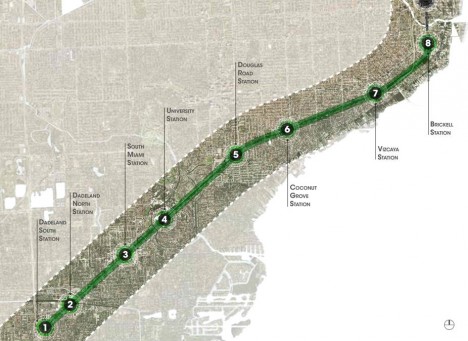
Following in the footsteps of the High Line (and Low Line) of New York City, the Underline project aims to take the underutilized space below Miami’s elevated MetroRail and transform it into a connected park-and-pathway system spanning ten miles and hundreds of acres.

miami underline project

The undertaking is ambitious, but it has solid precedents around the country: “The Underline will connect communities, improve pedestrian and bicyclist safety, create over a hundred acres of open space with restored natural habitats.”

underline system map

Before-and-after concept images, shown above and below, highlight key points along the trail, including expanded park space, bicycle repair stations and play areas.

miami before after park

Connecting Miami, Coral Gables and South Miami, the design further aims to “encourage a healthy lifestyle, provide an easily accessible place to exercise, create a mobility corridor that integrates transit, car, biking and walking, provide a 10-mile canvas for artistic expression, attract development along US1, and generate significant economic impact.”

underline master plan

Beyond its immediate and direct effects, the trail would also connect out to a system of existing bike paths as well as ones under development, serving as a nexus between a total of 250 miles of extant and proposed trails across southern Florida.

miami park project

James Corner Field Operations of New York City was selected to create the master plan for The Underline, with input collected from surveys and six public meetings.

underline miami design

Their master plan provides “standards and requirements for the urban trails including trail widths and proposed materials. It also includes recommendations for lighting and wayfinding, seating, amenities, etc. The plan proposes improvements to crosswalks, intersections. Landscape recommendations include a plant palette and placement. There are also proposals for destination parks.”

Share on Facebook


[ By WebUrbanist in Architecture & Cities & Urbanism. ]

[ WebUrbanist | Archives | Galleries | Privacy | TOS ]


WebUrbanist

 
Comments Off on Underline: 10-Mile Park to Trace Path of Elevated Rail in Miami

Posted in Creativity


How to Use the Channel Mixer in Photoshop to Change Colors in Your Images

24 Feb

There may be times when you want to play around with some elements in your images. Perhaps you want to change a color to a more suitable one in post-processing. One of the tools you can use in Photoshop is the Channel Mixer. It is a simple process that allows you to change the color of any element in your image to any other color under the rainbow. The Channel Mixer adjustment is widely used for making good black and white image conversions, correcting color casts, and exaggerating color. But why not use it for fun too, such as changing the color completely!

channel-mixer-photoshop-tutorial_0007

Before you start, however, there is one vital thing you must know, if you want to work in Photoshop in a non-destructive way: layers and masks.

The examples below are from a photoshoot I did with my girls. I did not like the colors of their capes, and didn’t have any other alternative, so Photoshop was to be the answer.

channel-mixer-photoshop-tutorial_0000

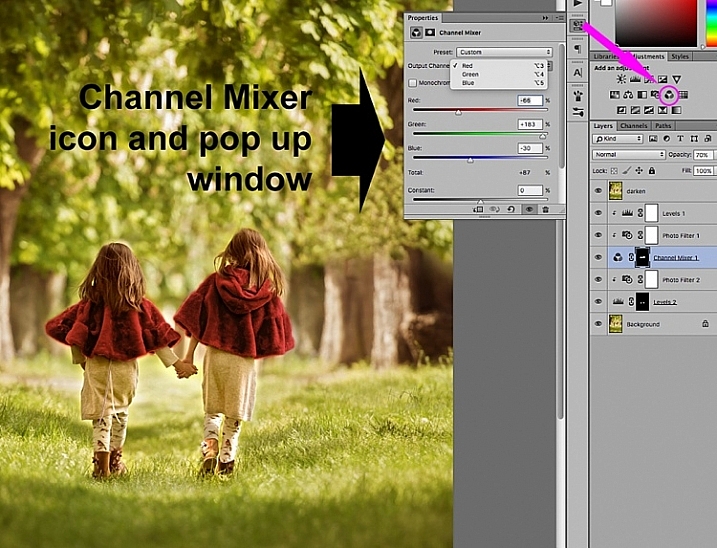
The first thing you need to do once your file is opened, is to select the area where you want the color changed using either the quick mask mode, or one of the lasso tools. While your selection is highlighted, add a channel mixer adjustment layer and your selection will automatically be added as a layer mask. Click on the channel mixer icon to the left of the layer itself and a window pops-up.

channel-mixer-photoshop-tutorial_0001

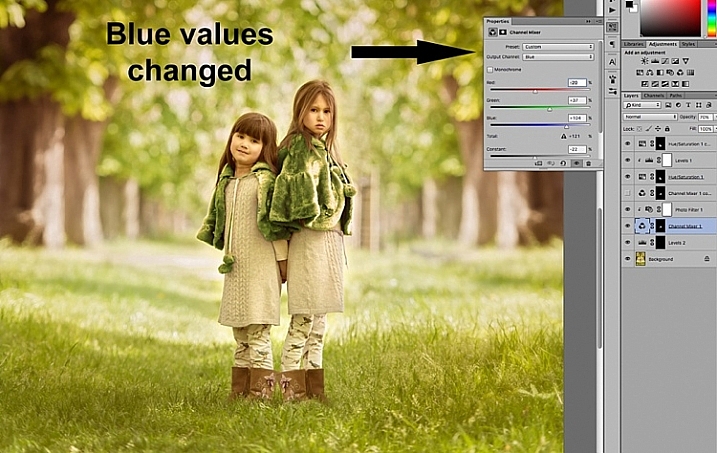
There are three values under the output channel: Red, Green, and Blue . You need to bring up each value and move the sliders until you get your desired color. It will take a little experimenting, and going backwards and forwards between the three colors, until you arrive at your chosen color. When the color change is vastly different, you will notice that the RGB values individually requires major changes.

channel-mixer-photoshop-tutorial_0002

You need to keep an eye on the total value for each channel, aim to keep it within 100%. A warning is displayed when you go over 100%, as this means the color output is too bright or dark, and you are losing data in the darkest areas or the highlights. A negative value means you are adding more of the colour to the channel, and a positive value means you are taking away.

channel-mixer-photoshop-tutorial_0003

channel-mixer-photoshop-tutorial_0004

Once you have decided on your new color, don’t forget to check the edges and carefully mask around if necessary. When the new color is a lot darker than the original color, such as on the image below, more meticulous masking is necessary to clean up the edges. In some cases, painting the highlights with the same color is needed for the image to look natural. You may also have to adjust the opacity of the brush, or the adjustment layer as required. The important thing is to make sure the image looks believable, if that was your original intention.

channel-mixer-photoshop-tutorial_0005

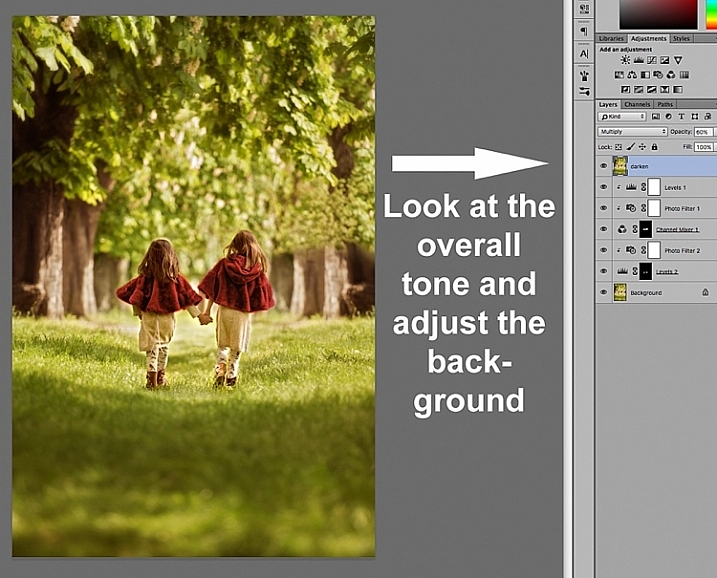
Once you have changed the color and cleaned up your masking work, check the overall look, and adjust the background accordingly.  In the case of the image below, the original background looked too bright for the new moodier look so I darkened it to go with the scene I was after.  There are various ways of darkening an image in Photoshop. The method I used here was to duplicate the original image (duplicate layer), and change the Blend Mode to Multiply. You can then mask out any areas you don’t want to get too dark, or change the opacity of the layer, as done on the image below.

channel-mixer-photoshop-tutorial_0006

You will notice that I have added additional layers such as levels for brightening some areas, and photo filters for warming up or cooling down other areas. It is essential to have a good look at the overall picture, not just the isolated area and selective changes you have made. This is because our perception of color is relative and mostly dependent on the colors around them. Here are the before and after images (below).

channel-mixer-photoshop-tutorial_0010

channel-mixer-photoshop-tutorial_0008

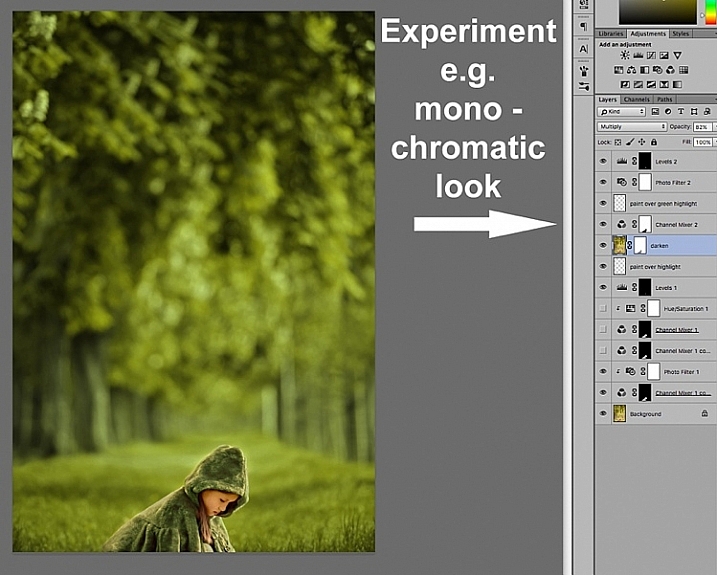
Your Photoshop play doesn’t have to end in isolated color changes. You can experiment in many various ways to achieve any look you desire. In the image below I decided to go for a more monochromatic look. This involved selecting the background, applying another channel mixer adjustment layer, and moving the sliders on each RGB value until I got the color I was after.

channel-mixer-photoshop-tutorial_0009

Or you can throw all caution to the wind and go totally crazy. You can add and remove colors from each channel at purely 100% in a mix and match fashion, and see what array of unrealistic looks you get, such as the magenta image below – for fun!

channel-mixer-photoshop-tutorial_0011

I hope this has been a little helpful tip for your Photoshop play.  Do you have other ideas on how to use the channel mixer to achieve various effects in Photoshop? Share them in the comments section below please.

googletag.cmd.push(function() {
tablet_slots.push( googletag.defineSlot( “/1005424/_dPSv4_tab-all-article-bottom_(300×250)”, [300, 250], “pb-ad-78623” ).addService( googletag.pubads() ) ); } );

googletag.cmd.push(function() {
mobile_slots.push( googletag.defineSlot( “/1005424/_dPSv4_mob-all-article-bottom_(300×250)”, [300, 250], “pb-ad-78158” ).addService( googletag.pubads() ) ); } );

The post How to Use the Channel Mixer in Photoshop to Change Colors in Your Images by Lily Sawyer appeared first on Digital Photography School.


Digital Photography School

 
Comments Off on How to Use the Channel Mixer in Photoshop to Change Colors in Your Images

Posted in Photography


Sigma Mount Converter MC-11 adapts Sigma lenses to E-mount cameras, supports autofocus

23 Feb

$ (document).ready(function() { SampleGalleryV2({“containerId”:”embeddedSampleGallery_5668726877″,”galleryId”:”5668726877″,”isEmbeddedWidget”:true,”standalone”:false,”selectedImageIndex”:0,”startInCommentsView”:false,”isMobile”:false}) });

Sigma has announced an adapter for Sony E-mount cameras, making it possible to use Sigma’s most recent lenses in Canon and Sigma mount on full-frame or APS-C E-mount bodies. The MC-11 adapter is able to use phase detection AF with adapted lenses, and makes use of both camera and lens stabilization when present. An LED display on the side of the mount provides compatibility information of attached lenses. The adapter also communicates EXIF data to the camera body, and retains profiles of compatible lenses – those included in Sigma’s Global Vision line – to optimize AF performance. 

Sigma has not announced pricing or availability at this time.

Press release:

New Sigma Global Vision Lens Mount Converter Expands High-Performance Lens Options for Sony Cameras

Brings Sigma’s Global Vision Lenses to the Sony E-Mount Camera Family

KANAGAWA, JAPAN — February 23, 2016 – Sigma Corporation of America, a leading DSLR lens, camera, flash and accessories manufacturer, today announced the release of its new high-performance Sigma Global Vision lens converter – the Mount Converter MC 11 – for Sony E-mount, full frame and APS-C sensor cameras. With the new MC-11, Sony camera users will be able to utilize 19 Global Vision lenses in Sigma Canon Mount (EOS) and Sigma Mount (SA).

“There are many challenges to designing high-quality mount converter and topping the list is aptly handling phase detection AF in newer cameras and this is where the Sigma MC-11 is groundbreaking in its support for the Sony E-mount systems,” states Mark Amir-Hamzeh, president of Sigma Corporation of America. “The new Sigma MC-11 mitigates complications with a purpose-built lens control data system engineered for maintaining superior AF functionality. So the growing number of Sony E-mount camera users who have been asking for more lens options, now have access to a large pool of lenses that fully embody Sigma’s signature quality and performance.” 

The Sigma MC-11’s sleek LED display lets Sony users know if the attached Sigma lens is compatible and whether or not the MC-11 needs to be updated for that specific lens. Its internal control data system keeps detailed information on each compatible Sigma lens, automatically optimizing performance of AF drive, aperture control and other critical lens functions. The MC-11’s internal control data system also maintains continuity with key camera functions that control brightness and correct transverse chromatic aberration, distortion, and more. The complete compatibility with both Sigma lens OS and Sony in-camera OS ensures correction of camera shake and other stability issues and when used with in-camera stabilization, MC-11 allows angle shake correction in the lens. The integrated flocking helps prevent internal reflections and reduction in lens performance. In addition, the MC-11 retains important EXIF data ensuring users can analyze every detail of their lens setting. 

The Sigma MC-11 converter can be updated with the latest compatible lens information from a workstation or laptop using the Sigma Optimization Pro software and Sigma USB Dock (sold separately).

For more information on the Sigma MC-11 converter please visit www.sigmaphoto.com/mount-converter-mc-11

Articles: Digital Photography Review (dpreview.com)

 
Comments Off on Sigma Mount Converter MC-11 adapts Sigma lenses to E-mount cameras, supports autofocus

Posted in Uncategorized


DL or No DL? What you need to know about the Nikon DL compacts

23 Feb

Three’s company

Are compact cameras still relevant? Nikon seems to think they can be, if they’re good enough. It’s announced three premium compacts, all built around 20.8MP 1″-type BSI CMOS sensors its latest, ‘EXPEED 6A’ processor. If that sensor spec sounds familiar, it’s because the Nikon J5 uses a very similar…probably the same…one.

The firepower in that new processor results in 4K video capture capabilities and bursts up 60 fps without AF, and 20 fps with. Combine this speed with a hybrid AF system that uses 105 phase-detect and 171 contrast-detect points (the same one found in the 1-System), and you should have three seriously capable compacts.

When we sat down with Nikon reps back at CES 2016, they explained how engineers developed the three in unison, but targeted each camera’s focal length range toward a very specific customer. However, all three customers are expected to be DSLR shooters looking for a smaller, lighter alternative for everyday shooting. As such, all three can shoot RAW, offer Adobe RGB, can utilize Nikon i-TTL Speedlights, and use a menu system very similar to that found in their pro and enthusiast DSLRs.

Meet the family

The three cameras that make up Nikon’s DL line of premium 1″-type compacts include the DL24-85, DL18-50 and DL24-500. They may not have the most exciting or creative names, but at least they’re straightforward. As you might have guessed, the 24-85 offers a 24-85mm equivalent F1.8-2.8 lens and is the standard zoom compact of the bunch. Reasonably fast on the wide end, this camera has a lot of appeal as an everyday pocketable shooter.

The DL18-50 is the first 1″-type camera to have an ultra-wide lens which, in this case, is a 18-50mm equiv. It also features an impressively fast 1.8-2.8 aperture range, and sits as the DL’s wide/normal option. And on the tele end you have the DL24-500 F2.8-5.6. It isn’t as fast as the other two and certainly isn’t pocketable, but it is easily offers the most versatile focal range of the three.

Yet more choices

Style-wise, the DL24-85 and DL18-50 may seem oddly familiar. The concealingly small dial on the back looks a lot like those on the Nikon 1 series bodies, but from the front, they look almost as if Nikon’s borrowed the leftover tooling from Panasonic’s LX5. This is no bad thing – the LX5 was a really classy little enthusiast compact, but we thought it was faintly amusing, given how fiercely Nikon has protected its industrial design in the past.

We’re joking, of course, and there’s no such precedent for the DL24-500 – perhaps because its design resembles every other superzoom on the market. It’s pretty difficult to make an interesting-looking superzoom, just as it’s difficult to make an interesting looking SUV. And often inadvisable to do so.

How do they compare?

We’ve had to approximate how the available F number on each lens will decline, as you zoom in, but even with these approximated values, you can see that the DL24-85 sits between the lens range of the Sony Cyber-shot RX100 Mark III and IV, and that of Canon’s Powershot G7 X II.

The graph should also make clear just how unusual the DL18-50’s lens is. 18mm equivalent is significantly wider than any of the other 1″ sensor compacts currently on the market, yet it’s bright and able to reach a relatively practical 50mm equivalent focal length.

As usual, we’ve plotted these graphs to show both equivalent focal length and equivalent aperture.

Reaching for it

The DL24-500 joins an already impressive group of 1″ sensor superzooms, including the Sony RX10 II, Panasonic FZ1000 and Canon G3 X. These cameras are undeniably popular, especially amongst travel photographers. From its specs alone, the DL24-500 certainly seems like a competitor. Its 4K capture and slow motion video options compete directly with some of the most stand-out specs from the RX10 II (which we recently gave a Gold Award to).

All of these cameras offer considerably better image quality than conventional, small-sensor superzooms. So, although they can’t boast >80x on the little metallic stickers they wear on camera store shelves, they still offer a degree of reach that will be suitable for a huge variety of shooting situations.

And again, the factor that could set the Nikon apart from its competition is its Hybrid AF system. If the DL24-500’s AF system offers similar performance to that of 1-Series cameras (and there’s little reason to think it wouldn’t), the competition will have good reason to be concerned.

Super steady

Each of the three DL compacts offers a secret power, specific to their zoom range and unique to each. In the case of the DL24-500, its super power is Sports VR for added stability when panning at the tele end. Of course, all three cameras have Dual Detect Optical VR and historically, Nikon cameras have impressed us with their stabilization, especially the Nikon P900 superzoom. So we definitely have high expectations for the DL24-500.

Of course, what good is VR and reach if you don’t have quality glass? All three Nikkor lenses have fluorine coatings to keep away moisture and grime, and the 18-50 is the company’s first compact to have a Nano Crystal Coat, which reduces flare and ghosting.

The everyday pocket cam to beat?

The Sony RX100 series of cameras has long been viewed as the pocketable premium compacts to beat. The most recent Sony RX100 IV in particular impressed us. But the Nikon DL24-85 has us ready to reconsider the crown.

The two cameras share a whole lot of similar specs, including 4K video capabilities, optical image stabilization, fast burst rates with continuous AF, and tilting LCDs. They both offer 20MP 1″-type sensors and very similar focal range, though the Nikon does have a bit more reach.

But the two do vary in some key areas. While the Sony has a pop-up EVF, you’ll have to pony up for an optional tilting model on the DL18-50 and 24-85. Conversely, the DLs all have touchscreen OLED displays, while the RX100s use non-touch LCDs. 

But an even bigger difference can be found when looking into each camera’s AF system: the Sony uses a contrast-detection AF system, while Nikon uses a hybrid approach (combining depth-aware phase detection with high-precision contrast detection). But before you dismiss the Sony entirely, it’s worth noting that the RX100 IV really impressed with its AF capabilities during our testing. So, while the Nikon DL24-85 should  be able to outperform the Sony, we’ll just have to wait until we get one in to know for sure.

Nice and close

The DL24-85 is the only DL of the three to offer a 1:1 macro mode (its secret power). It can be accessed by turning the zoom ring all the way to the right to the S.macro position. In the macro mode, users have a 35mm equiv. field of view. And while all three cameras offer a manual focus mode, the DL24-85 also has a focus bracketing feature, which should be particularity useful for macros.

Unfortunately, the ring around the lens barrel of the DL24-85 is not customizable (same goes for the other DL’s). It can only be used for manual focusing.

Wide street shooter

The DL18-50 is the widest DL of the bunch, and while its 18-50mm focal length may not appeal to casual shooters, street photographers are sure to be enticed by its range and fast lens. Its tilting touchscreen allows for tap-to-focus and, we assume, tap-to-shoot capabilities that should suit that ‘decisive moment’ shooting style.

This camera’s focal range will also likely appeal to architecture and landscape shooters. To further tempt said group, it has a built-in perspective control feature that can be used to distort the image to correct for perspective distortion.

Unlike the other two, it doesn’t have a built-in flash – perhaps because it would be too difficult to offer such wide coverage without some clever optics and a lot more distance away from the lens.

Touch, see, shoot and share

Touchscreens can be great, especially when paired with physical control points (this way you can choose). All three DLs offer 1.04M-dot OLED touch displays. The displays on the DL24-85 and DL18-50 can tilt, while the display on the DL24-500 is fully articulating. This only adds to the DL24-500’s appeal as a video-centric all-in-one.

The DL24-500 also offers a 2.4M-dot OLED electronic viewfinder, while the other two cameras accept the the rather bulky accessory DF-E1 tilting electronic viewfinder with the same XGA resolution. 

The three DLs are also Wi-Fi and Bluetooth enabled, allowing them to take advantage of Nikon’s ‘SnapBridge’ technology, first unveiled to the world at CES 2016 during the company’s press event announcing the D500. ‘SnapBridge’ allows a camera to stay connected to one’s smart device via low power Bluetooth connection, without the need to reconnect. It’s worth noting that while we’ve written about SnapBridge in the past and are excited by its implication, we have yet to try it. The cameras also support NFC, for quick and easy pairing with Android devices.

Where they fit on the 1″ scale

Here’s how they fit into the wider market. We don’t yet know exactly how their apertures will change as you zoom, so we’ve had to approximate them here.

The pricing is exactly as we’d expect: the DL24-85 with its fast standard zoom is a direct competitor for Sony’s RX100 III and Canon’s G7 X Mark II. It doesn’t have a viewfinder, as the Sony does, so it’s no surprise to find it’s being pitched at $ 150 lower than the RX100 III’s launch price and $ 50 below the Canon’s.

Meanwhile, the DL24-500’s long, increasingly slow lens makes it look like Nikon is targeting the same customers as the G3 X. And, guess what? The Nikon MSRP is exactly the same as the Canon’s, at $ 999.

Finally, although it shares a lot in common with the 24-85, there’s a premium to be paid for the DL18-50. With no direct rivals, and the challenges of making such a fast, wide lens, it’s no surprise that it’s to be launched for $ 849.

In summary

It’s interesting to see how these new models fit in to the market. Ever since Sony announced the RX100, manufacturers have been developing ever more variations and options around the 1″ sensor. Since most cameras take at least two years to develop, it’s still relatively early in the timeline, but with the arrival of Nikon there are now four manufacturers building large sensor compacts.

So far we’ve seen Sony focus its RX100 series on the idea of a small camera with a large sensor and a bright lens, with zoom range being the trade-off being made. Canon very much followed suit with its G7 X models. And the Nikon DL 24-85mm, with its F1.8 – 2.8 is clearly targeting the same potential buyers.

Meanwhile, Sony, Panasonic and Canon have all developed riffs on the large bodied, long zoom theme. Sony’s RX10 (both I and II) opt for constant aperture zooms, while Panasonic’s FZ1000 gives greater range that gets slower as you zoom. Nikon’s DL 24-500mm is much closer to Canon’s G3 X, in offering still more zoom by letting the aperture drop even further.

As such, the standout camera in this group is the DL 18-50. It’s fast (F1.8-2.8), ultra-wide to just-beyond-normal zoom range is unique, and offers an exciting option for wide-angle shooters looking for a pocketable camera with what should be good image quality. Whatever our reservations have been in the past about Nikon compacts, the image quality has usually been very good.

Articles: Digital Photography Review (dpreview.com)

 
Comments Off on DL or No DL? What you need to know about the Nikon DL compacts

Posted in Uncategorized


How to Choose the Best Lens for Travel and Street Photography

23 Feb

If you were to ask me what the best lens for street and travel photography is, the first thing I would advise you to do, is to think about what you need from the lens. In my case, the following criteria are important to me –  your list, of course, may differ.

  • The lens should be small, lightweight, and unobtrusive.
  • The optical quality must be excellent.
  • Autofocus performance needs to be very good.
  • As I sometimes shoot in low light, a wide aperture is a must.

Best lens for street and travel photography

These criteria should point to several lenses that may be suitable for you. Perhaps you own these lenses already – in which case the next step is to take them out into the street, and take some photos with them. This is important, because you may find that in practice, the lens you prefer to use is different from the one you thought might be best.

For example, you may think that a zoom lens will come in useful because of the convenience of being able to quickly adjust focal length. But in reality, find that you prefer a prime lens with a wider aperture for shooting in low light, or using selective focus.

On the other hand, you may be approaching this exercise with the intent of choosing a lens to buy. It’s difficult to test a lens if you don’t already own it, although you may be able to borrow or rent it. If you can’t do that, the next best thing to do is to go online and do some research. Read some reviews of the lens. Look for articles written by photographers whose photos you like, who also use the lens you’re considering. Go onto Flickr and see if there is a group dedicated to the lens. Explore some good quality forums, ask the members if anybody owns the lens, and what they think of it.

My favorite lens

By now you are probably wondering what is my favorite lens for street and photography. The answer is – the Fujinon 35mm f/1.4 lens. To be honest, this has come as a surprise to me. When I first bought into the Fujifilm camera system, I thought that I would either prefer a short telephoto lens (such as the 56mm f/1.2) or a moderate wide-angle (like the 18mm f/2 pancake lens) for street and travel photography.

But in practice, I’ve found that I prefer the 35mm. It has received a lot of praise since it was released with the X-Pro-1 several years ago, and is a standard prime lens (for APS-C cameras). The angle-of-view is very similar to that of a 50mm lens on a full-frame camera, or a 25mm lens on a Micro four-thirds camera.

So, why has this lens worked so well for me? The short answer is that it is extremely versatile. I prefer to take the simple approach to street photography, and that means reducing the number of choices that I have to make. Using a prime means I don’t have to think about focal length, yet the versatility of this lens means I can use it a number of different ways.

For example, when photographing people I can keep my distance and frame the person in the context of their environment.

Best lens for street and travel photography

Or I can get closer and concentrate more on the person.

Best lens for street and travel photography

I can also get close to the subject for a tight detail shot, like this one.

Best lens for street and travel photography

Standard lenses for street photography

Working distance is a term used in macro and close-up photography to describe how far the lens is from the subject. You can apply this concept to street, and travel photography too. If you are using a telephoto lens, you will be farther away from the subject. That’s great for not being noticed, but it can also lead to a kind of detached feeling in the image. The viewer can tell you weren’t close to the action, and there may be a sense of lack of involvement in the scene.

A wide-angle lens forces you to get in closer to fill the frame. The closer you get to somebody on the street, the more likely they are to notice you, and react to the camera in some way. This is not necessarily a bad thing (Bruce Gilden has taken this confrontational style to an extreme) and using a wide-angle lens definitely shows involvement in the life of the street. It’s also an approach you can take if you like to go up to people, and ask permission to take their photo first.

The standard lens falls in-between these two extremes. It lets you get close enough to be involved in the scene, but not so close that people are overly bothered by what you are doing. It helps you blend in to what is a very common thing these days – people taking photos on the street (although most often with camera phones, not actual cameras).

Best lens for street and travel photography

By the way, all the photos in this article were taken in the Spanish city of Cadiz, and I wanted to show the people in context, with the historical buildings in the background, in at least some of the photos. The 35mm lens worked very well for this.

So, for me, the 35mm lens is a clear favorite for travel and street photography. But, what about you? What lenses do you prefer to use? Please let me know in the comments, I’d like to hear your thoughts.


Mastering Lenses photography ebookMastering Lenses

My new ebook Mastering Lenses: A Photographer’s Guide to Creating Beautiful Photos With Any Lens shows you how to get the best from the lenses you own already. A comprehensive guide to exploring the creative potential potential of wide-angle, normal and telephoto lenses, it’s also the ultimate buying guide for readers thinking about purchasing a new lens for their camera. Please click the link to learn more or buy.

googletag.cmd.push(function() {
tablet_slots.push( googletag.defineSlot( “/1005424/_dPSv4_tab-all-article-bottom_(300×250)”, [300, 250], “pb-ad-78623” ).addService( googletag.pubads() ) ); } );

googletag.cmd.push(function() {
mobile_slots.push( googletag.defineSlot( “/1005424/_dPSv4_mob-all-article-bottom_(300×250)”, [300, 250], “pb-ad-78158” ).addService( googletag.pubads() ) ); } );

The post How to Choose the Best Lens for Travel and Street Photography by Andrew S. Gibson appeared first on Digital Photography School.


Digital Photography School

 
Comments Off on How to Choose the Best Lens for Travel and Street Photography

Posted in Photography


Sigma announces 30mm F1.4 for E-mount and Micro 4/3 and 50-100mm F1.8 Art for APS-C

23 Feb

$ (document).ready(function() { SampleGalleryV2({“containerId”:”embeddedSampleGallery_8227781120″,”galleryId”:”8227781120″,”isEmbeddedWidget”:true,”standalone”:false,”selectedImageIndex”:0,”startInCommentsView”:false,”isMobile”:false}) });

Sigma has added two new fast-aperture lenses to its Art and Contemporary lineups. 

For owners of Canon, Nikon and Sigma APS-C bodies there’s the 50-100mm F1.8 DC HSM Art, which is equivalent to 75-150mm. This lens has a redesigned Hyper Sonic Motor, nine-blade rounded aperture and internal zoom. Being a weighty lens (1490g/3.3lbs), it also has a built-in tripod socket.

The other lens is for Sony E-mount and Micro Four Thirds bodies, and it’s a fast 30mm F1.4 prime, equivalent to 45mm and 60mm, respectively. This lens uses a stepping motor for fast and quiet focus during video and weighs just 263g/9.3oz. 

The 30mm F1.4 will ship in mid-March at an MSRP of $ 339, while the 50-100mm F1.8 is expected in late April priced at $ 1099.

Press release:

Sigma Expands Its Global Vision Lens Line With Two New High-Performance Lenses

50-100mm F1.8 DC HSM Art and 30mm F1.4 DC DN Contemporary 

50-100mm is first constant aperture F1.8 telephoto zoom; 30mm represents first affordable F1.4 high-performance lens for mirrorless cameras

KANAGAWA, JAPAN — February 23, 2016 – Sigma Corporation of America, a leading DSLR lens, camera, flash and accessories manufacturer, today announced the addition of two high-performance APS-C format lenses to the Sigma Global Vision product line: Sigma 50-100mm F1.8 DC HSM Art Lens and the Sigma 30mm F1.4 DC DN Contemporary Lens. 

“Sigma’s aim is to provide high-performance lens options that lead with innovation and break new boundaries for every photographic scenario our customers can dream up,” states Mark Amir-Hamzeh, president of Sigma Corporation of America. “These new lenses build on Global Vision’s great IQ technology and reflect this goal, delivering immense value, quality and performance that the Sigma brand is known for.”

Sigma 50-100mm F1.8 DC HSM Art

Building on the groundbreaking Sigma Global Vision 18-35mm F1.8 DC HSM Art Lens, the new Sigma 50-100 F1.8 (75-150mm on 35mm format) mid-range zoom lens embodies the same engineering prowess to deliver outstanding prime lens-like results. Factoring in the APS-C image circle of 1.5x, the 50-100mm F1.8 covers three popular short tele prime focal lengths: 85mm, 105mm and 135mm. Like the 18-35mm F1.8, the new 50-100mm F1.8 maintains a constant F1.8 aperture yielding exceptional brightness and resolution throughout the zoom, while simultaneously maintaining focus as the lens is zoomed, a feature videographers will greatly appreciate. 

Sigma Art Line Image Technology Innovation

  • Features three FLD (F Low Dispersion) glass elements, one SLD (Special Low Dispersion) glass element, and one high-refractive index, high-dispersion glass element to minimize aberrations.
  • Redesigned and enhanced, the new Hyper Sonic Motor is 30% slimmer and provides fast and accurate AF.
  • Highly durable polycarbonate diaphragm made with fluorine; blades feature carbon feather film offering exceptionally smooth operation even during continuous shooting.

Outstanding Zoom Lens Maneuverability

  • Inner focusing and zoom design offer versatile shooting options
  • Tripod socket for stable, comfortable operation
  • Features 21 elements / 15 groups, Minimum Aperture: F1.6, 82mm filter thread, Minimum Focus Distance: 37.4in, Dimensions: 3.7×6.7, Weight: 52.6oz

The new Sigma 50-100mm F1.8 Art will be available in Canon, Nikon and Sigma mounts. For more information, please visit www.sigmaphoto.com/50-100mm-f1-8-dc-hsm-art.

Sigma 30mm F1.4 DC DN Contemporary 

Combining outstanding optical performance and compact design, the new affordable Sigma 30mm F1.4 DC DN Contemporary Lens brings immense value to mirrorless cameras. Boasting superior image quality with F1.4 brightness, the versatile lens covers a wide range of photo and video capture scenarios, delighting users with its beautiful bokeh effects. 

Contemporary Line Performance and Value

  • Represents first affordable F1.4 performance lens for the mirrorless market
  • Sigma engineered quality within a sleek compact design
  • Fast, smooth AF stepping motor designed to support video
  • Features one aspherical element and one double-sided aspherical element producing imaging quality comparable to the Art line.
  • Features 9 elements / 7 groups, Minimum Aperture: F16, 52mm filter thread, Minimum Focus Distance: 11.8in, Weight: 9.3oz, Dimensions: 2.6×2.9in.

The new Sigma 30mm F1.4 DC DN Contemporary Lens will be available in Sony E-Mount and Micro Four Thirds mount. For more information, please visit www.sigmaphoto.com/30mm-f1-4-dc-dn-c.

Sigma Global Vision lenses including the new 50-100mm F1.8 DC Art and 30mm F1.4 Contemporary lenses can be updated with the latest lens software from a workstation or laptop using the Sigma Optimization Pro software and Sigma USB Dock (sold separately).

Tested for Optimum Performance

Sigma lenses are born of well-thought-out design concepts, exceptional Japanese craftsmanship and manufacturing, and advanced lens performance testing and evaluation. To this end, Sigma has developed its own A1 proprietary MTF (modulation transfer function) measuring system using 46-megapixel Foveon direct image sensors. Even the most elusive high-frequency details are within the scope of Sigma’s quality control inspections. Every Global Vision lens is A1 tested, analyzed and approved before leaving the factory ensuring maximum performance out of the box.

For more information on Sigma’s industry leading testing, please visit http://blog.sigmaphoto.com/2012/a1-mtf-testing-for-new-sigma-lenses/

Specialized Mount Conversion Services 

Ensuring continued ROI, Sigma will convert the current mount of your Sigma Global Vision lens to another of your choice. Sigma lenses currently from the Contemporary, Art or Sports line, in Sigma, Canon, Nikon, Sony, Pentax mounts can be converted to Sigma, Canon, Nikon, Sony or Pentax*.  Mirrorless lenses can be converted to Micro Four Thirds and Sony-E Mount. They cannot be converted to either an APS-C or a Full Frame format.  *For specific details, please visit http://www.sigmaphoto.com/service-support/mount-conversion-service

Sigma 30mm F1.4 DC DN Contemporary and 50-150mm F1.8 Art specifications

  Sigma 30mm F1.4 DC DN | C Sigma 50-100mm F1.8 DC HSM Art
Principal specifications
Lens type Prime lens Zoom lens
Max Format size APS-C / DX
Focal length 30 mm 50–100 mm
Image stabilisation No
Lens mount Micro Four Thirds, Sony E (NEX) Canon EF, Nikon F (DX), Sigma SA Bayonet
Aperture
Maximum aperture F1.4 F1.8
Minimum aperture F16.0
Aperture ring No
Number of diaphragm blades 9
Aperture notes Rounded blades
Optics
Elements 9 21
Groups 7 15
Special elements / coatings 1 aspherical and 1 double-sided aspherical Three FLD, one SLD, one HRI elements
Focus
Minimum focus 0.30 m (11.81) 0.95 m (37.4)
Maximum magnification 0.14× 0.15×
Autofocus Yes
Motor type Stepper motor
Full time manual No
Focus method Internal
Distance scale No
DoF scale No
Physical
Weight 265 g (0.58 lb) 1490 g (3.28 lb)
Diameter 65 mm (2.56) 94 mm (3.7)
Length 73 mm (2.87) 171 mm (6.73)
Sealing No
Colour Black
Zoom method Rotary (internal)
Power zoom No
Filter thread 52.0 mm 82.0 mm
Hood supplied No Yes
Tripod collar No

Articles: Digital Photography Review (dpreview.com)

 
Comments Off on Sigma announces 30mm F1.4 for E-mount and Micro 4/3 and 50-100mm F1.8 Art for APS-C

Posted in Uncategorized


How to Choose the Best Black and White Photo Printer

23 Feb

In the digital age, color accompanies most of the images we come across during our daily lives. So when it’s intentionally missing, as is the case with artistic black and white photography, people take notice. Monochrome photography is popular in the fine arts for a variety of reasons, many of which come down to how it emphasizes different aesthetic components Continue Reading

The post How to Choose the Best Black and White Photo Printer appeared first on Photodoto.


Photodoto

 
Comments Off on How to Choose the Best Black and White Photo Printer

Posted in Photography