RSS
 

Archive for January, 2016

Dyslexic Designer Creates Custom Typeface Addressing Disorder

21 Jan

[ By WebUrbanist in Design & Graphics & Branding. ]

dyslexic typeface

Designed to address the visual processing problems associated with dyslexia, this font uses a set of tailored strategies to make reading easier for those with the disability.

dyslexie bold letters bottoms

Christian Boer developed Dyslexie from first-hand knowledge of its effects. “When they’re reading, people with dyslexia often unconsciously switch, rotate and mirror letters in their minds,” he explains.

dyslexie regular design lines

“Traditional typefaces make this worse, because they base some letter designs on others, inadvertently creating ‘twin letters’ for people with dyslexia.”

dyslexie mirroring dislexic address

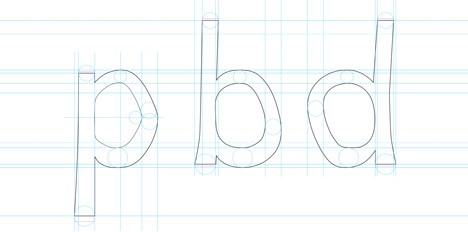
dyslexic p b q

For simplicity, clarity and consistency, most typefaces involve numerous mirrored letters, such as an ‘m’ that is a doubled ‘n’ which in turn is an upside-down ‘u’, or ‘b’ flipped to become ‘p’s and ‘q’s.

dyslexie design principles

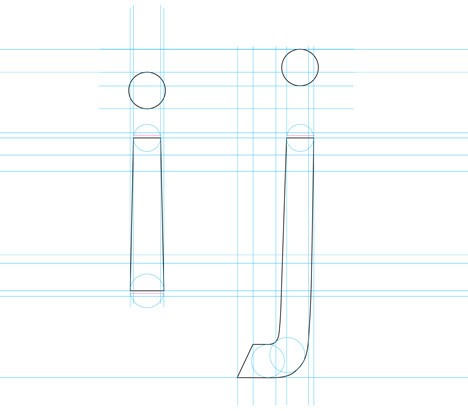
To address this, Boer thickened the bottom portions of letters, making it more clear which end is up and creating clearer distinctions between different characters in the process. Larger spaces and punctuation are also made to make everything more legible.

dyslexie design strategy

“By changing the shape of the characters so that each is distinctly unique, the letters will no longer match one another when rotated, flipped or mirrored,” Boer said. “Bolder capitals and punctuation will ensure that users don’t accidentally read into the beginning of the next sentence.”

Share on Facebook


[ By WebUrbanist in Design & Graphics & Branding. ]

[ WebUrbanist | Archives | Galleries | Privacy | TOS ]


WebUrbanist

 
Comments Off on Dyslexic Designer Creates Custom Typeface Addressing Disorder

Posted in Creativity


Understanding Natural Light Part 3: Direction of Light

21 Jan

Light has different qualities, and by understanding those differences and using them in your favour, you can become a better image maker.

In two previous articles I covered:

  • Understanding Natural Light Part 1: Quality of Light
  • Understanding Natural Light Part 2: Color of Light

Mix1
In this third chapter, you will learn:

  • How to control the direction of natural light in the field.
  • How to understand the different effects the direction of light will have on your portraits. How to mix light colors to create depth.
  • A few advanced techniques, like using reflectors or flags.
  • How to practice using exercises.

Please note that as a portrait photographer, I will be discussing portraits, and using them as examples. However, this knowledge applies to any kind of photography.

Working with natural light does not mean compromising

Most people will tell you that while working with artificial lighting will allow you to fully control the lighting situation in your shooting, working exclusively with natural light will limit your ability to control the lighting to almost zero. In my opinion, this false assumption is leading many photographers to mediocre images. Stating that the lighting is poor, because “that’s how it was” when they made the photo, is not acceptable.

So, the first step in controlling natural light is to carefully plan your time of the shoot. In the preview articles, we have discussed how the quality and color of light are affected by time, and weather, during the day. Now, let’s understand how the direction of light will change throughout the day, and how it will affect the lighting situation in our portraits.

Frontal lighting

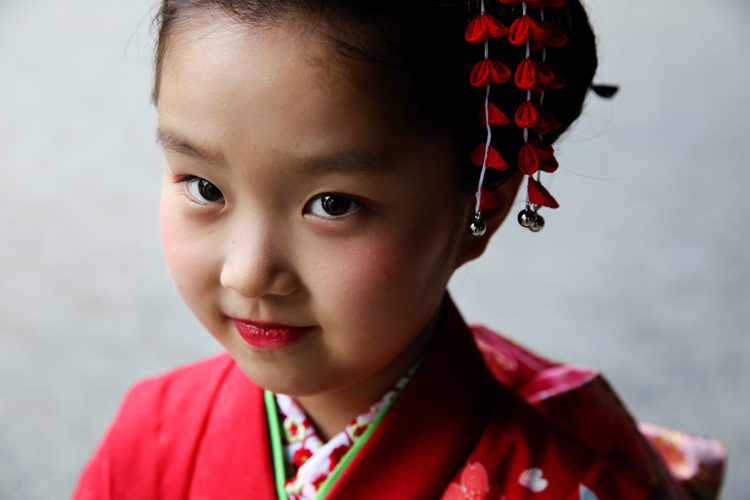
Frontal lighting refers to light which comes directly in front of your subject (the light source is behind you and the camera). The situation is possible or when your subject is facing the light source (for example face directed to a setting or a rising sun). Another possibility is with reflected light. Like in this image, Dialsiz was standing in the shade, but in front of her was a bright sunny wall, reflecting the sunlight directly on her face.

1b

Pros: Frontal lighting will usually illuminate your subject’s face evenly, without any shadows. It will create an aesthetic and balanced look, which is why this setup is very popular in fashion and beauty shoots.

Cons: The lack of shadows will create a lack and depth and drama.

45 degree lighting

As the name suggests, this refers to a situation where the light comes from an angle of 45 degrees from the nose of your subject. This is extremely popular lighting setup in portrait photography, which is sometimes called Rembrandt lighting. It can be easily achievable with side light coming from a rising or setting sun, or by positioning your subject at a 45 degree angle to a window.

26b

Pros: in this lighting setup, you will note how the light illuminates your subject’s face gradually. Creating a gradual shadow, and in our two dimensional art form, shadows usually mean depth and volume. That is the reason this setup is so appealing in the eyes of most viewers.

Cons: The dramatic effect of shadowing parts of the subject’s face might not be suitable for your visual story.

90 degree lighting

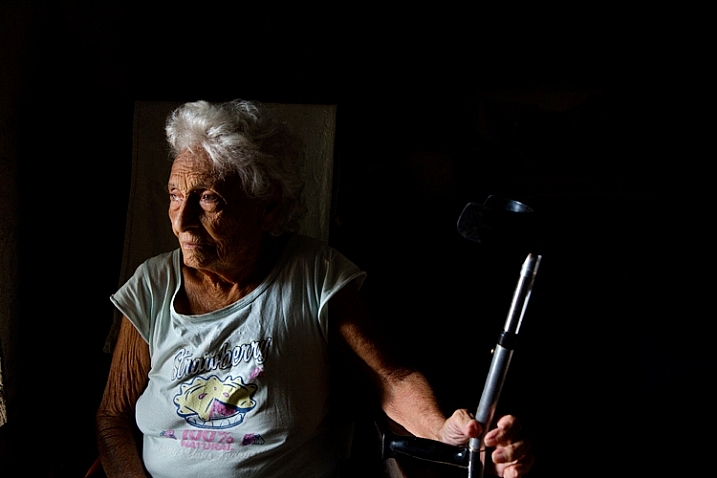
As the name suggests, this refers to a situation where the light comes from an angle of 90 degrees from the nose of your subject. It can be achievable with side light coming from a rising or a setting sun or by positioning your subject at a 90 degree angle to a window.

F11A1636

42


Pros: Extremely dramatic effect, which is almost impossible to ignore.

Cons: This dramatic lighting setup can be a little over dramatic, and with the right subject, this lighting can be scary! It all depends of course, on what you want to evoke in your visual story.

Backlighting

This refers to a situation where the light comes from behind your subject, and in front of you.

IMG 9185b

Pros: Backlight will create highlights in the contours of your subject, and unlike with frontal lighting, this will create a sense of depth, and a clear separation between the subject and the background. Unless the light source is very dim and fully covered by your subject’s body, working with backlight will force you to be creating with your photography, as it will make the exposure a bit more difficult. This is where switching from the automatic mode can be handy. While overexposing can be good for creating a burned out background or a lens flare, underexposure will usually result in a nice silhouette (as above)

Cons: As mentioned, this one is a bit more advanced to handle, and will mostly require switching out of your camera’s automatic mode, but again, a great opportunity for some creative photography.

Light from above

This refers to a situation where the light comes from directly above your subject, like during midday.

F11A0035b


Pros: This interrogation room style lighting setup will not be flattering to most faces. Light coming from above will result in deep shadows on your subject’s face, making the forehead shadow the eyes, and making the nose shadow the chin. However, it can be used as a way of creating a very dramatic image. Oscar-winning Cinematographer Gordon Hugh Willis, did a groundbreaking work in Francis Ford Coppola’s movie, The Godfather, with the combination of underexposing and positioning the lighting source above the actors’ faces. He managed to support the dark and mysterious sense of this movie, with the audience was unable to see most eyes throughout the movie.

Cons: As mentioned, when handled right, this lighting setup, can lead to great and creative results. Otherwise, you subject will look like he or she is going to answer some tough questions.

Controlling natural light

Basic: in the simplest form, controlling natural light is first in the planning. Choose the right time to be outside, or take your subject indoors to use the soft light coming from a window.

Advanced: You can control natural light almost like controlling artificial lighting, with the help of reflectors or/and flags.

Reflectors are used to bounce light into the subject’s face. For example, if you are dealing with light coming from above, you can overcome the problem of dark eyes by illumining them using a reflector. It can also lighten the dark side of the face, if needed, in the case of lighting from a 45 or 90 degree angle.

F11A1258b 1

2
You can see the reflection of the reflector used to bounce light back into this man’s face.

A flag is usually a piece of black fabric that can be used to block unwanted light and create shadows (shadows mean a sense of depth remember?) on the subject’s face. To use a flag properly, you will need somebody or something that can hold it. That is the way I use all kind of flags in the field. I have used my hat (which I was holding in my left hand) to shadow an overexposed forehead numerous times, or using the help of an innocent bystander that was asked to stand in one spot for a moment, to create a shadow when needed.

Exercise #1:

Christmas (or just after it) is the best time to ask for a favor. Bring your favorite friend, family member, or pet, and position it in front of a window. While moving your subject, practice the concepts of frontal, back, 90 degree and 45 degree lighting setups. Examine the images, and get a deeper understating of how light direction will affect your portrait.

Exercise #2:

Reflectors are effective and fun to use. You can buy yourself a reflector, or prepare one with a small piece of cardboard and a simple aluminum foil.

googletag.cmd.push(function() {
tablet_slots.push( googletag.defineSlot( “/1005424/_dPSv4_tab-all-article-bottom_(300×250)”, [300, 250], “pb-ad-78623” ).addService( googletag.pubads() ) ); } );

googletag.cmd.push(function() {
mobile_slots.push( googletag.defineSlot( “/1005424/_dPSv4_mob-all-article-bottom_(300×250)”, [300, 250], “pb-ad-78158” ).addService( googletag.pubads() ) ); } );

The post Understanding Natural Light Part 3: Direction of Light by Oded Wagenstein appeared first on Digital Photography School.


Digital Photography School

 
Comments Off on Understanding Natural Light Part 3: Direction of Light

Posted in Photography


Otherworldly? Lomography introduces Jupiter 3+ lens

21 Jan

$ (document).ready(function() { SampleGalleryV2({“containerId”:”embeddedSampleGallery_6385885616″,”galleryId”:”6385885616″,”isEmbeddedWidget”:true,”selectedImageIndex”:0,”startInCommentsView”:false,”isMobile”:false}) });

Lomography has resurrected another classic Russian lens to sit next to its Petzval 85mm and 58mm lenses. This time, the company has revived one of the Jupiter designs that are so popular in our Adapted Lens Talk forum. The 50mm F1.7 lens is offered in L39 mount with an included M-mount adapter. See the press release below for all of the details.

Press Release:

NEW JUPITER 3+ LENS (1.5/50 L39/M)

A BOLD, BEAUTIFUL & BRIMMING-WITH-BOKEH RESURRECTION FROM
THE ZENITH OF RUSSIAN OPTICAL DESIGN

  • A Resurrection of Planetary Proportions from the glory days of rangefinder photography
  • Unsurpassed Character with super-fast performance and incredible low light ability
  • Handcrafted Construction of solid chrome-plated brass and Russian glass optics
  • Rich Russian Heritage based on the iconic Jupiter lens

A RESURRECTION OF PLANETARY PROPORTIONS

Designed by the highly experienced Lomography team and manufactured by the expert technicians at the exact same Zenit factory in Russia as the original lens, the New Jupiter 3+ Art Lens retains the strong character and Soviet spirit of its forbearer — crisp sharpness, smooth, natural colors and lush, dreamy bokeh — while transcending it in many ways. With substantial improvements on design and compatibility, Lomography is extremely proud to introduce the New Jupiter 3+ Art Lens to their line of exquisitely handcrafted Lomography Art Lenses over half a century since the original Jupiter 3 lens was released.

UNSURPASSED CHARACTER

Equipped with a versatile 50mm focal length and fast f/1.5 maximum aperture, the New Jupiter 3+ Art Lens allows you to effortlessly capture every moment from portraits to everyday life. It has an outstandingly shallow depth of field at large apertures and yields stunning results in all kinds of settings, whether you’re shooting in low light or bright sunshine. Subjects will pop out from the frame while the defocused areas will be drenched in beautiful bokeh, resulting in an extremely unique image quality that makes this lens incredibly special and gives a character entirely its own!

HANDCRAFTED CONSTRUCTION

With years of knowledge and experience, the skilled and dedicated team of technicians at the Zenit Factory in Russia has produced the lens to the highest quality. In addition to having a modified 0.7m closest focusing distance (an improvement from 1m on the original lens), the New Jupiter 3+ Art Lens is directly compatible with L39 and M mount rangefinder and mirrorless digital cameras, as well as many more using adapter mounts.

Constructed from chrome-plated solid brass, the New Jupiter 3+ Art Lens is much more durable than the original Jupiter 3 lens, which was made out of aluminum, so it will last for many, many years to come.

RICH RUSSIAN HERITAGE

First developed in Soviet Russia in the late 1940’s, the original Jupiter lens was crafted by the optical pioneers at the Zenit factory in the suburbs of Moscow and came to be loved for the incredible character it gave to
the images captured with it. Since then, it’s been used to capture millions of photographs around the world. But
production of the Jupiter 3 was halted in 1988 and the option to find one has become more difficult as time goes on. Lomography is proud to bring this lens back into the spotlight and make it available once again to
a new generation of photographers. The New Jupiter 3+ Art Lens is being produced in small batches and thus will be available on a very limited first-come, first-
served basis in the Lomography Online Shop.

TECHNICAL INFORMATION

  • Focal Length: 50mm
  • Aperture: f/1.5 – 1/22
  • Lens Mount: L39, includes Leica M-mount adapter
  • M-mount Adapter Frame Line 
  • Triggering: 50mm frame line
  • Rangefinder Coupling: Yes
  • Minimum image circle: 44mm
  • Field of view : 46 degrees
  • Flange distance: 28.8mm (L39 mount) 27.8mm (M mount)
  • Closest Focusing Distance: 0.7m
  • Filter Thread Requirement: 40.5mm
  • Lens Construction: 7 elements in 3 groups

Order the New Jupiter 3+ Art Lens

http://shop.lomography.com/jupiter-3-plus

Visit the New Jupiter 3+ Art Lens Microsite

http://www.lomography.com/jupiter

Articles: Digital Photography Review (dpreview.com)

 
Comments Off on Otherworldly? Lomography introduces Jupiter 3+ lens

Posted in Uncategorized


1.4 and More: Canon EF 35mm F1.4L II comparison

21 Jan

Canon is making some big claims about the development put into its 35mm F1.4L II. Its new Blue Spectrum Refractive optical element is claimed to minimize longitudinal chromatic aberration, and a new 9-blade aperture promises smoother bokeh. Initial MTF charts provided by Canon showed improvements in resolution and sharpness over the old 35 F1.4, and the Sigma 35 F1.4 Art as well. Once a copy landed in our hands, we decided to test these claims.

Sharpness

These shots were all focused wide-open in Live View on the bottom of the Space Needle, and shot within a few minutes of each other with the cameras white balance setting on ‘Daylight.’ They were then processed with no exposure corrections or WB corrections in ACR using the ‘Adobe Standard’ camera profile.

$ (document).ready(function() { ImageComparisonWidget({“containerId”:”reviewImageComparisonWidget-63332475″,”widgetId”:296,”initialStateId”:null}) })

When used wide-open, the differences between these three 35mm F1.4 lenses seem fairly significant. The new Canon shows little to no chromatic aberration on the tower of the Space Needle, an area where the other two struggle. It also shows better performance wide-open in the extremes$ (document).ready(function() { $ (“span#imageComparisonLink-1864”).click(function() { ImageComparisonWidgetLink(1864); }); }) of the image$ (document).ready(function() { $ (“span#imageComparisonLink-1865”).click(function() { ImageComparisonWidgetLink(1865); }); }). At F2$ (document).ready(function() { $ (“span#imageComparisonLink-1872”).click(function() { ImageComparisonWidgetLink(1872); }); }) the Sigma starts to catch up in overall IQ towards the center, and the first version of the Canon starts to narrow the gap at F2.8$ (document).ready(function() { $ (“span#imageComparisonLink-1869”).click(function() { ImageComparisonWidgetLink(1869); }); }), although in this specific area it never quite catches up. There are areas where there is a similar amount of sharpness$ (document).ready(function() { $ (“span#imageComparisonLink-1870”).click(function() { ImageComparisonWidgetLink(1870); }); }) behind the Mark I’s aberrations, and there are places where it is far behind$ (document).ready(function() { $ (“span#imageComparisonLink-1873”).click(function() { ImageComparisonWidgetLink(1873); }); }) the Mark II version. These inconsistencies are part of the wonderful world of copy variation, and these lenses are by no means hand-selected examples. Overall, the Canon EF 35mm F1.4 L II does perform a step above the competition.

Copy Variation

After shooting this comparison on the Canon EOS 5DS R, we were concerned with how poorly the EF-mount Sigma 35mm F1.4 performed off-center. While we didn’t have access to more EF-mount versions at the time, we did have a Nikon F-mount Sigma 35mm F1.4 in the office, which we adapted to a Sony a7R II with a Metabones adapter to re-shoot the comparison. While we were at it, we also threw in the Sigma 24-35mm F2 zoom, to see how it stacks up against two of the best 35 primes in the business. We adapted both the EF-mount Canon 35/1.4L II and EF-mount Sigma 24-35mm F2 to the same Sony a7R II via a Metabones Smart Adapter IV for a fair comparison. Result of this comparison are below. Please keep in mind the general caveats surrounding adapters and adapted lenses, especially around compounded mount tolerances affecting off-axis performance (which we see little evidence of). 

$ (document).ready(function() { ImageComparisonWidget({“containerId”:”reviewImageComparisonWidget-51449040″,”widgetId”:300,”initialStateId”:null}) })

Immediately, we see that a better copy of the Sigma 35mm F1.4 Art performs admirably against the new Canon 35L II, at least matching, if not slightly exceeding, center sharpness wide open$ (document).ready(function() { $ (“span#imageComparisonLink-1926”).click(function() { ImageComparisonWidgetLink(1926); }); }) and even at F2$ (document).ready(function() { $ (“span#imageComparisonLink-1927”).click(function() { ImageComparisonWidgetLink(1927); }); }). The story is a little different at the extremes$ (document).ready(function() { $ (“span#imageComparisonLink-1924”).click(function() { ImageComparisonWidgetLink(1924); }); }) of the scene$ (document).ready(function() { $ (“span#imageComparisonLink-1922”).click(function() { ImageComparisonWidgetLink(1922); }); }): although we see a great improvement in this copy of the Sigma 35mm, it still does fall behind the Canon wide-open with a hint more coma at the extremes. At F2.8$ (document).ready(function() { $ (“span#imageComparisonLink-1925”).click(function() { ImageComparisonWidgetLink(1925); }); }) we see the gap between the Sigma 35mm and the Canon 35mm close, while the 24-35 F2 trails slightly behind.

The Canon 35L II continues to perform better with respect to chromatic aberration, though. The extreme variance in performance from copy-to-copy of the Sigma 35mm F1.4 is certainly concerning, and is a good reminder that discerning buyers should test their copy. Interestingly, Roger Cicala has actually found greater copy-to-copy variation with the Sigma 35mm Art in comparison to the Canon 35L II (see Conclusion of this article). This is also a reminder that any internet shootout (save for Roger’s work) is generally prone to only being valid for the copies tested. We hope to circumvent this issue by – in the future – performing these sorts of shootouts with a copy that represents the performance of the average of a population.

Longitudinal CA

Method

Here we look for longitudinal chromatic aberration (CA), which manifests itself as green or magenta fringing behind or in front of the plane of focus. This is particularly an issue with fast primes, and isn’t as easy to remove in post as one would like. Low amounts of longitudinal CA (LoCA) are, therefore, extremely welcome in fast primes that photographers are prone to shoot wide open, and Canon makes some bold claims in this department with the 35L II.

For this test we used our Lens Align tool, which shows green and magenta fringing quite easily in the horizontal black lines around the plane of focus.* The slight differences in lens size, optical center, and focal length meant moving the camera slightly to hold magnification constant. Focus was set wide-open on the center target in LiveView, then locked in place for the sequence.

$ (document).ready(function() { ImageComparisonWidget({“containerId”:”reviewImageComparisonWidget-20031416″,”widgetId”:295,”initialStateId”:null}) })

Results

It looks like the Blue Spectrum Refractive optical element does what Canon developed it for. The 35L II has the best control of LoCA of them all, and is far ahead of the original 35L which, frankly, really didn’t impress in this arena. While the Sigma Art does hold its own, it still falls behind the new Canon, with the magenta fringing even more obvious in our infinity shots of the Space Needle above. And even at F2$ (document).ready(function() { $ (“span#imageComparisonLink-1874”).click(function() { ImageComparisonWidgetLink(1874); }); }) in our Lens Align chart above, the Sigma hasn’t quite caught up to the 35L II. This, combined with the better across-the-frame sharpness, potentially makes the new Canon the better choice for photographers looking to shoot wide-open.**

Bokeh Comparison

While shooting the Longitudinal CA test, we put a net of Christmas lights a few feet behind our Lens Align tool to create beautiful balls of bokeh, giving us a way to visualize differences between the three lenses’ out of focus characteristics. Hover your mouse over any given aperture of any given lens to have the main image switch to a full-frame view of the resulting shot.

Canon 35 F1.4L 1.4 2 2.8 4 5.6 8 11 16
Canon 35 F1.4L II 1.4 2 2.8 4 5.6 8 11 16
Sigma 35 F1.4 Art 1.4 2 2.8 4 5.6 8 11

16

Comparing the new Canon to the old Canon, we can see the effect of the new 9-bladed aperture. Stopped down, the ‘bokeh balls’ have points to them on the older lens, whereas the new lens produces smooth out of focus areas. The odd number of aperture blades also ensures that the new 35 produces brilliant, multi-pointed sunstars.

It’s important to note that all lenses show relatively similar-sized ‘bokeh balls’, suggesting that subject isolation characteristics should be relatively similar between all these lenses. That said, because bokeh and sharpness fall-off is complex, we can’t make sweeping judgements about overall bokeh characteristics at any given plane; simply that, overall, it’s unlikely that there are drastic difference between these lenses in terms of ability to isolate subjects and throw backgrounds out of focus.

All in all, what theses tests show is that the $ 1799 sticker price of the new Canon EF 35mm F1.4 L II does offer some significant advantages over its predecessor, but only a slight advantage over the Sigma that only high-megapixel bodies can really expose the differences in. The biggest advantage it provides is usable wide-open results with nearly no corrections required, which is getting tougher to achieve as resolution goes up. Hats off to Canon for the achievement, but hats off to Sigma for still remaining competitive at a much lower price.


* The rulers on the top and bottom of the chart are NOT part of the tool and are there for framing purposes only. These rulers are not parallel with the focus plane, and should not be used to judge sharpness in any way.

** We should mention that there are limits to the utility of infinity tests focused at the center for prime lenses typically used to shoot wide aperture portraiture. A photographer is likely to focus on non-central human subjects using a non-central AF point, which may yield different sharpness result compared to our centrally-focused infinity shots (especially for lenses demonstrating significant field curvature). In future lens tests using charts, we’re considering providing results from two different focusing methods: centrally focused vs. focused at each measurement point on the chart. The latter may give a better idea of sharpness for non-central, closer-up human subjects.

Articles: Digital Photography Review (dpreview.com)

 
Comments Off on 1.4 and More: Canon EF 35mm F1.4L II comparison

Posted in Uncategorized


Leica launches its first rugged camera with the X-U (Typ 113) underwater compact

21 Jan

$ (document).ready(function() { SampleGalleryV2({“targetContainerClass”:”sampleGalleryImageViewerContainer”,”galleryId”:”5760715033″,”isEmbeddedWidget”:true,”selectedImageIndex”:0,”startInCommentsView”:false,”isMobile”:false}) });

German camera manufacturer Leica has announced it has produced a waterproof, shock-proof and dust-proof compact camera that uses an APS-C sensor. The Leica X-U (Typ 113) joins the X family of compacts, but offers waterproofing to 15m / 50ft and a body that is designed to be used both beneath and above the waves.

The camera uses a 16.3MP CMOS sensor like the other models in the X series, but sports a 23mm F1.7 Summilux ASPH lens that delivers the same angle of view as a 35mm lens would on a full-frame camera. The lens can focus down to 20cm and features a flash housing directly above the axis of the front element that reduces the distance between the flash and the subject – which will be useful underwater, as illumination drops off quickly. The flash has a guide number of only 5m at ISO 100, and according to Leica has an operating range of 0.3-2m at that ISO setting. 

The camera shoots both Raw and JPEG files, and has a movie mode that records at 30 fps in 1080 HD resolution. When used underwater a press of the UW button activates Underwater mode, which adjusts the white balance accordingly and sets distortion correction to suit the conditions.

Leica says the camera was designed in collaboration with Audi Design, and that the top plate is made from high grade aluminum and the body coated in ‘high-grip TPE armoring’. 

The camera is available now, and costs £2400 / $ 2,950. A floating neck strap is available for £50 / $ 95 and a wrist strap for £32 / $ 65. Correct me if I’m wrong, but I think this is Leica’s first ever commercially available underwater camera.

For more information see the Leica website. 


Press release:

Built for the challenge – born for adventure: Introducing the Leica X-U

New outdoor camera from Leica delivers outstanding picture quality in the harshest conditions   

Leica Camera has unveiled its first camera designed specifically for outdoor and underwater photography – the Leica X-U (Typ 113).  

Incorporating a fast Leica Summilux 23mm f/1.7 ASPH. lens (equivalent to 35mm in 35mm format) with underwater protection filter, and a large APS-C CMOS sensor, this fully waterproofed member of the Leica X family delivers images with exceptional brightness and clarity, even in the harshest of conditions.  

Created for the adventurous photographer, the Leica X-U allows the user to capture breathtaking underwater moments in perfect detail, at depths of up to 15 metres. Shock-resistant, dust-sealed and shatter-proof, this rugged camera is the ideal companion for any outdoor expedition or adventure – whether it’s action or underwater shooting, extreme sports, travel, architectural or landscape photography – and also offers video capture in full HD quality.  

Optimum picture performance is guaranteed, thanks to the cutting-edge technology the X-U shares with all models in the Leica X range. Combined with its professional 16.5 MP (16.2 MP effective) APSC CMOS sensor, the Leica X-U’s premium Summilux 23 mm f/1.7 ASPH. lens ensures natural colour reproduction and outstanding resolution, even at the closest focusing distance of 20 centimetres. Its fast f/1.7 maximum aperture also offers the freedom to explore the creativity of selective focusing. In addition, due to the camera’s excellent resistance to stray light and flare, the Leica X-U is the perfect choice for an extensive range of indoor and outdoor lighting conditions – at any time of day or night.  

Made in Germany in collaboration with Audi Design, the stylish yet minimal Leica X-U focuses on the essential features: simple and intuitive operation, as well as ultimate precision. With a top plate made from premium aluminium and high-grip TPE armouring, the body ensures exceptional usability, handling and durability, as well as water resistance to a depth of up to 15 metres.  

Designed to embrace the elements, and for the most ambitious photography projects, the Leica X-U incorporates a non-slip body, a toughened monitor screen cover, and a failsafe double locking system for the battery compartment and memory card slot. These robust protective features ensure that photographers can concentrate fully on their subject, with full confidence in the camera’s durability.  

Furthermore, the minimal, intuitive design of the Leica X-U puts the most important creative tools directly at the photographer’s fingertips. Aperture and shutter speed can be set quickly and easily using the straightforward, typical ’Leica-style’ dials, while a practical underwater snapshot button ensures the camera is ready to capture the wonders of the underwater world immediately – without the need to search through menus. Thanks to the camera’s high resolution three inch screen and a wide range of useful automatic features, it takes just seconds to find the precise settings the photographer requires to capture their decisive moment.

Additionally, with its anodised aluminium control dials and an integrated flash above the lens, the Leica X-U is a perfect example of exceptional quality and attention to detail.

For those on a challenging professional assignment or a magical holiday of a lifetime, important moments can also be recorded in full HD, cinema-quality video – with a choice of 1920×1080 or 1280×720 pixel resolution, at 30 full frames per second in MP4 format. And whether the footage is intended for a professional production or a home movie to share with friends and family, the Leica X-U delivers high quality results that perfectly capture that special adventure.

Leica X-U (Typ 113) specifications

Price
MSRP $ 2950
Body type
Body type Large sensor compact
Body material Aluminum
Sensor
Max resolution 4928 x 3264
Image ratio w:h 3:2
Effective pixels 16 megapixels
Sensor photo detectors 17 megapixels
Sensor size APS-C (23.6 x 15.7 mm)
Sensor type CMOS
Color space sRGB
Color filter array Primary color filter
Image
ISO Auto, 100-12500
White balance presets 5
Custom white balance Yes (2 spots)
Image stabilization No
Uncompressed format RAW
JPEG quality levels Super fine, fine
File format
  • JPEG (Exif v2.3)
  • Raw (DNG)
Optics & Focus
Focal length (equiv.) 35 mm
Optical zoom 1×
Maximum aperture F1.7 – F16.0
Autofocus
  • Contrast Detect (sensor)
  • Multi-area
  • Center
  • Selective single-point
  • Single
  • Continuous
  • Live View
Autofocus assist lamp Yes
Normal focus range 20 cm (7.87)
Number of focus points 11
Screen / viewfinder
Articulated LCD Fully articulated
Screen size 3
Screen dots 920,000
Touch screen No
Screen type TFT LCD
Live view Yes
Viewfinder type None
Photography features
Minimum shutter speed 30 sec
Maximum shutter speed 1/2000 sec
Exposure modes
  • Program
  • Aperture priority
  • Shutter priority
  • Manual
Built-in flash Yes
Flash range 2.00 m (at ISO 100)
External flash Yes
Flash modes Automatic, automatic/red eye reduction, on, on/red eye reduction, long-term synchronization/red eye reduction, off
Drive modes
  • Single
  • Continuous
Continuous drive 5.0 fps
Self-timer Yes
Metering modes
  • Multi
  • Center-weighted
  • Spot
Exposure compensation ±3 (at 1/3 EV steps)
AE Bracketing ±3 (3 frames at 1/3 EV steps)
Videography features
Resolutions 1920 x 1080 (30p), 1280 x 720 (30p)
Format MPEG-4
Microphone Stereo
Speaker Mono
Storage
Storage types SD/SDHC/SDXC
Connectivity
USB USB 2.0 (480 Mbit/sec)
HDMI No
Microphone port No
Headphone port No
Remote control No
Physical
Environmentally sealed Yes
Battery Battery Pack
Battery description BP-DC8 lithium-ion battery & charger
Battery Life (CIPA) 450
Weight (inc. batteries) 635 g (1.40 lb / 22.40 oz)
Dimensions 140 x 79 x 88 mm (5.51 x 3.11 x 3.46)
Other features
Orientation sensor Yes
GPS None

Articles: Digital Photography Review (dpreview.com)

 
Comments Off on Leica launches its first rugged camera with the X-U (Typ 113) underwater compact

Posted in Uncategorized


Masterpiece Mashup: Genre-Crossing Digital Art Compositions

21 Jan

[ By Steph in Art & Drawing & Digital. ]

masterpiece mashup 2

Diverse artistic disciplines from graphic design to architecture come together, crossing boundaries and merging eras, to bring the likes of Marina Abramovic and Marcel Duchamp together in this series of digital compositions. Italian architecture student Davide Trabucco diagonally bisects square-shaped sections of classic paintings, film stills, ad campaigns and photos of buildings and installations, putting them together in unexpected ways.

masterpiece mashup 9

masterpiece mashup 11

masterpiece mashup 4

The series, entitled Confórmi, has artists, designers and architects stepping into each other’s work, juxtaposing mediums and genres that you’d never imagine seeing in one image. These seemingly disparate masterpieces seamlessly meld together, revealing the basic elements of design that they all have in common, like composition, color, lines, tones and textures.

masterpiece mashup 3

masterpiece mashup 5

masterpiece mashup 6

masterpiece mashup 12

The Nike swoosh (designed by Carolyn Davidson in 1971) merges into the rooftop terrace of Curzio Malaparte in Italy. Architect Ludwig Mies Van Der Rohe steps in for the bartender in Manet’s famous 1882 painting of the Folies-Bergéres. Darth Vader’s light saber becomes an illuminated gallery installation by Dan Flavin.

masterpiece mashup 7

masterpiece mashup 8

masterpiece mashup 1

masterpiece mashup 13

Says the artist (translated from Italian), “I created this ‘archive’ to manage my ‘heritage’ of knowledge and references in art and architecture. The new images, then are born like this: at the very moment in which a painting, a facade, a sculpture I remember another. The subtitle of the work then, the forms belong to no one, aims to highlight that the artist and his products are independent… most forms are often already present in nature, and only need us to process them and give them new meaning.”

Share on Facebook


[ By Steph in Art & Drawing & Digital. ]

[ WebUrbanist | Archives | Galleries | Privacy | TOS ]


WebUrbanist

 
Comments Off on Masterpiece Mashup: Genre-Crossing Digital Art Compositions

Posted in Creativity


Going Pro: We interview Fujifilm execs in Tokyo

21 Jan

Toru Takahashi, (l) Director, Senior Vice President and General Manager of Fujifilm’s Optical Device & Electronic Imaging Products Divison and Toshihisa Iida, (r) General Manager of the Sales and Marketing Group of Fujifilm’s Optical Device & Electronic Imaging Products Division.

Both men are pictured at Fujifilm’s Tokyo headquarters at the launch of the X-Pro2 and X70.

Last week, Fujifilm announced several new products including two major new cameras – the X-Pro2 and X70. DPReview was at the launch event in Tokyo where we made time to sit down with two senior Fujifilm executives – Mr. Toru Takahashi and Toshihisa Iida. As well as the new cameras, we also spoke about Fujifilm’s long-term ambitions, which cameras sell best in which countries and Samsung’s apparent exit from the camera market.

The following transcript has been edited slightly for clarity.


The X-Pro2 clearly replaces the X-Pro1 but is it the new flagship? Or does it sit alongside the X-T1?

Toru Takahashi (TT): We have two flagships. The X-T1 and the X-Pro2. [Even after] the launch of the X-T1 the X-Pro1 still had a function. We have two different kinds of photographers to cater for.

Can you explain more about these different kinds of photographers as you see them?

TT: When we started the X-series with the X100 we were aiming at street photographers. And the X-Pro1 and now the X-Pro2 are extensions [of that concept]. The X-T1 is for those photographers who like to photograph sports, nature and wildlife. What they like to shoot is different, so we need to provide for two different kinds of photographers.

It has been four years since the X-Pro1 was announced – did you always intend to replace it with the X-Pro2?

TT: Of course. The X-Pro1 was our first mirrorless interchangeable lens camera. We knew it wasn’t perfect. And we’re always pursuing the perfect camera, so we always knew we’d have to improve on the X-Pro1. And now the time has come.

So why did it take so long?

TT: It’s not easy to improve this kind of camera! That’s one reason. The biggest element is the processor. The speed [of the X-Pro2] is much faster, in every respect. So that’s one reason it’s taken so long.

Fujifilm’s X-Pro2 brings several updates compared to the original X-Pro1, including an improved hybrid viewfinder, better autofocus and significantly increased resolution.

Can you tell me approximately how long it took to create the X-Pro2 from the original design concept?

Toshihisa Iida (TI): Since we produced the original X-Pro1 we got a lot of feedback from photographers, and we tried to improve it with various firmware upgrades. After receiving all that feedback we started designing [what became] the X-Pro2. Also we asked for feedback on operability. For example, it’s a small change but all the buttons on the back of the X-Pro1 are on the right side of the LCD, not the left side. This research took one year or so, and then we decided ‘OK this will be the right product’. Of course at the same time we were developing the sensor and the processor. So maybe two years, in total.

Mr. Takahashi – you mentioned in your presentation at the press conference that Fujifilm is not interested in becoming involved in a ‘pointless technical race’. What did you mean by that?

TT: We think that the most important thing is overall image quality. So for example just increasing [pixel count] won’t make a better picture. We [also] need better high ISO image quality. It’s always a tradeoff, and to find the optimal point is very difficult. That’s the reason we why we picked the APS-C image format. A 35mm full-frame sensor is bigger, but it’s difficult to handle and will make the camera bigger. So we’re trying to pursue the optimal [combination of qualities] for photographers.

A lot of photographers still regard full-frame as a better format – do you think in the future that Fujifilm will create a full-frame camera?

TT: First of all, I think you need to understand their thinking. Because of 35mm film, they’re convinced that sensors should be [this format]. But it’s not true. Now, you can shoot detailed images [on the X-Pro2] at ISO 3200. In the film age, the maximum ISO was 400-800. So things are changing, and innovations have occurred but [some photographers’] mentality has not changed. I think we can offer the best picture quality by using the APS-C format.

TI: If we could create a camera of this [X-T1 / X-Pro2] kind of size with a larger format sensor, that would be good, but the lens is analog technology so a bigger format means a bigger size, and weight.

Is there anything that Fujifilm will never compromise on?

TT: As I mentioned before, picture quality. And because we picked the APS-C format, also size and operability.

Historically I know it has been a little more difficult in America to sell cameras which are smaller. There seems to have been a feeling that bigger cameras are more professional. Is this still true, or is this changing?

TT: I think that kind of mentality is gone. Remember at the beginning of the home video age, people had huge cameras for shooting their family occasions, but that was ten, twenty years ago. The mentality has changed – even though [Americans] still have big cars!

TI: I think that the American consumer is very smart. I respect them a lot. Their number one priority I think is actually performance, not size and weight. Asian consumers care more about [smaller] size but for Americans the quality and performance are the priorities. So if big cameras offer much better results, they’ll pick them. But when small camera systems [achieve parity] they’ll start to buy into smaller systems.

Fujifilm’s X-A2 is a budget X-series model aimed at beginners and compact camera upgraders. Although it has not sold well in the USA, we’re told that thousands are sold every month in Thailand, where they are popular with young female photographers.

I learned yesterday that the X-A2 is very successful in some countries – specifically Thailand. Can you give me some idea of how your sales differ globally, from country to country?

TI: At the professional level – so cameras like the X-Pro1, X-T1 and hopefully the X-Pro2 as well – we can sell them across the world. They’re very popular in Japan, Germany and in the USA. But cameras like the X-A2, while they haven’t done as well in the USA, they’re popular in Asian countries.

Young women are buying these cameras, and the primary reason they like them is for their rendition of skin tones. Mirrorless sales are now double compared to DSLRs [in these countries] and we’ve captured a large market share. The latest market data from Thailand for example shows that Fujifilm is number one in terms of value within the total interchangeable lens system.

What are the essential ingredients of the Fujifilm X-series?

TT: Product design is a key point of differentiation. We do this by ourselves. So sensor design, although we don’t make the sensors by ourselves. We design our processors, but of course we do not manufacturer them so we require other companies. But [whether we manufacturer a component or not] we stick to designs that we’ve come up with [in house]. So [the sensor in the X-Pro2] is a good example. This is a 24MP sensor that can produce something like 30-36MP equivalent resolution. Design is our strength I think. And lenses. We have very strong lens design capabilities. Lenses, we have our own technologies, we make lenses by ourselves.

I was pleased to see that apparently, video quality in the X-Pro2 has been improved. Is this a consequence simply of the higher resolution sensor and a difference in sampling, or has the processing been improved?

TT: It’s due to processing.

TI: It’s also due to the sensor readout speed. Because of the copper circuitry the sensor reads out very quickly and the camera’s sensor is powerful enough to process all of this information.

Previous generations of X-Trans had a lot of moiré – what was the cause of that?

TT: It was because of the X-Trans filter pattern. They bayer-pattern is very simple, but we chose X-Trans, which is complicated. And I won’t say that video quality was the number two priority, but the number one priority was still imaging. So we needed to focus on movie image quality, and now thanks to the faster sensor and faster processor [in the X-Pro2] even with the complicated filter pattern we’re able to improve the quality of the video a lot.

In the past you’ve primarily focused on the needs of stills photographers – are you moving into trying to appeal to video shooters too?

TI: Also we have a lot of customers who use Fujinon cine lenses and they’ve made specific requests for these lenses to be useful on our X-series cameras. They want one set of lenses for everything. So we’re listening to feedback from these customers and from our X photographers.

TT: And as you know, still imaging and video are merging anyway…

In your opinion, what is the perfect sensor resolution for all purposes?

TT: We should separate commercial photographers [in this discussion]. I think we can satisfy [most] photographers with the APS-C format, but commercial photography is different. Excluding commercial usage I think 24MP is good enough and more than this I think would require a larger sensor format than APS-C.

TI: The megapixel race means much less in [cameras like the X-series]. Output quality is everything. So at the moment we think that 24MP is maybe not the maximum resolution, but certainly the best. Considering lens resolution, it is the best resolution for APS-C. If we increased to 28 or 30MP there would be more disadvantages than advantages. Of course technology changes and I can’t predict the future, but at the moment 24MP is the best.

The only manufacturer to go above 24MP in the APS-C format is Samsung, which has recently apparently retreated from the mirrorless camera market. How do you react to that?

TT: I am not surprised. I think that their cameras are mechanically good, but something is missing. Heart, or emotion. That’s just my personal opinion.

TI: Samsung’s processing engines are so powerful, as in the NX1. But a camera is more than just a processor. It’s a lens, sensor, processor, ergonomics and operability and also [customer] service and everything.

The slimline X70 boasts a 16MP APS-C sensor and a fixed 28mm equivalent F2.8 lens.

A lot of the X70’s features are taken from the X100T. Do you anticipate the customer base being different for the X70 versus the X100T?

TT: I like both cameras very much. But for me, the X70 is the perfect camera to carry around, and if someone asked me to pick up either camera I’d pick up the X70. It’s more flexible for picture-taking. It is 28mm, and [although] F2.8 is a little dark, it is bright enough. For me, 28mm [is perfect] and it’s smaller than the X100T. Someone who already owns an X100 might buy an X70.

TI: I had a discussion with one photographer who specifically said that he was going to buy the X70 in addition to his X100T. Two cameras, both small cameras, one with a 35mm lens and one with a 28mm. More flexibility.

TT: This is just my personal opinion but 24mm would be even better, but we couldn’t make [the X70] this size if it had a 24mm lens.

Something we’re interested in at DPReview is the emergence of virtual reality imaging. Is this something Fujfilm is looking into?

TT: For the moment we want to work on the basics. Products like GoPro are popular, but the cameras are nothing special. We like to provide our customers with something special and unique so for now, that area is not an are we’re [interested in] pursuing.

What kind of company will Fujifilm’s camera division be in five years’ time?

TT: We’d like to be at least in the top three companies in the camera business by market share.

And how will you achieve that?

TT: As you know, mirrorless cameras have many advantages over DSLRs. That is a fundamental fact. So we pursue this approach, while the other two manufacturers [Canon and Nikon] stay with DSLR. But I don’t think they will stay there forever!

So you think that Canon and Nikon will be forced to move into mirrorless?

TT: They will. For sure. But the question is just how soon.

And the other company of course is Sony…

TT: Sony has a big advantage, they make their own sensors. That is a very big advantage for them, but they are weak in lenses.

TI: And they are weakened by having so many formats. APS-C, full-frame, [across both] DSLR and mirrorless. So their lens division must be under a lot of pressure!

Where are the remaining gaps in the X-series lens lineup?

TT: Customers are requesting more compact lenses. Our 35mm F2 is one example. So we may need to supplement this lens [with others of this kind].

TI: And also photographers are challenging us to make more telephoto primes. And astrophotographers want fisheyes, and also [we have requests] for tilting lenses. So although the volume [of those products] might not be as big, photographers are asking us.

Fujifilm’s new 100-400mm telezoom, pictured under assembly in Fujifilm’s factory in Sendai, northern Japan.

We talk a lot about digital imaging, but Instax is still very popular. Why is that, in your opinion?

TT: Instax is being used by the younger generation. They have never seen prints! So a print popping out the side of a camera is a [novelty] for them. And physical pictures. Exchanging pictures has become a new mode of communication.

Do you think film in general will have a resurgence?

TT: No, I don’t think so. The infrastructure [is no longer in place]. We have to continue to supply film and maintain our labs for another 10-20 years, maybe but I don’t think we can change the [downward] trend.

You mentioned in your presentation that demand for film peaked in 2000. Can you give me a current idea of how that compares to demand today?

TT: We sell less than 1% of that amount now. Across all formats. But we have to supply film to photo enthusiasts. They demand it of us, so we do.


Editor’s note: Barnaby Britton

I’ve spoken to Mr. Iida many times over the past few years, both in interviews and privately. As always, he was candid and thoughtful when I spoke to him in Tokyo most recently. I have not met Mr. Takahashi before, but he impressed me with his candor, humor and obvious enthusiasm for photography. A keen amateur photographer before taking on his current role, Mr. Takahashi is very obviously someone with a clear idea of what makes Fujifilm unique, and a vision for how the company will develop in the future.

It was clear during our conversation that both Mr. Iida and Mr. Takahashi are proud of and pleased with the X-Pro2, and for good reason. As the successor to the original X-series interchangeable lens model it is perhaps the purest expression yet of the original concept behind the system. Fujifilm has yet to convince us that it can truly cater to the modern sports or wildlife photographer (the X-T1 is certainly no slouch but its autofocus system cannot compete with the likes of Nikon’s 3D tracking and as Fujifilm admits, the X-series lacks much in the way of serious long glass) but the X-Pro2 is an easier camera to get right and its appeal is obvious. It’s not too big, it’s not too small, its viewfinder is excellent and let’s be honest – it looks great. In short, it has precisely the same appeal as the original X-Pro1 and X100 but improves upon those models with significantly more resolution, better ergonomics (I love the AF joystick) and – after the passage of four years – a much more mature lens lineup.

And of course, better video. Although we haven’t yet tested the X-Pro2’s video mode in any depth, it certainly seems that the worst of the issues that afflicted previous X-Trans models are gone. Fujifilm’s focus is still primarily on stills shooters but we’re optimistic that the X-Pro2 is at least usable for video, if not entirely optimized for it. I get the feeling that the poor quality video of previous models in the X-series was something of an embarrassment for Fujifilm and it’s good to see the company making an effort to improve this feature. Part of the reason for this improvement is processing, and part of it might also be the increased resolution of the new sensor and a change in how the data is sampled to create a video signal. Regardless, both the new sensor and upgraded processor are good news for stills photographers, too. With significantly more resolution than the previous generation this new 24MP sensor is a big step up for the X-series and our first impressions of image quality are very positive.

I agree with Mr. Iida when he says that for now, pixel counts much beyond 24MP are of limited usefulness on APS-C format sensors, and I very much doubt that Fujifilm will ever create a full-frame camera built around the 35mm film format. However, I would not rule out a move into medium format. Fujifilm has a long history of creating cameras and lenses built around medium format film (and, it is rumored, also around medium format sensors) and with the X-series reaching maturity, I would not be at all surprised if Fujifilm unveiled a new medium format digital system at some point. And don’t forget: 2016 is a Photokina year…

Speculation aside, it is interesting to note that it was me, not Mr. Iida nor Mr. Takahashi that brought up Sony. Mr. Takahashi told me that he wanted Fujifilm to be in the top three camera manufacturers, but it was obvious that he was imagining Canon and Nikon to be the other two brands in that trio. Perhaps he was thinking in terms of competition in the APS-C space (representatives from more than one manufacturer have suggested to me privately that they doubt whether Sony is serious about sub full-frame formats in the long term) or maybe – to Mr. Iida’s point – he thinks that Sony will flounder as a consequence of supporting too many systems.

My personal opinion is that Sony will be fine, and will continue to concentrate on the full-frame space alongside Canon and Nikon, but that Fujifilm will side-step them all by focusing on APS-C and (in the longer term) medium format platforms. What do you think? Let us know in the comments.

Articles: Digital Photography Review (dpreview.com)

 
Comments Off on Going Pro: We interview Fujifilm execs in Tokyo

Posted in Uncategorized


Sony offers free inspection and service for RX1R II ‘light leak’ issue

21 Jan

Sony has posted an advisory on its support website for owners of the Cyber-shot DSC-RX1R II regarding reported ‘light leak’ issues. Those who have experienced photos with ‘unwanted light’ can send the camera to Sony for free inspection and repair if needed.

Only a certain set of cameras are affected, with serial numbers falling between 6310198 and 6311127. If that’s you, Sony can be contacted at 1-239-245-6360 in the US. The company says that this inspection service will be offered through the end of March 2018.

Articles: Digital Photography Review (dpreview.com)

 
Comments Off on Sony offers free inspection and service for RX1R II ‘light leak’ issue

Posted in Uncategorized


The Droids You’re Looking For? 10 Amazing DARPA Robots

21 Jan

[ By Steph in Conceptual & Futuristic & Technology. ]

darpa cheetah gif

No need to get too concerned about a robot uprising just yet, if the finalists at last year’s DARPA Robotics Challenge are any indication, but that doesn’t mean the field hasn’t made some impressive advances. Typically developed by Boston Dynamics with funding from the US Defense Advanced Research Projects Agency, most recent robotic creations were created to someday take the place of humans in dangerous scenarios like disaster response and war. We may still be a long way away from robot soldiers (which are, frankly, kind of terrifying), but DARPA and the teams that participated in the challenge have still produced some impressive results.

Challenger: DRC-Hubo
darpa hubo 3

darpa hubo 2

darpa hubo 1

darpa tasks

Held from 2012 to 2015, the DARPA Robotics Challenge was a bit underwhelming for robot fans, resulting in more funny GIFs of robots falling than amazing feats of robotic technological prowess. The entrants used the tall and gangly ‘ATLAS’ humanoid robot technology developed by Boston Dynamics as a base, and then made their own improvements. The goal was to develop semiautonomous ground robots that can complete “complex tasks in dangerous, degraded, human-engineered environments.” South Korea’s Team KAIST won with its DRC-HUBO, beating 23 other teams from around the world. The robots were tasked with opening doors, operating valves, driving cars and climbing flights of stairs. By the final challenge, where the robots had to take more risks, there was a lot more toppling, including one that fell so hard it lost its head.

Challenger: Running Man
darpa running man

darpa running man 2

darpa running man 3

Crowd favorite Running Man, by Team IHMC, was particularly adept at walking and balancing “in a complete whole-body control algorithm,’ hence its name. This guy took the lead early on and was only edged out by DRC-Hubo during the final challenge. Running Man successfully drove a Polaris off-road vehicle all the way down a dirt track, got out, walked to a door and opened it before successfully completing several more drills, but then fell and couldn’t right itself twice in a row. While the bots were being remotely controlled by their human operators for part of the time, they generally had to figure things out on their own.

Challenger: Tartan Rescue CHIMP
darpa tartan 1

darpa tartan 2

darpa tartan 4

Looking significantly less humanoid than the other challengers, Carnegie Mellon’s CHIMP dominated the challenges early in the competition, completing all eight tasks and picking itself up after falling. Designed to go virtually anywhere, the all-terrain bot moves on all four of its limbs, which is pretty cool to watch when it’s scaling vertical surfaces on ladders or working itself up to a full run. None of these robots move at lightning speed (one DARPA official likened the pace of observing the competition to watching a round of golf) but they’re doing some pretty cool things nonetheless.

Challenger: LEO
darpa trooper gif

Lockheed Martin’s Team Trooper produced the ‘Leo’ robot, named for Leonardo da Vinci. This bot stumbled when it started to close an open valve but then stopped midway through, requiring human intervention. Lockheed focused on the ability for a human operator to assist Leo at varying levels of autonomy, from sending commands to pick up tools to planning arm and finger trajectories manually if the robot was required to use an entirely new type of tool. It’s easy to see how this ability could translate into real life, helping robots carry out life-saving tasks like shutting valves at a malfunctioning nuclear power plant.

Next Page – Click Below to Read More:
The Droids Youre Looking For 10 Amazing Darpa Robots

Share on Facebook


[ By Steph in Conceptual & Futuristic & Technology. ]

[ WebUrbanist | Archives | Galleries | Privacy | TOS ]


WebUrbanist

 
Comments Off on The Droids You’re Looking For? 10 Amazing DARPA Robots

Posted in Creativity


An Introduction to Street Photography for New Photographers

21 Jan

You may have seen a lot of candid photography all over the Internet and wondered, what is it all about? If you’ve never tried it before, or only have a bit of experience, I am going to lay out a roadmap to help you get started and improve your street photography.
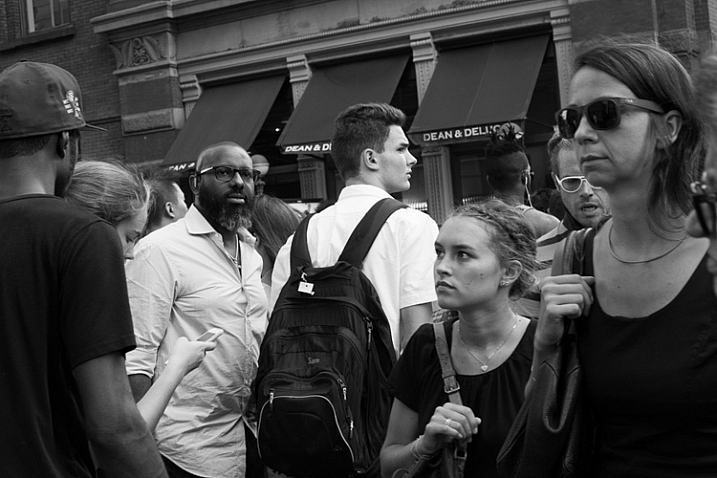
Street Corner, SoHo, NYC.

Street Corner, SoHo, NYC.

Street photography is the art of capturing life, culture, and humanity, in a candid manner. It is fascinating because a small percentage of photographers seem to be naturally drawn to it. Even before hearing about the phrase street photography, which can be a clunky term anyway, there are many photographers who prefer to point their cameras in the direction of culture and people that they’ve never met before, over mountains, sunsets, and landscapes.

However, if you haven’t done it before, street photography can be very intimidating to actually pull off. It’s one thing to admire it from afar, but it’s another to get in there and get your hands dirty. I promise though, that it’s a ton of fun and is a very rewarding art form to practice.

Here is list of my favorite tips to get you off and running.

1. Just do it

Construction Workers, Lower East Side, NYC.

Construction Workers, Lower East Side, NYC.

You can have all the tips in the world to get started. I can explain all of the techniques that I have learned from others and found so helpful over the years, and I will cover them here, but nothing beats pure, unbridled enjoyment and enthusiasm. No matter how much you learn, nothing beats the experience gained by being out there.

Street photography is one of the most difficult forms of photography, because it is so unplanned. A world of content is out there for you, and it is your job to go find it. You must develop your own visual language, to be able to see interesting moments, then to figure out how to capture them all in a quick, spontaneous instant. This takes regular practice. I’ve been doing street photography for nearly 15 years, and any time I take a month off (usually in the depressing February winter in New York), I feel very rusty when I grab the camera again.

Put in the hours, experience trumps everything. Enjoy the feeling of being out there, because it’s necessary to love it, to be able to put in the time to be successful.

2. Technical skills

Here are a few of the technical skills that are most important for street photography. I try to have my camera set up in a way so that I almost forget it’s there. So, it’s just me, and what I am seeing, and the camera doesn’t get in the way.
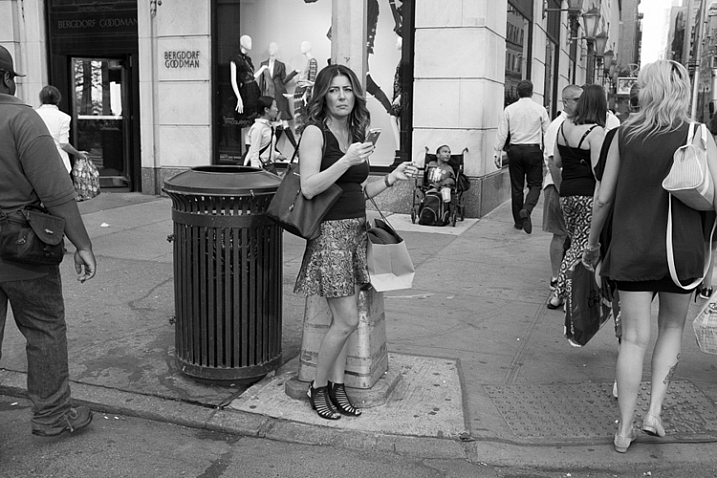
Bergdorf Goodman, 5th Avenue, NYC.

Bergdorf Goodman, 5th Avenue, NYC.

There are many different ways to set up your camera, but I prefer to shoot in Shutter Priority mode with a shutter speed around 1/250th of a second. That is a good minimum, to make sure you can freeze the motion of your subjects. In dimmer light, you can go to 1/160th and even 1/125th and still be okay. In strong sunlight you can go all the way up to 1/400th or 1/500th, but 1/250th is the number to keep in mind (as a good starting point).

Raise your ISO. There is no reason to go below ISO 400 for street photography, and I suggest staying between ISO 800 and 3200 when you’re not in bright sunlight. The reason is because, if you want to shoot at 1/250th, and you also want to use as small an aperture as possible, then something has to give, and that is the ISO.

You might be asking why it’s good to use a small aperture for street photography. That’s a creative choice of course, and sometimes the light is so low that you must shoot with as wide an aperture as possible. There are street photographers that prefer the look of a shallow depth of field for all their work. However, there are a few reasons why I believe a small aperture, and a lot of DOF is preferable. Because of the spontaneity, you never know where your subject is going to be, or if you are going to have multiple subjects at different depths. In addition, if you happen to miss the focus a bit, your subject will still be sharp if you are using a larger DOF. Finally, context is important. You are capturing culture, and surroundings are a part of the story. Do you really want to blur the surroundings away? The environment is a major part of street photography.
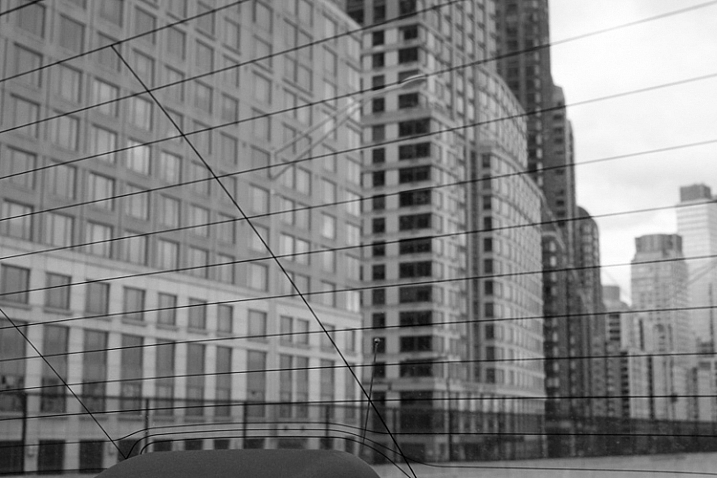
Greene Street, SoHo, NYC.

Greene Street, SoHo, NYC.

While a prime lens is not necessary, it can be very important for street photography, for a few reasons. First of all, zoom lenses are heavy and large. A small, light prime makes your camera a pleasure to carry around, and it looks much less imposing to your subjects. In addition, it can be a big advantage to get used to using a single focal length. You will start to learn how your camera sees, in a faster, and more intuitive way. I can’t overstate the previous sentence. When I wrote about forgetting that the camera is there, a prime lens is very important for this.

I prefer to use wide-angle primes, with 35mm and 50mm being my favorite. I like the wide-angle view because it will make you get closer to your subjects. In addition, the viewpoint will allow your foreground subjects to be more prominent and larger in the frame, while still being able to fit in more of the background, since it will be proportionally smaller. It’s a great look. If you are using a cropped camera, remember that a 35mm lens might not actually be a true 35mm view because of the crop factor, so try one that is the equivalent of a 35mm view.

3. Take photos for yourself

It is certainly important to see other people’s viewpoints and to pay attention to the images that they like, but I want you to focus on photographing for yourself. Capture an image that you love, first and foremost, and don’t worry if other people don’t get it. Street photography is still a niche genre, compared to other photography forms such as landscape, and because of that there are a lot of people that aren’t used to it.

Take weird images, take personal images, take ugly images, and take risks with what you capture. Be creative and have a good time. The more your images become a reflection of your voice and what you like, the better your work will be.
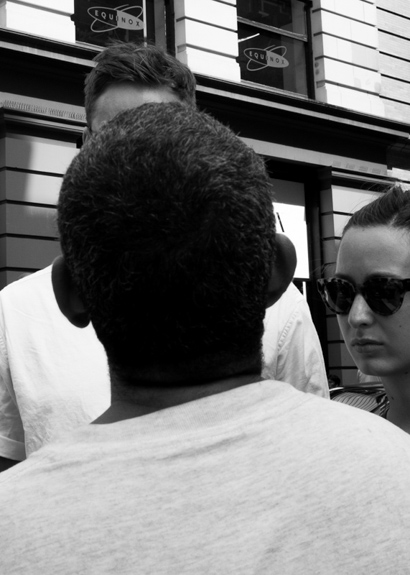
Panhandler, Broadway, NYC.

Panhandler, Broadway, NYC.


4. Shoot in a variety of locations and show us your area

A busy street corner in New York is usually the first place that comes to mind when people think about street photography, as it should be. New York has such a diversity of content, and that’s the reason why it’s one of the great meccas for street photography, but it is also only a very small part of the entire street photography world.

Street photography can, and should, be done anywhere. It can be done indoors, in coffee shops, at events, along country roads, or in small towns – you name it. Street photography is about culture and life. It is an idea, and a feeling. It doesn’t even need to have people in the images, just the hint of people.

The more you are able to capture images in the course of your daily life, the better you will become at it. Your images will be more personal and unique. For this reason, I suggest considering eventually trying a smaller camera, such as a Fuji X100T, a micro 4/3rds or mirrorless camera, or even a mobile phone camera, for the times where you don’t feel like bringing your large SLR. These cameras make it fun to capture images on a daily basis. You might bring one of these smaller cameras on a trip to the corner store, whereas a larger SLR would be more cumbersome for that situations.

5. Pick a location and wait there

Canal Street, NYC.

Canal Street, NYC.

It can be intimidating to photograph people candidly. I still feel pretty intimidated, depending on the situation. To offset this, one of my favorite techniques is to pick a location, and just hang out there for awhile. Find a spot where you think an interesting moment could happen, and then wait for it to unfold.

By waiting and not walking, you will spend more time looking around and watching, as opposed to moving. Then, when that moment happens, you will already be in position, and ready with your camera to capture it. Also, your subjects will be entering your space, instead of you encroaching on their space. If you are walking down a street and see someone that you want to photograph, it’s much tougher to get in their space, and still take a good candid photograph. By stopping and letting them come to you, not only will you be ready with your camera, but you can make it look like you are just photographing the surrounding area and they happened to enter your scene.

Go back to the same locations, over and over again at different times, and in different light. The more you get used to a location, the more you can anticipate what will happen there, and the more comfortable you will become photographing in the area. Also, people will start to get used to you being there.

Of course you should still walk around, but I prefer to break up long walks, with periods of waiting in good locations.

6. My favorite trick
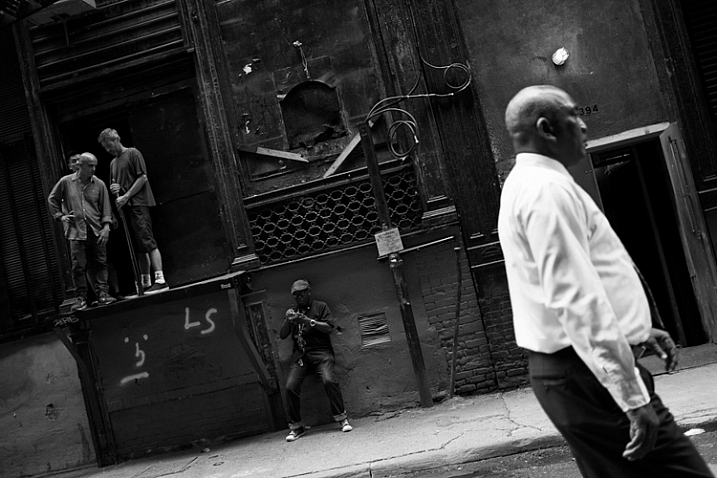
Cortlandt Alley, NYC.

Cortlandt Alley, NYC.

A natural reaction after you take a photo is to immediately take your camera away from your eye briefly. Take a picture and see. This is the number one thing that will tip someone off that you’ve taken their photograph. We don’t want to be too sneaky and creepy, but we also don’t want every person we’ve photographed to know, and stop us to figure out what we’re doing. That’s just tedious.

Whenever I capture an image of someone, I try not to remove the camera from my eye. I leave it there as they walk through the scene, as if I was trying to photograph the background and they got in the way. If you watch other photographers do this, you will see that sometimes the subjects will first think, “Hey did that person take my photo”, they will look back, and when they see the photographer with the camera still at their eye they will likely keep going, thinking that they were just in the way.

The flip side to this is when you are in an empty area, instead of a busy one. It is tougher to do this trick when there are only a couple people around, so what I will do in these situations is to aim up above, or to the side of the person, like I am photographing a building or a nice background. I will pretend to take an image or two, and then at the last second I will move the camera so that they are in the scene, in the right composition. I will quickly take the picture and remove the camera from my eye. When done right, it looks like you photographed the area above or next to them.

7. Don’t be too creepy
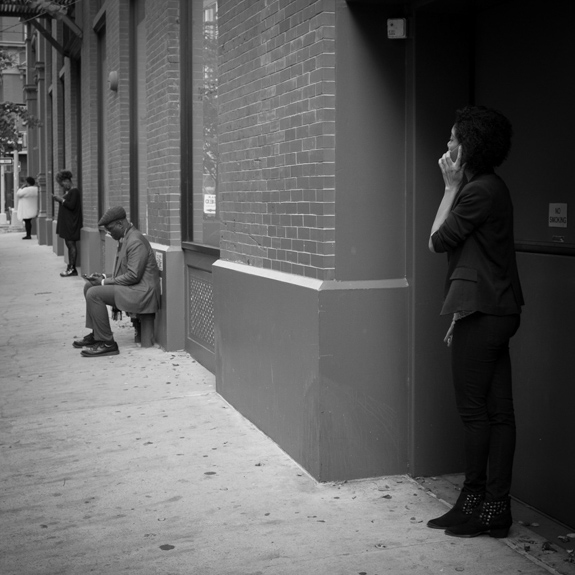
Cellphones, Nolita, NYC.

Cellphones, Nolita, NYC.

When I teach people street photography for the first time, there are inevitably those who will take five or six, or even twelve photos of one person. If you see a scene improving while you are photographing it, of course you should continue to capture the scene, but taking five or six candid photos of a person can get down right uncomfortable.

What we are doing, in my opinion, is a good thing. We are capturing and immortalizing culture and people. We do this because we like people, and unfortunately even when done as respectfully as possible, it is still a little bit creepy. We just have to accept that this is a worthy endeavor that offsets the slight creep factor. However, when you go to full on creep, it just gets uncomfortable for everyone. You don’t need to capture seven photos of a person. You don’t need to point your camera at a person for 30 seconds straight, while still pretending that you are not photographing them. If you want to do that, go up to them and ask for a portrait instead.

Take an image or two, then stop and reassess. If you see the scene developing further, put your camera down for a second. Act like you’re looking around for a way to capture the background, or pretend to play with your camera, and let the scene develop. Then, take another picture or two as it does. Just try not to point your camera at one person for too long.

8. Smile and carry a business card
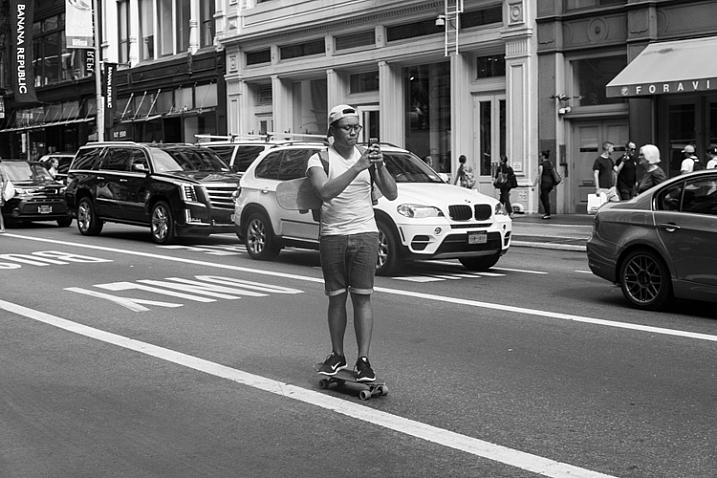
Skateboarder, Broadway, NYC.

Skateboarder, Broadway, NYC.

The more confident you act, the less people will notice you and care. If you look at master street photographers who have done this for a long time, many of them look almost invisible out there. This is not because they are necessarily sneakier, it’s because they carry themselves like they belong. They seem comfortable. When people see someone comfortably photographing in an area, they instinctively think that person belongs there. When they see someone who looks uncomfortable, like they are sneaking around, they will instinctively think they are are up to no good.

Whenever someone stops me and asks if I took their photo, I smile, say yes, and tell them that I’m a photographer doing a cultural project capturing daily life, and I thought they looked fabulous and had to capture them as part of the project (flattery goes a long way). I tell them I didn’t mean to make them uncomfortable, but it was just how I had to go about capturing the images. I carry cards to show them that I am a legitimate photographer and tell them to email me and I will send them the photo. After this, if they still seem very uncomfortable, I will offer to delete it. I’ve only ever had to delete two photos after a couple people asked me nicely. I’ve never had a bad interaction.

Of course, that doesn’t mean that others haven’t. Some photographers have certainly had bad interactions. You should make sure to pick the people that you photograph wisely, perhaps staying away from capturing someone that looks like they had a terrible day, or someone that looks angry or disturbed. Those are the situations where you are more apt to get yourself in trouble. Street smarts are important.

9. Capture images without people
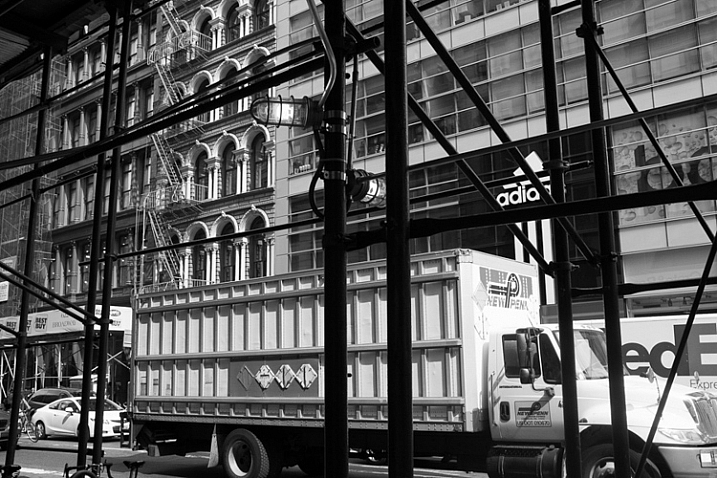
Scaffolding, Broadway, NYC.

Scaffolding, Broadway, NYC.

Usually the first thing that comes to mind when street photography is mentioned, is an image of an interesting looking person, walking down the street. That is a part of street photography, but there is so much more to it.

Capture environmental images in ways that still have the feeling of a traditional street photograph. Show culture and people in ways other than just capturing them directly. Figure out how to show stories, capture ideas, and foster feeling and mood in an image. Photograph in locations where others may not think to take pictures.

10. Capture expressions

One of the skills that all the great photographers have is their ability to capture expressions. This applies as much to street photographers, as it does to portrait ones. Look to capture people’s emotions. Do they look happy, sad, pensive, or angry? I always try to look at my subject’s eyes, and wait for them to give a look that exposes something going on in their head. Usually that look doesn’t come, but when it does, I’m ready for it. This is one of the most difficult things to both notice and capture, and it comes with experience. Try hard to notice it.
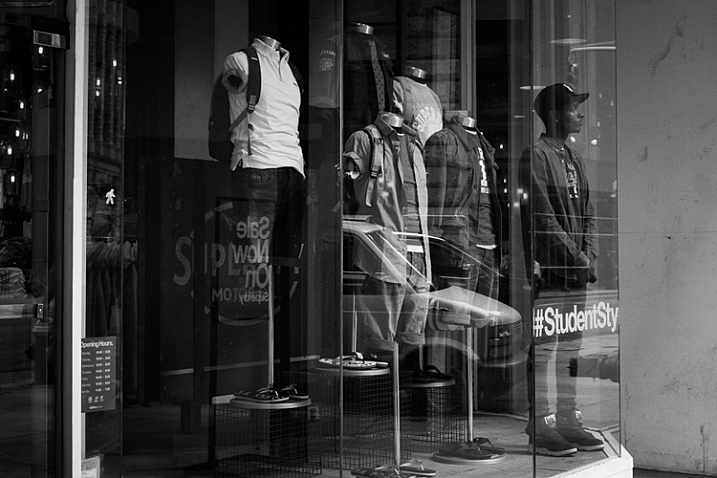
Student, Broadway, NYC.

Student, Broadway, NYC.

11. Edit and sequence your photos

Editing is just as important for your success as a photographer, as going out and shooting. Download and learn Lightroom, and learn to organize your photos well. I mark my best photos with three and five stars, to choose the decent and best photos from the day. Spend a lot of time reviewing, and narrowing down your photos, to the best of the best.

Start grouping your photos together. Learn which images work together, and figure out the reasons why. What are you trying to say and show? Can a sequence of your images create an interesting narrative? Use collections in Lightroom to group images together, without actually moving their location on the computer. Over time, you will start to identify themes, and ideas in your work, and it will help you figure out which images are your best. It will also help you know where you need to improve.

You will find that doing this will quickly help you improve when you are out shooting. The more time you spend organizing and thinking about your work, the more in-tune you will be to notice images that fit in, when you are out shooting. This is a way to help develop your voice in your photography.

12. Look at the work of other photographers

Spend a lot of time exploring the work of other photographers. This will both train your eye, and give you inspiration. It will quickly become a humbling experience. As a photographer, you don’t need to reinvent the wheel. So much has been done before, by photographers who spent decades doing it. What you need to figure out, is how to give your images a personal and modern take.

Look at both modern photographers, and go through lists of the old masters. Look at work done on busy street corners, and in quiet towns. Take it all in, then figure out what you relate to most, and build on that in your work.

13. Perfection is overrated
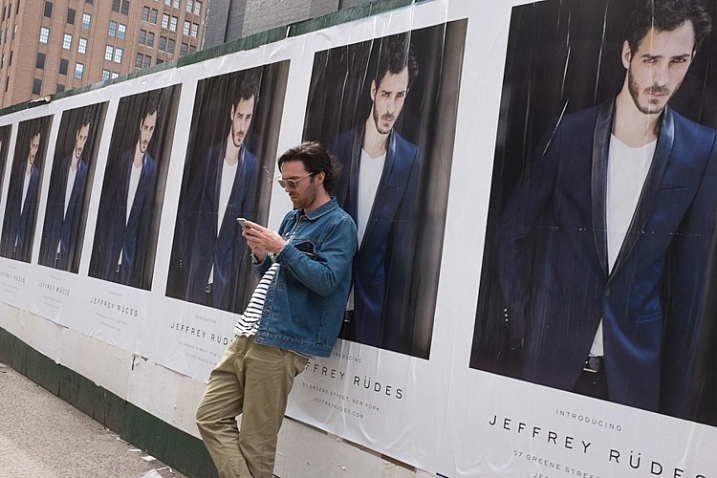
Greene Street, SoHo, NYC.

Greene Street, SoHo, NYC.

As a photographer, you need to become technically proficient with the camera. You need to learn to take sharp photos, that are well composed. You need to learn to see the light well. It is absolutely necessary for your growth. This is similar to a painter learning the fundamentals, before eventually gaining their voice, and going off in their own direction.

Once you have done this, is when you start to see that perfection in an image can sometimes be overrated. Your images don’t all have to be perfectly sharp, or perfectly composed. Sometimes a technical mistake will ruin a photo, but other times it may make it. Each image is completely different, and will work for completely different reasons. It is obvious when an image is ruined technically because a photographer didn’t know what they were doing, whereas it is different when it is just due to the situation presented to the photographer. If you take a look at the work of Garry Winogrand, so many of his images were slightly off-kilter. These days photographers might have decided to straightened them up a bit in Lightroom, but when you look at Winogrand’s work all together, that slight off-kilter look adds a sense of realness and spontaneity, and actually improves many of the images. The lack of perfection seems to make them better.

Have fun. Think of street photography like jazz and go a little off-kilter. Improvise and experiment. Just figure out how to find and capture, interesting and intimate moments.

googletag.cmd.push(function() {
tablet_slots.push( googletag.defineSlot( “/1005424/_dPSv4_tab-all-article-bottom_(300×250)”, [300, 250], “pb-ad-78623” ).addService( googletag.pubads() ) ); } );

googletag.cmd.push(function() {
mobile_slots.push( googletag.defineSlot( “/1005424/_dPSv4_mob-all-article-bottom_(300×250)”, [300, 250], “pb-ad-78158” ).addService( googletag.pubads() ) ); } );

The post An Introduction to Street Photography for New Photographers by James Maher appeared first on Digital Photography School.


Digital Photography School

 
Comments Off on An Introduction to Street Photography for New Photographers

Posted in Photography