RSS
 

Archive for September, 2015

Countdown to PIX 2015: Aaron Huey and his son Hawkeye

25 Sep

With PIX 2015 right around the corner, we’re taking the opportunity to introduce you to some of our inspiring re:FRAME speakers. Aaron Huey is a National Geographic photographer whose favorite gig is playing photo assistant to his talented 5-year-old son, Hawkeye Huey. Read more

Articles: Digital Photography Review (dpreview.com)

 
Comments Off on Countdown to PIX 2015: Aaron Huey and his son Hawkeye

Posted in Uncategorized


27 Hot Images that Incorporate the Color Red

25 Sep

Fall in the northern hemisphere can be very colorful and bright. Red is everywhere, look around you. Using this color in composition can be tricky. Here are 27 images that do it successfully:

Shadi Samawi

By Shadi Samawi

Moyan Brenn

By Moyan Brenn

Smilla4

By smilla4

Riccardo Cuppini

By Riccardo Cuppini

Richard Clark (Digimist)

By Richard Clark (Digimist)

Darwin Bell

By darwin Bell

ELKayPics

By eLKayPics

Oli4.D

By Oli4.D

SantaRosa OLD SKOOL

By SantaRosa OLD SKOOL

Darwin Bell

By darwin Bell

Lenchensmama.

By lenchensmama.

Darwin Bell

By darwin Bell

Photophilde

By photophilde

Sonny Abesamis

By Sonny Abesamis

Susanne Nilsson

By Susanne Nilsson

S Vivek

By S Vivek

Darwin Bell

By darwin Bell

K2D2vaca

By K2D2vaca

Karol Franks

By Karol Franks

Ed Suominen

By Ed Suominen

Thomas Hawk

By Thomas Hawk

Bruce Irschick

By Bruce Irschick

Katmary

By katmary

Rob.

By Rob.

Lulu Lovering

By Lulu Lovering

Ziva

By Ziva & Amir

Peter Roome

By Peter Roome

googletag.cmd.push(function() {
tablet_slots.push( googletag.defineSlot( “/1005424/_dPSv4_tab-all-article-bottom_(300×250)”, [300, 250], “pb-ad-78623” ).addService( googletag.pubads() ) ); } );

googletag.cmd.push(function() {
mobile_slots.push( googletag.defineSlot( “/1005424/_dPSv4_mob-all-article-bottom_(300×250)”, [300, 250], “pb-ad-78158” ).addService( googletag.pubads() ) ); } );

The post 27 Hot Images that Incorporate the Color Red by Darlene Hildebrandt appeared first on Digital Photography School.


Digital Photography School

 
Comments Off on 27 Hot Images that Incorporate the Color Red

Posted in Photography


Start Making Photographs to Become a Better Photographer

25 Sep

If you are an avid reader of this site, most likely you are a photography enthusiast wanting to learn more and advance your craft. If you really care about doing so, it is time to stop taking snapshots and start making photographs to become a better photographer.

Taking versus making can be a question of semantics; that’s why I prefer to call it snapshot versus photograph. But beyond semantics, in my humble opinion, you graduate as a photographer the moment you start making photos instead of taking them, regardless of the results. But wait, regardless of the results? Well, not really. Of course, you want great photos. What I mean by that is that you’ll progress in your craft the moment you start thinking about your photos, your vision, and how to reflect it with your image. The results could be bad or good, but you are thinking as a photographer. When you start thinking as a photographer, the results will come, sooner or later.

New Orleans Skyline

So what’s the difference? Taking a photo is the result of an impulsive reaction; you just press the shutter because you are there and you shoot it. Taking a photo is just snapping what you see. Instead, making a photograph is a process. When you make a photo, you are creating something from your vision. You are constructing it, and you are putting what comes from you in it.

The process of making a photo can take different periods of time. For some, it is a longer, thoughtful process, and for others it is a just a moment. For a National Geographic photographer, making a photo can take months; there is a lot of planning, research and being there just to get the right image that makes the cover of the magazine. For a street photographer, making a photo is totally different; they only have a split second to get it right without the luxury of setting up. But, there are other things they can control, like location, time of the day for best light, and so on.

I am telling you that you graduate as a photographer when you start making photographs because, for most us, enjoying the creative process is what makes us different from the rest. It does not matter if you are an enthusiast, serious amateur, or pro – we all enjoy it. Sure, learning how to expose, compose and post-process is important, but it’s something you can learn with enough practice and attention. That’s the technical aspect of photography, and when you master the basics, there will be always something new learn. But besides that, it comes with the freedom to stop thinking about aperture/depth of field and ISO/noise, and focus more on the photos you want to create.

Making a photograph will also help you to cut the clutter. When I first started to go on travel photography trips, I used to come back home with thousands of photos that were taken in just a span of a couple of days. That made the selection process a daunting task. First, who really wants to see thousands of photos? Second, is there any meaning in them? When you take the time to plan a more thoughtful photograph, you cut the clutter because often you’ll shoot less, but come out with better content.

Happy woman in Taung Tho Market Inle Lake

Last, I want to leave you with a couple of examples, starting with the opening picture of this article. I was going to be in New Orleans only for a long weekend and one the things I wanted to photograph was the skyline of the city. So, I started my research ahead of time to find the best spot to do it. I only had three nights in the city and as I wanted to shoot during the blue hour, I really didn’t have the chance of messing it up. Once I knew where I was going to make my photo from, it was all a matter of arriving there in time to set up and wait for the right moment. So besides finding the location and arriving early to set up, I also had the right tools with me to make it happen. I knew I wanted to include the Crescent Connection Bridge, so I brought a wide angle lens. I knew that it was going to be a long exposure, not only because of the time, but also because I wanted a smooth reflection over the Mississippi River, so I also brought a tripod and a neutral density filter to make a long exposure.

Sometimes making a photo also means finding an interesting subject, and trying to learn more from them by staying for a while, instead of grabbing a shot and moving. I found this amazing woman for this photo (above) from the Taung Tho Market of Inle Lake in Myanmar. I sat there taking pictures of her for a while, and I remember she pretended I was not there until I told my guide to tell her that she was beautiful. Her reaction was priceless and that made the photo.

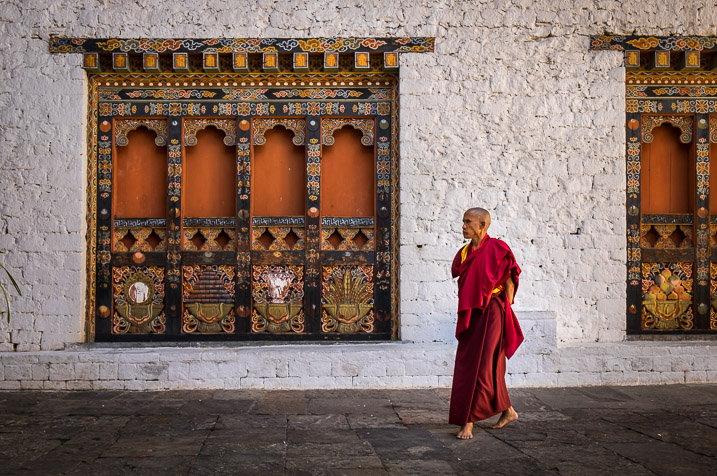
Monk in the Punakha Dzong

Other times, making a photo means waiting for something interesting to happen if you are in the right place. For the Bhutanese monk above, I found myself on a big patio surrounded by typical and colorful windows that I wanted to photograph, while I was visiting one of the many monasteries. But I needed something else besides the windows. Because I had seen them earlier, I knew that another monk would walk across my frame sooner or later, so I carefully composed my photo and waited until this one walked by.

There you have it. As you can see, there are different meanings and ways to create photos, and not just take them. But the most important thing is for you to understand that you can be a better photographer by making photos instead of just taking them. Plan and enjoy the process, and results will follow. By the way, if you are already making photos, why don’t you share one with us in the comments below with a short caption on how you made it and why.

googletag.cmd.push(function() {
tablet_slots.push( googletag.defineSlot( “/1005424/_dPSv4_tab-all-article-bottom_(300×250)”, [300, 250], “pb-ad-78623” ).addService( googletag.pubads() ) ); } );

googletag.cmd.push(function() {
mobile_slots.push( googletag.defineSlot( “/1005424/_dPSv4_mob-all-article-bottom_(300×250)”, [300, 250], “pb-ad-78158” ).addService( googletag.pubads() ) ); } );

The post Start Making Photographs to Become a Better Photographer by Daniel Korzeniewski appeared first on Digital Photography School.


Digital Photography School

 
Comments Off on Start Making Photographs to Become a Better Photographer

Posted in Photography


Phottix launches Laso Transmitter and Receiver for Canon flashes

25 Sep

Phottix has launched its Laso Flash Trigger System today for the Canon RT Wireless radio flash system and the camera maker’s non-radio E-TTL flashes. The Laso Transmitter can be used with up to 15 radio flashes in five groups, while the Laso receiver enables the setup to be used with non-radio E-TTL flashes. Read more

Articles: Digital Photography Review (dpreview.com)

 
Comments Off on Phottix launches Laso Transmitter and Receiver for Canon flashes

Posted in Uncategorized


Raus aus dem Kreatief! Teil 3

25 Sep

Abstrakte Landschaft aus Gelb und Violett.

Im Juli haben wir die Aktion „Raus aus dem Kreatief“ gestartet, die Euch Anregungen gibt, fotografisch neue Ansätze zu entdecken, die eigenen Arbeiten zu reflektieren und mit Techniken im Spannungsfeld zwischen Zufall und Selbsterkenntnis den eigenen Stil zu verfeinern – oder auch umzuwerfen und neu anzusetzen.
kwerfeldein – Fotografie Magazin | Fotocommunity

 
Comments Off on Raus aus dem Kreatief! Teil 3

Posted in Equipment


Adobe updates Elements applications with haze and shake removal, enhanced editing guidance

25 Sep

Adobe has announced updates to its Photoshop Elements and Premiere Elements imaging applications that introduce some new features and a number of improvements. A de-haze filter, similar in effect to that used in Photoshop CC and Lightroom, helps to cut through atmospheric misting in Photoshop Elements 14, while Premiere Elements gains the ability to work with 4K footage. Read more

Articles: Digital Photography Review (dpreview.com)

 
Comments Off on Adobe updates Elements applications with haze and shake removal, enhanced editing guidance

Posted in Uncategorized


Tone Tunnels: Huge Forest Megaphones Amplify Sounds of Nature

25 Sep

[ By WebUrbanist in Art & Installation & Sound. ]

tone tunnel art installatoin

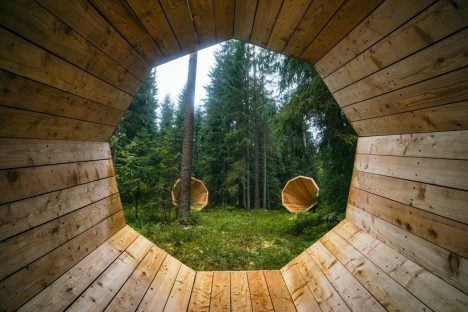
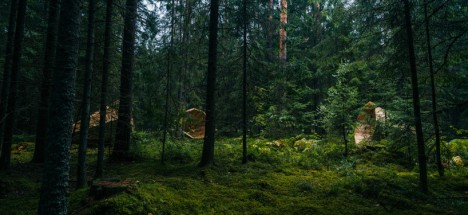
Large enough for visitors to enter and sit within, three gigantic wooden megaphones constructed in the forests of Estonia amplify ambient sounds of the environment.

forest huge megaphone

forest stage hiker

Nearly ten feet in diameter each, huge cones render quiet sounds of rustling leaves and birds chirping remarkably audible.

forest wood projection sounds

forest megaphone design

The Tõnu Tunnel installation was conceived of by interior architecture and design students from the Estonian Academy of Arts and implemented with advice from B210 Architects

forest sound project

forest megaphones

Thanks to their size and shape, the megaphones double as seating and shelter as well with space enough for a few hikers to spend the night.

forest musician

Each space can also be used in reverse as well by musical or other (small groups of) stage performers wishing to project sounds outward, or can double as seating for shows in the round.

forest wood construction project

student construction project

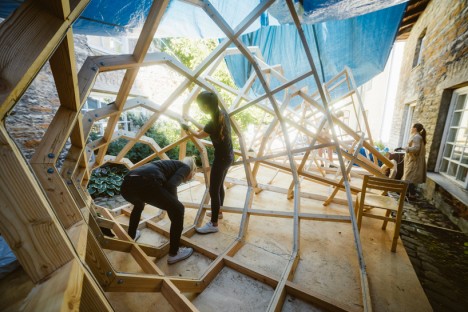
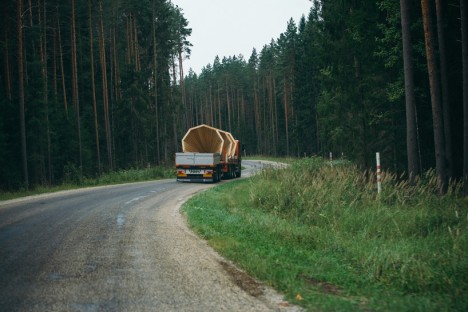
Construction of the megaphones was financed by RMK and the interior architecture department of the EAA. Each was built offsite and carefully transported into place.

truck students construction project

forest student construction

According to Valdur Mikita, a writer and semiotician involved in the project, “The trademark of Estonia is both the abundance of sounds in our forest as well as the silence there. In the megaphones, thoughts can be heard. It is a place for browsing the ‘book of nature,’ for listening to and reading the forest through sound.” 

Share on Facebook


[ By WebUrbanist in Art & Installation & Sound. ]

[ WebUrbanist | Archives | Galleries | Privacy | TOS ]


WebUrbanist

 
Comments Off on Tone Tunnels: Huge Forest Megaphones Amplify Sounds of Nature

Posted in Creativity


Ricoh announces 24-70mm F2.8 for upcoming full-frame Pentax DSLR

25 Sep

We’re still waiting for the much-teased full-frame DSLR, but Ricoh has today announced another full-frame zoom lens – the HD PENTAX-D FA 24-70mm F2.8 ED SDM WR, which features a weatherproof design and bright, constant maximum aperture. Read more

Articles: Digital Photography Review (dpreview.com)

 
Comments Off on Ricoh announces 24-70mm F2.8 for upcoming full-frame Pentax DSLR

Posted in Uncategorized


Droneport: New UAV Hub to Ship Medical Supplies Across Rwanda

25 Sep

[ By WebUrbanist in Architecture & Public & Institutional. ]

drone airport emergency medical

This architect-designed drone airport will be the first of its kind, created to facilitate an unmanned aerial vehicle supply chain servicing remote areas of Africa, addressing urgent medical and other ongoing needs. Just as much of the continent skipped landlines and went straight to mobile phones, this strategy could jump steps in the development of infrastructure for delivering for physical goods.

drone airport vaulted brick

Developed by Afrotech in collaboration with Foster + Partners, work is set to begin next year with a pilot program completed by 2020. The vaulted brick structure will have spaces for drone building and repair as well as packaging, shipping and storage of goods both medical and otherwise. The architecture is intentionally open, simple and able to be constructed with local materials and labor.

drone airport side view

Two systems will function simultaneously to provide emergency and ongoing supplies, respectively. The Redline will include small situation-specific drones that can serve targeted emergency needs, carrying over 20 pounds. Larger 200-pound-capacity Blueline drones will manage more sizable shipments of less urgent supplies.

drone airport rwanda

“The Droneport offers a new typology for a building which we hope will grow into a ubiquitous presence, much like petrol stations have become dispersed infrastructure for road traffic,” acting as a network of stopping, refueling and repair stations.

drone alternative shipping routes

Currently, only a small percentage of the African population lives within a mile of year-round accessible roads, while UAVs from the Droneport will be able to more quickly, easily, safely and reliably access nearly half of Rwanda’s citizens.

drone airport commerce

“We require immediate bold, radical solutions to address this issue. The Droneport project is about doing ‘more with less’, capitalising on the recent advancements in drone technology – something that is usually associated with war and hostilities – to make an immediate life-saving impact in Africa.”

drone airport hillside

“It is inevitable on a crowded planet, with limited resources, that we will make more intensive use of our sky using flying robots to move goods faster, cheaper, and more accurately than ever before. But it is not inevitable that these craft or their landing sites will be engineered to be tough and cheap enough to serve poorer communities who can make most use of them. Droneport is an attempt to make that happen, and to improve health and economic outcomes in Africa – and beyond.”

Share on Facebook


[ By WebUrbanist in Architecture & Public & Institutional. ]

[ WebUrbanist | Archives | Galleries | Privacy | TOS ]


WebUrbanist

 
Comments Off on Droneport: New UAV Hub to Ship Medical Supplies Across Rwanda

Posted in Creativity


A Brief Introduction to Lightroom

25 Sep
A Brief Introduction to Lightroom

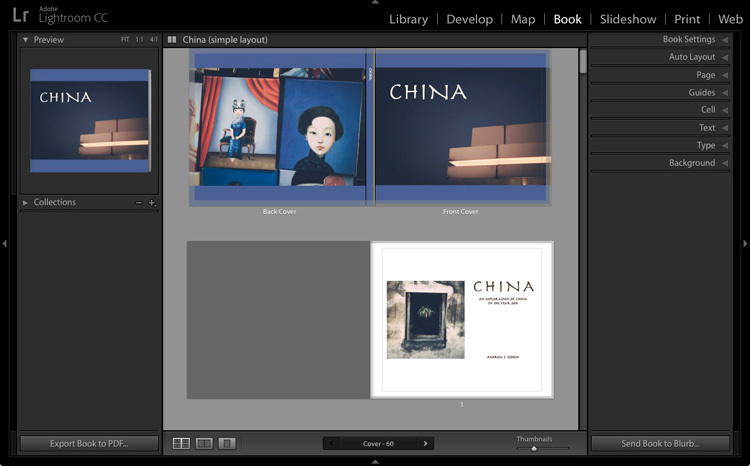
Lightroom’s Book module lets you create photo books to publish using Blurb’s print on demand printing service.

Since the first version was released over eight years ago, Lightroom has become the go-to software for many photographers, both hobbyist and professional. But if you’re new to Lightroom you may be wondering exactly what it does, what you would use it for, and how it differs from other well known programs like Photoshop.

What is Lightroom?

Lightroom is part Raw converter, part photo processor (yes, you can edit JPEG and TIFF files in Lightroom too), and part photo organizer. The latter task is often referred to as digital asset management (or DAM for short).

The key thing to understand about Lightroom is that it is a workflow application. It is designed to take care of your photos from the moment you copy them from your camera’s memory card, to your computer’s hard drive. Once in Lightroom you can process photos, add them to a map to show where they were taken, create a photo book or slide show, print them or export them to other programs for further processing.

This is why Lightroom is so useful, and so popular. It becomes the centre of your workflow, and while it is powerful enough to be used independently, it also integrates seamlessly with programs like Photoshop. You can use Lightroom by itself, or in partnership with other programs.
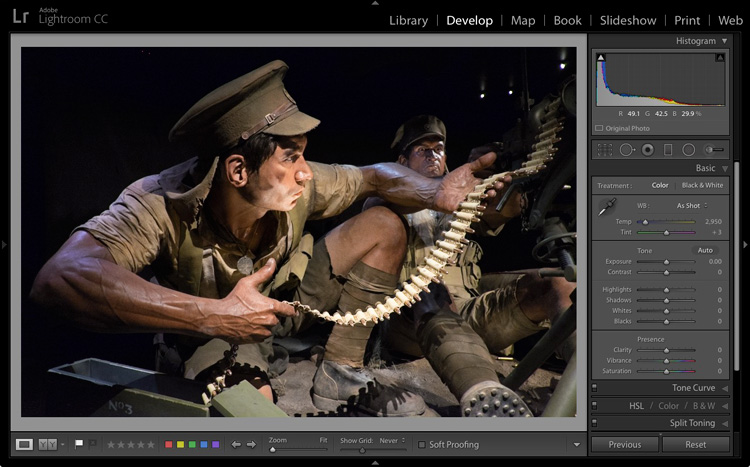
A Brief Introduction to Lightroom

The Lightroom Develop module. This is where you process your JPEG, TIFF or Raw files.

The Lightroom Catalog

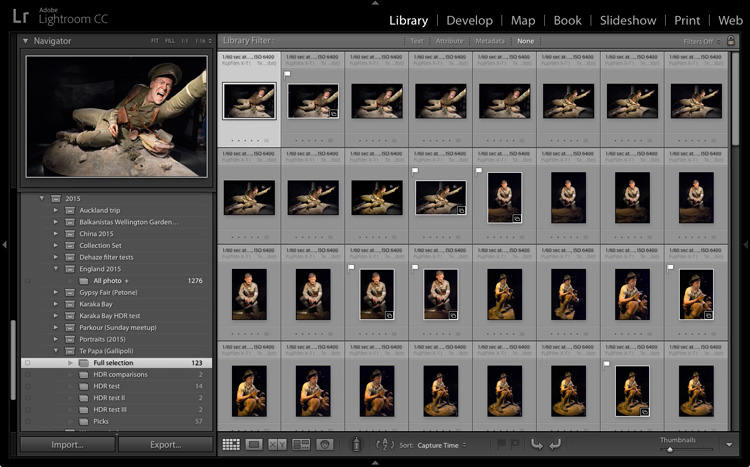
At the heart of Lightroom is the Catalog – a database that contains a preview of every photo that you have imported into the program, a record of each photo’s metadata (including processing) plus the location where it is stored on your hard drive.

It is important to note that the Catalog doesn’t contain the photos themselves, just information about them. Your photo files are always saved on a hard drive, even if you use Lightroom CC (Creative Cloud).
A Brief Introduction to Lightroom

The Lightroom Library module. This is where you view, organize, and search photos. It is the heart of Lightroom and arguably its most important module.

The database advantage

Because Lightroom is a database, it gives you several advantages over programs like Photoshop.

1. It saves you hard drive space

Lots of it. When you process a Raw file in Lightroom, the edits you make are saved in the Lightroom Catalog as a series of text commands which take up very little space.

When you process a Raw file in Photoshop, you have to convert it to a 16 bit TIFF or PSD file first (yes, you can use JPEG instead but the other formats give better image quality). TIFF and PSD (and even JPEG) files take up much more space than the text commands in the Lightroom Catalog do.

The end result is that, over time, you save hundreds of gigabytes of storage space, making it much easier to manage your growing photo collection.

Note that this benefit is diminished if you are in the habit of exporting photos to Photoshop or plug-ins for processing. That shouldn’t stop you from using those applications (although it is good practice to see if you can do something in Lightroom first) nor should it put you off using Lightroom.

2. Lightroom lets you see all your photos in one place

Provided you import all your photos into a single Catalog (it is possible to have multiple Catalogs in Lightroom but this is for advanced users only) you can view any of your photos using Lightroom’s Library module.

3. Lightroom lets you search your photos

Lightroom is a database, which is designed to collect, organize and search information.

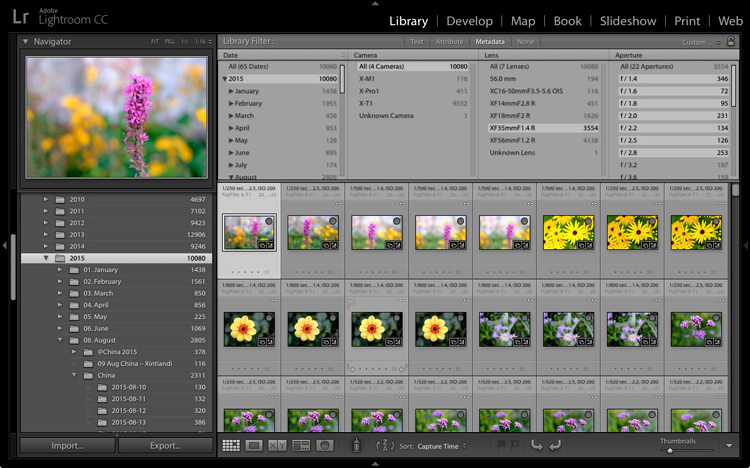
Would you like to find all your photos taken with a particular camera or lens? That’s easy in Lightroom. How about all portraits taken with the aperture set to f/2.8? That takes a little more work as it relies on accurate keywording, but it’s entirely possible. Or what about all photos of a specific person taken in 2012? Easy with the face detection tool in Lightroom 6 and Lightroom CC.
A brief introduction to Lightroom

In this example I used Lightroom’s Library module to find all photos taken in 2015 with my Fujinon 35mm lens at an aperture of f/2.8 or greater.

4. Lightroom lets your organize your photos how you want

The problem with storing images in folders is that you can only save a photo in one location. Let’s say you took some photos of a friend called Sarah, in London, in July 2015 (maybe you were at Wimbledon). When you copy those files to your hard drive, you can only save them in one folder (which may be called Sarah, or London, or something entirely different).

Lightroom Collections

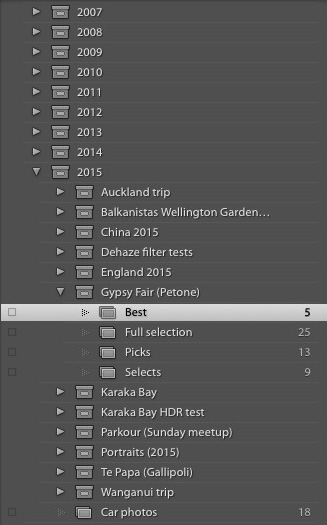
One of Lightroom’s key features is Collections. A Collection is like a virtual folder. You can call a Collection whatever you want, add as many photos as you like, and add photos to as many Collections as you need.

Using the above example, once you have imported your photos of Sarah into the Lightroom Catalog, you can add them to multiple Collections. For example, you may have one Collection that contains all your photos of Sarah, another with all your photos of London, and another with all the photos taken in July 2015.

It’s a simplified example, but the advantages of Collections become more apparent the more you use them. In short, they give you the flexibility to organize your images in a way that suits you.
A brief introduction to Lightroom

This is how I organize my photos using Collections. There is a separate Collection Set for each year. Each of those contains Collection Sets and Collections organizing photos by topic.

Lightroom versus Photoshop

Does that mean you should use Lightroom exclusively and forget about programs like Photoshop? Not at all. There are plenty of things that you can do in Photoshop (not to mention all the other plug-ins and editing programs that you can buy) that you can’t in Lightroom.

Many photographers use the two in conjunction. This is encouraged by Adobe with its Creative Photography Plan, which includes both Photoshop and Lightroom, along with Lightroom mobile and Lightroom web.

If you are new to Lightroom your first task is to import some photos into it so you can work on them. I’ll show you how to do that in my next article.

If you were unsure about what Lightroom is and what photographers use it for, then I hope this article has helped. Do you have any questions? Please ask in the comments and I’ll do my best to help.


The Mastering Lightroom CollectionMastering Lightroom ebooks
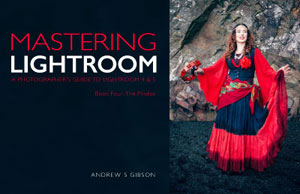
My Mastering Lightroom ebooks will help you get the most out of Lightroom. They cover every aspect of the software from the Library module through to creating beautiful images in the Develop module. Click the link to learn more or buy.

googletag.cmd.push(function() {
tablet_slots.push( googletag.defineSlot( “/1005424/_dPSv4_tab-all-article-bottom_(300×250)”, [300, 250], “pb-ad-78623” ).addService( googletag.pubads() ) ); } );

googletag.cmd.push(function() {
mobile_slots.push( googletag.defineSlot( “/1005424/_dPSv4_mob-all-article-bottom_(300×250)”, [300, 250], “pb-ad-78158” ).addService( googletag.pubads() ) ); } );

The post A Brief Introduction to Lightroom by Andrew S. Gibson appeared first on Digital Photography School.


Digital Photography School

 
Comments Off on A Brief Introduction to Lightroom

Posted in Photography