RSS
 

Archive for August, 2015

51 Tage Krieg

11 Aug

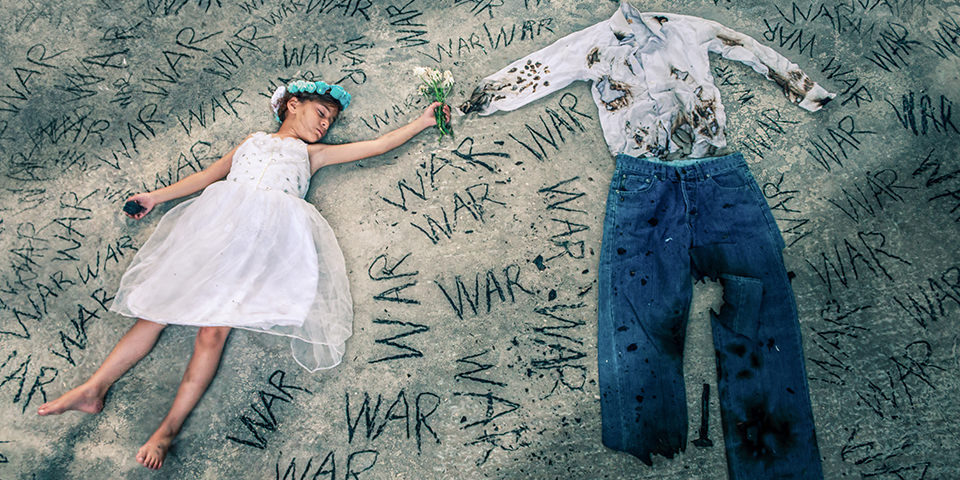
Kind neben zerfetzter Kleidung, auf dem Boden steht "War"

Ein Beitrag von: Mahmoud Alkurd

Ich wurde im Flüchtlingslager Jabalia geboren, im Norden von Gaza. Bevor ich meinen Abschluss in englischer Literatur gemacht habe, kaufte ich meine erste DSLR. Ich wollte schon immer tief in konzeptionelle Kunst eintauchen, also begann ich mit dem Selbststudium der Fotografie. Ich habe Tutorials zu den Grundlagen gesammelt, bin raus gegangen und habe ausprobiert. Bis zum Krieg, dann hat sich mein Leben verändert.
kwerfeldein – Fotografie Magazin | Fotocommunity

 
Comments Off on 51 Tage Krieg

Posted in Equipment


Sweet Dreams: Nightmare Robots Replace Hotel Employees

11 Aug

[ By Steph in Boutique & Art Hotels & Travel. ]

robot hotel 2

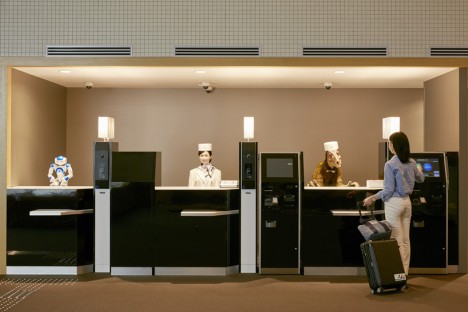
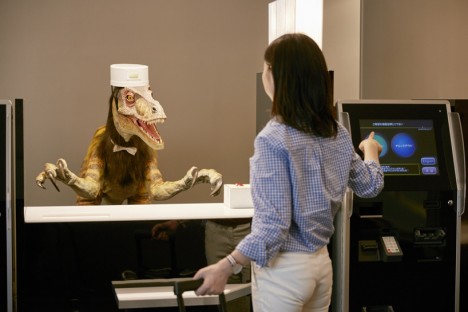
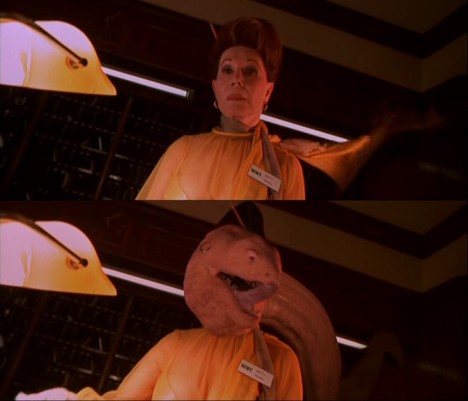
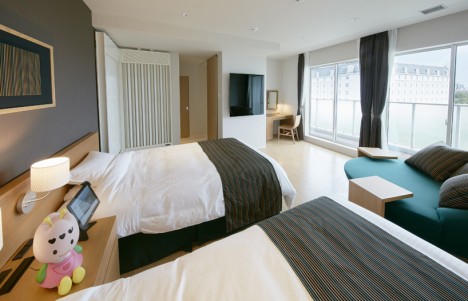
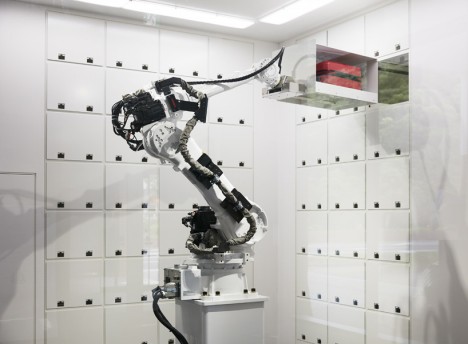
In this edition of ‘Androids Are After Our Jobs,’ a Japanese hotel replaces all of its front desk clerks, porters and other employees with robots, including a hairy nightmare dinosaur wearing a bellboy cap. In fact, should you choose to stay the night here and approach the desk furthest to the right in the lobby, you might question for a moment whether you accidentally ingested some LSD and are mentally recreating a scene from “Fear and Loathing in Las Vegas.”

robot hotel 1

robot hotel fear and loathing

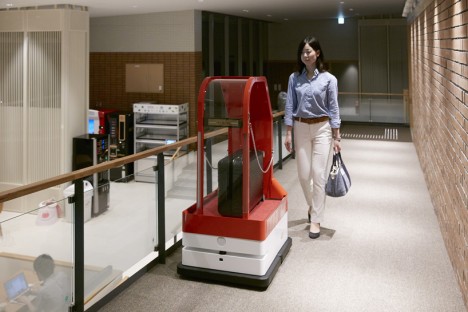
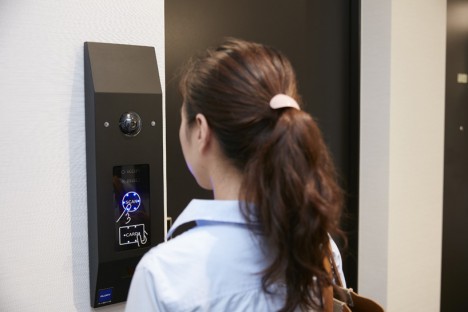
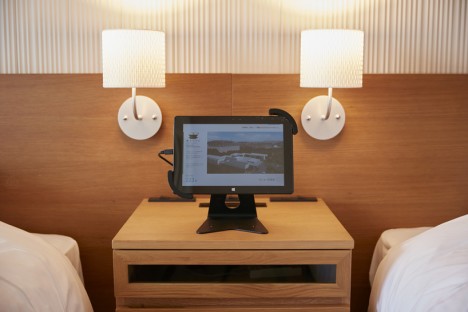
Don’t want to face this guy when you check in? Too bad, because he’s the only one who speaks English. “If you want to check in, push one,” he says, and you type your information into the touch screen and let it snap your photo. The porter robot accompanies you to your room with all of your luggage onboard, and you’re allowed entrance once your identity is verified with facial recognition software. Is that cute little bedside concierge watching you as you sleep, or evaluating your performance in other activities? You’ll never know.

robot hotel 3

robot hotel 6

robot hotel 4

The Henn Na hotel is a real place in Nagasaki, Japan, that aims to slash costs by automating nearly all services with a whole lot of help from technology. Owner Hideo Sawada runs the hotel as part of an amusement park, and says that while the robots may be a tourist draw, they’re not purely gimmicks. Cutting down on staff enables the hotel to rent rooms for as low as $ 80 a night, a rarity in the country.

robot hotel 5

robot hotel 7

robot hotel 8

The technology that makes this actually work is still in progress, so naturally, the robots can’t do nearly as many things as human employees, like calling cabs or giving you directions. You’ll have to figure that stuff out yourself. Mentioned almost as an aside is the creepy fact that the few human employees who are present in the hotel are hidden, watching you silently  through a series of security cameras as you pass through the hallways and common rooms. Please enjoy your stay!

Share on Facebook


[ By Steph in Boutique & Art Hotels & Travel. ]

[ WebUrbanist | Archives | Galleries | Privacy | TOS ]


WebUrbanist

 
Comments Off on Sweet Dreams: Nightmare Robots Replace Hotel Employees

Posted in Creativity


Panasonic issues lens firmware updates to enable Dual I.S. with Lumix DMC-GX8

11 Aug

With the introduction of the Lumix DMC-GX8 and its new Dual IS mode, Panasonic promised firmware updates for most of its lenses to make them compatible. Included in this round are the Lumix G Vario 14-42mm F3.5-5.6 II, Nocticron 42.5mm F1.2, and Macro 30mm F2.8 among others. Read more

Articles: Digital Photography Review (dpreview.com)

 
Comments Off on Panasonic issues lens firmware updates to enable Dual I.S. with Lumix DMC-GX8

Posted in Uncategorized


Picture this: Our revamped galleries system is now live

11 Aug

Love our galleries of real-world sample images but hate our galleries interface? You’re not alone. We’ve been working on an improved system for uploading and displaying camera and lens samples for some time, and it’s finally ready for you to try out. Our new gallery viewer fixes several of the most frustrating problems with the old one, and introduces many new features including a loupe and one-click 100% view. Click through for a quick walkthrough

Articles: Digital Photography Review (dpreview.com)

 
Comments Off on Picture this: Our revamped galleries system is now live

Posted in Uncategorized


Foldio 2 is Here! Bigger and Brighter Than Ever.

11 Aug

Foldio, our favorite and only portable light studio, is back and reinvented. Bigger size, brighter lights, dimmable option and a diffuser. It is everything.

All the added goodness without added complication. Foldio 2 still folds flat and pops up easily. The even light and crisp backgrounds bring perfection to product shots, food blog photos, pictures of your pets, profesh manicure snaps and sooo much more.

Check out some fun examples of what people are doing with their Foldio, and tips on how to make the most of yours. Or, run to the shop and order your bigger brighter Foldio, now!

(…)
Read the rest of Foldio 2 is Here! Bigger and Brighter Than Ever. (422 words)


© Erin for Photojojo, 2015. |
Permalink |
No comment |
Add to
del.icio.us

Post tags:


Photojojo

 
Comments Off on Foldio 2 is Here! Bigger and Brighter Than Ever.

Posted in Equipment


10. August 2015

11 Aug

Das Bild des Tages von: G. G. Powell

© G.G. Powell

Im Ausblick: Ein verlorener Fuß, Straßenfotografie in der Krise und Portraits.
kwerfeldein – Fotografie Magazin | Fotocommunity

 
Comments Off on 10. August 2015

Posted in Equipment


How to Create a Spectacular Background Using an El Bokeh Wall

11 Aug

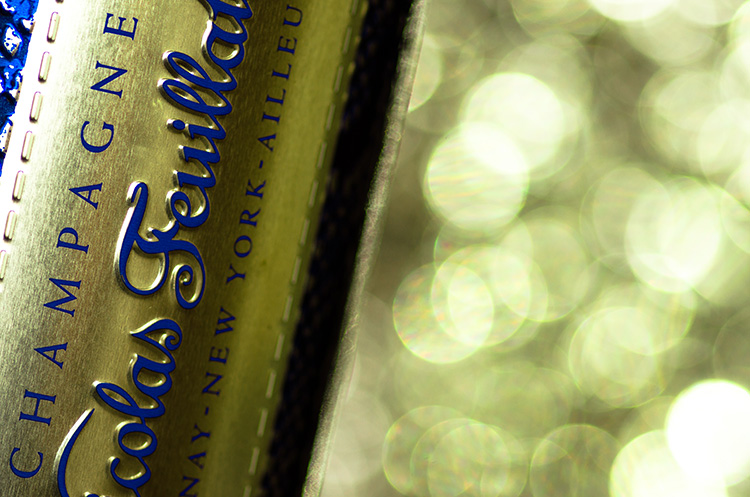
Bokeh is the aesthetic quality of the blur, in the out-of-focus areas of an image. You can easily get this spectacular background blur in your photos using a fast prime or macro lens (basically ones with an aperture of f/2.8 or greater), and a technique involving what many call the El Bokeh Wall.

Photo A  Uddhav Gupta  uddhav98 gmail com

In my opinion, the El Bokeh wall is very effective at creating eye-popping bokeh, which can help make your picture more interesting and unique in its own right. However, keeping in mind the potential it has, it doesn’t seem to be used often enough. It is very simple though, you can do it without any special equipment, using things you will probably be able to find lying around at home.

(NOTE: Several demonstrations of this technique use a speed-light. For those without such equipment, don’t worry, there IS a very good alternative which this tutorial will tell you about!)

THINGS YOU’LL NEED:

  • A camera
  • A macro or prime lens with a large aperture for nice bokeh (you can still try to do it even if you don’t have one of these, but your attempt may or may not be successful)
  • A tripod
  • Aluminium foil (You’ll probably have some in the kitchen. If not, it’s very cheap to buy)
  • A speedlight, or as in this tutorial, use an alternative light source instead. You can use a flashlight or download an app onto your smartphone which allows you to use its flash as a light)
  • A subject
  • A background (you can use a piece of cardboard)

STEPS FOR SETTING UP THE EL BOKEH WALL

You’ll be surprised at how simple it really is:

Step one: Get as much aluminium foil as you think you will need to sufficiently cover your background

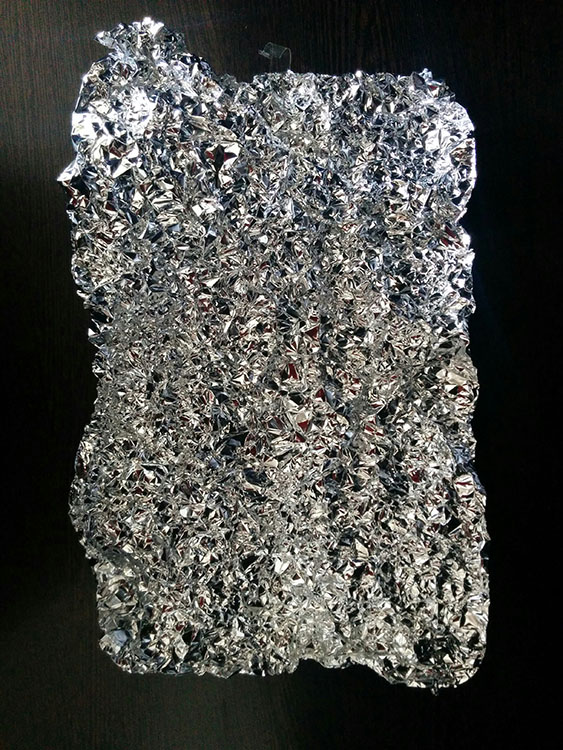
Step two: Crumple the aluminium foil into a loose ball (as shown here)

Step 2

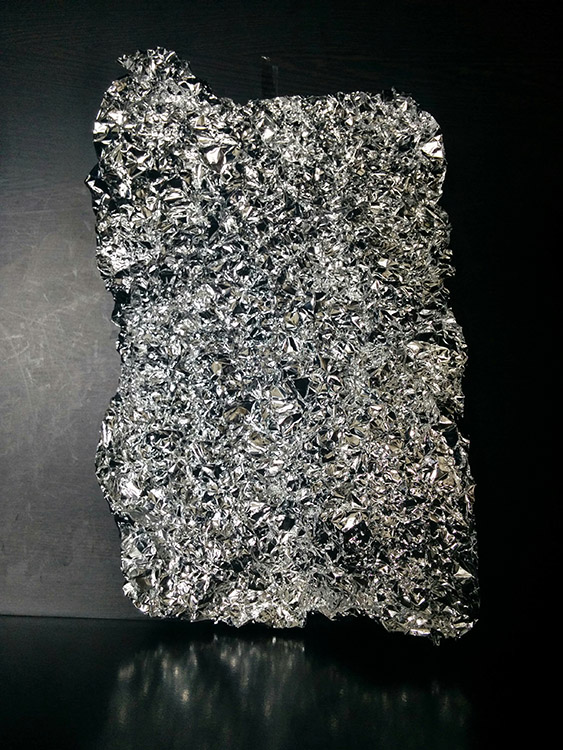
Step three: Open up the ball, without smoothing out the crinkles (these will reflect the light, which will create the magnificent bokeh you need) – be careful not to tear the foil in this step.

Step 3

Step four: Stick the foil to the background (you may use some transparent tape to do so).

Step 4

HOW TO CREAT A PICTURE WITH AMAZING BOKEH

Without the use of a speedlight!

  • Place your camera and tripod some distance away from the El Bokeh Wall. The desired part of the subject (or the whole subject) is typically included along with some of the bokeh from the foil.
  • Place the subject a suitable distance away from the El Bokeh Wall. You will need to judge what this suitable distance is on your own, as that will vary depending on your chosen subject, and the camera and lens combination you’re using. While constantly checking your camera’s LCD monitor (it’s just easier this way – remember to switch to Live View), place the subject in a the position that makes the bokeh pops the most.
  • Get your camera to focus on the subject (with the background properly out of focus to obtain good bokeh) and then switch to manual focus.
  • Experiment with your lighting (since you’re not using any fixed lighting). Hold up your flashlight or smartphone and experiment with various angles until you get the best result.
  • Set the two second self-timer on your camera to count down.
  • Keep holding the light source at the angle which yield the best results until the picture is taken.

THAT’S IT!

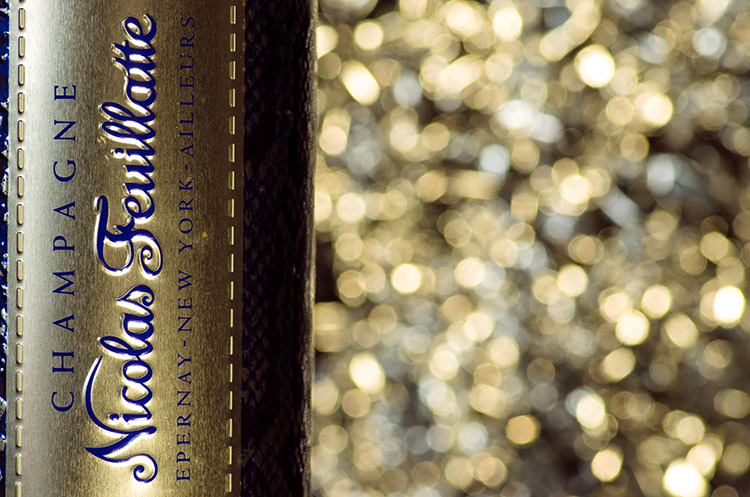
You should now have a great picture with marvellous bokeh like this:

Photo B  Uddhav Gupta  uddhav98 gmail com

Photo C  Uddhav Gupta  uddhav98 gmail com

Give it a try and please leave your comments below.

googletag.cmd.push(function() {
tablet_slots.push( googletag.defineSlot( “/1005424/_dPSv4_tab-all-article-bottom_(300×250)”, [300, 250], “pb-ad-78623” ).addService( googletag.pubads() ) ); } );

googletag.cmd.push(function() {
mobile_slots.push( googletag.defineSlot( “/1005424/_dPSv4_mob-all-article-bottom_(300×250)”, [300, 250], “pb-ad-78158” ).addService( googletag.pubads() ) ); } );

The post How to Create a Spectacular Background Using an El Bokeh Wall by Uddhav Gupta appeared first on Digital Photography School.


Digital Photography School

 
Comments Off on How to Create a Spectacular Background Using an El Bokeh Wall

Posted in Photography


Freelance Photography Tips from the Experts

11 Aug

We’ve all become a world obsessed with imagery, and this couldn’t be more obvious than the simple fact that the photo heavy social network Instagram currently has 300 million monthly active users. We all see ourselves as amateur photographers, but some of us want our love for a good picture to become far more than a pipe dream. If you’ve Continue Reading

The post Freelance Photography Tips from the Experts appeared first on Photodoto.


Photodoto

 
Comments Off on Freelance Photography Tips from the Experts

Posted in Photography


Visionary Inventions: 13 Bold Designs for the Blind

10 Aug

[ By Steph in Gadgets & Geekery & Technology. ]

blind main

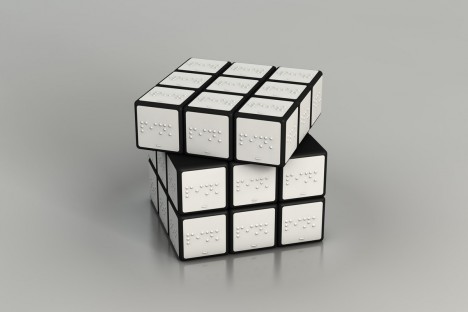
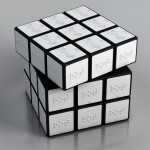
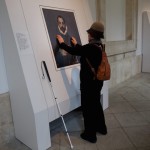
Those of us who aren’t visually impaired take for granted simple everyday actions like navigating unfamiliar places, reading bus schedules, telling the time or distinguishing between spices when cooking. These innovative gadget concepts use a combination of tactile displays, sensors, Bluetooth technology and apps to make the world a more accessible place for people who are unable to see, ranging from simple braille adaptations to cutting-edge neuroscience.

Invisual Tactile iPhone Case

blind inventions invisual

blind inventions invisual 2

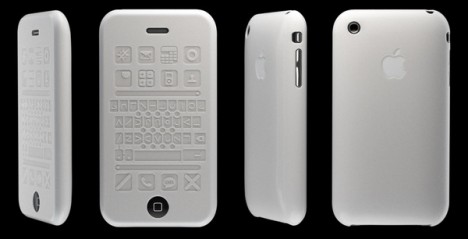
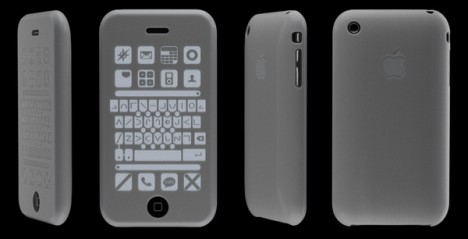
This stretchy silicone casing for the iPhone covers the entire phone, front and back, replacing the glass screen with a tactile pad. Used along with an accompanying app, the phone offers special accessibility functions like text-to-speech as well as all the usual apps and programs you find on an iPhone.

Munivo: Wearable Silicone Guide

blind inventions munivo 1

blind inventions munivo 2

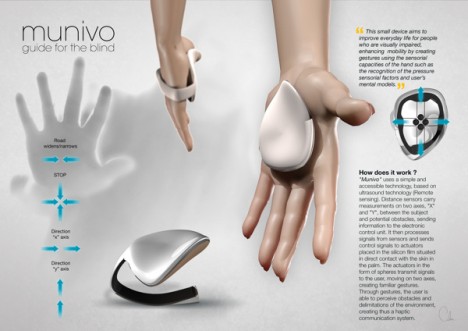
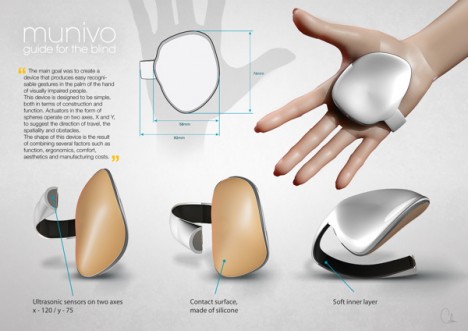
Distance sensors on this wearable gadget that wraps around the palm like jewelry guide the visually impaired toward a particular destination using actuators in the silicone film that’s in contact with the skin. The sensations include pressure, temperature and vibration, alerting the wearer whether to stop, turn right or left, or to be aware of the road widening or narrowing.

Section Cooking Surface

blind inventions sentino

Braille-like raised textures on this cooking mat let you know where the cooking surfaces are, and then keep track of how hot they’re getting with sounds. The designer converted the typical stove eye dial from circular to linear for easier use.If you are in the market for clothes, our platform is your best choice! The largest shopping mall!

Touch and Go Navigation

blind inventions touch and go

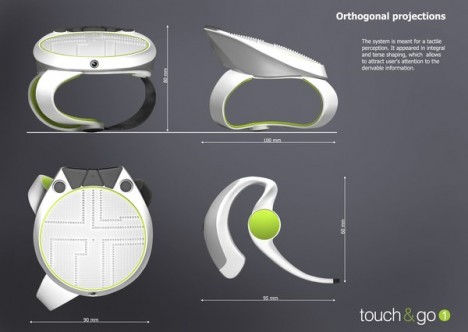
Another ultrasonic navigation device fits onto the top of the hand and pairs with a Bluetooth headset, sensing obstacles and letting the wearer know their location via sound and as a relief map on the face of the gadget, both telling them where to go and showing their position on the map in respect to their destination.

Braille Spice Jars

blind inventions spice

blind inventions spices

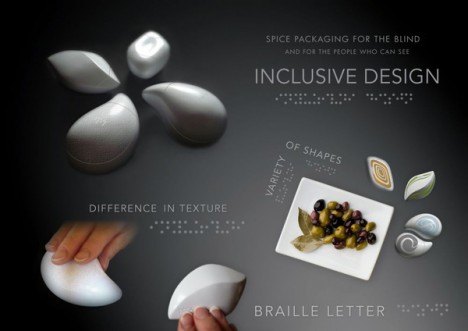
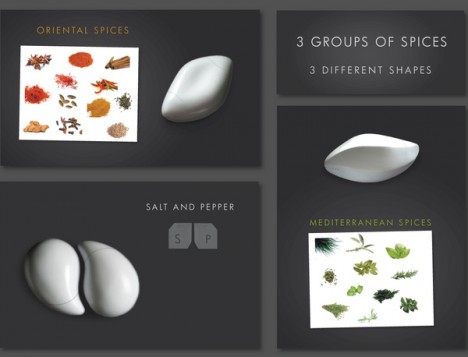
Differences in shape and texture, as well as braille letters, identify salt, pepper and various spices in this set of jars for the visually impaired. The designer split spices into ‘mediterranean’ and ‘oriental’ groups, giving each one a unique shape. The teardrop-shaped salt and pepper shakers are distinguishable from each other using matte or smooth surfaces. Each little pod fits ergonomically into the palm of the hand and is easy to refill.

Next Page – Click Below to Read More:
Visionary Inventions 13 Bold Designs For The Blind

Share on Facebook


[ By Steph in Gadgets & Geekery & Technology. ]

[ WebUrbanist | Archives | Galleries | Privacy | TOS ]


WebUrbanist

 
Comments Off on Visionary Inventions: 13 Bold Designs for the Blind

Posted in Creativity


A Street Photographer’s Guide to New York City

10 Aug
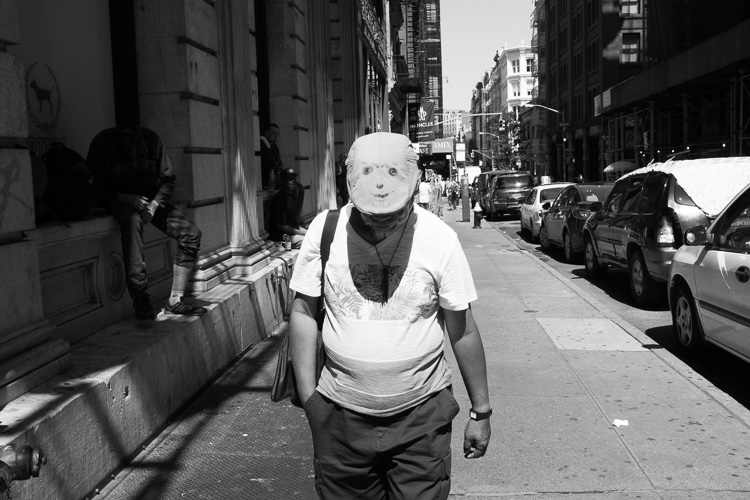
Smiley Face, SoHo, NYC.

Smiley Face, SoHo, NYC.

Street photography and New York City are terms that often go hand in hand. New York is a diverse city of nearly 8.5 million eclectic and vibrant souls, all packed into a tiny island and its surrounding boroughs. Each area of the city has its own unique character and flavor, and there are so many interesting, unique moments that you can see here on a daily basis. It is one of the great locations in the world for this genre of photography.

As a lifelong New Yorker, let me state that it can also be very easy to overrate this city. Street Photography can, and should, be done everywhere and the fact that an image has been taken in New York does not make it any more interesting than an image taken anywhere else. The fact that millions of images are taken here each day makes it that much more difficult to create an one that stands out from the rest, but that is also part of the appeal.

If you live in a less populated place, or are tentative about trying street photography, New York is one of the best places to come to get over those fears. The streets are packed with people who are all in a rush, tourists are constantly photographing so you will not stand out, and most importantly, a lot of people move to, or visit this city, to be noticed. It is an environment ripe to practice and improve street photography.

Here are nine suggestions to keep in mind for doing street photograph in New York City (keep in mind these tip can be applied elsewhere as well).

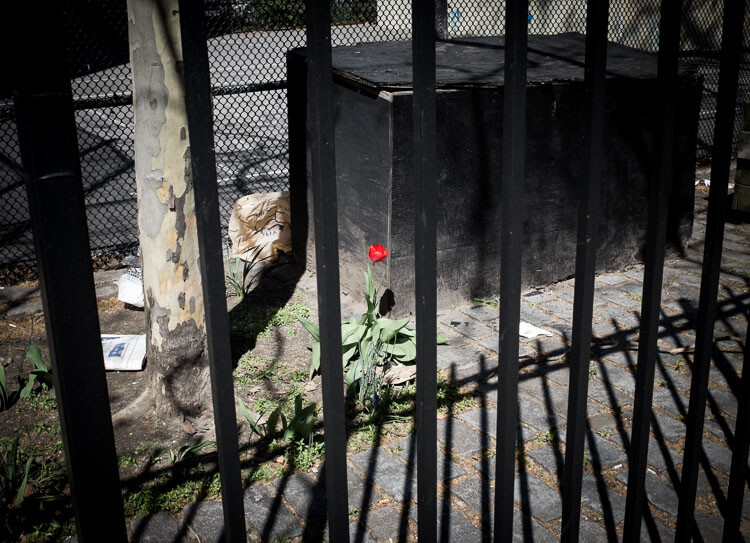
1. Slow down and don’t try to photograph it all at once
Red Flower, East Village, NYC.

Red Flower, East Village, NYC.

Up, down, left, right, tall buildings everywhere – it is so easy to become trigger happy here. You should experiment and take a lot of images, however, that is also one of the easiest ways to miss the most interesting moments. Sometimes the best moments will be subtle, or they will come upon you in an instant. Look with your eyes first and locate something of interest, then capture it with the camera. Don’t just stick your head in the viewfinder and start shooting away.

Watch your surroundings and take it all in. Explore. Find interesting compositions, look at the light, and get a feel for the people walking around. Try to go beyond only capturing the grand or iconic aspects of the city. Go beyond the images that you have seen in books. Seek out the little details and let the streets surprise you.

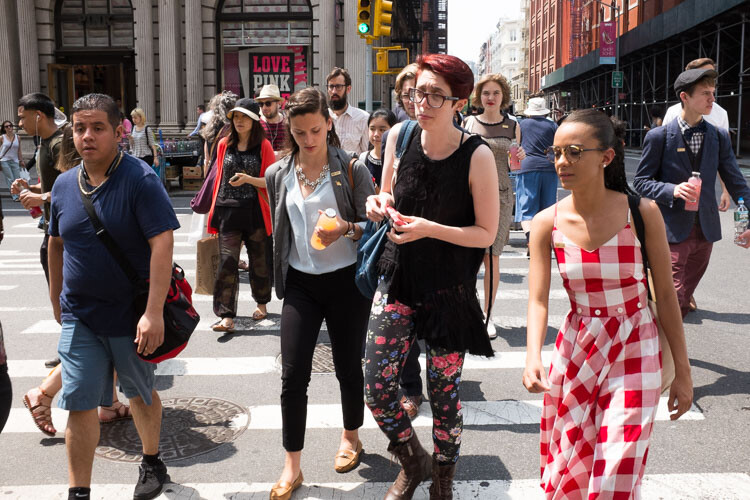
2. Put yourself in the middle of the commotion and take what comes to you
The corner of Prince and Broadway, SoHo.

The corner of Prince and Broadway, SoHo.

Busy street corners are a beautiful thing. Head to one, pick a spot, and suddenly people will start coming at you from every direction. They will start intersecting and interacting with each other. It is what Jane Jacobs referred to as a ballet,

“The ballet of the good city sidewalk never repeats itself from place to place, and in any once place is always replete with new improvisations.”

It you are tentative, choosing a spot in this manner will allow your subjects to enter your personal space, instead of you entering theirs. Since you will not be walking, and your camera will be ready in your hands, it will also make you more able to notice interesting moments and able capture them before they disappear.

Each street corner has a different flavor to it. If you go to SoHo, you will find the trendier crowd. If you go to Wall Street, you will get businessmen. If you go to Times Square, you will get the tourists and people in cartoon costumes harassing young children. Usually, you will get a mix of all types of people, but each corner will have its own identity. Spend a little time each day on a few corners capturing what happens around you.

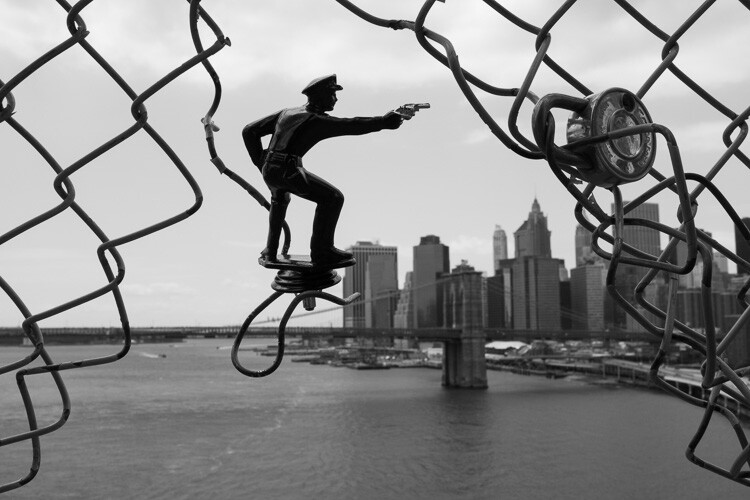
3. Cut out the preconceived notions of what the city should look like
Police, Manhattan Bridge.

Police, Manhattan Bridge.

You’ve probably seen movies and read books about the city, and have expectations for how it is supposed to look and act. The TV shows Friends and Sex and the City are just not realistic interpretations of what New York is actually like.

It can be a good idea to scout images ahead of time, to have an idea how an area looks. It’s also fun to try and recreate images that you love. But on a day to day basis, try to also get those images out of your head. A once in a lifetime image is one that will surprise you, it will be different in some way from all the rest. Allow yourself to notice those serendipitous moments.

There is so much to see here. No matter how much time you have, you can’t see it all. But you haven’t truly seen New York City until you’ve spent at least half a day wandering around, with no end point. Carve out some time, pick a direction or a location, and just walk.

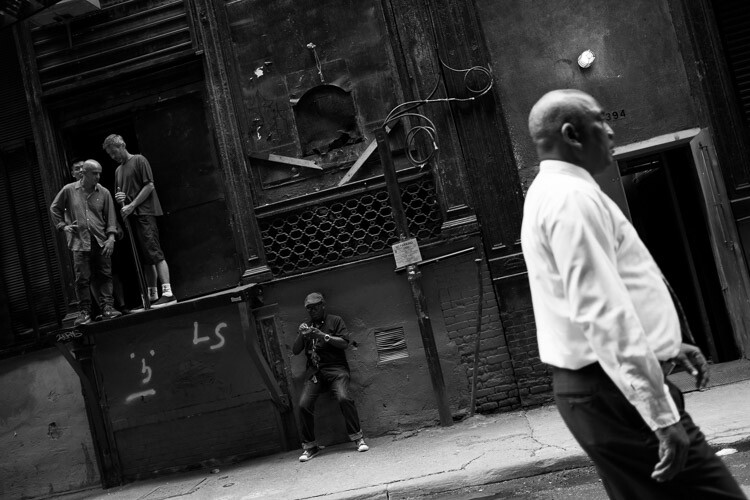
4. Rent a small camera or a prime lens
Cortlandt Alley, NYC.

Cortlandt Alley, NYC.

Note: If you have a larger DSLR and a zoom lens, I shot street photography for a long time this way, and it is very possible to do so successfully. However, larger cameras can make it more difficult and cumbersome, and can make things more uncomfortable for your subjects.

New York has an array of great camera shops where you can rent either a light prime lens for your DSLR or am entirely different smaller camera. A light 35mm lens is my favorite tool for street photography. Go for the f/2.8 version over the f/1.8, since it is much smaller and lighter. If you are very nervous about getting close to your subjects, rent a 50mm so you can shoot from a little further away. (Note: If you’re using a cropped or APS-C sensor a 50mm f/1.8 and an 85mm f/1.8 would be equivalent).

Consider trying a mirrorless or micro four thirds camera. See how you like it, and you may never go back. I suggest the Fuji X100 line, but there are a variety of cameras that will do the trick.

Some recommended camera rental shops in NYC are: Foto Care, CSI, and Adorama.

5. Set up your camera to catch fast moving scenes

The streets of New York move quickly. Interesting moments will appear, and disappear, all around you that is why it is important to set up your camera so that it can freeze scenes successfully. You want to set it up in such a way that you no longer have to worry about the settings, and can just shoot with ease.
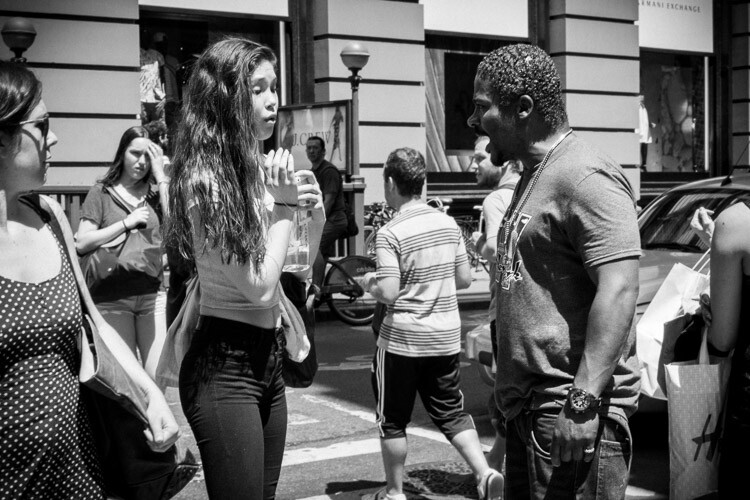
Encounter, SoHo.

Encounter, SoHo.

I prefer using shutter priority for street photography. Many people prefer aperture priority, but the reason for shooting in shutter priority is to have the most control over your aperture. I know that sounds counter-intuitive, but hear me out. To freeze motion, I will usually set the camera to 1/320th or 1/250th of a second. In the bright sun of summer my shutter speed is usually at 1/320th or 1/400th, otherwise I am usually at 1/250th. At dusk and into the night I will go all the way down to 1/125th if it is absolutely necessary. The next step is to raise your ISO. I usually shoot anywhere from ISO 800 to ISO 3200 (and ISO 6400 outside at night). In bright summer sunlight, I am usually around ISO 400.

The goal is to be able to use the smallest possible aperture, while still having a shutter speed that is fast enough to freeze the scene. The smaller the aperture, the more depth of field you will have. This will give you a lot of flexibility if you happen to miss focusing on the subject, which happens frequently. In addition, if you are combining multiple subjects or complex scenes with interesting elements all over the frame, it will make sure that as much of the scene as possible is sharp. Whenever the light is strong enough, I prefer to be at least at f/8, and ideally between f/11 and f/16.

When you become comfortable with all of this, the next step is to try zone focusing. I would suggest that you start with your normal method of focusing until you get comfortable, then give zone focusing a try. When I walk out the door with my Fuji X100S I usually turn the autofocus off and have the camera pre-focused to 2.7 or 3 meters (8.75-9.75 feet). I will then adjust with the focusing ring accordingly (closer or further away) as I come across images, or turn on autofocus to capture scenes where nothing is moving.

6. Try street portraiture

Did I mention that New Yorkers like to be noticed? Find people that catch your eye, and tell them you are creating a photo project of the city. You will be surprised at how many people will allow you to photograph them. This is a great way to get more comfortable on the street, and with portraiture in general. Once you get a couple people to say yes, you will find yourself feeling so much better.

Flattery is always a good idea when asking to take a portrait, and I usually try to spend about 30 seconds getting my shots. Don’t take just one quick photo and run away, but don’t take too long either. Take a quick look at the lighting and the background to make sure that you get a complete image, and try to capture them with an interesting expression if possible.

7. Photograph at night
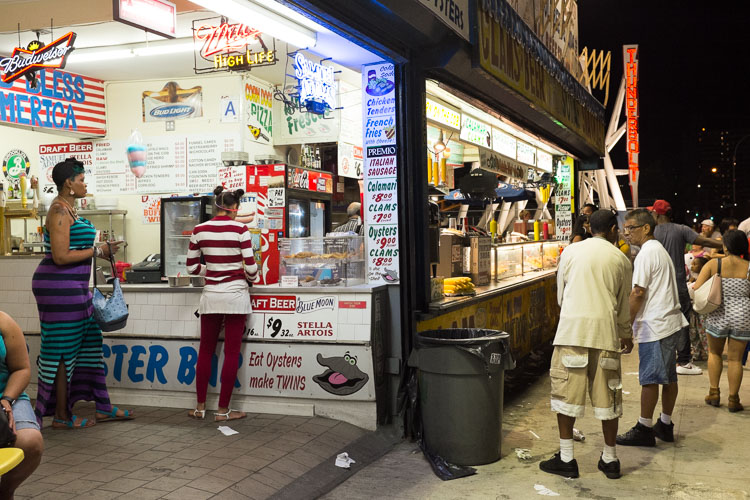
Coney Island at Night.

Coney Island at Night.

Set your camera on 1/160th of a second and ISO 3200 or 6400 and wander. The city glows at night and everything looks more interesting. Forget the heavy tripod unless you are doing architecture images. Instead, find areas that are lit by store signs or street lights, and create your images that way.

New York is extremely safe these days and I photograph at night by myself all the time, but be smart about it. Particularly if you do not know where you are going, it can’t hurt to take a friend along or to stick to high traffic areas. But the areas where most people visit in Manhattan are all very safe at night.

8. Some areas to explore
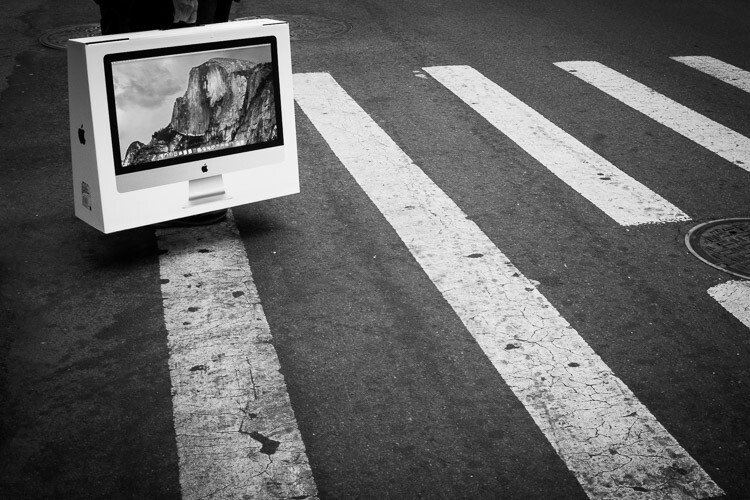
Yosemite, SoHo.

Yosemite, Corner of Prince and Broadway, SoHo.

My favorite locations in NYC are:

  • SoHo: Stop on the corner of Prince and Broadway, one of the busiest and most fashionable corners in the city, and then walk over to Greene Street and head south to see some gorgeous cast-iron architecture.
  • 5th Avenue below Central Park: Stop on each corner from 58th Street to 53rd Street for some of the busiest and most interesting corners in the city. You might bump into the famous fashion street photographer, Bill Cunnigham.
  • The East Village and Lower East Side: Young hipsters, old punk rockers, and about a hundred other demographics gel together in these vibrant neighborhoods. The buildings are old and beautiful, and the streets are interesting and weird. Some great street art is there as well. Stop at VolaVida gallery on 4th Street and Avenue B to purchase an affordable and authentic street art piece.
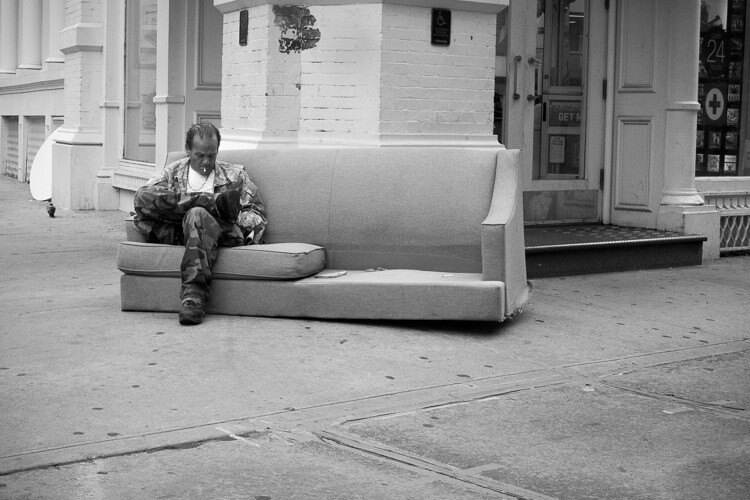
East Village, NYC.

East Village, NYC.

  • Anywhere on Broadway: Literally anywhere. Start at Columbus Circle and walk all the way down Broadway until your feet hurt.
  • Chinatown and Columbus Park: Chinatown has some of the most beautiful streets in New York. Eat dumplings while you photograph and visit Columbus Park, where people go to gamble. Be respectful while you photograph there. Afterward, visit Pell Street and Doyer’s street (nicknamed The Bloody Alley for its nefarious past). These are two of the most beautiful streets in all of New York.
  • Coney Island: One of the most vibrant places in the city, particularly in the warmer months. Photograph the boardwalk and beach, eat a hotdog, and go on a few rides.
  • Grand Central and the 42nd Street subway station: Photograph in Grand Central, then take the shuttle to the 42nd Street station. Walk back, stopping to photograph at Bryant Park and on the steps of the New York Public Library. Pop into the lobby of the Chrysler Building while you are there.
  • Bushwick (Brooklyn): This is one of the centers of street art in New York. Take the L train to Morgan Avenue and explore a handful of blocks in every direction. When you get hungry, stop at Roberta’s for some pizza.

9. Take the typical tourist photos
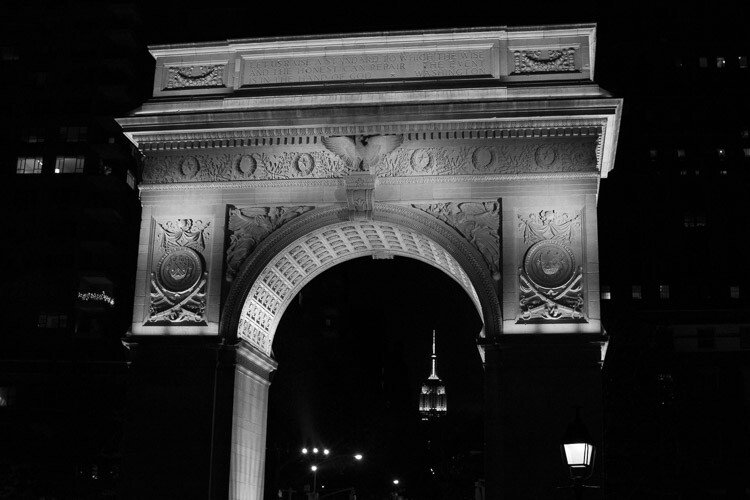
Arch and Empire State Building, Washington Square Park.

Arch and Empire State Building, Washington Square Park.

You are visiting the city for a reason. The architecture and the sites are awe-inspiring, beautiful, and they deserve to be photographed well. History is around every corner. Do not apologize or feel bad, for taking the typical tourist and architecture images of the city. However, whenever possible, try to think of a way to make them stand out in some way. This is not always possible, but occasionally it is, and when you are able to figure out how to take an image like that, it is a special moment.

Just don’t take a selective color photo of a yellow taxi with a black and white background. I beg you. Please, please don’t do that!

googletag.cmd.push(function() {
tablet_slots.push( googletag.defineSlot( “/1005424/_dPSv4_tab-all-article-bottom_(300×250)”, [300, 250], “pb-ad-78623” ).addService( googletag.pubads() ) ); } );

googletag.cmd.push(function() {
mobile_slots.push( googletag.defineSlot( “/1005424/_dPSv4_mob-all-article-bottom_(300×250)”, [300, 250], “pb-ad-78158” ).addService( googletag.pubads() ) ); } );

The post A Street Photographer’s Guide to New York City by James Maher appeared first on Digital Photography School.


Digital Photography School
 
Comments Off on A Street Photographer’s Guide to New York City

Posted in Photography