RSS
 

Archive for August, 2015

Show off: Sony Cyber-shot RX10 II slow-motion and 4K video samples

12 Aug

The Sony Cyber-shot RX10 II offers some impressive video capture capabilities including the option to record in 4K. And like the RX100 IV, the RX10 II can capture slow motion video at 240, 480 or 960fps, the latter of which gives the equivalent of 40x super slow motion. Read more

Articles: Digital Photography Review (dpreview.com)

 
Comments Off on Show off: Sony Cyber-shot RX10 II slow-motion and 4K video samples

Posted in Uncategorized


11. August 2015

12 Aug

Das Bild des Tages von: Carsten Frenzl

20003364470 © Carsten Frenzl

Im Ausblick: Underground Skateparks, märchenhafte Archivbilder und syrische Flüchtlinge.
kwerfeldein – Fotografie Magazin | Fotocommunity

 
Comments Off on 11. August 2015

Posted in Equipment


Blog View

12 Aug
Formerly a traditional blog, Strobist is now organized as a knowledge bank with occasional content updates. For those who prefer the traditional, last-in first-out blog format, this is the place to see the most recent entries. (Or, switch back to the Knowledge Bank view.)

Please note that some housekeeping posts are omitted from this view. As always, you can search by month and year on the Monthly Archives drop-down on the sidebar at right.

__________

QA | Shooting Events Without TTL Flash

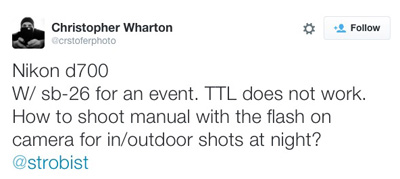
Reader Christopher Wharton has a flash-camera combo that will not work in TTL mode, so how he can shoot run-and-gun events?

Long forgotten in the age of TTL, this post explains hot to use your flash’s “automatic” mode.

Read full post

Kinda Genius: The LP742 LightSwitch

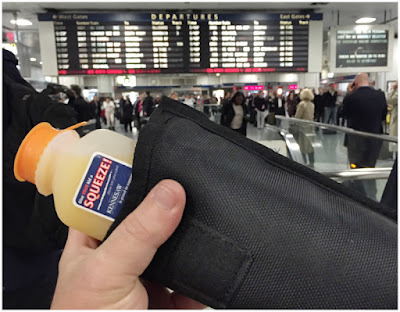
See that? That’s the high water mark to date for my dual-purpose creativity with a speedlight case. Being padded, I use it as a thermos for my station-purchased beverage when home-bound from New York City on the train.

(Works totally ace, BTW.)

But that bar just got seriously upped today by the LumoPro LP742 “LightSwitch” speedlight case.

Read full post

On Assignment: The Light You Don’t See

This photo is 100% flash, 0% ambient. But it almost looks like the reverse. And for this portrait of soprano Robin Steitz, a timeless available-light look was what we were going for.

But when you are working with flash (a single speedlight) and controlling your light (a scrounged “fill blanket” from the couch) you can keep the best of both worlds of strobe and ambient.

Read full post

GPP PopUP Seattle: What to Expect

Several folks have asked for more specifics on the Seattle GPP Pop-Up. So here’s the long version.

Read full post

On the Road? Backup Without the Bulk-Up

I seldom review gadgets these days, but sometimes something is so useful that it’s worth telling people about. Such is the case with the SD card-enabled Western Digital My Passport Wireless hard drive.

Read full post

Your Basic Lighting Kit: A Spin Around the Block

So the UPS guy just dropped your very first lighting kit at your front door. WHAT DO YOU DO NOW?

Read full post

On Assignment: I Got Rhythm

A cool little trick that forever changed the way I photograph dancers.

Read full post

On Assignment: Lighting Like Leo

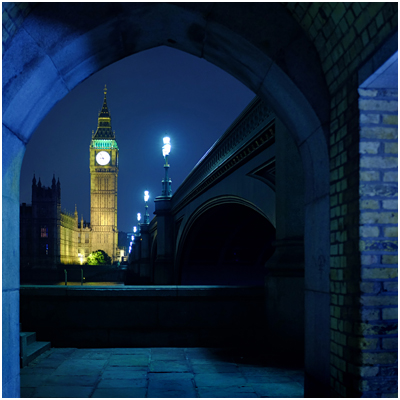
In which we travel to London to serve as a lighting tech for a documentary. Our goal? Lighting for a photographic reproduction of the Mona Lisa.

Read full post

Inspiration: Atbin Eslami’s Video Bio

Such a simple idea, and not so difficult to do—unless you count all of the self-inspection it will require. Iranian-born (now in Dubai) photographer Atbin Eslami’s video-bio of herself first made me think, “that’s really cool.”

And second, “Why haven’t I done that?”

Read full post

On Assignment: Ben Lurye

Who needs a studio when you have a bridge abutment? Today, we’ll explore a few of its facades while making an actor’s portrait.

Read full post

On Assignment: Choosing a Tripod

Little? Big? Aluminum? Carbon fiber? New? Used?

Three legs, many choices.

Read full post

__________

For older posts, please see the Monthly Archives dropdown menu on the right sidebar.


Strobist

 
Comments Off on Blog View

Posted in Photography


X-Ray Urbanism: Laser Scans Record & Reveal Sub-City Spaces

12 Aug

[ By WebUrbanist in Art & Photography & Video. ]

scan 3d london underground

Produced from over 200 laser scans, this remarkable 3D representation covers surface features as well as subterranean spaces of it’s London subject, captured and stored as a series of over 10 billion points. This data-rich compositing process has been called everything from spatial scanning to volumetric photography, but the goal is simple: capturing all dimensions of the subject matter in digital space. And as the cost of the requisite technologies continues to drop, it may not be long before lidar (laser + radar) scanners become commercial household products or even smartphone features.

scanlab subeterranean mail rail

The duo behind ScanLabs has done remarkable projects around the world, both artistic and documentary in nature, but their work with Mail Rail illustrates the near limitless potential of the technologies they employ. Using scanner that sent out millions of laser light bursts per second, they have generated a ground-piercing, interactive rendering that is ahead of its time. Static views and videos do not do their captures justice, which may someday be best experience via virtual reality or in some other format yet unimagined.

scanlab tube details

scanlab volumentric photography rendering

Matthew Shaw and William Trossell were commissioned to help document The London Post Office Railway by the British Postal Museum & Archive before a section is converted into an underground ride. The nearly 100-year-old and 23-mile-long LPOR, or ‘Mail Rail’ for short, transported millions of pieces of daily mail beneath the city at its peak. Before a massive revamp changes this subterranean landscape forever, stakeholders wanted a method for preserving all elements of the existing spaces.

scanlab seen from below

As Geoff Manaugh summarizes this novel approach to spatialization, “Their 3D point clouds afford a whole new form of representation, a kind of volumetric photography that cuts through streets and walls to reveal the full spatial nature of the places on display.”

scanlab forest view

ScanLab has engaged in many other projects as well, including augmented archeology at concentration camps and digital preservation of D-Day landing sites. Some, however, are simply experimental, designed to push the limits and explore ways to hack the technologies they use. The company has done everything from generating surrealistic renderings of forests to scanning clouds and mist simply to see what will come out the other side of the process. They have even snuck into famous works of architecture and surreptitiously scanned buildings, then recreating them in perfect detail with 3D printers or CNC routers. Regardless of the short-term applications, the key is the long-term data storage – the information being preserved today may be redeployed in the future in ways not yet envisioned.

Share on Facebook


[ By WebUrbanist in Art & Photography & Video. ]

[ WebUrbanist | Archives | Galleries | Privacy | TOS ]


WebUrbanist

 
Comments Off on X-Ray Urbanism: Laser Scans Record & Reveal Sub-City Spaces

Posted in Creativity


Samyang introduces new Xeen pro video lens series with interchangeable mounts

12 Aug

Korean lens brand Samyang has announced a new series of video lenses under the Xeen name. They feature wide apertures and resolution that the company says is aimed at users who shoot 4K and above footage. There will be 24mm, 50mm and 85mm focal lengths initially, and three more to follow next year. Read more

Articles: Digital Photography Review (dpreview.com)

 
Comments Off on Samyang introduces new Xeen pro video lens series with interchangeable mounts

Posted in Uncategorized


Think Tank Shape Shifter Backpack Review

12 Aug

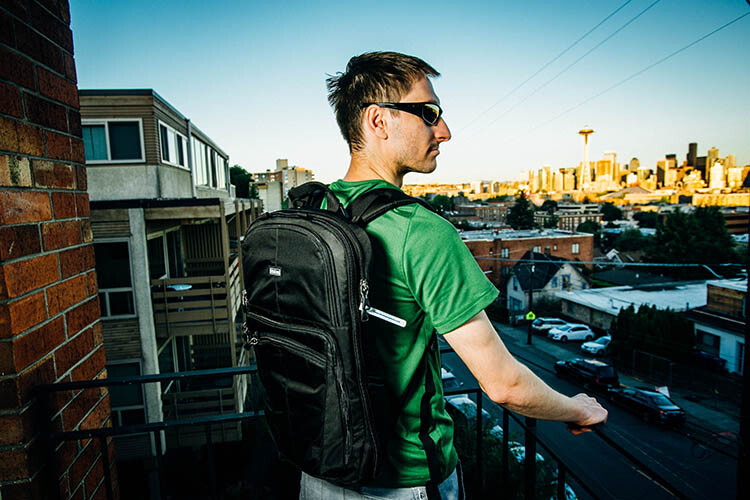
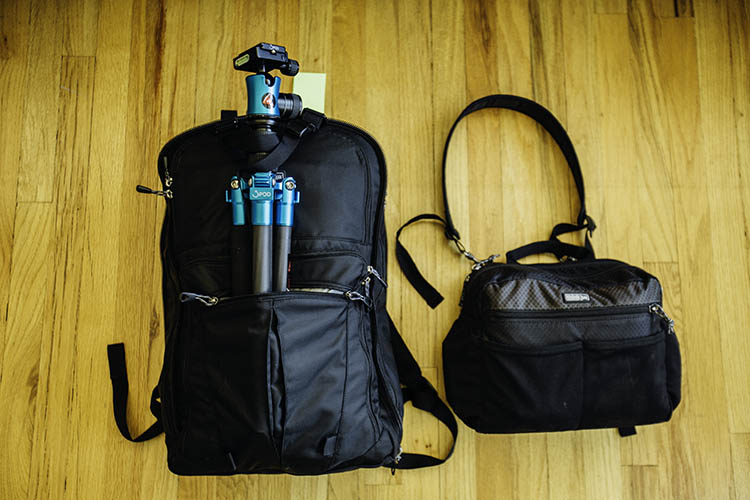
Finding the perfect camera bag is a challenge in today’s world where every bag style is possible. From messenger bags to belt packs to purses, there are many different camera bags out there to tickle your fancy. While the trend recently may be minimalist and compact, I’d like you to consider for a moment the exact opposite – a large, yet highly versatile, camera backpack known as the Think Tank Shape Shifter.

In general, many bags suffer from giving off the feeling and appearance of too much bulk, while at the same time not having nearly enough space for all of one’s camera gear. The Think Tank Shape Shifter is ingenious in that it is designed specifically to go from thin and skinny, to large and expansive, whenever you need it to. Top that flexibility off with fantastic padding and back support, as well as lots of pockets to hold all sorts of gear, and you have what I deem to be the perfect camera bag.

Think Tank Shapeshifter Backpack 2

Flexible sizing

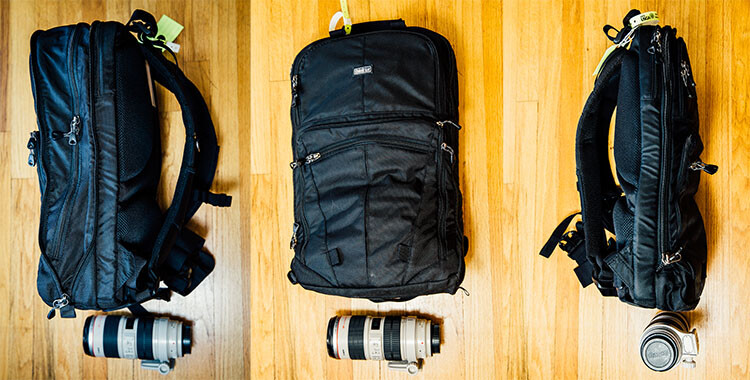
The Shape Shifter’s key feature is its flexibility in sizing, thanks to its rather simple zipper system. Similar to how luggage works, you simply unzip a section of the bag when you need it to expand, or zip it up to minimize the size. At its most compressed, the Shape Shifter measures 3 inches in diameter, and 7 inches at its maximum expansion.

Think Tank Shapeshifter Backpack

Sturdy build

As you can expect from all Think Tank bags, the Shape Shifter is built tough, despite having a minimalist profile. Featuring a black water-resistant exterior fabric, it also comes with a seam-sealed removable rain cover, just in case of a sudden downpour. The straps and back padding are made of 3D air mesh with a breathable air flow system, making the bag extremely comfortable to wear for long periods of time. There are also strong waist and chest straps to help equally distribute the bag’s weight across your upper body. The ergonomic value here is especially high, since backpacks already do a better job of equalizing the weight of heavy gear, as opposed to a one-sided messenger bag.

Think Tank Shapeshifter Backpack 4

Pockets galore

There are several main pockets in the Shape Shifter including a compartment for a laptop, up to 17″, and a huge compartment full of stretchable neoprene pouches for holding lenses and camera bodies. Alternatively, you could also stuff about four size small t-shirts in the pouches if you wanted to use the bag as a makeshift suitcase. There are also smaller zippered pockets on the bag’s exterior, where smaller items such as batteries and memory cards can be stored. Larger items such as tripods and lighting stands can also be strapped to the backpack if needed, using two sturdy straps that come with the bag.

Think Tank Shapeshifter Backpack 6

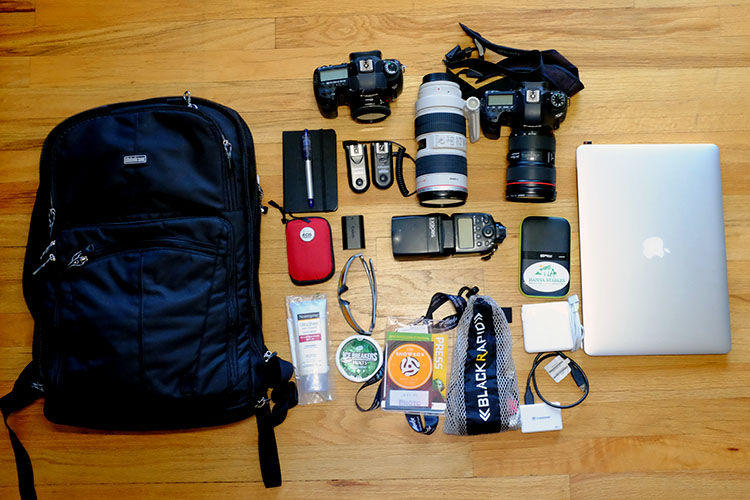
I took the Shape Shifter on a trial run while photographing the USGA U.S. Open at Chambers Bay recently. Needing to take along a majority of my photography equipment, I managed to fit all of the following into the backpack:

  • (2) Camera bodies (Canon 6D and 5D Mark III)
  • (3) Lenses (Canon 40mm f/2.8, 70-200mm f/2.8, 24-70mm f/2.8)
  • (1) Flash (Canon 580 EXII)
  • (2) Flash Triggers (Yongnuo)
  • (1) Laptop (Apple 15″ MacBook Pro Retina Display)
  • Camera accessories (memory card wallet, spare batteries)
  • Laptop accessories (card reader, external hard drive, charger)
  • Other goodies (sunscreen, sunglasses, mints, credentials holder, notebook)

The resulting bag was admittedly pretty heavy, but the comfortable back padding and straps made the bag much easier to carry despite the added weight.

Think Tank Shapeshifter Backpack 5

Versatile, despite shortcomings

One of the biggest challenges that the Shape Shifter has is in its ability to carry your whole photo studio. You can indeed do just that, but the bag gets extremely heavy, and some gear is difficult to reach without stopping to unzip and lay out the entire bag. Additionally, the structure of the bag makes it hard to carry preassembled cameras (lens attached) in it, meaning it is meant to have the lens and bodies in separate pouches rather than attached as one unit. The best way around this is to simply wear your cameras while shooting, and keep items you don’t need regular access to in the Shape Shifter.

Alternatively, you could also convert the Shape Shifter into a more functional daypack or suitcase, since its pockets and design don’t restrict it from being used as solely a camera bag. Say you’re travelling by air and trying to meet the two bag carry-on limit. You could put the majority of your camera gear that you need to be readily accessible in a smaller bag such as the Think Tank ChangeUp, and use the Shape Shifter to carry your overnight travel items and excess gear. Again, the big benefit of the Shape Shifter is its ability to shrink or enlarge depending on your needs.

Have you tried out the Think Tank Shape Shifter? Did it meet your expectations? Let me know in the comments below!

googletag.cmd.push(function() {
tablet_slots.push( googletag.defineSlot( “/1005424/_dPSv4_tab-all-article-bottom_(300×250)”, [300, 250], “pb-ad-78623” ).addService( googletag.pubads() ) ); } );

googletag.cmd.push(function() {
mobile_slots.push( googletag.defineSlot( “/1005424/_dPSv4_mob-all-article-bottom_(300×250)”, [300, 250], “pb-ad-78158” ).addService( googletag.pubads() ) ); } );

The post Think Tank Shape Shifter Backpack Review by Suzi Pratt appeared first on Digital Photography School.


Digital Photography School

 
Comments Off on Think Tank Shape Shifter Backpack Review

Posted in Photography


QA: How to Shoot Events Without TTL Flash

11 Aug

Technology is great. But it can also make us its slave.

For instance, TTL flash is pretty good at solving lighting problems on the run. (See, McNally? I'm open-minded…) But those problems existed long before we had TTL flash—or TTL exposure metering, for that matter.

And yet, we solved them on a regular basis. Even without feedback on the backs of our cameras. Or autofocus. While walking five miles to school barefoot in the snow. Uphill. Both ways.

Read more »
Strobist

 
Comments Off on QA: How to Shoot Events Without TTL Flash

Posted in Photography


Olympus ‘Pro’ wideangle lens Field Test: Rock n’ Roll and Skateboards

11 Aug

In our latest Field Test we put Olympus’s new M.Zuiko Digital ED 8mm F1.8 Fisheye Pro and M.Zuiko Digital ED 7-14mm F2.8 Pro in the hands of DPReview writer Dan Bracaglia. Dan put them to the test in some of his natural environments: a rock concert, skate park, and a beach landscape at sunset. See video

Articles: Digital Photography Review (dpreview.com)

 
Comments Off on Olympus ‘Pro’ wideangle lens Field Test: Rock n’ Roll and Skateboards

Posted in Uncategorized


7 Reasons Why You’d be Crazy Not to use Lightroom Presets

11 Aug

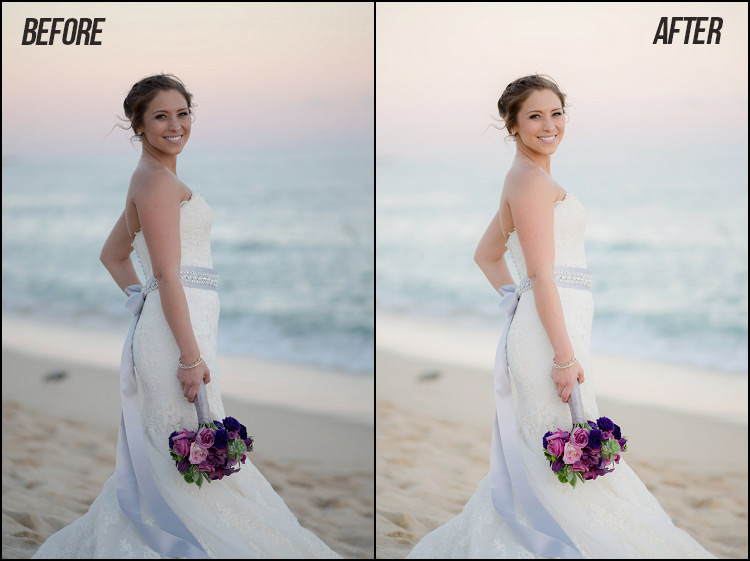
Today, in this digital age, your job isn’t done once you’ve taken the photos, you’re really only halfway there. You need to edit your photos. Luckily, using Adobe Lightroom, combined with some really high-quality presets, you can instantly start getting amazing results, rather than spin your wheels being frustrated trying to edit your photos.

But first – what is a Lightroom preset?
DPS Presets Article Cover Photo

A Lightroom preset is simply a collection of photo edit settings inside of Lightroom that are bundled into a single click allowing you to edit photos far more efficiently than you would otherwise by repeating those same settings and editing steps one by one.

Here are 7 reasons why you’d be crazy not to use Lightroom presets:

Save Time

When using Lightroom presets, with only one click you’ll be able to instantly get your photos to an 85-90% edited state, and sometimes you’ll even be completely done with one click! Rather than edit each photo from start to finish, you can spend your time on the fine-tuning part of the editing process.

Simple to Use

Learning any new software can be intimidating, and take time to master. While it’s certainly important to always take strides at truly learning the program, using presets will let you instantly get started in Lightroom, and edit your photos simpler than ever before.

LR Preset Screenshot what and why presets

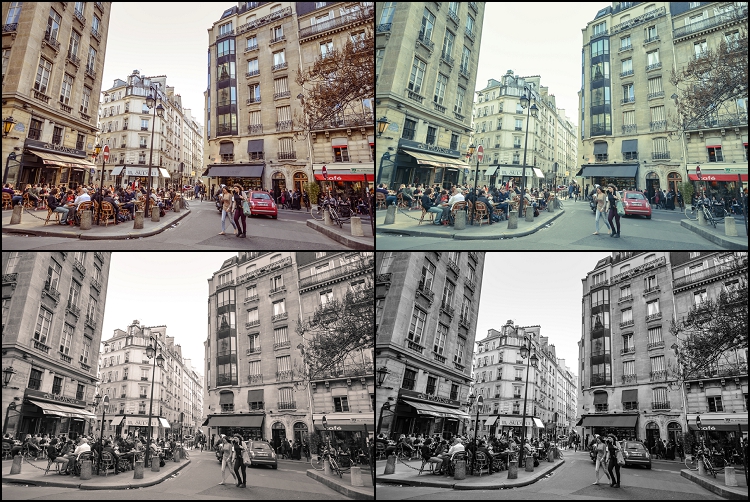
Variety

Does the photo look best in black and white or a sepia edit? Or maybe a vibrant color edit or a subdued vintage look? Using Lightroom presets will give you a ton of creative variety right at your fingertips so you can effectively try different edits and see which style is most fitting for a particular photo, or even full photo session. Quick tip – when you hover over a different preset, Lightroom will show you a preview of how that photo will look with that preset applied (in the Navigator box, at the top of the left panel in the Develop Module, see screenshot above).
Digital Photography School Lightroom Presets 0001 Variety

Consistency

When you are editing an entire photo session, using the same presets across the whole photo shoot will give your images a more uniform and consistent look, as opposed to editing each and every photo one-by-one, which can yield varying settings and a disjointed look to your image set.

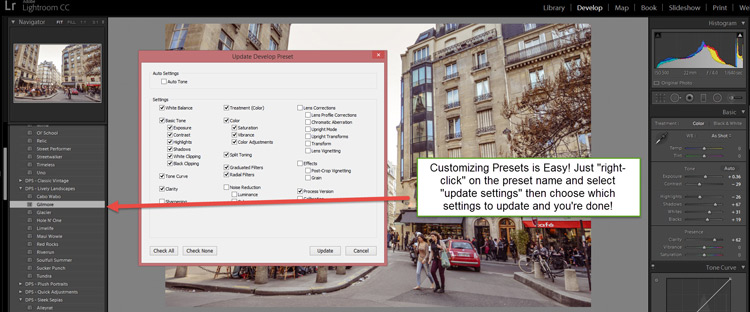
Completely Customizable

Have a preset you love, but you always have to slightly adjust the color or contrast? Or maybe your very own style has changed over time? No problem at all. Any develop preset you use inside Lightroom is completely customizable and it’s as easy as a couple mouse clicks.
DPS Customize Presets 750

Lightroom versus Photoshop

Presets work inside Lightroom and actions work inside Photoshop. Both programs have their place in a professional photographer’s editing workflow. However, Lightroom is the primary editing software of choice for both professionals and hobbyists alike. Not only is it far easier to use and learn compared to Photoshop, but within Lightroom all of your edits are non-destructive. That means that your original unedited photo is always stored in Lightroom so you can experiment as much or as little as you want, without ever degrading the quality of your original image.

Presets + Batch Editing = The Winning Combo
Final Landscape 750

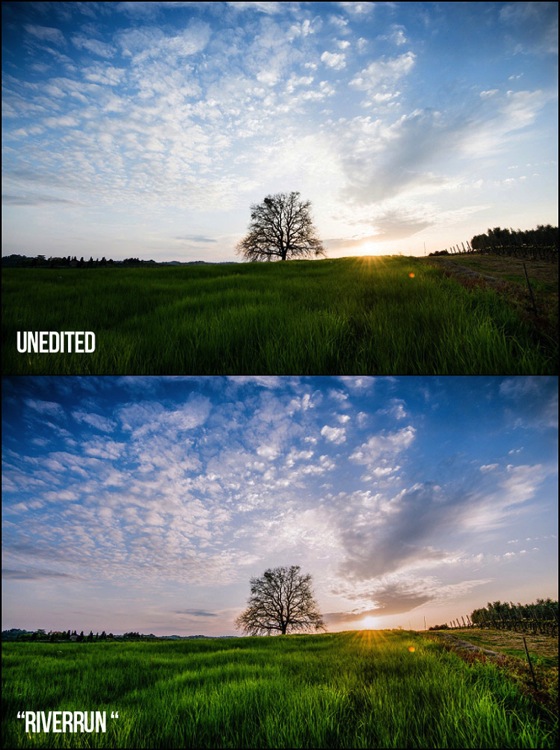
Example from the dPS 101 Lightroom Presets Pack

One of the greatest benefits of using Lightroom is its ability to edit a lot of photos very quickly by batch editing, or syncing, your settings from one photo to many at once. When you combine high-quality presets with batch editing in Lightroom you will be able to drastically cut down your complete photo editing time per session.

Now that you have a better understanding of how using Lightroom presets can dramatically reduce the amount of time you spend editing your photos, while getting you better results and increasing your creativity – it’s time to grab some presets for you to use inside of Lightroom.

Introducing the dPS 101 Lightroom Presets Pack

You can scour the web to research and find different Lightroom presets, you can choose to create your own, or you can make your life really easy and purchase the official Digital Photography School – 101 Lightroom Presets Pack that I’ve created.
Final Portraits 750

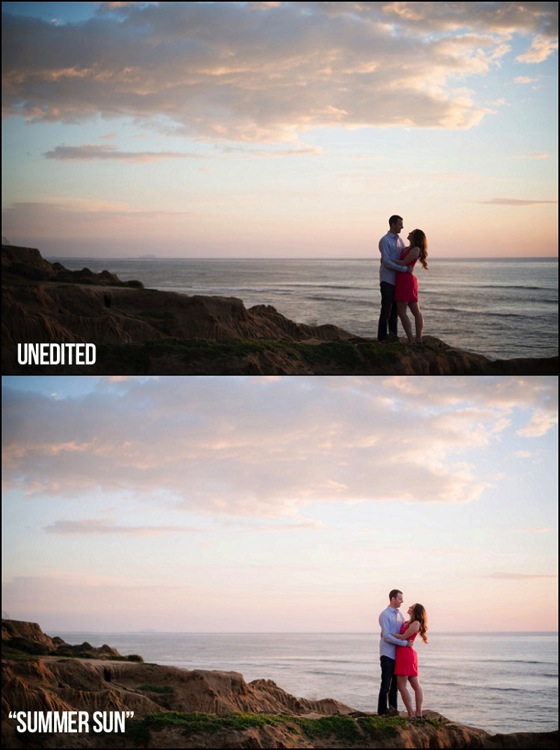
Example using the Summer Sun preset from the dPS 101 Lightroom Presets Pack

This ultimate preset bundle includes seven different themes, so you can easily find and use a preset that is the most fitting for your specific photo, without having to waste any time. You’ll find presets dedicated for portraits, stunning black and white & sepia presets, presets for landscape photography, street photography, vintage presets and much more.

It doesn’t matter if you are a beginner or professional, you’ll love these presets and the amazing results you’ll get from them. Click here to learn more and save big by getting them during this limited time introductory special promotion price.
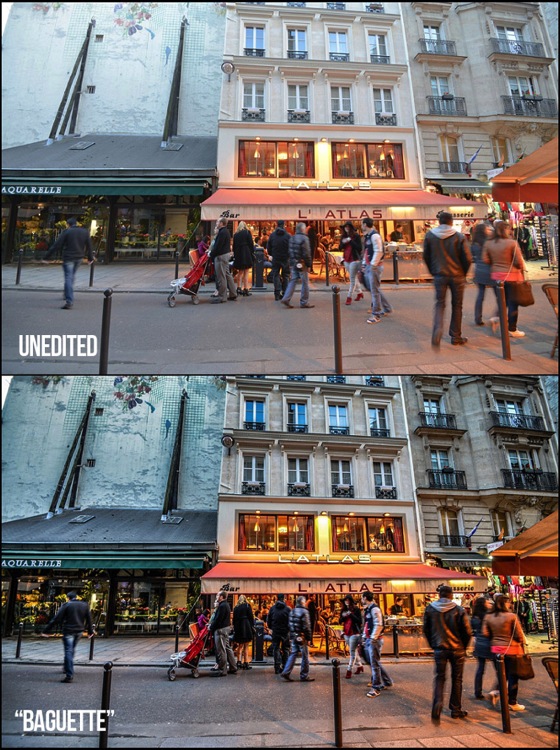
Final Street 750

Example from the dPS 101 Lightroom Presets Pack

presets_coverdPS 101 Lightroom Presets Pack

Cole’s handcrafted a brand new set of presets, exclusive to dPS.

  • Instant Digital Download
  • Guaranteed for 2 full months
  • Pay by PayPal or Credit Card

For a limited time only get them at the introductory price of $ 20.


googletag.cmd.push(function() {
tablet_slots.push( googletag.defineSlot( “/1005424/_dPSv4_tab-all-article-bottom_(300×250)”, [300, 250], “pb-ad-78623” ).addService( googletag.pubads() ) ); } );

googletag.cmd.push(function() {
mobile_slots.push( googletag.defineSlot( “/1005424/_dPSv4_mob-all-article-bottom_(300×250)”, [300, 250], “pb-ad-78158” ).addService( googletag.pubads() ) ); } );

The post 7 Reasons Why You’d be Crazy Not to use Lightroom Presets by Cole Joseph appeared first on Digital Photography School.


Digital Photography School

 
Comments Off on 7 Reasons Why You’d be Crazy Not to use Lightroom Presets

Posted in Photography


Landscape Comp Tip for Absolute Beginners

11 Aug

Landscapes are some of the easiest shots to take – no arranging meetups with others, no double chins, and that fresh air is super invigorating!

If you’re just getting the hang of creating gorgeous landscape shots, you’ll benefit from understanding how to add a sense of depth with composition. Think of your photo as having three parts: foreground, middle-ground and background. Try to make sure there something of interest in all three sections.

Check out this article for a perfectly simple visual example of great landscape composition.

Photo by Scott Bourne


© Erin for Photojojo, 2015. |
Permalink |
No comment |
Add to
del.icio.us

Post tags:


Photojojo

 
Comments Off on Landscape Comp Tip for Absolute Beginners

Posted in Equipment