Ever since Canon announced its 50MP EOS 5DS R, we’ve been eager to get it into our studio and in front of our test scene. The wait is over and the 5DS R has been added to our studio scene comparison tool alongside the likes of the Nikon D810 and Pentax 645Z. Read more
Month: May 2015
-
And Now For Something Different: Voigtländer 40mm f/2.8 Heliar samples and impressions
Voigtländer is one of the oldest names in photography, with a long history of making cameras and lenses. Recently, the company has turned its focus from affordable M-mount lenses to lenses with digital cameras in mind. We recently got our hands on the 40mm VM f/2.8 Heliar, made specifically for full-frame and APS-C Sony E-mount cameras. Read more
-
CyPhy’s LVL 1 camera drone features six rotors for stability
CyPhy Works, a company helmed by iRobot co-founder Helen Greiner, has introduced a camera drone with a few unique features. Called the CyPhy LVL 1, its six-rotor design promotes better stability over common quadcopters and its camera is integrated into the body of the drone. Read more
-
Ice Light 2 on the way with brighter LEDs and new battery system
Westcott has announced the second incarnation of its Ice Light LED lighting wand. Ice Light 2 promises to be 50% brighter than the previous model and comes equipped with Bluetooth for remote control and an interchangeable, rechargeable lithium ion battery. The light has a color temperature of 5500K, Color Rendering Index of 96 and a beam angle of 72.6 degrees. Read more
-
Big Zoom: Nikon Coolpix P900 real-world samples
Nikon’s Coolpix P900 offers a 16MP sensor and a mind-blowing F2.8-6.5 24-2000mm equivalent zoom. It features built-in Wi-Fi with NFC, 7 fps burst shooting, built-in EVF and a fully articulated LCD. The P900 also uses a new Dual Detect optical image stabilization system, claiming up to 5 stops of shake compensation. We’ve been shooting with it for a few days. See gallery
-
Man blickt in menschliche Abgründe

Ein Beitrag von: Timo Nowack
Der Fotograf Oliver Schmieg lebt und arbeitet seit 15 Jahren in Kolumbien. Im Interview erzählt er von seiner bewegendsten Recherche, deutschen Luxusproblemen und der Arbeit mit einem Auftragskiller.
kwerfeldein – Fotografie Magazin | Fotocommunity -
Rise of Robotic Graffiti: Drone Vandal Sprays Paint in Midair
[ By WebUrbanist in Art & Street Art & Graffiti. ]
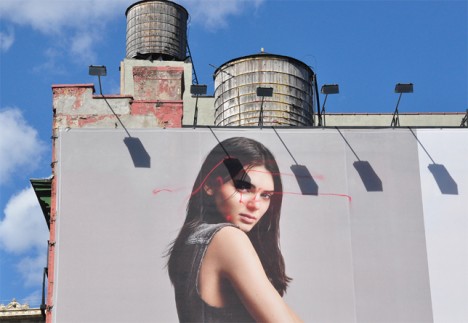
In what appears to be the first recorded work of public aerial drone vandalism, this off-the-shelf quadcopter was hacked to hold and use a can of spray paint, forever transforming the landscape of potential graffiti targets (image above by Arthur Holland Michel).
Attacking a giant Calvin Klein ad in the heart of New York City, this modified Phantom drone sprayed red paint on the face of model Kendall Jenner, able to fly up to and hover around the area of application much faster (then escape much easier) than a human ever could, finished in under a minute. Robot-made murals and computer-generated street art are nothing new, but putting them in the sky could change everything.
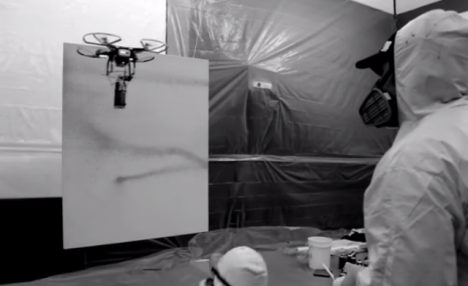
The artist behind this intervention, KATSU, has been exprimenting with drone-mounted spray cans for some time now in controlled indoor environments, but wanted to show the potential for his work to reach places inaccessible to humans.
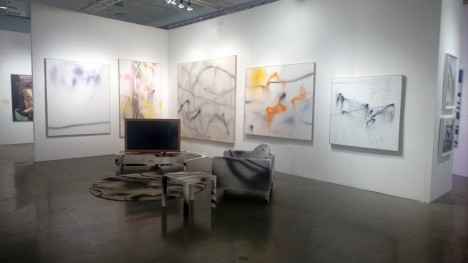
More proof of concept than finished piece, this particular work of graffiti was difficult to accomplish, with a great deal of effort put into stabilizing the aerial robot – creating a tag with any kind of precision using this method would be effectively impossible.
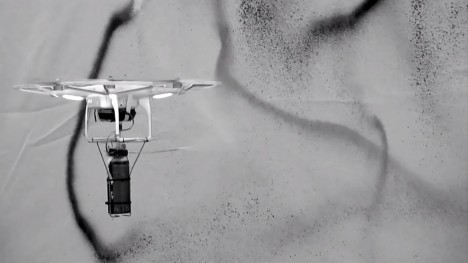
Per Wired, though, the implications are bigger than this test: “Given the enduring privacy, safety, and legal concerns around the technology, conceptually it makes a certain amount of sense that it would find uses at the peripheries of what most people (let alone the law) would consider acceptable. KATSU’s scribble high above SoHo might not look like much, but it represents the potential that drones have to transform graffiti forever.”
Want More? Click for Great Related Content on WebUrbanist:
Night Graffiti: Shake-Powered LED Spray Paint Can Sleeve
The nature of graffiti tends to result in nocturnal excursions, but painting completely in the dark can be a be problem and sometimes you just need a little …
Click Here to Read More »»
Paint Me White Again: Tunnel Type Graffiti Taunts Authorities
Well known for stenciling big block-lettered phrases on walls around his native Newscastle, Mobstr made this piece is unusually blunt (as well as hilarious) …
Click Here to Read More »»
Gratuitous Graffiti: Wild Robot Makes Random Wall Tags
If there is s science to the art of graffiti, well, this is not it – except insofar as this robot-artist was itself born of scientific experimentation!
Click Here to Read More »»


[ By WebUrbanist in Art & Street Art & Graffiti. ]
[ WebUrbanist | Archives | Galleries | Privacy | TOS ]
-
Remembering Rebecca Jackrel: Wildlife Photographer and Friend
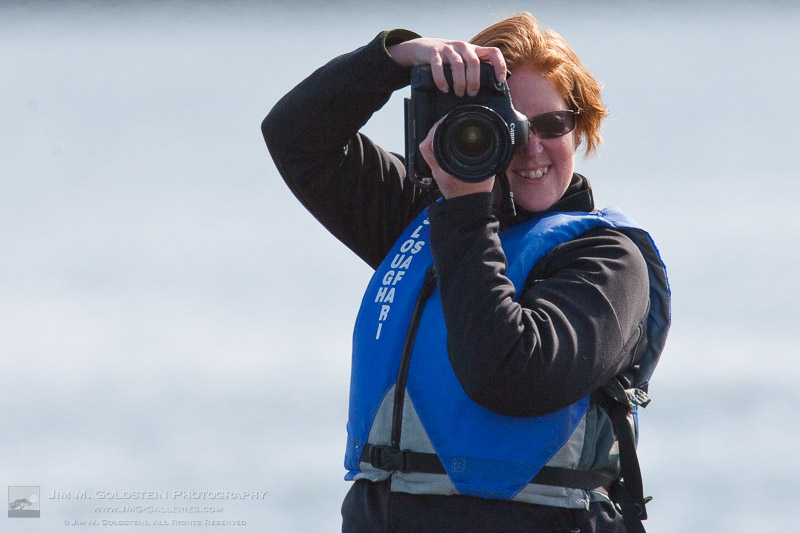
Rebecca Jackrel Having Fun Behind the Camera
It is with pain in my heart and tears in my eyes that I write this memoriam of my friend Rebecca Jackrel who recently lost her battle with cancer this week. Rebecca was a driven and dedicated wildlife photographer who prided herself in recent years raising awareness to the plight of the Ethiopian Wolf via the Ethiopian Wolf Project with Will Burrard-Lucas . Quite the world traveler her trips always centered around conservation wildlife photography of subjects spanning the Albatrosses of Midway, Polar Bears of Churchill and Svalbard, Spirit Bears of Vancouver Island, Manatees of Florida, Sea Otters of California or marine mammals & sea life along the California coast.
To say Rebecca loved animals would be an understatement as her respect and love of animals was at the core of her being. She worked as veterinary technician before catching the photography bug and regularly volunteered with her husband at the Marine Mammal Center in Sausalito, California. She shared her home with a variety of furry creatures including dogs, cats and even a lost hamster that literally walked into their house. There is little she would not do for an animal, wild or domestic, in need of care and/or protection.
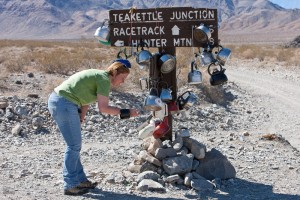
Rebecca at Tea Kettle Junction, Death Valley NP
I first met Rebecca at the Photochrome camera club in San Francisco back around 2004/5. She knew of me from my writing and images shared online and was in the cutest way smitten and shy in approaching me. Initially I thought I might have a stalker on my hands, but she quickly passed the non-stalker test and quickly became a good friend. It was at this time I got a glimpse of her generosity as she invited me to join her photographing the Wave in Arizona. In the years to follow she was incredibly generous in sharing her gear and most meaningful to me her support & heart felt believe in me. Very selfishly I mourn the passing of Rebecca because she was the rarest of friends who had a heartfelt interest in my work and believe in my artistic & professional development. Her support meant the world to me. I will forever treasure the time we spent together in the field and running workshops to photograph Sea Otters in Monterey and landscapes in Death Valley.
While Rebecca was never one to toot her own horn I will share her most recent and prized accomplishment she shared with me before she passed… it was her Certificate of Congressional Recognition for her work to study, document and defend the Ethiopian wolf.
Rebecca you will forever be in my heart. I will miss you more than words can describe.
You can view Rebecca Jackrel photography on her Photoshelter site.

Copyright Jim M. Goldstein, All Rights Reserved
Remembering Rebecca Jackrel: Wildlife Photographer and Friend
The post Remembering Rebecca Jackrel: Wildlife Photographer and Friend appeared first on JMG-Galleries – Landscape, Nature & Travel Photography.


Related Stories
- My Favorite Features in Adobe Lightroom 6 (CC)
- My Favorite Features in Adobe Lightroom 6 (CC) – Enclosure
- 6 Steps to Save Your Ass With Lightroom Catalog Changes
-
QromaScan uses your smartphone to digitize prints
Though digital photography has been around for quite some time now, most of us still have a few boxes of prints from the pre-digital era lying around. Digitizing them can be expensive if you use a professional service, or time-consuming if you decide to go the DIY way. QromaScan wants to solve this dilemma, by utilizing your smartphone camera and a foldable lightbox. Read more
-
7 Landscape Photography Mistakes That Could be Ruining Your Photos
If your photos aren’t turning out the way you expect them to, new gear is not necessarily the answer. In fact, chances are you are making one of these seven common mistakes. Don’t be discouraged though; just as a musician needs time to refine their skills, so does a photographer. Once you recognize where the problem lies, it’s easy to make adjustments and achieve better results the next time out.
1) Shooting at the Wrong Time of Day
Harsh afternoon sunlight can wreak havoc on a landscape photo. With bright highlights and dark shadows, the contrast makes for especially difficult exposures. For truly dramatic scenic opportunities, dedicate the hours around sunrise and sunset to photography. You’ll be amazed at how few people are there to clutter your composition. With the soft light and colorful skies, your photos will take on a new level of natural beauty.
2) Your Images Lack a Clear Subject
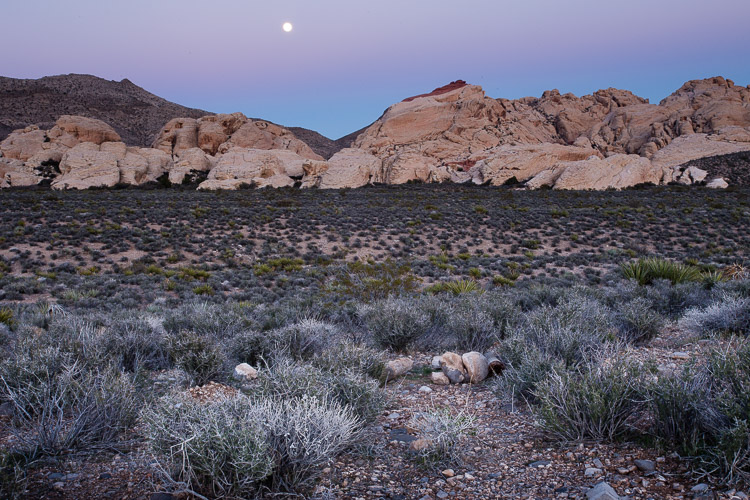
When you experience something grand, it’s tempting to try and include it all into one frame. The expansive landscape is undeniably beautiful but it’s lacking in any one point of importance. Before pressing the shutter, ask yourself “What is my subject?” If you’re able to provide an answer, you can learn to see like a camera. The human eye interprets a scene differently, heavily influenced by our peripheral vision and ability to scan from left to right. The camera however sees in a much simpler way, only able to record a small portion onto the sensor. By determining what the subject is, you can take the necessary steps to make an effective photo.

3) No Foreground
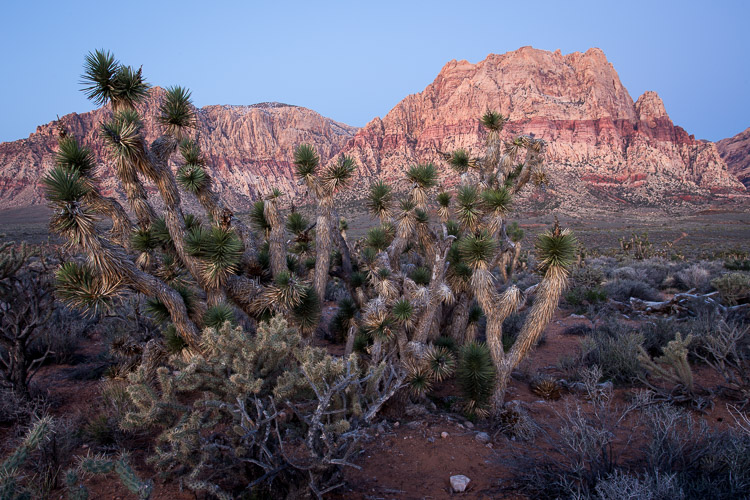
The gentle hues of dawn are worth getting out of bed for, but color alone won’t hold the viewer’s interest. To make a dramatic impact on your scenic and travel images, find a strong foreground element. This can be a field of flowers, a boulder, tree, or even a man-made object. The idea is to add visual interest all the way through the frame. As you explore various options, try several perspectives including ground level. By having this location worked out in advance, you’ll be ready to capture the fleeting light.
4) Lazy Composition
At nearly every scenic vista or photographic landmark, you’ll notice a definitive dirt spot where grass once grew. This well-worn spot is the final destination for scores of tourists who shoot the same photo year after year. Rather than following the crowd, take a quick loop around the area and search for unique perspectives. To more effectively communicate your vision, check all four corners of your viewfinder, and either zoom or physically move to make a stronger image. Do you need the fence in the bottom corner, or the tree that seems to enter the frame from nowhere? This type of attention to detail will help strengthen the composition in-the-camera which saves you time at home trying to clone out unwanted objects.

5) It’s Been Done Before
Automatic modes were designed to provide average results under a variety of conditions. While this can be effective on occasion, it’s fundamentally opposite of what you’re trying to achieve with your art. Do you really want your images to be just average? In order to go beyond the safe shot, creative photographers will push the boundaries to explore their own vision. Rather than trying to recreate what’s already been done, find your own twist on it. This may not always be in line with current trends, but who’s to say you’re attempts won’t cause their own stir.

6) There’s Too Much Contrast
One of the most common issues with scenic photos is the huge contrast difference between the foreground and the sky. The solution is not a new camera or complicated software. Actually, a simple tool known as the graduated neutral density filter is all you need. These commonly come in strengths of two (0.6), three (0.9), and four (1.2) stops. While HDR is another effective method, these filters allow you to achieve your vision in the camera at the time of exposure.
Start by manually spot metering the foreground. The goal is to expose in such a way that the foreground is not black, leaving some detail in the shadow areas. This could be at “-1″ on your meter, or “0”, or even “+1″. Of course if you are not sure which foreground looks best, bracket. Take a quick test shot and notice how the foreground looks well exposed but the sky is overexposed. The next step is where the magic happens.

Get out your graduated neutral density filter and position the dark portion over the top part of the lens. This will darken the bright sky while leaving your foreground properly exposed. You can fine tune the effect by adjusting the filter placement up or down in the mount.

7) Fear of High ISOs
You may be surprised to learn that a high ISO can be helpful for landscape photography. This is particularly true when shooting without a tripod or including a person in the frame. In these instances, the shutter speed can be no slower than about 1/125 to prevent camera shake and/or subject motion. Then, to achieve great depth of field and keep everything sharp from near to far, your desired aperture would be f/11 or f/16. With these two decisions made, you may take your photo only to find that it’s too dark. This is where the ISO comes into play. Simply double the ISO number and watch as the photo gets brighter.
Many photographers are overly sensitive about high ISO noise and refrain from using anything over 800. Instead they’ll slow down the shutter speed, rely on image stabilizers, or open the aperture wider. The results may look acceptable on the small LCD only to appear soft when viewed or printed larger. Like most aspects of photography, there is always a tradeoff to consider. Would you rather have a blurry, but noise-free photo, or a sharp image with a bit of noise? Considering that most image editing programs now offer terrific noise reduction options, the ISO noise isn’t as harmful as it once was.

googletag.cmd.push(function() {
tablet_slots.push( googletag.defineSlot( “/1005424/_dPSv4_tab-all-article-bottom_(300×250)”, [300, 250], “pb-ad-78623” ).addService( googletag.pubads() ) ); } );googletag.cmd.push(function() {
mobile_slots.push( googletag.defineSlot( “/1005424/_dPSv4_mob-all-article-bottom_(300×250)”, [300, 250], “pb-ad-78158” ).addService( googletag.pubads() ) ); } );The post 7 Landscape Photography Mistakes That Could be Ruining Your Photos by Chris Corradino appeared first on Digital Photography School.