RSS
 

Archive for March, 2015

Smart Space Solutions: 14 Innovative Japanese Home Interiors

03 Mar

[ By Steph in Drawing & Digital. ]

japan interiors house na 1

Extremely narrow lots and busy urban locations are no big deal for ingenious Japanese architects creating comfortable, daylight-filled residential interiors with a few crucial design tricks, like the use of staggered open platforms instead of closed-off rooms. Interior courtyards, faux facades concealing secret gardens, strategically placed windows and totally transparent walls make the most of limited space.

Transparent House NA by Sou Fujimoto
japan interiors house na 2

japan interiors house na 3

Few Japanese houses are quite as eccentric as this one – a multi-story, glassed-in home with no stairs, no closed-off rooms and no privacy. House NA by Sou Fujimoto is built on a thin, split-level steel frame full of small platforms that don’t have a preset function, so they can be used however the inhabitants like. The house is almost more like an experimental installation than a real residence, given all that glass – you’d have to be quite an exhibitionist to live there. The further you walk into the home, however, the more complex and opaque all of those built-ins become, obscuring the vision of neighbors and passersby at least a little bit.

Translucent Rooftop Shed Skylights by Tato Architects
japan interiors shed 1

japan interiors shed 2

japan interiors shed 3

The need to extend the availability of daylight in an area of Japan that stays dark for much of the winter led to this novel solution by Tato Architects: placing transparent sheds on the roof of a partially subterranean home to act as giant skylights. From outside, the sheds look like greenhouses, while inside, they are bright, light-filled spaces for working, playing and lounging.

Treehouse Residence by Ryo Yamada

japan interiors treehouse 1

japan interiors treehouse 2

japan interiors treehouse 3

Envisioned as a treehouse in an urban context, this home by Ryo Yamada doesn’t actually look anything like a treehouse from the outside. The interiors, however, bear that tacked-together, DIY feel, especially given the wooden walkways that connect one open upper-level platform to the next. Located in Sapporo City, the house is essentially a large shell filled with individual ‘treehouses’ that can be moved around within the space, added to or removed altogether.

Courtyard Home with Street-Like Hallways by Suppose Design Office

japan interiors buzen 1

japan interiors buzen 2

japan interiors buzen 3

This unusual house by Suppose Design Office is set up like a neighborhood block rather than an enclosed residence, with individual disconnected rooms under a large glass roof. The resulting spaces between the rooms function more like streets than hallways, with each room feeling like its own little house.

House H by Hiroyuki Shinozaki Architects

japan interiors house h 1

japan interiors house h 2

japan interiors house h 3

A stark white house on the outskirts of Tokyo conceals a complex, completely open interior in this project by Hiroyuki Shinozaki Architects. Eschewing interior walls, the design uses Y-shaped supports stretching from the pine floors to the ceilings and a series of staggered platforms to create individual spaces.

Next Page – Click Below to Read More:
Smart Space Solutions 14 Innovative Japanese Home Interiors

Share on Facebook


[ By Steph in Drawing & Digital. ]

[ WebUrbanist | Archives | Galleries | Privacy | TOS ]


WebUrbanist

 
Comments Off on Smart Space Solutions: 14 Innovative Japanese Home Interiors

Posted in Creativity


10 Fresh Photography Business Articles to Help You Thrive in 2015

02 Mar

Finally, spring came up and it’s a wonderful time of the year to start grow your business and improve yourself as a photographer. We do a little search to find the best fresh photography business articles from leading blogs which will help you to thrive in 2015. Here you’ll see 80 online and offline marketing strategies for photographers, the recipe Continue Reading

The post 10 Fresh Photography Business Articles to Help You Thrive in 2015 appeared first on Photodoto.


Photodoto

 
Comments Off on 10 Fresh Photography Business Articles to Help You Thrive in 2015

Posted in Photography


A closer look at the Nikon Coolpix P900 megazoom

02 Mar

The Nikon Coolpix P900 has the longest zoom of any camera by a large margin. Whether you’re a nature photographer or just spying on your neighbors (not that we’d recommend that), the camera’s 24-2000mm should cover any situation. We got our hands on this monster zoom and will run through its most notable features right here.

Articles: Digital Photography Review (dpreview.com)

 
Comments Off on A closer look at the Nikon Coolpix P900 megazoom

Posted in Uncategorized


New Gizmos for Instant Photo Saticfaction

02 Mar

Things are a-changin’ in the world of instant prints. The new Impossible Lab turns any phone or tablet into an instant cam.

Plus, Polaroids now come in round. Yeah, round. :-O

Click on through then scroll along to see the latest.

See Our Instant Photo Tools Roundup
(…)
Read the rest of New Gizmos for Instant Photo Saticfaction (0 words)


© laurel for Photojojo, 2015. |
Permalink |
No comment |
Add to
del.icio.us

Post tags:


Photojojo

 
Comments Off on New Gizmos for Instant Photo Saticfaction

Posted in Equipment


New Gizmos for Instant Photo Saticfaction

02 Mar

Things are a-changin’ in the world of instant prints. The new Impossible Lab turns any phone or tablet into an instant cam.

Plus, Polaroids now come in round. Yeah, round. :-O

Click on through then scroll along to see the latest.

See Our Instant Photo Tools Roundup
(…)
Read the rest of New Gizmos for Instant Photo Saticfaction (0 words)


© laurel for Photojojo, 2015. |
Permalink |
No comment |
Add to
del.icio.us

Post tags:


Photojojo

 
Comments Off on New Gizmos for Instant Photo Saticfaction

Posted in Equipment


Die Suche nach Anerkennung

02 Mar

Die Sucht nach Likes © Kat Kapo

Kwerfeldein publiziert eine mehrteilige Serie über „Reflexionen zur Fotografie“. Folgende Fragen stehen im Mittelpunkt: Warum machen wir bestimmte Bilder? Welche Bilder machen wir nicht und warum? Was motiviert Menschen dazu, sich mit Fotografie zu beschäftigen? Und was ist eigentlich gute Kunst? In unserem ersten Teil beschäftige ich mich damit, was es mit der wachsenden Bilderflut auf sich haben könnte, ob Fotografie ein Mittel zum Ausgleich eines Anerkennungsdefizits sein kann und welche Folgen die Suche nach Anerkennung für die Fotografie hat.
kwerfeldein – Fotografie Magazin | Fotocommunity

 
Comments Off on Die Suche nach Anerkennung

Posted in Equipment


Hands-on with Nikon D7200

02 Mar

Nikon’s new D7200 is an evolutionary upgrade to the D7100, and fixes one of the few major complaints about that model with an increased buffer depth. Other improvements are more subtle, but the addition of -3EV sensitivity to the D7200’s 51-point AF array will please low-light photographers. There’s also Wi-Fi with NFC, 1080/60p video, and improved battery life. Click through for some hands-on images

Articles: Digital Photography Review (dpreview.com)

 
Comments Off on Hands-on with Nikon D7200

Posted in Uncategorized


Better, buffer: Nikon D7200 First Impressions Review posted

02 Mar

Nikon’s D7200 has some big shoes to fill. The D7100 was one of our favorite midrange DSLRs of the past few years, and though it’s by no means a radical upgrade, the D7200 presents some notable new features. It has a 24.2MP CMOS sensor with no optical low-pass filter, an updated 51-point AF system sensitive to -3EV, a much larger buffer that can take up to 27 Raw images at 6 fps, and Wi-Fi with NFC. Read more

Articles: Digital Photography Review (dpreview.com)

 
Comments Off on Better, buffer: Nikon D7200 First Impressions Review posted

Posted in Uncategorized


Snow Calligraphy: Reverse Graffiti Artist Tags Parked Vehicles

02 Mar

[ By WebUrbanist in Art & Street Art & Graffiti. ]

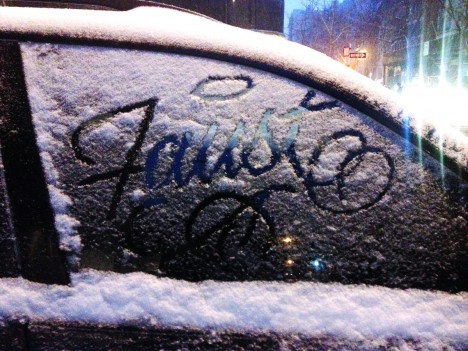
snow calligrapher signature work

For years, this graffiti calligrapher has made his mark around New York City, but some of his best work is reserved for special (and somewhat unpredictable) occasions, relying on seasonal snowfall.

Processed with VSCOcam with lv01 preset

Known for his interior and exterior calligraphic murals as well as his signature snow pieces, Faust notes that virtually “everyone has an affinity for writing in the snow as a child. When most people grow up they lose the urge. I guess I just haven’t been able to shake it.”

snow car front artwork

As with other forms of reverse graffiti, his snowy script is ultimately temporary and removes material that would be wiped and swiped away by brushes or wipers, thus leaving no lasting impact or damage.

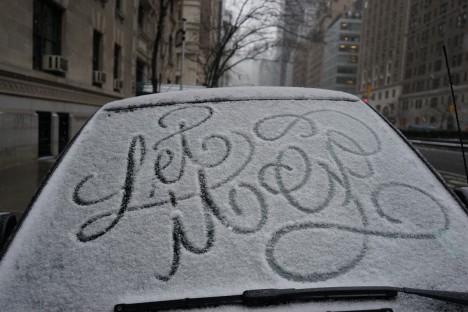
snowgraffiti car windshield

snow front of car

Some of his messages speak to the season (of snows and ice) while others are simply signatures left on the hood, trunk, windshield or window of a car as a simple surprise to brighten the dark winter days of passers by.

Share on Facebook


[ By WebUrbanist in Art & Street Art & Graffiti. ]

[ WebUrbanist | Archives | Galleries | Privacy | TOS ]


WebUrbanist

 
Comments Off on Snow Calligraphy: Reverse Graffiti Artist Tags Parked Vehicles

Posted in Creativity


Turn your DSLR Camera into a Wildlife Camera Trap

02 Mar

If you have an old DSLR camera lying around, you could be putting it to work as a camera trap for photographing wildlife.

What is a camera trap?

A camera trap is simply a camera that fires automatically when an animal is detected. All you need in order to turn your DSLR into a camera trap is a sensor that can detect animals, then trigger your camera. Once set up, a camera trap can be left for days or even weeks at a time. The longer you leave it, the greater your chances of capturing a shot of an elusive animal.

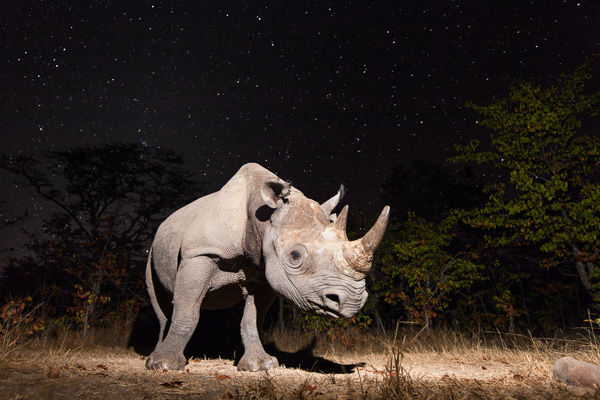
Camera trap 1

Black rhino at night in Zambia. A 30 second exposure time captured the stars. The rhino was illuminated by a flash at the start. I left my camera in the clearing for a week to capture this shot.

One of the main advantages of a camera trap is that you can take your time setting up off-camera flashes in order to achieve dramatically lit shots of nocturnal creatures. If you try to do this any other way, then the creature is likely to disappear well before you have finished setting up your lights!

As a result of these benefits, camera traps have become a key tool for wildlife photographers aiming to photograph shy and nocturnal animals.

So how do you set up a camera trap?

First, dig out that old DSLR that you don’t use any more. I mostly use a Canon EOS 1Ds Mark III. Camera traps can get much closer to animals than a human holding a camera, so you can use a wide-angle lens. My preferred lens is a 17-40mm f/4 lens.

Next, you need a way of detecting the animal and triggering your camera. If you are a handy, DIYer then you can do this by modifying a security device (I provide more information about how to do this on my website). The two most commonly used types of detector are beam-break and motion detectors.

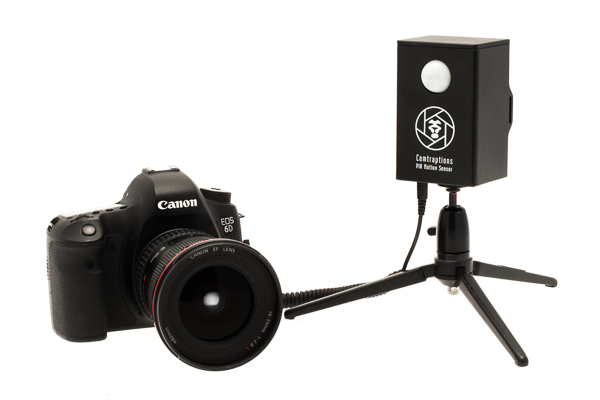
My preferred method of detecting animals is to use a Passive Infrared (PIR) motion sensor. This is similar to the sensor used on automatic patio security lights. I like these because they don’t consume much power, so they can remain on standby for a long period of time. They are also very easy to set up – you just point them at the trigger zone and wait for the animal to show up.

Camera trap 2

A PIR Motion Sensor plugs in to your camera’s shutter release socket

Now you have the camera and the trigger sorted, the next thing you need is a speedlight (flash), or two, so that you can capture nocturnal subjects.

I recommend setting up one or more off-camera flashes, connected to your camera with a TTL flash cord. It is important to get the flashes away from the camera itself because this will reduce redeye and make the shadows look more natural.

Camera trap 3

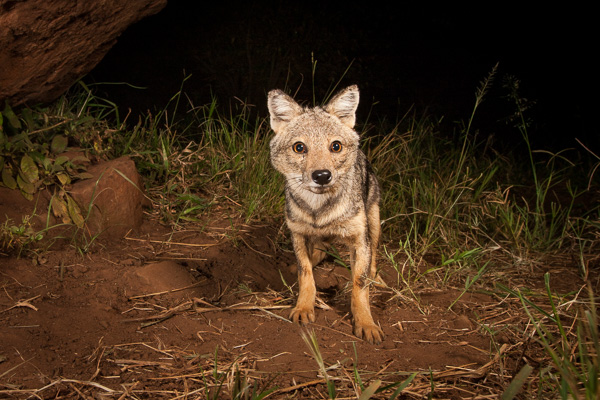
Side-striped Jackal, Kidepo Valley, Uganda. This is an example of a dual flash setup, with a primary light source on the right and a fill flash on the left.

I often just use one flash because I quite like dramatic shadows. However, sometimes, it is preferable to use a second flash to fill-in the shadows on the subject. If you want to get even fancier, you can also add more speedlights to illuminate the background.

Camera settings

The challenge with camera traps is that you don’t know when the animal will pass and therefore the camera and flashes need to be programmed so that the scene is attractively exposed in any lighting condition. Here are some general settings that I find work well in most situations.

Use manual focus and either low speed burst or single shot mode. Set the camera to aperture priority mode with a reasonably small aperture to provide a large depth of field. This means, if the animal isn’t quite in the right position, you should still get a sharp shot.

Camera trap 4

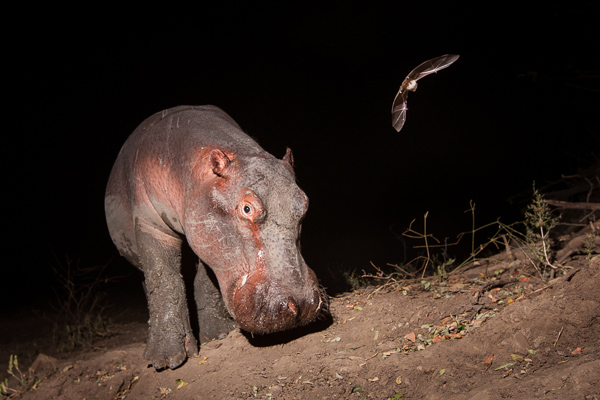
A hippo and a bat in Zambia. This was a lucky shot where the bat happened to be flying around the hippo. A small aperture ensured both animals were in focus.

Selecting aperture priority means that in darkness, the camera will select a long shutter speed. This means it will capture details in the background such as twilight colours in the sky, or even stars. However, if there is too much ambient light, then you may get ghosting when the animal moves. If ghosting is a problem for you then, limiting the shutter speed to one second or faster can help.

If I am using a single flash then I will leave it in TTL mode so the camera automatically determines the flash output based on its metering. For a multiple flash setup, it is usually easier to set the flash outputs manually. With manual flash output and your camera in Av mode, you may need to under-expose your camera (using exposure compensation) by a stop so that daylight images don’t blow-out.

Power considerations

If you plan to leave you camera trap set up for more than a night, then battery life will be an issue. Make sure your camera is set to power off and that it can be woken by the sensor. I also recommend turning off the image preview to conserve battery. Your camera should now be able to last for many days, assuming it isn’t firing the whole time.

Keeping your flashes powered is more challenging. Speedlights have a capacitor inside them which needs to be charged for the flash to fire. However, capacitors drain over time so flashes needs to constantly keep them topped up. If your flash isn’t set to sleep, then the batteries are likely to drain over the course of a single night. If your flashes are set to sleep then when you need them to fire, the capacitor may not have enough charge and so the flashes won’t be ready to fire immediately.

There are three ways to deal with these issues:

  1. Disable your flash’s sleep function – your flash will always be ready to fire but you will probably have to change the batteries every day, or power them with an external power supply.
  2. Use a flash that holds its charge well, even when sleeping. The best I know of is the Nikon SB-28, which can sleep for many days and still have enough charge in the capacitor to fire instantly.
  3. Set your camera to continuous drive mode and let your flashes sleep. The first and second shots may be black, but eventually your flashes will charge and fire.

If you are letting your flashes sleep, then you will need to connect them to your camera via a TTL cable. This allows your camera to wake the flashes. You will need long cords and a TTL splitter hub if you want to fire multiple speedlights.

Positioning your camera trap

Next you will need to find somewhere to set up your camera trap. The most productive places I have found are animal trails, particularly ones that cut through a difficult obstacle such as thick bush or a steep bank. I set my sensor up so that it covers a small section of the trail and then position the camera off to one side (so that it doesn’t block the animal’s path).

Camera trap 5

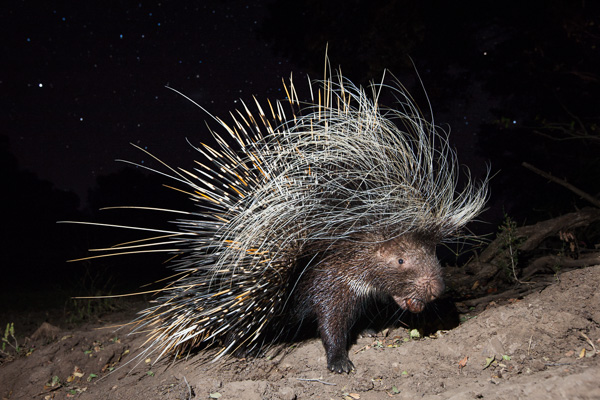
A porcupine photographed in Zambia. My camera was positioned next to an animal trail that lead up a steep bank. It captured many creatures including this porcupine.

The last thing to do is to camouflage, waterproof, and protect your equipment. Rain covers can be made from plastic sheeting. If you need protection from animals such as hyenas and lions then you will need to buy or build your own protective housing.

Once everything is set up, I recommend leaving your camera trap as long as possible in order to maximize the chances of getting results. You may just need to visit it from time to time to change batteries and check your settings.

I have created a series of videos that help illustrate the process of setting up a camera trap. You can watch the first video in this series below.

If you want more wildlife related tips and articles try these:

  • Writer’s Favorite Wildlife Lens – Tamron 150-600mm
  • Why Manual Exposure is Better for Winter Wildlife Photography
  • Nature and Wildlife Photography Tips for Beginners
  • Top 5 Tips for Wildlife Photography
  • Guide to Attracting Critters to Your Garden for Backyard Wildlife Photography

googletag.cmd.push(function() {
tablet_slots.push( googletag.defineSlot( “/1005424/_dPSv4_tab-all-article-bottom_(300×250)”, [300, 250], “pb-ad-78623” ).addService( googletag.pubads() ) ); } );

googletag.cmd.push(function() {
mobile_slots.push( googletag.defineSlot( “/1005424/_dPSv4_mob-all-article-bottom_(300×250)”, [300, 250], “pb-ad-78158” ).addService( googletag.pubads() ) ); } );

The post Turn your DSLR Camera into a Wildlife Camera Trap by William Burrard-Lucas appeared first on Digital Photography School.


Digital Photography School

 
Comments Off on Turn your DSLR Camera into a Wildlife Camera Trap

Posted in Photography