RSS
 

Archive for March, 2015

Win One of FOUR Online Photography Courses from New York Institute of Photography

04 Mar

Over the past few years here at dPS, we have run some of our most popular competitions with a very valued partner – the New York Institute of Photography – to give away to dPS readers handpicked photography courses.

Due to popular demand, NYIP and dPS bring you yet another opportunity to win one of these valuable courses!

NYIP logo440x232black In Post Top and Bottom

For this competition, NYIP is giving away FOUR prizes

Each will be won by a different dPS reader. Here’s what you could win:

  • Wedding Photography Course – $ 999 Value
  • Portrait Photography Course – $ 999 Value
  • Travel Photography Course – $ 999 Value
  • Photojournalism Course – $ 999 Value

These are NYIP’s newest courses. They will teach you everything you need to know to take your skills to the next level in each category. These courses are all online. As a student you get access to videos and lesson materials prepared by experts in each field. You can access the course materials on any device, from anywhere in the world, and learn at your own pace.

NYIP Graphic In Post

How to Win

To win this competition you’ll need to:

  • Visit each of the above four course information pages and choose which of the courses suits your needs best. Choose one that you’d like to win.
  • Leave a comment below and tell us which one you’d like to win and WHY you’d like to participate in the course. Please note: there is a limit of ONE entry per person.
  • Do this in the next 10 days and after March 13th, the team at NYIP will choose the best four answers – one for each course – and we will announce the winners in the following days.

The deadline to enter is March 13th, Midnight PDT (GMT-7). Comments left after the deadline will not be considered.

By best – we’re looking to see if you have an understanding of what the course offers and how it suits your needs, so you’ll need to check out the course pages to put yourself in the best position to win.

There’s no need to write essay length comments to win, but we’re looking to hear what you like about the course and how it would help your development as a photographer.

This competition is open to everyone around the world, no matter where you live, but there is only one entry per person.

To enter, simply leave your comment below.

Don’t forget to share this post with your friends and like NYIP on Facebook for special offers and announcements on all NYIP Courses

NYIP logo440x232black  In Post Top and Bottom

Learn more about NYIP’s online photography courses.

Disclaimer: NYIP is a paid partner of dPS.

googletag.cmd.push(function() {
tablet_slots.push( googletag.defineSlot( “/1005424/_dPSv4_tab-all-article-bottom_(300×250)”, [300, 250], “pb-ad-78623” ).addService( googletag.pubads() ) ); } );

googletag.cmd.push(function() {
mobile_slots.push( googletag.defineSlot( “/1005424/_dPSv4_mob-all-article-bottom_(300×250)”, [300, 250], “pb-ad-78158” ).addService( googletag.pubads() ) ); } );

The post Win One of FOUR Online Photography Courses from New York Institute of Photography by Darlene Hildebrandt appeared first on Digital Photography School.


Digital Photography School

 
Comments Off on Win One of FOUR Online Photography Courses from New York Institute of Photography

Posted in Photography


The Ultimate Guide to Buying a Tripod

03 Mar

You need a tripod for long exposures

Picture the scene – Bangkok airport and I’m settling into seat 16H on my short Thai Airways flight to Siem Reap, Cambodia. The lovely hostess hands me a hot, scented towel as I shout ”Bollocks” while slapping myself firmly on the forehead.

She gives me a justified look of disdain while I apologize for my outburst and then start begging her to contact Lost & Found as soon as possible. You see, I’d stupidly left my gorgeous carbon fibre, ball head tripod, in one of those plastic trays into which all airports now force you to empty your worldly goods before being forced through the X-Ray machine.

I’d somehow managed to wander through Bangkok airport, grab a snack, check my email and then board the plane without even realizing I’d lost one of my most essential pieces of equipment. I blame it on the terror filled drive through downtown Bangkok the night before while trying to find our hotel, it was a late night.

I realize I will never see that beloved tripod again.

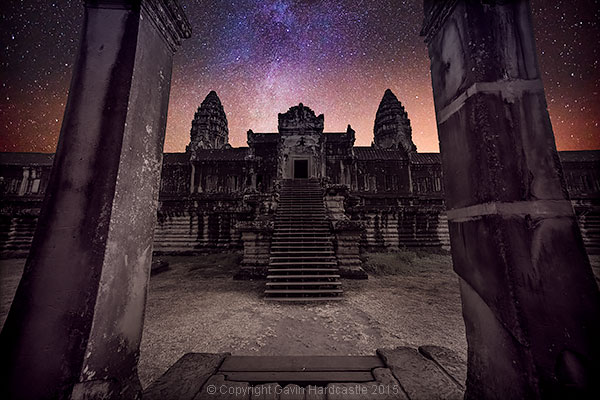
Night Photography requires a sturdy tripod

So I touch down in Siem Reap, Cambodia and the first thing I do is go shopping for a tripod. Siem Reap has seen some major development over the years but it’s still a galactic black hole when it comes to tripod shopping.

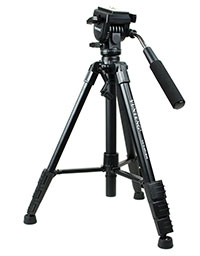
The best I could find was a $ 45 Yunteng tripod with a plastic video panning tripod head that has one of those long handles that poke you in the eye every time you try to look through the viewfinder.

It was like going back in time to the very first tripod I’d ever bought. The next four days of shooting were an exercise in rage management as it took me five times longer to set up my shots. If it hadn’t been for my ever present tuk-tuk driver and his calming influence, I would have bent that tripod over my knee and tossed it under the wheels of a bus for good measure.

No wonder so many beginner photographers quit at the tripod using stage.

A good tripod makes ALL the difference

When buying a tripod, if you go for an El Cheapo one, two things will happen:

  1. You’ll spend so much time messing around getting your camera in position that by the time you’re ready to take the shot, you’ve already lost the will to live.
  2. You’ll realize that the $ 45 you spent could have gone towards a proper tripod that you now know you’ll have to buy anyway.

I realize that for total beginners, spending around $ 400 on a tripod seems like a major financial commitment but I’ve seen so many of my workshop students struggle in frustration with shoddy tripods that it breaks my heart. When I lend them one of mine, it’s like a ray of sunshine for them. At that point they realize their cheap tripod is now junk.

Long exposure - Why You Need a Good Tripod

Speed is important

You might think that if you’re using a tripod to hold your camera in place, that means you’ve got plenty of time to frame your shot. Sometimes that’s true but more often than not, the scene changes quickly, especially when you’re dealing with nature. Weather and wildlife won’t wait for you to get your tripod set up.

Things to consider when buying a tripod and tripod head

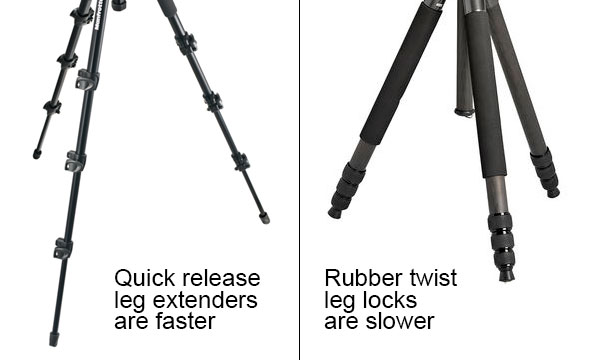
1 – How fast do the legs telescope?

I can’t stand those rubber twist leg locks that you have to loosen and then tighten. I much prefer quick release grips that flick open and quickly drop those tripod legs. Securing the extended legs requires a quick push of the thumb and you’re done. If your tripod has four telescopic extenders with threaded grips you’ll still be setting up your shot while I’m at the next shooting location.

Tripod Comparison

2 – How fast does the ball head adjust?

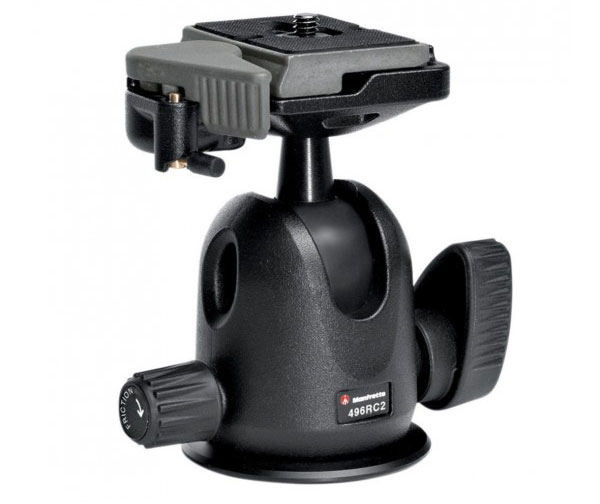
Once your tripod is in place and secure, it’s time to position your camera. For me, the best ball heads are those that only require one lever to loosen and tighten. That means that with just two turns of the lever I can position my camera in exactly the right position.

It’s also important to get a ball head that allows you to quickly switch between landscape and portrait aspect. A lot of cheapo tripods have those flippable mounts that you have to loosen first then tighten once in place. These are usually abysmal as you struggle to get just the right position and then the flimsy flippable part wobbles from the impact of just your breathing.

Ball Head Tripod

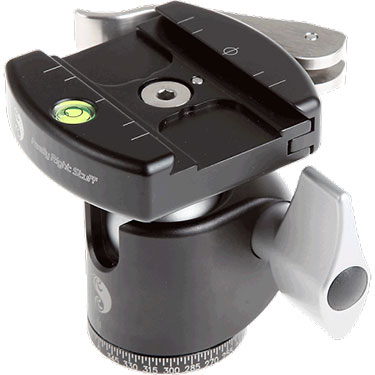
Manfrotto 496RC2 ball head


3 – Easy quick release

The thing that infuriated me the most with my temporary $ 45 Yunteng tripod was the quick release clip which mounts the camera on to the tripod head. I longed for my well oiled Manfrotto head with its trusty quick release clip.

Mounting the camera on the tripod head should be quick and easy. When shopping for a tripod, get the store clerk to demonstrate and then try it out yourself multiple times until you feel if it’s right for you. Some of the smoothest looking quick release plates I’ve seen are made by Really Right Stuff.

Really Right Stuff Quick Release Plates

4 – How heavy should my tripod be?

This is a personal choice based on your exact needs, and how much you can carry. There’s always a trade-off between portability and sturdiness. Heavier tripods will laugh in the face of a strong wind, while super lightweight carbon fibre tripods will vibrate. You can always attach a rock filled bag to the central stem of your tripod to give it more stability in high winds.

5 – How big should my tripod be?

Again, this depends on your travel plans. Since my recent loss at Bangkok airport, I’m now considering buying a smaller tripod that will actually fit into my camera bag. A smaller tripod won’t be anywhere near as sturdy, but for the Siem Reap shoot it’s not as if I had to face high winds and extreme weather, so smaller would have been okay.

Very tall photographers will most likely have to shop for tripods that cater to their height. Sure, you can always extend your tripod’s central column, but that’s always a last resort as you’ll find it induces major wobble from just your hand contact with the camera.

6 – How much should I spend?

Here’s another important thing to consider. If like me, you’re a bit of a Gormclops, don’t buy the best that you can afford. I abuse my tripods by shooting in the ocean, rivers, deserts and mountains. If I’m lucky, I’ll get two years out of a tripod (assuming I don’t leave it in the airport) so it just doesn’t make sense for me to spend big money when I can get a very capable tripod for under $ 400, that already comes with a good ball head.

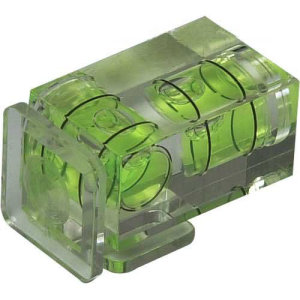
7 – Do I need a bubble level?Camera Bubble Level

Although not essential, it’s nice to have an accurate bubble level on the tripod stand itself, and one on the tripod head. If you’re lucky enough to have a digital level inside your camera (like my Sony A7R) you probably won’t use a bubble level much. If you have neither, you can always attach a bubble level to your cameras hot shoe attachment as pictured here (see photo right).

Why do I even need a tripod?

If you want tack sharp images (see my article on how to get super sharp landscape images) with the best possible image quality, accept that a tripod will become a part of your anatomy. For long exposures, a tripod is essential. If you shoot weddings, portraits, action and events, a tripod may just get in your way.

Which brands should I buy?

I’m not going to recommend one brand over another. I advise that you try out as many tripods and heads as you can. It’s fine to read reviews but you need to get hands on to decide which tripod and head combination works best for your needs. A specialist camera store should have a much wider choice of consumer and pro level tripods to choose from.

Enough Yunteng Bashing

Cheap Yunteng TripodTo be fair to Yunteng, I got the sturdiest tripod I believe it’s possible to find for a measly $ 45. It didn’t fall apart, was light, and in all honesty the tripod head was made for video, not stills. I got exactly what I paid for. I’ll keep it in my studio as a demonstration tool for showing people the difference between a $ 45 tripod and a $ 400 tripod.

What features do you look for in a tripod? Do you have any horror stories or recommendations for our readers?

googletag.cmd.push(function() {
tablet_slots.push( googletag.defineSlot( “/1005424/_dPSv4_tab-all-article-bottom_(300×250)”, [300, 250], “pb-ad-78623” ).addService( googletag.pubads() ) ); } );

googletag.cmd.push(function() {
mobile_slots.push( googletag.defineSlot( “/1005424/_dPSv4_mob-all-article-bottom_(300×250)”, [300, 250], “pb-ad-78158” ).addService( googletag.pubads() ) ); } );

The post The Ultimate Guide to Buying a Tripod by Gavin Hardcastle appeared first on Digital Photography School.


Digital Photography School

 
Comments Off on The Ultimate Guide to Buying a Tripod

Posted in Photography


Tips for Photographing Cars

03 Mar

tips-photographing-cars-01

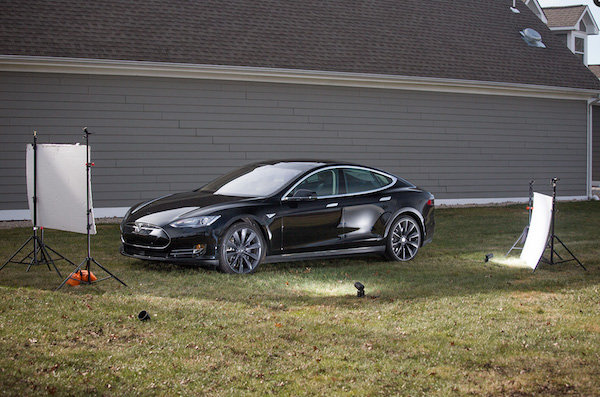
The scene setup – by placing parking a car in the shade of a building on a sunny day, you can use the ambient light as your main light, illuminating the contours of the vehicle.

Photographing reflective surfaces is no walk in the park. So, as you can imagine, photographing cars, which are essentially just giant reflective objects, is really difficult. It comes with all the same challenges, magnifies them, and adds the new wrinkle of your subject being too heavy to reposition easily. Sounds like fun, right? It can be, and it can still be pulled off without the use of a commercial studio, a giant cyclorama wall, or car-sized softboxes.

Made in the Shade

Take a look at the image above, you can see that I have a Tesla Model S set up in the shade of a building, on a sunny day. By positioning the car so that the ambient light illuminates the overall contours of the car and then placing lights in the shadow areas, it treats the ambient as the main light, and uses the surroundings to advantage, rather than fighting against them. This will minimize the frustration of trying to eliminate the ambient light, which would likely be an exercise in futility, especially when using small flashes.
tips-photographing-cars-02

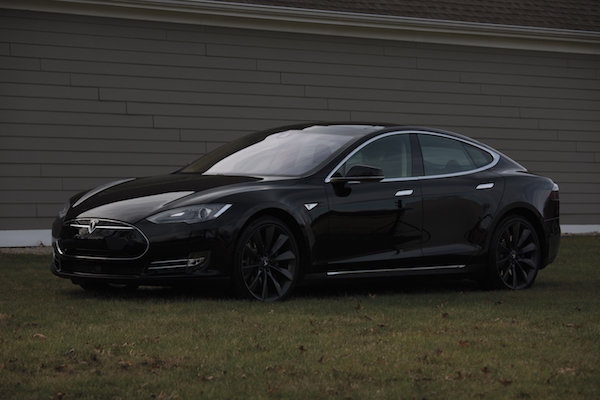
The ambient light reading – by exposing for the highlights on the car’s windshield, I was able to determine which areas in which to add flash.

Before setting up any lights it’s helpful to start by taking a test shot, getting an exposure of the car’s highlights, especially such as the windshield, which would typically be the brightest spots. This exposure will likely look pretty dark, not unlike the image above. It will allow you to see exactly what the ambient light is doing and whether you need to reposition the car to change the angles of the light falling on the car. This exposure will also help you to determine where to add your flashes. The diagram below shows the lighting diagram used for the Tesla shot.
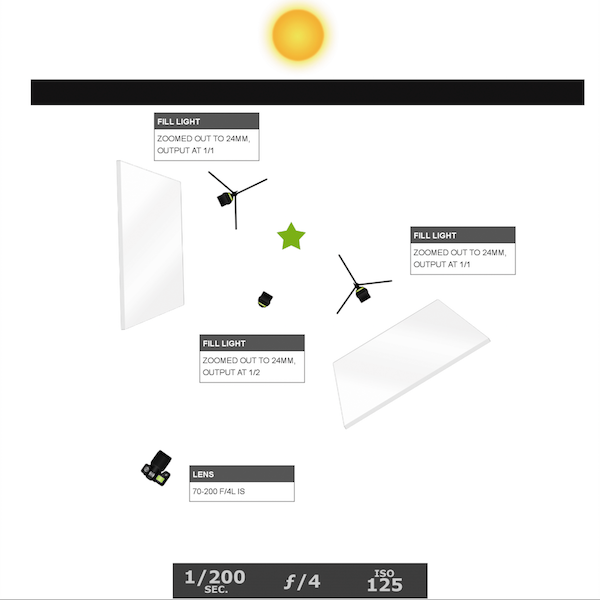
tips-photographing-cars-03

The lighting diagram – after getting an exposure of the ambient light, I was able to determine where to best place my three speedlights.
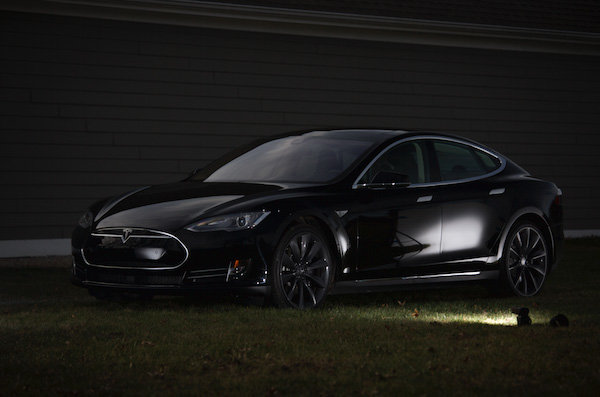
tips-photographing-cars-04

The raw file – the shadow areas are filled in with accent lights, although some cleanup in post-processing was needed.

I own three flashes, and I needed all of them for this shoot. When lighting reflective surfaces, you need a large, soft light source. To accomplish this, I brought several 40×60” white foam core panels with me, along with several light stands and sand bags. I set up two panels, one at each end of the car, securing them to light stands. I then aimed a full-powered flash into each panel. Since I couldn’t set up a third panel to light the middle of the car without blocking my view of it, I set my third flash on the ground, aiming it into the tire rim. The light placement was effective, although a bit of cleanup in post was still needed.
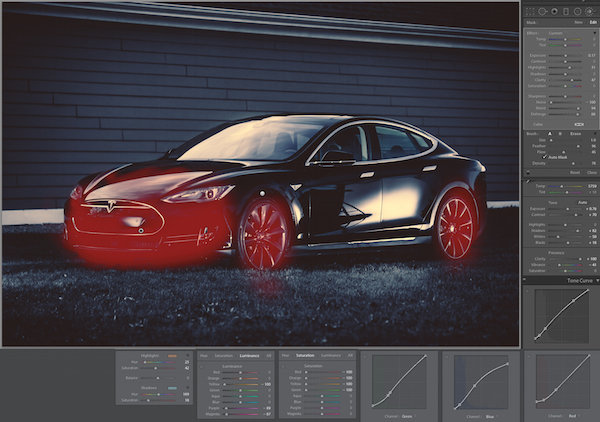
tips-photographing-cars-05

The lightroom settings – I chose to desaturated the image, one color channel at a time (rather than toggling over to Black and White mode or lowering the global saturation) in an effort to retain the mood in the photo.

The most obvious issue that needed taken care of was the unsightly reflection in the car door. Though the white panel served in lighting the contours of the side of the car, it left a garish reflection. Eliminating it required something a bit more powerful of a tool than the what Lightroom’s Spot Removal tool offered. Instead, I used Lightroom to color grade the image as well as bring up the highlights in a few areas, (see above). The red highlighted areas show where I painted in a brush adjustment, raising up the Exposure, Brightness, and Clarity sliders.

I also chose to desaturate the image, since it was already essentially monochromatic, except for the grass. Note that I kept the file in Color mode, rather than toggling over to Black and White mode or lowering the global saturation, and opted to instead desaturate the individual color sliders in the HSL panel. This is because I wanted to preserve the dark, moodiness in the image, and for reasons I don’t didn’t quite understand, the overall brightness of the image increases when I toggle over to Black and White mode. I also used the Luminance sliders to control the highlight and shadow portions of the image. For example, by lowering the Yellow slider in the Luminance panel, I dimmed the highlights in the grass, which had yellow in it, and shifted the focus back to the car.
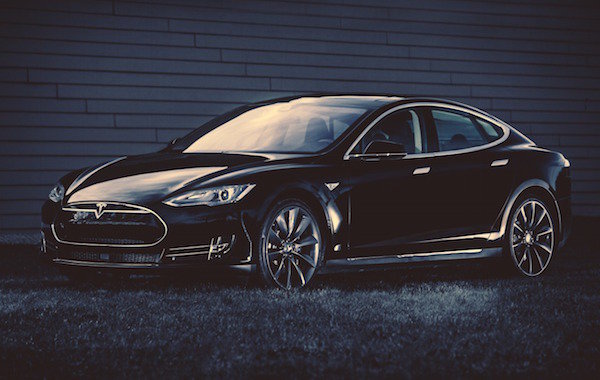
tips-photographing-cars-06

The final shot – once the image was color graded and minor spots had been removed, I opened up the file in Photoshop to remove the white-board reflections, specifically the white panels at the base of the building in the background and the edge of the roof, (Figure 6). If specialized cleanup is not your forte, it’s totally acceptable (if not recommended) that you send the file off to a retoucher to finish it up for you.

Attention to Detail
Tips photographing cars 07

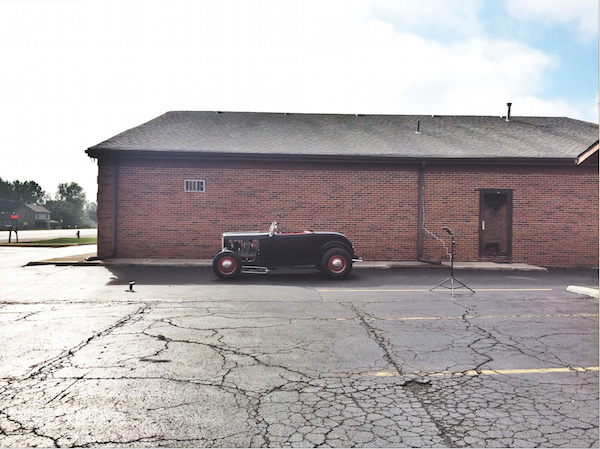
The setup – I am not a car person. By that I mean that I couldn’t tell you one old hot rod from another. That said, I find them to be absolutely gorgeous objects to look at. So, when the owner of this beautiful machine led me back to the spot where his latest project sat, I got really excited when my eyes caught sight of the immaculately restored, 1932 Ford Roadster (I only know the name because he told me). The details were phenomenal. Though I knew nothing of its history, and didn’t even really care about driving it or even riding in it, I knew that I had to photograph it. The owner pulled out a vintage magazine photo of a similar car and asked if I could make a photo that looked like that. I smiled and said, “We can do better than that.”

But first, the car needed to move. He had parked the car in front of a large, white door, in full view of the morning sun. This meant harsh, direct light, which was unflattering and boring. I quickly scanned the area, spotting a one-story brick building across the street, with a wall, still in the shade. I asked if he could drive the car over there, positioning it just inside the shade (see above).
Tips photographing cars 08

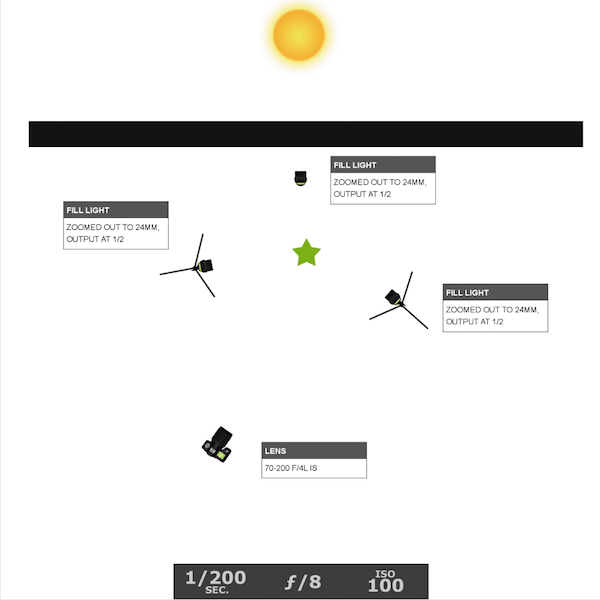
The lighting diagram – similar to the previous Tesla scenario, I used two of my lights to illuminate the front, and back ends, of the car. This time, however, I placed my third light between the car and the back wall, creating a nice separation between them.

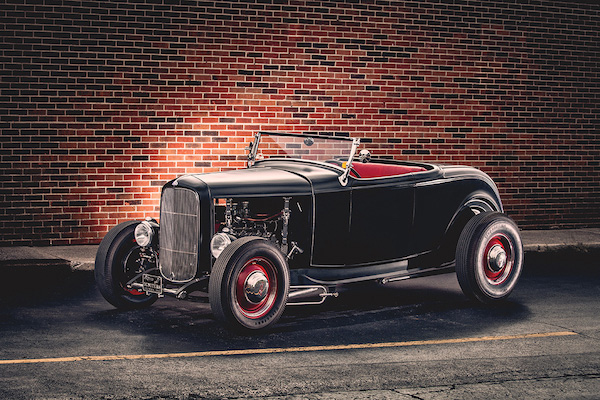
Since I had come to the shoot prepared to photograph portraits and not cars, I didn’t have white panels to bounce light off of. I still only had three flashes that I could use to light an entire car. But just like the previous scenario, I used the ambient sunlight as the main light, adding accent lights to the front and back portions of the car. It helped that I had less car to light. This was a two-seater roadster, and thus was about three feet shorter than the Tesla. This meant that the back rear flash was able to light both tires this time, freeing up my third light to be placed between the car and the building behind it. That created a nice separation between the car and the wall. It also served to highlight the amazing detail of the open-air hood, which allowed you to see straight through to the wall (see below)
Tips photographing cars 09

The final shot – my favorite part is the open-air engine that allows you to see straight through to the back wall.

Do you have any other tips for photographing cars? If you’ve tried it share your ideas. If you haven’t give it a try and share your images and any questions you may have.

googletag.cmd.push(function() {
tablet_slots.push( googletag.defineSlot( “/1005424/_dPSv4_tab-all-article-bottom_(300×250)”, [300, 250], “pb-ad-78623” ).addService( googletag.pubads() ) ); } );

googletag.cmd.push(function() {
mobile_slots.push( googletag.defineSlot( “/1005424/_dPSv4_mob-all-article-bottom_(300×250)”, [300, 250], “pb-ad-78158” ).addService( googletag.pubads() ) ); } );

The post Tips for Photographing Cars by Nick Fancher appeared first on Digital Photography School.


Digital Photography School

 
Comments Off on Tips for Photographing Cars

Posted in Photography


Kunst im Museum

03 Mar

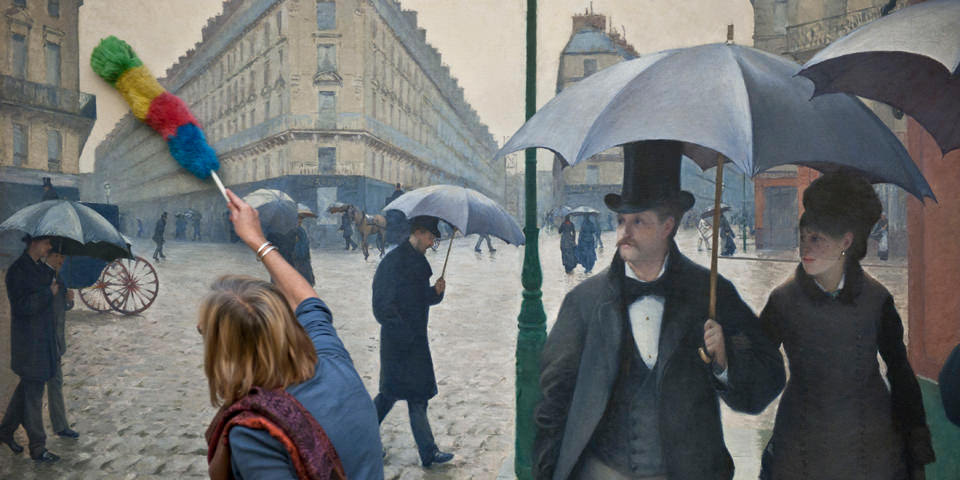
Eine Frau putzt ein Gemälde

Kunst ist genau das, was man in einem Museum erwartet. Aber der französische Fotograf Nicolas Krief zeigt in seiner Serie „Accrochages“ (frz. „Zusammenstöße“) einen völlig neuen Blick auf diese Kunst. Mit einem großartigen Sinn für Humor sieht er hinter die Kulissen des Museumsalltags.
kwerfeldein – Fotografie Magazin | Fotocommunity

 
Comments Off on Kunst im Museum

Posted in Equipment


Geodesic Housing for the Homeless: Dome Made of Umbrellas

03 Mar

[ By Steph in Drawing & Digital. ]

earth lander 1

Could a low-cost, lightweight geodesic dome made from umbrellas, garbage bags and a space blanket provide a real life-saving solution for people forced to sleep on the streets? ‘Earth Lander’ reclaims common materials in totally unexpected ways for a visual result that looks just as its name suggests, and it’s thermally efficient, providing a warm space that’s also resistant to water and wind.

earth lander 2

earth lander 3

Umbrella frames were altered to make them more structurally secure, and combined with waterproof umbrella fabric to create the outer structure. Air-filled garbage bags, cellulose wool and a space blanket provide insulation.

earth lander 4

earth lander 5

The umbrellas were assembled to create a geodesic dome that Bucky Fuller would be proud of. The transparent trash bags act as inflatable windows so the inhabitant can peer outside, and the octagonal door is secured with ties.

earth lander 6

earth lander 7

It’s an intriguing idea that could help save the lives of countless homeless people who die from exposure each year during the harsh winter months, and keep them dry in other seasons. Check out 14 more innovative ideas for homeless housing, from similar short-term survival shelters to long-term transitional living spaces.

Share on Facebook


[ By Steph in Drawing & Digital. ]

[ WebUrbanist | Archives | Galleries | Privacy | TOS ]


WebUrbanist

 
Comments Off on Geodesic Housing for the Homeless: Dome Made of Umbrellas

Posted in Creativity


Nikon introduces Coolpix P900 with whopping 83x optical zoom range

03 Mar

Nikon has extended its superzoom range to include the Coolpix P900, offering a 16MP sensor and world’s longest zoom lens, which is equivalent to a mind-boggling 24-2000mm. It features built-in Wi-Fi with NFC, 7 fps burst shooting, built-in EVF and a fully articulated 3″ 921k-dot LCD. The P900 uses a new Dual Detect optical image stabilization system, claiming up to 5 stops of shake compensation. Read more

Articles: Digital Photography Review (dpreview.com)

 
Comments Off on Nikon introduces Coolpix P900 with whopping 83x optical zoom range

Posted in Uncategorized


Nikon D7200 boasts low-light AF improvements and increased buffer depth

03 Mar

Nikon’s prosumer line gets an update today in the form of the D7200. With a 24.2MP APS-C CMOS sensor it offers a very slight resolution increase over its 24.1MP D7100 predecessor, and like that model it lacks an optical low-pass filter. But the D7200’s primary enhancements include a next-generation 51-point AF module with increased low-light sensitivity, built-in Wi-Fi with NFC and an improved 100-shot buffer depth when shooting JPEGs or Raw files at 6 fps. Read more

Articles: Digital Photography Review (dpreview.com)

 
Comments Off on Nikon D7200 boasts low-light AF improvements and increased buffer depth

Posted in Uncategorized


In the Spotlight: Sony Alpha 7S Review posted

03 Mar

The Sony Alpha 7S is a full-frame interchangeable lens camera sporting a 12.2MP CMOS sensor. It is identical in body design to the Sony a7 and Sony a7R, but don’t let that fool you. Unlike the other two, the a7S is specially geared toward video and low-light shooters. It’s capable of 1080/60p video with full-sensor readout and can turn out uncompressed 4K footage to an external recorder over HDMI. Read review

Articles: Digital Photography Review (dpreview.com)

 
Comments Off on In the Spotlight: Sony Alpha 7S Review posted

Posted in Uncategorized


Lowepro launches Echelon luxury bag line

03 Mar

Lowepro has announced a line of new photography bags with a high-end design. The Echelon series includes a roller, laptop brief and attache with premium touches like leather handles and each piece includes a removable All Weather cover. We took the attache model for a spin – find out our first impressions of it. Read more

Articles: Digital Photography Review (dpreview.com)

 
Comments Off on Lowepro launches Echelon luxury bag line

Posted in Uncategorized


2. März 2015

03 Mar

Das Bild des Tages von: Ronny Garcia

16648495791_6753b37d9c_b_Ronny Garica

Im Ausblick: Ein umstrittenes Fotoprojekt. Was darf Kunst?
kwerfeldein – Fotografie Magazin | Fotocommunity

 
Comments Off on 2. März 2015

Posted in Equipment