RSS
 

Archive for February, 2015

CP+ 2015: First samples from the Sigma 24mm F1.4 DG HSM Art lens

12 Feb

We’re at the CP+ show in Yokohama Japan, where Sigma is showing its brand new 24mm f1.4 full-frame prime lens. The latest in the company’s ‘Art’ series of fast primes, we have high hopes for the new lens based on our extremely positive impressions of the 35mm and 50mm lenses which have come before it. Sigma very kindly let us shoot some sample images on a late pre-production lens and it does indeed look very, very nice. Click through to take a look.

Articles: Digital Photography Review (dpreview.com)

 
Comments Off on CP+ 2015: First samples from the Sigma 24mm F1.4 DG HSM Art lens

Posted in Uncategorized


Das zersplitterte Phantásien

12 Feb

Kasmodiah 2 © Tabea Simple

Puppenaugen aus Glas schauen mich an. Das Licht ist diffus und die Gestalten darin seltsam verbogen. Die Farben sind da und sind es doch nicht. Aus den Augen einer Frau wachsen Blütenblätter und auf der Anhöhe einer Wüstenlandschaft betrachtet mich eine stolze Königin mit aufgefächertem Kragen.

Ich träume nicht und doch könnte es einer meiner Träume sein, in denen ich mich gefangen fühle, aber mit kindlicher Neugier den Gestalten stelle, die sich vor mir auftun.

Ein Kind mit geschlossenen Augen liegt da und öffnet den Mund.

Eine Frau schwimmt halbnackt.

Ich kenne die Arbeiten von Tabea Simple schon lange und immer wieder verirre ich mich auf ihre Seite. Lasse mich von ihren Bildern in den Geschichten treiben. Warum ich sie nicht schon längst hier vorgestellt habe, ist mir ein Rätsel. Vielleicht ist das manchmal so: Du findest etwas, es berührt Dich und Du verwahrst es für Dich. Aber jetzt ist Schuss damit. Hier ist sie!

Tabea erschafft Wesen, die an eine verzerrte und viel morbidere Alice im Wunderland erinnern. Ihre Geschöpfe können Angst machen und das ist es, was den Betrachter in die Bilder hineinzieht. Sie konfrontiert uns mit dem Schönen und Hässlichen, mit dem Traumhaften und Albtraumhaften. Sie fordert uns auf, weiter zu schauen, die Bilder zu hinterfragen und somit auch uns selbst.

Eine Königin steht auf einer Düne.Eine Frau mit einer Puppe

Was zunächst an sehr gut gemachte Fashion-Fotografie erinnert, ist weit mehr als das, nämlich Bilder mit einer Tiefe, so tief, dass ich Gefahr laufe, zu stolpern und hineinzufallen, wenn ich nicht aufpasse, wo ich meinen Blick absetze.

In ihren Bildern steht kein Label im Vordergrund, keine Firma, die sie beauftragt. Die Kleider und Requisiten findet sie auf Flohmärkten. Sie nimmt sie mit nach Hause und verändert sie, so dass es oft zu einem Überraschungsmoment kommt, wenn sie gewöhnlichen Flohmarktfunden neues Leben einhaucht und eine neue Bedeutung. Und so kann ein einziges Bild eine ganze Geschichte sein.

Eine Frau steht vor einem Einhorn.

Eine Frau trägt einen roten Stern.

In ihrer Welt dürfen wir träumen, singen und tanzen. Wir dürfen Abenteuer bestehen oder uns in der Falte eines alten Kleides wiederfinden, aus dem wir wie ein Winzling blicken und staunen. Ich bin mir sicher, Michael Ende hätte seine wahre Freude an ihren Geschichten.

Seit 2014 muss sie die Outfits ihrer Modelle übrigens nicht mehr allein herstellen. Sie hat die Modedesignerin Florina Farcas kennengelernt und die beiden sind augenscheinlich ein gutes Team.

Eine Frau liegt auf dem Rücken und schaut in die Kamera in einem fast durchsichtigem Kleid.Eine Frau und eine Doppelbelichtung.

Seit vier Jahren fotografiert Tabea Simple und seitdem werden auch die Settings umfangreicher. Dennoch versammelt sie kein großes Team um sich, verlässt sich aber gern auf eine helfende Hand, ihren Mann und eine Visagistin. Es wird auch kein großes Lichtarrangement getroffen, sondern mit natürlichem Licht gearbeitet, was sie immer wieder vor neue Herausforderungen stellt.

Derzeit arbeitet sie an einem Buch, das ihre besten Arbeiten der letzten vier Jahre beinhalten soll. Ich bin sehr gespannt und werde sie nicht aus den Augen verlieren. Und wer noch weiter träumen möchte, der besucht ihre Webseite oder schaut auf Facebook vorbei.


kwerfeldein – Fotografie Magazin | Fotocommunity

 
Comments Off on Das zersplitterte Phantásien

Posted in Equipment


Jenga-Like Twisting Tower Won’t Leave Neighbors in the Shade

12 Feb

[ By Steph in Architecture & Offices & Commercial. ]

twisting tower 1

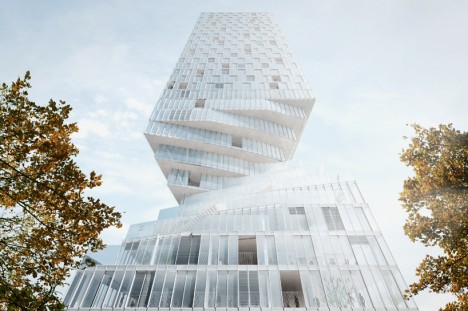
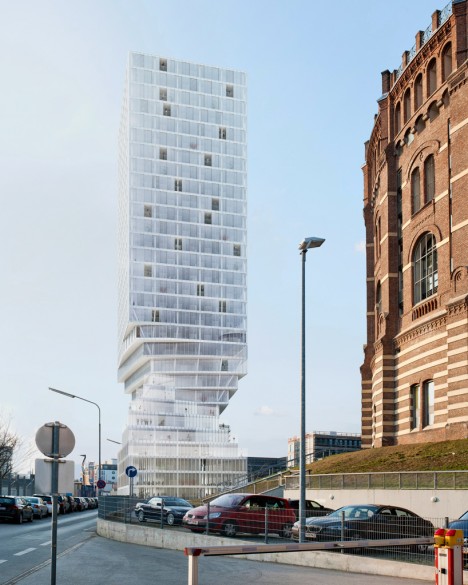
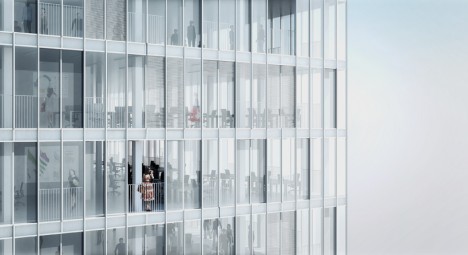
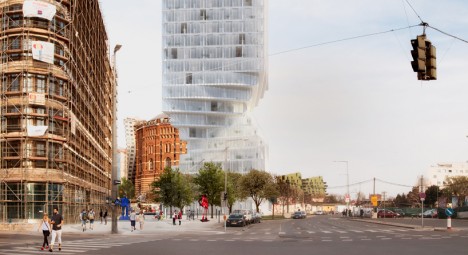
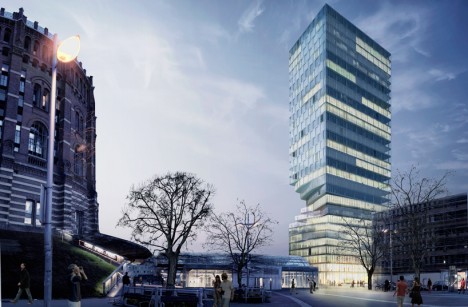
In order to get around strict city zoning regulations that forbid new structures from putting neighbors in the shade for more than two hours a day, architecture firm MVRDV devised a tower that twists upon itself to the point of seeming as if it could snap and fall over at any time. The twist creates an ultra-narrow profile right at the section of the building that would cast a shadow on nearby buildings.

twisting tower 2

twisting tower 3

From certain angles, it seems like chunks of the Hochhaus Tower have been taken right out near the base in a Jenga-like effect. Not only does this mean the bottom ten floors won’t cut off sunlight, it also routes strong winds away from the building’s plaza.

twisting tower 4

The twisting floors have outdoor terraces, while the rest feature glazed walls and 12-foot ceilings for sweeping views of Vienna and lots of natural daylight. The steel and glass facade will also have operable windows and full-height French doors.

twisting tower 5

Designed to be multifunctional for residential units, offices or other businesses, the Hochhaus Tower won three-stage international competition. Construction will begin in 2016, with an expected completion date of 2018.

Share on Facebook


[ By Steph in Architecture & Offices & Commercial. ]

[ WebUrbanist | Archives | Galleries | Privacy | TOS ]


WebUrbanist

 
Comments Off on Jenga-Like Twisting Tower Won’t Leave Neighbors in the Shade

Posted in Creativity


Out With The Old – In With The New

12 Feb


The LuLa team is back from the Antarctica trip.  We’ll have more to report on this trip soon.

This is a big week for Luminous-Landscape.  This Saturday, February 14th, we will be launching the NEW Luminous-Landscape.  We are very excited about this and we are sure you will enjoy the new look and ease of use.  We’ll have a lot more about the new site in the Welcome Article that will appear on the day of the launch.

Until this Saturday there will be no more stories added to the present LuLa site.  All articles previously published for the last 15 years will be available when we launch the new site this weekend.  

Sometime Friday afternoon the Luminous-Landscape site will go offline and be replaced with a Coming Soon Splash Screen.  This will also go for the Forum.  So if you have posting for the forum please finish them by Friday morning.  The forum will relaunch where it was stopped with the launch of the new site.

Once we flip the switch turning the new site on it could take between a few hours and 48 hours for all DNS Servers to see the changes around the world.  If all goes well we expect the new site to go live on Saturday afternoon Eastern Standard time US.

Thank you for your patience during this transition.


The Luminous Landscape – What’s New

 
Comments Off on Out With The Old – In With The New

Posted in News


Ricoh releases inexpensive all-weather AF201FG external flash

12 Feb

Ricoh has announced the AF201FG external flash for Pentax interchangeable lens cameras. The AF201FG is weather-resistant, can tilt down ten degrees and up ninety, and has a  guide number of 20 meters at ISO 100. It also weighs just 141g (5oz). The AF201FG will be available in March for $ 149/£129. Read more 

Articles: Digital Photography Review (dpreview.com)

 
Comments Off on Ricoh releases inexpensive all-weather AF201FG external flash

Posted in Uncategorized


11. Februar 2015

12 Feb

Das Bild des Tages von: ecce foto

After The Move © ecce foto

Fotolinks des Tages

1. Über die Grenze bringen

Der Fotograf Emanuele Satolli hat illegale Einwanderer in Amerika portraitiert, zusammen mit ihren Habseligkeiten, die sie auf ihrer gefährlichen Reise über die Grenze mitgenommen haben, und schafft durch seine Fotoserie einige Vorurteile von Amerikanern aus der Welt, die in den Flüchtlingen meist Gangster und Drogenhändler vermuten. → ansehen

2. Der Film „Life“

Filme über Fotografen oder über die Fotografie an sich sind momentan nicht selten, was uns durchaus freut. Der Film „Life“ von Regisseur Anton Corbijn ist einer davon und dreht sich um den Magnum-Fotografen Dennis Stock (gespielt von Robert Pattinson) und den Schauspieler James Dean (gespielt von Dane DeHaan). Mehr dazu weiß der Tagesspiegel. → ansehen

3. Fotografien zum Thema Mutterschaft

Kuratorin Susan Bright aus New York sucht momentan Fotografien über Mutterschaft für eine Ausstellung. Ein schönes, ausführliches Interview zum Thema und der Arbeit als Kurator gibt es auf „feature shoot“. Allein die vielen wunderbaren Fotos sind schon ein Klick wert. → ansehen


kwerfeldein – Fotografie Magazin | Fotocommunity

 
Comments Off on 11. Februar 2015

Posted in Equipment


Sigma announces pricing for 24mm Art and 150-600mm Comtemporary lenses

12 Feb

Sigma has attached prices to its very recently announced 24mm F1.4 Art lens, as well as the 150-600mm F5-6.3 super telephoto that appeared at Photokina. The full frame 24mm lens, which supports Canon, Nikon, and Sigma mounts, will be available next month at a price of $ 849. The 150-600mm – also designed for full frame bodies – will be priced at $ 1089 and will ship next month for Canon and Nikon mounts. Read more

Articles: Digital Photography Review (dpreview.com)

 
Comments Off on Sigma announces pricing for 24mm Art and 150-600mm Comtemporary lenses

Posted in Uncategorized


Depth of Field and the Importance Distance to Subject Plays

12 Feb

Let’s say that perhaps you’ve been taking photos for a while now. You’ve gotten yourself a good DSLR camera and have recognized that the standard 18-55mm kit lens that comes with your camera is nice, but just doesn’t give you the shots that you are looking for.
IMG

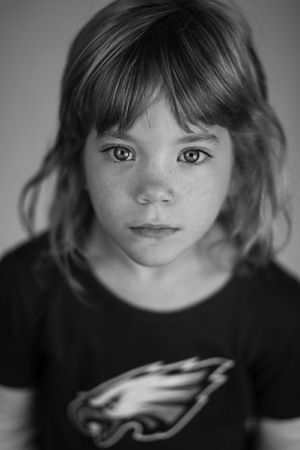
So you plunk down your money on the ever-popular 50mm f/1.8 prime lens that everybody is talking about, mount in on your camera, change your aperture to its widest (f/1.8) setting and start shooting. You spend all day shooting with this wonderful little lens and then you get home and put them on your computer and realize that 80% of your shots are out of focus.

In the past, when this used to happen to me, I would reason that shooting wide open was just not possible, because I ended up with too many shots that were out of focus. I incorrectly reasoned that I always needed to close down my aperture when shooting portrait subjects, or they would end up out of focus because the shallow depth of field was just too unusable wide open. For a while, I only used my 50mm 1.8 lens at f/4 because it was the widest aperture that I trusted to get the shot in focus. Crazy yes, I know. But then I figured out something that has changed my use of wide-aperture lenses forever.

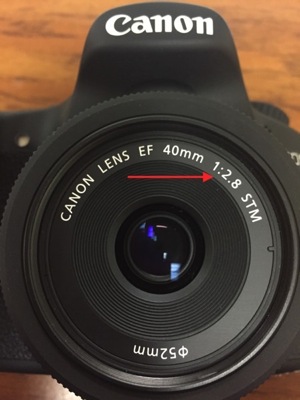
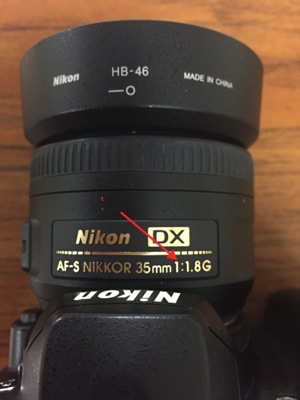
Before we continue, let’s break down the meaning of “wide open” and “fast prime lenses”. To shoot “wide open” means that you are choosing to photograph at your lens’ widest aperture setting or f-stop. On a lot of lenses, the widest aperture is listed somewhere on the lens itself with Canon usually listing it on the front of the lens, and Nikon listing this information on the body of the lens. Generally the ration looks something like this: 1:2.8 or 1:1.8. (See photos)

IMG 4418 IMG 4419

A “fast prime lens” is one that has one focal length (does not zoom) and has “fast” light-gathering ability (due to its wider apertures). Most photographers consider a fast lens to be one with an aperture number of f/2.8 or wider (the smaller the number, the wider the aperture). Two of the most popular features of fast prime lenses are their ability to obtain beautiful out of focus backgrounds and shallow depth of field, as well as their ability to handle low-light conditions because of the aforementioned large apertures.

Let me let you in on a little secret about shooting wide open – it’s about the distance to your subject. Most people learn that wide-aperture lenses blur the background and let in more light, but they never understand that the really neat shallow depth of field created by their lens is also affected by another factor; how close they are to the subject.

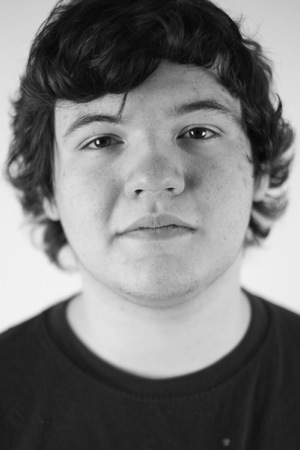
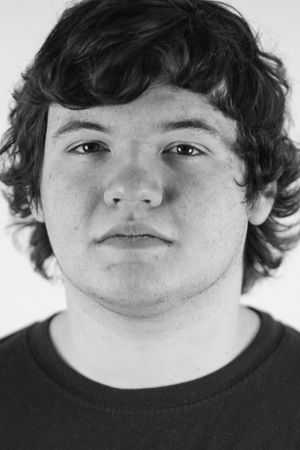
You won’t find many manuals on subject to camera distance. It’s kind of an assumed topic that doesn’t get enough attention. Let’s look at it as simply as possible: the closer you are to your subject, the shallower the depth of field is relative to your chosen aperture. In other words, if you are shooting at f/1.8 and you are 20 feet away from your subject, you will have MORE depth of field than you will if you are shooting 2 feet away from your subject.

To get more mathematical, if you’re using a 50mm lens at f/1.8 and photographing something at 4 feet, your depth of field will be around 1.5 inches deep. But if you photograph that same subject from 10 feet, you will have a depth of field of just under 10 inches deep.
2ft 35mmP

Shot at 2ft with a 35mm lens at f/1.4.

9ft 35mmP

Shot at 9ft with a 35mm lens at f/1.4. 

The right image cropped to similar framing as the left. Notice the increase in depth of field on the hair and ears, and also the reduction in lens distortion.

2ft 35mm

Shot at 2 ft with a 35mm lens at f/1.4.

9ft 35mm

Shot at 9ft with a 35mm lens at f/1.4. Cropped to similar framing. Notice how the pencils in the back row come into focus.

With this information, it is also very important that you get to really know your lens and its abilities. For instance, if you happen to know that you shoot a lot of portraiture close to your subjects, be aware of how much depth of field your lens gives you at three feet, four feet, and so on, when shooting wide open. In time, with experience, you will be able to immediately predict the depth of field your lens will give you based on the distance you are away from your subject.
5ft 85mmP

Shot at 5ft with an 85mm lens at f/1.4.

12ft 85mmP

Shot at 12ft with an 85mm lens at f/1.4.

The depth of field does increase slightly in the right image, but not as dramatically as the 35mm lens due to the 85mm longer focal length.

In conclusion, you can see that the reason your photos might be coming out blurry would be because of your distance to your subject when shooting wide open. So the next time you find yourself frustrated at your results shooting with that wide-aperture lens at its widest aperture, take a step or two back. You might like the results.

googletag.cmd.push(function() {
tablet_slots.push( googletag.defineSlot( “/1005424/_dPSv4_tab-all-article-bottom_(300×250)”, [300, 250], “pb-ad-78623” ).addService( googletag.pubads() ) ); } );

googletag.cmd.push(function() {
mobile_slots.push( googletag.defineSlot( “/1005424/_dPSv4_mob-all-article-bottom_(300×250)”, [300, 250], “pb-ad-78158” ).addService( googletag.pubads() ) ); } );

The post Depth of Field and the Importance Distance to Subject Plays by Al Jurina appeared first on Digital Photography School.


Digital Photography School

 
Comments Off on Depth of Field and the Importance Distance to Subject Plays

Posted in Photography


Opinion: Does the arrival of the EOS M3 mean Canon is finally taking mirrorless seriously?

11 Feb

The Canon EOS M3 has 24 million pixels, an APS-C sensor, DSLR features and it looks like a camera. So, does this mean Canon is now taking the mirrorless market seriously? Senior DPR contributor Damien Demolder weighs in. Read more

Articles: Digital Photography Review (dpreview.com)

 
Comments Off on Opinion: Does the arrival of the EOS M3 mean Canon is finally taking mirrorless seriously?

Posted in Uncategorized


Photo Journaling Can Help you Become a Better Photographer

11 Feb

MonicaDayDPS-Journal-01

Let’s face it, photographers are artists. We love creating works of art in our photography. We love to express ourselves with our camera. We create photographs based on what our mind sees. You can take five different photographers with the same setting or model and get five completely different photographs. We are artists and photograph in our own unique ways. It’s important for us to continue to learn and grown and keeping a journal is an amazing way to do that. Your photo journal will serve two purposes. The first is to document your growth as a photographer. The second is to show where you were mentally when you took your photos. You’ll love being able to reference this information in the future.

Why Journal?

MonicaDayDPS-Journal-03

I learned photography by shooting with a 35 mm Pentax camera I picked up from a pawn shop. I didn’t have the luxury of looking at my screen (or chimping) after each shot. I had to shoot a roll of film, bracket, and then review the contact sheet to see what worked. I did this for months until I was able to predict what my settings needed to be in a variety of situations. I kept a journal of my photos and wrote down the settings that corresponded with each shot. I learned to do this while in art school. Nowadays, you don’t have to do this, but keeping a journal is still an amazing way to see your progress.

How Do You Journal?

MonicaDayDPS-Journal-02

There’s really no right or wrong way to do this, the key is to just do it. Basically, you’ll be writing consistently and adding your photos. When you have an awesome shoot – journal it. When you have a sucky shoot – journal it. Attach your photo and write about your feelings, the settings, the occasion, your equipment, anything new you tried, and anything else you might find relevant. The key is to write about anything that might give insight into how you created that photo. I’ll often add my inspiration sheets to the journal page. It’s just a nice way of referencing where you were pulling your inspiration at that time in your life. I encourage you to date your entries as well.

Just get started and you’ll develop a system that works for you. You can get as creative as you’d like. This is YOUR journal.

Creating Your Journal

MonicaDayDPS-Journal-05

The first thing you want to do when creating your photo journal is to find a book of some sort that you’ll be using. I like big sketch books. These give me plenty of room to attach my photos and to write about them. Next, get to snapping! That’s right. Take photos. Make it a habit to take photos weekly or even daily. You might not use all of these in your journal but you’ll have them to pull from. Take care that you are attaching your photos in a way that they won’t fall out. Double sided tape is excellent. You can even use photo corner adhesive pieces so that you can remove your photos if you ever need to later.

This journal is an expression of yourself, for yourself. You can get creative with it, or keep it simple. This is for your reference only.

MonicaDayDPS-Journal-04

Photo journaling is an excellent way for you to work on your photography and know where you need improvement. It’s a great way to express yourself and keep from being burned out. Photo journaling is a great way to get yourself shooting out of your norm, and even try new things. I encourage you to try this for a while and see how it changes your world. I’m sure you won’t be disappointed.

googletag.cmd.push(function() {
tablet_slots.push( googletag.defineSlot( “/1005424/_dPSv4_tab-all-article-bottom_(300×250)”, [300, 250], “pb-ad-78623” ).addService( googletag.pubads() ) ); } );

googletag.cmd.push(function() {
mobile_slots.push( googletag.defineSlot( “/1005424/_dPSv4_mob-all-article-bottom_(300×250)”, [300, 250], “pb-ad-78158” ).addService( googletag.pubads() ) ); } );

The post Photo Journaling Can Help you Become a Better Photographer by Monica Day appeared first on Digital Photography School.


Digital Photography School

 
Comments Off on Photo Journaling Can Help you Become a Better Photographer

Posted in Photography