RSS
 

Archive for September, 2014

Veränderung versteckt sich in der Stille

17 Sep

Natürlich bin ich eine ernstzunehmende Fotografin des 21. Jahrhunderts und natürlich bestätigen mich meine Facebook-Freunde und Flickr-Beobachter in meinem Schaffen. So läuft das heutzutage eben. Daran müssen sich auch die Älteren langsam mal gewöhnen.

Scherz beiseite. Auch wenn darin natürlich immer ein kleiner Funken Wahrheit, aber vor allem ein großes Blitzgewitter an Selbstironie liegt. Die Aufklärung dazu folgt später im Text.

Ich habe es wieder mal getan. Ich habe die Dunkelkammer aufgebaut. Es ist mühsam, aber ich beschwere mich nicht oft darüber. Nach dem ganzen Aufbau hat man oft schon gar keine Lust mehr, dann noch Negative auf Papier auszubelichten. Ich muss meinen inneren Schweinehund immer besänftigen oder ablenken.

Aber gesagt getan, da stand ich im Dunkeln und musste mir jeden Handgriff ins Gedächtnis rufen. Es war niemand da zum Fragen, zum Kontrollieren und Bestätigen. Die ersten fünf Abzüge gingen schief. Aber ich hatte genug Kaffee intus und vorher genug gegessen, so dass meine Energiereserven nicht sofort aufgebraucht waren.

Also forschte ich nach den Ursachen, immer mit dem Gedanken in meinem Kopf: „Du kannst die Duka gleich wieder abbauen; es hat keinen Sinn, du kannst es einfach nicht.“ Aber ich hörte meinen Gedanken einfach nicht zu und machte weiter.

Nach drei Stunden war mir dann klar, dass die Negative, die ich ursprünglich zum Lithen rausgelegt hatte, sich dafür nicht gut eigneten.
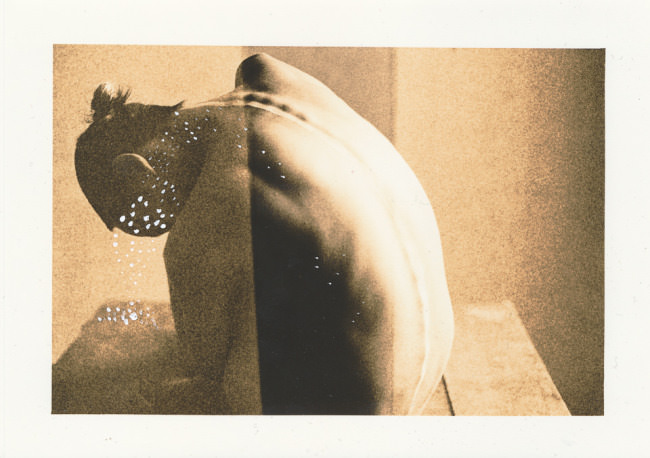
Eine Frau mit Punkten im Gesicht sitzt auf einem Tisch.

Hier ging eindeutig etwas schief. Ich hatte den Abzug im Entwicklerbad nicht genug bewegt. Es entstanden merkwürdige Streifen. Doch dann wuchs mir plötzlich Kreativität aus dem Kopf und ich malte einige Punkte.

Ich nahm mir eine Stunde Zeit und suchte mir neue Negative raus. Ich entschied mich für einen Film von 2011. Ich hatte sie noch nie abgezogen und war gespannt. Und tatsächlich: es erschien mir wie ein Wunder. Nach fünf Stunden Dunkelheit und dem Einatmen von Chemie kann man schon mal an Wunder glauben.

Da war es! DAS Negativ! Der Grund, weshalb ich das alles aufgebaut hatte und warum sich das alles lohnen sollte. Ansel Adams und Susan Sontag standen hinter mir und nickten anerkennend. Natürlich sind die beiden nicht gerade Lith-Experten, aber das sagte ich ihnen nicht.

Ich benötigte noch einmal zwei Stunden um vom perfekten Negativ auch einen perfekten Lithabzug abzuziehen – oder sagen wir eher – einen, mit dem ich zufrieden war.
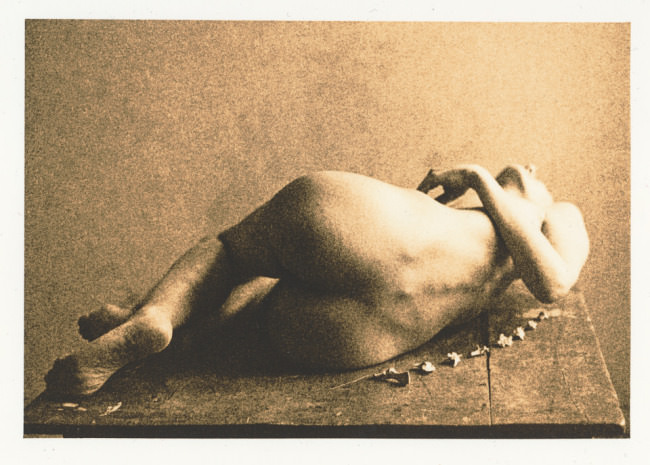
Eine nackte Frau auf dem Tisch. Hinter ihr liegen kleine Knöchlein eines Fuchses.

Als sich das Bild langsam herausschälte, hatte sich der ganze Aufbau und die Mühe für mich gelohnt.

Aber das Spannendste an der Arbeit in der Dunkelkammer im Eigentlichen waren meine Gedanken während des Prozesses. Ich war fast sieben Stunden komplett allein in der Dunkelheit. Nur eine rote Glühbirne erleuchtete den Raum. Meine Gedanken und ich versammelt auf wenigen Quadratmetern.

Ich hinterfragte meinen Umgang mit meinen Bildern. Warum ich beispielsweise nach dem Entwickeln und Scannen meiner Negative, die gerade mal ein paar Tage alt sind, die Bilder immer schon gleich auf Flickr & Co hochladen muss?

Natürlich liegt eine Form der Selbstbestätigung darin, etwas zu können und sich von Anderen abzuheben, und gleichzeitig die Suche nach Gleichgesinnten. Also die Suche nach der fotografischen Identität.

Das ist nicht verwerflich. Aber als ich am Ende mit gerade mal einem wirklich, wirklich guten Abzug in der Hand da stand, wünschte ich mir auch Ruhe und Zurückgezogenheit. Ich wünschte mir fünf Jahre Leere, nur angefüllt mit Dunkelkammerarbeit, Essen und Trinken.

So eine Dukasession verändert Dich.


kwerfeldein – Fotografie Magazin | Fotocommunity

 
Comments Off on Veränderung versteckt sich in der Stille

Posted in Equipment


Durchschnittene Zeit

17 Sep

Welche Zeit ist perfekt für ein Bild? Welches Licht wirkt besser: Sonnenauf- oder -untergang? Richard Silver umgeht dieses Fotografen-Problem in seiner Serie „Time Sliced“ und fotografiert berühmte Gebäude, wie die Hagia Sophia, die Statuen der Osterinseln oder das Olympiastadion in Beijing einfach bei jeder Lichtsituation und fügt die Bilder dann zu einem Foto zusammen.

Seine Bilder wurden auf der ganzen Welt aufgenommen: In Peking, Istanbul, London, Warschau, Singapur, Shanghai, Goa, Dubai, in Italien und auf der Osterinsel. Sie alle wurden über einen Zeitraum von zwei Jahren aufgenommen und Richard sucht weiter nach neuen Motiven.

Für jedes Foto benötigt er etwa anderthalb Stunden. Etwa 45 Minuten vor Sonnenauf- oder -untergang beginnt er mit der Aufnahme der Bilder, setzt sie während Sonnenauf- oder -untergang und beendet sie etwa eine halbe Stunde danach. Die Nachbearbeitung dauert eine Stunde pro Bild.

Er fotografiert meistens mit einer Nikon D800 und dem Objektiv f/2.8 24 – 70 mm von Nikon. Für die Aufnahmen nutzt er ein Stativ sowie einen Fernauslöser. Dieser gibt ihm die Freiheit, sich ein wenig vor Ort bewegen zu können und vermeidet Vibrationen beim Auslösen.

Nationalstadion in Peking

Kolosseum in Rom

Hagia Sophia in Istanbul

Die Houses of Parliament in London

Marina Bay Sands in Singapur

Der Mailänder Dom

Pudong in Shanghai

Gateway of India

Ahu Tongariki auf der Osterinsel

Triest

Venedig

Die Idee für dieses Projekt stammt vom Konzept für ein Buch, für das Richard ikonische Gebäude in New York auf ähnliche Weise aufnahm. Aus dem Buch wurde aus finanziellen Gründen nichts, aber die Idee inspirierte ihn und er trug sie hinaus in die Welt.

Mehr Arbeiten von Richard Silver findet Ihr auf seiner Webseite, oder Ihr folgt ihm auf Twitter.


kwerfeldein – Fotografie Magazin | Fotocommunity

 
Comments Off on Durchschnittene Zeit

Posted in Equipment


NYC Skyway: From Brooklyn to Manhattan in 4 Minutes by Air

17 Sep

[ By WebUrbanist in Technology & Vehicles & Mods. ]

east river skyway tram

Building on the strategy of the Roosevelt Island Tramway (connecting to Manhattan over the East River), this proposal promises record commuting times, bypassing subways, streets and ferries to use the sky instead.

east river skyway above

The East River Skyway project aims to make the jump between Boroughs faster, cleaner, safer and cheaper, all while reducing the load on the subway system, already packed to more than capacity under the ground below.

east river skyway cars

The design proposal calls for an initial connection between Williamsburg and and Lower Manhattan, followed by extensions deeper into Brooklyn and, ultimately, links to Queens and Long Island City as well.

east river skyway diagram

skyway project high speeds

Beyond the ultra-fast transit time boasted by the system there are some non-financial considerations as well: tourists and locals alike can also take the tram (as they already do to and from Roosevelt Island) in part simply to get a better view of the city from above.

hovering skyway project design

east river skyway design

Its designers cite other major international cities deploying and contemplating similar initiatives, from Singapore to London, England and  Rio de Janeiro, Brazil.

Share on Facebook


[ By WebUrbanist in Technology & Vehicles & Mods. ]

[ WebUrbanist | Archives | Galleries | Privacy | TOS ]


WebUrbanist

 
Comments Off on NYC Skyway: From Brooklyn to Manhattan in 4 Minutes by Air

Posted in Creativity


17. September 2014

17 Sep

Ein Beitrag von: Sebastian Kahl

Portrait einer Frau, die auf dem Boden liegt.


kwerfeldein – Fotografie Magazin | Fotocommunity

 
Comments Off on 17. September 2014

Posted in Equipment


Leica introduces D-Lux 24-75mm equiv compact with Four Thirds sensor

17 Sep

Leica has announced the D-Lux (Typ 109), a compact camera with a 24-75mm equivalent, F1.7-2.8 zoom and a Four Thirds sensor. If those specifications sound familiar, it’s probably because they’re shared with the Panasonic LX100. The D-Lux will be available in November. A license for Adobe Photoshop Lightroom is included.

Articles: Digital Photography Review (dpreview.com)

 
Comments Off on Leica introduces D-Lux 24-75mm equiv compact with Four Thirds sensor

Posted in Uncategorized


20 Reasons Why I Won’t Cover Fashion Week for Free (But I Would for Expenses)

17 Sep

London Fashion Week just wrapped up, and a lot of the people I follow on social media were there, taking over brands’ social media accounts, taking pictures, looking good. I spent most of the past four days sitting around at home with absolutely no plans to go anywhere, and I think if you’d touched me, my relief would have actually Continue Reading

The post 20 Reasons Why I Won’t Cover Fashion Week for Free (But I Would for Expenses) appeared first on Photodoto.


Photodoto

 
Comments Off on 20 Reasons Why I Won’t Cover Fashion Week for Free (But I Would for Expenses)

Posted in Photography


Updated Leica X (Typ 113) APS-C compact boasts F1.7 lens

17 Sep

Leica has announced a new X-series camera with an F1.7 lens. The Leica X (Typ 113) continues to use a 16MP APS-C sensor and offer a 35mm equivalent lens but now with a considerably faster aperture than the F2.8 of its forebear. The existing X2 model will essentially live on as the Leica X-E. The Typ 113 will cost around $ 2,295/£1,550.

Articles: Digital Photography Review (dpreview.com)

 
Comments Off on Updated Leica X (Typ 113) APS-C compact boasts F1.7 lens

Posted in Uncategorized


Video preview of the Canon Powershot G7 X

17 Sep

If posts to our news articles and forums are any indication, one of the most exciting announcements from Photokina is the Canon G7 X, a genuinely pocketable camera with a large 1”-type sensor. In this video DPReview’s Richard Butler takes us through a preview of the G7 X and gives us an idea of what to expect from it.

Articles: Digital Photography Review (dpreview.com)

 
Comments Off on Video preview of the Canon Powershot G7 X

Posted in Uncategorized


Nikon D750: What you need to know

17 Sep

The D750 is Nikon’s latest full-frame DSLR, and sits between the D610 and D810 in the company’s FX format lineup. With specifications in common with both cameras, the D750 may be of interest to anyone considering stepping up to full-frame from one of Nikon’s APS-C format models. As well as our detailed first impressions review we’ve prepared a quick ‘cheat sheet’, telling you everything you need to know about the new camera. Click through to read more.

Articles: Digital Photography Review (dpreview.com)

 
Comments Off on Nikon D750: What you need to know

Posted in Uncategorized


Split, Broad & Short Lighting Techniques

17 Sep

Image from Alana Tyler Slutsky's Surrealia series featured on Fashion Photography Blog (FashionPhotographyBlog.com)SPLIT, BROAD AND SHORT TECHNIQUES

Hey FashionPhotographyBlog.com readers! Welcome back.

Today we’ll cover the other three basic techniques for lighting – split, short and broad lighting.  If you missed yesterdays’ basic techniques of Paramount, Loop and Rembrandt lighting, you can find them here.

Let’s jump right in!

LIGHTING TECHNIQUES

Split Lighting: Slight lighting literally divides the subject’s face in half.  It’s also known as side lighting.  Because of the nature of this type of lighting, it’s great slimming light.  Keep in mind that in lighting from the side, it will show any texture (and imperfections).  Aka- this is not ideally the light to be used on a very zitty person.

Split/side lighting is exactly as it sounds – Place the key light at your subjects side.  It will illuminate half of their face and leave the other half in shadow.

If you don’t want as extreme a shadow as pictured above, use a bounce fill or fill light to bring in detail on the shadow side.

Split lighting diagram featured on Fashion Photography Blog (FashionPhotographyBlog.com)

Split Lighting Diagram

These next two lights are not exactly a lighting pattern, but terms that deal with the subject and the lights orientation to the camera.  The two lighting scenarios below deal with the subject being 3/4 to the camera.

Broad Lighting: Broad lighting will create a “broad” or “wide” face.  This is because the part of the face that is lit (the part of the face that is facing the camera) is wider than the section of the face that is in shadow.  Don’t use this type of light on heavier people, it will make them look bigger than they are.  It’s ideal for thin people.

To achieve this, place the light opposite the direction of your subject’s face.  For example, If the subject is looking to the left of the camera, place the light to the right of the camera.

Broad lighting example featured on Fashion Photography Blog (FashionPhotographyBlog.com)

Broad lighting diagram featured on Fashion Photography Blog (FashionPhotographyBlog.com)

Short Lighting: Short lighting will create a narrower looking face.  This is because the part of the face that is in shadow (the part of the face that is facing the camera) is wider than the section of the face that is lit.  This type of light is great for heavier people!  It creates a thinning effect which makes it really flattering lighting.

To achieve this, place the light in the same the direction of your subject’s face. For example, If the subject is looking to the left of the camera, place the light to the left of the camera.

Short lighting example featured on Fashion Photography Blog (FashionPhotographyBlog.com)
Short lighting diagram featured on Fashion Photography Blog (FashionPhotographyBlog.com)
Lighting type guide featured on Fashion Photography Blog (FashionPhotographyBlog.com)

If you want to know more about Kickers, Rim, Hair, and Background lights, check our post on Types of Light.

As always, if you have any questions, feel free to shoot me an email.

– Alana


IMAGE SOURCE:

Feature image & image 1: photography by Alana Tyler Slutsky from her Surrealia series. To view the rest of the photos from this series visit her website.

Image 2-8: Alana Tyler Slutsky


Fashion Photography Blog

 
Comments Off on Split, Broad & Short Lighting Techniques

Posted in Uncategorized