RSS
 

Archive for June, 2014

Finding Vivian Maier – Der Film

10 Jun

Was ist interessanter: Die Fotos von Vivian Maier oder ihr geheimnisvolles Leben? Für einige Personen des Dokumentarfilms „Finding Vivian Maier“ ist es ganz klar die Geschichte dieser exzentrischen Frau, die als Kindermädchen arbeitete und ganz nebenbei und heimlich großartige Bilder machte.

John Maloof, Regisseur des Films und „Entdecker“ Vivian Maiers fand ihre Negative bei einer Auktion. Eigentlich auf der Suche nach historischen Aufnahmen des Stadtviertels, enttäuschten ihn die Aufnahmen zunächst. Sie zeigten Straßenszenen Chicagos aus den 50ern und 60ern, Portraits von Menschen. Doch er erkannte bald, dass er da auf etwas gestoßen war, was mehr als nur historischen Wert besaß.

Eine schöne Frau steht im Mittelpunkt einer Straßenszene und sieht nach rechts.

Eine Nachtaufnahme. Zwei Männer schleppen einen scheinbar Betrunkenen zwischen sich über die Straße.

Die Aufnahmen waren spannend, zeigten die Menschen auf eine besondere, gefühlvolle Weise. Einzig mit dem Namen der Fotografin und dieser Kiste voller Negative machte sich Maloof auf die Suche nach der Frau, die bei Google damals noch keinen einzigen Treffer ergab.

Im Dokumentarfilm begeben sich Maloof und sein Kollege Charlie Siskel auf Spurensuche. Menschen, die mit dem Kindermädchen in Kontakt standen, werden interviewt und berichten ausführlich über die Stärken, Schwächen und Exzentriken dieser mysteriösen Frau. Einig sind sich alle vor allem in einem: Warum hat sie nie gezeigt, was sie da macht? Keiner kannte ihre Bilder, niemandem hatte sie ihre Arbeiten gezeigt.

Plakat: Finding Vivian Maier

So kamen sie erst nach ihrem Tod ans Licht. Und mit ihnen der Ruhm, Ausstellungen und Veröffentlichungen. Hätte Vivian Maier das gewollt? Auch diese Frage wird in der Dokumentation aufgegriffen und zum Teil beantwortet. Ob sie einen so privaten Film über sich selbst gewollt hätte, bezweifle ich stark, aber ja, ich habe ihn mit Faszination gesehen. Trotzdem.

Wir alle bestimmen, was die Welt über uns erfährt. Doch ob wir wollen oder nicht – am Ende müssen wir Farbe bekennen. Es ist gut möglich, dass wir nichts über Vivian Maiers Leben und ihre Fotos wissen würden, wenn es nach ihr gegangen wäre. Sie entschied sich für eine heimliche Existenz und versteckte ihre Kunst, solange sie lebte. Doch wer seine Kunst verbirgt, vernichtet sie eben nicht. Vivian Maier bewahrte ihr Werk auf und überließ dessen Schicksal anderen.
– Charlie Siskel, Regisseur

Der Film ist abgesehen von diesem moralischen Konflikt sehr empfehlenswert. 84 Minuten mit deutschen Untertiteln. Ich habe gespannt die Geschichte um Vivian Maier verfolgt, habe mitgerätselt, war manchmal erstaunt, manchmal schockiert. Zudem bekommt man neben den besten Fotografien Maiers auch noch viele ihrer eigenen Filmaufnahmen zu sehen.

Der Film „Finding Vivian Maier“ kommt am 26. Juni 2014 in die deutschen Kinos.


kwerfeldein – Fotografie Magazin | Fotocommunity

 
Comments Off on Finding Vivian Maier – Der Film

Posted in Equipment


Electrifying Art: Sculptures Made of Wire and Cable Ties

10 Jun

[ By Steph in Art & Sculpture & Craft. ]

Cable Tie Sculptures 1

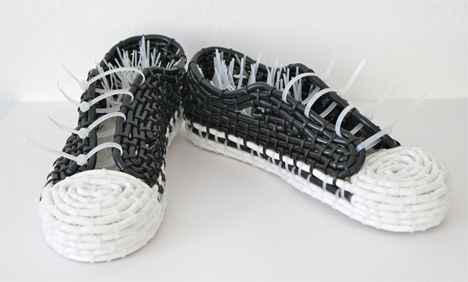
All it took to create this series of sculptures – aside from ingenuity and artistic talent, of course – was a trip to the hardware store for some electrical wire and cable ties. Artist Pavel Sinev coils black and white wires into works of art that range from the straightforward to the slightly surreal, like a vaguely disturbing baby with a bottle in its mouth.

Cable Tie Sculptures 5

Calbe Tie Sculptures 3

Cable Tie Sculptures 2

Cable Tie Sculptures 4

The wiring is carefully wound into three-dimensional shape and held together with the zip ties, the designs ultimately reflecting the unconventional ways in which common household materials can be used with a little creativity.

Wire Sculptures

Wire Sculptures 2

Wire is a surprisingly versatile artistic medium. Check out a stunningly intricate motorcycle and sidecar by Chinese artist Shi Jindian, fluid human sculptures by Derek Kinzett, minimalist works by Gavin Worth and more.

Share on Facebook


[ By Steph in Art & Sculpture & Craft. ]

[ WebUrbanist | Archives | Galleries | Privacy | TOS ]


WebUrbanist

 
Comments Off on Electrifying Art: Sculptures Made of Wire and Cable Ties

Posted in Creativity


The Most Valuable Photography Tips Ever – Results of a Social Media Survey

10 Jun

I recently asked the following question on social media: “What was the most valuable photography tip you ever received?” Needless to say, I received a plethora of really useful tips from the audience. Some were spot on, others were debatable. I thought it would be fun to post a few here and expand on them briefly.  Let’s get started with the most valuable photography tips ever.

The best zoom lens is your own feet

That is often true but please don’t try it if you are photographing a polar bear and her cubs or a bulky football player running for touch down. Get the right tool for the job! On the other hand, I must say that on any given photography workshop, the day my students do their best work is when they use a fixed focal length lens. I really believe in the power of limitations.

Look for the light

The day I understood how to see the light and how to harness it, is the day my photography took a leap forward. There is no bad light, learn to assess the quality and quantity of light and work with. It’s all about learning to use it to your advantage.
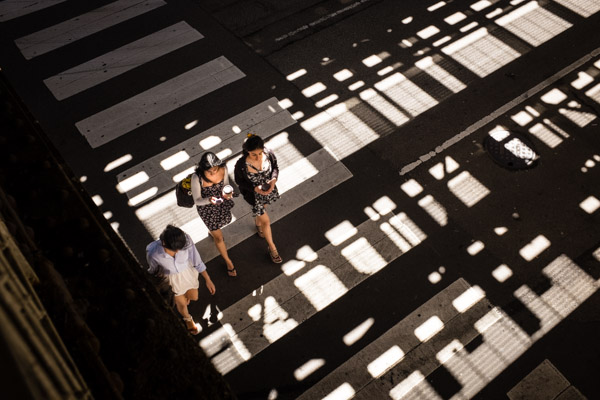
See the light and use it to your advantage. ©Valerie Jardin

See the light and use it to your advantage.
©Valerie Jardin

Get close. Then Get Closer

Okay, I had to smile because this one came from one of my former students. I could hear myself say that exact same sentence. Learn to see photographically and make stronger images. Photographers tend to leave too much ‘stuff’ around their subject. The viewer gets lost in the chaos and doesn’t know where to look. Less is often more. It’s important to learn to crop in camera and using a prime lens is a great way to learn to see photographically. Learning to remove distracting elements from your frame before your press the shutter is essential to improving your photography.

Get close. Then get closer! ©Valerie Jardin

Get close. Then get closer!
©Valerie Jardin

Stop thinking and shoot

Before you press that shutter you should know why you composed the way you did. Using the ‘spray and pray’ approach will certainly get you some lucky shots but not much satisfaction. You obviously stopped because you saw something that grabbed your attention, work the scene and follow your instinct. Don’t over analyze at the risk of making a technically perfect image with no story or feeling. Perfection is not always the goal.

Never stop practicing

There is no better way to improve your craft than by exercising those ‘visual push-ups’ daily. You don’t even need to leave the house. Experiment with anything, make an ordinary object look extraordinary. Go ahead and use your camera phone even. The tool doesn’t matter, your vision does.

Don’t use the flash

Okay, I have to use a ‘Sammonism‘* here and remind you to “Turn the darn flash off!” This tip applies to your camera or your phone.

After you’ve taken the shot, look behind you.

For sure! If you are photographing another sunset, the scene lit by the golden light behind you may be even more spectacular.
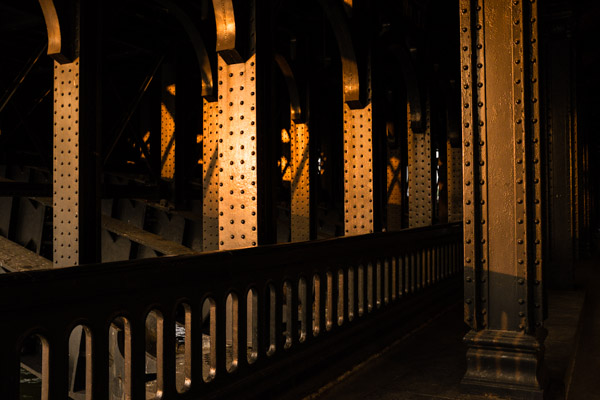
Look behind you! Everyone was looking at the sun setting over the river Seine in Paris, I looked back and was struck by the beautiful golden light hitting the bridge posts.  ©Valerie Jardin

Look behind you! Everyone was looking at the sun setting over the river Seine in Paris, I looked back and was struck by the beautiful golden light hitting the bridge posts. – ©Valerie Jardin

Shoot in manual mode

That may not always be your best choice. If you are shooting landscape then I would say yes, by all means, shoot in manual and take full control. If you are shooting street photography for example, shutter priority or aperture priority may be better choices. There is no coming back to get the shot again, so let the camera do some of the thinking for you or you’ll miss the moment.

Lighten your load and expand you creativity

A comfortable photographer is a happier photographer. Take one camera, one lens and let those creative juices flow.  It will save your back too.

Shoot for yourself. Don’t try to get approval of others.

So true, unless you need to please a client, of course. If photography is a hobby, why should you care what other people think of your pictures, as long as you like them? That said, having a critique of your work in order to improve on it is one thing, and I would highly recommend it. But, the need for gratification via ‘likes’ on social media is something you should try to learn to live without. If that is the goal then I would recommend posting a daily kitten picture to get your fix. Then just shoot what you love (if it’s kittens, then it’s a win-win). In all seriousness, not every genre of photography will get ‘Oohs and Aahs’ on social media. For example, street photography is not understood and appreciated by the general public like landscape photography. Is that a reason to shoot landscape if your heart is in street photography? I hope not or you’re a photographer for the wrong reasons. Follow your heart and your work will shine!

Stop reading and start clicking

It’s good to read about photography and get inspiration online and in books but that should not replace your time behind the camera. You are not going to get instantly better after reading an article or watching a tutorial. You are only going to get better if you shoot often. Period.

Slow Down

Having unlimited shutter clicks without a cost factor attached is both good and bad. Good for the learning curve. Bad because it tends to make us lazy. Start shooting as if you were shooting film, make every shot count and you will have more keepers at the end of the day. Slow down and know why you are about to press the shutter.

Practice, practice, practice. Any ordinary object can be a great learning subject to exercise those 'visual push-ups' ©Valerie Jardin

Practice, practice, practice. Any ordinary object can be a great learning subject to exercise those ‘visual push-ups’  ©Valerie Jardin

Never pack your camera away until you are back home

You never know what is going to cross your path. Keep that camera handy, and always on.

Take the lens cap off

Better yet: Leave it at home.

Happy shooting!

Please share some tips that made a difference in your photography in the comment section below.

*In reference to our friend and photographer extraordinaire Rick Sammon

The post The Most Valuable Photography Tips Ever – Results of a Social Media Survey by Valerie Jardin appeared first on Digital Photography School.


Digital Photography School

 
Comments Off on The Most Valuable Photography Tips Ever – Results of a Social Media Survey

Posted in Photography


Updated HTC Gallery app offers adjustable UFocus feature

10 Jun

IMAG0421_1.jpg

One of the most talked about new features of the HTC’s latest flagship smartphone, the One M8, is the Duo Camera. Using the primary camera and a second sensor to create a shallow depth-of-field effect, the Duo Cam produced less-than-perfect results in our testing. But thanks to an update to the Gallery app, the effect can now be adjusted. Learn more

News: Digital Photography Review (dpreview.com)

 
Comments Off on Updated HTC Gallery app offers adjustable UFocus feature

Posted in Uncategorized


Fake Chuck Westfall reveals identity and announces retirement

10 Jun

chuck.jpg

Chuck Westfall is the unassuming and authoritative head media liaison for Canon, USA. Fake Chuck Westfall is an invented anti-hero and the surly voice behind the Fake Chuck Westfall blog, a site that pokes fun at Canon, Nikon and the photo industry in general. After maintaining secrecy for six years the man behind the account has revealed his identity, announcing that he’s moving on from the blog.

News: Digital Photography Review (dpreview.com)

 
Comments Off on Fake Chuck Westfall reveals identity and announces retirement

Posted in Uncategorized


National Park Photography Workshop Permits: Are They Really Necessary?

10 Jun
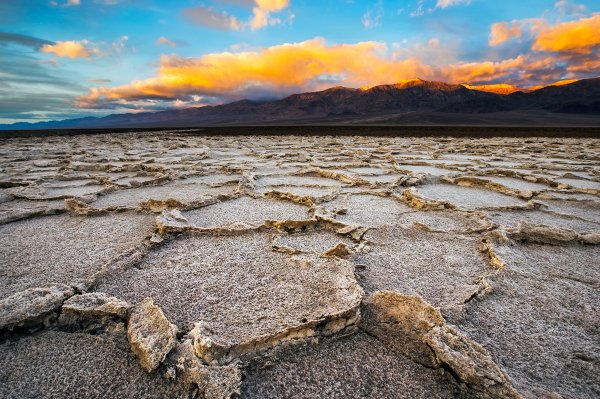
badwater-sunrise

Sunrise on the West Side Road at Badwater Basin, Death Valley

Back in February of 2014, I led two back-to-back photography workshops in Death Valley National Park with my friend and fellow photographer Mike Mezeul. Planning workshops is a lot of work and takes a lot of love and dedication to do right. Before the process of getting everything set up (making sure the students had all booked their flights, hotels, rental cars, etc.) we needed to apply for a workshop permit. This is sort of a tough thing to do timeline wise. You can apply for it ahead of time before you even announce the workshop; but then you run the risk of paying the $ 210 (average cost) and the workshop falling through or something like that. Or you can wait until you book spots for the workshop and then apply for the permit; but then you run the risk of not getting the permit in time for the workshop. We opted for the latter because we had plenty of time to get the application in and get the permit back. We got our workshop permit in time and had nothing to worry about. We weren’t going to risk getting in trouble with the park in an effort to save a few hundred bucks.

Now fast forward to the second workshop. We had just wrapped up a beautiful sunrise shoot at Badwater Basin on the West Side Road (Death Valley. The patterns at the main part of Badwater (by the parking lot) were in pretty terrible shape but we decided to take the group there after the sunrise shoot so they could see all the educational signs, walk around for a bit and get a picture of the “280 Feet Below Sea Level” sign. While we were there, a man came up to me and asked if we had found any good patterns. I’ve never been one to withhold secrets so I told him about the spot we found over on West Side Road. I noticed he had a van full of people and shortly after, they were on their way.

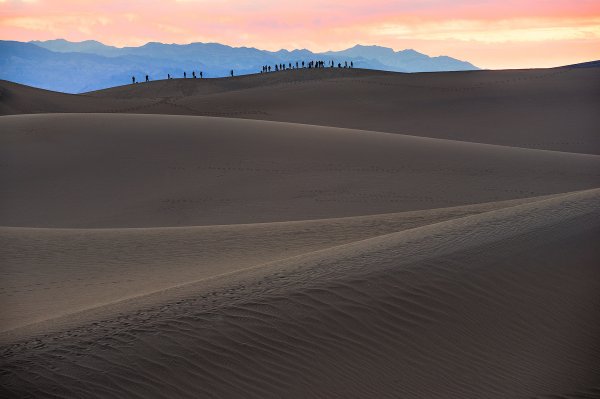
Workshop students set up for sunrise at the Mesquite Flat Sand Dunes

Workshop students set up for sunrise at the Mesquite Flat Sand Dunes

Our group stayed at the Badwater parking lot for another 30 minutes or so before heading back into Furnace Creek for breakfast. When we got to the Forty Niner Cafe we saw a large table of around 20 people (all with their photography gear) sitting in silence. It was really strange. Nobody was really talking and everyone looked stressed out and upset. I went to use the restroom and that’s when I saw the same guy who I’d spoken to at the Badwater Basin parking lot.

He told me that he was a workshop instructor and they were on day two (the first full day) of their photography workshop. He had taken my advice and driven his group down to the West Side Road but when he got there, a Park Ranger was waiting for him. As it turns out, the instructor and his partner had decided to forgo the workshop permit because they had applied for one the year before and never got asked about it at during that workshop. He figured, “Why not save the $ 210?” It’s not like Death Valley has much staff left after all the government cutbacks, right? Wrong.

The Ranger asked for his permit and when the instructor said he didn’t have one, he was told to leave the park immediately. He was instantly given a $ 2,000 fine for conducting a workshop inside a National Park without a permit. He had to leave his group of around 20 students inside the park–students who had paid the tuition for the workshop, bought plane tickets into Vegas, rental cars to drive into the park and $ 200/night hotels within the park. On top of that, he had to appear before a judge in federal court in California three months later. That meant another flight to book, a couple nights in a hotel, a rental car and living expenses for the trip. Based on the outcome of the court appearance, he was facing upwards of $ 10,000 in fines and a lifetime ban from the park. I’m not sure what the outcome was with his group of students but I’m assuming they got their money back for the workshop.

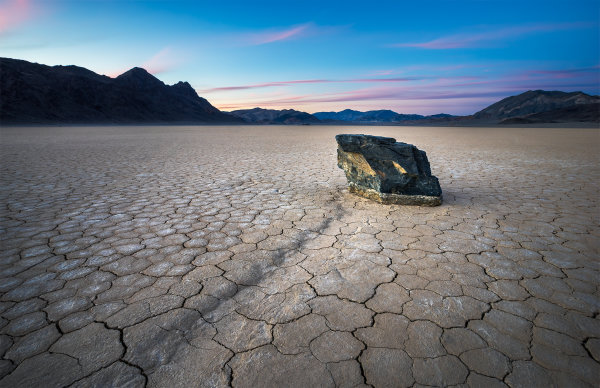
A mysterious sailing rock during sunset at the Racetrack Playa

A mysterious sailing rock during sunset at the Racetrack Playa

The Lesson to be Learned

The takeaway here is not to cut corners. If you are conducting a workshop inside of a national park, a national monument or even some state parks; get a permit. It’s not worth taking the risk and there are Park Rangers out there doing research. I talked to another photographer who was holding a workshop out in Zion National Park a while back. He had applied for a permit (and got one) to take his group into the Subway. When he got to the parking lot to start the hike, a Ranger was waiting there for him to check his permit. I’ve heard other stories of the Rangers looking up workshops on Google and then keeping track of the instructors on social media. They then try and pinpoint where the group will be and see if they can track them down to make sure they have the permit. All it takes is a tweet saying, “Beautiful sunrise at the Mesquite Dunes this morning.” To be honest, $ 210 is a very small fee to pay for holding a workshop inside of a national park. On top of that, you are supporting the park by paying the fee much in the same way you support it by purchasing park passes and entry fees.

If you are a student and will be attending a workshop inside a park, make sure that your instructor has the right permits. In my opinion, an instructor that cuts corners to save their bottom line isn’t an instructor worth paying tuition for a workshop.

For more information on choosing a photography workshop or tour, read these:

  • Taking a Photography Workshop; Why it is Different from a Photo Tour
  • Choosing a Photography Workshop Or Tour
  • Is that a Workshop, Tour or Seminar [Part I]

The post National Park Photography Workshop Permits: Are They Really Necessary? by James Brandon appeared first on Digital Photography School.


Digital Photography School

 
Comments Off on National Park Photography Workshop Permits: Are They Really Necessary?

Posted in Photography


The Future Takes Flight: 13 Forward-Thinking Airport Ideas

10 Jun

[ By Steph in Architecture & Public & Institutional. ]

Futuristic Airports Main

With their inefficient terminals and bloated footprints, today’s airports are typically ill-equipped to adapt to sharp increases in demand, scarce land availability or new flight technologies. These 13 futuristic airport designs address current and upcoming air travel challenges, from beautiful expansions currently under construction to fantastical concepts that accommodate vertical lift-off.

Airport Skyscraper

Future Airports Skyscraper

Beijing is in dire need of new airports, but also doesn’t have a lot of acreage to spare. This concept for the 2012 eVolo Skyscraper Competition solves both problems with ‘airport skyscrapers’ shaped like giant mushrooms. Not only does this free up the space below, it also effectively reduces the length of the runways since wind speed is higher 450 meters in the air than it is at sea level.

Floating Airport for London with Underwater Tunnels

Future Airports Floating London 1

Using the surface of rivers and the sea also frees up precious land, as illustrated in this futuristic airport design by architecture firm Gensler. Envisioned for the Thames River, the London Britannia consists of a series of rounded pods connected to four floating runways anchored to the sea floor. Underground tunnels would connect passengers to the city and to European rail networks.

Shenzen Airport Mimics a Manta Ray

Future Airports Shenzen 1

Future Airports Shenzen 2

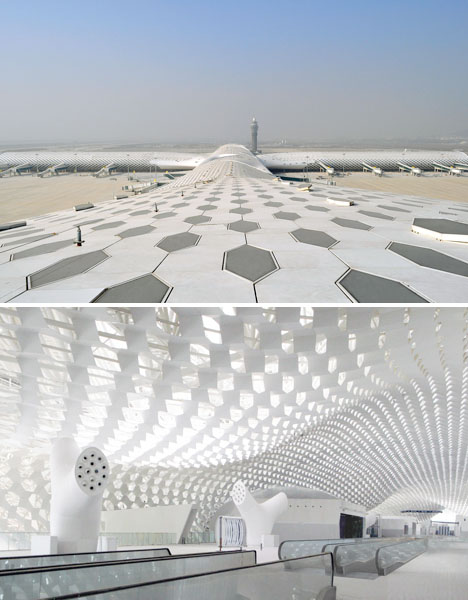
Taking inspiration from both the natural form of a manta ray and the more obvious shape of an airplane, the Shenzen airport extension in China is covered in thousands of hexagonal skylights across a steel and glass canopy, creating a honeycomb pattern within the undulating all-white interior.

Malpensa Airport Proposal

Future Airport Malpensa

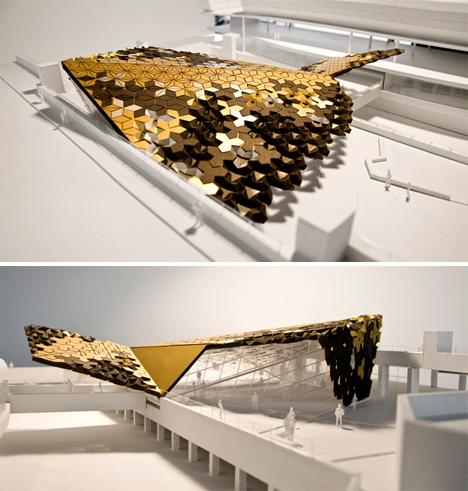
A modular geometric roof consisting of brushed metal in three golden shades makes a big impact on the Malpensa Airport, creating a covered area that serves as an exhibition space and pedestrian walkway between the Expess Train Station and Terminal 1 of the Milan Airport.

Next Page – Click Below to Read More:
The Future Takes Flight 13 Forward Thinking Airport Ideas

Share on Facebook


[ By Steph in Architecture & Public & Institutional. ]

[ WebUrbanist | Archives | Galleries | Privacy | TOS ]


WebUrbanist

 
Comments Off on The Future Takes Flight: 13 Forward-Thinking Airport Ideas

Posted in Creativity


Sony Cyber-shot DSC-RX100 III shooting experience

09 Jun

RX100-III_Right-1200.png

Our first impressions review of the Sony Cyber-shot RX100 III just keeps growing. The latest aims to answer one of the most important questions potential owners ask about a camera – ‘What’s it like to use?’ With promising specifications like a 20 megapixel 1″-type sensor, a fast 24-70mm equiv F1.8-2.8 Zeiss-branded lens and a pop-up EVF, the RX100 III looks excellent on paper. Does that hold up in real-world use? Read more

News: Digital Photography Review (dpreview.com)

 
Comments Off on Sony Cyber-shot DSC-RX100 III shooting experience

Posted in Uncategorized


9. Juni 2014

09 Jun

Ein Beitrag von: Jennifer Wettig

© Jennifer Wettig


kwerfeldein – Fotografie Magazin | Fotocommunity

 
Comments Off on 9. Juni 2014

Posted in Equipment


Nova: The First Ever Off-Phone Flash that Really Flashes

09 Jun

Extra photos for bloggers: 1, 2, 3

Who is that ghost haunting all of the pics you took last night? Oh, it’s you? There has got to be a better flash than that one on your phone.

There is! It’s the Nova, the first ever off-phone flash that syncs with your phone (and protects you from haunted photos).

It talks to your phone via bluetooth so it’s free to roam up to 20 feet away, light from any angle and still flash when you hit your shutter.

The Nova is so small it fits in your wallet, but it is packed with LEDs that make it mighty bright.

Use the Nova app to adjust the brightness and color of your flash. Add warmth when the lights are low to give your smiling face an attractive glow and keep ghostly creatures from creepin’ in.

Get Your Own Nova Flash
$ 59 at the Photojojo Shop


© Britta for Photojojo, 2014. |
Permalink |
No comment |
Add to
del.icio.us

Post tags:


Photojojo

 
Comments Off on Nova: The First Ever Off-Phone Flash that Really Flashes

Posted in Equipment