RSS
 

Archive for March, 2014

Samsung Galaxy S5 hands-on video shows camera features

11 Mar

samsunga53.png

The new Samsung Galaxy S5 smartphone offers a lot to mobile photographers with a 1/2.6-inch 16MP sensor, video with up to UHD (4K) resolution and a F2.2 lens. Samsung has recently released a Galaxy S5 hands-on video that talks about the camera and shows some of the new imaging features. See video

News: Digital Photography Review (dpreview.com)

 
Comments Off on Samsung Galaxy S5 hands-on video shows camera features

Posted in Uncategorized


Aperitif: Diese Woche auf kwerfeldein

11 Mar

Fotografie entspinnt sich immer um den Menschen, auch wenn es sich nicht um Portraitfotografie handelt. Das sehen wir auch in der nächsten Woche auf kwerfeldein, die wir Euch hier in Form von kleinen Häppchen zum Appetit anregen schon einmal schmackhaft machen möchten.

Kennt Ihr zum Beispiel unseren Herausgeber Martin Gommel? So ein bisschen wahrscheinlich, durch seine Artikel. Morgen wird es allerdings Zeit, ihn etwas genauer kennenzulernen. Er stellt sich vor und folgt damit dem Vorbild aller anderen Redakteure, die das hier bereits getan haben.

Nicht nur Martin ist im Genre der Straßenfotografie unterwegs, sondern auch zwei Gastautoren, die im Laufe der Woche ihre Arbeiten vorstellen werden. Spannend wird es dann, die drei verschiedenen Stile miteinander zu vergleichen, die von Absurdität über Situationskomik bis zu Reportage reichen.

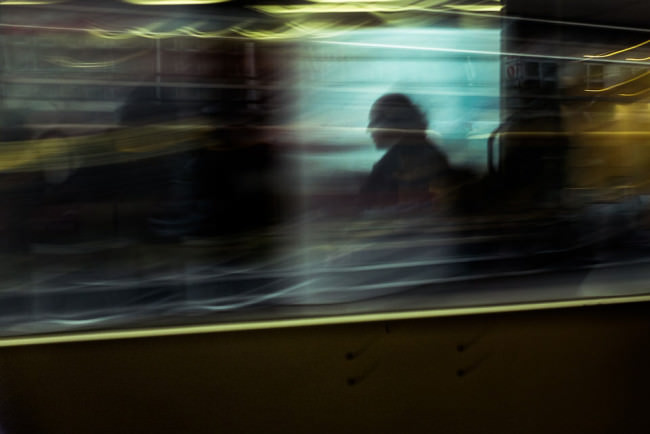
Mann, Fenster, Haare

Habt Ihr Euch schon einmal überlegt, woher Eure Kreatitivät kommt? Wann kommen einem besondere Ideen und wann nicht? Katja hat wissenschaftlichen Hintergrund sowie ganz praktische Tipps zur großen Frage der Kreativität zusammengetragen. Nicht nur für die Mädchen- und Märchenfotografie.

Außerdem haben wir noch Stillleben im wahrsten Sinne des ursprünglichen Wortes „nature morte“ – also „tote Natur“ – für Euch. Eine Dokumentation über das, was der Mensch dem Planeten als Parasit antut. Aber wir wollen nicht zu viel verraten – bleibt gespannt!

Natürlich haben wir am Sonntag wie gewohnt die browserFruits, einen bunten Früchtekorb mit leckeren Links und anderen Empfehlungen, für Euch. Und wer nun den bisher montäglichen Blickfang vermisst, sei getröstet: Er kommt! Ab jetzt immer freitags.


kwerfeldein – Fotografie Magazin | Fotocommunity

 
Comments Off on Aperitif: Diese Woche auf kwerfeldein

Posted in Equipment


Drowned Towns: 10 Underwater Ghost Cities & Buildings

10 Mar

[ By Steph in Global & Travel & Places. ]

Drowned Towns Main

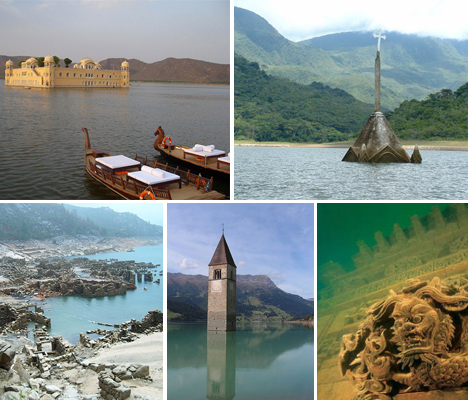
Mildewed crosses, lonely spires, barely-visible stone foundations and rusting bed frames are all that’s left to show for these 10 intentionally submerged towns and structures from India to Massachusetts. When additional water and power is needed to provide for growing populations, small villages often have to be sacrificed, and while some were demolished before their remains were flooded, others can still be seen as ghostly visions wavering beneath the surface.

Potosi, Venezuela

Drowned Towns Potosi 1

Drowned Towns Potosi 2

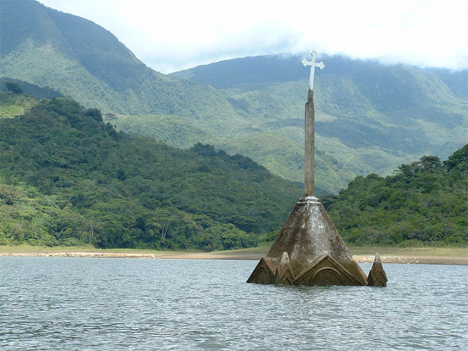
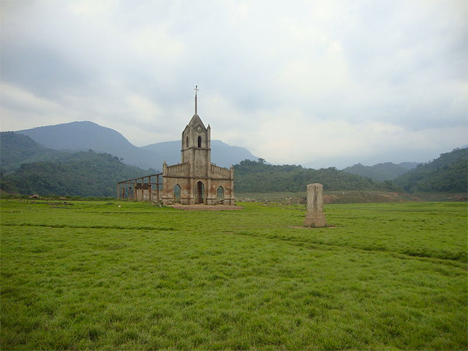
Another town lost to the creation of a hydroelectric dam, Potosi was abandoned in 1985, its residents relocating and leaving their former homes to be filled with water. For 20 years, all that was visible of the Veneuzuelan town was a single mildewed cross topping a drowned church, but by the year 2010, the waters began to recede and the town slowly reappeared. The gothic church that was once submerged is visible again due to droughts and water shortages, erosion and water damage making it appear much older than it really is.

Steeple Tombstone: Curon Venosta, Italy

Drowned Towns Steeple Tomb 1

Drowned Towns Steeple Tomb 2

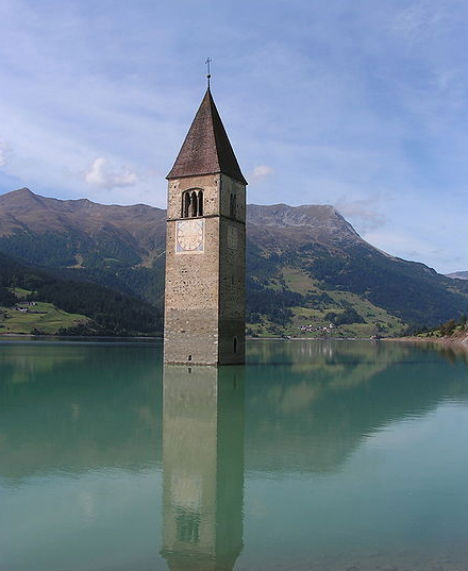
A single spire marks the location of an entire town lost beneath Lago di Resia. The alpine village of Curon Venosta was flooded soon after World War II when officials decided to merge three pre-existing lakes into one to create a hydroelectric dam. Before it was inundated, the town – which included 163 houses and nearly 1,300 acres of land planted with fruit – was filled with sand. The bell tower, which was built in the 14th century, was left intact as a memorial, and can be reached on foot in the winter when the lake freezes over.

Vilarinho da Furna, Portugal

Drowned Towns Vilarinho da Furna

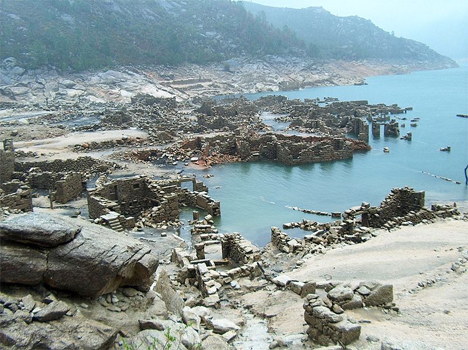
In 1972, the creation of a new dam meant the ancient Vilarinho da Furna was lost beneath the water. The Portuguese village, which dates back to Roman times, was home to almost 300 people inhabiting 80 houses before it was submerged; the property still belongs to their descendants, and reappears every now and then when the reservoir levels fall. The community was unique in that it had a communitarian social system with a council called the Junta made up of a single member from each family, a practice dating back to the Visigoths. When the villagers left they took as much as they could, creating their own road to transport things like rocks and roof tiles to their new homes. Some of those rocks were used to build a museum commemorating Vilarinho da Furna, which contains a collection of clothing, agricultural tools, and paintings depicting daily life in the village.

Jal Mahal, Jaipur, India

Drowned Towns Jal Mahal 1

Drowned Towns Jal Mahal 2

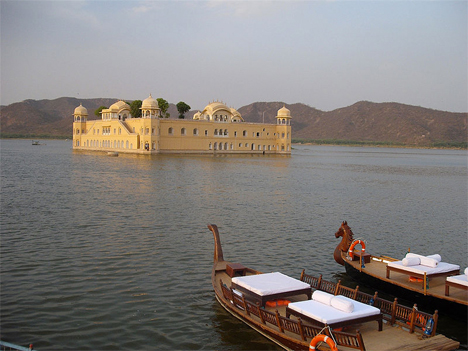
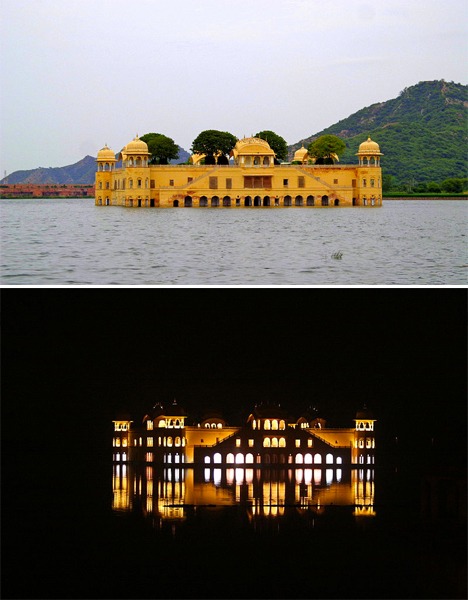
The Water Palace of Jaipur, India sits in the center of Man Sagar Lake. No one knows exactly when it was built, but it’s believed that the red sandstone structure is at least 300 years old and was constructed before damming created the lake, submerging its lower four stories. When the lake is full, only the top level can be reached, and only by boa. At night, the place is illuminated with floodlights like some kind of hallucinatory ghost structure. The palace was recently restored and is now open to visitors.

Next Page – Click Below to Read More:
Drowned Towns 10 Underwater Ghost Cities Buildings

Share on Facebook


[ By Steph in Global & Travel & Places. ]

[ WebUrbanist | Archives | Galleries | Privacy | TOS ]


WebUrbanist

 
Comments Off on Drowned Towns: 10 Underwater Ghost Cities & Buildings

Posted in Creativity


5 Steps to Help you Take Better Landscape Photos

10 Mar

When photographing landscapes, it can sometimes be difficult to produce a an image that is focused in its content, that leads the viewer’s eye exactly where you as the artist want it to go.   Sometimes, even though you may be presented with a beautiful vista, an image may not present itself and you have to work to find it.  Here are five basic steps to help you take better landscape photos. I follow these any time I’m looking to create a landscape image.

#1 Find your subject

Sometimes it’s easy. You choose a building, or a rock formation, or a tree, and it all just comes together.  Other times, it becomes more difficult.   Sometimes nothing in particular stands out.  Look around the scene, find something that draws your eye. Look through your viewfinder, and see how things frame up through your camera’s eye.  Once you have found your subject, you have more decisions to make.
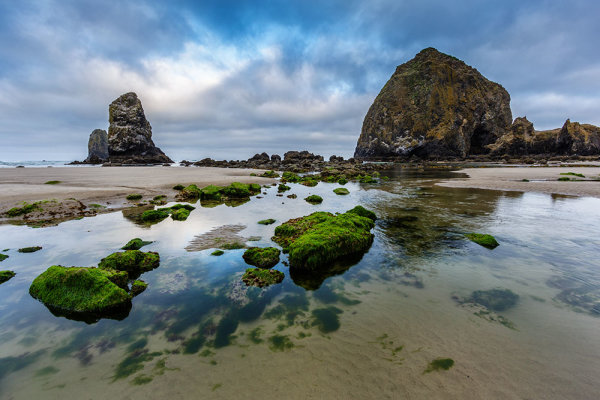
Haystack Rock is a fairly obvious subject. But there are myriad options when it comes to photographing it.  For this image, I decided to use a tidal pool and some rocks in the foreground, but also wanted to include plenty of sky since there was so much interest in the clouds.

Haystack Rock is a fairly obvious subject. But there are a myriad options when it comes to photographing it. For this image, I decided to use a tidal pool and some rocks in the foreground, but also wanted to include plenty of sky since there was so much interest in the clouds.  The rocks and water create some nice lines leading right to Haystack Rock.  EOS 5D Mark III with EF 14mm f/2.8L II, at f/16, ISO 100.

#2 Where is your subject in the composition?
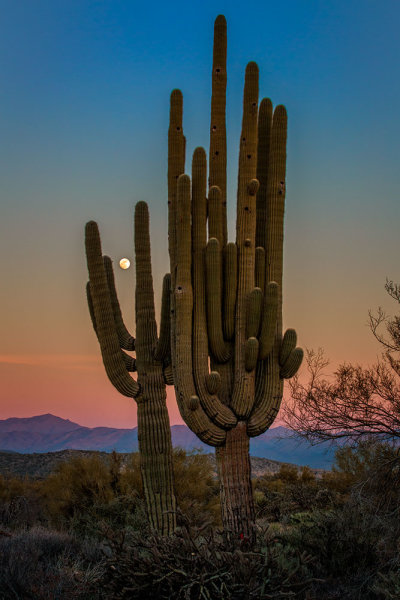
There was no real foreground to speak of here. Just a lot of sand and some uninteresting brush.  What I did see was the way the moon was rising between the arms of the saguaro, and the soft gradation from orange to blue as the sun set behind me.  Taken with EOS 5D Mark III, EF 70-200 f/2.8L IS II, 1/20 @ f/22, ISO 1000.

There was no real foreground to speak of here. Just a lot of sand and some uninteresting brush. What I did see was the way the moon was rising between the arms of the saguaro (cacti), and the soft gradation from orange to blue as the sun set behind me. Taken with EOS 5D Mark III, EF 70-200 f/2.8L IS II, 1/20 @ f/22, ISO 1000.

This will partly be dictated by its location in relation to you, but also by what else is in your scene. Look for interest in relation to what you’ve chosen as the subject. Is there an interesting object or pattern in the foreground, which could lead the viewer’s eye to the subject? Is there something in the foreground that frames your subject or otherwise adds interest without being distracting?  I will often use water or rocks in the foreground if I can.  If it’s water, can you get a reflection of your subject in it?  Sometimes it’s leaves, sometimes trees or a fence.

If there is nothing in the foreground, try minimizing it by putting the subject as the foreground, and looking for background interest.  Interesting clouds or sky, buildings, or trees, can all create a backdrop for the landscape. Sometimes, you’re lucky enough to get both an interesting background AND foreground. These are the times to play with your composition and vary the amounts of foreground and background to see what works best, or what doesn’t work at all.   Generally speaking, if the sky is flat and lacks interest, I will place it in the top third of the frame, using the rule of thirds.  If the foreground lacks interest, I place that in the bottom third.

#3 Tie it together

Once you decide where your subject goes in the frame, what’s in the foreground and what your background will be, it’s time to find a way to tie it all together. Are there leading lines that will lead your viewer from foreground to background?  Leading lines are an easy way to tie your composition together.  Framing is another way, which I included in my discussion of choosing your foreground.  Without tying your composition together, it can often seem like you have two separate images in one.  Creating a composition that pulls the viewer through it and leads them where you want them to look is the best way to create an effective landscape image.

For this image of Kaaterskill Creek, I knew the small cascade was my main subject.  There were some rocks to create interest in the foreground, and the water creates a nice leading line back to the cascade in the middle ground, and then to the foliage in the background.  EOS 5D Mark III with EF 16-35mm f/2.8L II. I was zoomed into 35mm on this one. Exposure was 1.6" at f/20, ISO 100.

EOS 5D Mark III with EF 16-35mm f/2.8L II. I was zoomed into 35mm on this one. Exposure was 1.6″ at f/20, ISO 100.

For this image of Kaaterskill Creek (above), I knew the small cascade was my main subject. There were some rocks to create interest in the foreground, and the water creates a nice leading line back to the cascade in the middle ground, and then to the foliage in the background.

#4 Read the light

Are you at your location at an optimal time? Some locations are better in the early morning, some in late afternoon.  Some are good no matter what time you are there. The difference in the light at these times can mean the difference between a dramatic landscape image, or a snapshot of a pretty place. To find out where the sun will be in a given location at a given time, use an app such as The Photographer’s Ephemerus, or Sunseeker Pro, which will show you the sun’s exact location.  This will enable you to plan when to be a location for optimal light.

Side lighting will create dramatic shadows and show off textures. Backlighting will help create silhouettes, which can be very effective for dramatic images with prominent features breaking the horizon. Front lighting will reveal detail everywhere. Often, I will photograph the same location at different times, as different light will create a variety of images from the same location.

Montauk Point is a great location with lots of photo opportunities, but it's a much better location at sunrise than later in the afternoon or at sunset, due to the shadows created by high cliffs. At sunrise, it can be magical. EOS 5D Mark II, EF 17-40 f/4L. Exposure was 15 seconds, f/11, ISO 800.

EOS 5D Mark II, EF 17-40 f/4L. Exposure was 15 seconds, f/11, ISO 800.

Montauk Point (above) is a great location with lots of photo opportunities, but it’s a much better location at sunrise, than later in the afternoon or at sunset, due to the shadows created by high cliffs. At sunrise, it can be magical.

#5 Choose your shutter speed

Finally, think about what your shutter speed will do to the image.  If you’re shooting water, shutter speed has a lot to do with the water’s appearance in your image. If there are trees, and it’s a breezy day, a faster shutter speed will be necessary to freeze the leaves and avoid motion blur. These are things to be aware of when composing your image.  Learning to visualize these effects in your mind before pressing the shutter button will go a long way toward making you a better photographer.
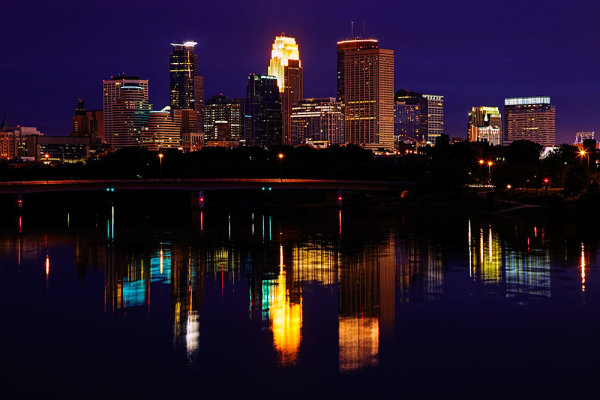
The Minneapolis skyline was an obvious choice for subject here. But the sky was flat for a background, so I pushed the skyline to the top of the frame.  Thankfully, I caught the Mississippi River on an uncharacteristically calm day and was able to get a nice reflection for foreground interest.  EOS 5D Mark II with EF 24-105 f/4L IS. Exposure was 10 seconds at f/11, ISO 400.

EOS 5D Mark II with EF 24-105 f/4L IS. Exposure was 10 seconds at f/11, ISO 400.

The Minneapolis skyline was an obvious choice for subject here. But the sky was flat for a background, so I pushed the skyline to the top of the frame. Thankfully, I caught the Mississippi River on an uncharacteristically calm day and was able to get a nice reflection for foreground interest. I used a slow shutter speed  (or long exposure) to smooth the waters even more.

Do you have some great landscape tips you’d add to this list? Please share in the comments below.

The post 5 Steps to Help you Take Better Landscape Photos by Rick Berk appeared first on Digital Photography School.


Digital Photography School

 
Comments Off on 5 Steps to Help you Take Better Landscape Photos

Posted in Photography


10. März 2014

10 Mar

Ein Beitrag von: Florian Oberlechner

© Florian Oberlechner


kwerfeldein – Fotografie Magazin | Fotocommunity

 
Comments Off on 10. März 2014

Posted in Equipment


Panasonic UK announces price and availability for Lumix DMC-GH4

10 Mar

GH4_H_FS14140_slant.png

Panasonic UK has announced pricing and availability for its flagship 4K video-recording mirrorless camera, the Lumix DMC-GH4. It’ll go on sale on 5th May for £1299.99 body only, £1749.99 with 14-140mm zoom, or £2499.99 with the specialist DMW-YAGHE video interface unit. 

News: Digital Photography Review (dpreview.com)

 
Comments Off on Panasonic UK announces price and availability for Lumix DMC-GH4

Posted in Uncategorized


Shoot Pro Quality Videos (Without a Hollywood Budget)

10 Mar

Extra photos for bloggers: 1, 2, 3

Whether the Oscars inspired you to shoot like the greats, or displeased you to the point of “I could do better,” NOW is the time to step up your video shootin’ game!

Take up your trusty DSLR, a Focus Shifter, the Oh! Wow. Ring Light and start writing that acceptance speech.

The Oh! Wow. Ring Light surrounds your lens in LEDs that provide even light at three brightness settings. It has a constant mode (perfect for videos) and also flash mode for stills.

The Focus Shifter fits snug on any lens, giving you a handle for max control of your focus ring and a marker board to set your focus points before you shoot.
Just don’t forget to thank the Academy, your mom and Photojojo. 🙂

See more example pix from our Ring Light
$ 99 at the Photojojo Shop

Learn More about the Focus Shifter
$ 49 at the Photojojo Shop


© laurel for Photojojo, 2014. |
Permalink |
No comment |
Add to
del.icio.us

Post tags:


Photojojo

 
Comments Off on Shoot Pro Quality Videos (Without a Hollywood Budget)

Posted in Equipment


Nikon D3300 real-world samples gallery

10 Mar

Screen_Shot_2014-03-07_at_2.37.03_PM.png

The Nikon D3300 continues on the path of its entry-level DSLR predecessors, with plenty of built-in shooting and retouch modes, a small footprint, and beginner-friendly user interface. It has a 24.2 megapixel CMOS sensor with no optical low-pass filter, as well as an Expeed 4 image processor. The camera’s ISO range tops out at 25,600 and with continuous shooting up to 5 fps. We’ve been out and about with the D3300, shooting everyday situations and family life. See gallery

News: Digital Photography Review (dpreview.com)

 
Comments Off on Nikon D3300 real-world samples gallery

Posted in Uncategorized


Liège-Guillemins

10 Mar

Ein Beitrag von: Yannick Wegner

Die Brüder Lumière zeigten im Dezember 1895 im Grand Café am Boulevard des Capucines in Paris ihren Kurzfilm „Die Ankunft eines Zuges auf dem Bahnhof in La Ciotat“. Die Uraufführung endete angeblich damit, dass Zuschauer das Café aus Panik fluchtartig verließen, weil sie glaubten, der Zug würde gleich in das Café fahren.

1881 veröffentlichte Eadweard Muybridge seine berühmten Serienaufnahmen „The attitudes of animals in motion“, die unter anderem den Beweis dafür erbrachten, dass sich bei einem galoppierenden Pferd zeitweise alle vier Beine in der Luft befinden.

Muybridge schaffte es also, Dinge, die für das menschliche Auge nicht wahrnehmbar sind, sichtbar werden zu lassen. Die Pioniere des Bewegtbildes waren die Inspirationsquelle für meine Masterarbeit „Liege-Guillemins“.

Im Laufe meines Designstudiums spezialisierte ich mich immer mehr auf die Architekturfotografie. In einem Urlaub experimentierte ich zum ersten Mal mit Zeitrafferaufnahmen und war von der Idee fasziniert, dieses Stilmittel auf die Architekturfotografie anzuwenden.

Daraufhin begann dann eine Phase des Ausprobierens und Experimentierens. Nachdem ich das Gefühl hatte, diese Technik ausreichend zu beherrschen, begann die Suche nach einem Bauwerk, das interessant genug für meine Abschlussarbeit war. Die Wahl fiel auf den vom spanischen Architekten entworfenen Lütticher Bahnhof „Liège-Guillemins“.

Liège-Guillemins © Yannick Wegner

Der 2009 fertiggestellte Bahnhof erschien als besonders geeignet, da er Bewegung, Kommunikation und Transparenz vermittelt. Auf die klassische Bahnhofsfassade wurde verzichtet. Stattdessen gehen Außen und Innen nahtlos ineinander über.

Es ist der wichtigste Bahnhof in der belgischen Region Wallonien. Rund 500 Züge verkehren hier pro Tag. Dominiert wird das Bahnhofsgebäude von seinem spektakulären Dach.

Liège-Guillemins © Yannick Wegner

39 Stahlbögen, zum Teil 40 Meter hoch, tragen eine auf- und abschwingende Kuppel, eine gewaltige Welle, die sich über knapp 200 Meter erstreckt. Die Reisenden bewegen sich auf drei Etagen. Große Freitreppen führen direkt von Gleis 1 in die Innenstadt.

Die Verkaufspassage im Erdgeschoss wird erhellt vom Tageslicht der Bahnsteige. Gläserne Aufzüge führen von hier aufs Gleis. Der Fußgängerdurchgang hat auch eine städtebauliche Funktion. Er verbindet zwei sehr unterschiedliche Quartiere miteinander.

Liège-Guillemins © Yannick Wegner

In Zeiten von CGI und 3D-Renderings muss die Fotografie einen Weg finden, nicht ins Abseits gedrängt zu werden. Sicherlich haben Renderings ihre Daseinsberechtigung in der Visualisierung geplanter Bauwerke und anderer Bereiche – trotzdem werden sie nie die Realität abbilden können, so wie es die Fotografie vermag.

Ziel meiner Abschlussarbeit war es, einen Weg zu finden, außergewöhnliche Architektur visuell neu erfahrbar zu machen. Simulierte Kamerafahrten, die aus tausenden Einzelaufnahmen entstanden und in der Postproduktion stabilisiert und aneinandereiht wurden, vermitteln ungewohnte Sichtweisen und sollen ein neues „Raum-Zeit-Gefühl“ beim Betrachter auslösen.

Liège-Guillemins © Yannick Wegner

Durch das Raffen der Zeit und das damit einhergehende Sichtbarwerden des wandernden Lichtes wird aus einem leblosen Gebäude ein scheinbar mit seiner Umgebung agierendes Objekt.


kwerfeldein – Fotografie Magazin | Fotocommunity

 
Comments Off on Liège-Guillemins

Posted in Equipment


Sand Paintings: Temporary Street Art Will Blow (You) Away

10 Mar

[ By WebUrbanist in Art & Street Art & Graffiti. ]

sand painted sidewalk drawing

After 650 such works, it is perhaps no wonder that this artist generates each new sand painting spontaneously on the spot, letting the pattern evolve as he pours him efforts (and handfuls of sand) into each piece.

sand 1

Joe Mangrum is a New York City painter, sculptor and all-around installation artist whose works of colorful, organic and fractal geometry often span as much as 15 or 20 feet in diameter.

sand art painting floor

Inspired by Celtic knots and Asian mandalas, he began creating these public pieces which, in turn, kept being swept up from the city streets. His story gained national attention in part due to tension with authorities, including a Parks Department in California.

sand colorful public art

Part of the beauty of his approach is its accessibility, both conceptually and physically – people can watch him work on a sidewalk for hours, and see the art evolve before their eyes.

sand public space art

He describes his work as “visual rebellion” against “the urban grid” – a sort of organic counterpoint to the strictly-defined and linear streets and sidewalks on which he works.

sand sidewalk street painting

He writes of his strategy: “Each painting  is spontaneously improvised, using colorful sand, poured directly from my hand. In the process of creation, I whisk a mash-up of visual cues, inspired by ancient traditions synced up with a rhythm of animation.”

sand art street fractal

His free-style approach and Pop Art colors are inspired by everything from undersea creatures to carnivorous plants, botanical geometries and other cultures experience through international travels.

sand 2

His pieces have be set indoors as well as outside, and in formal as well as informal contexts: “Mangrum’s  work has been exhibited worldwide. Creating over 650 public sand paintings since 2009. In 2012 he has been featured in  “Swept Away” at the Museum of Arts and Design in NYC, The Flag Art Foundation’s “Watch Your Step” exhibit and at The Corcoran Gallery Rotunda in Washington DC.  In 2003 Joe was awarded the Lorenzo de Medici Award at the Florence Biennale for his piece titled “Fragile” as it relates to economic structures. “

Share on Facebook


[ By WebUrbanist in Art & Street Art & Graffiti. ]

[ WebUrbanist | Archives | Galleries | Privacy | TOS ]


WebUrbanist

 
Comments Off on Sand Paintings: Temporary Street Art Will Blow (You) Away

Posted in Creativity