RSS
 

Archive for February, 2014

Pop-Up Parks: Brackets Turn Scaffolding into Furniture

25 Feb

[ By Steph in Design & Furniture & Decor. ]

Softwalks Pop Up Scaffolding Park 1

Scaffolding is ugly, and steals valuable sidewalk space from city residents – but with a simple kit of parts that fit onto the frame with brackets, it transforms into an instant pop-up park. The Kit of Parts by Softwalks includes fold-up chairs, planters, counters, light reflectors and decorative screens that snap right onto scaffolding to create impromptu public spaces that encourage congregation and conversation.

Softwalks Pop Up Scaffolding Park 3

Softwalks Pop Up Scaffolding Park 2

Inspired by the interaction with urban environments that’s fostered by sidewalk cafes and by the sturdiness and ubiquity of scaffolding (or ‘sidewalk sheds’), the designers came up with a few essential components that make for a comfortable resting place. Leaving scaffolding up for long periods of time can have a negative effect on businesses, communities and sidewalk culture, and Softwalks saw an opportunity to change that.

Softwalks Pop Up Scaffolding Park 4

The pop-up park kit can’t be ordered by just anyone, and there’s a reason for that: the designers don’t want people potentially interfering with active construction sites in a dangerous way. But lots of scaffolding is ‘passive.’ The Softwalks team found that in New York City, when businesses fail the mandatory 5-year facade inspection, they sometimes leave scaffolding up for a long time to avoid having to do expensive repairs. In one case, scaffolding remained in place for 12 years.

Softwalks Pop Up Scaffolding Park 5

The design team identified an ideal site to install the parts for the pilot project, ensuring that there was plenty of room for pedestrians, and plan to make the kit available to cities for use at special events, street festivals and for temporary installations.


Share on Facebook


[ By Steph in Design & Furniture & Decor. ]

[ WebUrbanist | Archives | Galleries | Privacy | TOS ]


WebUrbanist

 
Comments Off on Pop-Up Parks: Brackets Turn Scaffolding into Furniture

Posted in Creativity


How to Handle Image Theft Peacefully

25 Feb

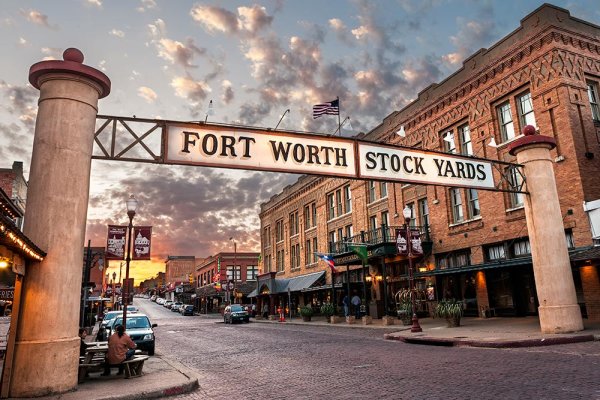
stockyards-entrance

First off, I am certainly not a lawyer and am not giving legal advice in this article, I’m simply telling my story and how I handle image theft. If you have questions about legal advice, please consult with an attorney.

Recently I received a phone call from a family member who believed a local news station was using one of my images as a green screen background. This was interesting considering I hadn’t had any conversations with any news stations recently about such a thing. I asked him to send me a photo of the segment and sure enough, it was mine.

I’ve dealt with my fair share of image theft over the last five years of being a professional photographer and I’ve certainly seen a lot more situations of other photographers getting their images stolen.

One thing that has never sat well with me is when I see some photographers attempt to completely destroy people for using their images without permission. Taking a situation like this to social media and damaging the reputation of the offender should be an absolute last resort, not a first knee-jerk reaction.

Quick Side Story

I had this same image stolen by a well known wedding photographer in the Dallas/Fort Worth area. I am friends with him on Facebook and was just scrolling through my feed when I saw this image being used as a photo booth background. I could not believe my eyes! What many photographers would have done is create a public post calling him out and saying what a despicable thing he had done. This would damage his local reputation and certainly go a long way toward making sure he never did it again.

Instead, I sent him an invoice for use of the image (it was in about 30 photo booth images in his wedding gallery), a cease and desist letter and a short email explaining why he was getting all this. Within 5 minutes he paid my invoice and sent very heartfelt apology letter and also thanked me for solving it privately instead of publicly. Turns out he hired someone to man the photo booth and told the person to only used free and clear images, but the person he hired was uneducated in finding the right images and found mine on Google and just assumed. Sure, he should have done a better job educating the hired help but it was a mistake. Not intentional.

Ok, Back on Topic – How I Handle Image Theft

Instead of calling the news station out publicly and demanding the image be taken down, I simply stepped back and analyzed the situation. I came to three conclusions…

  • The image was indeed used without my permission.
  • It had been shown on national television to hundreds of thousands (if not millions) of people.
  • Whether they stopped using the image or not, I deserved compensation for the use that had already occurred.

Now it was time to make contact. I sent this short email…

Hello,

My name is James Brandon and your news program used one of my copyrighted photographs without permission this evening (I’m attaching a photo in the email). Also attached is a Cease & Desist letter to stop further use. Since the image has already been used and run on air, I’ll be sending an invoice for the unauthorized use of the photo as well. Please let me know immediately how you plan to respond to this matter, so I can act accordingly.  

– James 

I got an email back shortly that simply said, “James, I’m forwarding this to our corporate attorneys.”

I’m guessing the person writing the email didn’t think I had a case and figured his attorneys would confirm that. The next email I got from him was a lot more wordy and apologetic. It said…

Second reply from offending party

James,

I’m so sorry about the use of your photo.  It was an unintentional error. 

The editor thought he had found something in the public domain. Obviously, he was mistaken.  He would never have used it if he’d realized it was copyrighted material.

OF COURSE we will immediately stop using the image.  I’ve already deleted it from our system so it doesn’t get used again. In light of the error, could you please consider waiving the fee you would normally charge for such use? 

– Mitch (name changed for purpose of article)

Decision time

This is where I had to make a decision. I didn’t send them an outrageously expensive invoice for thousands and thousands of dollars. Rather, I went to the Corbis website and used their pricing guide to figure out how much they would typically charge for similar use of a stock image. I then added a small percentage to that amount since it was unauthorized use. Should I just let them off the hook since he apologized? I think that I might have actually considered that option if that latest email had been the first thing he wrote me. I however got the impression that he was very unthreatened by my letter initially and only after talking to his corporate attorneys did he see the need to be nice to me and apologize. So I decided to (politely) press on.

Mitch,

 I appreciate the apology. Since the image has already been used and run on air (and who knows how long), I really don’t see how it’s fair to ask me to waive the fee. I sent you a very reasonable invoice. 

 I will however agree that once the invoice is paid, I will send over a licensing agreement so that you can keep using the image in the future (provided that it is left in it’s original state and not Photoshopped like it was). 

 Thanks. 

 P.S. Do you know where the editor found the image? Was it on my website? 

-James

Assuming that it actually was a mistake, I was more than willing to let them keep using the image if they were willing to pay my invoice. Some would say that’s too nice of me, but that’s just the decision I made. He wrote back quickly…

Hello, again, James. (<—-That didn’t sound very nice. I think he’s getting tired of me)

 The editor thought he was on a site for which we have rights and somehow managed to get onto another site.

 As to the invoice, I understand your need to charge for use of the image, accidental or otherwise.  The fee is quite high, however, considering that it was on the air for only a few seconds. 

 Could you cut the fee in half?  I could submit that invoice TODAY and we wouldn’t need the license to keep using the image.

 Mitch

At this point I was getting frustrated. He spoke with his attorneys and they clearly told him that the news station was in the wrong. Now he’s trying to barter with me. I could have said screw it and gone to social media. I could have gone off on him and demanded my money and threatened a lawsuit. Instead I simply stood my ground and let him know my stance on the situation. I also let him know how I could have handled the situation…

Mitch,

When bartering, there has to be incentive on both sides to negotiate. If we were speaking before the image aired, there would be at least some incentive to get my image up on your news program. In this case, the image has already aired without my permission. I didn’t get a say in that. 

This image has been stolen before, I guess there just aren’t that many photos of the Stockyards sign out there. The other people/companies that used the image paid my invoice without question (for the same price) and didn’t try to negotiate it. They understood they were in the wrong and didn’t want to risk having the matter becoming public. They were also nowhere near the size of your news program. 

What most photographers do in a situation like this is immediately call out the business or person using their image on social media and their website. This gets the photographer’s followers up in arms and they will typically go bombard the Facebook page of the person or company in question. This looks very bad to the person/company’s followers and it usually gets the ball rolling pretty fast to get it resolved. 

I’ve chosen to take a more peaceful approach, and attempt to settle this matter privately first. Please pay the invoice so we can put this matter behind us and move on.

-James 

That was the last contact I had with Mitch. After that email, I got an email from somebody higher up asking for a W-9 and new invoice sent directly to him. I ended up talking to that person on the phone and explained the situation. He apologized for Mitch’s behaviour and for the unauthorized use of my image and said that I had every right to be compensated for it. He also thanked me for handling it privately and not defaming them publicly. He then paid my invoice over the phone and the matter was settled.

Conclusion

There are many ways to handle image theft, but most situations can be handled professionally without the need for burning bridges or destroying reputations. It can also nearly always be resolved without the use of attorney or going to court.

If someone steals an image blatantly and then refuses to take it down or ignores all attempts at making contact, then by all means sound off on social media and send your army. That’s not what happened here. The entire process of finding out about my image being used and getting the issue resolved and the invoice paid took about 6 days. It took some patience but in the end it was resolved peacefully.

What are your thoughts? Was I too easy on them? Too hard? What would you have done differently? Let me know!

For more articles on some legal ins and outs of photography and copyright try these: 

  • Intellectual Copyright – What is considered ‘stealing’?
  • Using Image Watermarks In Lightroom
  • Working with a Second Photographer – Legal Ins and Outs

The post How to Handle Image Theft Peacefully by James Brandon appeared first on Digital Photography School.


Digital Photography School

 
Comments Off on How to Handle Image Theft Peacefully

Posted in Photography


New and improved: Nikon D4s First Impressions Review posted

25 Feb

news.png

Nikon’s latest flagship body, the D4s, gets an updated 16 megapixel full-frame sensor, Expeed 4-level processing, 1080/60p video recording and can now autofocus at up to 11fps. Beyond that it boasts a laundry list of small (but potentially meaningful) improvements over its predecessor. After spending some brief time with the camera, we’ve prepared some first impressions of the pro-level body. For a detailed analysis of what’s new in Nikon’s top-of-the-line, take a look at our first impressions review.

News: Digital Photography Review (dpreview.com)

 
Comments Off on New and improved: Nikon D4s First Impressions Review posted

Posted in Uncategorized


25 February, 2013 – Nobody Knows Anything

25 Feb

A common phrase in the motion picture industry is “Nobody knows anything……", meaning that what it takes to produce a hit movie is not always obvious. The same is true in the camera business when it comes to releasing new cameras. A new article by Michael Reichmann explores who does and who doesn’t get it.


You can win an all-expenses paid photographic expedition to Antarctica, along with air fare from anywhere in the world. The value of this prize is $ 15,000.

The Luminous Landscape wants you to try any of our more than 60 training or travel videos and our new free video player. Each purchase is an entry, and an annual subscription that includes all previous as well as new videos counts as six entries. The winner of a free lifetime subscription is also chosen from each month’s entries.

FIND OUT MORE


The Luminous Landscape – What’s New

 
Comments Off on 25 February, 2013 – Nobody Knows Anything

Posted in News


Samsung Galaxy S5 adds 16MP camera with 4K video

25 Feb

samsunga53.png

Samsung’s latest flagship smartphone, the Galaxy S5, has been announced at Mobile World Congress in Barcelona. It features a 16MP camera that shoots 4K video, a 5.1-inch screen and new water resistant shell. Also new is a fingerprint scanner for biometric screen locking and mobile payment. Learn more on connect.dpreview.com

News: Digital Photography Review (dpreview.com)

 
Comments Off on Samsung Galaxy S5 adds 16MP camera with 4K video

Posted in Uncategorized


Fujifilm X-T1 and XF 10-24mm F4 R OIS (beta) samples gallery

25 Feb

1024mm_DSCF2161.JPG

We’ve just returned from the CP+ show in Japan, where Fujifilm was kind enough to loan us a beta sample of its new 10-24mm zoom lens for the X-series interchangeable lens cameras. Although this is a beta (not final) sample, Fujifilm is confident enough about its performance to allow us to post images. We’ve prepared a gallery of sample images taken in various conditions at various ISO sensitivity settings on the X-T1 for you to take a look at. See gallery

News: Digital Photography Review (dpreview.com)

 
Comments Off on Fujifilm X-T1 and XF 10-24mm F4 R OIS (beta) samples gallery

Posted in Uncategorized


Blickfang: Laura Makabresku

25 Feb

Die Fotos der polnischen Fotografin Laura Makabresku habe ich durch Aileens Interview mit ihr von 2011 entdeckt. Diese düsteren Märchenbilder haben mich seit dem nicht losgelassen und als Laura ihr erstes Fotobuch veröffentlichte, musste ich nicht lange überlegen.

Zum Glück, denn innerhalb weniger Tage war das auf 300 Exemplare limitierte Büchlein ausverkauft. Mein heutiger Blickfang stammt aus besagtem Buch und ich hoffe, Ihr könnt ihn genießen, auch wenn das Buch selbst leider nur schwer in Euren Besitz zu bringen sein wird.

Zu sehen ist auf dem von mir ausgewählten Bild eine junge Frau, die nackt auf einem Bett liegt. Neben ihr steht ein Rehkitz, das scheinbar auf sie hinab sieht. Das schwarzweiße Foto wirkt trotz Nacktheit sehr unschuldig und zerbrechlich.

© Laura Makabresku

Ob das Mädchen trauig ist? Schläft sie oder ist sie gar tot? Das Foto lässt viel Raum für Fantasie. Interessant an dem Bild ist, dass es ja eigentlich das ausgestopfte Rehkitz ist, das im Bild tot und leblos wirken müsste, es jedoch den aktiven Part einnimmt. Es wirkt, als würde es das Mädchen wecken wollen.

Das Bild im Buch hat keinen Titel, wodurch ich mehr erfahren könnte. Aber ich bin neugierig und habe im Internet nach dem Foto gesucht. Auf ihrem Blog schreibt Laura zu ihrem Bild selbst:

She doesn’t sleep. darkness pulls her body slowly into itself. her spirit wake beside her: looking as darkness give her lesson about death.

Wir hoffen, Laura bringt schon bald ihr nächstes Buch heraus. Bis dahin gibt es mehr von ihr auf Flickr oder Facebook zu sehen.


kwerfeldein – Fotografie Magazin | Fotocommunity

 
Comments Off on Blickfang: Laura Makabresku

Posted in Equipment


Fallen Starchitects: 7 Failures of Famous Architects

24 Feb

[ By Steph in Architecture & Offices & Commercial. ]

Architectural Failures 1

Even the world’s most famous and celebrated architects have their failures, whether due to unforeseen consequences of an extraordinarily complex design or just plain shoddy construction. From the mold and cracks in Frank Lloyd Wright’s masterpiece Fallingwater to downright dangerous flying roof panels at Calatrava’s opera house in Valencia, these structural defects have led to injuries, lawsuits and in some cases, potential razing of a project before it’s even opened to the public. You can’t quite call these buildings outright failures just because they’ve got structural issues, especially since some of them are already iconic. But is this what happens when architects neglect practical considerations in favor of bold aesthetics?

Mold and Structural Failures: Frank Lloyd Wright’s Fallingwater

Architectural Failures Fallingwater 1

The masterpiece of perhaps the only architect who’s a household name in America, Fallingwater by Frank Lloyd Wright was a fantasy home, a grand experiment that sought to push the boundaries of existing technology and building methods of the time. Cantilevered over a waterfall on Bear Run in rural Pennsylvania, the residence is undeniably stunning. Who wouldn’t want to live in a house perched right over the water, constantly filled with aquatic sounds and reflections? Anyone who’s ever dealt with mold. Fungal growth and excess humidity got so bad so quickly, owner Edgar Kaufmann nicknamed the house ‘Rising Mildew.’ And that’s just one of the major problems that began to plague the house almost immediately after it was built.

There were conflicts all along between Wright, Kaufmann and the contractors building the house and various elements were rebuilt several times. The cantilevers developed for the structure weren’t quite up to the task of holding it up, and the building started to deform before it was even complete in 1937. Two large cracks formed on the terrace’s parapet as soon as the formwork was removed. Wright insisted that the design didn’t require any kind of propping system, but by 1995, a deflection of 7″ was measured at the edge of the largest cantilever, along with a number of serious cracks. The Western Pennsylvania Conservancy, which owned it by that point as a museum, had to do an extensive restoration and add steel trusses to support the cantilevers. Of course, these problems hardly put a dent in the importance of this house’s impact on 20th century architecture, or in Wright’s legacy.

Roof Falling Off: Calatrava’s Palau de les Arts Reina Sofia Opera House, Valencia, Spain

Architectural Failures Calatrava Opera House

Architectural Failures Calatrava Winery

Santiago Calatrava is best known for sweeping, bird-like designs that seem like they could lift up off the ground and fly away. His Palau de les Arts Reina Sofia Opera House in his hometown of Valencia, Spain is a perfect example of his signature style, with 14 above-ground stories and three below-ground, all covered in a curved roof reminiscent of a helmet. The tallest opera house in the world at 246 feet, it contains four auditoriums. Right after it opened to the public in 2005, a series of problems began to plague the structure: the main stage platform in the largest hall collapsed, forcing the cancellation of performances. Then, the complex was inundated with 7 feet of floodwaters, destroying electronic equipment in the lower levels.

But in early 2014, the city of Valencia filed suit against Calatrava for a more serious issue: sections of the mosaic roof began to come off in high winds, forcing authorities to cancel performances and close the building to the public. And this is just one among many lawsuits and accidents relating to Calatrava’s structures. A conference center he designed in Oviedo suffered structural collapse, his footbridge to the Guggenheim museum in Bilbao has required the city to pay out medical costs for dozens of pedestrians who slipped on the glass surface, and another footbridge over the Grand Canal in Venice has required ‘excessive repairs.’ Calatrava was also ordered to pay for the leaking roof of the Ysios Winery (pictured above.)

Leaking, Cracks and Falling Ice: Gehry’s Strata Center

Architectural Failures Gehry Strata Center 1

Architectural Failures Gehry Strata Center 2

This massive 720,000-square-foot academic complex for the Massachusetts Institute of Technology is known as the Ray and Maria Stata Center after its two primary donors, and houses the Computer Science and Artificial Intelligence Laboratory in addition to other academic departments and offices for thinkers like Noam Chomsky. It would be hard for anyone who knows the slightest thing about architecture to miss the fact that it’s a Frank Gehry design, with its sharp angles and melange of metallic finishes. Like most of Gehry’s work, the structure is both praised and reviled – you either love it or you hate it. Gehry himself says it “looks like a party of drunken robots got together to celebrate.”

But MIT administrators have a less than glowing opinion of it for a different reason. The structure leaks, masonry has cracked, mold has developed, drainage has backed up and falling ice and debris repeatedly blocks emergency exits. MIT sued the architect in 2007, accusing him of negligence and breach of contract in the design of the center. Gehry’s response is that MIT is simply after his insurance money, stating “A building goes together with seven billion pieces of connective tissue. The chances of it getting done ever without something colliding or some misstep are small. I think the issues are fairly minor.”

Falling Apart: Zaha Hadid’s Guangzhou Opera Center

Architectural Failures Guangzhou Hadid 1

Architectural Failures Guangzhou Hadid 2

Zaha Hadid’s Guangzhou Opera Center has been praised as the world’s most beautiful performing arts venue with a futuristic ‘twin boulder’ design on the edge of the Pearl River. Sharp angles, geometric patterns and stark white surfaces belie Hadid’s organic inspiration, taken from the geology and topography of the setting. Dotted with starry lighting, the main auditorium has a womb-like feel in gleaming gold. Unfortunately, just a single year after it opened to the public, the building was marred by falling glass and large cracks in the walls and ceilings, leading to serious leaks.

Like many of these ‘failures,’ the problem here isn’t so much Hadid’s design as it is the shoddy materials and construction techniques of the contractors that built it. Many of the 75,000 granite slabs that make up the exterior have begun to fall off, with some blaming poor quality craftsmanship and others blaming Guangzhou’s extraordinarily humid climate. But in China, deadlines to complete even the most complex buildings are often rushed, and a lot of architecture is built with the expectation that it will only stand for about 25 years. The construction group that built the opera center say that it was just extremely difficult to fulfill Hadid’s vision.

Next Page – Click Below to Read More:
Fallen Starchitects 7 Failures Of Famous Architects

Share on Facebook


[ By Steph in Architecture & Offices & Commercial. ]

[ WebUrbanist | Archives | Galleries | Privacy | TOS ]


WebUrbanist

 
Comments Off on Fallen Starchitects: 7 Failures of Famous Architects

Posted in Creativity


Anatomy of a Concert Photography Shoot

24 Feb
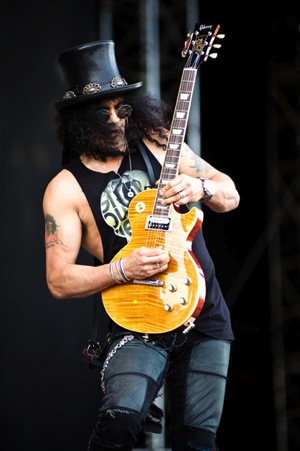
Concert photography Slash

Slash from Guns N’ Roses

In my last article 6 tips for budding concert photographers I explained the basics (and camera settings) of how to start your career as a concert photographer. I would like to say a big thank you for your awesome feedback and your ongoing comments on that post. It really means a lot to me and shows how many talented and hard working concert photographers are out there.

This article is a follow up, and I will go into more details about the “anatomy of a concert photography shoot“. Especially when you are new to concert photography, it can be overwhelming to stand in the photo pit all alone with your camera. The venue lights go out, the band enters the stage and you have only three songs (average 10 minutes) to get your awesome shots. Honestly, in the beginning it was also scary for me, but trust me, after you have shot some concerts you’ll feel much more comfortable in front of the stage and you’ll learn to know your camera settings by heart.

One of the points that are often undervalued is the fact that a band consists of various individuals. It is tempting to only shoot the lead singer (the key person), but this would be just one out of the whole band. There’s also a guitarist, drummer, bass player and additional musicians that are worth taking a closer look. Hence, it is more difficult to photograph the other band members, but you definitely should try to catch everyone on stage.

Let´s break it up:

The Lead Singer (The celebrity of the band)

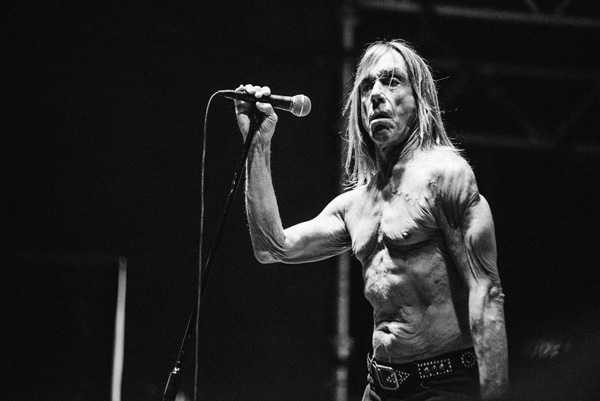
This guy is the one whose name is often linked to the bands name such as Iggy Pop, Morrissey, David Bowie, Neil Young or Leonard Cohen.

They are the celebrities and will be shown on every VIP party and on TV. So, to photograph this person is a must have. From a concert photographers perspective, this is the easiest member to photograph. They are always at the front of the stage and get the best lighting. I always focus on the lead singer first and once I’ve got some awesome shots, I will follow up on the other band members.

Concert photography Iggy Pop

Iggy Pop

The Guitarist and the Bass Player

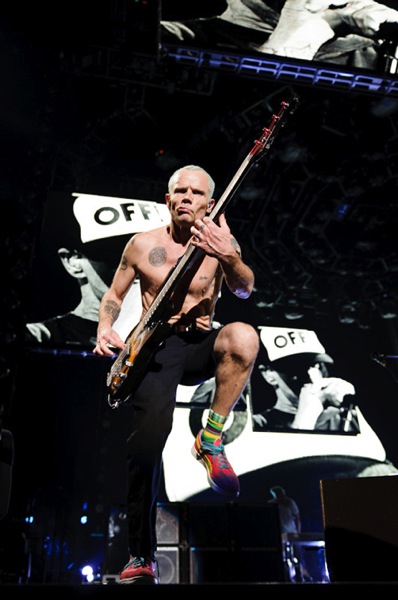
Next I focus on the guitarist and bass player. Both of them are standing on one side of the stage, either behind the singer or on the same level. I’ve shot concerts where the bass player was standing in total darkness, so I won´t have a chance (even with a full frame sensor DSLR, f/1.4 lens, and ISO 6400) to get a decent picture. These are the hard times of a concert photographer and you just have to accept it sometimes. However guitarists and bass players provide great shots when you catch them e.g. posing when playing a solo or jumping around.

(See photo below of Flea from the Red Hot Chili Peppers and Slash from Guns N’ Roses top of the article)

Concert photography Flea bass player

The Drummer

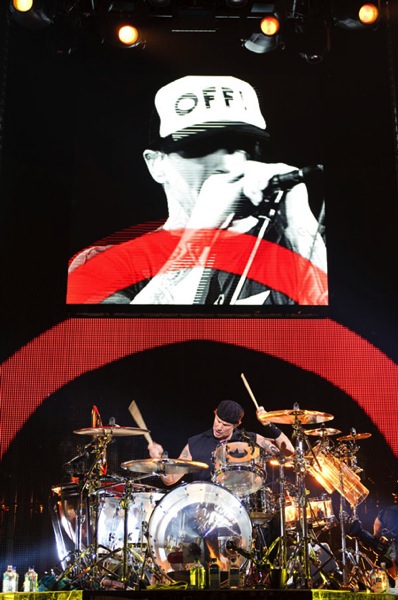
The drummer is the “heart“ of the band and the pulse generator. A rock band without a drummer doesn’t work, but photographers tend to ignore them in their pictures. The drummer is also the one who gets you awesome action shots if you catch them in the right moment. However, these guys are almost always in the back of the stage and therefore you need a telephoto lens like the 70-200mm to capture his presence. On bigger stages (like festivals) it can happen that the drummer is so far away, that it is not always possible to reach him with your basic lens kit. But try your best, and your efforts will be rewarded.

Concert photography drummer

Chad Smith, Red Hot Chili Peppers

The Band

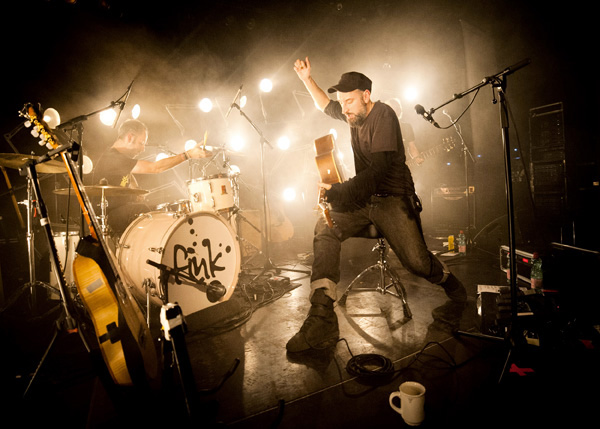
Also try to get a picture of the entire band. Your best bet is the use an ultra wide-angle lens such as a 14mm lens. This will allow you to get the whole stage in one picture. If you are allowed to shoot the complete show (you have to ask the band first), try to get other viewpoints such as from a balcony, from the back of the venue, or on stage.

Concert photography band

Fink

The Audience

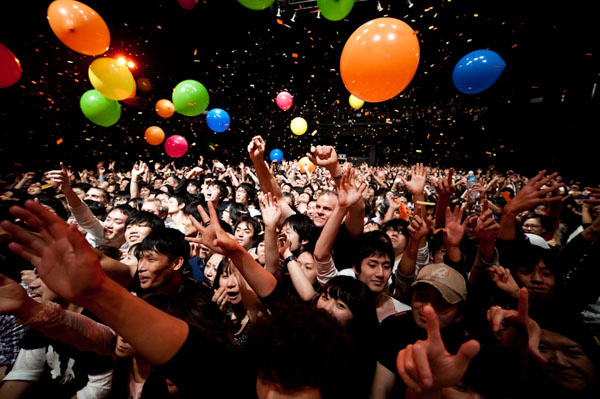
In addition, you can also take pictures of the audience. Just turn around in the photo pit and you are facing the screaming fans squeezed into the first row. This is a tricky one, because there is lack of lighting there and you need a ultra wide angle lens to capture some good action shots. Try to catch them when they are ecstatic about the band.

Concert photography Audience

Some general notes for you as concert photographer:

  • I always try to get the musicians with their instruments. So when I shoot the lead singer, I take care to include the microphone. When shooting the guitarist, get the guitar in the shot and the drummer needs to show his drumsticks, otherwise it looks strange when someone sits behind a huge drum kit, but you can’t actually see him playing.
  • In general I try to frame my pictures in a way that I don´t chop off guitar necks, bass bodies or keyboards. For a close shot of the drummer you need to crop the drum kit. Thats fine, just try to get a clear framing.
  • Shooting famous bands like Metallica, Iron Maiden, Red Hot Chili Peppers, they always provide good lighting on stage. It gets more difficult in smaller clubs where you are confronted with poor lighting conditions.
  • Try to get some details shots too. Shoes, tattoos, fancy stage outfits such as lamps, visuals or flags. Some bands can be very creative.

Summary:

  • Get to know your gear by heart first (camera settings, lenses)
  • Even though the lead singer is the celebrity of the band, try to also get the other band members
  • For the drummer, you often have to use a telephoto lens
  • Show the context in your pictures e.g. The singer with a microphone, drummer with drumsticks, etc.
  • Frame your pictures to avoid cropping off the instruments
  • Get pictures of the band, audience and details on stage
  • The more famous the band, the better lighting on the stage (rule of thumb)


The post Anatomy of a Concert Photography Shoot by Matthias Hombauer appeared first on Digital Photography School.


Digital Photography School

 
Comments Off on Anatomy of a Concert Photography Shoot

Posted in Photography


24. Februar 2014

24 Feb

Ein Beitrag von: Marcel Pommer

© Marcel Pommer


kwerfeldein – Fotografie Magazin | Fotocommunity

 
Comments Off on 24. Februar 2014

Posted in Equipment