RSS
 

Archive for February, 2014

In Defense of Pretty Pictures

11 Feb

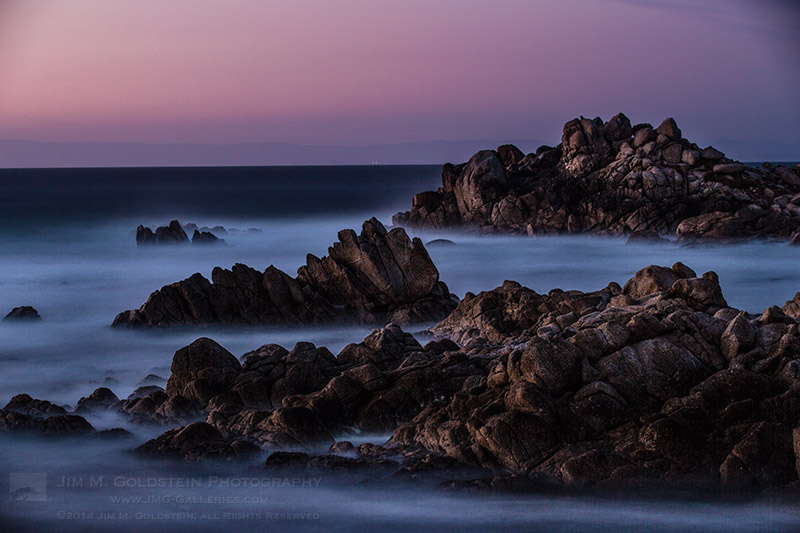
As someone who take pictures with a very critical eye, it’s easy to put not only by own work but the work of others under a very critical magnifying glass. As the ups and downs of life pass by like the ebb and flow of the tide it’s refreshing to take a step back and just enjoy a pretty picture for what it is. Doing so is a sure fire way to lift one’s spirits, regain more level headed thinking and remember why I took an interest in photography in the first place.

Here’s to all the pretty pictures! Thanks for the inspiration and positive energy.

Copyright Jim M. Goldstein, All Rights Reserved

In Defense of Pretty Pictures

The post In Defense of Pretty Pictures appeared first on JMG-Galleries – Landscape, Nature & Travel Photography.


Related Stories

  • In Defense of Pretty Pictures – Enclosure
  • Best Photos of 2013 by Jim M. Goldstein
  • Best Photos of 2013 by Jim M. Goldstein – Enclosure
Feed Ads by FeedBlitz
powered by ad choices


JMG-Galleries

 
Comments Off on In Defense of Pretty Pictures

Posted in Equipment


MEGA iOS app adds PhotoSync feature

11 Feb

mega.jpg

There are many major cloud storage providers out there, but one in particular aims to improve privacy and security options: MEGA. Founded by the man behind the controversial and now defunct Megaupload.com, MEGA has just announced that its latest iOS app adds a feature to automatically sync your photographs, much like Google Drive and Dropbox do now. Click through for more.

News: Digital Photography Review (dpreview.com)

 
Comments Off on MEGA iOS app adds PhotoSync feature

Posted in Uncategorized


Testbericht: Lomography Experimental Lens Kit

11 Feb

Ein Beitrag von: Tamara Skudies

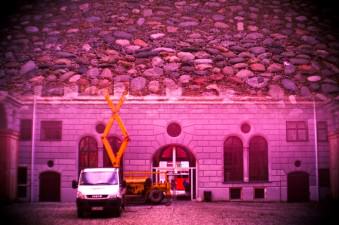
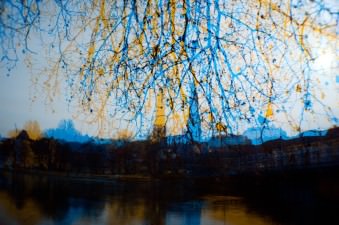
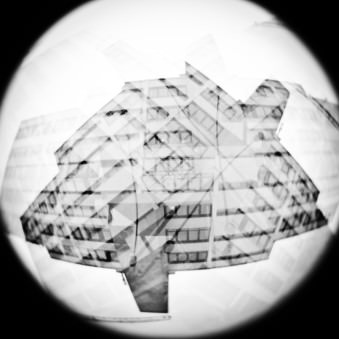
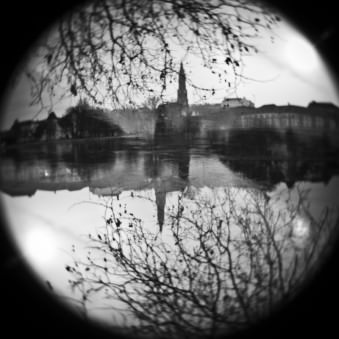
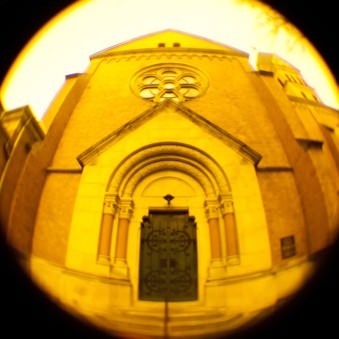
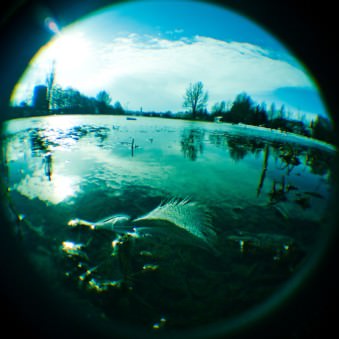
Seit Oktober 2013 bietet Lomography ein Linsenset für Micro-Four-Thirds Kameras an. Es soll mit drei Linsen und bunten Farbfolien für lomografisches Feeling und für mehr Möglichkeiten zum Experimentieren auch beim digitalen Fotografieren sorgen.

Das Set beinhaltet eine Fisheye-Linse für fantastische 160°-Aufnahmen, eine Weitwinkel 12mm-Linse und eine Standard 24mm-Linse. Sie bestehen alle aus Kunststoff – nicht nur das Äußere, sondern auch das Wichtigste, die Linsen selbst, sind aus Kunststoff.
© Tamara Skudies

© Tamara Skudies

Jede davon ist mit einer festen Blende von f/8 ausgestattet und besitzt die zwei Verschlusszeiten N (1/100) und B (Bulb). Mit dem T-Blendenverschlusshebel kann man die Blende dauerhaft öffnen, um der Kamera die Belichtungszeit zu überlassen oder die Blende schließen, um an der Linse selbst mit einer der beiden Verschlusszeiten auszulösen.

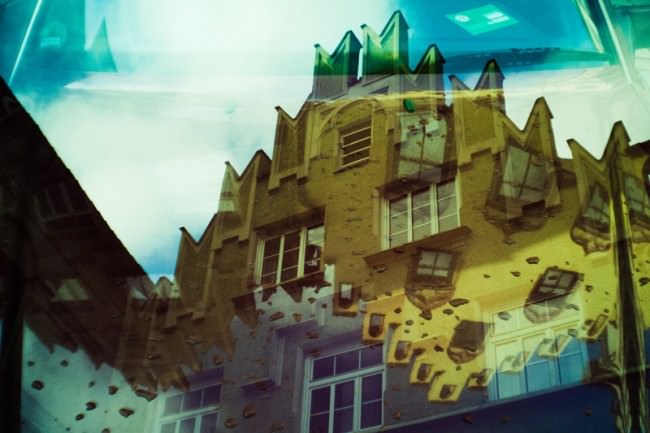
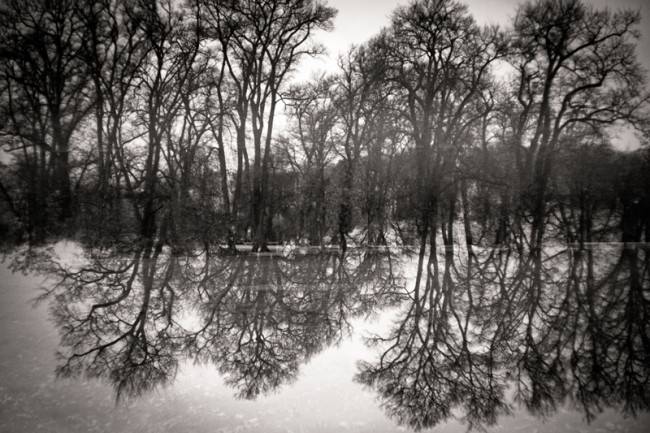
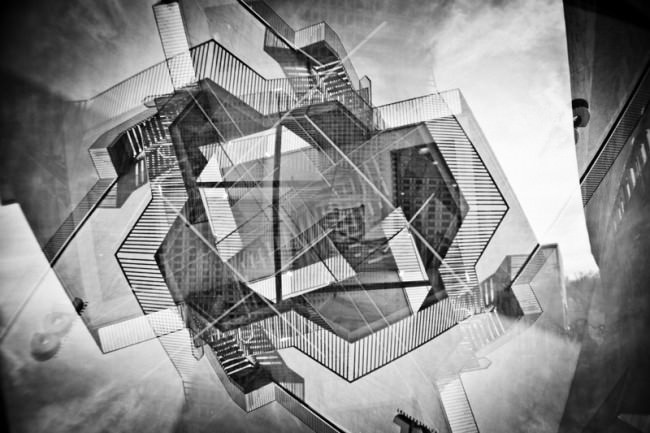
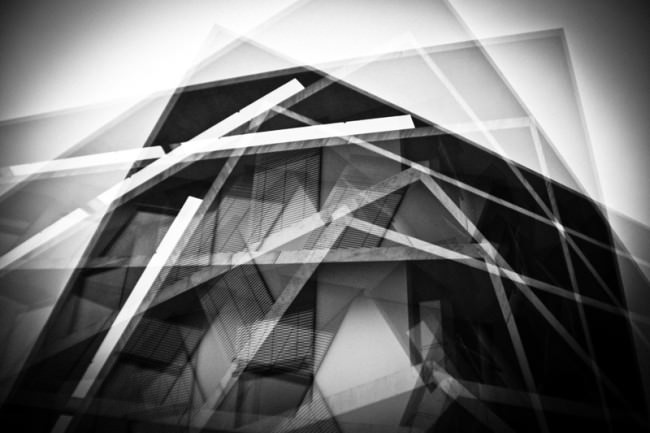
Letztere Einstellung nutzt man am besten für Mehrfachbelichtungen, indem man an der Kamera eine lange Belichtungszeit einstellt und an der Linse mehrfach auslöst. So fällt nur dann Licht auf den Chip, während man an der Linse auslöst und man erhält direkt in der Kamera Mehrfachbelichtungen, auch wenn die Kamera keine eigene Funktion für Mehrfachbelichtungen hat.
© Tamara Skudies

© Tamara Skudies

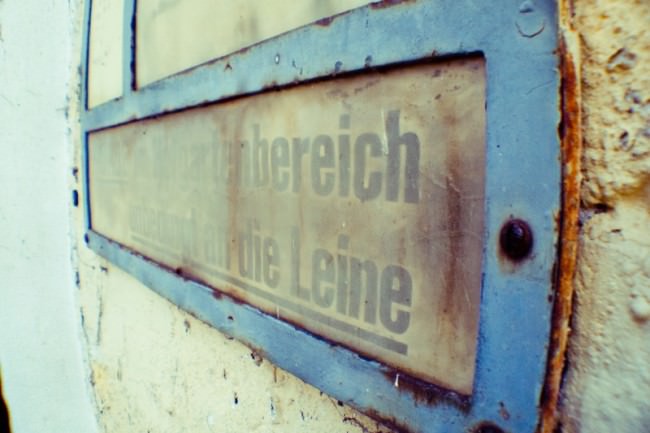
Bei jeder Optik gibt es je eine Entfernungseinstellung für unendlich und eine für den Nahbereich. Bei der Fisheye-Linse sind es 5cm, bei 12mm sind es 20cm und bei 24cm sind es 60cm. Zu den Linsen werden noch fünf Farbfolien in gelb, blau, orange, grün, lila und zwei unterschiedlich starke ND-Filter mitgeliefert.

Die ND-Filter sind für die Mehrfachbelichtungen wie oben beschreiben (Kamera auf lange Belichtung, an der Linse auslösen) sehr gut geeignet, da es sonst schnell zu Überbelichtungen an hellen Tagen kommt. Ebenso kann man auch die Farbfilter benutzen, um die einfallende Lichtmenge zu reduzieren.

© Tamara Skudies© Tamara Skudies

Dieses Feature der Linsen, direkt an ihnen auslösen zu können und so echte digitale Mehrfachbelichtungen erstellen zu können, ist meines Erachtens das absolute Highlight an den Linsen. Man ist nicht mehr an die Einstellung seiner Kamera gebunden und kann einfach wilde Mehfachbelichtungen schießen.

Während des Fotografierens bleibt der Monitor der Kamera natürlich schwarz, was den Überraschungseffekt, wie das Bild am Ende aussieht, erhöht. In der analogen Fotografie werden gerne HQME (High Quantity Multiple Exposure) Fotos vom gleichen Objekt gemacht. Das ist jetzt Dank der Linsen und den ND-Filtern auch mit den Micro-Four-Thirds Kameras möglich.
© Tamara Skudies

© Tamara Skudies

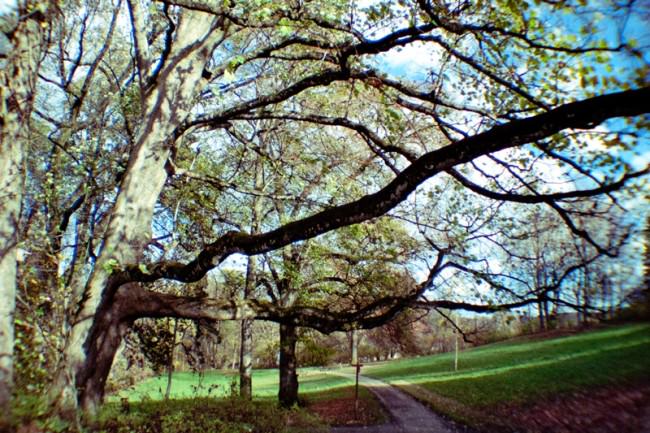
Im hinteren Teil der Linsen setzt man die Farbfilter ein. Man kann den Bildern dadurch einen Farbtouch geben, ohne am PC das Bild großartig nachbearbeiten zu müssen. Am liebsten mag ich die orange und grüne Folie. Bei Benutzung der orangen Folie sehen die Bilder fast aus wie die eines Redscalefilm und mit der grünen wie bei einem cross-entwickelten Fujifilm, wenn man den Kontrast am PC noch etwas erhöht.

Zusammen mit dem Lomography Colorsplash Flash nahm ich meine Olympus und die Linsen in die Disco mit. Die feste Entfernungseinstellung ist an den Linsen wirklich praktisch, wenn man beim Weggehen mal Partyfotos machen möchte.

© Tamara Skudies© Tamara Skudies

© Tamara Skudies

Man muss nicht mehr warten, bis die Optik in der Fast-Dunkelheit endlisch scharf gestellt hat, wenn sie es denn überhaupt schafft. Somit sind der spontanen Fotografie im Dunkeln mit Blitz, bunten Farbfolien und Doppelbelichtungen keine Grenzen gesetzt.

Zusätzlich habe ich sie noch mit den Holga Close-Up-Linsen getestet, da ich gerne Nahaufnahmen mache. Das Ganze funktioniert am besten bei der 24mm-Linse, da man bei 12mm gern mal den Rand der Nahlinse im Bild hat. Natürlich kann man auch jegliche andere Nahlinsen damit nutzen.

© Tamara Skudies© Tamara Skudies

Die Linsen machen wirklich sehr viel Spaß. Auch, wenn sie für mich niemals eine analoge Kamera ersetzen können, würde ich sie mir kaufen. Am liebsten ist mir die 12mm-Linse, die eine schöne Unschärfe im Randbereich hat und weil ich einfach ein großer Weitwinkelfan bin. Im nächsten Urlaub werden mich die Olympus und die 12mm Linse auf jeden Fall begleiten.


kwerfeldein – Fotografie Magazin
 
Comments Off on Testbericht: Lomography Experimental Lens Kit

Posted in Equipment


Blob: Oblong White Mobile Home Looks Like a Dino Egg

11 Feb

[ By Steph in Architecture & Houses & Residential. ]

Blob Modern Mobile Home 1

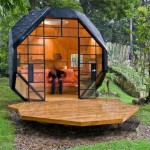
Designed as an extension to a home, this mobile live/work pod eschews conventional mobile home aesthetics in favor of something decidedly more eccentric. ‘Blob VB3′ is an oblong white living space that looks like a gigantic egg when it’s all closed up, but the sides open to reveal a gridded interior for storing small items, working and even sleeping.

Blob Modern Mobile Home 2

Architecture firm dmvA came up with the prototype in response to strict building codes in the client’s city. It contains lots of open niches for storage, multipurpose platforms, lighting, a kitchen and a bathroom. When the airplane-like ‘nose’ is open, it functions as a roof for a small indoor/outdoor space.

Blob Modern Mobile Home 3

Primarily made of polyester, the Blob VB3 is easy to transport, aerodynamic and versatile. It could be used as a guest room, office, pool house or garden house. A circular skylight lets light into the bright white interior.

Blob Modern Mobile Home 4

While the open shelves don’t exactly make it ideal for pulling behind a truck like an Airstream, it’s an interesting way to add a little extra space to an existing building without having to deal with local building regulations.

Share on Facebook


[ By Steph in Architecture & Houses & Residential. ]

[ WebUrbanist | Archives | Galleries | Privacy | TOS ]


WebUrbanist

 
Comments Off on Blob: Oblong White Mobile Home Looks Like a Dino Egg

Posted in Creativity


10 February. 2014 – Photographing The Arctic

11 Feb


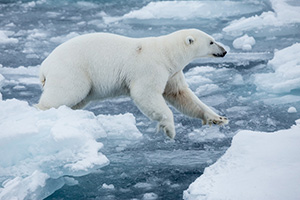
This July Peter Cox, Kevin Raber along with Morten Jørgensen will lead two small ship tours to the Arctic region around Svalbard, Norway.  This is a very unique workshop as it is a small ship trip with 11 participants on each trip.  This area is known as Land Of The Polar Bear.  We will be photographing landscapes, wildlife and polar bears.  Ten years ago Iceland was hardly a blip on the radar for photographers.  That was until Luminous-landscape did some workshops there.  We feel that Svalbard is the new Iceland.  This is your chance to be one of the first to explore this region and come back with some amazing images.  The small ship we will use is ideally suited to photograph polar bears in this region since it has a main deck close to the waterline.  To get a better idea of what you can expect from a trip like this, read Peter Cox’s article Photographing In The Arctic – Svalbard 2013.  This is a trip log from a trip we did this past August.  And when you are ready to sign up for this year’s trip you can find out more information HERE.

Are you planning on attending this year’s WPPI Trade Show and Convention in Las Vegas March 3-5?  If so drop us an email.  Kevin and Chris will be there reporting on the show and it would be great to meet soemwhere and say hi.


The Luminous Landscape – What’s New

 
Comments Off on 10 February. 2014 – Photographing The Arctic

Posted in News


Blackmagic Production Camera 4K available now for $3000

11 Feb

blackmagicproductioncamera4kfront.png

Blackmagic Design has announced it is shipping its 4K, global-shutter camera for $ 1000 less than originally suggested. The Blackmagic Production Camera 4K is built around a Super 35mm (roughly APS-C-sized) sensor and can shoot 4K and 1080p footage in Apple ProRes 422 (HQ) or Adobe CinemaDNG Raw formats, direct to SSD. The camera offers 4K at 30p, 25p, 24p and NTSC equivalents. It has a Canon EF-compatible lens mount, offering electronic aperture control with Canon and Zeiss lenses. It is available for $ 2,995.

News: Digital Photography Review (dpreview.com)

 
Comments Off on Blackmagic Production Camera 4K available now for $3000

Posted in Uncategorized


Blickfang: Homeworks #3

11 Feb

Ich mag Bilder, die auf den ersten Blick perfekt und schön sind, bei denen aber eine Kleinigkeit die Perfektion bricht. Das Foto „Homeworks #3“ aus der Serie von Miles Aldridge ist so ein Bild und mein heutiger Blickfang.

Zu sehen ist eine schöne blonde Frau, geschminkt, mit Perlenohrringen und einem auffallenden Kleid. Es könnte aus einem Beautyshooting sein, wie viele andere, die man in Zeitschriften sieht, aber da ist noch etwas. Die Frau hat eine Zigarette im Mund und zündet diese gerade an einem Gasherd an. Sie lehnt sich dabei so weit vor, dass ihre blonden Haare auf den Herd fallen.

Eigentlich müssten sie gleich brennen, denkt man. Aber die Frau sieht gelangweilt weg. Am Zigarettenende sieht man ihren Lippenstiftabdruck. Noch so ein Perfektionsbrecher.

Homeworks #3 © Miles Aldridge

Das Foto habe ich im Buch „Traumfrauen: Starfotografen zeigen ihre Vision von Schönheit“ gefunden. Das Buch ist aufgeteilt in verschiedene Bereiche: Klassisch, glamourös, persönlich, lyrisch, ironisch, eigenwillig und visionär. Das Foto von Aldridge findet sich im Kapitel „ironisch“. Neben dem Bild steht ein Zitat des Fotografen:

Ich mag keine langweiligen Frauen. Ich mag keine schönen Frauen. Ich mag sonderbare Frauen, obsessive Frauen, verrückte Frauen.

Was mich stört, ist der Buchfalz, der das Bild genau zwischen Oberkörper und Kopf des Modells trennt. Leider ein Problem vieler Bücher und vielleicht auch Geschmackssache.


Informationen zum Buch

„Traumfrauen: Starfotografen zeigen ihre Vision von Schönheit“*
Verlag: DuMont
Seiten: 200
Sprache: Deutsch
Maße: 31,4 cm x 24,8 cm x 2,6 cm
Einband: Hardcover, gebunden
Preis: 49,90 €

* Das ist ein Affiliate-Link zu Amazon. Wenn Ihr darüber etwas bestellt, zahlt Ihr keinen Cent mehr, wir erhalten aber eine kleine Provision.


kwerfeldein – Fotografie Magazin

 
Comments Off on Blickfang: Homeworks #3

Posted in Equipment


Crochet Playscapes: 13 Interactive String Art Installations

10 Feb

[ By Steph in Art & Installation & Sound. ]

Crocheted Playgrounds Main

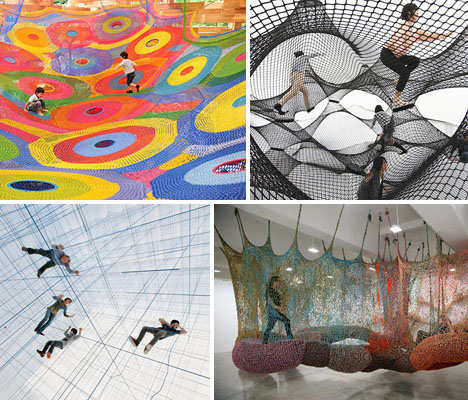
Miles of yarn and string stretch across inflatable structures, galleries and outdoor environments in these crocheted and knotted art installations, offering massive interactive playgrounds that invite people to climb, bounce and lounge. String is used as both an art medium and a functional, supportive structure in projects ranging from vast playscapes for children to a public NYC installation made of 1.4 million feet of hand-knotted rope.

Colorful Crochet Playgrounds by Toshiko Horiuchi MacAdam

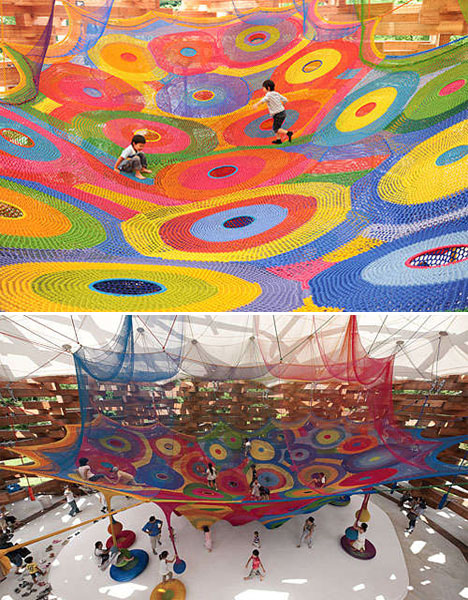
Crochet Playgrounds Horiuchi

Perhaps the most vast and complex crocheted works ever created, Toshiko Horiuchi MacAdam’s colorful installations are literal playgrounds for kids and adults, installed in parks and playgrounds. The artist starts her design process by creating a wooden scale model of the space where the net will be installed, and thence rockets the piece in fine cotton thread. That design is then adapted to full scale with yarn. ‘Rainbow Net,’ her most famous piece, took three years to complete and is located at the children’s area of the Takino Suzuran Hillside National Park in Sapporo, Japan.

Crocheted Alligator Playground by Olek

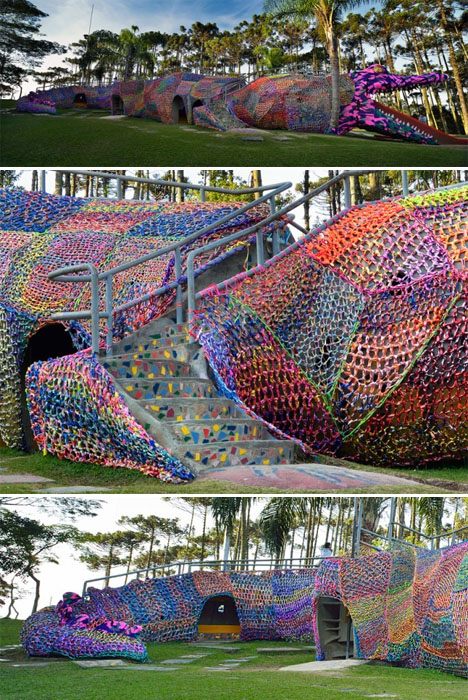
Crocheted Playscapes Alligator

An alligator the size of a particularly massive dinosaur is covered in colorful crocheted yarn in ‘Crocheted Jacaré,’ a piece in Brazil by Brooklyn-based artist Olek. The alligator was already a part of the playground, Olek simply created some temporary clothes for it that made it stand out even more.

In Orbit: Transparent Suspended Net Playground

Crocheted Net Playscapes In Orbit 2

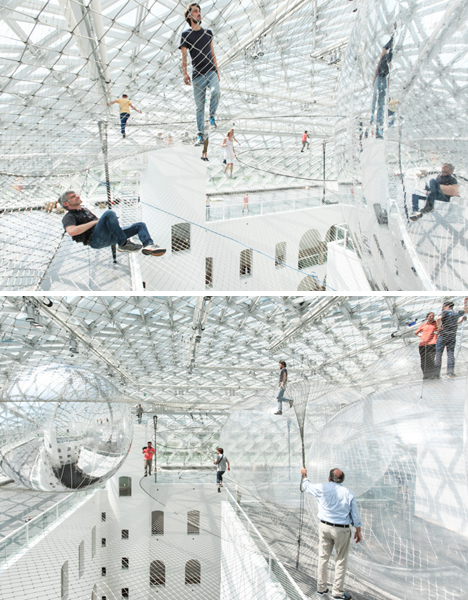
Transparent net hung over a four-story drop offers a rather frightening play experience for anyone with the slightest fear of heights. Artist Tomás Saraceno created the 2500-square-meter installation at the Kunstammlung Nordrhein-Westfalen museum in Dusseldorf, Germany, inviting visitors to walk out onto the cloud-like nets amidst mirrored spheres.

Inhabitable String Structure by Numen/For Use

Crochet Playscapes Inhabitable String

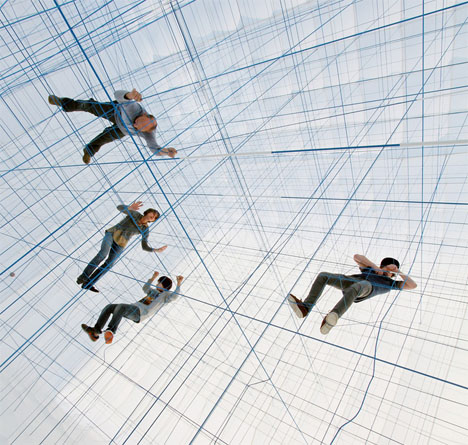
Climbers make their way through a grid made of string in this ‘social sculpture’ installation by design collective Numen/For Use. The ropes are contained within an inflatable structure, secured to all sides of the interior. When the bubble is deflated, they fall to the ground, and when it’s inflated, they become a taut interactive playground. The designers describe it as “bodies entrapped in a 3D grid, flying in unnatural positions throughout superficial white space, resemble dadaist collages. Impossibility of perception of scale and direction results in the simultaneous feeling of immenseness and absence of space.”

Crocheted Net Nests by Ernesto Neto

Crochet Playscapes Ernesto Neto 2
Crochet Playscapes Ernesto Neto 1

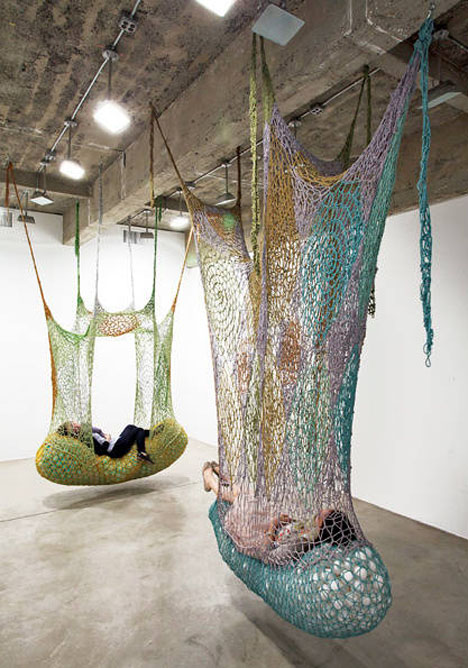
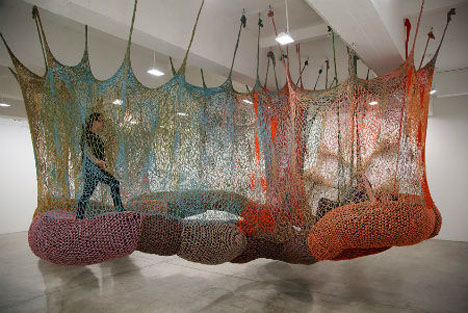
Brazilian artist Ernesto Neto creates massive crochet installations reminiscent of the playgrounds by Horiuchi MacAdam, but in more muted tones. Strung from gallery ceilings, these strange little ‘nests’ offer an inhabitable space that can be either playful or quiet and comforting. Larger pieces encourage running and jumping, while the smaller ones are cocoon-like relaxation spaces.

Next Page – Click Below to Read More:
Crochet Playscapes 13 Interactive String Installations

Share on Facebook


[ By Steph in Art & Installation & Sound. ]

[ WebUrbanist | Archives | Galleries | Privacy | TOS ]


WebUrbanist

 
Comments Off on Crochet Playscapes: 13 Interactive String Art Installations

Posted in Creativity


10. Februar 2014

10 Feb

Ein Beitrag von: Christoph Boecken

Jeriko, Portrait, Frau, Scheibe, Fenster, Schwarzweiß,


kwerfeldein – Fotografie Magazin

 
Comments Off on 10. Februar 2014

Posted in Equipment
 

How to use Lens Flare to Your Advantage

10 Feb

Flare can be a polarizing topic in photography, and many articles have been written about how to prevent or eliminate lens flare. But there are many situations where you can use lens flare creatively to enhance your photographs.
McEnaney-flare-columns

What is Lens Flare?

Lens flare and sun flare are terms that are often confused in photography literature. Sun flare generally refers to turning the sun into a starburst shape, while lens flare is an artifact of stray light bouncing around the lens and being recorded by the sensor. This article will focus on lens flare, but you can read more about Using Sun Flares to Create Dramatic Images.

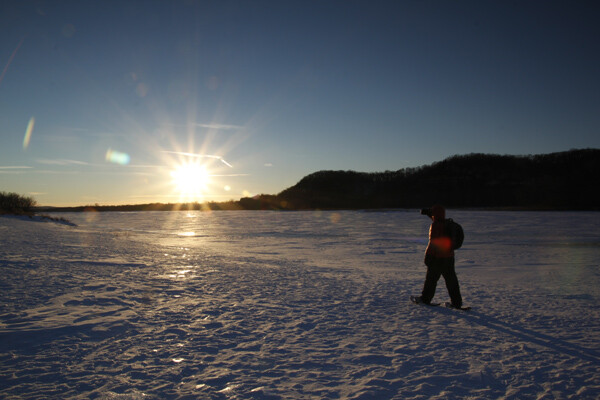
Lens flare comes in several varieties but all are related to light (generally from the sun) bouncing around inside the lens. It can include circular, or curved areas of light, around the sun, somewhat like a natural sun dog, as well as the more common stray flashes of light, or dots and dashes of light in a line.

McEnaney-flare-varieties-snowshoer

Most articles are full of advice for how to avoid lens flare, which is a good place to start if you then want to do the opposite. The first strategy for avoiding lens flare is to use a lens hood on your camera, which blocks light coming into the camera lens from the sides. The second strategy is to limit the use of filters in front of your lens, as additional glass, especially low-quality glass, can lead to more flare. There is some debate about whether a UV filter alone helps to eliminate or accentuate flare, but the pricier the glass, the less likely that there would be adverse effects.

Creating and Controlling Lens Flare

So, if you want to create lens flare intentionally in an image, you should first remove your lens hood. This allows more sunlight directly into your lens. As for filters, you can experiment with removing your filters all together or trying to combine more than one filter (such as a UV filter and a polarizer) at a time. I have not found much difference between keeping or removing my UV filter, so I tend to keep it on for ease and lens protection.

McEnaney-flare-bw-woods

Consider using a zoom lens rather than a prime lens when shooting for flare. Zoom lenses tend to have more internal elements than prime lenses, which create more potential to interfere and add flare. Zoom lenses also give you a range of focal lengths and compositional options to allow you to best place and manipulate the flare exactly where you want it in your image.

You will need the sun in, or near the edge, of your frame to create successful flare. This is easier to accomplish in the early morning or late afternoon when the sun is lower in the sky. Be careful any time you are shooting directly into the sun, as there is potential to damage your camera’s sensor and your eyesight. Be sure to wear your sunglasses and compose shots quickly. You can often get flare effects with just a hint of the sun coming in from the top edge of your image, which will also reduce potential damage to you or your camera.

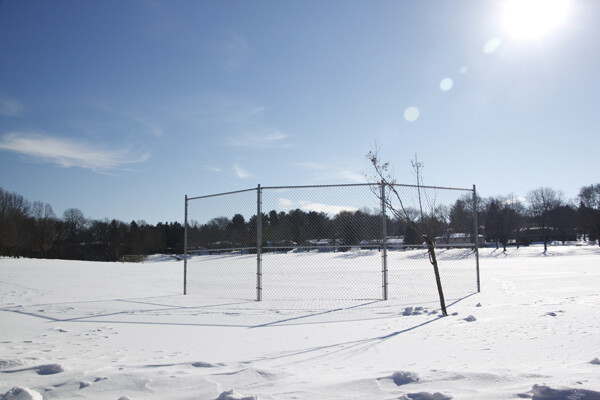
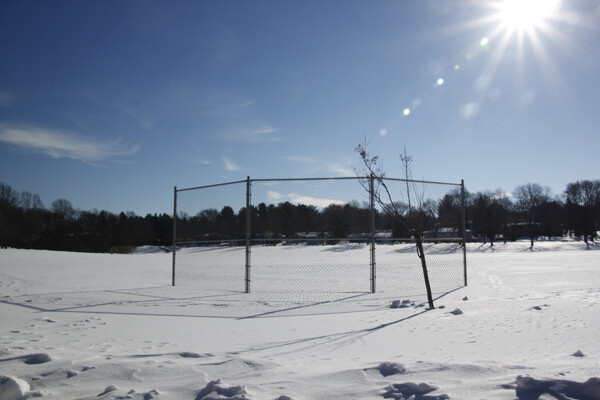
Flare effects are often more pronounced at narrower apertures, like f/22, as the narrower opening in the lens gives the light more potential to scatter. But, as you can see from the comparison shots below (at f/8 top and f/22 bottom), you can get lens flare at many apertures.

McEnaney-flare-compare-top

Shot at f/8

McEnaney-flare-compare-bottom

Shot at f/22

Depending on your subject, you may need to shoot in manual or use exposure compensation to overexpose your scene (positive values) relative to your camera’s sensor. Because lens flare requires additional light entering your camera, your subject might otherwise appear dim or darker than intended. Meter for your subject (or set exposure compensation to a positive value), and you will have a correctly-exposed subject against the extra brightness of the background flare.

Creative Uses of Lens Flare

Flare has become trendy as a way to emphasize the brightness or perceived warmth of a scene. Lens flare is even starting to make inroads in movies, as popularized in J.J. Abrams’ Star Trek reboot, where he uses lens flare and lighting to cement the futuristic nature of the film. Post-processing to add lens flare to an image is even common among portrait photographers.

How will you share your flare? Show us in the comments below!

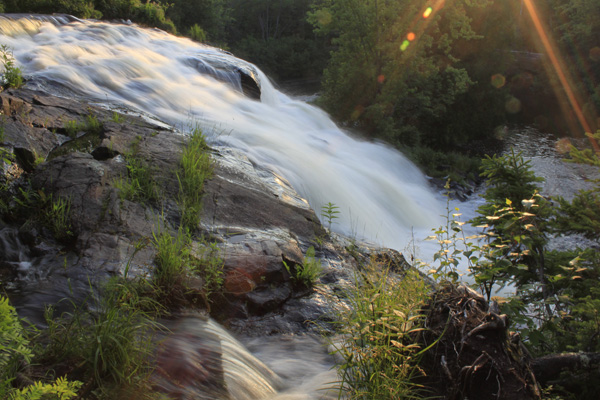
McEnaney-flare-waterfall

The post How to use Lens Flare to Your Advantage by Katie McEnaney appeared first on Digital Photography School.


Digital Photography School

 
Comments Off on How to use Lens Flare to Your Advantage

Posted in Photography