RSS
 

Archive for September, 2013

Flying Robots: 6 Stunning Unmanned Aerial Vehicle Projects

24 Sep

[ By WebUrbanist in Technology & Vehicles & Mods. ]

unmanned aerial vehicle flights

From the MIT Senselab quadcopter and ETH Zurich self-assembling multicopter to DIY drones mounted with paintball guns, toy rockets and automatic weapons, flying robots are quickly making their way from distant war zones to local city streets. The big question in the minds of many is whether this proliferation is a utopian or dystopian development. The following six examples (each with its own video) highlight extremes both positive and negative in the controversial and fast-paced evolution of unmanned aerial vehicles (or: UAVs for short).

Headline-Making Buzz as UAV Makes Surprise Flyby

Recently Angela Merkel made headlines as she was photographed close-up by a UAV, which then promptly crashed when its controller was approached by police and had to drop the controls. The Pirate Party claimed credit, stating they wanted to force the issue of urban surveillance and the domestic use of non-combat drones. At and it worked: her close encounter with a miniature UFO has sparked serious debate about the roll of UAVs in everything from front-line combat to city surveillance.

Self-Assembling Multi-Copter Flies in Raft Formation

self assembling multi copter

Before going further down the complex political and social implications of drone development, it is worth looking at the innovative upside and sheer technological achievement associated with UAV innovations, starting with the following Distributed Flight Array developed in a Swiss research lab. In this experimental project, a series of autonomous hexagonal copter pods assembles itself into a group on the ground using laser guidance systems. Once attached and aloft, each component copter within the larger composite ‘raft’ plays a roll in maintaining altitude and stability, rotating clockwise or counterclockwise to create lift and cancel torque.

self flying helicopter raft

From Gizmag: “As the united band of robots hovers and climbs off the ground, each robot module is using inertial sensors to detect tilt and roll – exactly the same sensors found in an iPhone or iPad to detect tilt. Each of the modules determines how to correct for pitch (forward and back tilting) and roll (side to side tilting) by making small adjustments to the speed of its propeller. The data link on the infrared light beams helps the robots decide which direction and axis is which.”

Flying Tour Guide Takes You to Desired Destinations

mit lab autonomous vehicle

Meanwhile, researchers at Massachusetts Institute of Technology have built a less playful and more purposeful autonomous quadcopter designed to help people navigate cities or to aid in remote search-and-rescue missions. The SkyCall from Senseable City Lab provides networked intelligence in physical form, and is more than just a prototype – initial versions are being deployed on MIT’s campus to give guided tours or take visitors to specific on-demand destinations when summoned by phone or via other mobile devices.

mit campus tour robot

From Dezeen: “UAV technology holds huge disruptive potential …. We want to harness this and specifically explore its value to the city and its inhabitants.” In this case: “Rather than the visitor diverting their attention to a map, the autonomous guide provides an intuitive navigational system of simply ‘following’.” Of course, not everyone has such a bright vision for these various new flying devices, as you will see below.

Next Page:
Rise Of Drones 6 Sides Of Unmanned Aerial Vehicle Debate

Share on Facebook


[ By WebUrbanist in Technology & Vehicles & Mods. ]

[ WebUrbanist | Archives | Galleries | Privacy | TOS ]


WebUrbanist

 
Comments Off on Flying Robots: 6 Stunning Unmanned Aerial Vehicle Projects

Posted in Creativity


Editorial: Why I can’t stop taking iPhone Panoramas

24 Sep

iphone.png

DPReview editor Barnaby Britton spent his weekend taking pictures on the new Apple iPhone 5s, which among other refinements features a new camera, larger sensor, built-in filter effects and a unique two-color flash. It also offers an improved panorama mode with adaptive ‘live’ metering across the frame. In this short article he explains why even if you don’t have any interest in the new iPhone, you should definitely pay attention to the iPhone 5s’ panorama feature.

News: Digital Photography Review (dpreview.com)

 
Comments Off on Editorial: Why I can’t stop taking iPhone Panoramas

Posted in Uncategorized


NYT offers a look ‘hometown’ across the U.S. through the eyes of teens

24 Sep

518022d39eff66dbb4000050-1024.jpg

The New York Times’ Lens Blog asked teenagers across the U.S. to submit photos of their hometowns for a project simply called ‘My Hometown.’ Thousands of teens responded to the call, with submissions coming from 45 states. The resulting collection is a yearbook of sorts, documenting the friends, family and places closest to a small sampling of the country’s young people. Lens Blog has published a selection of 145 Editor’s Choice photos, and the whole collection is available online – searchable by student or state. Take a look at a few standouts.

News: Digital Photography Review (dpreview.com)

 
Comments Off on NYT offers a look ‘hometown’ across the U.S. through the eyes of teens

Posted in Uncategorized


Auf den Straßen Schwedens

24 Sep

Ein Beitrag von: Ola Billmont

Wenn man auf den Straßen Schwedens mit einer Filmkamera fotografiert, braucht man irgendwann einen Blitz, weil es zwischen September und April ziemlich dunkel ist. Dieses Problem hat dazu geführt, dass ich vor einem Jahr angefangen habe, einen Blitz zu benutzen und zur analogen Fotografie wechselte, ohne die ich heute nicht mehr leben kann.

Ich fotografiere noch nicht wirklich lange. Obwohl ich über die Jahre schon viele Kameras besessen habe – benutzt habe ich sie nicht wirklich in dem Ausmaß, wie ich es jetzt tue. Und ich mag es, mit verschiedenen Techniken und Formaten zu experimentieren.

Tango © Ola Billmont

Ich fotografiere monochrom sowie in Farbe und die selbst durchgeführte Entwickelung des Films erlaubt mir, die volle Kontrolle über den kreativen Prozess zu haben. Das ist eine intensive, persönliche Befriedigung.

Zwar kann es ziemlich herausfordernd sein, wenn man mit Planfilm der Größe 8×10″ arbeitet, aber es ist den Aufwand wert. Erst recht, wenn man dann die Endergebnisse sieht.

Ich bevorzuge es aus ästhetischen Gründen – dem vorsichtigeren Prozess des Fotografierens und der geduldigen Antizipation bezüglich finaler Resultate – auf Film zu fotografieren.

Beim digitalen Fotografieren ist es einfach, mehrere Fotos zu machen, ohne nachzudenken. Ich finde, dass das Fotografieren auf Film mich konzentriert hält und jeder Schuss zählt.

Sunprice © Ola Billmont

Wenn man meine Fotos sieht, könnte man denken, dass ich ernstzunehmende Konflikte mit Personen hatte und um ehrlich zu sein: Es gab auch ein paar. Für einen „in your face“-Fotografen scheint es bei mir jedoch ganz gut zu laufen.

Obwohl meine Körpergröße 1,96m beziffert, bin ich ein glücklicher Kerl und gewöhnliche lächle ich Menschen nach dem Foto an und bedanke mich. Die normale Reaktion ist: „Was machen Sie da? Und warum?“ und meistens mache ich den Menschen ein Kompliment und hoffe, dass sie es positiv aufnehmen.

Weiter trage ich Visitenkarten und ein kleines Portfolio bei mir, damit die Menschen verstehen können, was ich tue.

Angels © Ola Billmont

Ich mag es sehr, Projekte, Veranstaltungen und verschiedene Themen zu fotografieren und wähle Format sowie Equipment passend dazu aus.

Beispielsweise ging ich letztes Jahr nach Dalarna in Zentralschweden, wo es ein amerikanisches Auto-Treffen gibt, das Menschen von überall her anzieht (diese haben einen Spitznamen: raggare).

Passanger © Ola Billmont

Die Autos variieren von raren, minzefarbenen, restaurierten Autos bis zu Ab-auf-den-Müllberg-Autos. Es ist immer ziemlich viel Alkohol am Start und allein schon deshalb kann eigentlich alles passieren. Dieses Projekt fotografierte ich auf Mittelformat mit der Mamiya 7 und bin mit den Ergebnissen sehr zufrieden.

Bei einem noch laufenden Projekt, das „0.35“ heißt, mache ich mit ein paar Nikon-SLRs und einem entfesselten Blitz Portraits aus kürzester Distanz.

Broom © Ola Billmont

Obwohl ich Anerkennung für die Nahaufnahmen mit Blitz bekomme, mag ich es, mit anderen Stilen herumzuexperimentieren und möchte nicht als ein bestimmter Typ Fotograf einsortiert werden. Außerdem arbeite ich an vielen anderen Projekten, die ganz ohne Menschen auskommen.

Mein Interesse an der Fotografie geht jedoch über das Bildermachen hinaus. Zusammen mit zwei anderen habe ich das CUP Stockholm als eine Plattform gegründet, um andere Fotografen vorzustellen und ausstellen zu lassen.

Wir haben gerade unser erstes Projekt mit dem In-Public-Kollektiv fertiggestellt, was soweit ein großer Erfolg ist.

Mario © Ola Billmont

Wenn ich mir die Zukunft so ansehe, bin ich sehr gespannt auf all die fotografischen Abenteuer, die sich am Horizont abzeichnen. Einschließlich dem Oktoberfest in München und etwas Weihnachtssonne in Los Angeles.

* Dieser Artikel wurde aus dem Englischen von Martin Gommel übersetzt.


kwerfeldein – Fotografie Magazin

 
Comments Off on Auf den Straßen Schwedens

Posted in Equipment


Photographing Fall Foliage

24 Sep

Fall colours can be very different from place to place. Some areas will have a very short colour-changing season of a week or less, while elsewhere it can last nearly a month. Every location will produce different colours, depending on the type of flora and other factors such as climate and soil.

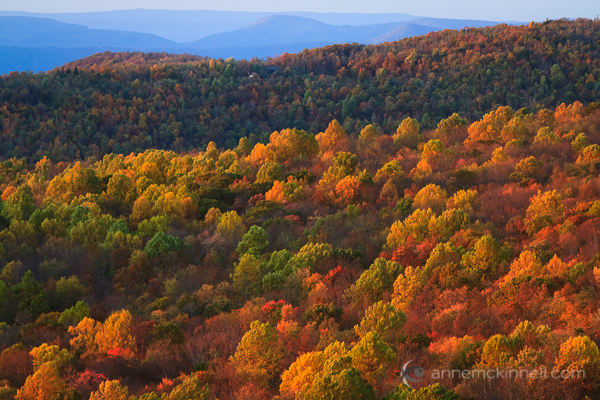
The hillsides of New England, which attract thousands of photographers every year, are famous for their dappled assortment of species producing different shades, ranging between reds and greens.

Shenandoah National Park, Virginia, by Anne McKinnell

The Sierra Mountains of California and Nevada, on the other hand, are known for their vast yellow forests of Aspen and Birch.

Do some research into your area to find out when the leaves are expected to change so you can make the most of this opportunity. A quick Google search will help you find the best areas for autumn foliage in your vicinity.

If you’re planning a photo expedition, you can use services such as Flickr and Panoramio to see what different areas look like at different times of the season, simply by searching tags for the time and place you’re considering.

Whatever the Weather

No matter how the weather behaves when you go out shooting, you can get great shots in any type of light. If it’s sunny, you have plenty of light to work with, but you may get harsh shadows and glare that can diminish the colours. To conquer this, try using a polarizing filter, changing your angle of view, or shooting when the sun is low in the sky.

If the sky is white, simply leave it out of the composition. The soft light of a white sky day is perfect for photographing the smaller details which will be free of bright areas and harsh shadows.

Fall in New Hampshire by Anne McKinnell

A rainy day might seem like a wash-out, but water actually brings out colour like nothing else. The best time to shoot is right after it stops raining, especially as the sun peaks through the clouds to illuminate the saturated landscape.

If there’s a sudden cold snap, you might find some frost forming on your foliage. If you brave the cold, you can capture some amazing textures, particularly in the early morning when the air is crisp.

Techniques

Backlight

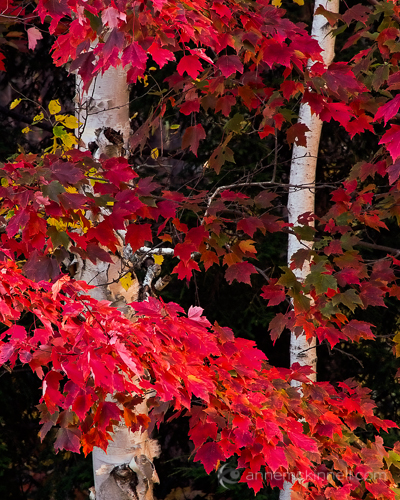
If you position a leaf between your camera and the sun, the back lighting will illuminate it all the way through making it appear to glow and revealing the details of the veins. If the sky is visible between the leaves, try it on the blue sky day for a beautiful colour contrast.

Backlit Maple by Anne McKinnell

Reflections

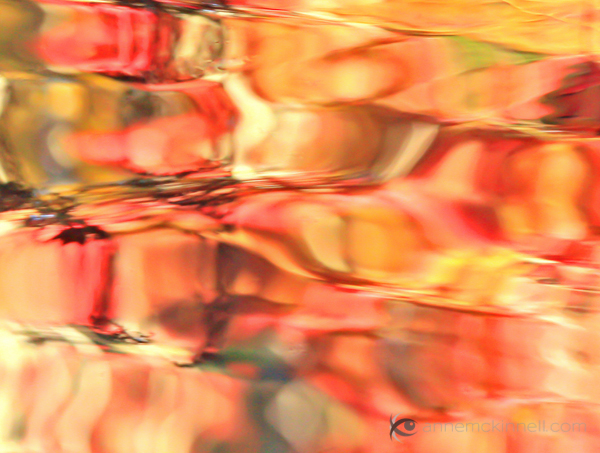
Photographing leaves can be especially difficult on a windy day. On these occasions I try to find reflections of the fall colours and create a more abstract image.

Fall Reflections by Anne McKinnell

Perspective

Leaves that have fallen on the ground are excellent subjects. Try getting a squirrel’s point of view for a unique perspective.

Mushroom and Maple Leaf by Anne McKinnell

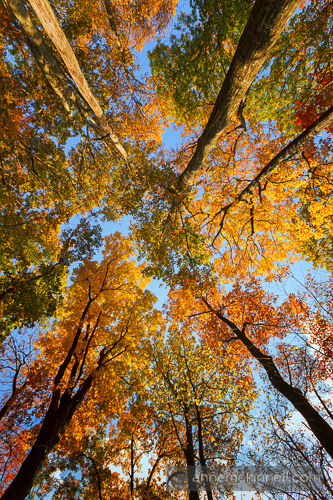
Try looking straight up into the trees to emphasize their tallness and magnificence.

Fall Trees by Anne McKinnell

Waterfalls

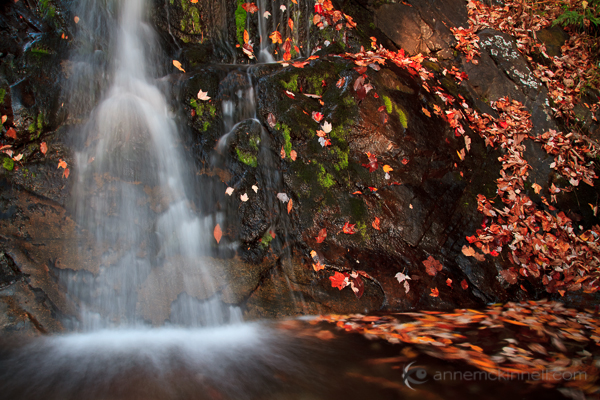
Combining the beautiful colours of the fall leaves with a silky smooth waterfall can be magical. Try using a long exposure to blur the water as it cascades past the fallen leaves.

Fallingwater Cascades, Virginia, by Anne McKinnell

Close-ups

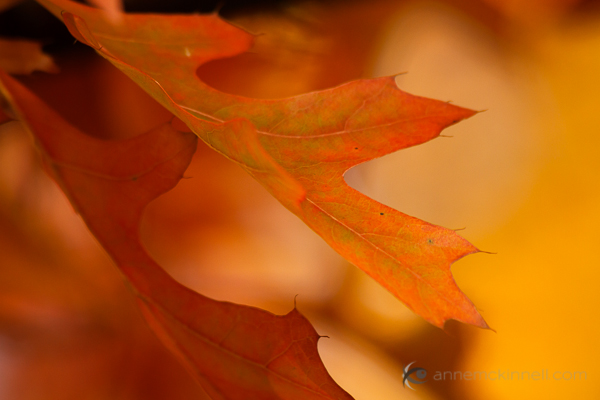
A simple, minimalist composition can be just as evocative of the season as a complex scene. Try getting close to a single leaf and using a wide aperture, like f/2.8 or f/4 to achieve a shallow depth of field that isolates fine details.

Autumn Oak Leaves by Anne McKinnell

Camera Settings

  • Depth of Field: Decide how much of the picture you want to be in focus, and use your aperture to control the depth of field.
  • Underexpose: To deepen the tones and make the colours stand out more, underexpose your image slightly. The easiest way to do this is to locate your exposure compensation (+/-) button and dial it down somewhere between -0.5EV and -1.0EV.
  • White balance: If you’re photographing during the golden hours (just before sunset or just after sunrise), you probably don’t want your camera’s auto white balance to eliminate the light’s yellow-orange tone, which is exactly what it will try to do. However, if you set your white balance to “daylight”, your pictures will retain the sun’s warm glow. Try different settings in any given lighting situation to find the best colour balance. It is particularly important to get this right if you’re shooting JPEG files, but if you use RAW format, the white balance can be perfected in post-production.

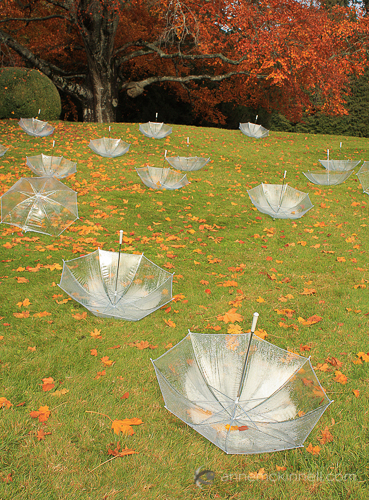
Fall Umbrellas by Anne McKinnell

Composition

When we find a great autumn location full of dramatic colours, it can be easy to become overwhelmed by the colour and forget everything else. Fall colours don’t create a good landscape photo on their own, they simply add an element of colour. The composition should be strong even when turned black and white, so remember your basic rules of landscape composition: create a focal point, and use lines, shapes, and forms to create balance and harmony.

To create images that stand out from the rest, compose them with thought and purpose, and never be afraid to try a different angle.

Post originally from: Digital Photography Tips.

Check out our more Photography Tips at Photography Tips for Beginners, Portrait Photography Tips and Wedding Photography Tips.

Photographing Fall Foliage


Digital Photography School

 
Comments Off on Photographing Fall Foliage

Posted in Photography


My Week With Heisler, Pt. 2

24 Sep
Editor's Note: Contributor Sara Lando continues her three-part series chronicling her 10-day stint as an assistant/mole with Gregory Heisler in Dubai. This is part two. Part one is here.

By Sara Lando — "Lighting is a lot like cooking. You have a gazillion different instruments and what you use will depend of what you want to eat. Also, you don't learn how to cook by eating at restaurants. You have to cook."

When Heisler was talking about this during his lecture, I thought it was cool and made sense. But it was probably only when we stepped into Cavalli Club that I got to realize how much "having to cook" was going to be put into test.

He was entering the club for the first time himself: for a series of reasons, we weren't able to scout the location beforehand and he only got a glimpse of the place from some cellphone footage. When we stepped into the club, the first word that came through my mind isn't one I'd feel comfortable reporting.

The place was pitch black.

Read more »
Strobist

 
Comments Off on My Week With Heisler, Pt. 2

Posted in Photography


Word Worship: Church Converted to Awe-Inspiring Bookstore

24 Sep

[ By Steph in Architecture & Offices & Commercial. ]

Converted Church Bookstore 1

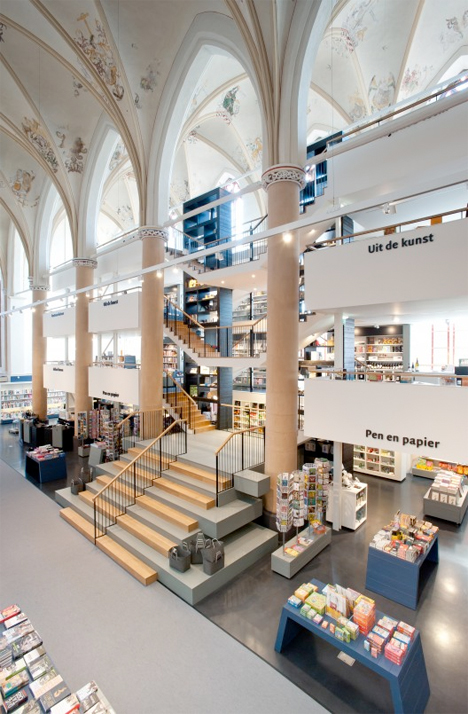
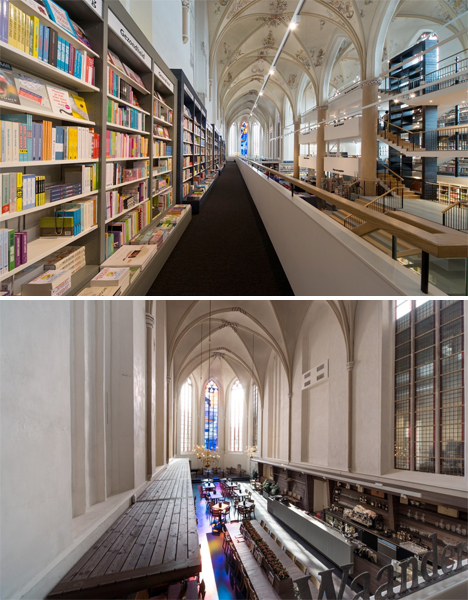
This stunning 15th-century Dominican church is dedicated to much more than just one book – it contains thousands of them, in fact, stacked row upon row in a modern three-story addition. Located in The Netherlands, ‘Waanders In de Broeren‘ opened to the public in July, offering a large selection of tomes as well as an assortment of retail goods.

Converted Church Bookstore 2

The new converted church bookstore is highly reminiscent of Selexyz Dominicanen, a similar concept in Maastricht, Holland with a multi-level black volume sitting lightly within the church’s arches and vaulted ceilings. Where that structure was darker and more dramatic, this one is light and bright, complementing the original colors of the church.

Converted Church Bookstore 3

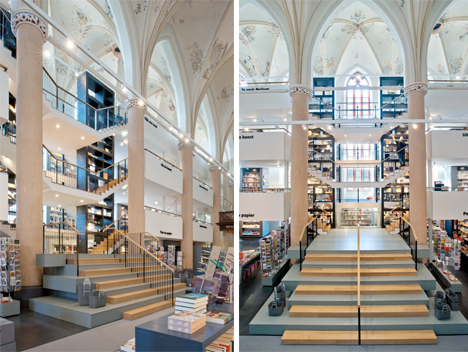
The three additional floors  were placed in the side wing of the church, between the original pillars. The central axis was left open so visitors can still appreciate the grand scale of the building, with views of the organ  and a modern stained glass window.

Converted Church Bookstore 4

Converted Church Bookstore 5

A central staircase routes customers through the merchandise display area a half-level at a time, ending right under the renovated church arches. Inspiration for the furniture was taken from Dom Hans van deer Laan, a Dutch architect who was also a monk. The addition is not secured in any way to the original architecture, so it can be easily removed without damage

Share on Facebook


[ By Steph in Architecture & Offices & Commercial. ]

[ WebUrbanist | Archives | Galleries | Privacy | TOS ]


WebUrbanist

 
Comments Off on Word Worship: Church Converted to Awe-Inspiring Bookstore

Posted in Creativity


7 Tips for Photographing Paddlers

24 Sep

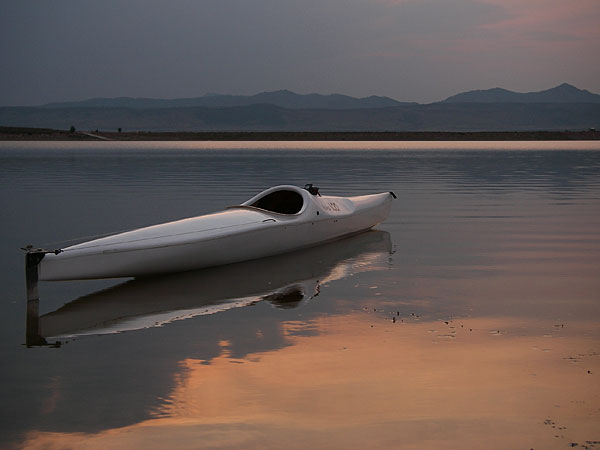
I would like to remind you this old post, How Did you Shoot It? with some updates and revisions. It was written two years ago as part of ProBlogger’s group writing project – “How to …” I hope that these tips are still useful. They represent quite well my own approach to paddling photography.


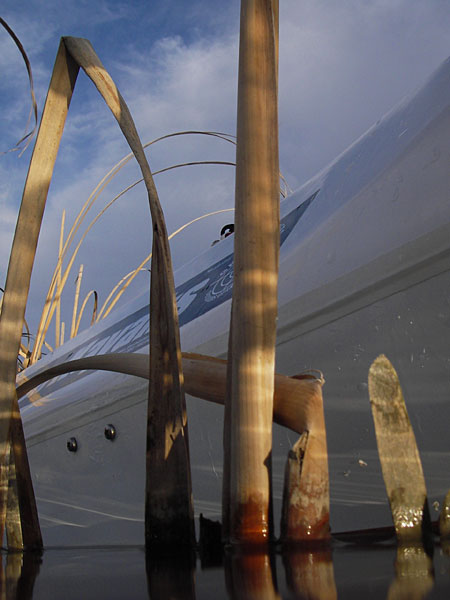
After posting the above picture, “Paddling in Clouds”, I’ve got several questions: How did you do it? And, I had troubles to provide a reasonable answer since the shot was technically really trivial.

Finally, I figured out that it is more about seeing pictures than about shooting and wrote these more general comments.

1. Look and See

Learn to see pictures. You do not need a camera to practice it. I am often “shooting” without camera, especially, when driving: that would be a good picture, this old barn would look great at sunrise, that dust devil at a horizon can be seen only through polarized glasses.

I believe that looking at photographs in magazines, books and calendars also help to develop your seeing capability. I am checking all new photography books arriving to my university library and browsing most of photography magazines in a local bookstore.

There are several good books on the art of seeing. Freeman Patterson comes to my mind first. Recently, I spent a lot of time with Photographer Eye by Michael Freeman.

2. Have a Camera

A photographer is shooting pictures, not a camera, but you should have your camera ready. “Ready” means not only accessible. You should be familiar with your camera settings and operations. Learn what camera settings are working for your paddling photography. It may be difficult to figure out camera features when sitting in a tippy kayak and waves are splashing.

Compact waterproof digital cameras like Pentax Optio “W” or Olympus Stylus “SW” revolutionized my kayak photography. I can shoot pictures I was not able to execute before, e.g., with a partially submerged camera. I am ready to sacrifice some camera features or to some extend a picture quality for convenience and accessibility of these tiny camera for paddling environment.

3. Be Aware of Light

The best light for outdoor photography is when the sun is low, i.e., around sunrise and sunset. I know that I can expect interesting light at the end of my afternoon paddling workout. If the sunset is not very exciting I can shoot water reflections or a tree silhouette.

Ironically, on paddling trips, we are often passing the best scenery in the middle of day, when the light is harsh and unpleasant. I am still shooting some snapshots for documentary purposes. My primary motivation to start paddling fast kayaks was to get in time to my shooting spots. All that racing craziness came later …

4. Point (compose) and Shoot

Do not be afraid to shoot without viewfinder. Well, you don’t have one in Pentax Optio. And, the LCD display is often difficult to read in a bright sun. It shouldn’t stop you from shooting. Use some creative angles as far as you can extend your arm. Remember, you can put this camera under water next to you kayak. The lack of a viewfinder is perhaps the main reason preventing some photographers from buying this camera, but I think that this a reasonable compromise in the camera of this size.

I didn’t have a clear view of the camera display when shooting my “Paddling in Clouds” picture. I was just trying to keep a paddle diagonally in my frame.

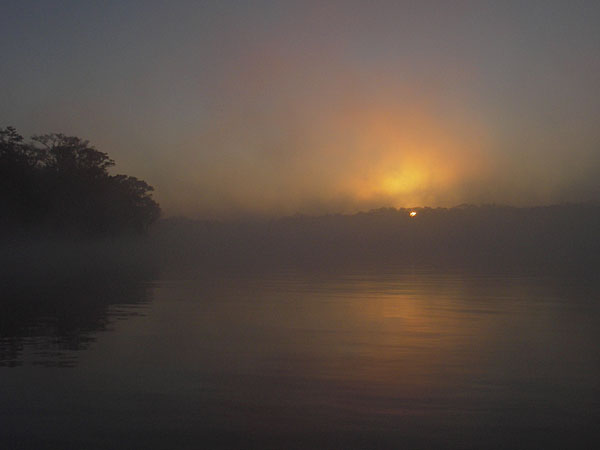
foggy sunrise over Suwannee River, Florida

5. Shoot Multiple Frames

Shooting pictures with a digital camera is cheap. You do not need to worry about film cost. You can always erase the picture and shoot again unless you are after some action shots. So, do not be afraid to experiment and shoot even if you do not see the image in your LCD monitor. Shoot some extra frames. It is helpful to have an adequate memory card.

I shot about 30 frames trying to catch a sky reflection in water and in my paddle. However, I would show not more than 3 or 4 from those 30 frames.

6. Practice

The more you shoot the better you should get. I have shot similar pictures before including reflections and a paddle.

Review your pictures on the camera LCD if possible. Check the histogram. Analyze your shots after paddling on a computer screen. You have all information about camera setting included in each digital image file. Try to figure out what worked and what not. Learn from mistakes.

7. Have Fun

I don’t consider myself a professional photographer. When paddling I am shooting what I like just for fun. Documenting my paddling trips and races is still fun. I feel free to experiment.

The great Alfred Stieglitz was an amateur photographer too. Anyway, the photography is not a profession…

Sometimes I sell a picture to a magazine or donate to a book cover. A year ago, I started to sell my pictures through microstock agencies. I am just taking more often my DSLR camera and a tripod for paddling.

Related posts:kayaking Colorado - Douglas Lake

  • Use Your Paddle to Stabilize Camera
  • No Viewfinder? 10 Tips on Shooting Pictures without Viewfinder
  • Pentax Optio WP/WPi – 10 Tips on Paddling and Shooting
  • Can Pentax Optio waterproof cameras be used in the water?
  • Pentax Optio W10 as a Helmet Cam – Inline Skating along the Poudre
  • Shooting movies with Pentax Optio WP and W10 and Sisson Nucleus 100 kayak


paddling with a camera

 
Comments Off on 7 Tips for Photographing Paddlers

Posted in Photography


More of a good thing: Sony Cyber-shot DSC-RX100 II review posted

24 Sep

rx100ii_news.jpg

We’ve just posted our full review of the Sony Cyber-shot RX100 II. Following on the success of the RX100 is no easy feat, but just the same the RX100 II does so with a new BSI CMOS sensor. Also new to this model is an accessory port/hotshoe, Wi-Fi connectivity with NFC, and a tiltable display. Did Sony make a good camera even better? Click through to read our full analysis.

News: Digital Photography Review (dpreview.com)

 
Comments Off on More of a good thing: Sony Cyber-shot DSC-RX100 II review posted

Posted in Uncategorized


Submarine Structures: 7 Wonders of Underwater Architecture

24 Sep

[ By Steph in 7 Wonders Series & Global. ]

Underwater Buildings Submerged Hotels Main

Enjoy a luxurious lunch, spend the night gazing at deep sea creatures, take in museum exhibits or even catch a glimpse at an underwater stripper pole in these seven wonders of submerged architecture. Located from 20 to 50 feet below the surface, these real-life submarine structures (including a couple concepts currently under construction) would make for a swinging town for mermaids and mermen if they were all located in the same place.

Abandoned Underwater Strip Club, Israel

Underwater Strip Club 2

Underwater Strip Club 1

Once, this barnacle-covered underwater building in Eilat,  Israel was the Red Sea Star restaurant, bar and observatory. But when that didn’t work out, it became perhaps one of the weirdest submerged businesses of all time: a strip club. The entrance is above water; visitors crossed a 230-foot bridge and descended a flight of stairs to gain access, so no scuba suits were necessary. Surprisingly, the Nymphas Show Bar wasn’t a big hit. Since its closure, it has been abandoned. Marine biologist Gil Koplovitz captured a series of shots that peer inside, which can be seen at The Huffington Post.

Water Discus Hotel, Dubai

Underwater Hotel Dubai 2

Underwater Water Discus Hotel Dubai 1

If you’re skeptical that the Water Discus Underwater Hotel will ever really be built, you’re hardly alone – it seems like one of many fantastical structures in Dubai that get a lot of attention as concepts but never manage to become reality. However, the developer has announced that construction is about to begin. The hotel will consist of a series of discs, some underwater and some above the surface, with 21 two-guest rooms in the submarine space.

World’s Largest Underwater Museum, Mexico

Underwater Museum Mexico

It may not have walls, but the world’s largest underwater museum is impressive nonetheless, with a series of displays made of pH-neutral concrete that can only be seen by divers and tourists in glass-bottom boats. The sculptures were designed to attract algae and marine life, making them an ecosystem. A total of 400 structures are planned. The Cancun Underwater Museum is located off the coast of Isla de Mujeres, Mexico.

Ithaa Undersea Restaurant, Maldives

Underwater Restaurant Resort Ithaa

While many similar concepts have never gotten past the ‘impressive renderings’ phase, the Ithaa Undersea Restaurant at the Hilton Maldives Resort has been open since 2005. Made of acrylic with a 270-degree panoramic view, the restaurant seats only fourteen at a time, for an intimate and quiet underwater dining experience (that’ll cost you at least $ 120 per person – for lunch.)

Next Page:
Submarine Structures 7 Wonders Of Underwater Architecture

Share on Facebook


[ By Steph in 7 Wonders Series & Global. ]

[ WebUrbanist | Archives | Galleries | Privacy | TOS ]


WebUrbanist

 
Comments Off on Submarine Structures: 7 Wonders of Underwater Architecture

Posted in Creativity