RSS
 

Archive for September, 2013

Olympus PEN E-P5 Review

05 Sep

Olympus E-P5.jpg

The Olympus PEN E-P5 sure took some getting. Following a briefing by Olympus it was two months before I actually got my sticky fingers on one in the review-atorium. And even then I had to fight, persuade and jollify every Olympus contact I had. It seems every man, beast and journalist wanted a P5.

So, what’s so special?

I know it has nothing to do with photography and camera technology, but this little number sure pulls the heart strings in the retro stakes.

Coinciding with the 50th anniversary of the legendary PEN F film camera, the PEN E-P5 is a digital update of a classic that offers much in digital capture. Its all metal cased body shrieks of Olympus classic — and even a touch of Leica!
Olympus E-P5 back.jpg

The review camera was supplied with the f2.0/12mm, f1.8/45mm and the f1.8/17mm lenses.

Olympus PEN E-P5 Features

Pretty stunning specs:

  • 16.05 million effective pixels
  • Live View CMOS.
  • Mechanical shutter runs from 60 seconds to 1/8000 second; Time and Bulb exposures.
  • Time lapse shooting of stills or movies. Set a time interval between 1 second to 24 hours, setting how many shots the camera will capture in a series (1-99).
  • Built-in Wi-Fi.
  • 5-Axis Image stabilisation.
  • Focus peaking emphasises the contours at the point of focus in white or black.
  • LCD screen can be tilted to face upwards at an 80 degree angle and downwards at a 50 degree angle.

The maximum image size is 4608×3456 pixels, enough to make a 39x29cm print.

Video can be shot in MPEG4 format, up to Full HD 1920×1080 resolution. If you shoot stills in the middle of a video recording, the latter stops.

The stabiliser works remarkably in video shooting but you have to watch focus; a tap on the shutter button and AF comes to heel!

Handling: the camera is nicely balanced in the hand, thanks to a moderate sized speed grip at the right edge. Whilst you could operate the P5 one-handed, it feels better with two.

Pocketability: camera body will fit into one pocket; a lens or two should fit into another.

Controls: pop up flash is to the left, with its switch just beneath; external flash and accessory shoe mid deck.
Photo story 1.JPG

Photo story 2.JPG

The mode dial has positions for auto and PASM; movie settings; the novel photo story setting.
Scene mode.JPG

Art Filter.JPG

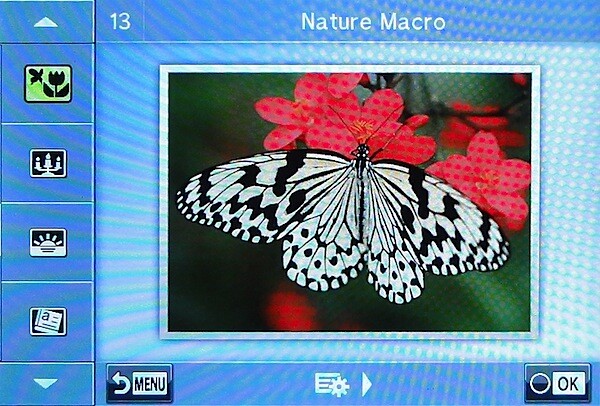
Then there are 23 scene modes, including landscape, children, macro, fish eye etc; here are also found 12 Art Filters: Pop Art, Light Tone, Diorama etc.

Photo story: in this fun mode you can shoot multiple shots, then combine them into a single image. Over this you can add handwritten text.

Still on the top deck: the shutter button; on/off lever; and a function button.

On the leading and rear edges are found two dials: when rolled, the for’ard, sub dial can adjust such matters as ISO setting and exposure compensation; the rear, main dial is used to adjust aperture value or white balance.

Put another way: when shooting manually, moving the dial at the front of the camera adjusts the aperture while the back dial affects exposure time. At rear, the dial changes the ISO value and white balance.
Menu.JPG

Shooting tips.JPG

Rear: video record button; a two position lever (see below); menu; info; four way jog dial offering access to exposure compensation, flash options, burst shooting and self timer, AF area positioning.

Lower down are found the replay and erase buttons.

Carving 2.JPG

Narrabeen lake 4 Dramatic tone.JPG

Tree 3 Key line.JPG

The big deal with the P5 is the ease in which it can be linked with a smart device, such as an iPad or smart phone. You can synchronise the screens of the smart device and the E-P5 so you can mirror the camera’s LCD view on the smart device, then control it by touching the smart device display as if it were your camera. Great for self-portraits and for remotely shooting dangerous subjects like wildlife that may be startled or even turn on you! You can even use your smart device to embed GPS info into your shots.

There is no turret finder on the P5, but you can acquire an optional hi def VF-4 viewfinder, with an impressive 1.48X magnification, a high res 2.36 million dot LCD.

Olympus PEN E-P5 ISO Tests

Olympus Pen E-P5 ISO 200.JPG

Olympus Pen E-P5 ISO 400.JPG

Olympus Pen E-P5 ISO 800.JPG

Olympus Pen E-P5 ISO 1600.JPG

Olympus Pen E-P5 ISO 3200.JPG

Olympus Pen E-P5 ISO 6400.JPG

Olympus Pen E-P5 ISO 12800.JPG

Olympus Pen E-P5 ISO 25600.JPG
Only by ISO 3200 was noise becoming an issue. At ISO 6400 still looking good and sharp. At ISO 12800 noise was up but still useable IMHO. At ISO 25600 noise well up but, for certain subjects, useable.

Olympus PEN E-P5 Review Verdict

Quality: above average
Why you’d buy the P5: plenty of control.
Why you wouldn’t: too good for run-of-the-mill snap-shooting!

I liked the P5 but felt some of the controls unnecessary: like the two control dials.

Olympus PEN E-P5 Specifications

Image Sensor: 16.05 million effective pixels.
Metering: Multi pattern, centre-weighted averaging, spot.
Effective Sensor Size: 17.3×13.0mm (22.5mm diagonal) Live MOS.
Lens Mount: Micro Four Thirds.
35 SLR Lens Factor: 2x.
Shutter Speed: 60 sec to 1/8000 second, Time, Bulb. Internal/external flash sync: 1/320/250 sec.
Continuous Shooting: 9 fps.
Memory: SD/SDHC/SDXC cards and Eye-Fi.
Image Sizes (pixels): 4608×3456 to 640×480. Movies: 1920×1080, 1280×720, 640×480.
LCD Screen: 7.6cm LCD (1,037,000 pixels).
File Formats: JPEG, RAW, JPEG+RAW, MPEG4.
Colour Space: sRGB, Adobe RGB.
ISO Sensitivity: Auto, 200 to 25600.
Interface: USB 2.0, HDMI mini, AV, accessories.
Power: Rechargeable lithium ion battery, DC input.
Dimensions: 122.3×68.9×37.2 WHDmm.
Weight: 420 g (inc battery and card).
Prices: Get a price on the Olympus E-P5 (body only) or Olympus E-P5 17mm with a f1.8 and VF.

Post originally from: Digital Photography Tips.

Check out our more Photography Tips at Photography Tips for Beginners, Portrait Photography Tips and Wedding Photography Tips.

Olympus PEN E-P5 Review


Digital Photography School

 
Comments Off on Olympus PEN E-P5 Review

Posted in Photography


Blickfang: Dalí Atomicus

05 Sep

Das Bild aus dem Band „Photographie des 20. Jahrhunderts“*, das ich heute vorstellen will, ist eines meiner Lieblingsbilder in der Geschichte der Fotografie. Der amerikanische Fotograf Philippe Halsman zeigt den Künstler Salvador Dalí auf einem Bild, das eines seiner eigenen Gemälde sein könnte.

Über Dalís generelles Verhältnis zur Fotografie könnte man selbst ein komplettes Buch schreiben. Belassen wir es an dieser Stelle bei: Er hat mit vielen Fotografen zusammengearbeitet, die sehr viele wunderbare, überraschende, humorvolle Bilder mit ihm in der Protagonistenrolle anfertigten.

Meine Favoritenbilder stammen dabei allesamt von Philippe Halsman, worunter es mir wiederum das Foto mit dem Titel „Dalí Atomicus“ (der Titel bezieht sich auf den Titel eines Gemäldes des Künstlers, das im Hintergrund des Fotos zu sehen ist) von 1948 besonders angetan hat, da es den Künstler meiner Aufassung nach am treffendsten portraitiert.

Das Foto entstand in New York und es ist überliefert, dass es 28 Versuche brauchte, um es in dieser Form aufzunehmen. Es ist keine Bildbearbeitung, man kann bei einer der leicht unterschiedlichen Versionen, die kursieren, die Schnüre sehen, die die verschiedenen Gegenstände tragen.

atomic_dali-650x494-2

Wir sehen zunächst: Extreme Dynamik, eine perfekt choreografierte Einfrierung simultaner Bewegungen völlig unterschiedlicher Elemente. Es sind aber nicht irgendwelche Bewegungen, die hier passieren, es findet ein absurd übertriebener Surrealismus statt, der irre komisch wirkt:

Der Künstler scheint in einer seiner eigenen Zeichnungen gefangen, hängt darin vor der buchstäblich leeren Leinwand, dessen Rahmen nicht bespannt ist, in der Luft; von der anderen Seite springen mitten aus dem Nichts drei schwarze Katzen ins Bild und zu allem Überfluss hängt da auch noch ein Stuhl in der Luft, unter dem sich ein Wasserschwall ins Bild ergießt.

Schaut man genauer hin, erkennt man noch viel mehr Details: Die Staffelei selbst schwebt ebenfalls. Das Gemälde „Leda Atomica“ ist zu sehen, das Gesicht der Figur verdeckt. Wie kann der Wasserstrahl einen solchen Bogen schlagen, was hält Dalí in den Händen und wie funktionieren hier eigentlich die Schatten, die an der Decke und auf dem Boden auftauchen?

Das Foto „Dalí Atomicus“ ist, wie auch die beiden Künstler, die es entstehen ließen, seiner Zeit sehr weit voraus. Es ist ein kompletter David-Lynch-Film, auf einen Moment reduziert, es nimmt die ganze Kategorie surrealer Fotomanipulationen, die seit einigen Jahren sehr populär sind, vorweg, obwohl es keine Bildbearbeitung ist.

„Dalí Atomicus“ verkörpert die Essenz einer Richtung des Surrealismus, die bis heute sehr stark in alle Kunst- und Kulturbereiche wirkt. Es ist ein einflussreiches, ein grandioses, unterhaltsames und nicht zuletzt auch urkomisches Bild – ein echter Klassiker der Fotografie.

* Das ist ein Affiliate-Link zu Amazon. Wenn Ihr darüber etwas bestellt, erhalten wir eine kleine Provision, Ihr bezahlt aber keinen Cent mehr.


kwerfeldein – Fotografie Magazin

 
Comments Off on Blickfang: Dalí Atomicus

Posted in Equipment


64-bit Corel PaintShop Pro X6 now available

05 Sep

paintshopprox6.png

Corel has announced Paintshop Pro X6 ‘Ultimate’, which improves on the previous version of PSP X6 with the addition of built-in automatic image correction by Athentech Imaging. The update to 64-bit architecture should result in better performance on modern operating systems, as well. Apparently, the new software was created after a research study indicated that ‘more power, more speed and improved usability were the changes users most wanted to see in X6’. Who knew? Click through for the press release. 

News: Digital Photography Review (dpreview.com)

 
Comments Off on 64-bit Corel PaintShop Pro X6 now available

Posted in Uncategorized


Wearable Tech of the (Distant) Future: 13 Sci-Fi Suits

04 Sep

[ By Steph in Art & Drawing & Digital. ]

Imaginary Wearable Tech Sci Fi Suits Main

We’re probably a century or two away from working mechanized exoskeletons modeled on the movements of crickets, but the great thing about digital concept art is there are no limits other than those of the creators’ imaginations. These gadget-covered robotic suits and helmets for the humans of the future may not be coming to stores any time soon, but it’s easy to imagine them playing major roles in movies and video games. In fact, you might just find yourself making up stories about what each one can do as you view them.

Cricket Exo-Suit by Matthew Burke

Imaginary Wearable Tech Cricket Suit

Artist Matthew Burke envisions a combination exoskeleton/vehicle inspired by a cricket in this 3DStudio Max rendering finished in Photoshop.

Combat Mech Suit by Mike Andrew Nash

Imaginary Wearable Tech Mech Suit

Imaginary Wearable Tech Mech Suit 2

This incredibly detailed CGI rendering by Mike Andrew Nash looks so real, it’s hard to believe it’s not a physical model. It’s a combat mech warrior suit the artist calls 21-A BW, or Terran Infiltration Unit.

Diving Suit by Cat-Meff

Imaginary Wearable Tech Diving Suit

Artist Cat-Meff envisions a diving suit that would turn any human into a sort of mechanized dolphin/mer-creature. “This is probably one of the coolest ways to spend your holidays in 2025,” the artist writes.

Hazard Suit by Lucas Hardi

Imaginary Wearable Tech Hazard Suit

“The character is a high-ranking official wearing a suit equipped for hot, cold and bad air,” says artist Lucas Hardi of this 3D hardsurface modeling exercise.

Next Page:
Wearable Tech Of The Distant Future 13 Sci Fi Suits

Share on Facebook


[ By Steph in Art & Drawing & Digital. ]

[ WebUrbanist | Archives | Galleries | Privacy | TOS ]


WebUrbanist

 
Comments Off on Wearable Tech of the (Distant) Future: 13 Sci-Fi Suits

Posted in Creativity


4. September 2013

04 Sep

Ein Beitrag von: Christian Richter

Meer, Langzeitbelichtung, Wolken, Freiheit, Fotografie, Mensch, Zeit, Du, Alleine


kwerfeldein – Fotografie Magazin

 
Comments Off on 4. September 2013

Posted in Equipment


Sony reveals QX10 and QX100 camera modules for smartphones

04 Sep

QX100_Main1-1200.png

Sony has announced a pair of mobile photography camera/lens modules, the QX10 and QX100. Both units are essentially self-contained cameras that can be controlled by smartphones, using Wi-Fi. The QX10 features a standard compact-camera 1/2.3″ sensor and a 25-250mm equivalent zoom lens. The QX100 uses the 1″ sensor and 28-100mm equivalent zoom used in its high-end RX100 II compact. Both are NFC-compliant to make connection to some smartphones even easier. We’ve had both modules in the office and have had a close look – click through for more details.

News: Digital Photography Review (dpreview.com)

 
Comments Off on Sony reveals QX10 and QX100 camera modules for smartphones

Posted in Uncategorized


Mobile madness? Our opinion on Sony’s QX clip-on cameras

04 Sep

qx10_2.jpg

The Sony QX cameras are mobile-photography-targeted modules that allow you to clip a larger sensor, zoom lens and additional battery to your smartphone to extend its capabilities. The modules use a Wi-Fi connection to allow their control from a camera app – making them some of the most connected cameras yet. So just what do we make of the compact 10x QX10 and the larger-sensor QX100? Click through for links to our first impressions content at dpreview.com and connect.dpreview.com.

News: Digital Photography Review (dpreview.com)

 
Comments Off on Mobile madness? Our opinion on Sony’s QX clip-on cameras

Posted in Uncategorized


DxO Optics Pro 8.3.1 adds support for five recent cameras

04 Sep

opticspro8logo_large.png

DxO Labs has released version 8.3.1 of its Optics Pro RAW conversion and image correction software, adding support for the Panasonic Lumix GF6 and G6, the Olympus PEN E-P5, the Sony Cyber-shot DSC-RX100 II, and the Pentax K-50. It also adds 490 extra camera/lens combinations to the library of optics correction modules. Click through for the full press release, including download links.

News: Digital Photography Review (dpreview.com)

 
Comments Off on DxO Optics Pro 8.3.1 adds support for five recent cameras

Posted in Uncategorized


Olympus fraud saga rumbles on with UK prosecution

04 Sep

shared:Olympus.png

Olympus will be prosecuted by the UK Serious Fraud Office over charges that it provided ‘misleading, false or deceptive’ material in accounts submitted by its medical supplies subsidiary Gyrus Group Limited. Earlier this year three former senior executives of the company were handed suspended jail sentences for their part in a massive accounting scandal which hid huge investment losses dating back to the 1990s, and was uncovered by former CEO Michael Woodford. A statement issued by Olympus states that the potential impact of the prosecution on the Group’s business is unclear, as it’s difficult to estimate the level of any fines which may be imposed if the prosecution is successful.

News: Digital Photography Review (dpreview.com)

 
Comments Off on Olympus fraud saga rumbles on with UK prosecution

Posted in Uncategorized


The Ultimate, Detailed History of Photography That Will Blow Your Socks Off!

04 Sep

Although everyone understands the importance of photography in our daily lives, very few know about how this seemingly magical art form developed. The following is a detailed look into the long history of photography that has lead to the cameras we know and love today. 500 BC – 1700s Beginning back in China and Greece around 500 BC, ancient philosophers Continue Reading

The post The Ultimate, Detailed History of Photography That Will Blow Your Socks Off! appeared first on Photodoto.


Photodoto

 
Comments Off on The Ultimate, Detailed History of Photography That Will Blow Your Socks Off!

Posted in Photography