Ein Beitrag von: Elke Vogelsang

kwerfeldein – Fotografie Magazin
Als Fotograf hält man so oft nur die Oberfläche fest. Das Sichtbare ist unsere Leidenschaft. Röntgenbilder spiegeln hingegen die Sehnsucht wieder, auch in das Innere der Dinge zu dringen. Für unser Fotospecial haben wir uns deshalb auf die Suche nach diesen geheimnisvollen Bildern gemacht. Desweiteren findet Ihr wieder Links und Tipps rund um die aktuelle Fotografie. Viel Spaß beim Stöbern!
Fotospecial: Röntgenbilder
Flickr


500px


Deutschsprachig
• Diese großartige Foto- und Textreportage in Form eines Tagebuchs über den Einsatz von „Clowns ohne Grenzen“ in Syrien legen wir Euch ganz besonders ans Herz!
• Großartig aufgenommen: Marcus Pink fotografierte einen der „beeindruckendsten Bahnhöfe Europas“.
• Langweiledich.net zeigt die großartigen Lichtgraffities von Darren Pearson.
• Ihr polarisiert gern? Pola Bear Zine wartet auf Eure Einreichungen.
International
• Samuel Poromaa, den wir hier mal im Interview hatten, denkt in seinem Journal auf deviantArt laut über Konzeptuelle Fotografie nach. Prädikat: Lesenswert!
• Schön und schrecklich zugleich: Bilder von einem Großbrand in Südkalifornien Anfang des Monats. Poetische, alles verzehrende Flammen.
• Noch einmal Spaß mit Fotos bzw. Montagen: Klassische Statuen, fotografiert als alltägliche Hipster.
• Erinnert Ihr Euch noch an die Portraitserie mit durch Klebeband völlig entstellten Gesichtern? Wes Naman hat jetzt noch einen draufgesetzt und eine zweite, ähnliche gemacht. Autsch, aber witzig.
• Tom Robinson war sechs Monate lang in Südamerika und nahm dort atemberaubende Fotos auf.
• Abandoned America: Der Traum aller Lost Places-Fotografen – alte Schulen, Kirchen und Gefängnisse.
• Was Yang Yionglang aus seiner Kamera und Photoshop an chinesicher Kunst herausholt, verschlägt einem den Atem.
• Diese zehn Künstler zaubern unglaubliche fotorealistische Ölgemälde.
• Folgende 41 Gründe, keinen Fotografen zu daten, sind nicht unbedingt ernst zu nehmen, aber lustig.
• Kennt Ihr schon die akrobatischen Selbstportraits von Isabell Wenzel?
• Weshalb Annie Leibovitz falsch liegt, was die Beurteilung der Fotografie im Allgemeinen betrifft, beschreibt Reid Singer sehr anschaulich.
Neuerscheinungen und Tipps vom Foto-Büchermarkt
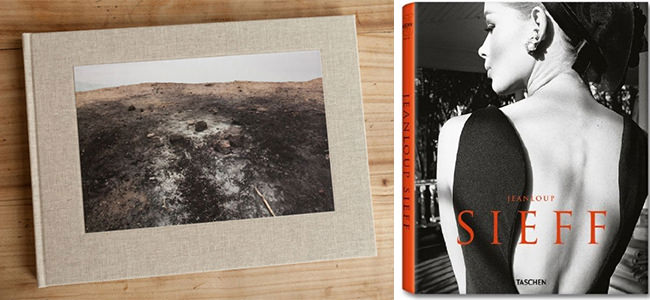
• Ein großartiges Buch ist der Bildband „Nowhere“ von Leon Kirchlechner, der in Kooperation von dienacht Publishing and Der Greif entstand. Einen schönen Einblick ins Buch könnt Ihr hier erhaschen. Die Hardcover-Ausgabe ist limitiert auf 800 Stück und für 29,80 € zu haben.
• Der Modefotograf Jeanloup Sieff starb bereits im Jahr 2000. Einen schönen Überblick über sein Werk gibt der Bildband „Jeanloup Sieff“* von TASCHEN, der zu einem unschlagbaren Preis von 9,99 € erhältlich ist.
Videos
Supercooles (und staubiges) Making-Of zu Thomas Davids „Dust and Fight“. Mehr darüber gibt’s hier.
Ausstellungen
Göran Gnaudschun – Luft berühren
Zeit: 25. Mai – 29. Juni 2013
Ort: fotopension, Marsiliusstr. 55, 50937 Köln
Link
Im Guten Glauben – Religiöse Vielfalt im Ruhrgebiet
Zeit: 20. April – 30. Juni 2013
Ort: Zeche Hannover, Günnigfelder Straße 251, 44793 Bochum
Link
Thomas Hoepker /// Heartland
Zeit: 24. Mai – 3. Juli 2013
Ort: 25books, Brunnenstraße 152, 10115 Berlin
Link
Dieter Blase: Marathon – Salamis – Korinth – Mykene – Aulis
Zeit: 12. Mai – 6. Juli 2013
Ort: Stadtmuseum Bocholt, Osterstr. 66, 46397 Bocholt
Link
TILL BRÖNNER – Faces of Talent
Zeit: 17. Mai – 6. Juli 2013
Ort: Leica Galerie Salzburg, Mirabellplatz 8, 5020 Salzburg
Link
WORLD PRESS PHOTO 13
Zeit: 13. Juni – 7. Juli 2013
Ort: Willy-Brandt-Haus, Stresemannstr. 28, 10963 Berlin
Link
Gudrun Kemsa – URBAN STAGE
Zeit: 16. Mai – 7. Juli 2013
Ort: LVR-LandesMuseum Bonn, Colmantstr. 14-16, 53115 Bonn
Link
Max Scheler. Von Konrad A. bis Jackie O.
Zeit: 3. Mai – 7. Juli 2013
Ort: Städtische Galerie, Theodor-Heuss-Ring 24, 58636 Iserlohn
Link
Ryuji Taira – Fluffy Platinum
Zeit: 7. Juni – 7. Juli 2013
Ort: Galerie Edition Camos, Aldringenstraße 1a, 80639 München
Link
“Le Grand Bordel”, Fotografien von Gerd George
Zeit: 19. Juni – 12. Juli 2013
Ort: kulturreich, Wexstraße 28, 20355 Hamburg
Link
Michael Lange – Wald
Zeit: 8. Juni – 13. Juli 2013
Ort: L.A.Galerie Lothar Albrecht, Domstraße 6, 60311 Frankfurt
Link
VINTAGE – Dozentinnen und Dozenten der Neuen Schule für Fotografie zeigen Arbeiten aus ihrer Studienzeit
Zeit: 15. Juni – 14. Juli 2013
Ort: Neue Schule für Fotografie, Brunnenstr. 188?–?190, 10119 Berlin
Link
Ralf Cohen “WeltAnschauung” / Simone Demandt “Futility”
Zeit: 13. März – 14. Juli 2013
Ort: Sammlung Hurrle, Almstraße 49, 77770 Durbach
Link
Arno Schmidt. Fotografien
Zeit: 13. April – 14. Juli 2013
Ort: Landesmuseum für Kunst und Kulturgeschichte, Damm 1, 26135 Oldenburg
Link
Jürgen Bürgin: Urban Ballads
Zeit: 28. Juni – 2. August 2013
Ort: Fotogalerie Friedrichshain, Helsingforser Platz 1, 10243 Berlin
Link
kwerfeldein – Fotografie Magazin
[ By Delana in Art & Sculpture & Craft. ]

Amusement parks are a big part of most peoples’ childhoods, with fond recollections of roller coasters and snow cones dancing in our memories. But what happens to those amusement parks after they have lived out their lives? For artist James Dive of The Glue Society, one amusement park from his past was turned into a creepily touching piece of art.

The sculpture, entitled Once, contains an entire amusement park compressed into a single four-ton cube. Dive’s treatment of the park is gentle and reverent while being inherently violent. To prepare for his unusual work of art, Dive first did the exact opposite of his ultimate goal: he carefully cleaned, painted and restored every bit and piece of the park.

Over the following two weeks, a 28-ton excavator smashed and crushed the entire amusement park into a neat, gigantic cube. Parts of the park’s former life can still be glimpsed – a brightly-painted sign here, a string of lights there, some creepy dolls scattered about. The feeling Dive tries to evoke with this exceptionally odd sculpture is “the finality of a missed moment. And how brutal that can sometimes be.”

The irony of this piece lies largely in its finality, given that the pleasures of an amusement park are so transient and fleeting. In this sculpture they become more permanent, all compressed into one strangely savage yet sentimental four-ton cube. Once was installed as part of the Sculpture By the Sea program in Aarhus, Denmark.


[ WebUrbanist | Archives | Galleries | Privacy | TOS ]

     |
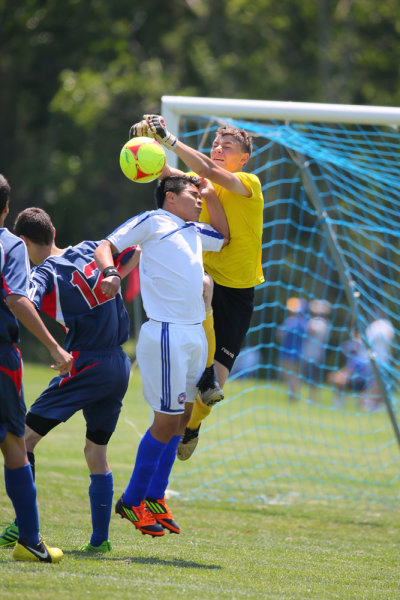
I moved out to the sideline for this shot. Right around the 18 yard line is a great place to stand and turn back to the goal for the action there. Canon EOS-1D X, EF 200-400 f/4L IS Extender 1.4X. 1/1000, f/5.6, ISO 800.
I spent a good portion of my career photographing sports, from children all the way up through the pros. One of the most challenging sports to photograph was soccer (football or futbol if you’re outside North America). I’ve had colleagues liken it to “photographing a moving tree in a moving forest” because you’re focused on one player, while other players are moving across the frame between you and the subject all the time. It takes patience and some knowledge of the game to be really good at photographing it.
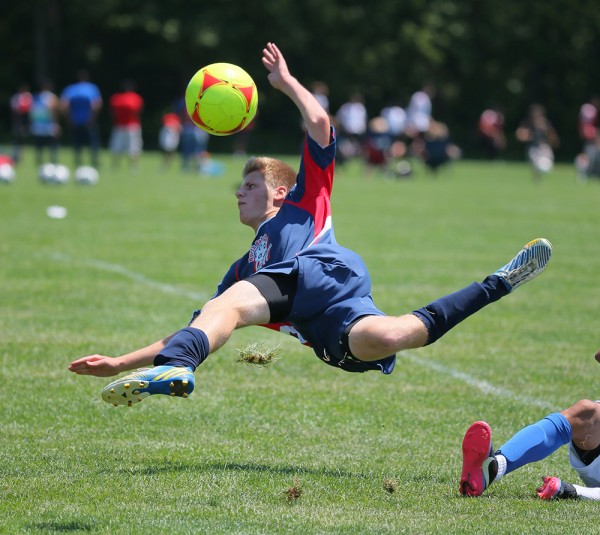
This shot was part of a sequence that started with this player making a run with the ball. A few frames prior to this, he was tripped and went airborne along with the ball. I never would have had this frame if I wasn’t shooting at 12 fps. Canon EOS-1D X, EF 200-400 f/4L IS Extender 1.4x. 1/1600, f/5.6, ISO 800.
From behind the end line, you can often capture two players fighting for position on the ball. Canon EOS-1D X, EF 200-400 f/4L IS Extender 1.4x. 1/1000, f/5.6, ISO 400.
Soccer is a fast-moving sport and thus requires your camera to be set a certain way. I shoot most of my action using Aperture Priority, with the aperture set around f/4 or f/5.6. I want a pretty shallow depth of field so the athletes pop off the background, and so that background objects don’t distract from the subjects. I then set the ISO to be sure I get a fast enough shutter speed to freeze the action. Generally this means 1/500 minimum. Faster if you’re using a lens longer the 500mm. I set my camera’s autofocus system to AI Servo or Continuous (dependent on the brand of camera you use- it means the same thing). AI Servo or continuous simply means that your camera will focus on the subject and continue to track the subject as it moves towards or away from the camera. Finally, I set my camera’s drive to continuous so that I simply have to press and hold the shutter button to take multiple images. This enables me to take an entire sequence of action, meaning I won’t miss peak action by taking only one shot, or more importantly, I’ll get multiple images to choose from of the play to be sure I get the best shot out of the action. Note that some cameras have multiple continuous settings, such as continuous low or continuous hi. I suggest getting as many shots as possible and using continuous hi, if you have a choice. For instance, the images accompanying this article were taken using an EOS-1D X, with the drive set to Continuous Hi, which is 12 frames per second. Realistically, faster is better, but even a consumer camera firing at 4 frames per second can produce outstanding results.
Unfortunately, soccer is a sport that screams for long glass on your camera. The fields are so large, and the game so spread out, that putting anything less than a 300mm lens on the camera will leave you missing a lot of shots. Truth be told, a 500mm lens is ideal. I found a lens such as Canon’s EF 200-400 f/4L IS Extender 1.4x to be a great combination as I could zoom in and out and cover things close to me at 200mm, and zoom all the way in when the action moved away. Nikon makes a similar lens, without the 1.4x extender built in. For more cost-conscious options, lenses such as Canon’s 100-400mm or the many 70-300mm lenses on the market are also good choices.
When on the field, or pitch as the rest of the world calls it, I have several places I like to stand. My favorite place is behind the end line, to the side of the goal. This allows me an angle on the goalie when he comes out to make a play, but also gets action coming more or less right at me. I find it much easier to photograph players running towards me, rather than to try and pan with action moving parallel to me. When the action is coming to me, I don’t have to work to keep the AF point on the athletes. When I have to pan with the athletes, there’s always the chance I move too fast or too slow and the AF point loses focus.
I find the combination of speed and physicality to make soccer incredibly rewarding. I love capturing the players fighting for the ball, fighting for position. I love capturing the emotion as they score a goal, or the dejection of losing a big game. Spending an afternoon at a soccer game provides a ton of great opportunities, so go take advantage of them!
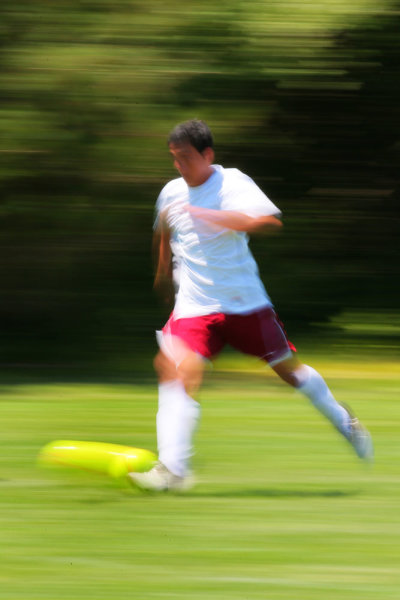
Occasionally, I’ll try something a little different. I had a lot of standard action from this game, so I decided to switch it up a bit and try some panning. The darker backgrounds lent themselves perfectly to this. Canon EOS-1D X, EF 200-400 f/4L IS Extender 1.4x. 1/10, f/36, ISO 100.
Post originally from: Digital Photography Tips.
Check out our more Photography Tips at Photography Tips for Beginners, Portrait Photography Tips and Wedding Photography Tips.
Get A Kick: Photograph Soccer!
Ein Beitrag von: David Uzochukwu
Die Frage, die mir wohl am häufigten gestellt wird, wenn Leute meine Bilder sehen, ist die nach meinem Alter. Wenn ich dann mit 14 antworte, sind die meisten Menschen erst einmal erstaunt. 14?
Ich habe unglaubliches Glück, dass ich so früh auf die Fotografie gestoßen bin. Im Sommer 2009 entdeckte ich die Digitalkamera meiner Mutter und war sofort fasziniert von der Idee, Momente festzuhalten. Wie besessen fotografierte ich Blümchen und Katzen. Doch nach einer gewissen Zeit war das nicht mehr so befriedigend wie am Anfang und so suchte ich nach etwas Neuem.
Ich fand flickr. Schnell hatte ich mich angemeldet und erforschte die Seite. Was es da alles gab! So viele Farben und so viel Bokeh! Schnell stieß ich an die Grenzen der Kompaktkamera. Vor anderthalb Jahren bekam ich dann meine Canon EOS 500D geschenkt. Der Qualitätsunterschied begeisterte mich. Aber man kann von einem Blumenstrauß nur eine begrenzte Anzahl Fotos machen, bis man sich langweilt. Ich brauchte Abwechslung!

Da stieß ich auf Alexis Mire und Brendon Burton und war absolut fasziniert – von ihren Bildern und von den Geschichten, die sie erzählten. So begann ich, mich für Portraits zu interessieren und für das Geschichtenerzählen. Bloßes Dokumentieren war mir nicht mehr genug. Ich wollte erschaffen, erzählen, Menschen mit meinen Bildern zum Nachdenken und zum Fühlen bringen. Das wurde mein Ziel.
Ich durchsuchte das Internet nach Möglichkeiten, meine Idee Wirklichkeit werden zu lassen. Ohne die vielen Menschen, die sich dazu entschlossen haben, ihr Wissen online zu teilen, wäre ich wahrscheinlich nie weitergekommen. Die Werke meiner beiden Vorbilder wurden untersucht und im Detail analysiert.

Ich fragte mich: Wie geht das? Ich war besessen und ich kann nicht sagen, dass diese Besessenheit inzwischen verschwunden wäre. Ich probierte aus und experimentierte, versuchte mich in analoger Fotografie und dann auch in Photoshop. Hier fand ich letztendlich, was ich gesucht hatte: Einen Weg, meine Bilder zu verbessern. Ich las unzählige Artikel über Bildbearbeitung, sah mir Tutorials an, probierte, machte Fehler und probierte erneut.
Um so viel zu üben, brauchte ich viele Bilder. Aber wen sollte ich fotografieren? Ich kam zu dem Schluss, dass ich mir wohl oder übel selbst als Modell dienen musste. Der Anfang war schrecklich. Alles lief schief: Von der Schärfe der Bilder über die Komposition bis hin zu meinem Gesicht, das ich nicht mochte. Doch ich hörte nicht auf. Ich wollte unbedingt so gut werden wie die Fotografen, die ich im Internet gesehen hatte.

Und mit der Zeit wurden die Bilder besser. Ich konnte Ideen, die ich hatte, genauer umsetzen, die Bilder wurden öfter scharf und manchmal gefielen sie mir auch. Hin und wieder mochte ich es sogar wirklich, wie ich auf einem Foto aussah. Das Fotografieren wurde zu etwas Persönlichem, Therapeutischem.
Ich fotografiere mich heute nicht, weil sich kein anderes Modell auftreiben lässt, sondern weil ich es will. Das hat nichts mit Narzissmus zu tun, sondern mit Selbstwertgefühl und Selbstbewusstsein. – Wie oft blieben Leute schon stehen und schauten mir zu, während ich halbnackt im Wald lag, angezogen in einem halbversunkenen Boot saß, in einen Container auf der Straße kletterte oder mich auf Baustellen in Erde verbuddelte?

Fotografie hat mich als Person verändert. Sie gibt mir Sicherheit und sie fordert mich heraus. Sie ist ein Teil von mir. Sie hat meine Aufmerksamkeit geschärft, meinen Sinn für Ästhetik geprägt. Sie hat mir neue Freunde verschafft und mir gezeigt, was Leidenschaft ist. Ich weiß jetzt, dass mich die Fotografie nicht mehr freigeben wird und das ist gut so.
Die Frage, die mir wohl am häufigten gestellt wird, wenn Leute meine Bilder sehen, ist die nach meinem Alter. Wenn ich dann mit 14 antworte, sind die meisten Menschen erst mal erstaunt. 14? Und ich nicke, manchmal stolz.
kwerfeldein – Fotografie Magazin
A few weeks ago as part of the launch of our new eBook – Photo Magic – we announced we’d be giving one Early Bird buyer of the eBook $ 1500 USD towards a new camera or lens.
Today we drew that winner and it is… Beverly Everson.
We’ve just emailed Beverly with details of how we can get that prize to her – Congratulations to Beverly, we look forward to hearing what you put your prize toward!
Post originally from: Digital Photography Tips.
Check out our more Photography Tips at Photography Tips for Beginners, Portrait Photography Tips and Wedding Photography Tips.
The Winner of $ 1500 in Camera Gear is….

Posting your images online for critique is a common practice in DPReview forums as well as on Flickr and other sites. But you usually have to go to a photo festival, or travel to have your portfolio reviewed by a professional curator. One of those curators created Eyeist.com, a service to connect photographers with creative professionals who can help them focus their selection for projects of many types, from books to websites to presentations. Click through for our review of Eyeist.
News: Digital Photography Review (dpreview.com)

If they’re young enough, your kids have always known a world in which smartphones are the most-popular devices for taking photos. That’s too bad. In this article we’ve rounded up a selection of cameras that will suit aspiring young photographers of all ages from under-10s to teenagers. Click through for a link.
News: Digital Photography Review (dpreview.com)

You must be logged in to post a comment.