RSS
 

Archive for June, 2013

645 Pro update brings even more DSLR control to your smartphone

26 Jun

645pro.PNG

645 Pro’s latest update has given the iOS app a complete makeover. Now called 645 Pro Mk II, Jaggr’s ‘professional’ photo app now makes your smartphone’s camera interface look and perform even more like that of a modern DSLR. For a detailed look at what’s changed, head over to connect.dpreview.com.


News: Digital Photography Review (dpreview.com)

 
Comments Off on 645 Pro update brings even more DSLR control to your smartphone

Posted in Uncategorized


Photojournalist gives new perspective on Google Glass

26 Jun

Koci.png

What happens when you give Google Glass to a skilled photographer? Richard Koci Hernandez is a San Francisco Bay Area-based photojournalist and prolific iPhone photographer who’s recently been trying Google’s new wearable technology to capture his surroundings. See how his style translates behind Google Glass, today on connect.dpreview.com.

News: Digital Photography Review (dpreview.com)

 
Comments Off on Photojournalist gives new perspective on Google Glass

Posted in Uncategorized


Little & Local: Staircase Cinema & Sidewalk Library Projects

25 Jun

[ By WebUrbanist in Art & Installation & Sound. ]

small local installation projects

Public art used to be synonymous with huge and impersonal and location-agnostic sculptures made of metal and marble. Countering that classic Modernist trend are installations like this pair: a set small, site-specific and community-oriented design-build projects located in Auckland, New Zealand, and New York City, New York, respectively.

small sidewalk stairway cinema

First, from Oh No Sumo (images by Simon Devitt), the Stairway Cinema, a sheltered spot for watching movies on steps rising right off the sidewalk and open to pedestrians passing by. Public participants are invited to curate the collection of films shown on the screen.

small movie theater stall

About its creators and inspiration: “Our ongoing goal is to experiment with architecture and the way it can engage with the public in unique and exciting ways. This project takes inspiration from the site and its inhabitants. The intersection of Symonds Street and Mount Street is a place of ‘hard waiting’. Bus stops and laundromats create a hard-scape of poor space for social interaction.”

Next Page:
Little Local Staircase Cinema Sidewalk Library Projects

Share on Facebook


[ By WebUrbanist in Art & Installation & Sound. ]

[ WebUrbanist | Archives | Galleries | Privacy | TOS ]


WebUrbanist

 
Comments Off on Little & Local: Staircase Cinema & Sidewalk Library Projects

Posted in Creativity


Design A Wedding Dress For Less Than $20 by Angy Chesler

25 Jun

I was looking for a way to make a dress that would hold up in a trash the dress session. This year I got help when I went to Photography workshop by Bambi Cantrell. She taught us how to make an amazing wedding dress out of window screen. All you need is about 30 yards of grey tulle. It has to be grey, white won’t match the screen and 20 yards of window screen and a box of paper clips. At targeted I also bought a slip for the model in skin color, to cover her body and make her more comfortable. I started out with the 30 yard tulle, which I wrapped around her waist twice. It’s important not to wrap it too much around the waist, since you can easily lose any waist line. Once it’s tight around the waist I cross the tulle over her shoulders and keep wrapping it until I create a nice shape.

Hawaii-Wedding

You can get really creative here, it doesn’t have to be symmetrical. I played with different versions, over one shoulder, over both shoulders and also left the shoulder free of tulle. The end of the tulle I tug under the first wrapper around the waist line. Once you are finished with the tulle the fun begins. It’s time to move the window screen. I bought silver metal window screen at Wal-Mart. I wrap it around the waist like a scarf that I would use as a dress. With the help of paper clips I secure it. You have to open the clips to be able to weave it through the screen. Once the first two rounds of screen are wrapped it’s time to form the metal screen. You can just bend it in any directions you want to and secure it with paper clips. Keep going and adding to the design until you use all the screen.

Searching for a background that would reflect the design in shape and color I decided that the beach after sunset would be the best place. !0 minutes after sunset the light was perfect. I put my Canon 5 D Mk 2 on a tripod. I used a slow shutter speed of a 1/6 at ISO 100 and F 2.8 with a 16-35 mm lens. My model stood super still without any movement, so I could blur the waves with the slow shutter speed. I used an off camera Flash with 1 f-stop over from the right to give the model some light and shape.

I studied photography in Europe. Since 2001 I have been working in Hawaii. My work includes U/W photography and videography, Architecture and Weddings
http://www.vip-wedding-hawaii.com

dslrBlog

 
Comments Off on Design A Wedding Dress For Less Than $20 by Angy Chesler

Posted in Photography


An Alternative Rule-of-Thirds

25 Jun

An alternative rule-of-thirds

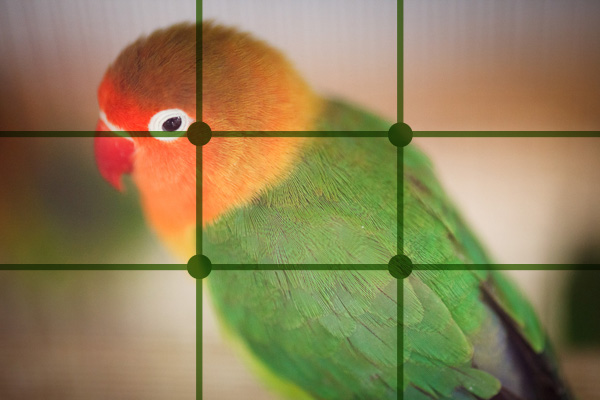
Most of you will be familiar with the rule-of-thirds: the idea that you can improve composition by placing the main subject a third of the way in from the side of the frame. For those of you who haven’t heard of this, here’s a diagram showing how it works:

An alternative rule-of-thirds

The lines show the ‘thirds’. The four points where the thirds intersect are said to be good spots to position the most important parts of the image. In this photo, the bird’s eye is close to one of the intersecting points, and we can say it is composed according to the traditional rule-of-thirds.

Regardless of how much faith you place in the rule-of-thirds (there are plenty of photographers who will tell you that it is nonsense), subject placement is only part of the story when it comes to composition and creating strong images. One danger with concepts like the rule-of-thirds is that you might fail to look beyond its application towards the other factors that contribute to the creation of successful images.

Alternative #1

I rather like Cole Thompson’s version of the rule-of-thirds:

“A great image is comprised of 1/3 vision, 1/3 the shot and 1/3 processing.”

What does this mean, exactly? Statements like this are open to interpretation, but here’s my take:

Vision: This is an understanding of the fundamentals of composition, combined with an appreciation of beautiful light and an eye for an interesting subject. These come together along with world view and the sum of the photographer’s life experiences to form a personal style and a way of visually interpreting the world.

The Shot: This is where Henri Cartier-Bresson’s ‘decisive moment’ and the photographer’s craft skills come together to capture an image that realises the photographer’s creative vision. It’s where the technical and creative sides of photography meet. You have vision and style on one hand, and the technical knowledge required to achieve that vision on the other. It’s about understanding which focal length lens to use, which aperture, ISO and shutter speed settings are required, how to obtain the optimum exposure and so on.

Processing: This is the work you do on your images in post-processing. It’s where you take the original Raw file and adjust the colour, contrast and tonal values to create a finished image that expresses what your creative eye originally saw. Post-processing has taken the place of traditional darkroom work and printing skills for many photographers

I encourage you to read Cole’s article on this topic. You might also like to read an interview I carried out with Cole last year.

Alternative #2

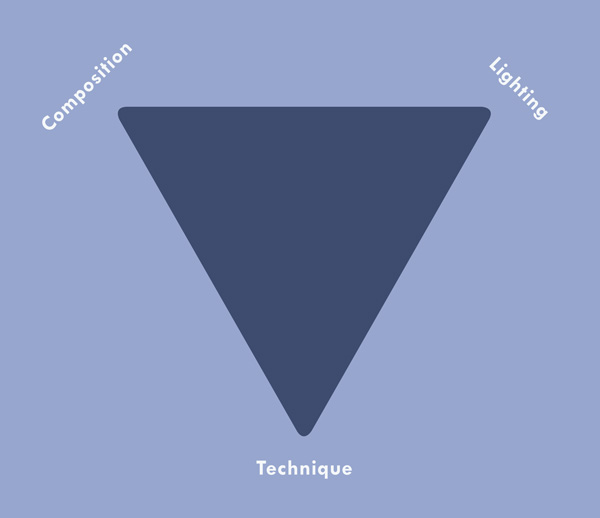
I have my own version of the rule-of-thirds, though I tend to present it in the form of a triangle:

An alternative rule-of-thirds

Let’s paraphrase Cole:

“A great image is comprised of 1/3 composition, 1/3 lighting and 1/3 technique.”

Composition: This is understanding the best way to arrange the elements of the scene within the frame to produce a pleasing result. It goes beyond the rule-of-thirds and includes concepts such as tonal contrast, colour contrast, simplicity, negative space and use of line (I’ll go into these topics in depth in future articles).

Lighting: Great photographers demand beautiful light. Anything less than that is a compromise. If something is worth photographing, it is worth doing so when the light is at its most beautiful. There are exceptions (photojournalists can hardly ask their subjects to return when the light is better, for example) but it’s a principle I place high value on.

Technique: This is the craft side of photography. It’s knowing which lens to use, which aperture to set, how to obtain the optimum exposure and how to process your Raw files to get the best possible results. This is the technical side of the craft. It may seem complex at times but it’s essential to master.

Putting it all together

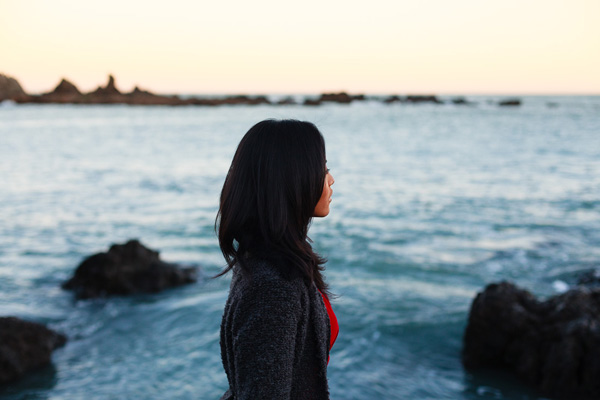
Let’s take a fresh look at the opening photo and see how these ideas tie together:

An alternative rule-of-thirds

Vision: I wanted to take a portrait of a friend of mine looking out to sea at sunset. I’m familiar with the location as it’s close to my home and I’ve visited it many times. This was the starting concept for the image.

The Shot: I directed my model to look out to sea and used an 85mm lens with the aperture set to f2.8 to defocus the background.

The Processing: I used a warm colour temperature to capture the rich tones of the setting sun and darkened the edges to guide the viewer’s eye towards my model.

Composition: The horizon line is placed on a third and my model is more or less central. This composition ‘felt’ right to me – I often operate on instinct rather than try and place my subject in a specific part of the frame, such as a third. The dark rocks either side of my model provide balance.

Lighting: We shot close to sunset to capture the deep warm colours of the late afternoon sun. Light is essential to the ‘feel’ of the photo. If we had shot earlier in the day, the mood would have been very different.

Technique: I used a portrait lens set to a wide aperture to throw the background out of focus. I deliberately used natural light, rather than portable flash, to create ambience.

Mastering Photography

An alternative rule-of-thirds

My latest ebook, Mastering Photography: A Beginner’s Guide to Using Digital Cameras discusses the creative triangle and other concepts in more detail.

Post originally from: Digital Photography Tips.

Check out our more Photography Tips at Photography Tips for Beginners, Portrait Photography Tips and Wedding Photography Tips.

An Alternative Rule-of-Thirds


Digital Photography School

 
Comments Off on An Alternative Rule-of-Thirds

Posted in Photography


25. Juni 2013

25 Jun

Ein Beitrag von: Jonas Hafner

9061304040_1cd2c66528_by Jonas Hafner


kwerfeldein – Fotografie Magazin

 
Comments Off on 25. Juni 2013

Posted in Equipment


Just posted: Canon EF 200-400mm f/4L IS USM Extender 1.4x review

25 Jun

200-400.png

Just posted: Our quick review of the Canon EF 200-400mm f/4L IS USM Extender 1.4x: the world’s first SLR lens with a built-in switchable teleconverter. It’s been two years in the making, but when Canon offered to show us a production version of its professional super-telezoom, we couldn’t help but be intrigued. In this review we’ve teamed up with DxOMark to bring you full optical test data of this unique lens, backed up by some quick real-world examples. So how does it perform? Click through to find out. 

News: Digital Photography Review (dpreview.com)

 
Comments Off on Just posted: Canon EF 200-400mm f/4L IS USM Extender 1.4x review

Posted in Uncategorized


Eye-Fi Mobi SD Card:Move Photos Onto Your Phone, Wire Free!

25 Jun

Extra photos for bloggers: 1, 2, 3

Your camera is going to love this. It finally has its own way to play with that smartphone it sees you tapping on all day.

The new Eye-Fi Mobi SD Card gives your camera a wifi connection to your phone. Simply stick it in your camera to automatically send your photos to your phone, as you shoot!

The newest card from our pals at Eye-Fi is optimized to work with mobile devices. The set up process is simpler than ever, under 10 seconds on any iOS or Android tablet or phone.

Combine your DSLR’s best features (high quality optics and complete photo taking control) with your phone’s easy to use go-anywhere super duper editing skillz and sharing powers.

Your camera and your phone just became BBFL (best buds for life).

Check out the new Eye-Fi Mobi
$ 49.95 at the Photojojo Store

 Tweet it!      Share

Related posts:

  1. Make Your Own Memory Card Holder Using a Credit Card Help Wanted! We’re looking for a freelance writer/editor and a…
  2. Make Your Photos Move with a Thaumatrope! Extra photos for bloggers: 1, 2, 3 Thauma-what? Sounds Greek…
  3. Attachable Lenses for Your Camera-Phone, Fisheye & Macro/Wide Angle Phone Lenses Extra photos for bloggers: 1, 2, 3 Camera-phones. They’re a…


Photojojo

 
Comments Off on Eye-Fi Mobi SD Card:Move Photos Onto Your Phone, Wire Free!

Posted in Equipment


The Day The Judging Stopped – The Mediocrity of Photography

25 Jun

One of the most difficult topics to discuss about photography and many other art forms is creativity. Creativity is an intangible that often isn’t recognized until it’s seen and often appreciated until the artist has passed. This is one of the many reasons creativity isn’t discussed as much as gear. The tangible is always easier to grasp and has finite boundaries of understanding, where as creativity is amorphous and tough to pin down due to its variability from person to person. Complicating this in the world of photography is the lowering of barriers to make photography easy and accessible to everyone. While this is great for most it really ruffles the feathers of long time photographers and in some aspects rightly so. Creativity is often lost on those obsessing on gear stats, subject location, exposure settings, machine gunning photo after photo and comments/likes.  Rightly or wrongly it’s tough to hear and see cranky old photographers complain about how it IS versus how it USED TO BE. Case and point this recent article, Humanity takes millions of photos every day. Why are most so forgettable?

Slow vs Internet Speed
If you come across a film photographer these days you’ll never hear a complaint about the process being slow. Film photographers, those that are remaining, love the slow process as its methodical, allows for contemplation & thought before executing a photograph. Digital photographers that use DSLRs and mobile devices by contrast shoot and share at lightning speed. Given that the methodologies of these two camps are so different it’s no surprise there is often philosophical friction.

Story Telling & Narcissism
While these two camps operate so differently is it really realistic that one camp should expect the other to think the way the other does?

Good pictures that tell a story, he said (Larry Towell, a member of Magnum Photos), are always about other people. But when “everybody with a phone thinks they’re a photographer,” the result is “the autobiographical and the narcissistic.”

Mr. Towell’s grandparents used to have their picture taken once a year, and they had to dress up and go into town to have it done. He cherishes those photographs today. They are a record of what was. But he fears that his granddaughters won’t have any memorable photographs of their own children: They will be lost in the technological deluge.

“People aren’t photographing for history any more. It’s for immediate gratification. If you’re photographing to share an image, you’re not photographing to keep it.”

This is the part of the Humanity takes millions… article that baffles me. I straddle both sides on this one. I have thousands of photos on my iPhone. They’re a great way to document a moment and share it with others via online tools that didn’t exist years ago. In fact I tell stories with these photos more frequently than I do with photos from my DSLR (ex. 4 months of triptychs on Instagram). The upside is great new tools (iPhones, mobile apps for editing and social media web sites) allow me to communicate in ways unimaginable years ago. The downside which I hear, read about and often struggle with is not living in the moment and living behind an iPhone and DSLR. And true people don’t print photos like they used to, but its not the only way to share a photo now either.

One of the more interesting things I’ve observed since I’ve begun sharing DSLR images and mobile images online is that the images that garner the most attention are the those that reflect the life experience of the photographer whether they’re behind the scenes photos of a shoot or sharing spontaneous moments of one’s life. And yes the  majority of these types of images are now taken with mobile devices to create a new form of story telling. That being said I still love taking more time with my DSLR to capture images that also tell a story.

Judge Hissy Fit
Should any of us be alarmed that that 3 judges decided to abstain from making any awards in a recent photo contest? I find it interesting, but its certainly not going to change my outlook on my photography. Contests are great for bragging rights, but they don’t really help you improve as a photographer. Not to take anything away from anyone who has won a contest, but having been a judge on multi-judge panel I can tell you that no 3 people like the same things and as a result winners are often compromises. As a result that means the best images aren’t always the ones that win.

So what went wrong at the 2013 Banff Mountain Photography Competition? Did photographers not read the rules and ignore the “photo essay” emphasis? Did photographers rely on photoshop too much? Were there photos truly uninspired or unedited? Did the judges have an unrealistic expectation and unbending view of photography? I’m sure it was all of the above to some degree. Still if I were an entrant I’d look at the contest in a much more skeptical light. At $ 10 an entry I’m sure they made a pretty penny from all the entries and it’s convenient that their $ 3000 grand prize won’t be awarded. Frankly if the organizers can’t guide their judges to follow their own rules it tarnishes their contest and erodes the trust of photographers who take part. In reviewing their rules there isn’t anything said about entries being non-refundable and given no award was granted I wonder if anyone will start demanding a refund. Either way it’s unfortunate that the judges decided to railroad the competition to make a statement versus awarding the best of the entries even if they didn’t think they were the best that could have been.

Creative Catalysts
Here lies some grounding news… for most photographers just starting out you do suck. If you’re pretty good now at photography at one point you sucked and you just suck a little less. If you’re great at photography now you sucked a lot and still suck from time to time, but you stuck with it to be great. If you’re a master photographer you suck at times just less than most, but you know what not to show. All photographers have one thing in common, at one point you sucked. Case and point This is Why Your Pictures Suck. by Ibarionex Perello

How do you suck less? Practice, devotion, tenacity and not biting on the fact that some judge, expert or critic is always right.  Find things that inspire you, as inspiration is a catalyst to developing your unique creative outlook. Don’t fret over originality as Originality Is A Matter of Perspective. Get inspired, get comfortable in your own skin and find yourself. It may take a lifetime, but the creative journey will be worth it.

Fantasy vs Reality… Oh the Irony
The flip-side of the coin is just as amusing as mobile photographers also have their gripes. Video, it’s tarnishing the magic of still photography by making things too real! When I read Instagram Video and the Death of Fantasy it gave me a chuckle because it crystalized the fact that no camp of photography is ever truly happy. I’d argue that if anything is keeping photography mediocre it’s photographers inability to focus on their work and spending too much time complaining. *Looking at the time* Oh my how much time did I spend writing this?!


Copyright Jim M. Goldstein, All Rights Reserved

The Day The Judging Stopped – The Mediocrity of Photography

The post The Day The Judging Stopped – The Mediocrity of Photography appeared first on JMG-Galleries – Landscape, Nature & Travel Photography.


JMG-Galleries – Landscape, Nature & Travel Photography

 
Comments Off on The Day The Judging Stopped – The Mediocrity of Photography

Posted in Equipment


Marathon

25 Jun

Ein Beitrag von: Jürgen Bürgin

Die Welt des Langstreckenlaufens blieb mir Zeit meines Lebens fremd. Ich war dem Schmerz nie zugetan und die Beglückungen des oft kolportierten Adrenalinrauschs blieben mir stets versagt. Das erste Mal, dass Langstreckenläufe dennoch mein Interesse erregten, war mit Alan Sillitoes Erzählung „Die Einsamkeit des Langstreckenläufers“* sowie mit Tony Richardsons Verfilmung* der Erzählung.

Wir lasen die Erzählung irgendwann im Englischunterricht und damals sahen wir auch den Film. Ich weiß, dass ich beides mochte. Es war eine angenehme Begegnung mit dem Langstreckenlauf, die sich im Sitzen erleben ließ. Ich glaube, man hat uns damals erzählt, dass der Langstreckenlauf bei Sillitoe eine Metapher für das Leben sei, vielleicht ist das so, wenngleich höchstens eine Metapher für ein Leben voller Qualen und Entbehrungen, wie es der Ich-Erzähler zu erdulden schien.

Und der Ich-Erzähler versuchte redlich, mir Hinweise darauf zu geben, wie die Entbehrungen des Langstreckenlaufs zu ertragen wären: „Denn eigentlich renn ich mit niemandem um die Wette; ich lauf einfach, und irgendwie ist mir klar, wenn ich nicht dran denk, daß es ein Wettrennen ist, und bloß so langtrab, bis ich nicht mehr weiß, daß ich lauf, da gewinne ich jedesmal.“ Und: „Und das alles kann ich, weil ich dabei nachdenke; und ich frag mich, ob ich in der Laufbranche der einzige mit diesem System bin, das Laufen vor lauter Nachdenken zu vergessen (…).“1

Marathon © Jürgen Bürgin

Meine nächste nennenswerte Begegnung mit dem Langstreckenlaufen fand viele Jahre später statt: In Berlin. Dort geht die Laufstrecke des jährlichen Marathons nicht weit an unserer Wohnung in Kreuzberg vorbei. Und hin und wieder besuchte ich die Strecke und sah den Läufern zu. Beinahe gezwungenermaßen, denn eine Marathonstrecke stellt ein schier unüberwindliches Hindernis dar. Die nicht enden wollenden Massen an Läufern halten einen davon ab, zur so nahe scheinenden gegenüberliegenden Straßenseite zu gelangen.

Ein Marathonlauf ist ein verkehrstechnischer Ausnahmezustand: Um von A nach B zu kommen, bedarf es ausgeklügelter Planungen und fundierter Kenntnisse der örtlichen Gegebenheiten. Nun stand ich also am Straßenrand und beobachtete Tausende von Läufern, die alle das eine Ziel hatten: Die 42,195 Kilometer erfolgreich zurückzulegen – wie schnell auch immer, jedenfalls schneller als der von hinten dräuende Besenwagen, der dem Lauf jener, die zu langsam unterwegs waren, irgendwann gnadenlos ein Ende setzte.

Marathon © Jürgen Bürgin

Ich sah in die Gesichter der Läufer, beobachtete ihre Körperhaltung beim Laufen, versuchte einzuschätzen, wie sehr einige bereits an ihr Limit gerieten. Aber was mich am meisten überraschte, war, dass mir die Marathonläufe gar nicht als einsame, einzelgängerische Unternehmung erschienen, wie ich es eigentlich erwartet hatte. Die Läufer schienen ein Gemeinschaftserlebnis zu durchleben, sie liefen zusammen, man sprach miteinander, winkte dem Publikum zu, trug lustige Kostüme, machte Faxen.

Und irgendwann fing ich an, beim Berlinmarathon zu fotografieren. Irgendwie hatte ich im Sinn, den Schmerz, die Leiden, aber auch die Freude und das Gemeinschaftserlebnis der Läufer abzubilden. Doch eigentlich gelang mir das nicht wirklich – und bald erschien mir das auch zu langweilig. Aber dann fand ich jene Stelle, an der die Feuerwehr Schläuche installiert hatte, mit denen Wasser auf die Laufbahn gespritzt wurde. Die Läufer konnten unter dem Wasserstrahl hindurch laufen und sich abkühlen.

Marathon © Jürgen Bürgin

Und statt das Leiden und die Freude der Läufer zu dokumentieren, versuchte ich fürderhin – und fürderhin bedeutet für die nächsten drei Stunden, in denen ich mich nicht mehr von der Stelle bewegte – meinen Bildern einen abstrakten, verfremdeten Eindruck mitzugeben. Was ich damit meine, ist das Folgende:

Erstens: Das aufspritzende Wasser, die Lichtflecken und die Schatten hinterlassen eine grafische, künstliche Wirkung, erzeugen abstrakte Strukturen. Die Tropfen und Spritzer, die im Licht funkeln, die Schatten der Füße und der Körper erzeugen eine unwirkliche, zeichnerische Bildsprache.

Zweitens: Die Silhouetten der Körper im Gegenlicht wirken wie stilisierte Archetypen von Läufern. Die eingefrorenen Gesten – der nach hinten geworfene Kopf, der angespannte Muskel, die in die Luft gestreckten Arme, die zum Wasser gerichteten Hände – all das sind mehr aufs Äußerliche reduzierte Elemente, die nichts wirklich über die Mühsal der körperlichen Anstrengung erzählen.

Marathon © Jürgen Bürgin

Dieser abstrakte Charakter der Fotos verhalf mir zu einer Erkenntnis: Marathon und Fotografie repräsentieren gewissermaßen zwei diametral entgegengesetzte Konzepte: Bewegung zum einen und das Einfrieren einer Bewegung zum anderen. (Aus-)Dauer einerseits und Sekundenbruchteil andererseits. Körperlichkeit einerseits und rein äußerliche Ästhetik andererseits. Wenn wir die Bilder betrachten, führen wir die Bewegungen in Gedanken fort:

Der Fuß wird gleich den Boden berühren, das Wasser wird gleich aufspritzen, der Läufer wird einen Fuß hinter den anderen setzen, noch viele tausend Mal. Das Bild zeigt Statik, aber unsere Wahrnehmung und unsere Erfahrung erwarten Bewegung.

Marathon © Jürgen Bürgin

Meine Bilder erzählen nichts vom Schmerz, nichts vom Leiden, nichts vom Glück, nichts vom Adrenalinschub. Ich bin dem Verständnis dessen, was die Faszination eines Marathonlaufes ausmacht, keinen Deut näher gekommen. Aber ich habe eine Serie von Fotos produziert, die in ihrer Verfremdung, in ihrer Abstraktion eine Spielerei mit den visuellen Elementen eines Marathonlaufs darstellen. Immerhin.

Und weil ich nicht viel übers Langstreckenlaufen gelernt habe, stattdessen einige abschließende Worte vom Langstreckenläufer aus der Erzählung: „Manchmal denk ich, ich bin noch nie so frei gewesen wie in den beiden Stunden, wenn ich den Weg draußen vor den Toren langtrotte und bei der laublosen, breitbauchigen Eiche am Ende des Heckenwegs wende. Alles ist tot, aber gut, weil’s tot ist, bevor’s lebendig wird, und nicht tot ist, nachdem’s lebendig war.“ 2

Marathon © Jürgen Bürgin

Klingt gut.

  1. Alan Sillitoe: Die Einsamkeit des Langstreckenläufers. Zürich 1975, S. 66.
  2. S. 12.


kwerfeldein – Fotografie Magazin

 
Comments Off on Marathon

Posted in Equipment