Ein Beitrag von: Erkan Camlilar

kwerfeldein – Fotografie Magazin
[ By Steph in Design & Furniture & Decor. ]

3D printing has enabled designers to take the manufacturing process into their own hands for the creation of one-of-a-kind objects, many of which you can buy to liven up your home decor. The computer-generated designs are printed in three dimensions in materials like plastic, ceramic and metal, and are often based on mathematical algorithms. Here are 14 lamps, light switches, tea cups and more that are available for purchase.

This intricate two-piece Jellyfish lampshade was designed using fractal techniques and 3D computer-aided design methods, inspired by a modified Mandelbulb fractal. The dangling ‘tentacles’ are chains that billow around in the wind. It works with a standard IKEA bulb kit.

This 10-pack of Aqueduct Mini Planters hooks together into a modular system that shares water from one unit to the next. The water flows from the top planters into the bottom. Made up of 3 double-channel planters and 7 single-channel planters, it can be assembled in all sorts of configurations and hooked up with additional sets to create window-sized screens of plants.

This fun light switch plate adds both visual interest and extra functionality: the antlers can be used as hooks for keys or to hold your cell phone.

You can get this cool star lamp customized to a specific place, date and time in history to reproduce the sky of a special moment, like when you were born. Printed in sandstone and fitted with a battery-operated light, it makes for a cool accent lamp or night light.

Says the designer of this unusual 3D-printed mug, “In the grand manner of the very best salons of old, this mug is raised up on an arcade so that it may occupy the airy summit of its own ‘Piano Nobile’. Elevated above the common detritus of your breakfast table, this dining item elegantly maintains the dignified sanctity of your morning brew.”

Build your own three-dimensional Icosahedron out of 30 pencils using a simple kit of 3D-printed plastic joints. The resulting object can be used as a functional lampshade, a toy or decor. You can even adjust the size by using shorter or longer pencils.

Put a bird (back) on your egg with these cute little 3D-printed egg cups, which will hold medium eggs or flex to accommodate larger-sized eggs.


[ WebUrbanist | Archives | Galleries | Privacy | TOS ]

     |

Our friends and collaborators over at DxOMark have been looking into how lenses score on specific cameras, and most recently they’ve been examining Canon’s latest SLR, the EOS 700D / Rebel T5i. In an ongoing article they investigate how 130 lenses from Canon, Carl Zeiss, Samyang, Sigma, Tamron and Tokina measure up on the 700D’s 18MP sensor. As this is essentially a variant of the sensor used in every Canon APS-C camera since the EOS 7D in 2009, the article could be of interest to a lot of Canon users. Click through for the links.
News: Digital Photography Review (dpreview.com)

The Milky Way rises over Half Dome as seen from Glacier Point – Yosemite National Park
One of the many things I love about Yosemite National Park is that it’s equally photogenic at night as it is during the day. During my last visit I focused on astro-landscapes, but Mother Nature had other things in mind with a lot of clouds. Fortunately for me the heaviest clouds cleared just in time for me to take this photo and several others.
My location of choice was Glacier Point as the increased altitude above the valley floor allows you to see the Milky Way rising a little earlier without obstruction. In addition you have an amazing view of Half Dome and Nevada and Vernal Falls. These of course make for amazing foreground subjects.
One interesting note about this photo is that it was taken with out a tripod. I had two other cameras running time-lapses on a tripod when this was taken and I was left with only my ingenuity to stabilize my 3rd camera. To stabilize my camera for this long exposure I lodged the camera on a rock and used the strap with a great deal of tension to lock it into place. If there is interest I’ll go over exactly how I did this.
Photo Details:
Canon 5D Mark II, Canon 15mm f/2.8 fisheye, ISO 6400, 30sec
Copyright Jim M. Goldstein, All Rights Reserved
Milky Way Over Half Dome, Yosemite National Park
The post Milky Way Over Half Dome, Yosemite National Park appeared first on JMG-Galleries – Landscape, Nature & Travel Photography.
JMG-Galleries – Landscape, Nature & Travel Photography

The Sigma 18-35mm f/1.8 DC HSM zoom lens has garnered a huge amount of interest from our readers, as the fastest zoom lens ever made for SLRs. UK residents can now win one courtesy of Sigma UK’s latest competition, along with a two day landscape photography workshop in Dartmoor with pro photographer Lea Tippett. For a chance of winning, submit your best landscape photo, along with 80 words saying how you’d benefit from the workshop. The closing date for entries is 31st July 2013: click through for full details.
News: Digital Photography Review (dpreview.com)
The moon has long been a source of deep fascination for mankind. As long as anyone can remember, human beings have stared up into its source of light in the pitch black of night and wondered about it. Some have even gone a bit batty thanks to the moon’s effects (at least, some would have you believe). But hardcore photographers Continue Reading
The post Killer Tips for Photographing the Moon That You Can’t Pass Up appeared first on Photodoto.
[ By WebUrbanist in Global & Travel & Places. ]

For all its art and controversy, the desert is perhaps the most unique defining characteristic of Black Rock City, home of the Burning Man Festival in rural Nevada. Potentially even more challenging than harsh heat and dust storms: Emphermisle, a temporary autonomous zone on the water, coming to California again this year in the middle of July.

From its creators: “We construct a floating city on the Sacramento River Delta and live on it for five days. Ephemerisle has elements of Burning Man in the early 1990s: a new adventure into an alien environment, with discoveries, adventures, and mishaps along the way.” Unlike the current form of Black Rock City, though: “There are no tickets, no central organizers, and no rangers to keep you safe.”
Its creation, though, is about more than just at temporary experience: “Seasteading seeks to move human communities out into the vast expanse of our planet covered in water. Ephemerisle gives an introduction into the physical challenges of being water and learning ways to deal with them. It also provides for small scale experimentation in differing forms of governance.”

Atossa Abrahamian describes the experience of arriving this year at the event, with its patchwork neighborhoods, impromptu parties and unpredictable ad hoc public transit system: “It looked, at first, like a shapeless pile of floating junk, but as the boat drew closer, a sense of order emerged. The island was made up of two rows of houseboats, anchored about a hundred feet apart, with a smaller cluster of boats and yachts set off to the west. The boats had been bound together with planks, barrels, cleats, and ropes, assembled ad-hoc by someone with at least a rudimentary understanding of knots and anchors. Residents decorated their decks with banners and flags and tied kayaks and inflatable toys off the sides”
[ WebUrbanist | Archives | Galleries | Privacy | TOS ]

| |

Pentax is not a company to sit quietly on the sidelines and watch the traffic go by. The most recent and startling example of this was the introduction of the Marc Newson designed camera, the K-01.
Going further back and with more relevance to this camera under review were some Pentax products way back in the film era. Remember those times?
The 1970s saw the minuscule 110 format launched by Kodak and a whole avalanche of cameras appeared from seemingly every camera maker that accepted the tiny film cartridge.
And Pentax were in there with the Auto 110, an interchangeable lens reflex camera. Can you believe it!
The camera was so tiny the lens aperture was not built into the lens but into the camera body and doubled as the shutter!
The relevance of this camera is in the film area: each frame measured 13x17mm. Diagonal measurement: 21.4mm.
Welcome to the Pentax Q10!

The light sensitive area of the sensor is 6.17×4.55mm and its CMOS diagonal is 11.04mm.
By referring to the diagonal, the Pentax Q10 would have an effective 35 SLR equivalent factor of 5.53. This makes it ‘the world’s smallest, lightest digital interchangeable lens camera.’
The review camera was supplied with two lenses: an f2.8/5-15mm and an f2.8/15-45mm. Applying the factor of 5.53 would make the former have a zoom range (as a 35 SLR equivalent) of 27.6-82.95mm and the latter as 82.95-248.85mm. Got that?
Taking it further, you can acquire an adapter Q to accept the Pentax K-mount lenses. So, attach a Pentax 300mm lens and you get a 1650mm! There are other ways to attach Leica, Nikon or Olympus lenses.

Not only is the Q10 novel in many respects but, as an indicator of it eventual market, the Q10 can be bought in any of 100 ‘pop-tastic’ colour combinations!
The idea is to make the Q10 a fun camera to take fun photos. The whole digital camera game, I reckon, is now sufficiently broad to allow models such as this to catch your attention.
To be realistic, the Q10 is barely smaller than many fixed lens compact digicams. For example, take Sony’s Cybershot HX9V digicam: it measures 104.8x59x33.9mm while the Q10 measures 102x58x34 mm. Comparative weight? Sony: 245g. Pentax (with 5-15mm lens): 280g.
Add a lens and you get the full picture: it looks like a real fun camera. Hold the magnesium alloy body, attach a lens, it and looks and feels right! The rubberised surface makes handholding a treat, aided by a relatively prominent speed grip.
(insert Civic centre 2, Shop front 1, Play centre and Shop front 1)
Front panel: right next to the lens is a ‘quick dial’ button to which you can assign frequently used functions.

Top deck: tap the flash button and you will be surprised at how high the pantograph raises the flash cell; from flash to lens centre is a healthy, anti red eye 70mm!

To the right you’ll find the replay, power and shutter buttons, flanked by the mode dial and a controller called the E-dial. The mode dial has positions for auto, PASM, video record, scene modes (21 in all: portrait, macro, food etc) and a blurr control setting. The latter lets you shoot a picture ‘that looks as if it was taken with a wide-open aperture and shallow depth of field’; it shoots multiple images with different focus positions and merges them into a single picture.
The E-dial in shoot mode lets you set shutter speed, aperture and exposure values; in replay it will enlarge the on screen image.
Rear: a button for exposure compensation; trash; four way jog dial with positions for flash options, ISO setting, white balance and self timer. In the centre is an OK confirm button. Lower down are info and menu buttons.

Unusually, there are side hatches for the battery and a memory card.
Overall, a terrific and workable layout, despite the camera’s small size. With one caution: while the various controls are clearly labelled in smallish white text, the actual buttons are black on a black background: difficult to see the actual button you need to press.
The Q10 has an internal stabiliser, thanks to a shifting sensor, so all lenses can be used with no shake.
It also has a supersonic vibration mechanism, which vibrates the image sensor at high speed to shake the dust off its surface.
The maximum image size is 4000×3000 pixels, so expect to make a 34x25cm print.
Video is captured in FullHD at 19209x1080m pixel resolution.
As with its stablemate, the Ricoh GR, there is only one ‘shoot’ button (for stills and video). I had a bit of a contretemps with the camera at this stage with video record: I couldn’t make it bend to my wishes!
No help in the manual. But at last I found the answer on the Internet: you must gently depress the shutter button to confirm auto focus; once the confirmation green square appears on screen you then depress the shutter button all the way and … voila! You’re recording! Hope this helps yo’all!


The Q10 performed very well up to ISO 3200, with noise not too objectionable. Even at ISO 6400 you could use it for some subjects.
Quality: about average. No more.
Why you’d buy the Pentax Q10: small; you can add a bundle of lenses.
Why you wouldn’t: is it really a better alternative than a fixed lens, compact digicam?
A novel camera for the person who has everything.
Image Sensor: 12.4 million effective pixels.
Sensor: 11mm CMOS.
Lens: Mount: Pentax Q.
Lens Factor: 5.53.
Metering: Multi segment, centre-weighted, spot.
Exposure Modes: Auto, Program AE, shutter and aperture priority, manual.
Shutter Speed: 30 to 1/2000 second, Bulb. Flash sync: 1/2000 sec (electronic shutter).
Memory: SD/SDHC/SDXC.
Image Sizes (pixels): Stills: 4000×3000 to 1440×1440.
Movies (30 fps): 1920×1080, 1280×720, 640×480.
Continuous Shooting: 1.5 or 5 fps.
Viewfinder: 7.6cm LCD screen (460,000).
File Formats: RAW (DNG), JPEG, RAW+JPEG, MPEG4.
Colour Space: sRGB, Adobe RGB.
ISO Sensitivity: Auto, 100 to 6400.
Interface: USB 2.0, HDMI type D, AV, DC input.
Power: Rechargeable lithium ion battery, DC.
Dimensions: 102x58x34 WHDmm.
Weight: 200g (inc battery, card).
Price: Get a price on the Pentax Q10 at Amazon.
Post originally from: Digital Photography Tips.
Check out our more Photography Tips at Photography Tips for Beginners, Portrait Photography Tips and Wedding Photography Tips.
Pentax Q10 Review
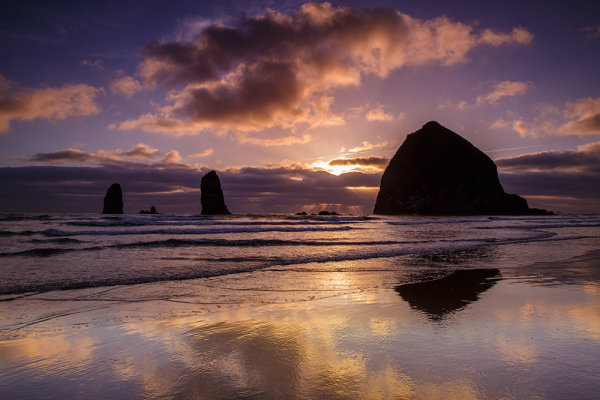
Haystack Rock dominates the landscape at Cannon Beach. The wet sand, dramatic skies, and great light combined for some great images. Canon EOS 5D Mark III, EF 24-70 f/2.8L II at 24mm. 1/40 second at f/16, ISO 200. I used a 4 stop graduated neutral density filter on the sky.
Every year I try to dedicate at least one week of vacation to photographing a destination that’s on my lifetime list of places to see- some might call it their bucket list for photography. The past few years those trips included Yosemite, Acadia, and Denali. I have wanted to photograph the Oregon coast since I first began photographing landscapes, and decided that this year was the year for that.
I had seen photographs of the beaches in Oregon and knew they were beautiful, but nothing prepared me just how beautiful they really were. And nothing prepared me for the diversity of the landscape. From wide sandy beaches, to towering sea stacks, rocky headlands, and temperate rainforest, the coast of Oregon offers a little of everything to photographers seeking dramatic landscape images. I was in heaven. For this trip, I took along the following: EOS 5D Mark III, EF 16-35mm f/2.8L II, EF 24-70 f/2.8L II, EF 70-300 f/4-5.6L IS, EF 100mm f/2.8L IS macro, and EF 14mm f/2.8L II. I had my lightweight travel tripod (a Gitzo 1541T), and my set of 4×5 inch graduated ND filters and ND filters, as well as a polarizer.
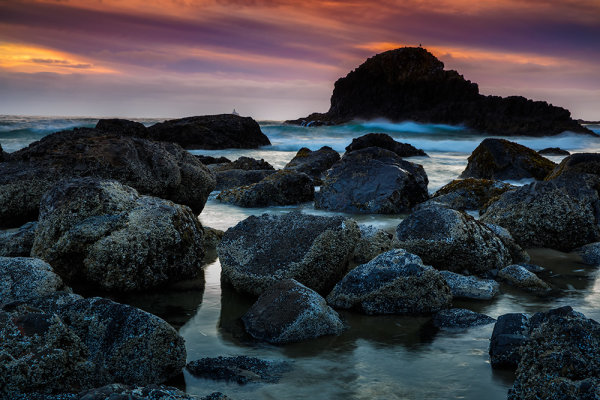
Indian Beach features a rocky area along with a wide expanse of sand. On this day, gray clouds had been hanging around all day, keeping the light pretty flat and boring. Just as the sun began to set, the layers of clouds separated and began reflecting this unbelievable color. To capture it, I used both a 3 stop hard edged graduated neutral density filter, stacked on top of a hard edged 4 stop graduated ND. That brought out the color nicely and allowed me to maintain good detail in the foreground. 1/15, f/16, ISO 400. EOS 5D Mark III, EF 24-70 f/2.8L II at 50mm.
I stayed in Cannon Beach, and was immediately drawn to the dominant feature of the landscape, Haystack Rock. At 235 feet tall, Haystack Rock towers above everything else in the area. Cannon Beach, like much of the coastline, features sand pounded flat by the tides, so you can see for miles down the beach. When the sand is wet, it becomes highly reflective, and since the beach is so flat, the water just keeps running over the sand. This presents fantastic opportunities for reflections. In addition, the water and wind will carve the sand, creating patterns that just beg you place it in the foreground using a wide angle lens. Finding interesting compositions of the monolithic Haystack Rock can keep any photographer going for days.
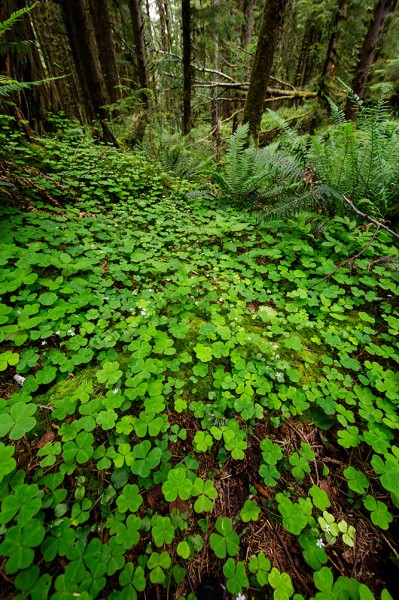
The temperate rain forest features a plethora of flora. This is wood sorrel blanketing the forest floor. EOS 5D Mark III, EF 14mm f/2.8L II. 1/25, f/8, ISO 400.
Low tide is a macro photographer’s dream. You can walk all the way out to Haystack Rock, where tide pools form around smaller rocks. These tide pools feature a plethora of marine life, including crabs, star fish, limpets, ochre sea stars, and sea anemone, among others. One can spend hours amongst the tidal pools, alternating between landscapes and macro work, and still not exhaust all of the opportunities presented.
Just north of Cannon Beach is Ecola State Park. Ecola State Park is a mix of rocky headlands, temperate rain forest, and sandy beach. I spent half a day photographing in the rain forest. Trees covered in moss, ferns and wood sorrel blanketing the forest floor, and winding trails lead to tons of photographic opportunities.
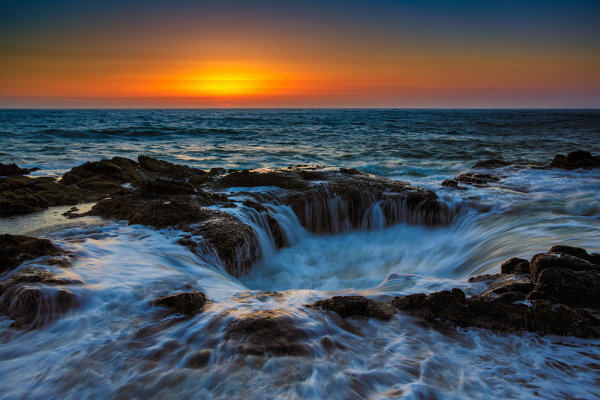
Thor’s Well, at Cape Perpetua, is breathtaking in showcasing the ocean’s power. EOS 5D Mark III, EF 24-70, f/2.8L II, at 31mm. 1/5, f/16, ISO 100. Due to the spray I was unable to use a graduated neutral density filter, so in the raw processing I pulled the exposure for the sky back using a digital graduated filter in Adobe Camera RAW.
South of Canon Beach is a stretch of beaches and state parks such as Arcadia Beach, Oswald West State Park, Hug Point State Park (which features a beautiful waterfall), and more. A few hours further south is Cape Perpetua, which features some of the most dramatic coastline I’ve ever seen. Specifically, the area around Devil’s Churn, which features waves crashing on the rocks like thunder, water being forced out of blow holes, and a cauldron-like feature called “Thor’s Well”. This area is best photographed at high tide, where the waves create massive splashes, and Thor’s Well literally boils over. While I was there, the wind was blowing spray all over the camera, making it a nightmare trying to keep the camera dry.
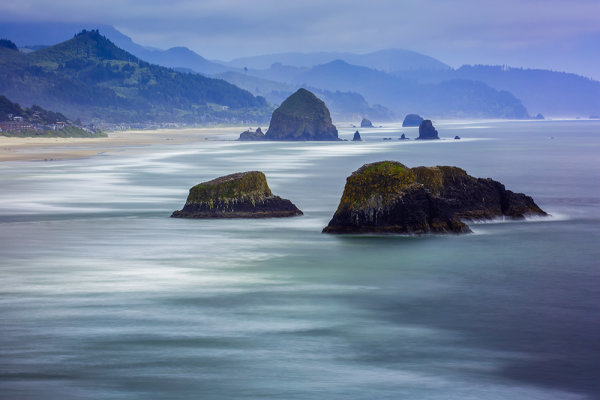
From Ecola State Park, you can view the vast expanse of Cannon Beach below. EOS 5D Mark III, EF 70-300 f/4-5.6L IS, with a 5-stop and 6-stop ND filter stacked together to create the long exposure. 30 seconds, f/25, ISO 160.
I could not believe how many good photo ops there were waiting for me in Oregon, and I didn’t even get a chance to explore the Columbia River Gorge or the southern coast. I definitely plan to go back and explore more, so it stays on my list. And I must go back for a marionberry scone from the Lazy Susan Cafe in Cannon Beach!
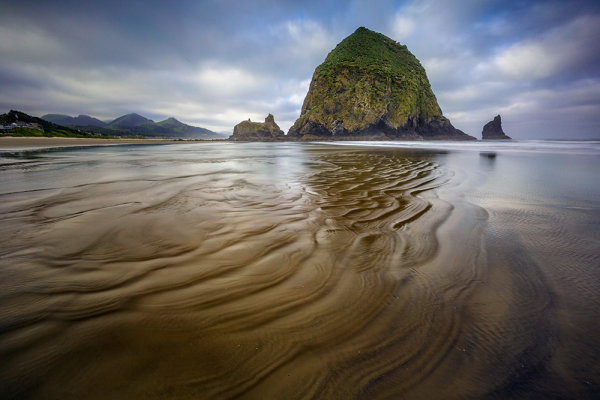
Wind and Water carved up the sand on the beach, creating a great foreground to use for this shot. EOS 5D Mark III, EF 16-35 f/2.8L II. Exposure was 4 seconds, f/16, ISO 100. I used a 3 stop, soft edged graduated ND filter to help darken the sky, and a 6 stop ND filter to slow down my exposure.
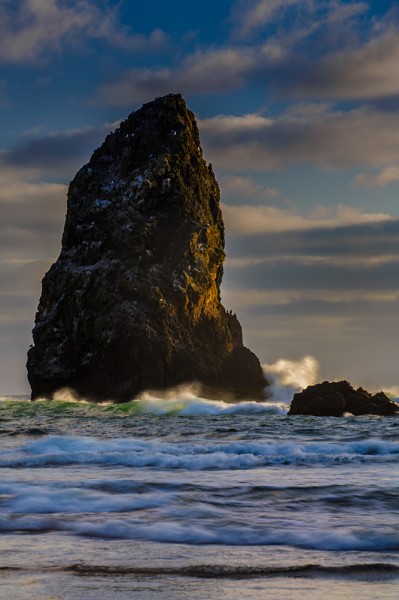
The Needles are the tall, thinner sea stacks to the south of Haystack Rock. I photographed this with the EOS 5D Mark III and EF 70-300 f/4-5.6L IS. 1/10, f/16, ISO 200.
Post originally from: Digital Photography Tips.
Check out our more Photography Tips at Photography Tips for Beginners, Portrait Photography Tips and Wedding Photography Tips.
Destination: Oregon
Unser browserFruits-Foto ist wunderschön, aber mittlerweile schon sehr alt. Wir haben Lust auf Abwechslung und suchen ein neues Titelbild für unsere sonntägliche Linksammlung. Und Ihr könnt mitmachen: Nur noch bis zum 30. Juni ist Zeit, um uns einen Foto dafür zu schicken. Wie genau Ihr bei unserer Aktion teilnehmen könnt, erklären wir hier.
Fotospecial: Stillleben
Flickr


500px


Deutschsprachig
• Die Doku über einen kenianischen Straßenfotografen kann man noch bis zum 20. Juni bei ARTE+7 nachsehen.
• Im Oktober wird eine Camera Obscura in Form eines Bauwagens im Raum Württemberg und Franken unterwegs sein. Tolles Projekt, das Ihr im Auge behalten solltet, wenn Ihr aus der Region kommt. Mehr Termine sind noch in Planung!
• Simon Kunkelmoor ist der erste Deutsche, der für die neue Google-Funktion „Google Business Photos“ 360°-Fotos vermarkten darf.
• Bei Photodil könnt Ihr Eure Bilder bearbeiten lassen. Und das zu einem sehr guten Preis und mit Zufriedenheitsgarantie: Ihr zahlt erst, wenn Euch die bearbeiteten Bilder auch wirklich gefallen.
• Kraut|Kopf ist ein neuer Foodblog mit großartigen Foodfotografien und den kreativen Rezepten dazu. Mmmmh, lecker!
• Provisorium ist eine großartige und humorvolle Serie über … eben, Provisorien.
• In dieser Woche haben uns die Bilder vom Taksim-Platz in Istanbul sehr bewegt.
International
• Der Rumäne Petrut Calinescu betätigt sich als Dokumentarfotograf und versucht, Themen zu präsentieren, die von den Massenmedien ignoriert werden.
• Beeindruckend: Die Gewinner des indonesischen Unterwasserfoto-Wettbewerbes 2013 „DEEP“ wurden bekannt gegeben.
• „Candidates“: Pascal Fellonneau fotografierte Wahlplakate in Paris.
• Gespiegelte Fotografien und Wasserfarbe sind eine großartige Kombination, wie Fabienne Rivory wunderbar vorführt.
• Emil Nyström portraitiert seine kleine Tochter auf sehr unterhaltsame Weisen.
• Fotografisch nicht sehr wertvoll, aber lustig: Eine Tumblr-Sammlung von Tieren, die auf Tieren stehen.
• Für den Fall, dass Ihr jemals Eure Kamera verliert: Hier ist eine Idee, mit der Ihr sie vielleicht wieder bekommt, da Ihr dem Finder ein Lächeln auf die Lippen zaubert.
• Sebastião Salgado’s best shot: Warum es sich lohnt, große Bürden für ein Foto auf sich zu nehmen.
• Wäre er nicht in einem Naturschutzgebiet, würden wir da gern mal ein Unterwassershooting machen: Bilder vom klarsten See der Erde.
Neuerscheinungen und Tipps vom Foto-Büchermarkt

• Herausgeber Martin Gommel musste sich sehr zusammenreißen, den Bildband „New York“* von Thomas Hoepker nicht sofort zu bestellen. Der in gebürtige Münchner ist Mitglied bei Magnum und fotografierte die Stadt der Städe von den 60ern an auf ganz wundersame Weise.
• Ihr habt es bestimmt schon gehört: Der Stilpirat hat ein neues Buch am Start. Der Bildband „Logbuch Vietnam“ hält seine Reise durch Vietnam fest.
Videos
Doppelbelichtungen in Bewegung
Unser Redakteur Michael zeigt eine Möglichkeit, um ein Foto von Lens Flares zu befreien.
Ausstellungen
Andrea Diefenbach – Land ohne Eltern
Zeit: 14. Juni – 14. Juli 2013
Ort: Münchener Stadtmuseum. Sammlung Fotografie.
St.-Jackobs-Platz 1, München
Link
Bourgeoisie, Swing und Molotow-Cocktails – Das Amerika Haus im Wandel der Zeit
Zeit: 13. Juli – 15. September 2013
Ort: C/O Berlin – Hardenbergstraße 22-24, Berlin
Link
Mehr aktuelle Ausstellungen
* Das ist ein Affiliate-Link zu Amazon. Wenn Ihr darüber etwas bestellt, bekommen wir eine kleine Provision, Ihr bezahlt aber keinen Cent mehr.
kwerfeldein – Fotografie Magazin
You must be logged in to post a comment.