Month: March 2013

  • Shadow Sculptures: Illusions from Clumps of Junk

    [ By Steph in Art & Sculpture & Craft. ]

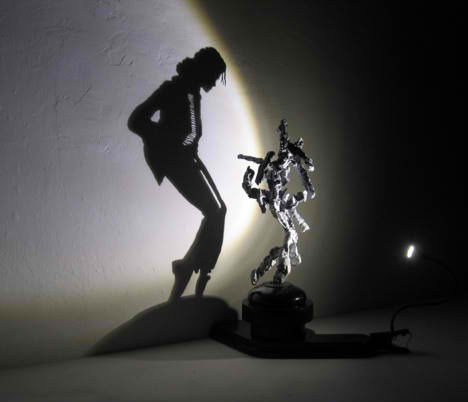
    Wiegman Shadow Sculptures 1

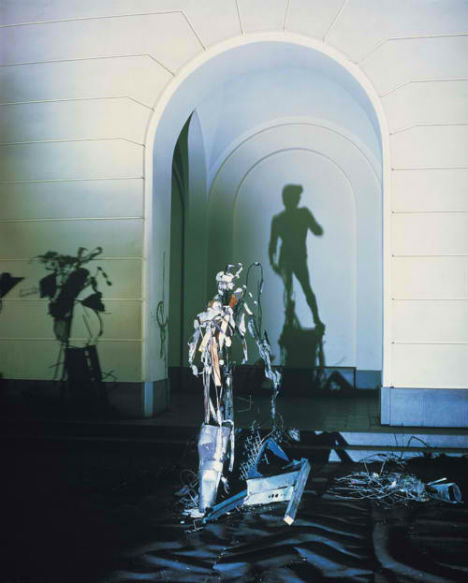
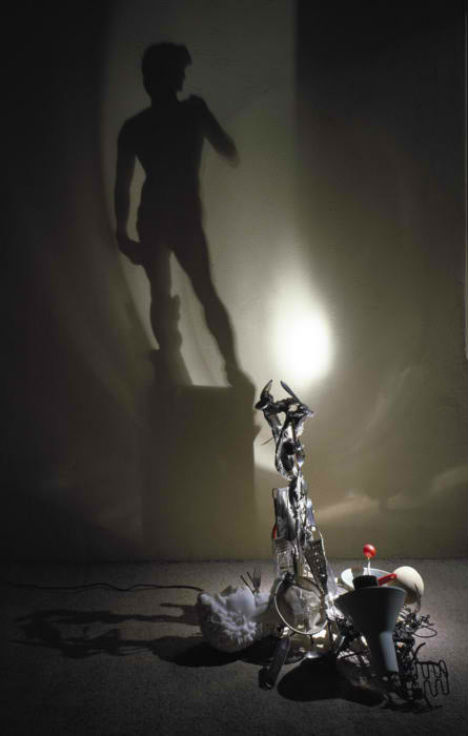
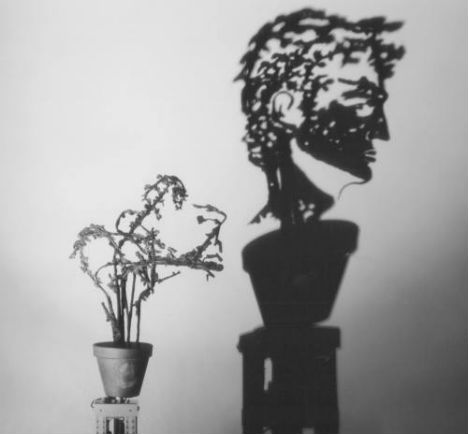
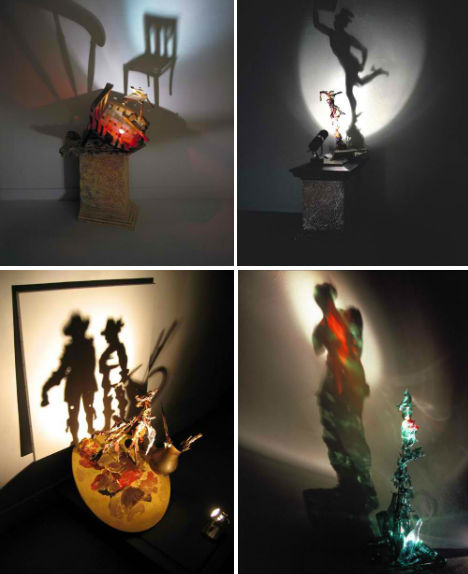
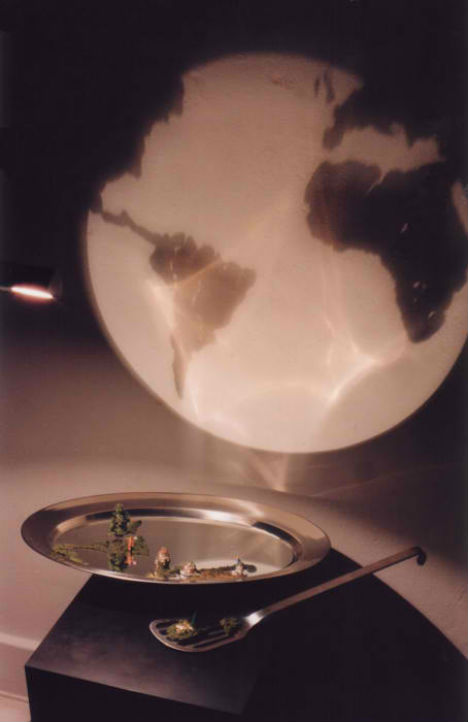
    These chaotic and random collections of objects placed on pedestals don’t seem gallery-worthy on first glance, but shine a light upon them in just the right way, and something magical occurs. These bits of broken glass, disassembled furniture and household objects created by Diet Wiegman transform into Michelangelo’s David, the Venus de Milo, hovering chairs or Michael Jackson.

    Wiegman Shadow Sculptures 2

    Wiegman Shadow Sculptures 3

    Wiegman Shadow Sculptures 4

    While Wiegman is not the only artist producing light and shadow art of this kind, he seems to have been the first; most of these works were created in the 1980s. In addition to these light and shadow sculptures, Wiegman is known for ceramics that mimic broken and rusted junkyard finds, from crumpled tin cans to pieces of old gears.

    Wiegman Shadow Sculptures 5

    Wiegman Shadow Sculptures 6

    Wiegman has a gift for seeing beauty in the most unexpected places, whether in these surprising sculptures or in his still-life photography of his own art juxtaposed with trash and a cast of a human head. See his entire portfolio at his Tumblr.

    Share on Facebook


    [ By Steph in Art & Sculpture & Craft. ]

    [ WebUrbanist | Archives | Galleries | Privacy | TOS ]


    WebUrbanist

  • Photographer clicks pictures from top of Egypt’s Great Pyramid of Giza

    original__1_.jpg

    Russian photographer Vitaly Raskalov, known on the web for his ‘skywalking’ exploits in which he scales man-made structures (without authorization) has added Egypt’s Great Pyramid of Giza to his list of conquests. And, as is his custom he has posted photos taken atop of one of the Seven Wonders of the World. Raskalov and his companions managed to hide from armed guards and climb the pyramid undetected under at night. Climbing the Great Pyramid is illegal of course but you can click through to see the images Raskalov captured. (via Daily Mail)

    News: Digital Photography Review (dpreview.com)

  • Lost camera reunited with owner after six years drifting in the ocean

    htcamera1.jpg

    A photographer has been reunited with her Canon PowerShot camera, six years after losing it in the ocean off Hawaii. The camera, which was in a waterproof housing, drifted for thousands of miles to the coast of Taiwan, where it was picked up by an employee of China Airlines. The airline identified its owner, Lindsay Scallan of Georgia, USA from photos on the memory card. Click through for pictures and more details (Hawaii News Now via Petapixel)

    News: Digital Photography Review (dpreview.com)

  • Just posted: Sony Alpha NEX-6 Review

    sony_nex6.png

    We’ve just posted our review of Sony’s NEX-6 mirrorless interchangeable lens camera. The NEX-6 brings a much-requested mode dial and ISO standard hot shoe to Sony’s mirrorless lineup, and also adds a Hybrid AF system, Wi-Fi, and downloadable ‘apps’. The NEX-6 also features a 16MP CMOS sensor, articulating LCD, XGA OLED electronic viewfinder, and fun point-and-shoot features like Sweep Panorama and various automatic modes. Click through to read our full review of what may be the most rounded NEX yet.

    News: Digital Photography Review (dpreview.com)

  • Photos of The Beatles taken by an amateur photographer fetch £30000

    Beatles1_BBC.png

    A rare set of photos taken by an amateur photographer of the Beatles’ 1965 concert at the Shea Stadium, New York have been sold at an auction for £30000 (~ $ 47000). Photographer Marc Weinstein used a fake press pass to get a spot next to the stage. According to Weinsten, the only other photographer present at the show ran out of film during the concert. Weinstein’s 61 pictures fetched £30,680, compared with a pre-sale estimate of £15,000-£20,000. Click through for some pictures and links to the full story on the BBC, and an Examiner.com interview from 2009.

    News: Digital Photography Review (dpreview.com)

  • Twin Tree-Covered Towers: The World’s First Vertical Forests

    [ By WebUrbanist in Architecture & Offices & Commercial. ]

    vertical towers construction progress

    Concept designs from far-fetched futurists have toyed with the idea for years, but one firm has finally made the vision a reality: towers extensively populated with intensive (meaning: large and heavy) plant life. In short: trees!

    vertical forest sky trees

    Situated in Milan, Italy, many skeptics were sure these two towers were just another pie-in-the-sky plan for an impossible building. After all, the load-bearing requirements alone for over 10,000 trees and 5,000 shrubs are extreme. Stefano Boeri Architetti (photos by Marco Garofalo) is showing them otherwise.

    vertical green skyscraper lighting

    The added weight is not wasted, nor ornamental – the vegetation layers will reduce the need for temperature regulation within the building. They will also filter the congested air of the city and serve to help reduce the temperature (always higher in urban areas).

    vertical forest tree diagrams

    vertical forest buildings

    The pre-grown plant life was carefully selected for the structure based on the regional climate, light and wind exposure, and is even now being hoisted into final positions. When complete, this will be, on some metrics, quite literally the greenest pair of buildings in the world.

    Share on Facebook


    [ By WebUrbanist in Architecture & Offices & Commercial. ]

    [ WebUrbanist | Archives | Galleries | Privacy | TOS ]


    WebUrbanist

  • Samsung announces price and availability of NX300 and 45mm F1.8 lens

    samsung_nx300.png

    Samsung has announced that its NX300 mirrorless camera will be available in both US and European markets by the end of this month as a kit with the 20-50mm lens for $ 749.99 and £599 respectively. The 3D-capable camera is built around a 20MP sensor, 3.3″ OLED screen and built-in Wi-Fi. The kit will also include a free copy of Adobe Photoshop Lightroom 4 editing software. The company has also announced that the 45mm F1.8 2D/3D lens will be available at the same time for $ 499.99. There is currently no information about its European price.

    News: Digital Photography Review (dpreview.com)

  • 26 March, 2013 – Why I Hate Electronic Finders

    It’s safe to say – if you can’t see it properly, you likely can’t shoot it properly. For me that applies to electronic finders, which though they have improved greatly over the past few years still are deficient in terms of having a wide enough contrast range.

    I share my thoughts on this in Why I Hate Electronic Finders.


    Don’t forget our "win-an-iPad 
    with all our software included" contest.

    Win a New 128GB iPad with Retina Display
    Including all Major Luminous Landscape Videos
    – Pre-Installed –

    Find Out More 


    The Luminous Landscape – What’s New

  • Der Frühling: Neues Leben überall

    Ein Beitrag von: Hermann Hirsch

    „Alles freuet sich und hoffet, wenn der Frühling sich erneut.“ – Friedrich Schiller

    Gezwitscher klingt von überall her, ein feiner Duft von frischem Gras und den ersten Blumen liegt in der Luft. Es ist Frühling! Nichts ist so erfrischend wie diese jahreszeitliche Erneuerung der Natur. Während die letzten Schneereste schmelzen und die Temperaturen tagsüber den einstelligen Bereich verlassen, sprießt überall neues Leben hervor.

    Auch für die Naturfotografen ist der Frühling eine wunderbare Zeit. Die Vögel singen und balzen um die Wette und während die Männchen um die Gunst der Weibchen buhlen, hat der Fotograf jedes Jahr aufs Neue die Möglichkeit und Chance, dieses Gebaren festzuhalten. Es ist ein faszinierendes Schauspiel, das sich jedes Jahr von Neuem abspielt.

    Frühling © Kevin Winterhoff & Hermann Hirsch

    © Kevin Winterhoff & Hermann Hirsch

    Bei den Vögeln ist das Frühjahr geprägt von der Rückkehr aus den Überwinterungsgebieten. Kaum im Brutgebiet angekommen, beginnt der Streit um die besten Reviere. Die Männchen singen sich die Seele aus dem Leib und versuchen, die weiblichen Vögel mit sogenannten Brautgeschenken zu beeindrucken.

    Es gibt aber auch Vögel, die nicht durch ihren Gesang auf sich aufmerksam machen, sondern andere Arten und Weisen finden, auf sich aufmerksam zu machen. Der Flussregenpfeifer ist ein Beispiel dafür: Das Männchen plustert sich auf, spreizt das Seitengefieder und lässt es seltsam hängen. Dies wird durch eigentümliche Bewegungen unterstützt.

    Flussregenpfeifer © Kevin Winterhoff & Hermann Hirsch

    Auch bei den Säugetieren beginnt im Frühjahr der Zyklus der Fortpflanzung von Neuem. Überall werden nun Tierkinder geboren, sei es bei den Wildschweinen, den Hirschen oder den Rehen.

    Letztere legen ihre Kitze im hohen Gras der Wiesen ab, wo sie in den ersten Wochen, ohne sich zu bewegen, vollkommen von der Mutter abhängig sind. Dieses Verharren führt teilweise zu schrecklichen Ereignissen.

    Kitz © Kevin Winterhoff & Hermann Hirsch

    Nämlich dann, wenn die großen Mähmaschinen durch die Wiesen fahren, um die erste Mahd einzufahren. Kitze fliehen nicht und wenn zuvor die Wiese nicht durchsucht wurde, zerstört das dumpfe Geräusch eines stockenden Mähwerks die Idylle der Natur.

    Von alledem bekommen die jungen Uhus im entfernten Steinbruch nichts mit. Sie sind bereits im April geschlüpft und verharren die erste Zeit in der Brutnische. Wenn es wärmer wird und sie bereits ausreichend groß sind, verlassen sie diese und sitzen zumeist gemeinsam an einer Stelle und üben das Flügelschlagen, während sie auf die nächste Fütterung durch die Mutter warten.

    Uhu-Jungvögel © Kevin Winterhoff & Hermann Hirsch

    Waldkauz Ästling © Kevin Winterhoff & Hermann Hirsch

    Nicht ganz so sicher sind die jungen Waldkäuze, die in der sogenannten Ästlingszeit das sichere Nest verlassen müssen, um fliegen zu lernen. In dieser Zeit können sie nur klettern und sind somit den Gefahren durch Füchse oder freilaufende Hunde schutzlos ausgesetzt.

    Für uns Naturfotografen ist das Frühjahr die wohl schönste Zeit im Jahr. Es gibt Motive im Überfluss und oft weiß man nicht einmal, wo man als erstes anfangen soll. Da hilft nur eines: Konzentration auf einige Themen und diese Projekte konsequent durchziehen.

    Frühling © Kevin Winterhoff & Hermann Hirsch

    Nur so können ausdrucksvolle Bilder entstehen, die das Leben der Tiere in vielfältiger Weise darstellen. Dieses Jahr haben wir uns den Dachs vorgenommen, bereits jetzt suchen wir wieder nach besetzten Bauen, denn schon bald beginnt die Zeit:

    Dann blüht das Schneeglöckchen wieder, es wird wärmer und Gezwitscher liegt in der Luft…


    kwerfeldein – Fotografie Magazin