RSS
 

Archive for March, 2013

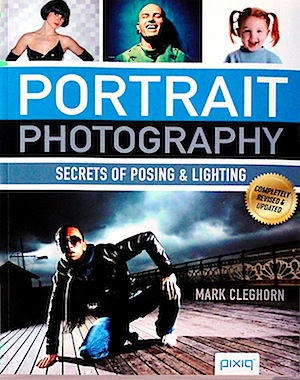
Portrait Photography: Secrets of Posing & Lighting [Book Review]

12 Mar

Portrait Photography.jpgPortrait photography, IMHO, is up there in degrees of difficulty with wildlife and sports/action photography … but at least, when faced with a tiger or a pole vaulter, you don’t have to face a possibly irate subject when you’ve finished the shot. Hopefully!
With portrait photography you not only have to face the sitter during and after the session but you also have to deal with that particular person if they’re also the client!

The book’s author Mark Cleghorn has been a pro photographer for over 30 years, specialising in ‘creative’ wedding and portrait photography. He is a member of a number of pro associations and has won a number of awards for his work as well as running many training workshops and seminars.

In Cleghorn’s view ‘Understanding the fundamentals of posing and lighting is crucial to successful portrait photography.’

You might also add the stricture — KISS! His own personal motto is ‘Natural light before reflector, reflector before flash, and flash as a last resort.’ He also suggests you should understand how to use and manipulate natural ambient light before you complicate things with technology …. Got me!

The chapter headings are informative:

  • So much equipment, so little money.
  • Poses and expressions.
  • Studio lighting made simple.
  • Creative lighting techniques.
  • On location.

First up, choosing a camera and lenses. The advice is that while a bulky, expensive medium format camera gives a better quality of image and delivers huge file sizes that are perfect for advertising, they are overkill for a simple portrait.

The DSLR is a preferable choice due to its comparatively reasonable cost, moderate size, along with access to a wide range of lenses and access to complete camera control.

This is followed by a rundown of the three types of flash available: accessory, shoe-mounted; power pack kits; monolights. Considerable detail is given on how to modify their flash output, the use of gels, metering, softboxes, reflectors, snoots and spotlights, diffusion, etc.

A key chapter covers posing and expression, which is where the human interface is at its most important and Cleghorn displays his extreme knowledge of the human figure and how to show it off at its best: ‘Every pose … starts with the feet, as it is the way in which the subject stands that determines whether or not he or she looks comfortable.’

His advice on how to photograph children is golden: keep things simple, allow the expressions to tell the story, work on the same level and, with very young children, encourage them to move around the studio, make it seem like a game.

And how to cope with problems like a subject’s bald head, spectacles, double chins, squinting and those who are obviously overweight, disabled subjects, those with ‘sleepy eyes’, big ears or noses and (with couples) differing heights. The advice is magic!

Moving on to lighting, there’s detailed discussion on how to place lights, control fill, hair and backlights and control their output. Low, mid and high key lighting is covered in considerable detail, with excellent examples shown.

Some off the wall techniques are demonstrated, like the projection of another image onto the subject, introducing a surreal effect. The use of a single light source and softlight are discussed as well as the role of the cross processing effect achievable in Photoshop.

Quite a few pages are given over to the searching for and use of suitable locations, natural exteriors and shooting in the home.

I often wonder, having read such a useful book, as to the sanity of such a high end and obviously successful photographer in this field in giving away such seriously useful hints, tips and advice.

This is the ‘go to’ book on the subject!

Author: M Cleghorn.
Publisher: pixiq.
Size: 28x22x1cm. 128 pages.
ISBN 978 1 4547 0243 6.
Price: get a price on Portrait Photography: Secrets of Posing & Lighting at Amazon (currently 36% off).

Post originally from: Digital Photography Tips.

Check out our more Photography Tips at Photography Tips for Beginners, Portrait Photography Tips and Wedding Photography Tips.

Portrait Photography: Secrets of Posing & Lighting [Book Review]


Digital Photography School

 
Comments Off on Portrait Photography: Secrets of Posing & Lighting [Book Review]

Posted in Photography


Why Making Mistakes is Good for your Photography

12 Mar

A Guest Contribution by Draycat

It is said the longest journey starts with a single step. The unfortunate part of life is that sometimes that step will cause you to fall, or you may even find you are walking in the wrong direction. But such things are normal and natural in life, and these are often the experiences that we learn the most from. A baby will fall down many times as he/she learns to walk. The falling down is part of the process of learning to walk, and without it the baby will never learn.

It is the same for photography, from the first day you pick up a camera you will make mistakes.

  • You may spend a day shooting only to realise that your camera was on the wrong setting and instead of shooting full size RAW you’ve been shooting the smallest size jpg
  • you may leave the house with all your equipment prepared only to take the first shot and realise that you forgot to put a memory card in the camera (and find the nearest place to buy one is miles away)
  • you may take lots and lots of pictures which look good in the camera’s LCD, only to find they are all soft when you see them on your computer screen – you didn’t realise at the time because you didn’t zoom in and check on the camera’s LCD.

These are just a few of the mistakes that I have made since I’ve been shooting, and after each one I generally felt foolish and sometimes demoralised. I felt like my photographic journey had taken me no where while everyone else flew past me with their great camera skills.

But if you speak to any of the great photographers in world, present or past, they will smile and tell you that they made exactly the same mistakes, and many more besides.

They will tell you that they often learned more from their mistakes than from their successes. Often when we make mistakes we are too hard on ourselves, and beat ourselves up about how stupid we were, or how foolish we feel. This photographer or that photographer would never do such a thing, but the fact is that we all do.

The truth is that it isn’t about the mistakes you make, but rather about how you deal with those mistakes.

If you look at them and work out how they happened, what you did wrong, or what you forgot to do then it becomes a learning experience – something that will ultimately help you to be a better photographer. In a shoot I once wanted a little motion blur in a dance section.

I shot at 1/15 of a second, and on my small LCD camera screen the images looked ok. When I got home and put them on my main monitor, they were all a little too blurred. The next time I shot in a similar situation I set my camera to 1/25 of a second and made sure I got what I wanted by zooming in on the LCD on the camera, and I got exactly what I wanted. It was a learning curve and now in that situation I know exactly what to do or rather what not to do.

On the other hand, if you make a mistake and beat yourself up about it constantly it becomes something negative. It will create fear and actually stop you from moving forward. When you encounter a similar situation instead of going in there with a good idea of what not to do, you will instead do everything possible to avoid the situation altogether. Can you imagine a baby thinking ‘this walking stuff is just too difficult and falling down is painful. Who needs walking anyway, crawling is perfectly good enough. I’ll just stick to this crawling stuff in future.’

Being a good photographer is as much about learning what not to do as it is learning what to do.

Without making mistakes we could never become well rounded photographers, so the next time you make one when you shoot and you feel frustrated, walk around for a while and think about learning to walk. Then, get up, work out what you did wrong and then go and try it again.

Draycat is British photographer, teacher and writer currently based in Tokyo, Japan. See more from him at his Website on Twitter on Facebook and on Youtube.

Post originally from: Digital Photography Tips.

Check out our more Photography Tips at Photography Tips for Beginners, Portrait Photography Tips and Wedding Photography Tips.

Why Making Mistakes is Good for your Photography


Digital Photography School

 
Comments Off on Why Making Mistakes is Good for your Photography

Posted in Photography


Fujifilm harnesses silver for new touch-screen technology

12 Mar

logo_2x.png

Fujifilm is looking to bring down the cost of touch-screen technology by harnessing materials and manufacturing expertise used in creating film emulsions. Touch-screens are quickly becoming the standard interface of nearly every piece of mobile technology. Currently these screens utilize the fairly rare metal, indium. Due to its rarity, indium is responsible for a significant portion in the cost of current touch-screen displays. Fujifilm hopes to use its long history with silver to bring down the cost of these displays and grab a piece of the ever expanding touch-screen market.(via Bloomberg)

News: Digital Photography Review (dpreview.com)

 
Comments Off on Fujifilm harnesses silver for new touch-screen technology

Posted in Uncategorized


Dblcam app captures both sides of the story

12 Mar

Screen_Shot_2013-03-11_at_9.17.09_AM.png

Dblcam is a new free iOS app that simultaneously captures images with the front- and rear cameras of your iPhone. The app by developers Social Print Studio then combines the two pictures to a collage. Self portrait/scenery combinations are the most obvious results to come out of this process but some users are using Dblcam in a more creative way. Read more about the app and check out some sample images at connect.dpreview.com

News: Digital Photography Review (dpreview.com)

 
Comments Off on Dblcam app captures both sides of the story

Posted in Uncategorized


FujiFilm harnesses sliver for new touch screen technology

12 Mar

logo_2x.png

Fujifilm is looking to bring down the cost of touch screen technology by harnessing materials and manufacturing expertise used in creating film emulsions. Touch screens are quickly becoming the standard interface of nearly every piece of mobile technology. Currently these screens utilize the fairly rare metal, indium. Due to its rarity, indium is responsible for a significant portion in the cost of current touch screen displays. Fujifilm hopes to use its long history with silver to bring down the cost of these displays and grab a piece of the ever expanding touch screen market.(via Bloomberg)

News: Digital Photography Review (dpreview.com)

 
Comments Off on FujiFilm harnesses sliver for new touch screen technology

Posted in Uncategorized


Pentax US offers mail-in rebates on 645D medium-format DSLR and lenses

12 Mar

pentax.png

Pentax US has announced mail-in rebates on its 645D medium-format DSLR and select Limited series lenses when purchased with the K-5 IIs DSLR. Buyers of the 645D body will receive a free D-FA 55mm lens and $ 500 rebate on the purchase of the D-FA 25mm and HD 90mm lens. Additionally, consumers who purchase the K-5IIs camera body will receive a $ 250 rebate on the purchase of FA 31mm, 43mm and 77mm Limited series lenses. The rebates can be claimed from March 11th through March 31st 2013 and will be paid in the form of a Visa gift card.

News: Digital Photography Review (dpreview.com)

 
Comments Off on Pentax US offers mail-in rebates on 645D medium-format DSLR and lenses

Posted in Uncategorized


Tips for Objective Evaluation of Composition

12 Mar

Composition is one skill within photography that we can probably never master, but just continually develop.  The composition we choose when taking a photograph, i.e. where we choose to place the boundaries of the frame, the perspective we choose to employ from the chosen focal length, how we choose to arrange objects within a scene etc, all influence the way a viewer interacts with the image, and so are all crucial to the success of any given image.

When a composition of an image is broken down to the most basic level, it can almost always be considered as the balance and interaction between different shapes, patterns and light within the scene.  It is very easy to critically assess the photographs of others in this way within a couple of seconds of laying eyes on them, however, how often do we apply that objective critique to our own images?

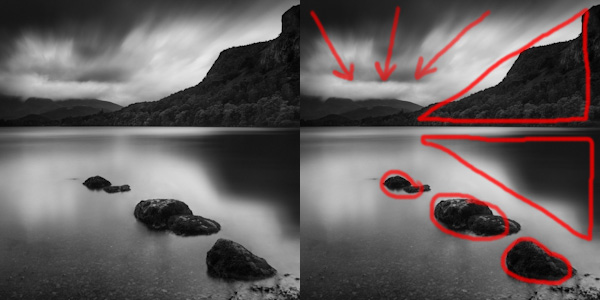
Here I've outlined the major components that contribute to the composition of this image, namely the three stones leading in from the foregound, the two blocks of dark tone acting as triangles drawing in from the right, and the movement in the clouds leading the eye in from the top of the image

Here I’ve outlined the major components that contribute to the composition of this image, namely: the three groups of stones leading in from the foregound, the two blocks of dark tone acting as triangles drawing in from the right, and the movement in the clouds leading the eye in from the top of the image.

Personally, there are times when I find it very difficult to ‘see’ my own images in this way as I can have a strong emotional attachment to the image that can cloud my judgement.  What do I mean by emotional attachment?  One of the big draws of photography for me is to be outside, amongst nature, seeing scenes unfold in front of me that no-one else is witnessing at that point in time.  Therefore, after photographing an awe-inspiring sunrise across a landscape, it can be difficult for me to separate the resulting image from the experience of being there whilst taking the image – I can end up seeing my images through ‘rose tinted’ glasses and not judging them with the objectivity that others will.

One effective way to overcome this is to not process images immediately, but to leave them for a few days or weeks until the memory of that moment of taking the photographs isn’t quite so fresh in your mind.  That way, you will see the image with fresh eyes, as others will.

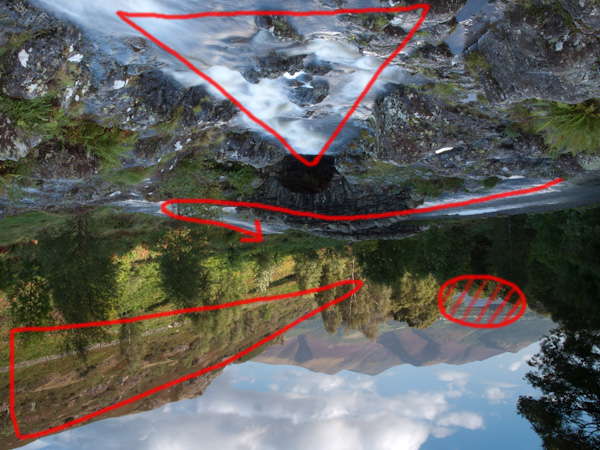
Another method I find very useful is to rotate the image by 180°, i.e. turn it upside down, during post processing.  When you do that, the image in front of you no longer resembles the landscape that you captured, but instead resembles the series of shapes and patterns the make up the composition of the landscape.  When the image is upside down, it becomes very easy to be objective about how well balanced elements within the landscape are and to see the distribution of positive/negative space; therefore it becomes easier to decide where to crop an image or to see where you may need to dodge/burn to help direct the eye to the points of interest.

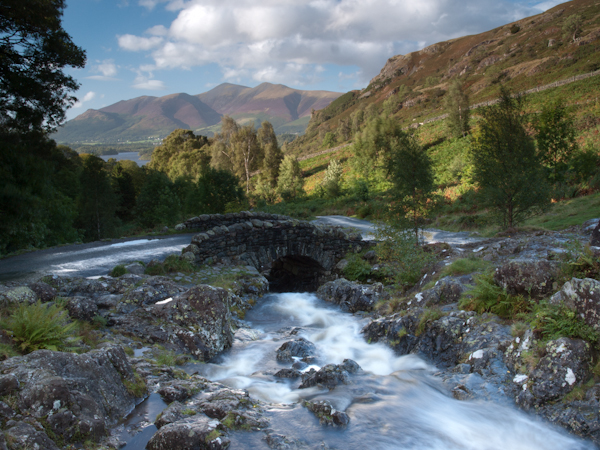
An image from the Lake District, UK, straight out of the camera.  It is a very busy landscape, with a lot going on

An image from the Lake District, UK, straight out of the camera. It is a very busy landscape, with a lot going on, so I needed to whether the composition works as is, or if any additional processing could help lead the eye of the viewer.

By turning the image upside down, it is easier to distill the key components of the composition, namely: the cascade of water running towards the bridge, the road over the bridge to lead the eye further into the scene, and the hatched circle of interest in the background, being pointed towards by the triangle of well lit trees

By turning the image upside down, it is easier to distill the key components of the composition, namely: the cascade of water running towards the bridge, the road over the bridge to lead the eye further into the scene, and the hatched circle of interest in the background, being pointed towards by the triangle of well lit hill side.

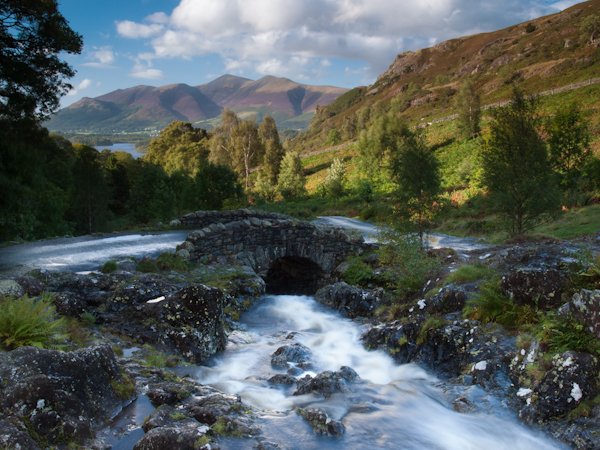
The final image, with processing influenced by the upside-down evaluaiton

The final image, with processing influenced by the upside down evaluation.

So, if you haven’t tried this before, give it a try the next time you’re processing images and I think you’ll be surprised how useful it can be, and not just with landscapes either.  Do you have any other tips for ensuring you are evaluating the composition of your images objectively?  If so, please share them in the comments.

Post originally from: Digital Photography Tips.

Check out our more Photography Tips at Photography Tips for Beginners, Portrait Photography Tips and Wedding Photography Tips.

Tips for Objective Evaluation of Composition


Digital Photography School

 
Comments Off on Tips for Objective Evaluation of Composition

Posted in Photography


Lowepro introduces Flipside Sport 20L AW weather-resistant backpack

11 Mar

logo_lowepro.jpg

Lowepro has announced the Flipside Sport 20L AW weather-resistant backpack for adventure-oriented photographers. The Flipside 20L can hold two pro-level DSLRs, two lenses, a tripod/monopod and a flashgun. Made of lightweight materials and breathable padding, the bag features expandable pockets for treckking poles and 1.5L bottles. The Flipside is also available in two smaller sizes with Orange/Light Grey and Galaxy Blue/Light Grey color options.

News: Digital Photography Review (dpreview.com)

 
Comments Off on Lowepro introduces Flipside Sport 20L AW weather-resistant backpack

Posted in Uncategorized


Architecturally Literate: 13 Built Alphabets Spell Design

11 Mar

[ By Steph in Design & Furniture & Decor. ]

Built Alphabets main

For those in love with letters, typography is – or should be – virtually everywhere, from furniture to office buildings. These 13 designs indulge typophiles with three-dimensional typefaces in functional objects including hand fails, bookcases, chairs, pavilions and fun concept architecture.

Alphabet Building, Amsterdam by MVRDV

Built Alphabets Amsterdam MVRDV

Architecture firm MVRDV has given their Alphabet Building a facade of 24 unusually-shaped windows that spell out most of the alphabet (curiously, I and Z are missing.) The building provides office space for small to mid-size creative agencies in Amsterdam, with a series of spacious loft-like units.

Negative Space Alphabet

Built Alphabets Buildings Photography

Berlin-based photographer and illustrator Lisa Reinermann captured the entire alphabet in the negative space between buildings in Barcelona. “I loved the idea of the sky as words, the negative being the positive. If I could find a ‘Q’, other letters should be somewhere around the corner.”

3D Font by Bank Associates

Built Alphabets 3D font

A single neon tube can be manipulated in three dimensions to look like any letter of the alphabet in this project by Adam Slowik of Bank Associates. Just turning it in various directions to face the camera produces the effect.

Bauhaus Concept by Chris Labrooy

Built Alphabets Bauhaus

A typeface and its architectural namesake are united in this Bauhaus concept, a digital illustration by designer Chris Labrooy.

Jumble of Letters Shelf by Pieter de Leeuw

Built Alphabets Jumble

Haphazardly jumbled together, the letters of the alphabet form a creative shelf unit that can hold books and other objects in its random niches.

Handrails, Shelves & Tables by Andrew Byrom

Built Alphabets Byrom 1

Built Alphabets Byrom 2

Typography enthusiast Andrew Byrom creates his own three-dimensional typefaces with physical objects, including shelves, chairs, tables and metal hand rails.

Alphabet City by Scott Teplin

Built Alphabets Teplin

Letters make for interesting building shapes in designer Scott Teplin’s ‘Alphabet City’ series of illustrations. Each letter provides a residential, commercial or industrial function, and the shapes work better than you might imagine – even W and Q. See them all at X-ing Books.

Share on Facebook


[ By Steph in Design & Furniture & Decor. ]

[ WebUrbanist | Archives | Galleries | Privacy | TOS ]


WebUrbanist

 
Comments Off on Architecturally Literate: 13 Built Alphabets Spell Design

Posted in Creativity


Turn Your iPhone Into An Action Cam With The Optrix iPhone Adventure Suit

11 Mar

Extra photos for bloggers: 1, 2, 3

Your iPhone can be a bit of a scaredy-cat. It just can’t seem to get up the courage to join you on your kayaking expeditions! Until now…

The Optrix iPhone Adventure Suit will give your iPhone 5 the boldness it needs to transform into a go-anywhere action cam.

In this suit your iPhone will be able to withstand a 15 foot drop and snap photos safely, 15 feet underwater. It even has a built-in wide-angle lens, so your now-courageous cam can capture more of the action than ever before.

Combine it with the Super Sucker to give it an extra boost of bravery. This mount uses industrial strength suction to hold onto a car, kayak, surfboard, just about anything!

“Ha ha ha!” What’s that? Oh, just your phone laughing at danger.

The Optrix iPhone Adventure Suit
$ 130 at the Photojojo Store

 Tweet it!      Share

Related posts:

  1. The iPhone Scuba Suit Takes Your Phoneography To New Depths Warm summer months are upon us, which means you’ll adopt…
  2. The Polaroid iPhone Decal: Turn Your Phone into a OneStep! Your iPhone4 is the Swiss army knife of the mobile…
  3. The iPhone Rangefinder Adds a Shutter, Viewfinder, and Tripod Mount to Your iPhone Fifty years ago, photogs were all about the rangefinders. They’re…


Photojojo

 
Comments Off on Turn Your iPhone Into An Action Cam With The Optrix iPhone Adventure Suit

Posted in Equipment