RSS
 

Archive for February, 2013

CUTE: Weekly Photography Challenge

09 Feb

Olive the mini dachshundThis week your photographic challenge is to take and share a photo on the theme of ‘Cute’.

We’re expecting to see cuddly kittens, big eyed puppies, gorgeous babies shots of toddlers doing… cute… things – and other such cuteness!

Once you’ve taken and selected your best Cute shot upload it to your favourite photo sharing site and either share a link to it or – embed it in the comments using the our new tool to do so.

If you tag your photos on Flickr, Instagram, Twitter or other sites with Tagging tag them as #DPSCUTE to help others find them. Linking back to this page might also help others know what you’re doing so that they can share in the fun.

Also – don’t forget to check out some of the great shots posted in our last challenge – Bokeh challenge where there were some beautiful shots submitted.

Post originally from: Digital Photography Tips.

Check out our more Photography Tips at Photography Tips for Beginners, Portrait Photography Tips and Wedding Photography Tips.

CUTE: Weekly Photography Challenge


Digital Photography School

 
Comments Off on CUTE: Weekly Photography Challenge

Posted in Photography


Beautiful London Ep1 – Nikon D7000 – JJF Studio

09 Feb

A walk from vauxhall to Waterloo. ?????????????????????????????? Beautiful London Ep1 – Nikon D7000 – JJF Studio Nikon D7000 HD Test Lens: Nikon 28mm f3.5 DIY AIS Edited by Final Cut Pro X Music: Garageband
Video Rating: 5 / 5

To order, go to — fotosharp.com
Video Rating: 5 / 5


Steve McCurry’s ‘Last Roll of Kodachrome’ photos are now live on his blog

09 Feb

sharbat_gula_on_national_geographic_cover.jpeg

Award-winning photographer Steve McCurry has published the photos taken with the last roll of Kodakchrome to come off the production line on his WordPress blog. McCurry has shot more than 800,000 photos including his iconic ‘Afghan Girl’ portrait, with the film. In a National Geographic article in 2009 McCurry equated ‘losing the medium to losing a dear friend.’ Click through for the link the gallery.

News: Digital Photography Review (dpreview.com)

 
Comments Off on Steve McCurry’s ‘Last Roll of Kodachrome’ photos are now live on his blog

Posted in Uncategorized


8. Februar 2013

09 Feb

Ein Beitrag von: Stefan Zwahlen

stefan-zwahlen


kwerfeldein – Fotografie Magazin

 
Comments Off on 8. Februar 2013

Posted in Equipment


HDSLR 101 #1: Intro to shooting video on a HDSLR

09 Feb

Download the entire HDSLR 101 series plus a BONUS EPISODE on our store site: store.nextwavedv.com Find more training resources on our website: nextwavedv.com Join our Facebook community facebook.nextwavedv.com Follow us on Twitter twitter.com In Episode 1 of HDSLR 101, we discuss how DSLRs first got video, sensor sizes and how they affect the look of video, and the pros and cons of shooting video on HDSLRs.
Video Rating: 4 / 5


Nikon D5200 added to our studio comparison database

09 Feb

nikon_d5200.png

We’ve added the Nikon D5200 to our database of studio comparison images. We’re in the process of running a production D5200 through our studio tests, so wanted to present the results of our standard test scene. These test shots are also available from other reviews and the standalone tool, which can be accessed via the ‘Review Comparison Tool’ link in the Reviews menu on any page of the site. We’ll be adding a complete set of studio and real-world sample images to our previously-published preview in the coming days, but in the meantime, click through to see how the D5200 stacks up to the competition in terms of JPEG and RAW image quality. 

News: Digital Photography Review (dpreview.com)

 
Comments Off on Nikon D5200 added to our studio comparison database

Posted in Uncategorized


8 February, 2013 – Spaces Open on Kimberley Workshop with Michael Reichmann and Art Wolfe

09 Feb

The Kimberly PODAS Workshop June 1 – 8, 2013 has just had a couple of cancellations and now has a Double Cabin (2 people or a couple) and 2 single share berths available.  

This is one of the premier workshops for 2013 traveling to an incredible location with the finest instructors in the business.  Join Michael Reichmann, Art Wolfe, Christian Fletcher and Kevin Raber and shoot with a Phase One medium format digital system in one of the most remote locations on the planet.  If you interested please contact Kevin Raber at kwr@phaseone.com.

On a personal note, this will be the only workshop that I will be teaching during 2013. Don’t miss it.

Win a New 128GB iPad with Retina Display
Including all Major Luminous Landscape Videos
– Pre-Installed –

Find Out More  


The Luminous Landscape – What’s New

 
Comments Off on 8 February, 2013 – Spaces Open on Kimberley Workshop with Michael Reichmann and Art Wolfe

Posted in News


Deciphering Photo Jargon – Learn to Speak “Photographer”

08 Feb

If you’ve ever been a little lost while reading your camera’s manual, or a photography magazine it could be that you just need to learn to speak “photographer” language. In this article I’ll go over some of the most common technical terms, as well as some less common slang or photographer jargon. By the end I promise you will have a better grasp on the language and be able to have a conversation with a seasoned pro and hold your own!

Speaking “Photographer” – the Basics

These are the terms you’ll find in your camera’s manual and in most beginner tutorials on how to use it. Hopefully this will help you get a better grasp on them so the manual isn’t quite so foreign.

  • Photography – the word photography comes from two old Greek words “phos” meaning light and “graph” meaning to draw.  So photograph literally means to draw with light, or a drawing made with light.  So photography is the art of drawing with light.
  • Aperture – the variable opening in the lens through which light passes to the film or digital sensor.  Measured in  f-stops. I like to compare it to your pupil which opens and closes to allow more or less light to enter your eye depending on the brightness level of the room.
  • Bracketing – taking a series of images at different exposures or EV. You may see a setting on your camera that says AEB (auto exposure bracketing). This is often used when creating HDR images or in difficult lighting situations where you may want to have a range of exposures from light to dark.
  • Bulb – the “B” setting on your camera where the shutter remains opened as long as the button or cable release (remote trigger) is pressed. On a Canon it may be on your mode dial on top of the camera, or at the low end of the shutter speed settings (also where it is on a Nikon)
  • DSLR – digital single lens reflex camera. Any digital camera with interchangeable lenses where the image is viewed using a mirror and prism, and the image is taken directly through that lens. What you see in your viewfinder is what the lens sees.
  • EV – Exposure Value is a number that represents the various different combinations of aperture and shutter speed that can create the same exposure effect.
  • Exposure compensation – modifying the shutter speed or aperture from the camera’s recommended exposure to create a certain effect (over or under exposing) – usually used in the Shutter Priority or Aperture Priority modes. Represented by a little +/- button on your camera. Your camera reads light bouncing off your subject and is designed to expose for medium grey. So when photographing a subject that is lighter or darker than 18% grey, you can use this setting to tell the camera the proper exposure (- or + respectfully)
  • Exposure – the total amount of light reaching the digital sensor. It is controlled by setting the aperture, shutter speed and ISO.
  • F-stop – is a measure of the aperture opening in the lens defined by dividing the focal length of the lens by the aperture diameter. Sequence of f-stops are multiples of the square root of 2 (1.414…): 1, 1.4, 2, 2.8, 4, 5.6, 8, 11, 16, 22, etc. Even though these numbers are rather cryptic, just remember that each step is double the amount of light. Know that and it’s half the battle.
  • ISO – stands for International Standards Organization and represents the sensitivity of your camera’s digital sensor to light. The lower the number (ISO 100), the less sensitive, the higher the number (ISO 3200) the more sensitive. A higher ISO allows you to shoot in low light conditions.
  • Shutter speed – the amount of time the shutter is opened during an exposure. The shutter speed controls motion. Use a fast speed (like 1/2000th of a second) to freeze motion, or a slow one (1/4 of a second or longer) to blur moving objects.
  • Zoom lens – any lens that has variable focal lengths such as a 24-70mm or 18-55mm. You zoom in or out by rotating the barrel of the lens.
  • Prime or fixed lens – any lens that does not zoom and is a set focal length such as a 50mm lens.
  • Remote trigger or digital cable release – a device that allows the camera to be fired without pressing the button or touching the camera. Helps eliminate movement of the camera during long exposures.
  • Macro lens – one that focuses very close to the subject allowing for 1:1 reproduction size of the object or larger.
  • “Normal” lens – generally a 50mm lens (on a full frame sensor camera) is considered to be a “normal” lens because it is closest to what the human eye sees.  If you have a cropped sensor that will be closer to 35mm.
  • Telephoto lens – simply stated a telephoto lens is one that is longer than a normal lens, eg., 70-300mm. The dictionary says: a lens with a longer focal length than standard, giving a narrow field of view and a magnified image.  Super telephoto is usually 300mm and longer lenses.
  • Wide angle lens – again simple answer is a lens that shows a wider field of view than a normal lens, which allows more to be fit into the frame. Depending on the degree of wide angle there may also be edge distortion (super wide angle), and if you get wide enough the image will become a circle (fish-eye).
  • Tilt shift lens – a lens that attempts to recreate the movements available when using a view camera. Being able to tilt the front lens element allows for realignment of the plane of focus. Shift allows adjusting the placement of the subject within the frame without angling the camera, thus keep parallel lines from converging. This is a popular lens for architectural and landscape photographers, and is becoming more widely used by portrait photographers for creating a unique stylized look.
  • Camera resolution – expressed in megapixels is the dimensions your camera’s sensor is capable of capturing. For example Canon’s new 6D has a resolution of 5472 x 3648 which equals 19,961,856, which they’ve rounded off to 20 megapixels. This is not the only factor in image quality, but generally the large the number, the larger prints you can produce from it without loss of quality.
  • File format jpg versus RAW – most DSLR’s have the ability to shoot both formats. If you choose JPG, the camera will shoot a RAW file, process it using the picture style you’ve selected in your menu, save it as a JPG and discard the RAW version. If shot in RAW the resulting file will be larger, carry more information (but the same pixel resolution, see above) and require software to process. It gives you the photographer more control over the final look of your image. For more on the subject see this article
  • Full frame vs cropped sensor – I get asked about this in my classes all the time. A full frame sensor is roughly the size as the “old” 35mm frame of film. Lenses are made to create a circle of light just large enough to cover that area (covering power). In a cropped sensor camera the physical size of the sensor is smaller so it only captures a portion of the entire image the lens is projecting, effectively cropping part of the image out. For more information on this see “Crop factor explained“. Common crop factors are 1.5 or 1.6x so if you put on a 50mm lens it is more like a 75mm with a 1.5x crop factor.
  • Camera modes – manual: full manual the user is setting the ISO, shutter speed and aperture. Shutter priority (Tv on a Canon or S on a Nikon) the user is selecting ISO and shutter speed, the camera is then choosing the aperture to make a correct exposure. Aperture priority (Av for Canon users, A for Nikon) the photographer selects the ISO and aperture and the camera picks the shutter speed.

Lighting and Portrait Photography Terms

  • Ambient light – also referred to as available light, is the light that is occurring in the scene without adding any flash or light modifiers. This could be daylight, or man made light such as tungsten or fluorescent bulbs.
  • Main light or key light: is the main light source for a photograph. It could be the sun, a studio strobe, a flash, a reflector or something else. But it is the source of light that is producing the pattern of light on the subject with the most intensity.
  • Fill light: is the light source that is secondary to the mail light. It is used to “fill” in the shadows to a desired degree. It can be produced by using a flash, a reflector, or a studio strobe.
  • Lighting pattern: this is the way the light falls on the subjects face. A particular pattern of light and shadow that is created.
  • Lighting ratio:  is a comparison between the intensity (brightness) of the main light and the fill light and thus the difference of the lit and shadow sides of the subject’s face.
  • Incident light meter: is a handheld device separate from your camera that measures the amount of light falling on a subject (as opposed to the reflective reading your camera takes which is light bouncing off the subject back to the camera). The incident meter is not fooled by the brightness range of the subject, where as in camera reflective meters can be fooled.
  • Speedlight (speedlite for Canon users): small portable flash which can attach to your camera’s hot shoe, or stand alone if activated remotely.
  • Reflector – a device that is used to reflect light, generally back towards the subject. It can be a specialized factory made reflector (I recommend getting a 5-in-1 if you get one) or as simple as a piece of white cardboard.
  • Light meter – a device that measures the amount of light in a scene. Your DSLR has one built in, it uses reflective readings (light bouncing off the subject coming back through the lens [TTL])
  • Remote flash trigger – a device used to fire speedlights off camera. Pocket Wizard is a popular brand.
  • Subtractive lighting – as the name implies it is the taking away of light to create a desired affect. Commonly it involves holding a reflector or opaque panel over the subject’s head to block light from above and open up deep eye shadows cause by overhead lighting. It can also mean holding a black reflector opposite your main light to create a deeper shadow, in essence reflecting black onto the subject instead of light.
  • Hard light – harsh or undiffused light such as produced by bright sunlight, a small speedlight, or an on-camera flash. It produces harsh shadows with well defined edges (edge transfer), contrast, and texture (if used at an angle to the subject). Emphasizes texture, lines and wrinkles, and used to create a more dramatic type of portrait (character study).
  • Soft light – diffused light such as from an overcast sky, north facing window with no direct light, or a large studio softbox. This type of light produces soft shadows with soft edges, lower contrast, and less texture. Generally preferred by most wedding and portrait photographers as it flatter the subject more.
  • Edge transfer – where the light turns into the shadow, the edge transfer is how quickly it goes from dark to light. If using harsh light the edge transfer is very defined and sudden, almost a clear line. When using soft lighting the edge transfer will be much more subtle, almost imperceptible as it gradually changes from light to dark.
  • Flash sync – simply put is the synchronization of the firing of an electronic flash and the shutter speed. You need to know what shutter speed your camera syncs at, otherwise if you shoot too fast a shutter speed you may get a partially illuminated image. For most cameras that is around 1/200th of a second, but it can be adjusted if you have a flash that can be set for fast speeds.

Slang and Photography Jargon

Here’s a few other terms that are a bit more advanced, and even completely made up jargon. Become familiar with them so you can walk among the pros with confidence!

  • Fast glass – refers to a lens with a very large maximum aperture such as f1.8 or f1.2. “Fast” as in, it allows you to shoot at a fast shutter speed due to the large aperture.
  • Chimping – slang term meaning looking at the back of the camera after every image. Spending too much time reviewing images on camera, not enough time shooting.
  • Bokeh – often mispronounced “bow-kay” or “bow-kuh” it is correctly pronounced as “bo-ke” like the ke in kettle. It is used to described the out of focus blurred bits in the background when “fast glass” is used. Most often bokeh occurs where small light sources are in the background, far in the distance.
  • Depth of Field (DOF or DoF)- the distance between the nearest and farthest objects in your scene that appear in focus.  It is controlled by many factors including the aperture, lens focal length, distance to subject, film or digital sensor size, and camera format. Read about how to use aperture to adjust depth of field.
  • Circles of confusion – closely related to the above bokeh, the textbook definition is:  the largest blur spot that is indistinguishable from the point source that is being rendered. Objects outside the depth of field of an image that the human eye can determine as “out of focus”.
  • Hyperfocal distance – often used by landscape photographers, it is the focus distance providing the the maximum amount of depth of field. Older prime lenses for film cameras usually had hyperfocal distance marks to aid in finding this magic sweet spot. With today’s lenses it is possible to calculate, just takes a bit more work and a hyperfocal distance calculator.
  • Gobo – something used to block unwanted or stray light from falling onto the subject. Often a reflector (using the black side) can serve a dual purpose and act as a gobo as well.
  • Scrim – a translucent device used to diffuse and soften the light, could be a reflector with a translucent panel or option. Also used on movie sets scrims can be made extremely large, several feet across, and clamped in place to create shade where these is direct sun without it.
  • Shutter lag – every camera has a slight delay from the time you press the shutter button to the time it actually fires and opens. In DSLR’s it is minimal and almost unnoticeable. In smaller point and shoot cameras the delay is more pronounced such that it may actually cause a missed shot of a fast moving subject.
  • Chromatic aberration – in terms of lens optics it is the failure of the lens to focus all colours (RGB) at the same point. It shows up as colour fringes in areas of the image where dark meet light (think edge of a building against the sky). It is more common in wide angle lenses, and those of inferior optics (kit lenses). It is correctable, to some degree, using Photoshop, Lightroom or software of your choice.
  • Rear shutter curtain sync – by default most cameras are set to front curtain sync which means that if the flash fires, it does so at the beginning of the exposure time. By setting to rear shutter curtain sync it fires the flash at the end of the exposure time. The difference in some cases me be negligible, but in shooting a moving subject front sync will put any motion blur in front of the subject, where as rear sync will place the blur behind the subject. Neither is wrong, just preference.
  • Camera shake – this is a blurry image which has resulted from an insufficiently fast enough shutter speed, while hand holding the camera. So how slow is too slow? Many teachers will say that 1/60th of a second is the rule of thumb. I tend to recommend 1 over the focal lens of your lens instead, as the longer the lens the more amplified any shake will become.
  • Lens flare – occurs when the light source hits the lens directly, it can manifest as a hazy looking image or artifacts such as circles of light. Some photographers actually desire lens flare and position their camera to create it and use it as a compositional element.
  • Kelvin – is the absolute measurement of colour temperature. On your camera under the White Balance settings you make see a “K” setting. This allows you to adjust the colour manually by degrees kelvin. The lower numbers represent warmer colours like orange (tungsten light) and the higher numbers are cooler (blues). Play with this scale to create different affects.
  • ND filter – stands for neutral density filter which is a filter designed to go in front of the lens to block out some of the light entering the camera. Often used by landscape photographers to be able to get slow shutter speeds when photographing waterfalls and streams in full daylight.
  • Panning – the act of using a slow shutter speed, and moving the camera in the same direction as a moving subject, during the exposure to create a blurred background. See panning tips here.
  • Stopping down – the act of closing down the aperture to a smaller opening.  EI going from f5.6 to f8.
  • TTL and ETTL – stands for Through The Lens, refers to the metering system in regards to flash exposure. The flash emits light until it is turned off by the camera sensor. ETTL is evaluative through the lens metering and fires a “preflash” to evaluate and calculate for lost light then compensates and fires the main flash. It happens so fast you do not see two flashes.
  • Photog – short for photographers, something pros often call each other
  • Glass – lens, as is “what glass do you own?”
  • Golden hour – also called “magic hour” is the hour right before sunset or right after sunrise. The sun is low on the horizon and it is an optimal time for photography.
  • Spray and pray – shoot as many images as possible and that hope and pray you got something good. Not a philosophy I personally recommend.
  • Blown out – having highlights that are off the chart on the right side of the histogram, having no detail in the white areas.  Eg: “the bride’s dress is blown out”
  • Clipped – similar to blown out being off the histogram, but it can also apply to shadow or blacks areas of the image.
  • Grip and grin – often used to describe a quick photoshoot at an event or set up with two people shaking hands. Most photographers have had to shoot these during their career.
  • Selfie – a self portrait
  • SOOC  – straight out of camera, no post processing or editing done
  • Dust bunnies – dark spots that appear on the image, caused by bits of dust on the digital sensor
  • Pixel peeper – someone that spends too much time looking at images at 100% size in Photoshop
  • Nifty 50 – an old school prime 50mm lens, great to have
  • ACR – Adobe Camera Raw
  • Flash and drag – the method of using a slow shutter speed combined to flash to capture more of the ambient light in proportion to the flash
  • Wide open – using your lens with the aperture at the widest setting (f1.8 for example)

Enjoy and get out there and start practicing your Photographer Speak. This list is not exhaustive by any means, and if there’s any I missed please mention them in the comments section below.


Post originally from: Digital Photography Tips.

Check out our more Photography Tips at Photography Tips for Beginners, Portrait Photography Tips and Wedding Photography Tips.

Deciphering Photo Jargon – Learn to Speak “Photographer”


Digital Photography School

 
Comments Off on Deciphering Photo Jargon – Learn to Speak “Photographer”

Posted in Photography


Church Bells To Doorbells: 8 Churches Turned Into Homes

08 Feb

[ By Marc in Architecture & Houses & Residential. ]
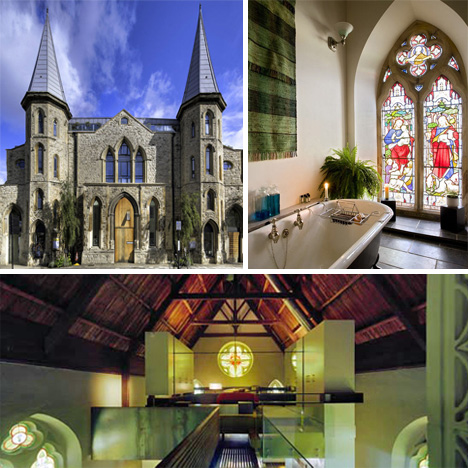
Church-House-Renovations-Montage

Churches are some of society’s most stylistically beautiful buildings. A large amount of building design comes down to functionality and affordability, so churches, built for a spiritual purpose rather than a materialistic one, tend to include elements that highlight beauty and detail. When these churches grow old, or are purchased, they can then be renovated into amazing houses that uniquely introduce religious elements into a pedestrian environment.

The Church of Living

Church-House-Zecc-Netherlands

The Church of Living is a transformed structure, from church to residence, carefully designed by Zecc architecture in the Netherlands. This firm is no stranger to church conversions, and their design chops are shown to full affect in this example from Utrecht. White walls and modern appliances and motifs maintained the atmosphere of the church, while making it a home worth living in. The small old church touches that remain are what keep this building anchored. For example, the chandelier in the ultra modern bathroom is the perfect example of an old touch balancing out a very modern renovation.

WG Architects, Brisbane

Church-House-Bonney-Ave-Willis-Greenhalgh-Architects

Willis Greenhalgh Architects, known better as WG Architects, transformed this Brisbane church into a gorgeous home full of light. Built in 1867, this is a heritage site, and thus required a very delicate renovation. The unique elements of an old style church were maintained, while contemporary elements were introduced to bring the church house “up to speed.”

Westbourne Grove Church

Church-House-Dos-Architects-Westbourne-Grove

This imposing building, Westbourne Grove Church, was transformed into a modern home with a 2 floor renovation by London-based DOS Architects; the steps taken to complete the process are presented visually on their site here. Design site Abduzeedo provides additional background information about the history of the church, which despite seeming ancient, was built with a Victorian style in 1953. The design team decided to go highly modern in the interior, which contrasts nicely with the old-style stone outside.

Glenlyon Church

Church-House-Glenlyon-Multiplicity

Multiplicity is the two person team of designer Sioux Clark and architect Tim O’Sullivan. Bedecked with awards (for good reason) they hold tightly to their commitment of “creating spaces that are intrinsically beautiful, highly useable, readily enjoyable and environmentally friendly.” Their 2004 conversion of the Glenlyon church into a livable residence pulls out all of the design stops, as it required that they literally create a 2nd story out of thin air. Utilizing glass and the many gorgeous windows, they were able to highly increase the usable space, while keeping the structure in the middle from making it seem too crowded.

Next Page:
Church Bells To Doorbells 8 Churches Turned Into Homes

Share on Facebook


[ By Marc in Architecture & Houses & Residential. ]

[ WebUrbanist | Archives | Galleries | Privacy | TOS ]


WebUrbanist

 
Comments Off on Church Bells To Doorbells: 8 Churches Turned Into Homes

Posted in Creativity


How to shoot HDR timelapse

08 Feb

Here’s a tutorial on shooting HDR timelapse with the Dynamic Perception Stage Zero system. I go into detail on some advanced features of the MX2 controller as well (ramping) – Finally can post it here on youtube after they lifted the video length limitation.
Video Rating: 4 / 5

This week Mark Wallace talks about high key and low key lighting. In it’s simplest terms a high key image is a bright image full of light and mostly white tones whilst a low key image is a dark with minimal lighting and rich in black tones and lots of shadow areas. Let’s explore these two dramatic lighting alternatives.
Video Rating: 4 / 5