RSS
 

Archive for the ‘Creativity’ Category

Scooped: 12 Chilled Out Abandoned Ice Cream Stands

19 May

[ By Steve in Abandoned Places & Architecture. ]

abandoned ice cream stands
Cone in 60 seconds? Though these 12 cool abandoned ice cream stands thought they could take a licking and keep on ticking, they ended up just being licked.

Twistee Treat Retreat

abandoned ice cream Twistee Treat(image via: Telestar Logistics)

Around 90 fiberglass Twistee Treat buildings were produced from 1983 until 1990, when the original company filed for bankruptcy, and about half the distinctive, cone-shaped buildings remain standing. Above is an abandoned Twistee Treat in Sarasota, Florida, captured in September of 2005 by Flickr user Telstar Logistics.

abandoned ice cream Twistee Treat(images via: Noahsgram, Yooperann and Facebook/Twistee Treat)

Designed by Robert G. Skiller, many of the 28 ft tall and 20 ft wide buildings have been painted in a wide variety of colors; others don’t even sell ice cream anymore. Due to their unique visual appeal, abandoned Twistee Treat buildings often exist in an odd architectural limbo between being quickly re-opened/re-purposed or (thanks to their light, unit construction) transported someplace where someone’s opening a new ice cream shop – it’s free advertising from the get-go, without the expense of a sign!

Ice Of The Beholder

Sarah Ortmeyer abandoned ice cream shop Lasso Laden Sad Eis(image via: Latitudes)

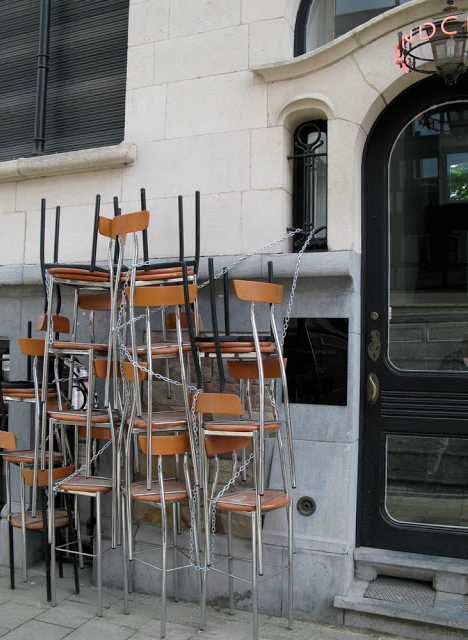
German Photographer/artist Sarah Ortmeyer‘s first solo show, “Sad Eis” (Sad Ice), included the above evocative snap of the closed Lasso Laden ice cream shop. Would it not have been easier to simply leave the shop’s seats inside and locked up instead of chained together outside, vulnerable to the vagaries of vagrants? Only Ortmeyer knows for sure, and she’s keeping that scoop to herself.

Ore-gone

abandoned ice cream shop Portland Forest Park(image via: Swedotorp)

Flickr user Swedotorp picked the perfect days (June 14th and 15th of 2008) to immortalize the abandoned Forest Park ice cream stand in all its faded glory. Located near Portland, Oregon, the stand would seem to be the right business in the right place at the right time. Unfortunately, the aged elegance of the mid-century style paint & neon signage indicates this stand’s time has long since melted away.

abandoned ice cream Forest Park Portland Darren Sethe(image via: Darren Sethe)

Flickr user Darren Sethe stopped at the abandoned Forest Park ice cream shop four years later in 2012 but not much had changed, barring the loss of a few more flakes of paint from the ancient sign. Sethe’s stark monochrome treatment seems to add a dash of timelessness to the ice cream-less scene.

The Other Meltdown

abandoned ice cream Kiyosato Japan(images via: Spike Japan)

Kiyosato, Japan was a popular travel and tourism destination whose prospects weren’t improved by the 2011 Great East Japan Earthquake and the subsequent Fukushima Daiichi Nuclear Plant accident. Among the area’s attractions was the now-abandoned One Happy Park, explored and recorded in September 2011 by urban explorers from Spike Japan. The abandoned park exudes an unfortunate and uneasy aura epitomized by the not-so-merry Merry Land ice cream kiosk just outside a ramen restaurant.

Next Page:
Scooped 12 Chilled Out Abandoned Ice Cream Stands

Share on Facebook


[ By Steve in Abandoned Places & Architecture. ]

[ WebUrbanist | Archives | Galleries | Privacy | TOS ]


WebUrbanist

 
Comments Off on Scooped: 12 Chilled Out Abandoned Ice Cream Stands

Posted in Creativity


Find the Perfect Parking Spot Before You Even Leave Home

18 May

[ By Delana in Conceptual & Futuristic & Technology. ]

parkme app

There are countless maps and other direction-finding methods for your smartphone that can help you get to where you want to go – but once you get there, you still have to worry about parking. This, of course, is one of the most frustrating aspects of going anywhere in a mid-to-large-size city. In fact, some 30 to 50 percent of urban congestion is caused just by people driving around looking for parking spots. But never fear – an app called ParkMe is here to provide real-time parking availability information in cities and countries all around the world.

parking facility availability

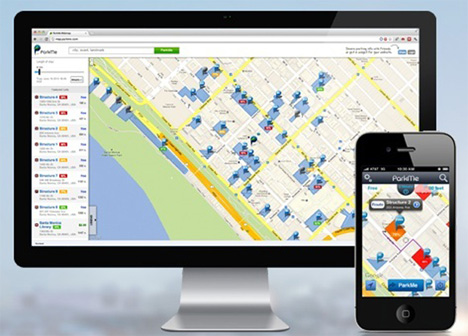
The smartphone app works by utilizing data from a number of sources. Parking facility operators can update the app with their capacity and availability. Businesses can use a widget to provide real-time availability near their establishments, which is a win-win for them and their customers. Payment options are listed so you’ll know ahead of time if you need to have cash available.

parkme app locations

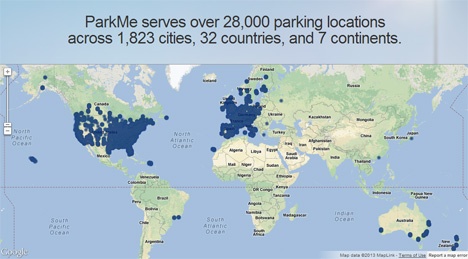
Not all of the 1800 cities featured on ParkMe have real-time data available; only a handful of cities in the US offer that level of seamless parking integration. But the app does tell you where you’re most likely to find parking near your destination and how much you’ll have to pay for the privilege of leaving your car there. If you enter the amount of time you’ll need to park, the app will even tell you what your total cost will be.

parkme mobile and computer

Overall, the app will reduce traffic congestion in cities by helping people find a place to park in advance. If  you could figure out your exact route, down to the entrance to the lot you’ll leave your car in, before you even leave your house – imagine how much easier it would be to get to your destination and get your fun outing started.

Share on Facebook


[ By Delana in Conceptual & Futuristic & Technology. ]

[ WebUrbanist | Archives | Galleries | Privacy | TOS ]


WebUrbanist

 
Comments Off on Find the Perfect Parking Spot Before You Even Leave Home

Posted in Creativity


NeoLucida: Optical Drawing Tool Lets You Trace Real Life

17 May

[ By Steph in Art & Drawing & Digital. ]

NeoLucida Drawing Aid 1

Have you ever wondered how 19th century artists were able to produce such incredibly realistic drawings? It isn’t just because they were unusually talented, though it’s hard to argue that they were. Many of them benefitted from the use of a ‘camera lucida’, an optical device that reflects real-life images onto a drawing surface so they can be traced. A new version of the tool, called the ‘NeoLucida,’ aims to bring this drawing aid back, with a few modern updates.

NeoLucida Drawing Aid 3

Essentially a prism on a stick, the camera lucida was once a very popular drawing tool, making it easy to create realistic drawings. A portable version hasn’t been manufactured in nearly a century. Antique versions sell for hundreds of dollars, but Pablo Garcia and Golan Levin, the makers of the NeoLucida, aim to sell theirs for just $ 40.

NeoLucida Drawing Aid 2

“We want to make this remarkable device widely available to students, artists, architects, and anyone who loves to draw from life,” say the pair on their Kickstarter page, which has already raised nearly half a million dollars – far over the original goal of $ 15,000. “But to be clear: our NeoLucida is not just a product, but a provocation. In manufacturing a camera lucida for the 21st century, our aim is to stimulate interest in media archaeology—the tightly interconnected history of visual culture and imaging technologies.

NeoLucida Drawing Aid 4

The NeoLucida is made from a combination of mass-manufactured and custom-machined parts. It has a clamp to fit onto the edge of desks and tables, and a goose neck for adjustability. It’s lightweight, non-electric, and compact enough to fit in a handbag. Get more details at the project’s Kickstarter (via notcot.org.)

Share on Facebook


[ By Steph in Art & Drawing & Digital. ]

[ WebUrbanist | Archives | Galleries | Privacy | TOS ]


WebUrbanist

 
Comments Off on NeoLucida: Optical Drawing Tool Lets You Trace Real Life

Posted in Creativity


Small Worlds: Strange & Shocking Miniature City Scenes

17 May

[ By WebUrbanist in Art & Sculpture & Craft. ]

surreal model architecture

There is no unifying theme to these surreal depictions of urban architecture and landscapes, save perhaps their imaginative improbability and singular creator, Frank Kunert, a German photographer and his bemused sense of wonder.

surreal crafted city scenes

Each is at once clearly a model yet quite lifelike, lovingly crafted, painted and photographed. Some show impossibilities seemingly for shock value alone, while others contain a subtle message – some commentary on politics, religion, television or other aspects of everyday life.

surreal architecture model images

The resulting scenes question function, accessibility and the role of architecture, exterior and interior design in shaping both public and private experience.

surreal structural montage scapes

It is also worth noting, too, that none of them are post-edited – they are created sans Photoshop and shot with an analog camera. The process and product are closely related, and each creative choice is made carefully by hand.

Share on Facebook


[ By WebUrbanist in Art & Sculpture & Craft. ]

[ WebUrbanist | Archives | Galleries | Privacy | TOS ]


WebUrbanist

 
Comments Off on Small Worlds: Strange & Shocking Miniature City Scenes

Posted in Creativity


Under 400 SF: New Modular Micro-Apartments for NYC

16 May

[ By WebUrbanist in Architecture & Houses & Residential. ]

nyc micro apartments

With New York City’s inexorable growth, 1980s legislation barring the creation of 400 square-foot, one-to-two-person apartments has been lifted. And the results are in: award-winning compact units ranging from 250 to 330 square feet each have arrived.

nyc modular prefab units

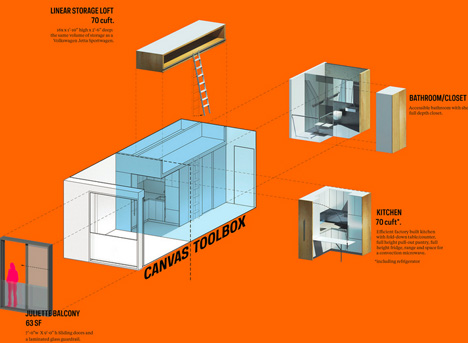
The solutions, sans traditional square-footage restrictions, involve both production and living innovations. They make the most of modular components and prefabrication, on the one hand, and utilize adaptable floor plans, copious common spaces and expansive rooftop decks to extend livable areas on the other.

nyc unit plan components

Anyone who has spent time in ultra-dense yet highly-organized cities like Hong Kong, Tokyo or London knows that every square foot counts in terms of cost savings, and the less you have, the more you need to creatively make use of what is there.

nyc small apartment scene

Per NYC.gov and CBS New York and via ArchDaily,“Succeeding 33 international proposals and providing an innovative housing model for New York City’s micro-apartments, a team consisting of Monadnock Development LLC, Actors Fund Housing Development Corporation and nARCHITECTS was selected as winner of the adAPT NYC competition. Construction on the pilot project will begin by the end of the year and residents are expected to move in by 2015.”

Share on Facebook


[ By WebUrbanist in Architecture & Houses & Residential. ]

[ WebUrbanist | Archives | Galleries | Privacy | TOS ]


WebUrbanist

 
Comments Off on Under 400 SF: New Modular Micro-Apartments for NYC

Posted in Creativity


Wearable Tech: Mask Gives Users Superhuman Senses

16 May

[ By Steph in Gadgets & Geekery & Technology. ]

Superhuman Senses Mask 1

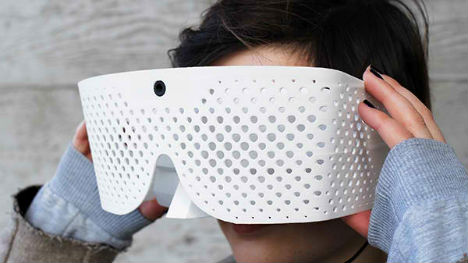
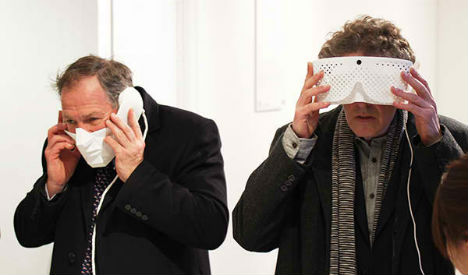
Put on a futuristic-looking, geometric white mask and you’ll suddenly have superhuman senses, hearing targeted sounds from long distances or applying effects to images in real-time. The ‘Eidos’ masks were developed by a group of students from the Royal College of Art in London, fitting over the mouth or ears to enhance sensory perception.

Superhuman Senses Mask 2

The mask that fits over the mouth and ears features a directional microphone to capture audio, which is processed by software to eliminate background noise. The sound is transmitted directly to the inner ear through bone vibrations to make it seem as if someone else’s speech is coming from inside your own head.

Superhuman Senses Mask 3

Superhuman Senses Mask 4

The second mask, which fits over the eyes, adds visual effects to the wearer’s range of vision, and can also analyze visual data. That data is sent to a computer, where software processes it and picks out patterns and movements that are invisible to the naked eye.

Superhuman Senses Mask 5

“Eidos has broad application in areas where live audio and video analysis is valuable. For example, sportspeople can visualise and improve technique in real time. Eidos also has healthcare benefits where it can be used to boost or refine sensory signals weakened by ageing or disability. In the arts, Eidos can augment live performance such as ballet, fashion or music concerts. It allows us to highlight previously invisible or inaudible details, opening up new and customisable experiences.”

Share on Facebook


[ By Steph in Gadgets & Geekery & Technology. ]

[ WebUrbanist | Archives | Galleries | Privacy | TOS ]


WebUrbanist

 
Comments Off on Wearable Tech: Mask Gives Users Superhuman Senses

Posted in Creativity


Future Present: 7 Soon-to-Be Wonders of Technology

15 May

[ By Steph in Conceptual & Futuristic & Technology. ]

Tech Predictions Main

Within five years or less, we could be chatting with the three-dimensional holograms of faraway friends, controlling our computers with mental commands, charging our phones with energy harvested from wasted ambient energy and logging into our bank accounts with facial recognition scans. These are among the technology innovations that computer giant IBM has predicted within the last few years of its annual technology forecast. Here are seven of the most intriguing prospects.

3D Hologram Chat

Tech Predictions Holographic Chat

(image via: Star Wars 20th Century Fox screen capture)

A 3D holographic chat system called “TeleHuman” is the first example of what will likely be a flood of virtual hologram technology that lets us see faraway contacts in three dimensions. TeleHuman creates a life-sized rendering of its subject using six XBox Kinect sensors, a 3D projector and a cylindrical display; the creators say it will be available for $ 5,000 within five years. A similar project called the RGB+D Toolkit is making waves in the indie filmmaking community.

Microsoft is also working on telepresence technology for Skype using holograms to literally bring conference participants to a central table, no matter where in the world they’re located.

Mind-Controlled Devices

Tech Predictions Mind Controlled Gadgets

(image via: forbes)

Wouldn’t it be nice if you didn’t have to type at all? You could simply think a command, an email, or anything else you want to do and it appears on your screen. Maybe we’re not quite there yet, but progress is encouraging. Brain-Computer Interface (BCI) technology is appearing in all kinds of experimental gadgets, from headphones that play music based on your mood to a headband that measures brain activity in real time and displays it on your smartphone or tablet. BCI devices are also being used to allow quadriplegic patients to complete previously impossible tasks.

Of course, there are drawbacks to this inevitably invasive technology. A 2012 study found that connecting minds to machines can allow sensitive private information to ‘leak out’ along with the users’ mental commands. The information revealed included the location of their homes, faces they recognized and even their credit card PINs.

Energy-Scavenging Gadgets That Don’t Need Batteries

Tech Predictions Energy Scavenging Gadgets

(image via: dennis siegel)

Power lines, data centers, televisions and even your coffee maker output waves of ambient energy that typically just dissipate in the air, going to waste. That energy could be used to power all kinds of things, including crucial wireless sensors running on batteries, which keep track of factory machinery or measure environmental pollution. MIT has developed an energy-harvesting microelectromechanical system (MEMs) that translates even tiny vibrations, light and ambient energy into a surprising amount of power, eliminating the need for batteries.

Designer Dennis Siegel shows off some of the possibilities on the consumer side of the spectrum with ‘Energy Parasite,‘ a gadget that gathers energy from home appliances and power plants, stores it in a conventional battery and allows you to use it later for cell phones, mp3 players and other devices.

Multi-Factor Biometrics Eliminate Need for Passwords

Tech Predictions Biometrics Passwords

(image via: siemens)

We’re not far from an era in which passwords are a thing of the past. Fingerprint scanners have been available for a range of devices for quite a while now, but they’re not ideal – burns, cuts, oil and other irregularities can interfere with scanning. In the future, a range of biometrics including voice, retina and face scanners could be used to verify our identities so we can access devices, personal accounts and private data.

Researchers are developing systems that ensure biometric data is secure, like taking a sample of a user’s voice, dividing it into similar samples, and then cryptographically protecting them before performing a comparison on the voice trying to gain access.

Computers That Can Smell, Taste & Replicate Touch Sensations

Tech Predictions Computers Taste Smell Hear

(image via: ntdtv)

IBM predicted that within five years, computers will be able to output and recognize smells and flavors, and even replicate textures, so we can ‘feel’ fabrics before purchasing, for example. Texture data fed into a computer’s drivers can re-create vibrations and temperature on a touch screen, similar to the way some computer game controllers shake to indicate on-screen action. Digitized taste buds breaking down flavors to their molecular components can help compare them, so users can find something that tastes like a favorite food, but is healthier, or get a sense of a recipe before trying it out. Chemical sensors that enable computers to ‘smell’ could guess health problems from changes in your breath or detect environmental toxins.

Changes in the way computers ‘hear’ sound could also lead to some major breakthroughs. Hearing the ‘whole picture’ rather than isolated voices or music could allow computers to learn more about the situations in which the sounds are produced. For example, a computer could analyze the sounds of a baby crying and identify based on past experience whether the cause is need for a diaper change or food, or more serious problem. Japanese researchers are currently integrating smell technology into humanoid robots, as well.

The End of Junk Mail

Tech Predictions No More Junk Mail

(image via: Minority Report 20th Century Fox Screen Capture)

Advances in creepily targeted advertising could mean that junk mail is no longer junk. When the ads that appear in your inbox and physical mailbox are tailored specifically to your tastes and interests, you’re going to be more likely to click on them, which is exactly what marketers want. Information assembled online, through customer loyalty cards and by other means tell advertisers more than ever about your purchasing habits, your household and your income. Of course, we’re trading the annoyance of junk mail for what could be considered a serious invasion of privacy. Many consumers have no idea how much can be learned about their lives from their surfing habits.

Finely tuned junk mail filters will also help combat the constant flood of invitations to buy black market Viagra, enlarge certain body parts and claim inheritances from long-lost relatives in Nigeria.

Harvesting Kinetic Energy

Tech Predictions Kinetic Energy

(image via: pavegen)

Just like all that ambient energy, kinetic energy from movement of all sorts is a potentially rich source of power that currently goes to waste. The movement generated by trains, cars, and our own hands and feet could provide electricity to the venues in which it’s harvested. This technology is already in place at a number of human-powered gyms, dance clubs and subway stations. Treadmills, stationary bikes, roller coasters, sidewalks and handrails absorb the energy from movements and convert it into power for lights and other electrical equipment.

Pavegen floor tiles are one example. These tiles, which capture kinetic energy from footsteps, have been installed at the Westfield Stratford City Shopping Centre in London, and were also used at the 2013 Paris Marathon.

Share on Facebook


[ By Steph in Conceptual & Futuristic & Technology. ]

[ WebUrbanist | Archives | Galleries | Privacy | TOS ]


WebUrbanist

 
Comments Off on Future Present: 7 Soon-to-Be Wonders of Technology

Posted in Creativity


Sideways Street Art: Muralist Makes Figures Walk on Walls

15 May

[ By WebUrbanist in Art & Street Art & Graffiti. ]

wall walking mural figures

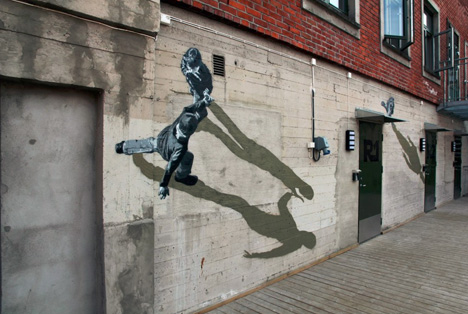
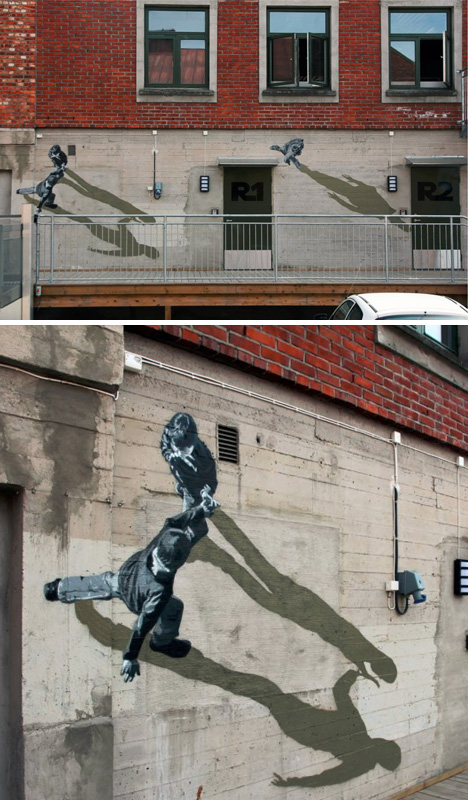
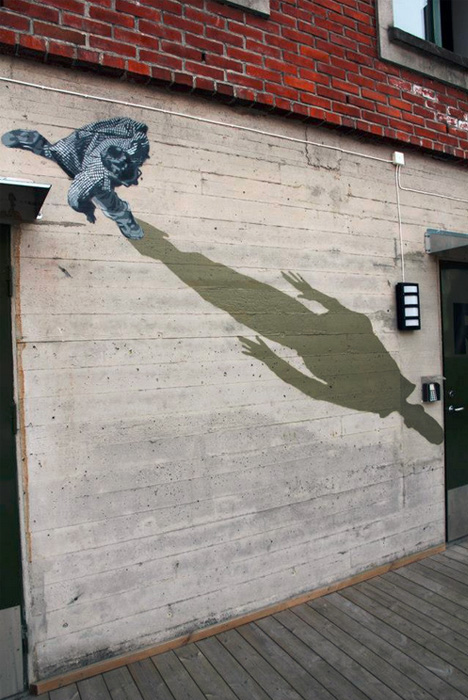
These layered creations are surprisingly realistic, even in black and white, thanks in part to their scale and reinforced by their shadows, but also due to the ordinary nature of the sidewalk scenes being depicted.

wall mural stencil art

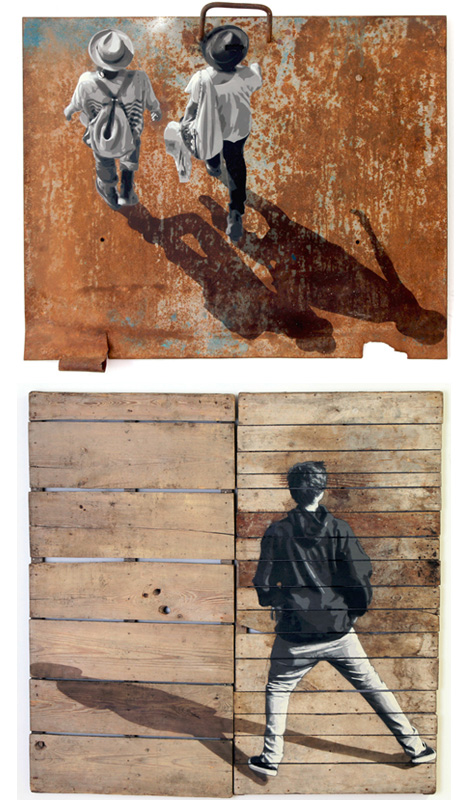
Strøk (Anders Gjennestad) is a stencil artist and mural maker from Norway with works in various contexts, from city streets to suburban galleries.

wall gallery street artwork

Some of his gallery works repeat the same themes and similar scenes on scrap objects, from wooden pallets to metal doors, to those he presents on building walls.

wall sketch photo realistic

From the creator’s website: “His hand-cut, multi-layered stencils create photo-realistic imagery with depth and detail that [are] complex, tactile and mentally engagement. The placement and choice of material … painted on rusty metal, gritty walls, shiny glass”


Share on Facebook


[ By WebUrbanist in Art & Street Art & Graffiti. ]

[ WebUrbanist | Archives | Galleries | Privacy | TOS ]


WebUrbanist

 
Comments Off on Sideways Street Art: Muralist Makes Figures Walk on Walls

Posted in Creativity


Hidden Depths: Architectural Illusion Unfolds Underground

14 May

[ By WebUrbanist in Design & Guerilla Ads & Marketing. ]

russian underground

Facade or fantasm, this series of images presents an alluring picture of the layers – perhaps even literal  levels – of  history that lies beneath aged and famous buildings.

russian architecture kremlin photoshop

Blending physical fact and historical fantasy, these advertisements (for titled “Discover the Full Story”) extend three archetypal works of Soviet architecture to new subterranean depths. They seem a fitting set to promote the Shchusev State Museum of Architecture in Moscow, Russia.

russian architecture museum advertisement

russian architecture kremlin ad

The Kremlin, with its recognizably colorful onion towers, reveals even more (and larger) turrets below – what is on the surface turns out to be just the uppermost peaks. Neo-Classical and Gothic Revival play their parts as well, turning what looks like an old Greek tempt into the top of an edifice, and a stately structure into a skyscraper.

russian architecture underground drawings

russian building underground sketch

And for those who enjoy process as much as product, it is interesting to see the stages these illustrations went through to get to their final form – sketched figures and pillars, hand-drafted architectural elements, and then finishing touches.

Share on Facebook


[ By WebUrbanist in Design & Guerilla Ads & Marketing. ]

[ WebUrbanist | Archives | Galleries | Privacy | TOS ]


WebUrbanist

 
Comments Off on Hidden Depths: Architectural Illusion Unfolds Underground

Posted in Creativity


Test Your Geography Skills with Google Maps Game

14 May

[ By Steph in Global & Travel & Places. ]

GeoGuessr Google Maps Game 1

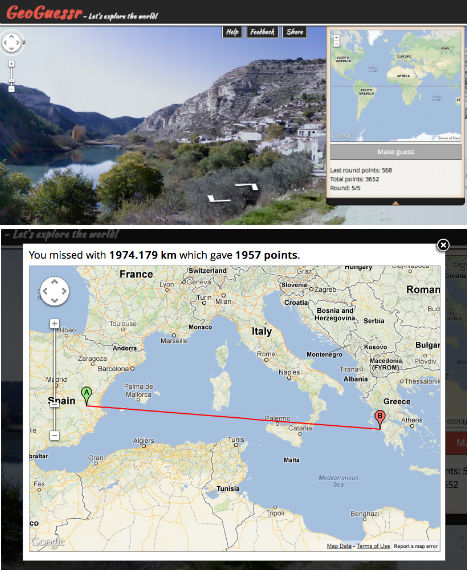
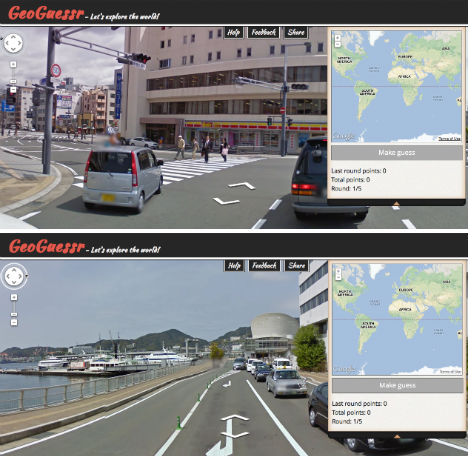
Can you guess where in the world this unidentified Google Maps location is by landscape, road signs, architecture and cars? Test your geography skills with GeoGuessr, a site that drops you into a random Street View and challenges you to answer correctly five times in a row. Brilliantly simple, this virtual travel guessing game will stump you with featureless fields, and city scenes that seem to belong on entirely different continents.

GeoGuessr Google Maps Game 2

Once placed in a location, you can move up and down the streets and use the arrows to view it in 360 degrees, just like on Google Maps and Google Earth. Sometimes, you might get lucky, and see some kind of identifying signs. Sometimes, there’s nothing but farmland and trees.

GeoGeussr Google Maps Game 3

When you think you’ve determined the location, drop a pin on the world map on the right side of the screen and make your guess. You might be surprised how many times you’re about as off as you can possibly be. Some streets in Northern Canada look an awful lot like those in Argentina. Try it for yourself at GeoGuessr.com (via Laughing Squid).

Share on Facebook


[ By Steph in Global & Travel & Places. ]

[ WebUrbanist | Archives | Galleries | Privacy | TOS ]


WebUrbanist

 
Comments Off on Test Your Geography Skills with Google Maps Game

Posted in Creativity