RSS
 

Archive for the ‘Creativity’ Category

Philography: Complex Philosophy Meets Graphic Simplicity

24 May

[ By WebUrbanist in Design & Graphics & Branding. ]

philosophy postcard simplified designs

The bigger the idea, the harder to understand, let alone distill. That is the idea and challenge  behind this growing set of graphic designs that seek to capture big ideas in simple shapes and single-sentence explanations.

philosophy flash cards simplified

Dubbed Philographics by their creator,  Genís Carreras, the original set contained just 24 designs, but has grown into a series of 95 (so far). Idealism, Dualism, Existentialism – if you can think of an ‘ism’ from philosophy, you can almost certainly find it represented here.

philosophy isms summary poster

And consider the alternative, hundreds, thousands, maybe tens of thousands of words in the dictionary definitions of such terms – a great way to flesh out your knowledge, but hardly the place to get started.

philosophy posters graphic designs

In fact, philosophy schools often force students to better understand philosophers and philosophies by condensing and summarizing – having to articulate long thoughts in short form helps the brain process and codify that information.

philosophy tongue in cheek

As for the forms these are taking: the Kickstarter project (funded at nearly four times the initial goal) has been such a success that what started as posters has branched into postcards and, in pre-production, softcover,  hardcover and electronic book editions as well.

Share on Facebook


[ By WebUrbanist in Design & Graphics & Branding. ]

[ WebUrbanist | Archives | Galleries | Privacy | TOS ]


WebUrbanist

 
Comments Off on Philography: Complex Philosophy Meets Graphic Simplicity

Posted in Creativity


Tinshed: Home Rebuilt from Shreds of Scrappy Shack

23 May

[ By WebUrbanist in Architecture & Houses & Residential. ]

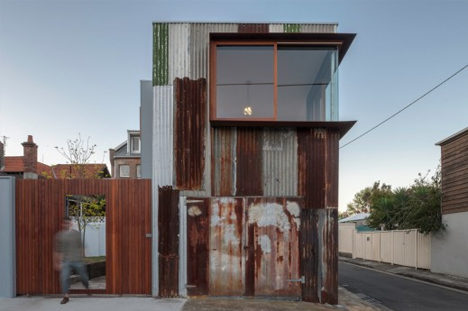
rebuilt upcycled industrial building

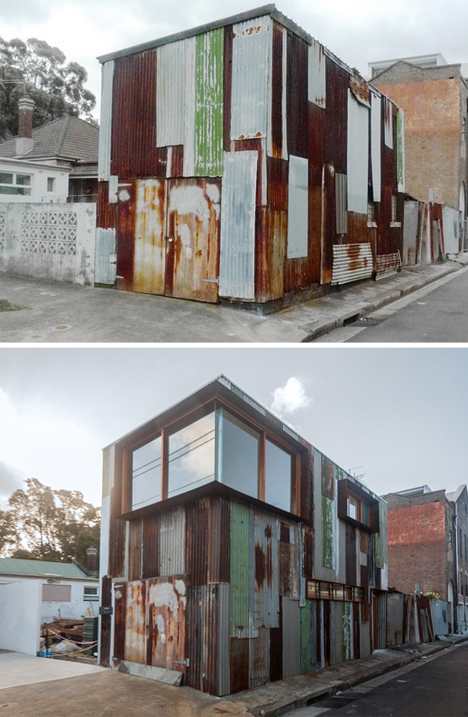
In a sleepy suburb of Sydney, Australia, long since taken over by mainly-one-story houses, sat a disused metal-sided shed. An ad hod affair, it was a rare leftover of what was once an industrial neighborhood, destined for demolition but instead converted into a strange new home.

rebuilt scrap metal house

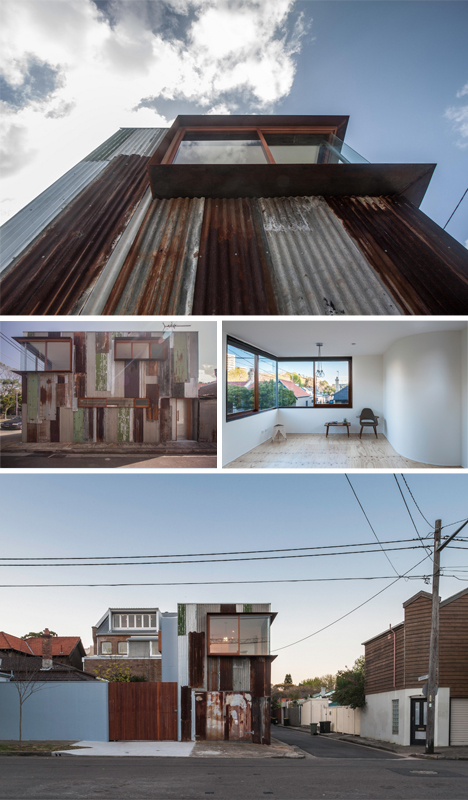
The newly-reconstituted building dubbed ‘Tinshed’  by Raffaello Rosselli (images by Mark Syke) is made from the metal of the old abandonment. It is still pockmarked, with a haphazard surface that slips between gray, green, white and red – its panels overlapping in odd and seemingly chaotic patchwork patterns. Now, however, it these frame a few more oddities, like windows for the first time in the site’s life.

rebuilding australia junk shack

Inside, the building has immaculate flat white walls and crisp curved surfaces, reflecting its fresh purpose as a studio (on the first floor) dwelling and office space (on the second level). The juxtaposition of interior and exterior is fitting, as the entire structure is itself a strange addition to its surroundings.


Share on Facebook


[ By WebUrbanist in Architecture & Houses & Residential. ]

[ WebUrbanist | Archives | Galleries | Privacy | TOS ]


WebUrbanist

 
Comments Off on Tinshed: Home Rebuilt from Shreds of Scrappy Shack

Posted in Creativity


Laser-Cut Record: Music Etched Onto Slices of Wood

23 May

[ By Steph in Art & Installation & Sound. ]

Laser Cut Wood Records 1

We already know what kind of music trees make when left to their own devices, and now we can make them sound the way we want. After developing a method for converting digital files into 3D printable records, designer Amanda Ghassaei has laser-cut records onto pieces of wood. While vinyl may be cheaper and provide sharper sound, it’s hard to deny that these hand-crafted records are works of beauty.

Laser Cut Wood Records 2

Ghassaei created digital wavelength forms of songs by Radiohead and Joy Division, converted them into PDFs and used an Epilog 120 Watt Legend EXT laser cutter to etch about three minutes of sound onto each side of a slice of wood. The resulting wood records, which are twice as thick as vinyl, can be played on an ordinary turntable.

Laser Cut Records 3

“With this project I wanted to try to extend the idea of digitally fabricated records to use relatively common and affordable machines and materials so that (hopefully) more people can participate, experiment, and actually use all this documentation I’ve been writing,” says Ghassaei.

Laser Cut Wood Records 3

Ghassaei has also cut audio onto acrylic and paper. Music with good midtones tend to sound best with this technique. Listen to more samples and get more details about the project at Instructables.

Share on Facebook


[ By Steph in Art & Installation & Sound. ]

[ WebUrbanist | Archives | Galleries | Privacy | TOS ]


WebUrbanist

 
Comments Off on Laser-Cut Record: Music Etched Onto Slices of Wood

Posted in Creativity


Future Perfect: 7 Potential Wonders of the World

22 May

[ By Steph in Conceptual & Futuristic & Technology. ]

Future Wonders of Technology Main

One hundred years from now, will we be living on other planets, teleporting from place to place, communicating to each other telepathically, or even becoming immortal by shifting human consciousness from our biological bodies to artificial ones? These predictions for the distant future seem outrageous and virtually impossible to achieve, yet steps are being made toward them at this very moment. The seeds of the potential future wonders of the world have already been planted, and in many cases, it’s not a question of whether they’ll happen, so much as when.

Teleportation

Future Wonders Teleportation 1

Future Wonders Teleportation 2

(images via: physical review focus, ail)

As unlikely as this may sound, teleportation isn’t entirely sci-fi. Physicists have already succeeded in teleporting photons – but right now, it’s not so much about teleporting matter from one location to the next, as it is information. Quantum teleportation is a complex topic involving concepts like ‘entanglement’, the connection that links the quantum states of two particles no matter who far apart they are. Teleporting a single particle is one thing, but what about human beings, Star Trek style?

As PBS’ The Nature of Reality column explains, “Remember that we wouldn’t be moving Kirk’s molecules from one place to another. He would interact with a suite of previously-entangled particles, and when we read the quantum state we would destroy the complex quantum information that makes his molecules into him while instantly providing the information required to recreate his quantum state from other atoms in a distant location. Quantum mechanics doesn’t forbid it. The rules of quantum mechanics still apply whether you’re talking about a system of two particles or human being made of 1027 atoms.”

The verdict? Teleportation is certainly possible, and scientists may soon begin working on attempts to teleport living matter, like viruses. Physicist Michio Kaku believes that the transport of a molecule will happen within the next ten years, followed by DNA, but that teleporting an entire human is probably still centuries away.

Artificial Intelligence Surpassing Human Intelligence

Future Wonders Artificial Intelligence

(images via: mashable)

How long do we have until human-level artificial intelligence is achieved? H+ Magazine surveyed experts, asking when they estimated AI would meet four major milestones: carrying on a conversation well enough to pass as a human, solving problems as well as a third grade student, performing Nobel-quality scientific work, and finally, surpassing human intelligence altogether. Robots can already see, hear, learn, solve problems and respond to questions, and some are even getting senses of smell and taste. The Eccerobot is creepily human in its movements thanks to artificial muscles and bones.

The general consensus was that we’ll have AI at the human level or beyond will happen by the middle of the century, or maybe even sooner – but may not surpass humans for a hundred years, if ever.

Space Settlements

Future Wonders Space Colony

(images via: space.com)

Applications are now open for a one-way ticket to a private space settlement on Mars. The Mars One project intends to land supplies on the red planet in 2016, and get settlers there by 2023; about 78,000 people have already applied. The company responsible, Lansdorp, insists that the technology needed to achieve this lofty goal already exists. And according to a group of astronauts, researchers and space flight firms who met in May 2013 for the first Human to Mars Summit, establishing a permanent, sustainable outpost on another planet might be a matter of saving the human species.

Supplies would be dropped off first, and then a crew of either humans or robots would construct the base. There are a lot of obstacles, not the least of which is the question of transportation between Earth and Mars, and whether Mars inhabitants could maintain their own food source, rather than relying on interplanetary deliveries.

Will it really happen? it’s hard to say. Private companies with an interest in space colonization are working with some of the same companies that have completed commercial cargo missions to the International Space Station. Lansdorp intends to make the technology developed during its mission available for sale, to fund Mars One and help speed up progress for additional colonies.

Body-Embeddable Electronics

Future Wonders Human Body Gadgets

(images via: io9, sync-blog)

In the future, it might be possible to hack other human beings thanks to all manner of body-embeddable gadgets. Many futurists and technology experts believe the trend for future devices isn’t to go smaller, but rather to integrate them into ourselves. Scientists have already developed tiny chips that can translate tiny bodily movements into energy to power gadgets, as well as devices that can be implanted into our bodies. Everyday electronics can already be implanted into human tissue, and medical devices are paving the way for recreational. Ready or not, the bionic human is on the horizon.

Researchers have also developed the first electronic sensor that can be printed directly onto human skin, creating a sort of ‘smart tattoo’ that could theoretically enable people to communicate with each other and our environments with thought commands. The devices, which are thinner than the diameter of a human hair, can detect electrical signals linked with brain waves, communicate wirelessly and receive energy.

Next Page:
Future Perfect 7 Potential Wonders Of The World

Share on Facebook


[ By Steph in Conceptual & Futuristic & Technology. ]

[ WebUrbanist | Archives | Galleries | Privacy | TOS ]


WebUrbanist

 
Comments Off on Future Perfect: 7 Potential Wonders of the World

Posted in Creativity


Solar Socket: Portable Plug-In Creates Free Energy to Go

22 May

[ By WebUrbanist in Gadgets & Geekery & Technology. ]

window socket

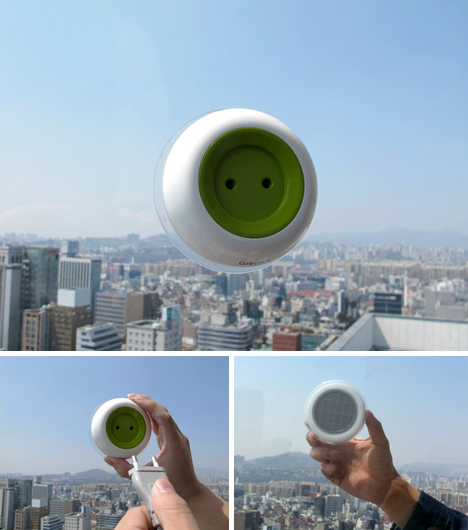
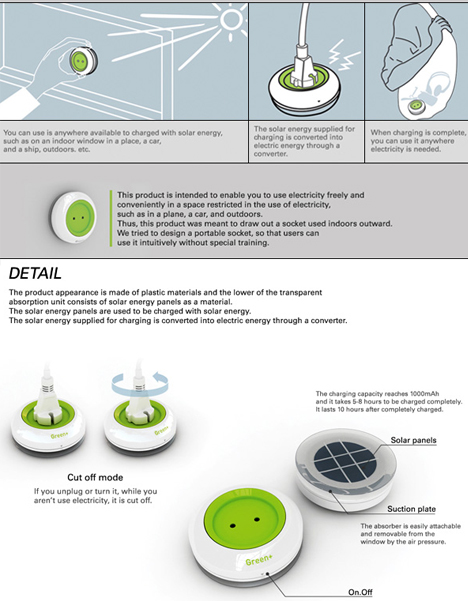
With batteries running low, your eye roams the room for a place to plug in, but then you remember: you brought your own power supply. Portable, easy and green, this solar socket design is a stroke of genius, able to both generate and hold a charge.

window portable power generator

A suction cup lets you stick the converter to any flat glazed surface, putting photovoltaic panels on the outside and a customary energy outlet on the other. And if you are worried about what happens at night or in overcast conditions: the device itself can store energy for in-place or mobile use.

window mounted solar cells

Kyuho Song & Boa Oh have added a few other functional quirks to the design: rotate your charger plug and you kill the power, spinning a circular cut-off switch built into the face plate. There is a second manual on/off switch on the bottom as well.

Share on Facebook


[ By WebUrbanist in Gadgets & Geekery & Technology. ]

[ WebUrbanist | Archives | Galleries | Privacy | TOS ]


WebUrbanist

 
Comments Off on Solar Socket: Portable Plug-In Creates Free Energy to Go

Posted in Creativity


Earthscraper: Inverted Pyramid Spans 1000 Vertical Feet

21 May

[ By WebUrbanist in Architecture & Public & Institutional. ]

earthscraper underground

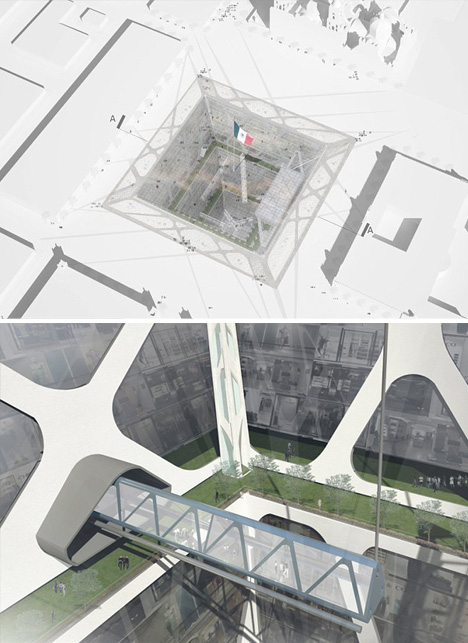
Skyscrapers are the traditional small-footprint solution for growing square footage in big cities, but what are developers to do in growing places like Mexico City where new building construction is limited to just ten stories tall?

earthscraper subterranean city park

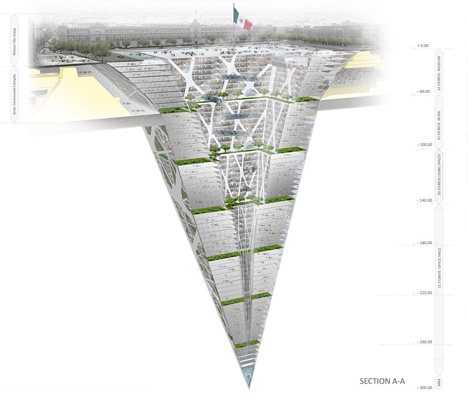
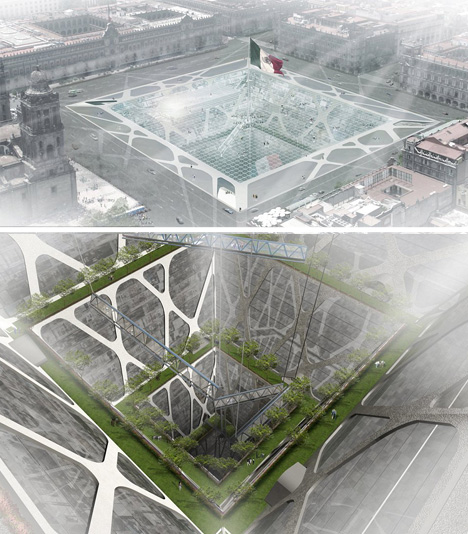
The only option, of course, is to reverse direction: build down instead of up. This his earth-scraper design by BKNR Arquitectura features a cental lightwell that doubles as a layered park, bringing illumination, ventilation and living greenery into the depths of the building.

earth scraper physical model

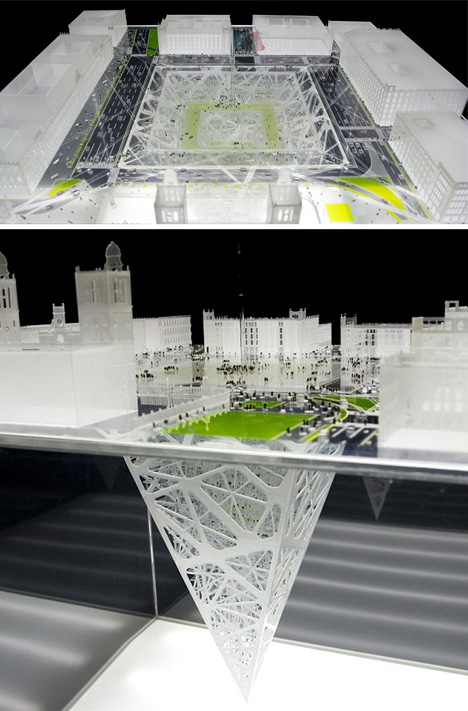
Since the ‘base’ of the structure is an open void rather than a filled volume, the existing city square is maintained – it becomes a transparent platform, effectively, adding dimension without subtracting functionality. This configuration provides not only a window to the world below that you can also walk on, still also allows for public gatherings, music festivals, open exhibitions, marches and parades.

earth scraping underground building

Below, the extensive building has multiple floors each of housing, shopping and office spaces, all arrayed around the exterior with views that face in rather than out – another inversion of expectations and conventions.

Share on Facebook


[ By WebUrbanist in Architecture & Public & Institutional. ]

[ WebUrbanist | Archives | Galleries | Privacy | TOS ]


WebUrbanist

 
Comments Off on Earthscraper: Inverted Pyramid Spans 1000 Vertical Feet

Posted in Creativity


Auto Draft

21 May

[ By WebUrbanist in Drawing & Digital. ]

adsf

adsf

Share on Facebook


[ By WebUrbanist in Drawing & Digital. ]

[ WebUrbanist | Archives | Galleries | Privacy | TOS ]


WebUrbanist

 
Comments Off on Auto Draft

Posted in Creativity


Infinite Garden Multiplies Miniature Forest with Mirrors

21 May

[ By Steph in Art & Installation & Sound. ]

Garden Optical Illusion 1

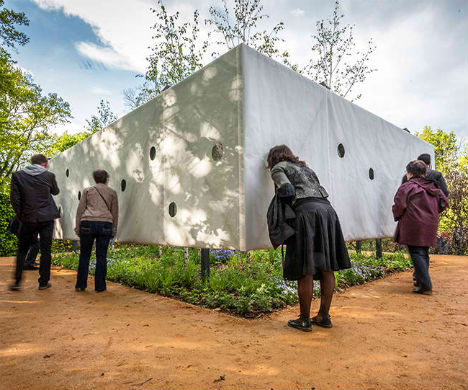
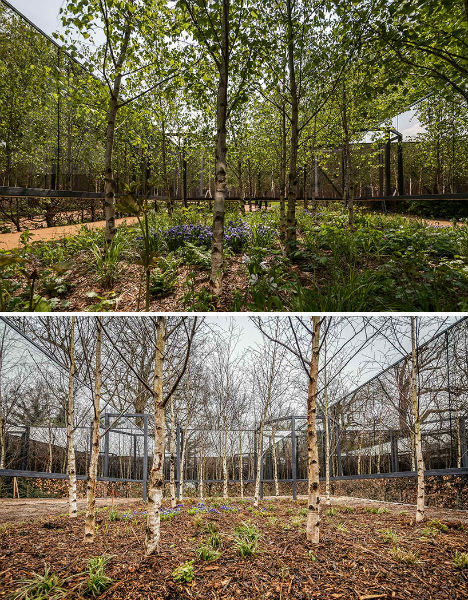
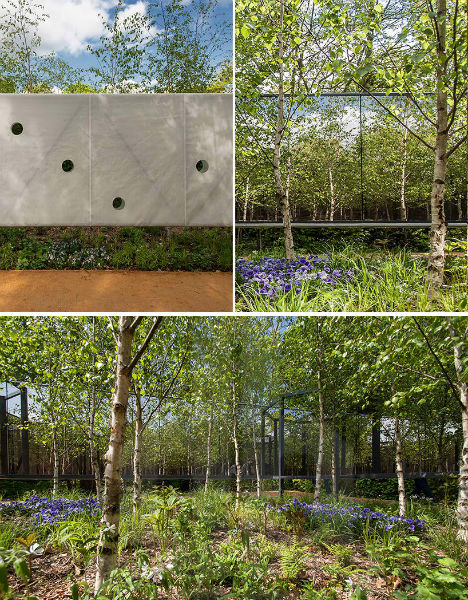
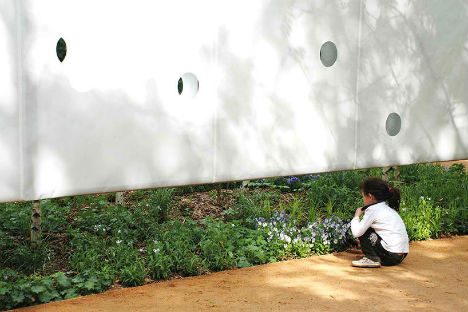
Peering through a hole in the hovering white skin of an unusual installation at the 22nd International International Garden Festival of Chaumont Sur Loire, France, seems to transport the viewer into a different place altogether. What could not be more than a few square meters, judging by the outside dimensions, becomes a vast forest that seemingly continues without end. Outside-In is a ‘visual paradox’ that intends to show us how relying on our senses can limit our imagination.

Garden Optical Illusion 2

Designed by Meir Lobaton Corona and Ulli Heckmann architects, the installation is a white canvas box punctured with circular windows, rendering a small planted area inaccessible. But mirrors mounted inside that box reflect the few trees that are actually contained within it. The effect is enhanced in warm seasons, when the leaves are at their lushest.

Garden Optical Illusion 3

“We think that all perception is locked within our body: The sense of seeing from the eyes, the sense of hearing from the ears, the sense of smelling from the nose, the sense of tasting from the mouth, and the sense of touch primarily from the hands,” say the creators.  “Our garden, entitled ‘outside-in’, is conceived as a visual paradox, as device that enhances such conditions in order to make the audience realize how by relying only on sight we rely on imagination, that is to say, on interpretation.”

Garden Optical Illusion 4

“‘Outside-in’ is a garden within a garden, a contemplative space, a small universe where landscape and architecture are fused to create an experience capable of raising questions rather than answering them, a live mechanism whose aim is to make us reflect on the contrast between what we know and what we see, demanding us to constantly negotiate the gap between physical reality and visual perception. It is a meditation on space, light, and the possibility of infinity as seen through the limitless reflections of a trapped narrative meticulously fitted inside a world of two-way mirrors.”

Share on Facebook


[ By Steph in Art & Installation & Sound. ]

[ WebUrbanist | Archives | Galleries | Privacy | TOS ]


WebUrbanist

 
Comments Off on Infinite Garden Multiplies Miniature Forest with Mirrors

Posted in Creativity


Alternative Landmarks: 12 Monuments As They Almost Were

20 May

[ By Steph in Architecture & Public & Institutional. ]


Alternative Monuments Main

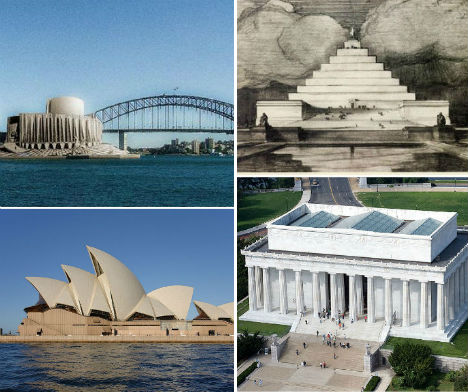
The Sydney Opera House might have been little more than a squat concrete building resembling a factory, and a visit to the statue of Abraham Lincoln at the Lincoln Memorial could have required scaling a massive stepped pyramid. Ranging from close second-place finishes in design competitions to proposals that were little more than pipe dreams, these alternative designs for 12 major iconic landmarks around the world represent radical departures from the monuments we’re accustomed to.

Sydney Opera House

Alternative Monuments Sydney Opera House

(images via: new world wonders, wikimedia commons)

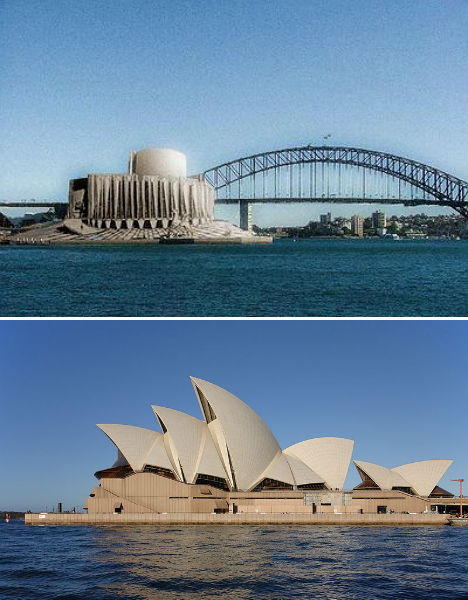
The Sydney Opera House is one of the most recognizable buildings in the world, with a dramatic series of vaults rising from the ground along Sydney Harbour. But Danish architect Jørn Utzon’s now-iconic design was controversial when it was first proposed in 1957, and the design that came in second place may have been more palatable to the public. American architect Joseph Marzella’s design was rather industrial in its appearance, but didn’t seem quite so out there.  It’s hard to imagine the magnificent performing arts venue looking so squat and dull.

Triumphal Elephant in Place of Paris’ Arc de Triomphe

Alternative Monuments elephant 2

Alternative Monuments Arc de Triomphe Real

Alternative Monuments Elephant 1

(images via: wikimedia commons)

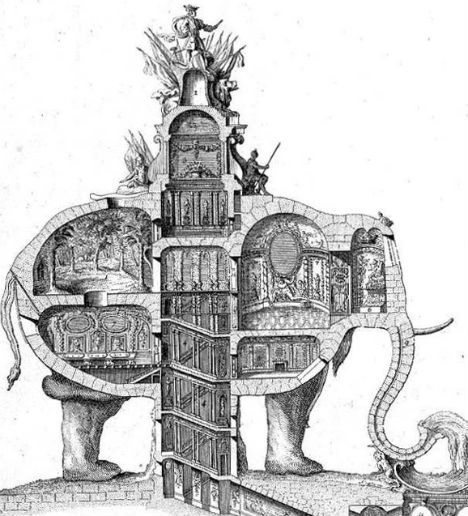
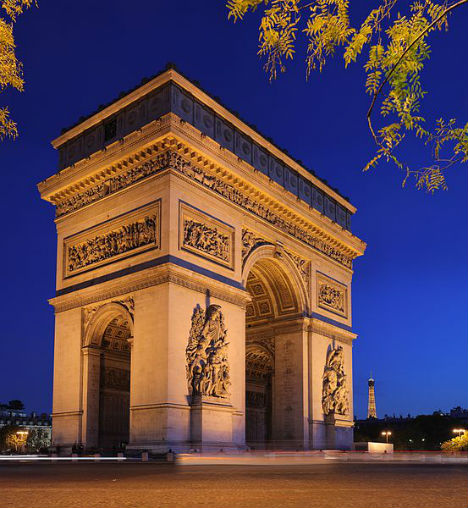
In place of one of Paris’ most famous monuments, the Arc de Triomphe, could have been a three-story elephant monument with a spiral staircase in the underbelly leading to the pinnacle. 18th century architect Charles Ribart offered this monument for the Champs Élysées, complete with a cross-sectional drawing showing the intricate rooms within, but was turned down by the French government.

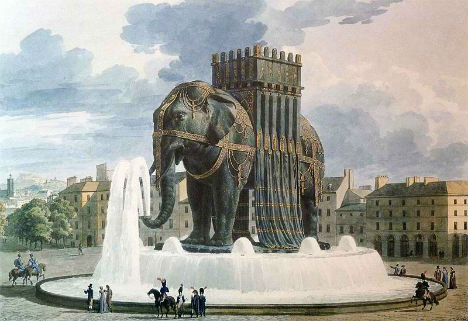
This isn’t even the only massive, ridiculous elephant statue envisioned for Paris. Originally conceived by Napoleon, the imposing Elephant of the Bastille (third photo) was meant to be cast of bronze and placed in Paris’ Place de la Bastille on the site of the old Bastille prison, which was the birthplace of the French Revolution. A stairway set into the legs would give access to the top, and the base would be surrounded by a fountain. However, only a plaster model was built, as memorialized by Victor Hugo in the novel Les Miserables, and eventually the July Column took its place.

Unbuilt Design for the Golden Gate Bridge

Alternative Monuments Golden Gate Bridge

(images via: pbs newshour, wikimedia commons)

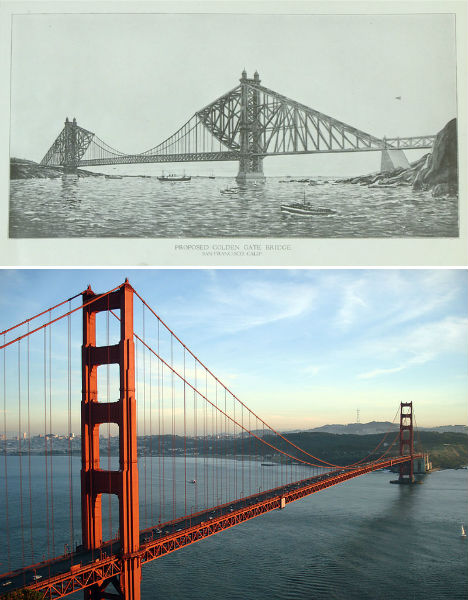
Now 76 years old, the Golden Gate Bridge is an iconic symbol of San Francisco, coated in literally millions of gallons of orange paint. The Art Deco-style bridge is one of the longest suspension bridges in the world, beating many experts’ predictions that it wouldn’t last against gale-force winds in the straight where the San Francisco Bay opens to the Pacific Ocean. But this wasn’t engineer Joseph Strauss’ first design. The original proposal is markedly different, with a heavier look combining cantilevered and suspension designs. It was rejected by the planning committee.

Lincoln Memorial Pyramid

Alternative Monuments Lincoln Memorial

(images via: i own the world, wikimedia commons)

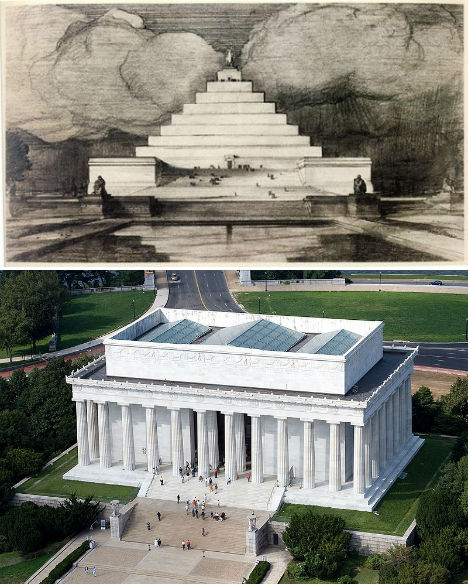
Highlighted at Unbuilt Washington, an exhibition at the National Building Museum in Washington D.C., John Russell Pope’s Lincoln Memorial Proposal replaces the columned rectangular building honoring the 16th president with a pyramid. Anyone who wanted to get up close to Abraham Lincoln’s statue would have had to climb that entire thing to reach it. Some historians believe that this proposal was ridiculous on purpose; Pope wasn’t a fan of the swampy location chosen for the memorial, and may have created this and other absurd designs in an effort to encourage the committee to seek a new setting. Pope went on to successfully design the Jefferson Memorial.

Pyramid Necropolis for London’s Primrose Hill

Alternative Monuments Primrose Hill Necropolis

Alternative Monuments Primrose Hill Real

(images via: andrew gough, wikimedia commons)

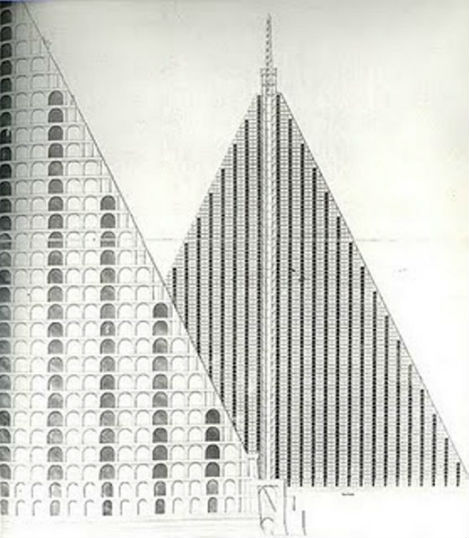
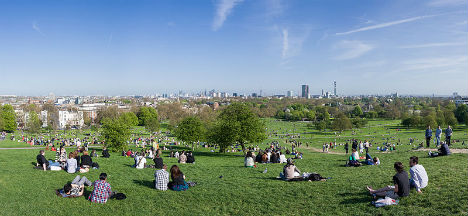
Infused in the Victorian preoccupation with melancholy and inspired by the Egyptian spoils of traveler and tomb-raider Giovanni Battista Belzoni, London architect Thomas Wilson proposed a massive, 15-acre pyramid-shaped necropolis for the city’s Primrose Hill. The granite pyramid would have towered into the air with 94 tiers of tombs in honeycomb shapes and a base measuring 18 acres, casting a gargantuan shadow over the hill many Londoners use for picnics and looking out over the city. Churchyards were so crowded at the time, that graves were bursting out of the ground – but concerns about what to do with London’s dead weren’t enough to convince the public that a necropolis was a good idea.

White House Alterations for President Harrison

Alternative Monuments White House

Alternative Monuments White House Real

(images via: loc.gov, wikimedia commons)

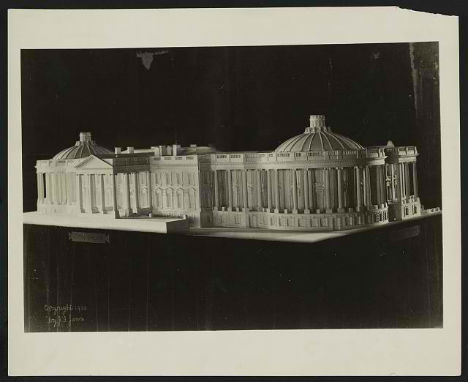
While he’s not nearly as forgettable as his grandfather, ninth United States President William Henry Harrison – who died after just 32 days in office – many Americans will struggle to recall any of twenty-third President Benjamin Harrison’s achievements during his tenure in the White House. However, Harrison could have made quite a mark. The first President to reside in the White House after it was wired for electricity, Harrison and his First Lady, Caroline Harrison, proposed significant changes to the complex that were never carried out. However, ten years later, Theodore Roosevelt made plenty of changes of his own, including the addition of the West Wing.

Next Page:
Alternative Landmarks 12 Monuments As They Almost Were

Share on Facebook


[ By Steph in Architecture & Public & Institutional. ]

[ WebUrbanist | Archives | Galleries | Privacy | TOS ]


WebUrbanist

 
Comments Off on Alternative Landmarks: 12 Monuments As They Almost Were

Posted in Creativity


Spectral Studio: 20 Sq M Space Uses Light & Dark as Decor

20 May

[ By WebUrbanist in Design & Fixtures & Interiors. ]

illuminated apartment

In an Paris apartment with just over 200 square feet, it is almost impossible to imagine anything but the more bare essentials resulting a boring space. But that is where illumination enters the equation, flooding in to add depth and complexity to this abode. This, then, is a short story of light.

illumination study axon existing

The architects, Betillon | Dorval?Bory, examined the limited space available architecturally, but also scientifically, testing the type and quality of the natural light to be found (and then suggesting what should be carefully introduced) across the existing interior zones.

illuminate room two tone

A single wall was introduced, dividing the main bedroom area from daytime activity spaces like the kitchen, but not just (nor even primarily) as a visual barrier – it was intentionally and most-importantly designed to be a backdrop for two types of light.

illuminated night sleeping area

On the ‘night’ side: a diffused orange streetlamp glow of the after-hours city that we associate with evening, which washes the walls in a more monochromatic direction (suited for sleeping and showering). On the ‘day’ side, a pure all-purpose white of the kind found in active spaces like offices – one which allows us to see things in black and color as well (suited for cooking and gathering).

illuminated flat natural daylight

Notably, the ‘night’ side lights can also be turned off (or overpowered by daylight), allowing the entire place to ‘open’ into a single space. If there is a lesson to be learned here, it is that physical objects are not the only things that form (or inform) the nature of space. Spatial variety can come via intangible elements like illumination, which in turn can serve equally powerful functions in fleshing out a space – particularly a small place with little room for solid decor.

Share on Facebook


[ By WebUrbanist in Design & Fixtures & Interiors. ]

[ WebUrbanist | Archives | Galleries | Privacy | TOS ]


WebUrbanist

 
Comments Off on Spectral Studio: 20 Sq M Space Uses Light & Dark as Decor
Posted in Creativity