Ricoh has just announced a new collapsible standard zoom lens. The HD Pentax-DA 18-50mm F4-5.6 DC WR RE is the world’s shortest zoom when its stored position, and is to be sold as a kit with the just-launched Pentax K-S2 DSLR. The lens offers weather-resistant construction for shooting in rain or mist, and uses Pentax’s multi-layer HD coatings to reduce flare and improve light transmittance. Read more
Tag: world’s
-
World’s First Public Streetlight Network Powered by Sun & Wind
[ By WebUrbanist in Conceptual & Futuristic & Technology. ]

Unveiled in Spain and planned for the streets of several towns and cities, these grid-free street lighting units are completely energy-autonomous, powered by solar and wind energy without needing to be networked with primary electricity grids.
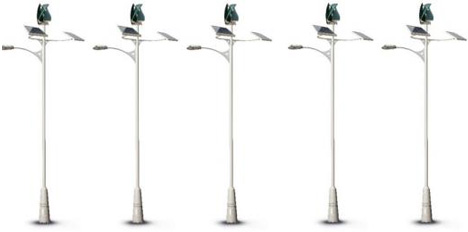
While other examples of self-sufficient streetlights exist as prototypes and installation art pieces, this system is set to be the first on the planet to be installed at scale for public use.
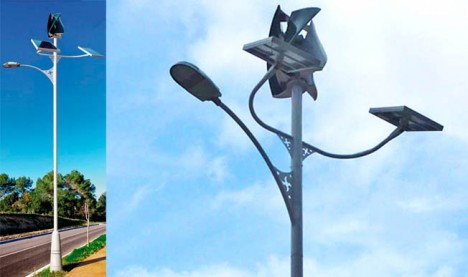
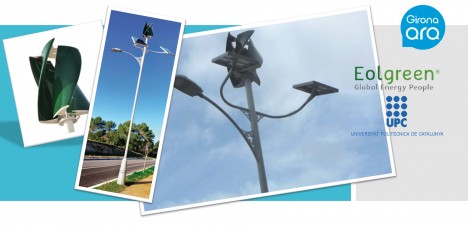
Ramon Bargalló of the Department of Electrical Engineering at the Barcelona College of Industrial Engineering (EUETIB) of the Universitat Politècnica de Catalunya (UPC) has been working with Eolgreen, a private company, to engineer the system.
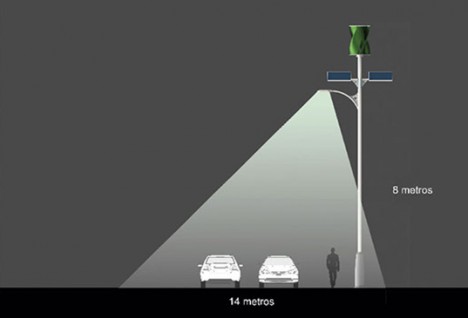
At roughly 30 feet tall, the posts feature leafy solar panels and turbines as well as built-in batteries for energy storage – relatively little wind or light are required to make the system work. Over 700 are set to be created in 2015, but the man and company behind their design are still working on increasingly efficient models for future deployment, testing and building as they proceed.
From their press release: “This system, developed after four years of research, is designed for inter-urban roads, motorways, urban parks and other public areas. It is unique in the world and reduces the cost by 20% compared with conventional public lighting systems. The turbine runs at a speed of 10 to 200 revolutions per minute (rpm) and has a maximum output of 400 watts (W). An electronic control system manages the flow of energy between the solar panel, the wind turbine, the battery and the light. “


[ By WebUrbanist in Conceptual & Futuristic & Technology. ]
[ WebUrbanist | Archives | Galleries | Privacy | TOS ]
-
Made in China: World’s First 3D-Printed Apartment Complex
[ By WebUrbanist in Architecture & Houses & Residential. ]

The same company known for printing 10 home in less than 24 hours is back with a new record-breaking construction project: a multistory apartment structure built using recycled building materials and fast-hardening cement, paired with an ornate villa assembled using the same technologies.

Construction waste forms the aggregate base of WinSun‘s quick-drying concrete, while a huge 3D printer array is responsible for building the large prefabricated parts that are then built on site with steel reinforcement and regulation insulation.

In a twist that will able to those who enjoy truth in architecture, much of the extrusion process is evident on the interior and exterior walls of the villa component as well.

Drawing on CAD files, the printer lays out the pattern like a cake decorator squeezes out frosting, creating space-frame gaps for insulating materials, plumbing and electrical – a high-tech process to quickly create a pair of low- and mid-rise buildings.

According to WinSun, “This process saves between 30 and 60 percent of construction waste, and can decrease production times by between 50 and 70 percent, and labour costs by between 50 and 80 percent. In all, the villa costs around $ 161,000 to build.”

While the company has yet to reveal just how big of a structure they can build using their existing equipment, their future goals include larger buildings, perhaps even prefab skyscrapers, and possibly bridges or other infrastructure. From 3Ders, “Today’s press conference attracted more than 300 building industry experts, investment bankers as well as media reporters. Ma Yi He, CEO of WinSun explained: the company’s success is due to their unique and leading techniques. First is their exclusive 3D printing ‘ink,’ which is a mixture of recycled construction waste, glass fiber, steel, cement and special additives. According to Ma, waste from recycling construction and mine rest produces a lot of carbon emissions, but with 3D printing, the company has turned that waste into brand new building materials. This process also means that construction workers are at less risk of coming into contact with hazardous materials or work environments.”
Want More? Click for Great Related Content on WebUrbanist:
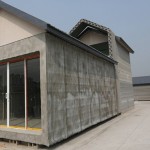
10 in 1 Day: Chinese Homes 3D-Printed from Scraps Materials
Using recycled construction waste and rapid prototyping processes, a Chinese company is showing off how 3D printing technologies can be applied to building at …
Click Here to Read More »»

Mobile 3D Clay Printer: Whole Houses from Local Mud & Fiber
Easy to disassemble and transport on demand, this 3D-printing solution uses natural materials to build completely stable homes from readily available …
Click Here to Read More »»

Speedy Prefab: How a 9-Story Apartment Was Built in 5 Days
We see conceptual modular designs of this kind all of the time, but rarely such exquisite real-world proof of how fast construction can be in the age of …
Click Here to Read More »»
[ By WebUrbanist in Architecture & Houses & Residential. ]
[ WebUrbanist | Archives | Galleries | Privacy | TOS ]
-
World’s Largest Indoor Farm is 100 Times More Productive
[ By WebUrbanist in Architecture & Offices & Commercial. ]

The statistics for this incredibly successful indoor farming endeavor in Japan are staggering: 25,000 square feet producing 10,000 heads of lettuce per day (100 times more per square foot than traditional methods) with 40% less power, 80% less food waste and 99% less water usage than outdoor fields.
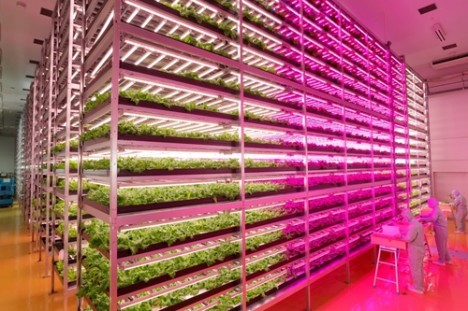

Customized LED lighting developed with GE helps plants grow up to two and half times faster, one of the many innovations employed in this enterprise by Shigeharu Shimamura, the man who helped turn a former semiconductor factory into the planet’s biggest interior factory farm.

Shimamura has shortened the cycle of days and nights in this artificial environment, growing food faster, while optimizing temperature, lighting and humidity and maximizing vertical square footage in this vast interior space (about half the size of a football field).

With a long-standing passion for produce production, he “got the idea for his indoor farm as a teenager, when he visited a ‘vegetable factory’ at the Expo ’85 world’s fair in Tsukuba, Japan. He went on to study plant physiology at the Tokyo University of Agriculture, and in 2004 started an indoor farming company called Mirai, which in Japanese means ‘future.’”

The beauty of this development lies partly in its versatility – since it deals in climate-controlled spaces and replicable conditions, a solution of this sort can be deployed anywhere in the world to address food shortages of the present and future. Saving space, indoor vertical farms are also good candidates for local food production in crowded and high-cost urban areas around the globe. Aforementioned strides in waste and power reduction also make these techniques and approaches far more sustainable and cost-efficient.
Want More? Click for Great Related Content on WebUrbanist:

Tons of Art: Christo Unveils World’s Largest Indoor Sculpture
Well known for grand gestures and huge installations, Christo has outdone himself once again in this latest work made of air, light and wonder.
Click Here to Read More »»

Swinging Times: 13 Stylish & Fun Indoor Swings
Why should kids have all the fun? These 13 indoor swing designs range from traditional to modern, to bring swings from the backyard into any interior.
Click Here to Read More »»
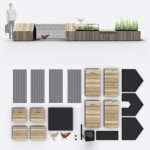
Urban Farm Kit: Modular Chicken Coops, Planters & Benches
A solution for all seasons and regions, the premise is simple: every would-be urban farmer has space, weather and other growing constraints, and yet draws from …
Click Here to Read More »»
[ By WebUrbanist in Architecture & Offices & Commercial. ]
[ WebUrbanist | Archives | Galleries | Privacy | TOS ]
-
Toshiba announces world’s first SDHC card with NFC
Toshiba has announced an SDHC card equipped with NFC, claiming it to be the world’s first. With the corresponding ‘Memory Card Preview’ app downloaded to a mobile device, the user can tap the card to view thumbnails of 16 images and see available storage. Read more
-
Airball with a View: Play in the World’s Sexiest Car Park
[ By Steph in Art & Installation & Sound. ]

When a parking garage is considered a landmark in itself and used as the setting for fashion shows, music videos and orchestral performances, perhaps it’s no surprise that people are happy to hang out there for hours on end playing airbag. 1111 Lincoln Road by Swiss architecture firm Herzog de Meuron is a work of modern art, so it was a natural setting for Snarkitecture to show off some of their own designs.


Known for unexpected installations and temporary works of architecture, the Brooklyn-based collaborative practice set up a bright white game room on level 5 of the carpark, inviting users to play ball and compete side-by-side on two fully-custom basketball arcade-style shootout games.


Of course, what takes this installation to the next level isn’t just the fact that it’s located in a parking garage – it’s the stunning views of the Miami skyline that guests take in as they play. No worries about losing your ball over the side, as there are safety nets in place.


The garage itself is famed for appearing incredibly light despite its concrete construction, influenced by designer Jacques Herzog’s perception of Miami as “all muscle without cloth.” Some of the levels feature triple-height ceilings to accommodate special events with the city’s Art Deco district as a backdrop.
Want More? Click for Great Related Content on WebUrbanist:
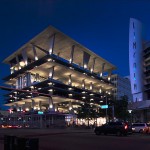
Can a Parking Garage be Sexy? Miami’s 1111 Lincoln Road
1111 Lincoln Road isn’t just a parking garage. It’s a destination in itself, serving as a desirable events space for weddings, photo shoots, concerts and more.
Click Here to Read More »»

Car Parks or Works of Art: 14 Exemplary Parking Facilities
Most parking facilities are eyesores, designed with function in mind without paying heed to context or aesthetics. But in some cases, parking garages can be so …
Click Here to Read More »»
Puzzle Facade: Play a Building Like a Giant Rubik’s Cube
The entire facade of the Ars Electronic Building in Linz, Austria has become the world’s largest playable Rubik’s cube thanks to a color-changing …
Click Here to Read More »»
[ By Steph in Art & Installation & Sound. ]
[ WebUrbanist | Archives | Galleries | Privacy | TOS ]
-
Lowline NYC: World’s First Underground Park Slated for 2018
[ By WebUrbanist in Architecture & Cities & Urbanism. ]

Using fiber optics as “remote skylights” to pipe illumination down from the surface, this bold plan aims to transform a century-old trolley station into a bright and green subterranean park. New York City is a natural candidate, having already inspired rail-related and elevated parks around the world with its innovative High Line Park.


Located beneath Delancey Street in the Lower East Side of Manhattan, the former Williamsburg Bridge Trolley Terminal is adjacent to active lines but has itself been abandoned for over 50 years. Proposed as the site of the Lowline, the space is being vetted for structural feasibility as well as civic support – discussions with the MTA as well as the city are ongoing and progressing.


As shown above and below, the group behind the project is already working with the city on crowd-funded prototypes that demonstrate the technologies to be deployed on the target site, including tests of illumination levels with live greenery.


Boasting 20-foot ceilings and multiple blocks of open space, the dilapidated station still has a lot of deserted-place charm including old cobblestones, trail tracks, vaulted ceilings and vintage signage.


Much of this will be preserved, rehabilitated and otherwise highlighted in the renovation, creating a balance between new design, urban exploration and historic context. “To explore our vision in greater detail, we commissioned a preliminary planning study in 2012 with Arup, the global engineering firm, and HR&A Advisors, the leading consultant behind the High Line. The study concluded that the Lowline was not merely technically feasible, but would also vastly improve the local economy and the adjacent transit hub. Once built, the Lowline would be a dynamic cultural space, featuring a diversity of cultural programming, youth activities, and popular retail.”


The ingenious sun-redirecting technology has already been tested, and works as follows: “Designed by James Ramsey of Raad Studio, the proposed solar technology involves the creation of a “remote skylight.” In this approach, sunlight passes through a glass shield above the parabolic collector, and is reflected and gathered at one focal point, and directed underground. Sunlight is transmitted onto a reflective surface on the distributor dish underground, transmitting that sunlight into the space. This technology would transmit the necessary wavelengths of light to support photosynthesis, enabling plants and trees to grow. During periods of sunlight, electricity would not be necessary to light the space.”
Want More? Click for Great Related Content on WebUrbanist:
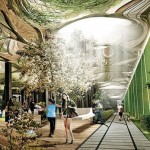
Urban Reuse Goes Underground: Subterranean Community Park
A long-abandoned underground space may soon be turned into a subterranean version of the High Line park, complete with high-tech sunlight harvesting.
Click Here to Read More »»
Deserted Parisian Metro Stops as Underground Pools & More
The myriad abandoned subway stations of Paris are full of hidden potential – and one current candidate for mayor is working with architects to show the …
Click Here to Read More »»

Cracked-Earth Desert Canopy Shelters Underground Oasis
Splitting at the seams like sections of sun-baked desert, this expansive park opens to the sky between a network of gaps and provides shade for people and …
Click Here to Read More »»
[ By WebUrbanist in Architecture & Cities & Urbanism. ]
[ WebUrbanist | Archives | Galleries | Privacy | TOS ]
-
Under Construction: World’s First Concrete-Printing Robot
[ By WebUrbanist in Conceptual & Futuristic & Technology. ]
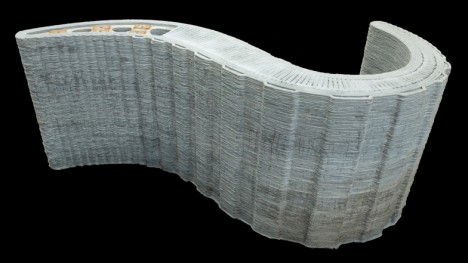
A prominent architectural firm has teamed up with an established concrete manufacturer and a university to develop a commercially-viable robotic concrete printer capable of precisely producing complex three-dimensional forms. The group aims to bridge the gap between what can be modeled via 3D rendering software and what can be manufactured in reality.

(Norman) Foster + Partners are working with Skanska and Loughborough University as well as various industry contractors on this 3D-printing project. Their primary joint goal is reduce the time (from weeks to hours) and increase the options available for the on-site deployment of concrete, creating new possibilities for one of planet’s most ubiquitously-used building materials.

Essentially, a computer-controlled robotic arm lays down layers of concrete, each building on the previous according to a programmed sequence. A highly-controlled extrusion of cement-based mortar, precisely positioned according to computer data and obviating the need for solid material inputs.
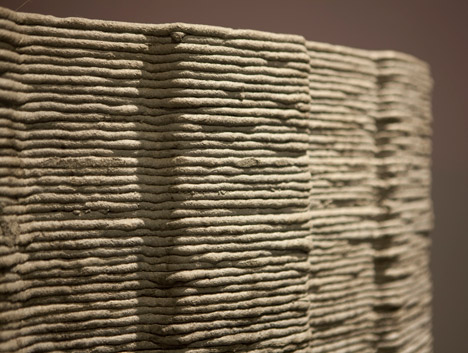
Currently, a phase two prototype has already been built and the team is working on a newer and more-mobile version able to create high-complexity shapes on building sites.
The results so far are promising: structurally-robust forms that would be difficult if even possible to create via conventional concrete construction techniques of either cast-in-place or precast varieties.
Want More? Click for Great Related Content on WebUrbanist:
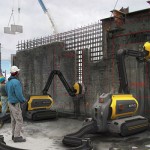
Building Eraser: Smart Robot Scans & Deconstructs Concrete
Whether the building is a bare-bones warehouse or five-star hotel, demolition is an equally messy business – but perhaps it does not have to be. What if …
Click Here to Read More »»

Magic Cement: Hidden Concrete Patterns Appear with Water
The writing is on the walls, but only when they get wet – that is when the secret messages or hidden designs appear in these seemingly innocuous concrete …
Click Here to Read More »»
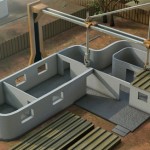
20-Hour House: How to 3D-Print 2,500 Square Feet in 1 Day
Combining ancient earthen-architecture approaches and cutting-edge robotic technologies, this contour crafting process promises a revolution in how we address …
Click Here to Read More »»
[ By WebUrbanist in Conceptual & Futuristic & Technology. ]
[ WebUrbanist | Archives | Galleries | Privacy | TOS ]
-
Inside RA001: World’s first Boeing 747 ‘Jumbo Jet’
The Boeing 747 ‘Jumbo Jet’ changed the world, bringing air travel to the masses, and allowing non-stop flights between distant cities across the globe. The prototype 747 – registration RA001 – first flew in February 1969, and is currently undergoing restoration at Seattle’s Boeing Field. DPReview editor Barnaby Britton has been documenting the process, inside and out. Click through for images
-
Big Game Hunting: The World’s 9 Biggest Board Games
[ By Steve in Gaming & Computing & Technology. ]

Board games may be old fashioned to some but they’re anything but boring no matter how big a board they’re played on. Here are 9 of the biggest.Triple (Size) Letter Score


Popular word game Scrabble celebrated its 50th anniversary in 1998 and in honor of the occasion, two teams from the United Kingdom’s armed forces played the biggest Scrabble game EVAR, turning London’s Wembley Stadium into a ginormous Scrabble board. The reinforced fiberglass letter tiles measured 2 x 2 meters (about 6 feet per side) and were 40cm (almost 2 inches) thick, requiring two team members to shift each one into position… and you thought soccer was a slow game! On the bright side, just be glad Welsh words weren’t allowed.
Take A Walk On The Boardwalk


Do you know the way to San Jose? Make a left at Baltic and don’t forget to bring your Get Out Of Jail Free card! We’re talking Monopoly here; Monopoly In The Park to be exact. The 930 sq/ft permanent Monopoly board offers anyone a chance to make it big on Silicon Valley real estate. I want the iron… darnit!
Ukraine Not Weak!


Beloved by Kramer and Newman, RISK is the classic game of world domination where the board is as big as the world… or so the players wish! Everyone from be-suited gentlemen to cosplaying geek gamers has tried to imitate Vladimir Putin playing larger-than-life RISK but there’s a drawback: the bigger the board, the harder it is to take the game with you on the New York subway.
Next Page – Click Below to Read More:
Big Game Hunting The Worlds 9 Biggest Board Games
Want More? Click for Great Related Content on WebUrbanist:
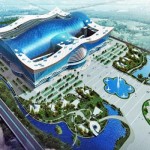
20 Million Sq Ft: World’s Biggest Building Opens in China
Night never comes to this massive complex newly constructed in China. Complete with its own artificial sun (as well as beaches and waves), the world’s …
Click Here to Read More »»
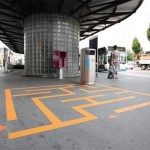
Good Clean Fun: Interactive Games Tidy Urban Spaces
How do you get residents to keep their city clean – and keep smiles on their faces at the same time? These fun public games are a truly excellent solution.
Click Here to Read More »»

Interact with Escher-Like Architecture in This iPad Game
Fantasy architectural structures inspired by M.C. Escher provide a playful setting for a fun iOS puzzle game called Monument Valley. Even if you aren’t …
Click Here to Read More »»
[ By Steve in Gaming & Computing & Technology. ]
[ WebUrbanist | Archives | Galleries | Privacy | TOS ]