RSS
 

Posts Tagged ‘Wildlife’

National Geographic drones help capture Serengeti wildlife close up

11 Aug

12-afternoon-nap-robo-cam-view-670.jpg

What’s the safest way to get close up photos of lions on the Serengeti? Send in a robot. And an aerial drone. That’s what photographer Michael Nichols and his team did, producing incredible images for a National Geographic feature. From a nearby car, Nichols and crew directed a small remote-controlled robot outfitted with a Canon camera toward lion prides as they hunted, slept and well, do everything lions do. And we do mean everything.

News: Digital Photography Review (dpreview.com)

 
Comments Off on National Geographic drones help capture Serengeti wildlife close up

Posted in Uncategorized


Making Sharper Wildlife Photographs – [Part 2 of 2]

06 Mar
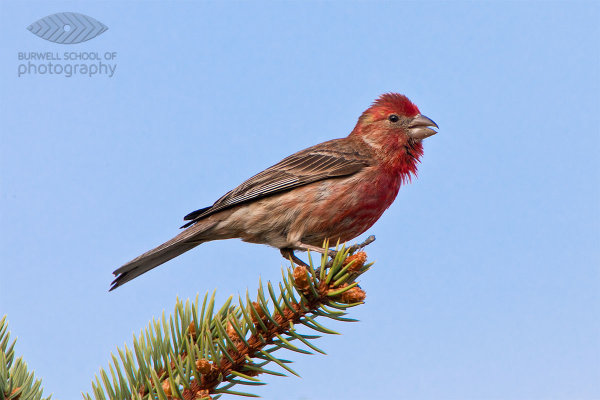
House Finch perched on a spruce tree branch: Canon 5D Mark II, Canon 500mm F4L IS lens, 1.4x Extender II and 2.0x Extender II @1400mm, 1/400th of a second at F10, ISO 800, Gitzo 3541 Tripod with Jobu Design BWG-Pro gimbal head

House Finch perched on a spruce tree branch: Canon 5D Mark II, Canon 500mm F4L IS lens, 1.4x Extender II and 2.0x Extender II @1400mm, 1/400th of a second at F10, ISO 800, Gitzo 3541 Tripod with Jobu Design BWG-Pro gimbal head

A contribution by Paul Burwell from Burwell School of Photography

In my last article I discussed the sort of equipment the average person might afford and use for wildlife photography. We discussed lenses and teleconverters along with tripods and monopods. This time, we’re going to look at how you use that equipment to come away with the sharpest possible images.

Tripod Heads

My first piece of advice is to learn how to use your tripod along with whichever type of tripod head you have. My recommendation for wildlife photography is to use some sort of Gimbal head like the excellent models sold by Canadian company Jobu Design.

These heads allow you to balance the lens/camera over top of the tripod while providing finger tip control. If you’re using a monopod, I’d mount the lens either directly to the monopod or use a quick release plate. At the risk of sounding like a children’s piano tacher, and not meaning to pester, but you do need to practice with this gear to become proficient. Photographic opportunities in the wild are often fleeting and you’ll need to rehearse so that when the time comes you’re making great images and not fumbling with knobs and latches.

Shutter Speeds

Another aspect of making sharp images is using a fast enough shutter speed. As a rule-of-thumb when photographing off of a tripod or monopod, you’ll want your shutter speed to come close to matching 1/2 of your focal length. This rule means that if I’m photographing at a focal length of 400mm, I’ll want to make sure that I’ve got a shutter speed of at least 1/200th of a second to make a sharp image of a stationary critter. If there’s a lot of action going on and you want to freeze the motion, shutter speeds of 1/500th of a second or quicker may be required. I’m also not afraid to use my camera’s higher ISO settings to get a higher shutter speed if required.

There is little doubt that today’s lenses with their built-in gyroscopes to help stabilize the image go a long way in letting photographers get away with slower shutter speeds than the one over the focal length rule of thumb would allow for.

Many of today’s stabilized lenses claim that they can save three or even four stops of shutter speed and still return sharp results. My experience has been that these lenses (IS for Canon users, VR for Nikon shooters, OS or some variation thereof for the rest) do make a tremendous difference and are especially useful in low light shooting conditions. Look at many of my pictures and you’ll see I’m a big beneficiary of this new technology.

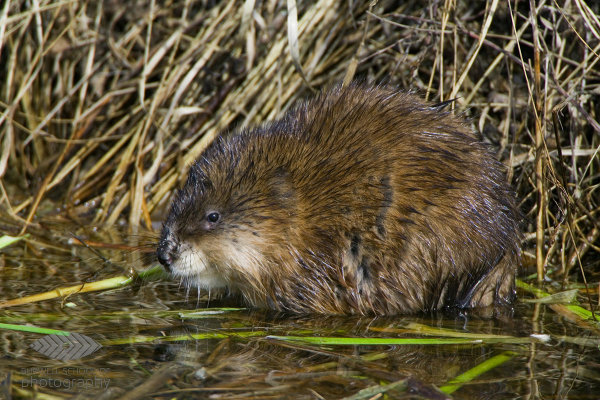
Muskrat pauses while eating: Canon 1Ds Mark II, Canon 500mm F4L IS lens, 1.4x Extender II and 2.0x Extender II @1400mm, 1/500th of a second at F10, ISO 640, Saddle-shaped bean bag from vehicle window

Muskrat pauses while eating: Canon 1Ds Mark II, Canon 500mm F4L IS lens, 1.4x Extender II and 2.0x Extender II @1400mm, 1/500th of a second at F10, ISO 640, Saddle-shaped bean bag from vehicle window

The Eyes Have It…

Another trick for making sharper images comes down to the connection between the camera and your body. While it might seem to make sense to just lightly rest your eye against the camera’s viewfinder, I suggest you do the opposite. When I’m photographing using telephoto lenses, I physically push my eye as firmly as possible against the viewfinder (or in my case glasses which leaves them very greasy at the end of a photo session).

This technique allows the mass of my body to help dampen vibrations the camera might be experiencing. Next, I hold the camera with my right hand positioned to press the shutter release and make adjustments to the camera’s settings. My left hand gets draped over top of the lens. Again, we’re trying to use our body’s weight to help dampen vibrations and steady the rig as much as possible.

Now that I’ve got my camera equipment mounted on a suitably weight-rated tripod or monopod, I’ve chosen a suitable shutter speed AND I’ve positioned my body against and on the camera to ensure steadiness, all I’ve got to do is shoot away and I’m good, right?

Squeeze the Shutter Release

Not quite. The next trick is to learn how to press the shutter release. If you were a casual observer watching just my finger on the shutter release, I’d wager you’d never be able to accurately guess when I’d made a photograph. And that’s because I’ve practiced my technique to the point where, much like the way a sniper squeezes the trigger on a rifle, I can release the shutter on my camera with the same controlled almost indiscernible action.

While I’m photographing, my shutter finger never loses contact with the shutter button and I’m not so much pressing it as I am squeezing it. Remember to squeeze and never stab the shutter button. When photographing wildlife at the longer telephoto lengths, you need to keep all of your actions as smooth as possible and the way you press the shutter is a huge factor in making sharp images.

To summarize these techniques, get your camera gear supported in the best way possible, choose an appropriate shutter speed, brace your body against the equipment so that you almost become part of it and finally squeeze the shutter button with the most subtle of movements. Remember to utilize the three P’s of wildlife photograph (Practice, Practice, Practice) and you have my guarantee that you’ll be well on your way to producing sharper images.

Paul Burwell is the owner Burwell School of Photography

Post originally from: Digital Photography Tips.

Check out our more Photography Tips at Photography Tips for Beginners, Portrait Photography Tips and Wedding Photography Tips.

Making Sharper Wildlife Photographs – [Part 2 of 2]


Digital Photography School

 
Comments Off on Making Sharper Wildlife Photographs – [Part 2 of 2]

Posted in Photography


Making Sharper Wildlife Photographs – [Part 1 of 2]

03 Mar
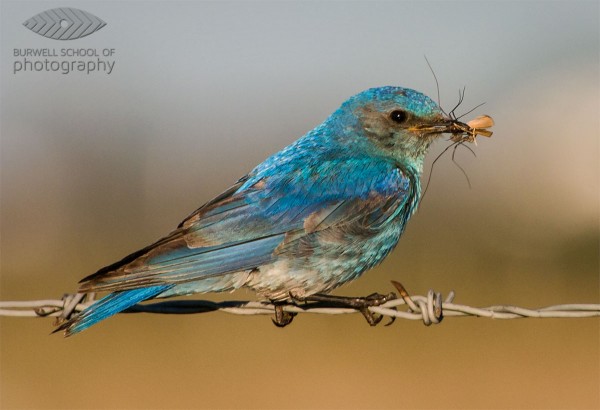
Canon EOS Digital Rebel, Canon 100-400 F4.5-5.6L IS lens @400mm, 1/800th of a second at F8, ISO 400 - Hand held

Mountain Bluebird with prey: Canon EOS Digital Rebel, Canon 100-400 F4.5-5.6L IS lens @400mm, 1/800th of a second at F8, ISO 400 – Hand held

A contribution by Paul Burwell from Burwell School of Photography

If there is one area that seems to flummox more aspiring wildlife photographers it is the subject of making sharp images. You’d think that with today’s modern cameras and equipment that there’d be no problem going home with sharp images after each wildlife encounter. Un fortunately, that isn’t the case and I’m going to provide you with some tips and tricks to make sure you’ve got the best possible chance of making sharp images.

Lenses

One of the truisms in wildlife photography is that it is virtually impossible to have too much lens. This means it is extremely rare that the wildlife critter you are trying to photograph is too big in your viewfinder and in fact the opposite is much more common. Not everyone can afford one of the prime super-telephoto lenses that the major manufacturers produce. These lenses in the range of 300mm to 800mm can set you back anywhere between $ 5,000 and $ 11,000 respectively. Unless you’re a pro or a serious amateur with a healthy bank balance, these lenses aren’t feasible for the average user.

So, what’s a person to do? My recommendation is to purchase the largest telephoto lens you can afford. And when you’re looking at telephoto lenses, you want the biggest number of millimetres that you can afford. Common lens lengths include 200mm, 300mm and 400mm.

If you end up purchasing a zoom lens, look for one that has the shortest range possible. Why? Because in general, the more extreme the range the lens covers, the lower the quality at all those ranges. Therefore, I’d choose a lens that gives a range of 70-300mm over a lens that gives a 35-3500mm range every time. You also want to purchase the fastest lens you can afford. All lenses have a maximum aperture they can photograph at.

A lens rated at F2.8 is two stops faster than a lens rated at F5.6 and allows four times as much light to reach the camera’s sensor. Because wildlife is often photographed under challenging lighting conditions, a faster lens allows for faster shutter speeds which equals sharper images.
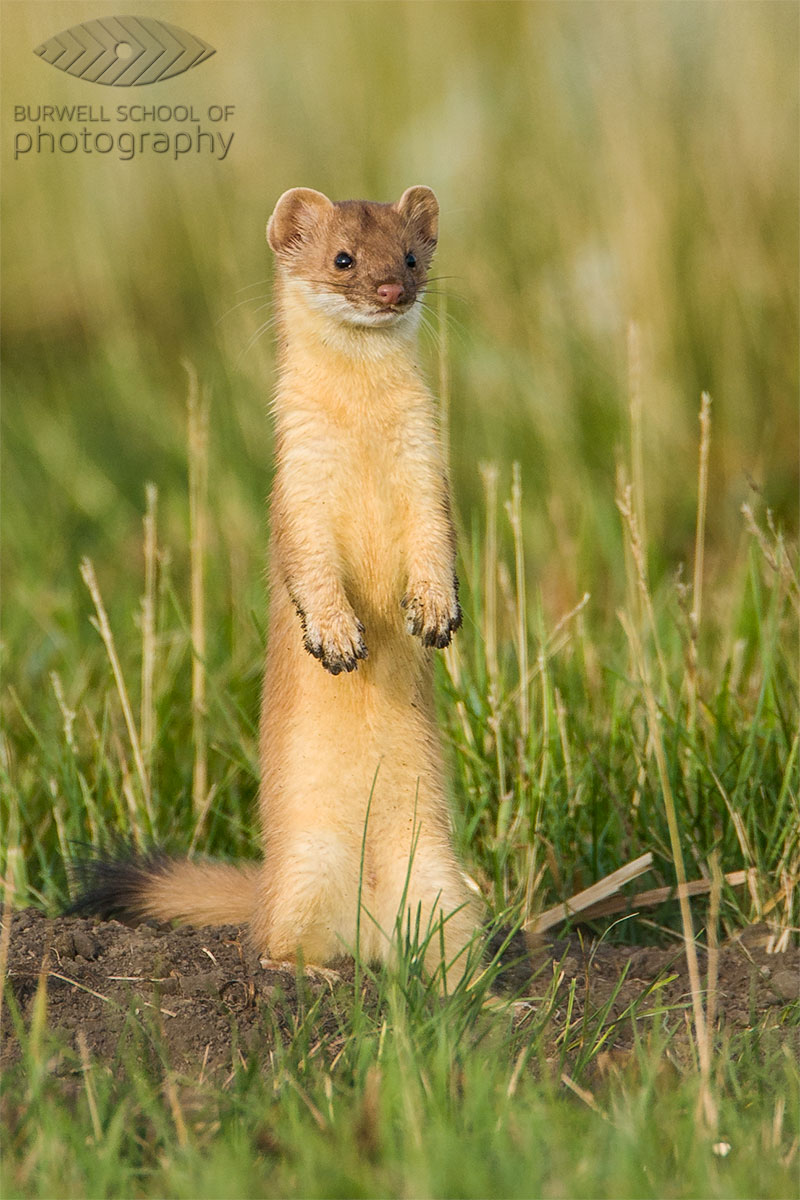
Long-tailed Weasel pauses outside of ground squirrel burrow: Canon EOS Digital Rebel,  Canon 500mm F4L IS, 1.4x Extender II @ 700mm, 1/500th of a second at F7.1, ISO 200 - Hand held

Long-tailed Weasel pauses outside of ground squirrel burrow: Canon EOS Digital Rebel, Canon 500mm F4L IS, 1.4x Extender II @ 700mm, 1/500th of a second at F7.1, ISO 200 – Hand held

Teleconverters/Extenders

I also recommend purchasing a teleconverter (or extender). Teleconverters are rated by the number of times they magnify your lenses range. So, if you’re using a 1.4x teleconverter on a 300mm lens, you’ve now got yourself a 420mm lens. Unfortunately, this comes at the cost of some light and so if your 300mm lens was rated at F2.8, a 1.4x teleconverter will cost you one stop of light and it will effectively become a 420mm F4.0 lens. Stay away from the two-times (2.0x) teleconverters unless you happen to own one of those multi-thousand dollar prime super-telephoto lenses we were discussing earlier.

You’ll often hear that teleconverters degrade the quality of the image and this is true, but there is a trick for overcoming this problem. The solution? Stopping down up to a full stop. If you’re not familiar with the terminology, stopping down means using a smaller aperture setting (smaller aperture == larger f-stop number).

While it is a general practice to photograph wildlife wide open (at the lenses largest opening or smallest f-stop) to separate the subject from the background, I recommend practicing with your lens/teleconverter combination to see how much you need to stop down to make sharper images. Depending on the lens I’m using, I find I need to stop down between 1/3 of a stop up to a full stop.

Support

What else can you do to get sharper images? Use some sort of support. I’ve met a few photographers who have no problem making sharp images hand-holding over 6.5kg (14 pounds) but the majority of people will make sharper images using support. Buy the highest quality tripod you can afford. Make sure the tripod is rated to support at least the amount of weight you’re going to put on it. High quality tripods can be pretty pricey but another alternative to consider that will also give your camera/lens combinations great support is a monopod.

These handy devices also provide excellent support for even the heaviest equipment and they are a lot easier to pack and move about. If you want to save some money, (and who doesn’t), consider purchasing aluminum tripods and monopods over carbon fibre. They aren’t quite as light and they get cold as heck in the winter, but they are strong and a whole lot more affordable.

So, now that you’ve got yourself the best wildlife photography equipment your pocket book will allow, stay tuned for my next column (next week) where I’ll give you the tips and tricks you’ll need to make the sharpest photographs possible.

Until then, get out there and practice, practice, practice!. Photograph ducks at the local pond or go to a dog park and capture some of the action there. Regardless of whether you are in a remote location or on your own back deck, the more familiar you are with your equipment, the better chance you’ll have of making an award winning shot.

Paul Burwell is the owner Burwell School of Photography

Post originally from: Digital Photography Tips.

Check out our more Photography Tips at Photography Tips for Beginners, Portrait Photography Tips and Wedding Photography Tips.

Making Sharper Wildlife Photographs – [Part 1 of 2]


Digital Photography School

 
Comments Off on Making Sharper Wildlife Photographs – [Part 1 of 2]

Posted in Photography


Hummingbird Photographers – Texas Parks and Wildlife [Official]

04 Jan

Meet a couple from East Texas who have combined their interest in birds and love of travel, along with a mastery of photography, to capture the fleeting flight of the hummingbird. Discover more about Texas wildlife at www.tpwd.state.tx.us


Wildlife Photography

22 Dec

Examples of wildlife photography – mainly birds – with details of camera and lens settings for each image. There is no sound with this video.
Video Rating: 0 / 5

 
Comments Off on Wildlife Photography

Posted in Nikon Videos


5 Big Tips to add Impact and Variety to your Wildlife Images

30 Nov

A Guest Post by Piper Mackay from www.pipermackayphotography.com.

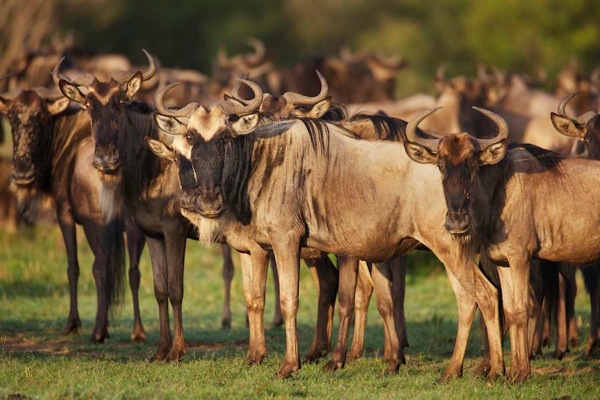
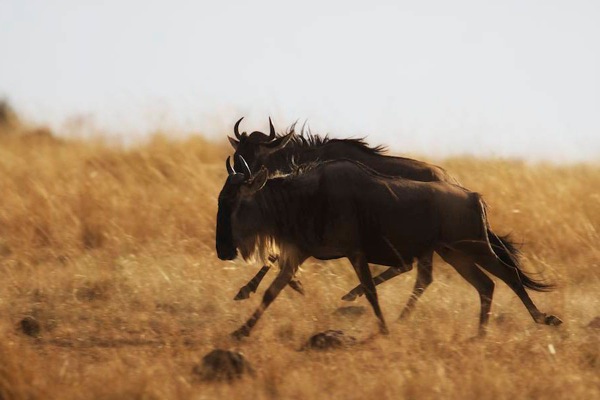
Wildlife photography can be very exciting, which generally means your adrenalin is running on overdrive. It is too easy to be caught up in the action of the moment and just snap away at what you are witnessing. What you saw was so great, yet when you view your images they just don’t seem to have the impact that you experienced. I have put together a series of images of wildebeest, generally a very boring animal that is quite drab in color. This is to help illustrate how light, mood, and motion can bring powerful visual impact to your images.

Wildlife Variety

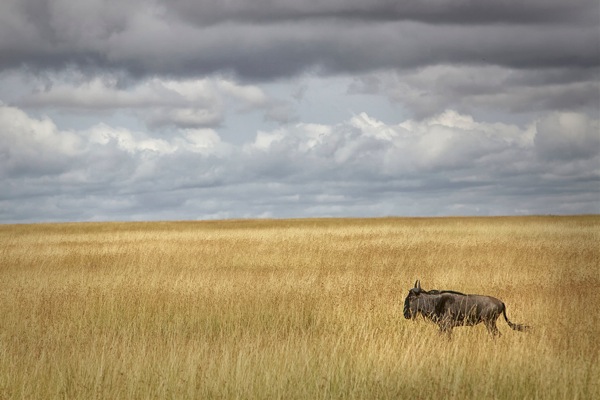
This is a Wildebeest for those of you who have not seen one.

Plan to go at the Best Time

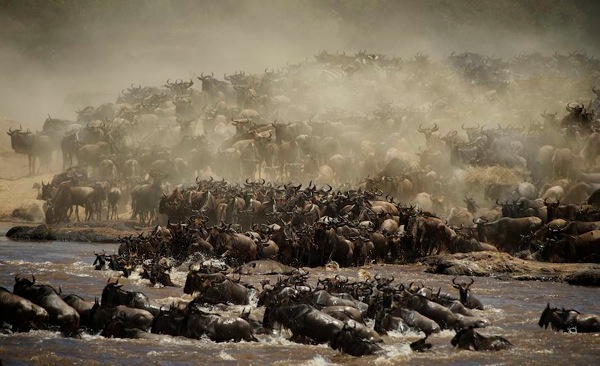
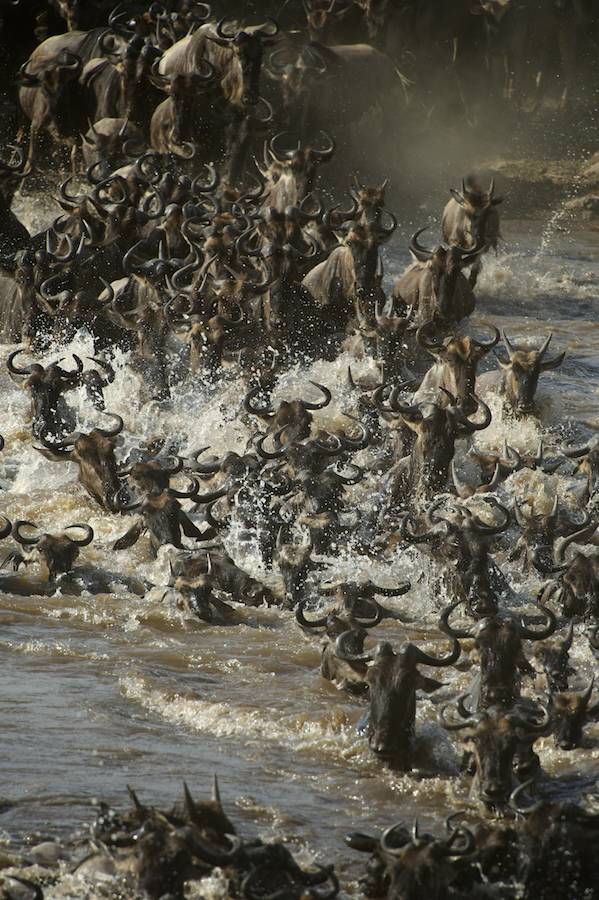
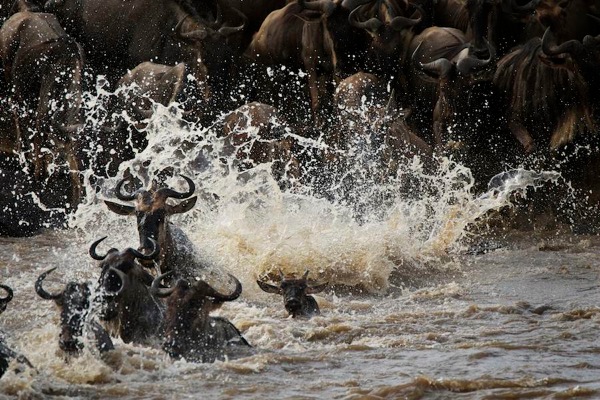
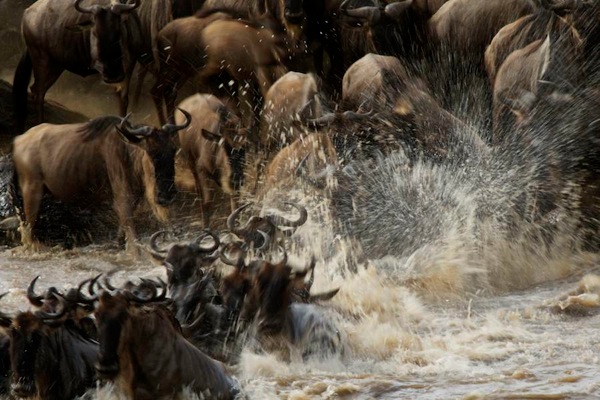
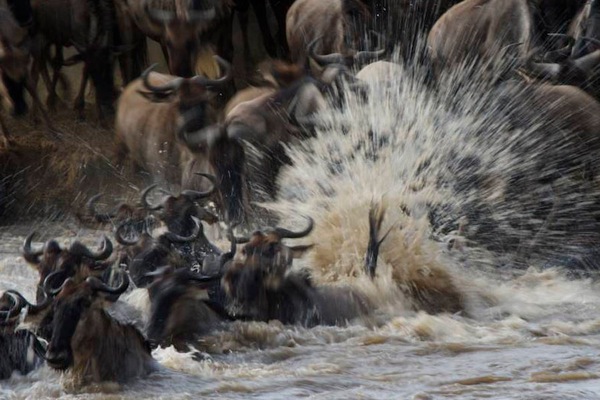
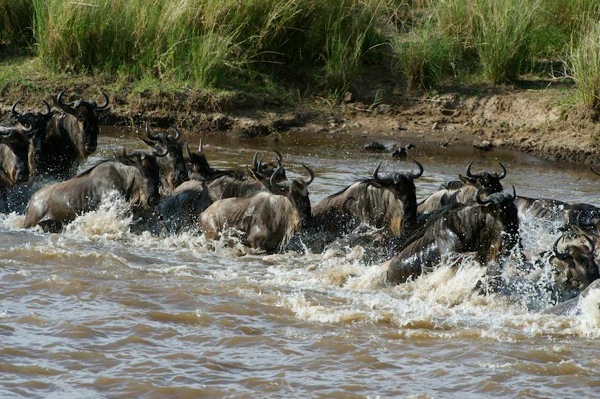
Many species migrate or give birth at particular time in a particular location. Plan you trip around these extraordinary events. This was photographed during the annual wildebeest migration crossing the Mara River in Kenya. It has been said to be the greatest wildlife show on earth. The mass of the animals and the dust kicking up gives big impact to this image. Large numbers of any species will add impact.

Wildlife Variety 1

Backlighting and Side Lighting

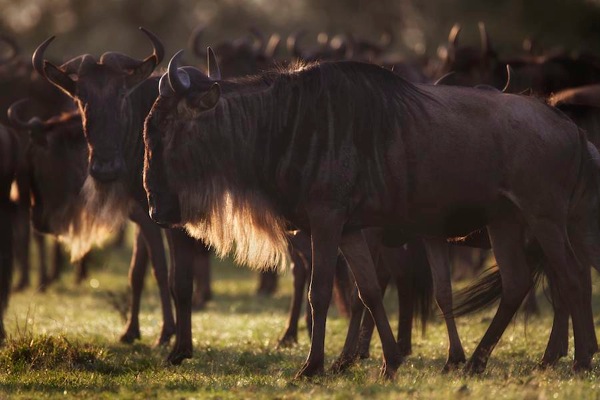
It is natural to want the beautiful golden light on a wildlife subject as you see in the first photograph, but more dramatic can be adding backlighting or side lighting shown in the image below it. Take the safe shot and then get creative. Backlighting works great on the wildebeest beards and it also creates some rim lighting. Rim light is when backlighting creates a lit edge around the subject.

Wildlife Variety 2

Wildlife Variety 3

Wildlife Variety 4

Look for Moody Elements such as Dust and Fog

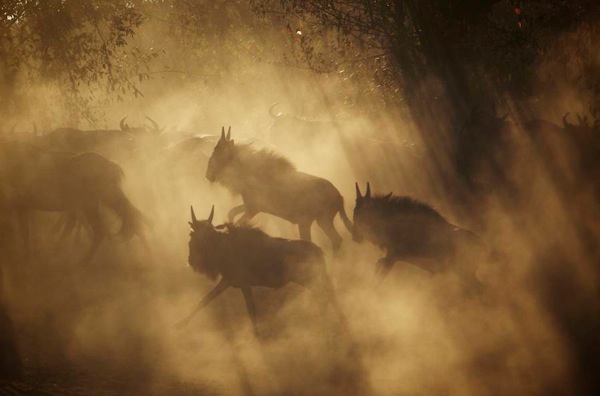
This is another great time to add backlighting or side lighting. Backlighting will generally create a silhouette so I generally prefer to use side lighting in these situations. The light filters thought the elements for dramatic light and you can still see the details in your subject.

Wildlife Variety 5

Add Motion to your Image with a Pan Blur

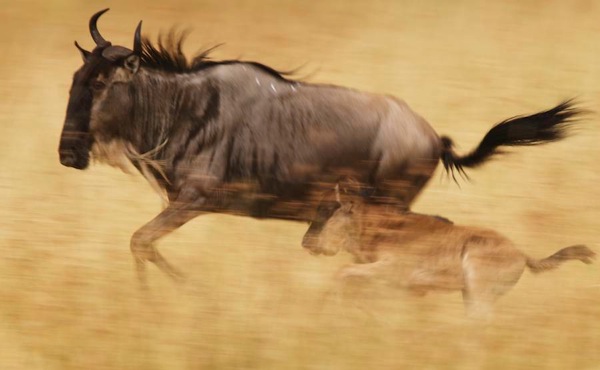
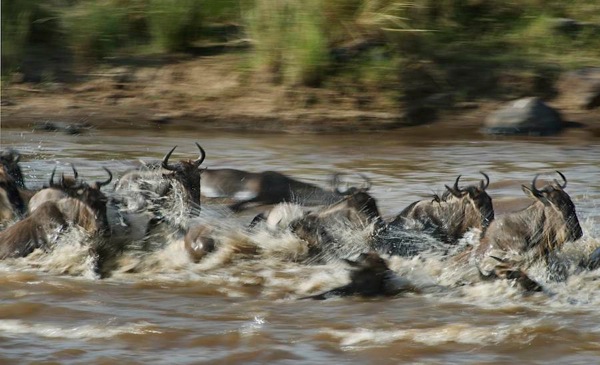
In the first image you can see the animals are in motion; notice I have a little backlighting going for added impact. However, by panning with the animals to create a blur in the background it shows a more dramatic sense of speed and motion.

Wildlife Variety 6

Wildlife Variety 7

To shoot a pan blur you need to slow down your shutter speed, 1/60-1/30 generally works, depending on the speed of your subject. You need to focus on the eye’s/shoulder of your subject, pan at the same speed as your subject while holding down the shutter. Yes, this takes lots of practice and you will delete hundreds of images, but when you get one that works it is very exciting. This is something you can practice anywhere so when the opportunity comes you are ready.

Here is another set of images to show the impact and difference between a fast shutter speed stopping the action and a pan blur to show motion. Notice in the second image the front wildebeest are in focus while the rest of the images has a slight blur giving the viewer a more powerful sense of motion.

Wildlife Variety 8

Wildlife Variety 9

Slow Down your Shutter Speed

Stopping the action of animals running through water with a high shutter speed makes a dramatic image, but slowing down the shutter speed will add a different impact and variety to the story. Different from a pan blur, here you hold the camera still and slow down the shutter letting the moving element create the effect of motion. Water works great as well as tall grass that is blowing or branches moving is a tree. In the first image my shutter speed was very high to stop the action and the explosion of water. In the second I showed down the shutter to create a different mood and show the spray of the water. In the third I slowed down the shutter just a little more to really show the blast of the water.

Wildlife Variety 10

Wildlife Variety 11

These simple tips will not only add impact and variety to your images but will make them stand out in a sea of imagery on the same subject.

Wildlife Variety 12

Piper Mackay is a professional travel and wildlife photographer whose work is heavily based in Eastern Africa. She is currently leading both wildlife and cultural safaris in Kenya, Tanzania, Rwanda and Ethiopia. Her work is represented by Getty images and she is and instructor for the Travel and Editorial track at Calumet. View her work at www.pipermackayphotography.com.

Post originally from: Digital Photography Tips.

Check out our more Photography Tips at Photography Tips for Beginners, Portrait Photography Tips and Wedding Photography Tips.

5 Big Tips to add Impact and Variety to your Wildlife Images


Digital Photography School
 
Comments Off on 5 Big Tips to add Impact and Variety to your Wildlife Images

Posted in Photography


Michael Mauros Wildlife Photography Gear – Part 1 of 2

19 Nov

You’ve seen our commercial shoot camera bag…now we show what we take when we are out shooting wildlife. Comments and or questions goto: mauromedia.com. Cheers, Michael

Hazuki’s testing out her vampire powers, and she finds Kouhei’s friend Hiromi to be easy prey. Celebration is short-lived though, as Elfriede crashes the party, quite informative this evening as she seeks some answers of her own. Kouhei, who is known among their kind as the “Vampire’s Lover,” has blood with the power to impart freedom to the taker. As the young vampire learns of her need to keep the photographer by her side, her recent actions seek to drive him away.
Video Rating: 0 / 5

 
Comments Off on Michael Mauros Wildlife Photography Gear – Part 1 of 2

Posted in Photography Videos


Getting Down Low in Wildlife Photography

15 Nov

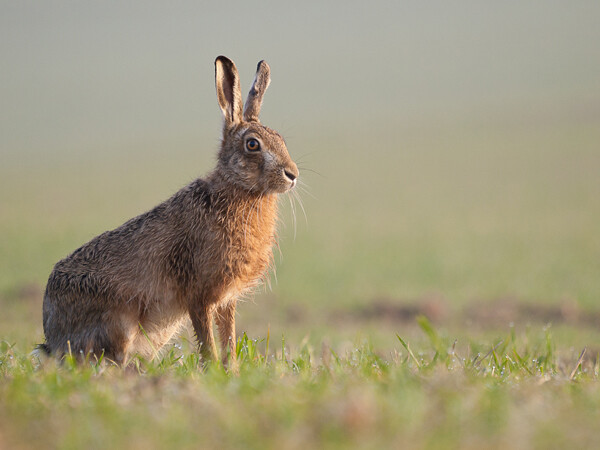
When photographing wildlife, the images that most resonate with the viewer are those that evoke emotion and offer an insight into the world of a particular animal.  There are numerous tips and pieces of advice that can be given to help improve your wildlife photography but the one tip that is the easiest to implement, and will show immediate benefit, is to get down low when taking your wildlife images.

Brown Hare (Lepus europaeus)

Brown Hare (Lepus europaeus)

Here are three reasons to persuade you to try it next time you are out taking photos of wildlife:

1. Getting closer

If you are shooting wild animals, as soon as they become aware of your presence, they will often retreat in the opposite direction.  You typically can’t just walk up to wildlife and expect it to pose for you and getting down low is only part of the good field craft required to get closer to wild animals.  By lying down, you will be far less noticeable than by standing upright or crouching, allowing you to crawl much closer to your subjects before they either become aware of you, or feel threatened.  Often, good field craft is better than the longest telephoto lens for capturing frame-filling shots.

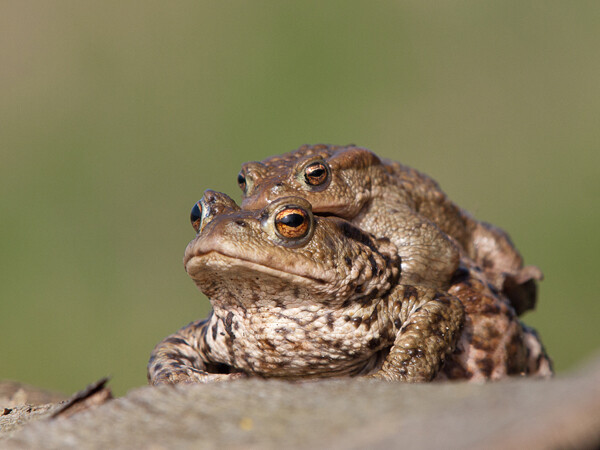
European toad (Bufo bufo)

European toads (Bufo bufo)

2. Isolating your subject

If shooting an animal at ground level from a standing position, you will be looking down on it, meaning that the ground or plants behind it will form the immediate background of the shot.  As this background isn’t very far away, it will be difficult to render it out-of-focus, even with the largest aperture, causing the background to distract the attention of the viewer away form the subject, in the final image.  Getting down low will often result in the background of the shot being much further away, meaning that you can capture the entire subject in sharp focus whilst ensuring that both the foreground and background are soft and blurred, isolating your subject in a fine plane of focus.

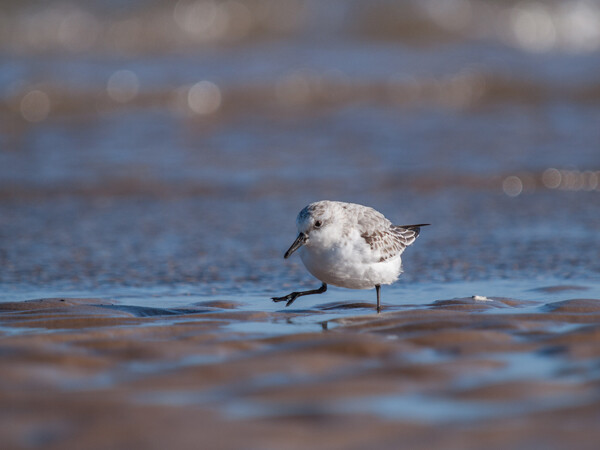
Sanderling (Calidris alba)

Sanderling (Calidris alba)

3. Eye level

By getting down low, you can take photos of animals at their eye level.  Typically in wildlife photography, if the face of the animal has been captured, it is key for the eyes to be the point of focus as that is where the eyes of the viewer will immediately be drawn.  If the eyes are soft or out of focus, you will lose the viewers attention, however if the eyes are sharp you create a relationship between the subject and the viewer.  This relationship is made all the more intimate by being down at eye level with the subject as the viewer feels like they are looking at the animal from within its world.  If you take a photograph looking down on an animal, the perspective gives the animal a sense of vulnerability (which can be used creatively in some circumstances) however by getting down low this is easily avoided, and much more powerful portraits an be captured.

You may find that you initially feel awkward crawling around on your front after wildlife and that you get much muddier than if you stay on our feet, but once you start doing it and see the results, you won’t be able to stop.

Post originally from: Digital Photography Tips.

Check out our more Photography Tips at Photography Tips for Beginners, Portrait Photography Tips and Wedding Photography Tips.

Getting Down Low in Wildlife Photography


Digital Photography School
 
Comments Off on Getting Down Low in Wildlife Photography

Posted in Photography


Wildlife Photographer, Simon Stafford: How’d They Do That?

19 Oct

Adorama Photography TV presents Simon Stafford. Simon is a wildlife, landscape and portrait photographer based in the UK He is the author of the Nikon Compendium as well as the Magic Lantern Guide series for Nikon. Learn how he captures beautiful photos of animals in their natural habitat so you can try it yourself. See more of Simon’s work at www.simonstafford.co.uk. For related articles and videos, go here www.adorama.com Products in this episode: Nikon 200-400mm f/4G ED, AF-S VR-II Zoom-Nikkor www.adorama.com Visit www.adorama.com for more photography videos! Send your questions to: AskMark@Adorama.com
Video Rating: 4 / 5

 
Comments Off on Wildlife Photographer, Simon Stafford: How’d They Do That?

Posted in Nikon Videos


Bundle of new picture with Nikon D60 (macro, black/white, wildlife, landscape, portraits)

05 Sep

this is just a whole bunch of pictures of all different kinds…

Nikon D60 my sample photos
Video Rating: 5 / 5